The Scaling Lab · 2026-04-04 · 16 min
This episode provides a tactical breakdown of using four interconnected custom GPTs to systematize video ad creation from research through deployment. The host demonstrates how to set up each GPT in ChatGPT (with migration to Claude underway for better outputs), structure the instructions, and feed outputs sequentially through a research phase that extracts emotional drivers and belief shifts, a creative strategy phase that outlines angles and frameworks without writing copy, a copy generation phase trained on winning formats, and an optional video production phase that generates shot lists and AI prompts. The workflow is designed for seven-figure brands experiencing creative bottlenecks, with real examples from a neuropathy supplement campaign achieving 6-10% click-through rates - significantly above industry benchmarks. The host includes downloadable instruction templates and emphasizes that while the 15-minute claim applies to the GPT execution, final video production still requires human editors to avoid "AI slop," and the process works primarily for video (with static image adaptation possible).
In ChatGPT, go to Explore GPTs > My GPTs > Create a GPT, then paste the instruction set for each GPT (research, creative strategy, copy, video production), optionally add knowledge files like brand guidelines or customer reviews, and save. The host provides all instruction templates as a free downloadable document.
The research GPT extracts emotional drivers, belief shifts, claims with proof, and benefits from customer surveys, reviews, website copy, and product pages, then structures everything as JSON output specific to your brand and product for the next GPT to consume.
The copy bot delivers a semi-brief with hook, body, and CTA structured for specific formats (e.g., 45-60 second Meta Reels in UGC style), but the host recommends having Claude or a human copywriter rewrite and improve it, which is why they migrated toward Claude for better quality outputs.
Without existing winning formats, the copy bot becomes a bottleneck because it can't know what to do - the host's GPTs are trained on their agency's proven formats, so you need to either research your own winning formats or adapt the instructions to your brand's best-performing ad styles.
The 15-minute claim applies only to running inputs through the four GPTs; the total timeline extends significantly once you factor in video production (AI generation or B-roll editing with talent), which still requires human execution to avoid low-quality output.
Computed from the transcript - who did the talking, and the words that came up most.
Many DTC advertisers embraced AI to scale production and reduce creative bottlenecks, only for outputs to fall flat. If different departments are feeding different prompts to different bots, the issue is not the technology- it’s the system. In this episode of The Scaling Lab , Jairet Crum walks through the exact workflow for creating and deploying a series of custom GPTs that move you from raw research to finished ad sets in under 15 minutes. Instead of guessing what to prompt next, you’ll have the exact tools and structures to move from idea to faster, sharper, cohesive performance creative. Get the free resource with the GPT instruction sets and workflow assets: Key Takeaways Structure multiple custom GPTs into a single creative workflow Learn why clear instructions and guardrails matter more than chasing perfect prompts Transform customer research into high-performing creative strategy and briefs Develop reliable formats, angles, hooks, and visuals that connect Move faster with a repeatable system that supports scale. Connect Want help building a creative system that scales without sacrificing quality? Book a strategy consultation with Jairet:
Transcribed and scored by The B2B Podcast Index.
The Scaling Lab-Tried & True Media: Hello and welcome to another episode of the Scaling Lab. I'm flying solo today while my co-host Kira Hug is off making the next winner for our clients. Today, I wanna go into the exact process, step-by-step on how you can create and deploy a series of custom GPTs that are a workflow for creating your next winner in less than 15 minutes. Now, there is some work on the backend.
to train these GPTs or the list of instructions that they're trained on. And I'm giving that away as a free resource so that if you want, you can download that, deploy this workflow today and see how the ads come out on the other end. Let's jump into the episode. Okay, so here's the overall process where each one of these steps is something that you need to do.
The orange one and the purple one are different. Obviously the yellow are all similar things. They're the steps in the process that you're actually gonna execute something. The orange is different because it's research.
You may or may not have all of this stuff. So it's kind of an optional step, but different from the video production step, which is over here. You may need a pre-production step, a video production bot, which is included. but it's optional because if you're going to just, let's say record with talent or you already have a big treasure trove of B-roll that you can have your team do mashups with, ⁓ that's where you can execute there.
So let's get over here. This is the string of GPTs that I use, starting with research, then creative strategy, moving on to copy, and then the video production one. As I said, that's included, but it's optional. ⁓ And then here is the document that has all of the instructions.
So the first thing we're gonna do is jump over into ChatGPT. which is the most common and why I built it here. We're currently in the process of moving this over to Claude and some of the internal stakeholders on the creative team that are owning the AI stuff for ⁓ ad production are rebuilding that over in Claude because we've just found that our outputs are better there. But this is the one that I built ⁓ to test out with a couple of clients and validate that we can get some winning ads out of this.
and the exact instructions that I did for those. So let's jump over to ChatGPT and see exactly how that's done. So over on your left sidebar, you want to go to explore GPTs. And once you're in there, you go up to the top right corner where it says my GPTs and then create a GPT.
You can see there the list that was in the screenshot that I already showed. Here, you're just going to name it, give it a description if you want to, but this is where you're going to paste the instructions. So this first one, which is the research GPT. I'm just gonna go ahead and copy all of this stuff from that research GPT.
And you can see ⁓ it's structured in JSON output so that what you get is platform specific, finds the emotional drivers beliefs. It will go through claims and proof benefits and just extract all of these things as a JSON output directly from. your research or from all of the research assets that you have, like customer surveys and customer reviews, your website, any kind of other product page information if you're focusing on a single product for this. So that is all listed here.
So I've got this all highlighted. I'm just going to copy it. I'm taking it over here, going to paste it into instructions. Now that's their conversation starters.
I'm just going to put, let's get started. And then if you have knowledge, So whether they're conversations with GPT that it says here, you know, can explain parts of ⁓ other documents that you upload. ⁓ Or if you have, let's say like brand voice files or brand guidelines, any kind of other stuff that's going to be a context for the output as well. And it can, it has to be true to every single conversation that you're going to have.
So if you did this for a specific product or a specific brand, You could name it as like product, you know, like brand product one research GPT. And then you can just click the create button up here. You see it's loading saving. If I click over to here, then there's the create button.
I'm not going to click create because I don't need to do this, but that's all you need to do. And that's the same for the other three that are in this process. If I go back, you can see my list of custom GPTs. And so those four that I'm talking about here.
So we jump back over to our board that. is the explanation of this right here. So check the link in the description for accessing this document of instructions for each one of those GPTs. But if we go into research, this, as I said, a kind of a pre step and why it's orange, it's all of the stuff that you have about this product and or brand.
So customer surveys, reviews, research about your personas, avatars, production information, company website, etc. This is really important because, you know, a seven or eight figure brand that is stalled out creatively. You scale to a point where your team's struggling to keep up with output. This is how you can unlock new ideas to get creative done more quickly and unlock that roadblock that may be in your team.
This is something we do regularly and as I said, we are moving it over to Claude. But again, this is something that's already gonna get you light years ahead. And if you want an exact like. plug and play process, you can use this today to get started and then experiment with it and then take that process and adapt it over to Claude and still use it there.
So we've got all the research, we added those documents, everything got uploaded into that research GPT that I already showed you, and then we plug it into the research bot. So at this point, this is where you throw those documents in there and your output's gonna look like this. So we've got emotional drivers. the leaf shifts needed.
This one's super important. This is for a brand that's doing a nerve relief supplement that we're working with and then constraints brand voice. So those things are all included, but this is obviously just a snapshot of that long output. It's going to have a bunch more than that, but these are ⁓ some of the examples that you can see of those important things that you're going to need.
And you can see quite a few listed for each one. Once you've done that, Then you move over into your creative strategy bot. So you're copying the output that came from your research bot. You're copying that over into your creative strategy bot and you're getting outputs that are outlining your body structures, outlining your CTA themes and giving you some ideas for what needs to be said there.
Not exactly copy, like the CTAs look like, you know, CTA encouraging them to take the first step now. So it's not the copy. That's in the next step, that's the copy bot. It's outlining what the copy bot should do to create the draft that your copywriter is gonna review or that you're gonna review.
So looking into the doc and the instructions of what the creative strategist is outputting, showing it the purpose of your outputs is really important. So big ideas, primary angles, secondary angles, belief shifts, strategic hooks, frameworks. And you see here, do not write scripts, do not write lines of dialogue, no scenes, no hook copy. You're telling it what to not do just as much as you're telling it the guardrails that you want to give it for what it should do.
I'm just checking here to see if we've included some of the instructions about images. Yeah, so curiosity based image guidelines. So this is specifically for something that's just an image to provoke curiosity about the problem or about the solution. So not necessarily the brand style.
So if you're going to be doing images, review this part of the instructions. And so you can see here, there's a desire first angle, a mechanism first angle. And so this outlines kind of the structure that the copywriter or copybot in this case can take to structure the copy. So open with a desired benefit, like sleeping through the night with warm, comfortable feet, show the morning routine and comfortable walking.
So it's a little bit of visual, a little bit of copy, ⁓ and that's how that's all structured. One thing I wanted to note is that for our agency, we do a lot of video. I only focus this workflow on videos. So if you're looking for something to do statics, you can train it to do statics.
So the creative strategist is identifying those emotional drivers that you can inject into statics too, but you'll need to include some instructions that home in on images. You can adjust this to include more specific like brand style or product style images and the layout that you're going for. So that's that moving on to the next step. You've got your copy bot.
This one's pretty straightforward. If you don't already have winning formats, that's going to be kind of a bottleneck. You can't expect it to just know exactly what to do. Ours is trained on some of the winning formats from our agency.
So it's giving outputs of the the UC video format here. UGC style explainer, which this is part of the next step for recording. So that's the kind of output that it's giving when it does the copy so that you know exactly what kind of video format it is and for what platform it is and what length the video style should be for the output. So copy isn't just writing copy.
It's delivering that copy semi brief. So it says here you put to include copy and a brief for the format and final delivery, either for talent or for your video editor. I suggest having like this says hook body CTA. That would be the copy that it's outputting for let's say a 45 to 60 second meta real or a tick tock in a UGC style explainer format.
Now that is not going to be your final copy. I heavily suggest that you have a human review this. It does pretty good, but something that I started doing with this process was having Claude rewrite it and I found that they were better. And that's one of the reasons why we started migrating to Claude.
You can try that and just have Claude rewrite it or, you know, just put it in the hands of a copywriter that can improve that and just beef it up a little bit. So now we're getting to that optional step, which is the video production bot. And if I go back to my list, you see video production GPT. So This is going to add some more required work, which is going to extend you out of that 15 minute workflow that I was mentioning, because what this is going to do is give you outputs of specific shots.
So you can see here it says shot list. So this is listing out every single shot for each clip of the video. So to zoom out here, this copy that I showed up here from the copy bot down here, the video production bot would outline every single clip. that needs to be shown with all of these, you know, description, camera angle, camera movement, framing, et cetera, to accompany the copy.
So you've got the copy and then you've got exactly step-by-step each frame of how that video should look. I have this generate prompts, but if you're having the video rely on AI a lot, know, VO or whatever you're using, Sora, even Hey Gen, you'll get those prompts, but obviously then you need to generate those prompts. So that's why I say it's gonna take you longer than those 15 minutes because you need to generate those videos. So after that you go on to B roll or talent execution.
So now that we're over into the B roll talent execution, if you already had a bunch of B roll, now you've got your copy and you've got your shot list, your video editor can just pull from that shot list. If you had the video production bot generate the prompts, you're delivering those in a folder to the video editor that they can mash up that B roll with those AI clips. If you're sending it off to talent, you know, doing something like this. Yeah, that's me.
I do some of the ads sometime for our agency when we need quick turnaround. But just wanted to illustrate that, you know, a walk and talk, my my coworking had ⁓ a podcast studio. So I would drop into the podcast studio and record some fake podcast stuff, those crush mini mic stuff. So you're getting close up.
It feels really personal. And and then green screen stuff where we actually sent this off to talent. But I recorded the background stuff just for some curiosity B roll. ⁓ And those all worked really well.
Those were all winners in those accounts. And so I shot that, but then it goes off to video editors. So I just put click, click, edit that. But obviously it's a lot more complex than that.
It's the workflow of your video editors where they're editing videos. You've gotten to this point in under 15 minutes. Obviously, I'm not expecting a video editor to crush this in 15 minutes and we're not turning it over AI to just do the video edit. I think that still produces AI slop.
We're not relying on that heavily. So stay tuned in the future as we lock that down, because we're experimenting with it, but we still rely on humans to do the best edits. And from there, you're just launching your campaign. So I just put here, ship the campaign.
In our company, we built an auto uploader. So once a click up card passes through, the project is done and it goes to a specific status where our internal software pulls the video assets and automatically uploads it to Meta and YouTube. So that's definitely something that is super helpful. If you're doing it manually, then you're just going to have to do it manually here.
But that's essentially the process. I know I blew through that really quickly. Start to finish. It's not, you know, over complicating this.
Here's one of the videos I mentioned that, you know, the screenshots that I showed were from a neuropathy brand. This is one of the videos I So these are actually from the prompts that AI outputted and I generated those clips had the video editor do this. So that video you can see the blue text as this one right here. It was the best performing video, which is why the click through rate is the lowest of this list.
But you can see here everything is above a 6%, which is fantastic. I think these days people are looking for twos and threes. When you have above a five, it's amazing. And this one actually compressed after we scaled it.
you know, eights and sevens. think this one actually started around a nine or a ten. And then it came down as it scaled to a broader audience, but still held around a six percent plus click through rate. Not allowed to share the conversion and revenue data on this one.
But that was the winning ad from that specific campaign. So this definitely works. So if you're interested in executing this for your brand or one of your products, you can follow this exact step. You're going to get access to this board so you can go through and review the entire step-by-step process and that comes with this document.
So you'll be able to access everything straight from here. If you have any questions about this process, please leave us a comment below. If you've tried something like this, did something different and you feel comfortable sharing what's working for you, please share those in the comments as well. But that's it for today's episode.
I hope you found this super helpful. If you like content like this, then also leave a comment and let us know so I can make more step-by-step process stuff and give you guys some free resources. If you've been following along with what we're doing at the Scaling Lab, thank you so much for being a part of this journey. And if you're new here, please consider subscribing.
Click that bell icon so that you get notified when we drop new episodes. And if you're listening on Spotify or on Apple Podcasts, Please leave us a review that helps other people find us and it's super valuable. We appreciate you so much and thanks for being with me. I'll see you in the next one.
Other episodes covering the same guests and topics, from across The B2B Podcast Index.
 Episode 029 AI and the Rise of the Superpowered SoloAI Tools for Practicing Lawyers · on Claude88 / 100
 Wins Above Replacement: The New Way to Judge FoundersVenture Unlocked · on ChatGPT88 / 100
 Paul Graham On Startups, Ambition, and Great FoundersY Combinator Startup Podcast · on ChatGPT88 / 100
 The AI-Native Law Firm, with Ryan Walker of General LegalMeeting of the Minds · on Claude88 / 100
 Adamma Ihemeson on Building Autonomous AI Systems You Can TrustBack on T-R-A-C-K · on Claude84 / 100
 657. Waziri Garuba, CEO of Harlem Labs, Introducing G.R.I.O.TUnleashed · on Claude80 / 100
 How We Scale YouTube Ads to $500K/Month (Without Getting Crushed by Compliance)69 / 100
 Your DTC Creative Data Is USELESS If Your Team Can't Define These 4 Words
 How to Ship 500 Ads a Week Without Killing Quality
 Stop Blaming CPM - This 1 Formula Tells You If You Can Scale
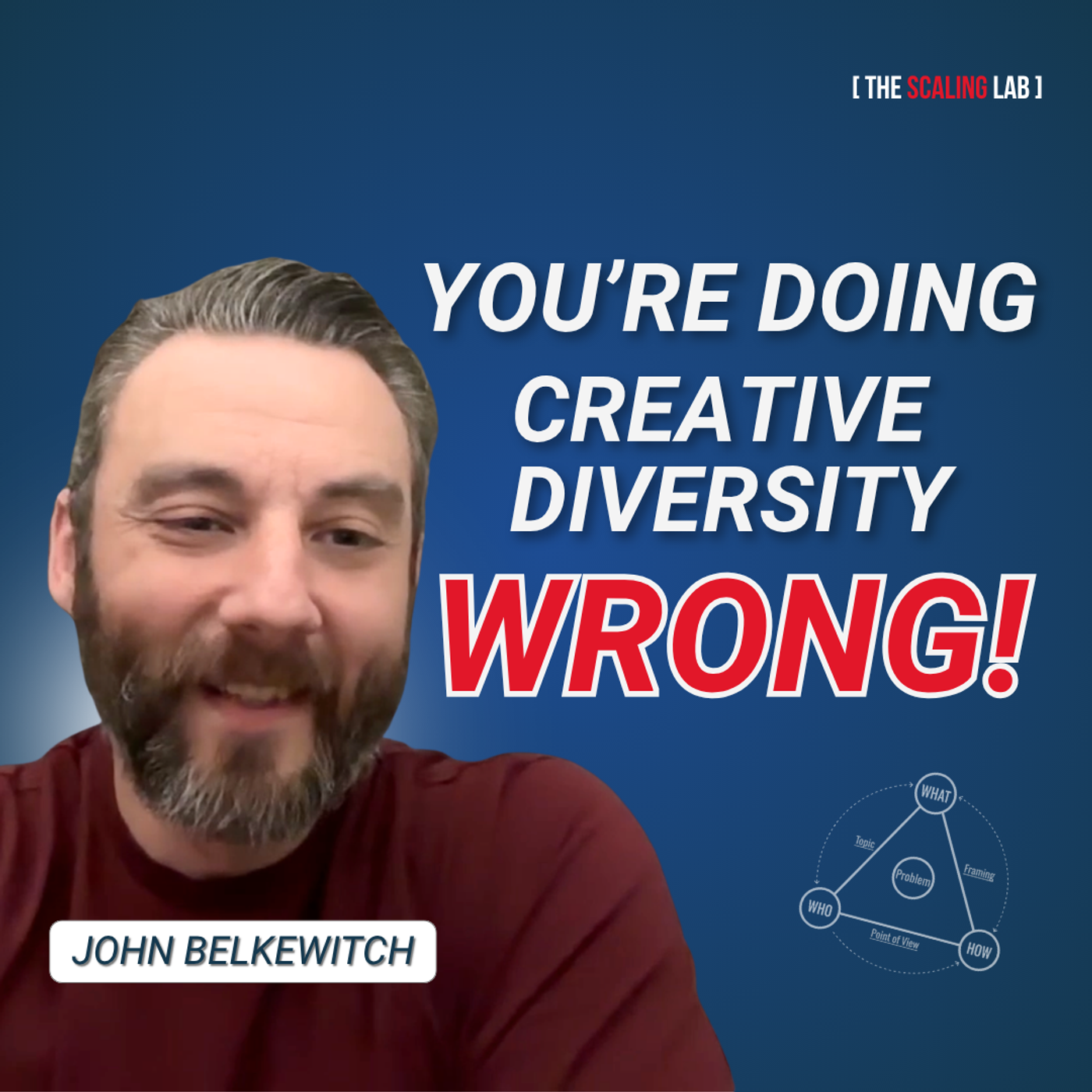 Creative Diversity Explained: The Who/What/How Triangle Driving Our Top Scaling Ads
