
The Scaling Lab · 2026-06-17 · 51 min
Creative teams across DTC brands waste significant budget because they conflate fundamental creative terminology, using words like 'concept,' 'angle,' 'format,' and 'structure' interchangeably. Jarrett and Kira from The Scaling Lab unpack why precision matters: concept is the umbrella big idea (e.g., "day in the life of a mom needing energy"), angle is the persuasive argument or thesis (e.g., "no 3pm crash, better than caffeine"), format is the delivery scene or ad type (e.g., car testimonial, two-person podcast, skit), and structure is the sequential order of persuasion blocks. They argue that conflating these - such as mistaking 100 ad variations for 100 new concepts - blinds teams to genuine testing opportunities. The discussion includes concrete examples from supplement and health brands, plus a Scream parody concept for a constipation product that illustrates how the same concept can support multiple angles and formats. The episode emphasizes that locked definitions enable teams to isolate what's actually driving performance (is it concept, angle, or format?) and scale winning creative faster. Media buyers, creative directors, and brand operators building content libraries will find immediate utility in separating these layers.
A concept is the big idea or umbrella (e.g., 'day in the life of a mom needing energy'), while an angle is the specific persuasive argument within that concept (e.g., 'no 3pm crash, better than caffeine'). One concept can support multiple angles, so defining both separately clarifies what's actually driving performance.
Separating these terms lets you isolate what's working - whether it's the core concept, the persuasive angle, the delivery format, or the copy structure - so you can iterate strategically instead of blindly producing variations and calling them new concepts.
A concept passes the one-sentence pitch test: can a stranger visualize the ad idea in one or two seconds? If not, you likely have an angle, format detail, or structural element, not a complete concept.
Creative teams use 'format' to describe the delivery style or scene (e.g., car testimonial, skit, two-person podcast), while media and spy-tool contexts use 'format' to mean ad type (e.g., video, carousel, static image), creating cross-team confusion without shared context.
If the concept is working, explore different angles and formats within it rather than generating new concepts; if a specific angle is working, test it in different concepts and formats to maximize the winning variable.
Computed from the transcript - who did the talking, and the words that came up most.
Your creative team says they shipped 100 new concepts last month. They didn't. They shipped 100 variations of a handful of real ideas labeled each one a "concept" - and called it a strategy. Here's what matters: it's not their fault. Nobody handed them a glossary. The confusion got baked in from day one. And now it runs silently through every brief, every post-mortem, every "let's test a new angle" conversation that goes nowhere - because everyone on the call is picturing something different. The four words responsible for most of it? Concept. Angle. Format. Structure. Not interchangeable. Not close enough. Not "we all know what we mean." When a team uses them at random, they lose the ability to read their own creative data. Which means they lose the ability to learn, improve, or deliberately scale anything. In this episode of The Scaling Lab, Jairet and Kira go head-to-head on exactly these four terms - breaking down what each one actually means, how conflating them distorts your testing data, and why variation and iteration aren't the same thing.
Transcribed and scored by The B2B Podcast Index.
speaker-0: Are you ready to lock in and talk about creative jargon? Some of the stuff that causes the most confusion on creative teams, which means it can lead to the most loss on your creative budget, wasted resources, wasted capital. We want to set the story straight today. We want to also lock this into exactly how this improves iterations and variations for the future so that you can learn using a common language with your creative team and scale more.
Rapidly ship more winning creative and make more money. Let's get into it. speaker-1: This isn't just about semantics or like playing with language because we like to play with language and figure out and debate terminology, but this is important because ⁓ you know, as an agency, we tag everything when we're testing and every possible variable ⁓ is tagged. And so this language, the jargon, ⁓ the terminology really matters so that we know what we're testing and we know what's performing, and we have a shared language among many different teams of people so that we can create better performance.
And then like also be able to communicate outside of our agency too, which we'll talk about. So it doesn't just this conversation and this language doesn't just exist in a vacuum. It's part of a larger world that is also important to connect to. This is an important conversation.
Well I'm excited to see where it goes and I'm excited to see if you and I disagree on some of the definitions we're gonna talk about today. speaker-0: Put your gloves on, Kira. I am a fierce debater. Some might even say I'm a master debater.
The entire industry confuses this. I think a quick call-out here is like even some of the most common creative platforms, ⁓ software is not name-dropping because we don't get paid for that. ⁓ but they get it confused. I mean, and I know through my years of experience that there's been multiple times where I've Debated like what is an angle?
You know, what is a concept? What, you know, and pe people just get it differently. And so through the years of working ⁓ with creative teams, it's really become clear to me just how important it is to lock down your definitions, set a common language so that you can speak to exactly what's being optimized or exactly what's being influenced in ⁓ net new creative or iterative creative or you know, whatever. So that's what we're going to talk about here today to make sure that everybody has a clear understanding about this.
And once and for all, slap down the hammer, slap down the gavel and say this is what it is. I'm sure people will still continue to be confused, but ⁓ we're gonna lock down our definitions here. So you've got a go-to definition. speaker-1: And I'm curious, Jarrett, how how this has progressed within our agency, you know, over the last seven years as you've been here, how these conversations have taken place and like any friction points and how it's evolved since you know, I've I've been here the last two years, so I'm less aware of the l larger conversation.
speaker-0: I think one thing that evolved quite a bit here is format. And so I guess I can finally just list off, you know, we're we're talking specifically about words like hook, concept, angle, format, structure, and even variation and iteration, which which commonly gets confused in ⁓ at least in conversations I had in my experience. And so here format has evolved quite a bit, and the overlap of format and structure. I think has caused some confusion in the past.
And now I think it's pretty clear, but we're gonna lock down our definitions a little bit later on. ⁓ and then one thing that we use that comes from the direct response copy world is lead. And so that's another one that used to get confused with hook. it it's it's pretty obvious, but like sometimes people would say, like, how well, how short is the hook?
And people would try to put like, ⁓ well it's the first sentence or put a a time duration on it and it's like, well, you know, if you're already into the lead of copy because your hook was only three seconds, you know, or your hook was five seconds, you know, what's the other five seconds of copy if we're trying to define that it's 10 seconds? So locking it down to really just that that that first thing that grabs your attention because honestly, a hook can actually be visual.
And so it doesn't actually have to be copy. ⁓ so it could go from no copy or even just text on screen or excuse me, like no audio. ⁓ and just text on screen and a visual into into the body or even purely visual into the body. And if it's hooking people, then it's a hook.
So ⁓ yeah, I think that's a that's another one. There's probably more examples, but I think those are the two that stick out to me the most. speaker-1: Yeah. And then why ⁓ why are we talking about these four?
Concept, angle, format, structure out of because there's so many different terms we use and the agency, you know, we could probably throw in like ten more easily today. ⁓ why do you feel like these are the most critical ones? speaker-0: The the way I see it is that, you know, concept is your high level, angle is the messaging that comes within that creative concept, format is almost like your your your setting or where the delivery is happening, and then structure is really the order of the persuasion elements of your copy.
And so I think within those four pillars, ignoring hook here because ⁓ that's part of structure. ⁓ but within those four pillars, also not speaking to variation or iteration, which we'll get to is kind of a bonus. I think with all those four, you you you really speak to the most important parts of creating an ad. And then all of the other stuff is either internal language or ⁓ maybe like sub descriptors.
Like I said, hook is a part of structure. Okay. speaker-1: Very cool. So why don't we start with concept?
⁓ and then go from there. And you and I may disagree, like I said, we may have to convince the other of why we're correct. ⁓ or maybe we'll disagree to disagree, or maybe who knows, we will agree on some of our definitions. speaker-0: Yeah.
Yeah. Well, I mean, I was talking to somebody about this during planning, you know, pre-production planning and the idea of concept. ⁓ you know, someone internally said like, ⁓ well, we don't really use that term too much. And ⁓ and I asked why.
And it was like, well, because you know, it's it's not too relevant. And it was like, Well, okay, I get that because if you already have your angle and your format and your structure, like you can almost glean what the concept is from it. But I think it lacks a level of intentionality if you don't define concept first, because you might be able to come up with one concept, and we'll go through some examples later, but you might be able to come up with a concept where the angle can be different within that concept, the you know, format can be different within that concept, and so can the structure.
And so if we do pin that down, then allows us to create more diversity within the concept and not just make ads at those lower levels and reverse engineer the concept as if it's not important. What do you think about that? Yeah. speaker-1: Yes, I agree with all of that.
Although again, I'm thinking we should we should define what we think of as a concept because I think mine might be more granular, whereas yours sounds like it's more of a larger umbrella. I think mine kind of is like living within another umbrella. And so maybe we can sort it out. And I I do ⁓ probably agree with the person you chatted with pre-podcast recording that concept is not a term that we typically use in our creative calls, but it could be a tool.
I mean, this is why we're creating this episode. If this is critical to thinking about ads and strategies and testing, then what are we missing by not using this concept and thinking differently? And so that's why I'm excited to talk about it because it has been missing from a lot of the conversations. And maybe it would be helpful for our team to understand what this is and how we can use it.
speaker-0: So again, it's kind of like the big idea that everything hangs on. ⁓ I wrote down a definition here that is ⁓ a concept is a distinct value proposition idea. And and then the examples that I put down for that is like ⁓ you know, one concept might be the greens powder that real doctors use. We work with a lot of supplement brands.
So I tried to stick with supplement as a product. And so that concept might be greens powder that real doctors that real doctors take. Another one might be, you know. Day in the life of a mom that needs more energy.
because you can see that if we pin down those two concepts, the angles can be different, meaning the like messaging about what is actually occurring in those two ads. ⁓ the format, meaning like the doctor could be in his doctor's office, or he could be in scrubs in his car, or he could be walking down the street with his dog. There's a bunch of different formats and then structure, obviously, we don't need to talk about that because that's just the order of those persuasion blocks.
So we move on to the mommy example. And it's like, okay, day in the life of a mom who needs more energy. And it might be because, you know, she's got to go to kids' practices after work, or it might be she has young kids and she just needs to get all the stuff done around the house. She's a stay-at-home mom.
And so those are just two examples that illustrate how different the angles could be once we drill down deeper into the messaging. ⁓ but at the the core high level, concepts are, you know, doctors, the green powders that doctors ⁓ themselves take. And ⁓ moms that need more energy ⁓ day in the life. speaker-1: So ultimately it is the big idea, right?
Like that's what we're seeing with a concept. speaker-0: Absolutely. Absolutely. Yeah.
I think of it as the the big idea that everything else kinda hangs on. Because if you if you have that, then you can go down to your next level, which would be angle. speaker-1: So let's see, I think we're saying the same thing, which could be good. speaker-0: We're supposed to disagree.
Put your gloves on. speaker-1: Yeah, I know, I know. I will we will soon. ⁓ so I was thinking the way it makes sense in my brain is the concept is like a one sentence pitch that helps someone else picture the ad.
Like you can say it like the examples you gave, day in the life energy comparison for moms. Like I can kind of quickly picture that, picture that idea. And so the concept allows people to like visualize it quickly and get it within a second or two. ⁓ so I kind of see the test, you know, is this a concept or not?
⁓ if you said that one line sentence to a stranger, could they get the idea in their head easily? If so, it's a concept. If they can't, then you don't have a concept yet. Like you might have something else.
You might have you might have, I don't know, like an angle or some other format, but it's not the whole concept. And so does that feel like it rings true and we're saying the same. speaker-0: Yeah, yeah, I think so. I actu I I definitely think so.
speaker-1: Here's another example before we move on from concept that helped me get it. pulling from a script I worked on last year. So the concept is a scream parody, like scream the movie for stuck for stuck poop. So if the angle, which we're gonna talk about shortly, is about stuck poop is this hidden killer, it can cause ⁓ bowel perforations and all types of problems.
The concept is the parody of the opening scene of Scream, where the menacing caller is actually warning the woman about her constipation. So this is an actual script. It was really fun to create. ⁓ But that's the big idea: is take take the scene from Scream.
This becomes a skit, which the format would be a skit, but but the whole big idea around this concept is turning this into a parody. that can share our specific angle about stuck poop causing constipation and megacolons. And so does that feel like that fits into concept? Like you can picture it quickly, you it.
speaker-0: Yeah. Yeah. And then and then angle being like, you know, stuck poop is a hidden killer. Cause if I said the concept was stuck poop is a hidden killer, there's so many different directions to go with that.
But when we flip it and like the concept is a screen parody, and then the angle is stuck poop is a killer, then you move down into into ⁓ format and and structure with ⁓ more clarity. Okay. Awesome. speaker-1: Yes.
Okay. speaker-0: Hey, just wanted to pop in for a quick break and let you know that if you're interested in signing up for our newsletter because you're enjoying the insights here and you want to get weekly insights directly to your inbox from our team of specialized experts, go ahead and use the link in the description to sign up for our newsletter, Scaling Secrets. And with no further ado, let's get back to the episode. speaker-1: Great.
So we're agreeing. Everything's great. We're agreeing so far. speaker-0: So far so good.
And we're at the one that's heavily debated. So, you know, people say concepts and say, Yeah, we do, you know, a hundred new concepts a month. And it's like, I seriously doubt it. I bet you're doing a hundred new creatives a month.
And you probably think that each creative is a concept. ⁓ interesting. ⁓ Yeah. I mean speaker-1: So they're talking about ad do you think they're just saying we do a hundred ads at variation?
speaker-0: Yeah. Well, in that, I think it's quite possible that, you know, just given the numbers and and I am just using a ⁓ a number off the cuff, but like if I heard somebody saying that they were doing a really large volume of concepts to that extent, like a hundred new concepts a month, I would expect that they're probably either talking about angle, ⁓ on one concept. So maybe they had twenty five concepts, which, you know, breaking it down, there's roughly, you know, six or seven a week.
That's nothing crazy. ⁓ six or seven, and then they have variations within that. Right. And ⁓ there's a tease to getting to variation and iteration later later in the episode.
⁓ but ⁓ I would assume they they might even be talking more about format and not even so much as angle that like it's almost like the different ad creatives are like, ⁓ yeah, so we have this one concept. There's maybe multiple angles, but even if it's you know the one individual and there's kind of those different scenes or settings. as format. So you've got like that one same main concept, but it's one person's delivering a car, one person's doing like, you know, golden hour, ⁓ get ready with me.
One person is anyway, you you see what I'm saying is like it's almost more about the setting and the variety comes from like different talent, you know, different creators and ⁓ different locations as opposed to really different concepts. People if if people are doing a hundred concepts, really, you know, y you'd be expecting ⁓ probably ⁓ I don't know, five hundred to a thousand ads a month. A few brands. I don't think many brands are doing that.
I'm sure there are a few, but anyway, it's just my speaker-1: Yeah, and that's where the opportunity is. If you think you're doing hundreds of concepts but you're not, well, then you could be missing out on new concepts because you're just using the same one over and over again. or if you do have a concept that's working and maybe you're creating too many concepts, maybe you could just go deeper with a few concepts that are working and create more angles and more format testing and ⁓ So either way I think it's good to know and look at what we're doing to see where there's opportunities and where we're missing out.
⁓ because it's easy to fall into habits of creating doing the same thing over and over again for speaker-0: Yeah, absolutely. So to the point of variety, I think moving on to angle, ⁓ you know, as kind of the persuasion lens, ⁓ this is kind of like why should you care? What's in it for me? This is where all of that starts to come into play.
And I think going back to your example, just to use something we've already talked about, is the angle of like stuck poop is a killer. you know, it's a hidden killer. And so to to kind of use that as our our springboard for jumping into angle, it's like that's the reason why someone's gonna care. It's cause you're opening them up to this idea that like there are these health concerns that you should care about within constipation that mean it's a bigger issue than just not going number two.
speaker-1: Yeah, so it seems like the angle is really the argument. And that's that's where the persuasion piece is taking place. And you can have many arguments, as we know, as humans. Like you can make many different ⁓ persuasive arguments.
And so that's where there's so many opportunities here to think ⁓ wider about what we can test. speaker-0: Yeah, a hundred percent. Cause it's like how you're attacking the person's objections or how you're leaning into the person's motivations, you know, their benefits or what they want to get out of it. And so yeah, it's like where you start setting the frame, as I said, like the persuasion lens, the like frame for your copy.
speaker-1: Right. And it's almost like making a thesis statement. You know, if we go back to school time terminology. Like what everything in some ways like everything hangs on this argument that you're making too.
speaker-0: Yeah. And so if I can quickly go back to the mommy example, because I I tried to like give myself a through line of using that greens example given our our our background with supplements, is it's like one angle for that day in the life with the mom who, you know, wants more energy, it could be like, no three pm crash, so it's better than caffeine. Another one could be like, you know, I get all this health stuff that I need to maintain stable energy without having to choke down a green smoothie, which is, you know, a bunch of veggies and blah blah blah.
So the green smo the green powder is better than like smoothies. And then one might be like, ⁓ you know, ⁓ yeah, I was getting my blood work done because ⁓ I've been feeling better and yada yada yada. Maybe it's ⁓ she went to the endocrinologist and the endocrinologist takes it. So she started taking it and now she feels better too.
⁓ that kind of a thing. So those are three different angles that can that give you a persuasion lens under that main concept of mom wants more energy, day in the life. speaker-1: And it allows you to shift beliefs with your audience and kind of reframe their beliefs too by making these comparisons and these these statements too and obviously like backing it up in the rest of your your messaging. So you can back up the claims that you're making and the argument that you're making.
But ⁓ this is where you can really start to shift how people think. speaker-0: Yeah. And the reason I think this one's important is separating out and and and really clearing the confusion around concept and angle allows you to get more specific about the choices you make moving forward. Cause if we say this concept working, do more of that.
And the concept is, you know, mom needs more energy, you're missing out on a angle layers. And if you're just looking at this angle's working, then you stay locked into the specific concept. And so being able to break those two pieces out and say, ⁓ what if we tried this angle in a different concept? Or if we have this concept, what other angles haven't we hit on?
Because if you think the concept is what's actually working, you need to explore different angles. If it's, you know, the angle that's working, go explore different concepts or even different formats or move downwards. But I I'm I'm of the school of thought that you can move up or down. speaker-1: Yeah, definitely.
And angles are not hooks. I think we've already said that, but that also can be really confusing too for people. And so, ⁓ you know, I think an example of that could be if your angle is about protein, you know, and you s your argument is really like your body wastes most of the protein you eat. And that's the argument I'm trying to make.
⁓ you could create so many different hooks that fit within that. angle, right? There's like infinite possibility. You could say, stop drinking protein shakes.
They're making you fatter. Or, you know, eighty-three percent of the protein in your shake is getting turned into sugar. Like you could just go on and on and on and on. But that's because the hooks sit underneath the angles and the those con those the angles and those arguments you're making.
speaker-0: Mm-hmm. Yeah, perfect. speaker-1: Okay, so I feel like we've covered concept, covered angle, we're agreeing on basically everything, which is super boring, but speaker-0: It's the calm before the storm, Kira. It's the calm before the storm.
speaker-1: Let's talk about format because yeah, I think we might disagree here. This is I think of format as alm I would say almost like the type of ad you're creating. And the type would be, is it a two-person podcast, or is it a skit, or is it a UGC style in a car? ⁓ or is it ⁓ like a walk and talk?
And the list goes on and on and on and on. Is it a doctor in a medical garb holding a model of a kneecap or you know, so that's how I think of format. That's how we've been talking about it on the creative team, but I think there's some confusion around this terminology too, right? speaker-0: Yeah.
And I would completely agree with what you're describing as format, but because there's kind of two layers to format, ⁓ this is where the confusion takes place. Is some people say format and they'll be talking about more of the like ad type format because we do have carousel image, you know, static image or video. and sometimes people refer to that or what format is it? And it's like, ⁓ yeah, it's a two person podcast.
No, I mean like, is it a video? Is it a, you know, that kind of thing. ⁓ and so there's that kind of platform ad type format, but then we also have that more internal like delivery style, or as I said, the the setting or the scene that is format. So, like you said, I would totally agree with you.
The way that we use format when we're talking on the creative team is definitely that, like, ⁓ yeah, it's a car testimonial, or it's a car skit, or it's a two-person podcast, or et cetera, et cetera, et cetera. Whereas the the other type is more of like. Almost for media buyers, or even when you're in like creative spy tools, there's the filter of like what, you know, sometimes they say ad type, sometimes they for say format, but like what kind of format was it? And it's like, yeah, that's not, you know, you you click on that that drop down menu and it says static video or carousel.
And it's like, wait, wait, that's not at all what I was expecting. You know, I was thinking, you know, UGC, blah, blah, blah, blah, blah. You know, founder, talking head, listicle, those types of formats. speaker-1: Yeah, so it sounds like we're having different conversations and using the terminology different ways amongst different teams, like the media team compared to maybe the creative team.
⁓ it still can create a lot of confusion, like you said. So how how would you clear that? speaker-0: Yeah, yeah. Well, confusion happens when we don't consider context and we assume that the other person knows what we're saying because, you know, one silly example that I like to quote, I don't know if anyone else said this, but it's something that ⁓ I use I use frequently is, you know, if I say dog, the image in your head and the image in my head are different.
And and that's where confusion comes from. If I say, Hey, Kira, go out, get me a dog and you come back with a great dane and I was expecting the chihuahua like we got a big problem. Right. And so that's where specificity is super important.
⁓ but I think in the context of like who you're talking to, you have to understand that these words are used differently. Because if I talk to a designer and I say format, you know, they're gonna think of a different thing in their head. They're gonna again the the chihuahua, you know, they're gonna think of a different thing than if I tell you that I need a new format. You're gonna look at the ad that I send you and ⁓ we need a new format.
And you might, you know. ⁓ translate it into let's say translate a car skit into ⁓ another format and this I probably I send the video and this guy's thinking ⁓ I need to take the copy and somehow translate this into a carousel or some you know a designer might anyway so you have to think am I talking to a designer am I talking to a media buyer like if a media buyer is saying like ⁓ yeah we don't have enough formats we don't you know our format diversity in the account isn't ⁓ distributed well enough it's like well wait what do you mean when you say format?
And will be willing to ask that and don't make assumptions. Because if you're talking to a media buyer or a designer depending, or if you know, you're talking from, hey, we pulled these formats from that ⁓ like ad spy software or creative analysis software, you know, just don't be afraid to double check. We'll save you in the long run. speaker-1: Yeah, I think that's great advice, you know, and just like covers the basics of communication, like how to be a good communicator and asking good questions and listening to understand contextual clues.
⁓ I also like the idea, you know, you said like it's ad type. So if I'm talking to the creative team, it's ad type thinking through the, know, the two person podcast or the UGC. And then if I'm talking about the delivery format, that's where we're talking about statics, or is it videos or is it carousels? Does that sound correct?
Or am I getting those reversed? speaker-0: Yeah, I would say reversed. I would say ad type for like the yeah, see? Hey, gotcha.
Yeah. But I would say I would say ad type for ⁓ because that's I only say that because that's the that's the alternate that I commonly see when I'm out in the marketplace is add type instead of format for when we're talking about the the different ⁓ like static video or carousel. speaker-1: Yeah. Okay.
That makes sense. So ad type, we're talking about carousels, videos, images. And then when we're talking about delivery format, that's like how we are delivering this content, this scripts. Yeah.
⁓ through like what type of production we're we're actually creating to deliver it, which that also makes sense. I think it's also worth noting, I've been confused previously too, because part of the conversation is also around platform that get platform gets mixed into format where it's like, well. Is the format meta or is it like Instagram or is it YouTube or is it whatever else? ⁓ speaker-0: That's a really good call out is aspect ratio or dimensions.
You know, ⁓ yeah, yeah, yeah. I don't know if that's exactly what you meant, but like yeah, you you saying that sparked that in my mind. I I realize, yeah, people have also done that to me where they say format when they're meaning aspect ratio or like you know, vertical, horizontal, that kind of stuff. So yeah, again, like being very intentional about the language and like here at our company.
This is the definition of this term. When you see this, it means that. And ⁓ sticking to it so that people don't get confused. speaker-1: Yeah, so then it would be like for me, it would be platform.
If we're talking about where this is gonna go, let's talk like let's call that platform. But if we're talking about the dimensions like you're talking about, that does get very confusing. Would we just say like dimension as the the category, the terminology, or would we use something else? speaker-0: Yeah, I prefer aspect ratio.
Okay. I guess dimensions is a is a good secondary one too, but yeah, I I I'd like to directly say aspect ratio. speaker-1: Aspect ratio. Great.
Yeah. And actually that language is in our system of tagging within Edge. We do use that term aspect ratio. So that's great.
I feel like this is all clicking for me, you know? It's it's making sense, making progress here. Okay, so the last big piece here is structure, which we've mentioned already, and we've hinted at. structure can get confusing too.
Like sometimes people consider structure the same thing as a format. And so how how do you think about structure? speaker-0: Yeah. So one a quick call out to the two similar to format, there's ⁓ I think two ways to use structure.
And again, if you're talking to a media buyer, they're hearing structure and they're thinking about the way their campaigns and CBO versus ABO and you know all the media buyer language, but it's like your account structure. You know, how are you setting up your meta or Google account to to deliver the most efficiency? And then we have the ⁓ creative script. structure or your ad unit structure.
And again, as I said, that's like the order of your persuasive blocks. And so, you know, we have the people say problem solution. And it's like, okay, well, let's imagine we have problem, then we have the solution, and then we have a value proposition, we add some social proof, and then a CTA. That order still needs a hook in front of it.
And so that's another thing to call out is that oftentimes structures won't include hook because Either it's assumed that like you're adding a hook onto the front of that, or whatever your first sentence is of that structure is going to be a hook. So that's why earlier in the episode, you remember I said, like, ⁓ yeah, not even not even talking about hook, because that's kind of a subset of structure. So thinking about if I add that back on, it's you know, hook, problem solution, value prop, social proof, CTA.
And that would be the structure. And you've got, you know, a bunch of other. structures that ⁓ like a attention, interest, desire, and action. And so, you know, obviously that is like a a really simple structure that I think a lot of people get started with when they start copywriting.
But ⁓ it's kind of like what are those movable parts? And as you start to break down ads, you create your own structures. And this is what we've done internally and this is what Edge helps us do is that because we tag everything, We're able to break things down, segment out like those winning elements and look at things in terms of like, okay, well, this structure is different from that structure. Do we have a new structure or does this align with a previous structure when we have like new winners or talking to the copywriter, like, ⁓ did you use a previous structure?
Was this something you kind of wrote off the cuff? Or what was the structure here that you tried to follow? And so we break those things down so that we can add to our structure library when we create new things. speaker-1: Yeah, I I think that's really helpful.
And I like the way you've defined it, where it's the campaign structure, more on the media side, and then the creative structure within the creative team. And and just even thinking about structure opens up so many opportunities because I know as as a writer, I've been caught up in using the similar structures or like the same structure because it usually works pretty well. But structure. There's so many different ways we can piece together the structure, which is really the skeleton of the script, so that we have s different s ⁓ structures for each script ⁓ that performs in different ways.
And so it's almost like infinite opportunities there. And I think ⁓ probably creative teams don't think outside the box enough because they get very comfortable with a certain type of structure and then they just like stick to that outline and don't move beyond that. But we should constantly test other structures and move things around. And like, well, what would happen if we moved, you know, we moved ⁓ the value prop up here or down here and then social proof maybe up here and like prioritize that this in this this structure.
And so it's really like a puzzle that ⁓ would give us a lot of opportunity for additional testing. speaker-0: Yeah, puzzle's a perfect word. And when I was still doing a lot of creative, shipping a ton of creative, like I keep you you keep hearing me say persuasion blocks, because that was essentially how I looked at them. It's like if I can structure these things like Legos, it might be this is the problem, here's the solution, here's the value prop, here's the social proof.
What happens if I take the social proof and I put it at the very beginning? So then it's social proof, problem solution, value prop. CTA and shuffling those things around. ⁓ you might wanna I mean one thing I remember I did a lot and and and and I know I'm kind of I'm gonna be transparent here that I was like within the bucket of social proof, I would do negative social proof, which you know would be the people just talking about the pains, ⁓ and then split it off to the positive social proof later.
So I mean it's really the problem. But rather than it being like copy and you know something unique, I pulled it straight from the testimonial. So there was two testimonial blocks, and one was the problem. And then there was a solution section that then, you know, after that, you know, whatever, whatever.
But ⁓ the social proof was obviously all of the positive stuff about this thing really works. And so I remember doing that. Okay, so now I'm gonna put negative comments up here and then I'm gonna put positive comments right after them. And then follow this different order.
And anyway, I was able to create, I would call it Frankensteining. And I would create, you know, 10 or 20 different ads just shuffling the blocks and thinking, can I split this in half? Can I cut this down? Can I move this over here?
And really just looking at the one ad almost as a ball of clay. What can I move around? What are the persuasion blocks here? And how can I reorder them to create different unique creative?
And multiple times I've made ads l that lasted over a year just using that approach. speaker-1: Yeah. And the cool thing is you will probably reach different segments of the audience as you rearrange the blocks and, you know, play with the puzzle and have a different structure. Because if you lead with like the transformational social proof at the beginning, that may appeal to a certain type of buyer.
Whereas if you lead with pain point testimonials, that may actually really speak to a different segment of your audience. So all of those different ⁓ Frankenstein structural versions, variations, which we'll talk about shortly, could reach different segments of your audience, which gives you more opportunity to reach more people. speaker-0: Absolutely. Absolutely.
speaker-1: Okay. So I mean, again, we haven't disagreed on anything, but maybe that's good. I think it'd be good to just recap, you know, if we can kind of restate like what is concept, angle, format, structure in a very simple way so it sinks in. speaker-0: Yeah, totally.
And I guess like I'll preface this by giving a shout-out to John Belkowitz, who is another one of our creative strategists that has his own episode where he talks about his creative strategy triangle. And you'll see as I as I give my definition that's you know, as punchy as I can, as short as I can, what each one of these things is. It it it overlaps pretty heavily with his creative strategy triangle. So concept is the what, angle is the why.
⁓ format is the form, or I like to also use the alternative setting. So we're not repeating format is form. And then ⁓ structure is the sequence of those persuasion blocks. ⁓ and so really that's how I think about it.
And a simple way to call back to understanding each one of them: what, why, form, or setting, and then sequence. speaker-1: And now that we have all of that nailed down, it's also just important to say it's something that our team talks about frequently. We ha we do disagree as team members frequently about like, is this this or is it that? ⁓ even today I was chatting with someone about whether or not this was a testing element or it was a format and how we're defining it and how we're tagging it so that we're all speaking the same language.
And We weren't totally sure. So we're gonna have a larger conversation about it because this is an ongoing process. So it don't feel like you need to have this nailed down today. It just might be something that you continue to work on and define.
So you're all speaking the same language within your your brand, your offer, ⁓ and you can be more effective. speaker-0: Absolutely. Absolutely. And you know, we made a couple of mentions here to the edge and how we tag all this stuff.
We're pretty rigorous about defining this stuff, even though, as Kira said, like we're still aligning on it at times. New people come into the team, new people have different ideas about stuff. A segment of let's say a a pod or something starts using a different term because it just feels right or they don't know that it is defined. And and and there's this constant kind of ebb and flow.
And so you really have to be res ⁓ persistent about making sure the team sticks to it. It's it's kind of rigorous ⁓ commitment to ⁓ reinforcing what the definitions are and not just like hearing somebody use a different term and like letting it go, and then three months down the road you've got half your team saying it. You know, ⁓ it's not something you say, we set these definitions, we put it in an SOP, we threw it in the company wiki. Now everyone uses the right terms.
It's like it is a constant day-to-day battle to make sure that we are all aligned and not ⁓ getting off track because that's confusion. Confusion causes wasted resources and wasted time. And so it's wasted money. And so to be as efficient as possible, it makes sense to have a system like this.
So, you know, the the edge helps us do that, not only have a common language, but make strategic decisions that are informed with intention. about what is the best performing element within each one of these buckets. And that's really helpful. And Kira, I'd like you to speak to how that helps you and how that helps the creative team because I know ⁓ our edge platform ⁓ breakdowns help the team a lot.
It's something they they say they love. speaker-1: Yeah. We collect all the data in Edge and we can look at it and make more intelligent decisions for each of our offers because we may see that for a particular offer, maybe this specific type of format, let's say a two-person pod, maybe that one outperforms every other format and we can start using it more effectively and using it more often because we know it works. and we can do that with structures.
If we know certain structures work really well, it doesn't mean you aren't testing new structures or experimenting, but you can start to see larger trends that can help you have more winning ads, you know, out the gate. And the same thing with with concepts. If you start to notice patterns with concepts too, or maybe there's even a hole, you start to realize as a creative team, hey, like there, we're really not. Testing enough concepts, or we're not testing enough angles, or maybe we're just testing the same angle over and over again.
And you don't it's hard to see those ⁓ outcomes if you don't have the data and you don't can't have the data unless you have everything tagged properly from the beginning. And you can't do that if you don't have these conversations around language and terminology. So it all, I mean, it all will benefit the end result. ⁓ but it starts at a very micro level.
As you can see with like just language. speaker-0: Yeah, absolutely. Absolutely. If you're enjoying this episode and you'd like to download our free resource about this exact topic so that you can execute the same way we're describing here in the episode, the way our team does it, then go ahead and use the link in the description to fill out a quick form and download this free resource so you can do it the exact way we do it here at TNT.
Let's get back to the episode. I know there's a camp out there just for the sake of like anybody showing in the c showing up in the comments being like Screw that, just ship ads. Like if you're making money, it doesn't matter. And one of the things that comes to mind is what we were talking about in the episode with Colin about shipping a thousand ads a week and getting on that hamster will of just shipping a thousand ads a week because you know your hit ratio is a certain number and you need that many ads to stay afloat.
Well, like that's the kind of thing that lacks intentionality because if you were able to be more intentional and increase that hit rate, you could function off of much less ads. Rather than just like keeping the wheel spinning on producing a thousand a week. So I get it. Like stop trying to analyze and label every tiny little component of each ad before they go live.
Just ship ads and make money. and I think that's a little bit lazy, to be honest. ⁓ and it leaves a big gap and an opportunity for optimization. And that's where I wanted to like quickly touch on iteration versus Variation is I would say think of iteration and variation as like one comes before an ad goes live and one comes after an ad goes live.
So, you know, if you make, you know, concept angle, da-da-da, everything that we just talked about, and you make small tweaks to create five of whatever that one things you have, five different hooks. Okay, well, those five different hooks that lead into the same ad are five different variations. It hasn't gone live yet. Then We analyze and we get data after it's gone live.
Now we're making iterations. So in case anyone is unclear about that, that is ⁓ a quick call out. ⁓ but kind of like wrapping up on the idea of ⁓ not tagging thing, like would you rather sit around and argue about what went live and split hairs with your team? And like how you can do more of that because you don't have a defined system, or tag everything and then know immediately, not have to do the evaluation because it's tagged, and then you can just ship more creative that wins faster.
I think the answer is pretty obvious to everybody. speaker-1: I hope so. ⁓ I really like that defining variation and iteration because I have you, you know, I throw out those terms all the time, and probably half the time I have not been correct in the way I'm using it, but ⁓ that makes a lot of sense too, and that can help us be more effective. As you move forward and you're thinking about concept, angle, format, structure, you know, this is great for your creative teams, especially so that as you think about New variations, you can start to ask your creatives and and your strategists and your writers to map out before they actually create a new ad, like nail down what is the concept, what is the angle.
That should be part of the conversation before they even start to script anything out. They should understand those four pieces and elements. Granted, it could change as they work on it, but have that as a starting point. I know that's something really important when we have our creative jams on the team I'm on.
The best ideas and some of my favorite writers will bring the the brief that includes all of these elements. And it's really easy to understand their vision rather than, you know, someone who might show up to the table with an idea, but it's not really fully formed because there's no structure, there's no delivery format, maybe there's an angle, but there's no concept. And so getting your creative team to think this way will only help them be more strategic and more effective in the work that they're doing and probably save time because they don't have to start from scratch when they realize it's not working.
speaker-0: Yeah, absolutely. Absolutely. So when because I believe the way I'm not on all these creative calls. So I believe the way that it works is that ⁓ you guys have a creative jam and a copywriter is going to come to you with a brief.
And so are you expecting them to show up with, you know, concept angle delivery format and the structure that they're planning to work on and you have to green light that or you just want them to come with concept and angle and then you guys workshop what the best delivery format and structure is for that or you workshop delivery format and then they just go run with the structure. Like how does that work? speaker-1: Every creative is different. So some of them are more prepared than others and will like fully bake everything into this brief.
And especially pulling elements. We've already mentioned John and his episode about the strategic ⁓ triangle. But like that that triangle has so many different elements. And so some creatives writers will package all of that together.
So the idea is like very clear and well defined. And as a creative team, we'll poke holes in it and we'll say, well, this is working. Like, but what about that format might not make the most sense? Here's a format that I've seen that's proven that could work really well.
And so that's where as a creative team we can support each other and again, like critique each other so that the outcome you walk away with an idea that's fully formed, ready to go. And then for others, some people might just have the angle. And that's okay too. Like sometimes you just have the angle and you need help.
figuring out the other elements. And so you might show up to a creative jam with just that piece. And then as a team, we can kind of help you fully form the idea. so it's basically everything you said.
People come in with different stages and different elements and some are lacking and we can we can figure it out together as a team. speaker-0: Yeah, so similar question, but for postmortems. I'm wondering if in postmortems you guys look at the same thing. So I had a a call out previously to like, what's really working here?
Is it the concept or the angle? Do you guys think about that kind of stuff when you do post mortems? Cause usually post mortems are, you know, this ad flopped and we thought it was gonna be a winner, or this ad's kind of close and you know, not putting words in your guys' mouth, but that's my understanding of how we do our postmortems and how I remember doing them. ⁓ but ⁓ you know, why did this ad not work?
You know, or or you know, if we're looking at something that was a winner, you know, are we looking at the concept angle, et cetera, et cetera, or do you mostly just focus on, you know, ⁓ it was the the angle in the format, or you know, it was it was just really good delivery from the person, the talent. speaker-1: I think I think we could actually be even more effective with post mortems are they're great as they are now. We focus on like at a micro level what's working, what's not working, and then at a macro level what's working and not working.
And that seems to get a lot of great feedback from our team. But I think just even this podcast episode and talking about these four elements, if we just c if we just pull those into every postmortem moving forward, we'll have a more useful conversation. And so I think that It's an ongoing process of like how can we improve these conversations? And so I think this is a good opportunity for speaker-0: Yeah, I expect you guys probably go over structure a lot and like, you know, what's in the copy, but ⁓ yeah, or how delivery was.
I know I've heard the horror stories and and seen it myself. speaker-1: We know language is powerful. ⁓ I think even just giving creative teams, performance teams, media teams this language allows them to have ⁓ more useful conversations together so that you can get better outcomes. And and that's why even though this can feel like we're in the weeds, ⁓ this type of conversation around language is so effective.
And ⁓ rather than otherwise conversations can just end up like, Yeah, you know, that ad like that hook seemed really good. Or like, yeah, the emotions seem solid. I don't know. Why didn't it work?
Just it could get very basic and dull if you don't have any guidelines to help you think through what you're looking at. speaker-0: Yeah. Yeah. Excellent.
So I guess one quick call out is like if if you're a brand operator or, you know, a brand owner ⁓ or you're a growth lead and you're looking at, you know, yourself or maybe it's your media buyer or it's your creative team, they can't sit down and agree on like which layer change, which one of these changed between ad A and ad B. You definitely have a creative testing problem. You definitely have like a A structural language problem around your guys' philosophy. ⁓ so even if you decide to call them different things, set that language in stone and you're going to increase creative production efficiency, you're going to cut down on waste, ⁓ you're going to ship winning ads faster.
⁓ and overall the company is going to perform better. And if you attach reporting onto it the way we do with the edge, it just gets even better. speaker-1: Awesome. So, you know, as we as we wrap, I think the important takeaway for me, ⁓ and hopefully for anyone listening, is just thinking about like what's coming for what's coming in 2026 as we move through 2026 and how can you use this episode to your advantage.
And it's not necessarily about technology, right? I mean, we all kind of have access to many of the same tools. ⁓ but it's really about like getting an edge over competition by using this information that we share today and these elements and this terminology so that you can create better briefs, you can produce better ads, you can create stronger strategies, you can analyze with precision. And I think precision is the right word here.
Like that's why we are getting into the minutiae because Precision is what separates, you know, an average ad from a great ad with performance. And so this is what gives you a comp competitive advantage in a space that is very crowded and competitive already, and where, you know, we all have access to the most advanced AI tools. And so how can you get an advantage in that space? And this it starts with this conversation and the language.
speaker-0: Yeah, absolutely. Because if you and your creative team do not have a common language around concept, angle, format, and structure, and you're relying on the AI tools to tag it for you, the industry out there is confused and people are using these terms in different ways. I see them used differently across these AI platforms. And so garbage in is garbage out.
You're relying on somebody else to do the work for you. AI is still pretty stupid. It's gonna make assumptions that are not right. So set that language in stone.
Have a common lexicon with your team and you're gonna see everything improve. I guarantee it. We sincerely hope that conversation cleared up the terminology of concept, angle, format, and structure for you. If you have any thoughts around it, leave it in the comments.
As always, if you like what you're seeing here on the scaling lab and you're on YouTube, subscribe and hit the bell icon. And if you're listening on Spotify or Apple Podcasts, make sure to follow along and please leave us a review because that helps more people find us. Really appreciate you being here with us and I hope you're getting value out of these episodes. Let us know.
Leave us some love and we'll see you in the next one.
 How We Scale YouTube Ads to $500K/Month (Without Getting Crushed by Compliance)69 / 100
 How to Ship 500 Ads a Week Without Killing Quality
 Stop Blaming CPM - This 1 Formula Tells You If You Can Scale
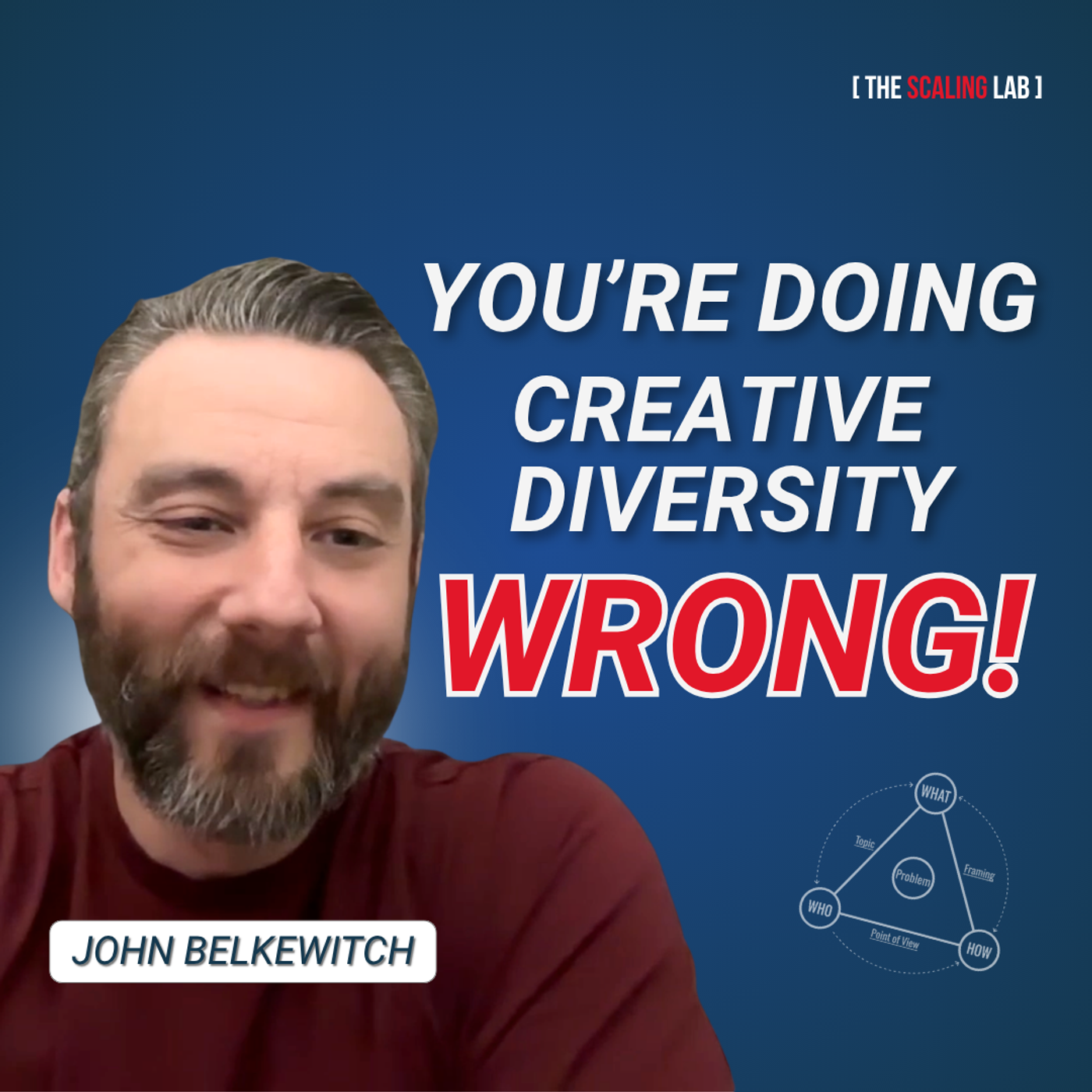 Creative Diversity Explained: The Who/What/How Triangle Driving Our Top Scaling Ads
 Your Winning Meta Ad Will FAIL on YouTube Unless You Do This