
Overall HR Podcast · 2026-02-10 · 28 min
Key moments - from our scoring
Substance score
30 / 100
Five dimensions, 20 points each
Chase shares his unconventional path into HR after initially pursuing pharmacy, then discovering HR came naturally in business school. His origin story reveals the painful reality many HR professionals face: the role demands diplomacy and confidentiality while bearing witness to organizational dysfunction, unethical leadership, and human messiness. As founder of Equip and former HR leader at hospitality companies including City Center, Chase articulates a philosophy that HR is fundamentally a culture protector - not a compliance department or a tool for leaders to escape accountability. He challenges the widespread practice of neutrality in HR, arguing instead for vocal advocacy rooted in fact-driven assessments when culture and integrity are threatened. The episode speaks directly to HR practitioners wrestling with value misalignment, operations leaders who underestimate HR's strategic role, and organizational founders building cultures. Chase discusses real situations including romantic boundary violations among senior staff, inequitable termination decisions, and how corporate decision-makers sometimes openly disregard employee welfare. He emphasizes that HR's power emerges when leaders understand their partnership role, and warns against joining organizations where HR reports to finance or where leaders weaponize the function to escape responsibility.
Chase started as an undeclared student in university, pursued pharmacy after being influenced by pharmacist relatives, worked as a pharmacy technician at Rite Aid, and realized it wasn't his calling. He then took business classes including finance, accounting, marketing, and human resources - the latter coming naturally to him despite not initially understanding the profession, and eventually became an HR major.
Knowing that corporate decision-makers did not have employees' best interests in mind while simultaneously having to convince mid-level managers to maintain hope and keep advocating for people, despite understanding there was ultimately no hope due to leadership's true priorities.
HR should be a culture protector, responsible for understanding how every decision - from meetings to email response times - impacts culture, and for reminding leaders of their obligation to maintain organizational integrity and serve the people who work there.
After returning from maternity leave, when the new general manager accused him of inciting insurrection, corporate blamed his postpartum hormones for raising concerns, and he realized the organization would not support him or respect the HR function.
The expectation that HR must always be agreeable and diplomatic regardless of circumstances; Chase argues HR should be vocal and call out issues in fact-driven ways when culture and integrity are at stake, with passion rooted in protecting the organization's values.
Our reviewer’s read on each dimension, with quotes from the episode.
The episode contains a handful of genuine practitioner observations - HR as culture protector, the cost of enforced neutrality, every organisational micro-decision shaping culture - but the majority of runtime is personal narrative and emotional processing rather than transferable, non-obvious frameworks a B2B operator could act on.
HR is your culture protector. They are the ones that understand every single decision, even the ones that are quiet. They are all keeping your culture moving into motion.
Email correspondence. It is indicative of your culture, how fast you respond.
The anti-neutrality stance and reframing of 'HR protects the company' as leadership weaponisation are mildly contrarian angles, but the broader HR-deserves-respect-and-a-seat-at-the-table argument is extremely well-worn territory in HR discourse and offers nothing a seasoned practitioner hasn't encountered.
When leadership says HR is here to protect the company, how I interpret that is it's bullshit.
There's nothing that is dignified about neutrality.
This is a solo episode with no guest; the host is the founder of a small HR consultancy whose practitioner background is limited to franchise hotel HR roles - limited scale and seniority relative to what a B2B operator audience would need for credible practitioner wisdom.
I own my own company called Equip.
I was HR leader for, uh, a franchise hotel.
A few concrete anecdotes provide texture - the 178-employee equity argument, the final-warning manager situation, the postpartum-return incident - but there are no named companies, no metrics, no research citations, and no dollar figures that would let a B2B operator extract a replicable lesson.
I could not in good faith advocate for the other 178 employees when I, uh. It wasn't equitable.
he had the final warning in addition to other things that had happened... and then he did it again like within two weeks.
This is an uninterrupted solo monologue structured loosely around questions the host typically asks guests; there is no interviewer, no follow-up, no challenge, and no productive friction - making the format the lowest-leverage possible for drawing out testable claims.
asking myself this question, have I ever seriously considered leaving HR and what pushed me there?
One HR best practice that I quietly disagree with. This is tough.
Computed from the transcript - who did the talking, and the words that came up most.
Send us Fan Mail This week on Overall HR , there’s no guest. Just me (Chase). I’m walking through the same questions I ask every guest and sharing my own HR story: how I landed here, the moments that broke my heart, the ones that clarified my values, and why I believe neutrality is one of the most damaging myths in this profession. From accidental beginnings to walking away when integrity was no longer negotiable, this episode is about what HR actually carries, what it costs to see everything, and why protecting culture sometimes means being willing to be unpopular. If you’ve ever loved this work and questioned whether it loves you back... this one’s for you.
Transcribed and scored by The B2B Podcast Index.
Speaker A: Foreign. Thanks for tuning in to the fourth episode of the second season of Overall hr. And this, uh, week I wasn't able to get a recording in with a guest, so. So I decided, hey, how about I walk through my HR story and walk through the same questions that I typically ask guests on the show. For those of you who care to hear, uh, my HR origin story or just how I landed into this complex yet rewarding function. A lot of folks may not know that I actually. So I have a minor in chemistry. And when I was in undergraduate I had no clue what I wanted to do. In fact, the first year of studies, um, I was undeclared and took a bunch of general education classes. And it reached a point where I had taken all of them, um, that was necessary for my degree. And my advisor was like, you have to decide Chase, because you're running out of classes to take in this general education sphere. And the university I attended didn't have just a general background bachelor's degree. Um, and I knew some folks. My aunt is a pharmacist, my mom's best friend is a pharmacist. And I thought, you know, um, this income supports the lifestyle that I want that I'm used to having. So I went with it and pursued that. Took all the hard classes and made it through organic chemistry too. I worked as a pharmacy technician in Rite Aid in my hometown. And I just quickly realized this is not what I want to do. It didn't, it didn't ignite that fire in my belly. And so I decided that I was going to take some business classes and I took finance, accounting, marketing and human resources. Did not know what human resources was. I just, I knew my grandmother. I was an HR manager for a factory here in central Kentucky, but didn't know what it was. I just knew it as a job title. And those classes quickly taught me that finance and accounting was not it for me. Um, I did not do well in those classes, but I did do well in hr. And it was the first higher education class I had taken that just came almost instinctively to me. So I guess you could say that it was, it was a, it was an accident, but it was a calling when it comes to landing into that profession. I do remember telling though my grandmother that I was going to major in human resources and her telling me, please don't do it because she understood something obviously she had retired and she understood something that I didn't yet quite grasp in that moment as a young, bright eyed and bushy tailed undergrad student, which uh, which segues into. The version of HR that I thought I was stepping into was a version that helped people and a version that was respected and a version where the seat at the table was the same as the cfo, not the same as the CEO, but was. Was viewed by leaders in a way that was respected. I didn't quite understand that it was a profession that was feared by not just other leaders, but also the very people that HR is supposed to serve. The moment I realized HR was more complex or heavier than expected, I, uh, interned for a consulting firm in my senior year of undergrad and learned a lot. I was exposed to a lot. But because I was in that buffer, we'll call it, or in that shell, um, I didn't see necessarily the reaction to HR delivery. I was just the one helping to advise. We weren't. We didn't execute anything. But I realized HR was more complex when I was in my first HR experience as HR leader for, uh, a franchise hotel. And every conversation that turned into a recommendation felt like a debate. It felt like a battle, and it felt like the person on the other end of the table wasn't. It was obvious they were not coming to the conversation with the same outlook as me. I viewed it as, we're on the same team, let's talk this out. And they viewed the conversation as them having to defend their job and defend the basis for their decision making when that really wasn't it at all. It wasn't that it at all. And I remember my first HR issue had to do with two senior leaders. And I was shocked that it had happened. Uh, without going too far into details, one senior leader had romantic interest in the other senior leader. And it crossed a line. Nothing that was criminal, but he was just really. He would give her gifts, leave her notes. And I had no clue that it was going on and having to address that. And there was a level of embarrassment there, um, with both parties, and I felt icky. And I don't really know why, but these were people that, you know, we. We worked together every day, had good. I had a lot of great deal of respect for each person. But when it kind of had reached that boiling point, when the receiver of the admiration, we'll call it, wanted to stop, there was a level of embarrassment and shame of her having to tell me that and then having to go and share it with the top decision maker and talk through recommendations and having those conversations, it was just difficult. And it was at that moment I realized that people are messy. They're always going to be messy. And you're never going to see behind the curtain until someone reveals what's behind the curtain. And so simultaneously, as an HR professional, while you are human and trying to grasp this fact that people aren't who you thought they would be or people are capable of this, you're also having to be diplomatic and strategic in addressing it in a way that's confidential and protects, uh, people's rights. What role I'm in now and how it's different is now, of course, you know, most of you all know this, but I own my own company called Equip. I do miss being in a traditional HR workplace setting because I miss those relationships. I miss going and seeing, saying hey to folks. I miss hearing about what their children are doing. I miss just, you know, developing relationships with people. But what I don't miss is making decisions or having to swallow decisions that I don't have the authority to make that misalign with my personal values. Because in the work that I do now, it's, it's mine, I own it. And if someone is misaligned with how I view the important things in life, like people respect integrity, I can walk from it and, uh, not cost my family. So it's very different, but it's still the same and it's continuing to advocate. Like, uh, I do enjoy posting online. I enjoy having, even though it is a small online presence, speaking against systems that people are victims of systems in organizations. And I enjoy doing that, um, rocking the proverbial boat. But if I were In a traditional W2 setting, I would not do that for obvious reasons, wouldn't be allowed to, um, moving on to what I believe about HR philosophy and what HR is actually responsible for beyond compliance and policy is HR is your culture protector. They are the ones that understand every single decision, even the ones that are quiet. They are all keeping your culture moving into motion. And it doesn't stop. You have to be intentional in decisions. It's not about optics. It's about genuine decisions that are the backbone of the culture. And every decision has an impact on culture. The ones, uh, even when a meeting takes place, who is there when it happens and how efficient that meeting is. Email correspondence. It is indicative of your culture, how fast you respond. It's indicative of your culture. And I think HR is responsible for protecting that and reminding, reminding leaders of that and reinforcing who the company is and what it is we do and why we do what we do so we can maintain that integrity of who we serve. And I don't mean customers or clients, I mean the people that work with us. Um, because why someone chooses to work for you is nothing to take lightly. When leadership says HR is here to protect the company, how I interpret that is it's bullshit. Pardon my French. HR is here to protect the company in the way I just mentioned, to protect it from individual parties that can very quickly strip a culture of its identity, strip an organization of its identity, that being the culture. I misspoke just a second ago. Um, but when leaders weaponize, HR is here to protect the company as a way to use HR as the scapegoat or the bail out for their poor decisions. That's a leader that I do not want to work with because that's a leader that wants the perks of being a leader, but does not want the responsibility or the criticism that naturally comes with the territory of being a leader that owns their decisions. HR has the most power. When leaders understand that they are the culture protector. Um, and it really is like a marriage. One of my favorite Instagram Reels or TikToks that I had seen a little bit ago just said, next time you're in an argument with your partner, look at them and say, hey, remember that you're my best friend. And that's an overlooked responsibility of hr. A lot of times is that HR doesn't just sit down to make you feel silly. HR doesn't sit down with leaders to try and coerce them into making a decision that they don't want to do. It's HR's job. It's good HR's job to sit down, look a leader in the eye when moments are tense and say, hey, remember we're best friends and we both decided to work here. There's something, if you're doing it right. There's something about this organization that clicked with both of our internal values we sought alignment on. And how can we see this conflict or this situation through that same lens? And that those situations are where HR can have the most power is reminding leaders in the midst of emotional decisions who it is they're serving and why they work for the organization with the culture that they do and the obligation leaders have to uphold that culture in every single decision. One HR best practice that I quietly disagree with. This is tough. I think it is this idea that you have to be agreeable, you have to be diplomatic, and that you don't really have a say. I can remember a leader, um, that I respect a great deal telling me that I had to learn how to play nice in the sandbox. With everyone. And I struggle with that. I do. And it's not, I don't think it's because I am, uh, hard to get along with. It's because when I have something that matters and people and relationships and values matter deeply to me, consistency is important and integrity is everything. When I know that another person doesn't share in that, I can't get over it. I really can't. So in those moments it goes back to protecting the culture. I think HR should be vocal. HR should call it out in a fact driven way. Um, it's okay to be passionate. It's okay as long as your passion is rooted in preserving the culture. It's not, not wrong. It's not wrong. And so therefore I think that I quietly disagree and publicly disagree with this idea that HR has to be agreeable and even diplomatic at all times, regardless of the reason. Next is the hardest moment of my HR career that I had to carry quietly is knowing that corporate did not have people's best interest in mind. Um, being at the table with the top decision makers, the one that was receiving the dividends, the one that is representing the company publicly on the news, online, social media, and hearing out of their own mouths that they don't care, they don't care about the people that is putting the money in their pockets, uh, and still choosing to advocate for people. Anyways, that has been the hardest moment of my career is to hear and simultaneously having to talk other leaders off the ledge. Yeah, I wish I could go further into that, but it's hard when you see it, you feel it, you know it. And other leaders that are in at a local level that are making decisions and are really in it for the right reasons and having to convince them to keep going because we couldn't tell these mid level managers that there was no hope because, and it was, it was hard. It was, it was nearly paradoxical to find the hope convinced local decision makers to keep the hope while also knowing that there was no hope. Um, that's been difficult when it comes to being asked to enforce something that conflicted with my judgment or values to a certain point. So in both of my W2 experiences, I walked away when my values, I couldn't stay because of the repetitive actions from more than just one leader. And for me that's it. Like when more than one is okay with operating in a way that is dishonest and in a way that uses people, exploits people. And I know those are damaging terms, but it's true. Um, but I can think of A time in my experience where um, and these were leaders that I respected, um, there was a manager that um, was on a final warning. And this manager was, well, it was a bad manager and not a bad manager because they didn't care, was a bad manager because they were just aloof and was on a final warning. And the final warning was, was because they were scheduling people to start work and would not, had not turned in the appropriate paperwork. Um, and I want to be really clear here, as an HR practitioner, I was okay with being inconvenienced that kind of come with the territory because really, truly and honestly understood that operators lived in a world that had navigating or competing demands of stakeholder engagement. And what I mean by that is in this environment, like a hotel, when you're working in housekeeping, you're working in the restaurant, working front desk, you're having to deal with your team management, point of sale systems, uh, tickets, like customer service issues and customers. Whereas in hr I'm just dealing with the employees. So I understood there was a lot of different competing demands. But what I had zero tolerance for was when a manager would inconvenience another person. So in this case we had written him up, given him a final warning because he kept scheduling people to come to meet with me. And not only did I not have it on my calendar, um, I didn't have the paperwork to put them in the system and we weren't prepared for them. And that was just, it was inconveniencing people. And there was, it was a level of just disrespectful respect, we'll use that term. Well, he'd had the final warning in addition to other things that had happened. It was just a conglomeration of dysfunction, we'll say. And so he had the final warning about that action and then he had, he did it again like within two weeks. And I would not have been aggravated about it if we hadn't terminated a manager not in the same department, but a manager of the same level a week prior to um, for an infraction that was the same post, her final warning. And it seemed like a non negotiable to me. And the general manager agreed with me. The director of operations did. But the manager of this middle manager was fighting for him, which I respect. And they had a closed door meeting without me, uh, which was their right to do. But I knew when they did that they didn't want my facts to interrupt their stream of conscience. And they sent the general manager, who was my boss, down and I knew when he come through the door. I knew when he come through the door what they had done. And they said they weren't going to proceed with termination. And he knew it was wrong. And I just set my head down and I looked him in the eye and I said, if you do this again, I'm quitting. And I meant that. I meant that because I could not in good faith advocate for the other 178 employees when I, uh. It wasn't equitable. It wasn't equitable. And that was. So that was one for me. That was. It comes immediately to mind is I knew it was wrong, it wasn't fair. But we had a lot of arrivals and they needed that manager that weekend, and so they chose. Chose not. Yeah, uh, that was one that was difficult to get over, but it wasn't one that I walked over. Um, because they knew it was wrong and they admitted it was wrong. And I don't think they repeated it. Um, the emotional toll of being the person who sees everything but can say very little. I touched on this, so I won't spend too much time, but it's a lot. It's heavy. Um, I say this not to overshare. I legitimately need Botox. Not because I have wrinkles. I need Botox in my muscles because I carry so much tension in my jawline. Um, and it's. I do attribute it to the function of the tension, of knowing how shitty people can be and how they lie to themselves, how they lie to other people. And I see right through it. And, um, I jokingly say that I'll probably die young because seeing that, it's just. It's lonely and isolating when you see people for who they really are and knowing that you can never actually be the whistleblower because it's not your news to tell. Um, now, I have told it in a few. In a few circumstances, when it needed to be told or when people asked. And I don't shy away from that. Um, that's just a consequence of treating people in a shitty way. But that's. That's one of the hardest parts is seeing people for who they really are and knowing that they are a wolf in sheep's clothing. People outside of HR most misunderstand the role. This one's a tough question, and I love asking guests on the show this question because it reveals a lot about their own experiences and their, of course, their ideologies. But I think people misunderstand what HR carries. Um, it's not our right to tell you what Your manager actually said, because they have equal rights as well. And m. I think people misunderstand that. They misunderstand that nothing's happened. Like, they misunderstand this idea that because they believe nothing is happening, that nothing's happened. And that's just not true. There have been times where we have had a meeting with leaders, we have decided on something, an action is required, and leaders either choose not to act and I'm operating off of this trust and assumption that they have closed the door, or leaders choose to act, but they act in a way that saves themselves. And what's communicated wasn't what was agreed upon. And I don't care who you are, HR cannot manage that. They can't manage it because especially like in my opportunities, I've worked in environments where there's 25 plus, 50 plus managers. And if you think HR, one HR person can filter or screen what those conversations that don't include HR actually look like you're. You're fooling yourself. So that's something that people don't understand is that they think that nothing is done, or they think that something was done and it really wasn't what was communicated, but somehow it's HR's fault. Uh, kind of getting towards the end. Part of this is the exit questions where I ask listeners, have you ever thought about, like, where do you stand with hr? So asking myself this question, have I ever seriously considered leaving HR and what pushed me there? My first experience and I don't have an NDA, so I guess I could share as much as I wanted to. It's just a matter of being respectful to people. I really thought at, uh, City center that I would retire there and individuals will make fun of me. One of my close friends, she even, like, she'll say, like, when you talk about City center, it's this utopian sort of ideal. But I never wanted to leave there. And when I literally, um. And maybe this speaks to the health of my own self. When I think of times that I was the happiest, it was there. I loved everything about that industry and about that opportunity and the people. And I can remember even like leaving every day. I remember thinking, one day this will be over. And it is. And I'm thankful for that opportunity. But after that opportunity went south and it went south south, I left. Um, I was on maternity leave. And while on maternity leave, a new general manager was hired. And that general manager kept calling me while I was on leave. And it was obvious that he had some issues. He was calling sharing about romantic Involvements of people that were at the hotel. He would call, asking for anything and everything I knew about employees there. Employees were calling me again. I am postpartum fresh, um, with the new baby. And employees, managers are calling me, telling me these crazy things they can do. I could do nothing. I was encouraging them to talk to the director of HR that was there at a corporate level. Um, and before I knew it, the general manager, um, that is still the general manager of this hotel accuses, um, me of inciting an insurrection to get rid of him. And I don't even know what that means. I go back, first day back. He doesn't introduce himself, doesn't say hello, this is my boss by the way. There's nothing there. I ended up going and introducing myself to him, shook his hand, was there for a week, went to corporate again. Corporate accused me of being too hormonal, blaming my postpartum hormones, which was hilarious. And I tried one more time to get some. Um, I didn't want him gone. I just wanted him to shut up. Um, it was very bizarre. And I knew then I had to leave. So I submitted my resignation because they thought that I was the problem child. I wasn't. I was not. And they told me to go. After that experience, I was so heartbroken. I looked at going into the teaching industry, the school system, and then landed an opportunity with another opportunity that broke my heart. But concurrently with that opportunity, I built out equip, which is still growing into what it is today. In terms of what I was trying to, uh, I was trying to escape a world where HR would never get the respect. I was trying to escape leaders that choose their own power over treating people like people. And I was trying to escape just the politics, the power dynamics. And I guess in a way I have because I could never go back. Uh, because when a person is benefiting in their seat of power, the last thing they want is accountability. Because if they look in that mirror, they will have to strip themselves of whatever false sense of security they've built um, for themselves. But what has kept me in HR is my hope for what I believe the profession can be. Neutrality is not going to get the profession to where it needs to be. Being a bobblehead, saying yes to leaders is not going to get the profession to where it needs to be. Being so hyper focused on policy and hiding behind policy is not going to get the profession to where it needs to be. Continuing to be complacent with HR reporting to accounting is not going to get the profession where it needs to be. Um, but what has kept me in the profession are guests that you hear on this show that are in it for the right reasons and that see the value that HR can be despite getting the criticism and subjecting themselves to the hurt that they get and have received. And if HR professionals are bold enough to protect the culture, to treat people with dignity, and to be bold in the name of speaking up against harm within organizations, I do think HR can be practiced in a way that's sustainable long term. But it's important that whenever you look for an HR role that you go into an organization that does. Does not report to finance. That is an organization that has values, that knows the values and that lives the values. And an organization with leaders that respect HR and the input that they provide to them and understand it's coming from that place of protecting, protect, to land the plane here. Uh, what I know now that I wish that I had known in my first HR role, the value, like how rare it is truly to have to work with leaders that care, um, and how rare it is to work with leaders that understand that no one person is more important than the entire team. I think that it would have saved me a lot of hurt if I had asked better questions in my second opportunity to understand the leadership style, not just the dynamic. And there's a difference in the two. You can have a strong dynamic, but if that strong dynamic is rooted in I scratch my back, you scratch mine, it's a corrupt dynamic. But if you have a leader that wants to be held accountable, that understands that people are what make the business, that creates a dynamic that is one of integrity and that is strong, but it's strong in service, not strong in protecting oneself. And there's a difference. Last question. Is the kind of HR professional or HR practitioner that the next decade actually needs is the bold one, is the one that understands there's nothing that is dignified about neutrality. It has to be an emotionally intelligent HR leader and one that's good at communicating, one that can influence people in a way that people want to work with you, but also one that is willing to walk away when things are inconsistent with one's personal values, but also the company values. All right, I think that's a wrap. Hopefully this, uh, rainbow session wasn't too much for you. Please hit subscribe and stay tuned next week where we'll have a guest talk about their same HR story. Thanks for tuning in.
Other episodes covering the same guests and topics, from across The B2B Podcast Index.
 How Multi-Threaded Selling and Building the Closing Strategy From First Contact Drives Revenue GrowthThe B2B Revenue Executive Experience · on Stakeholder engagement87 / 100
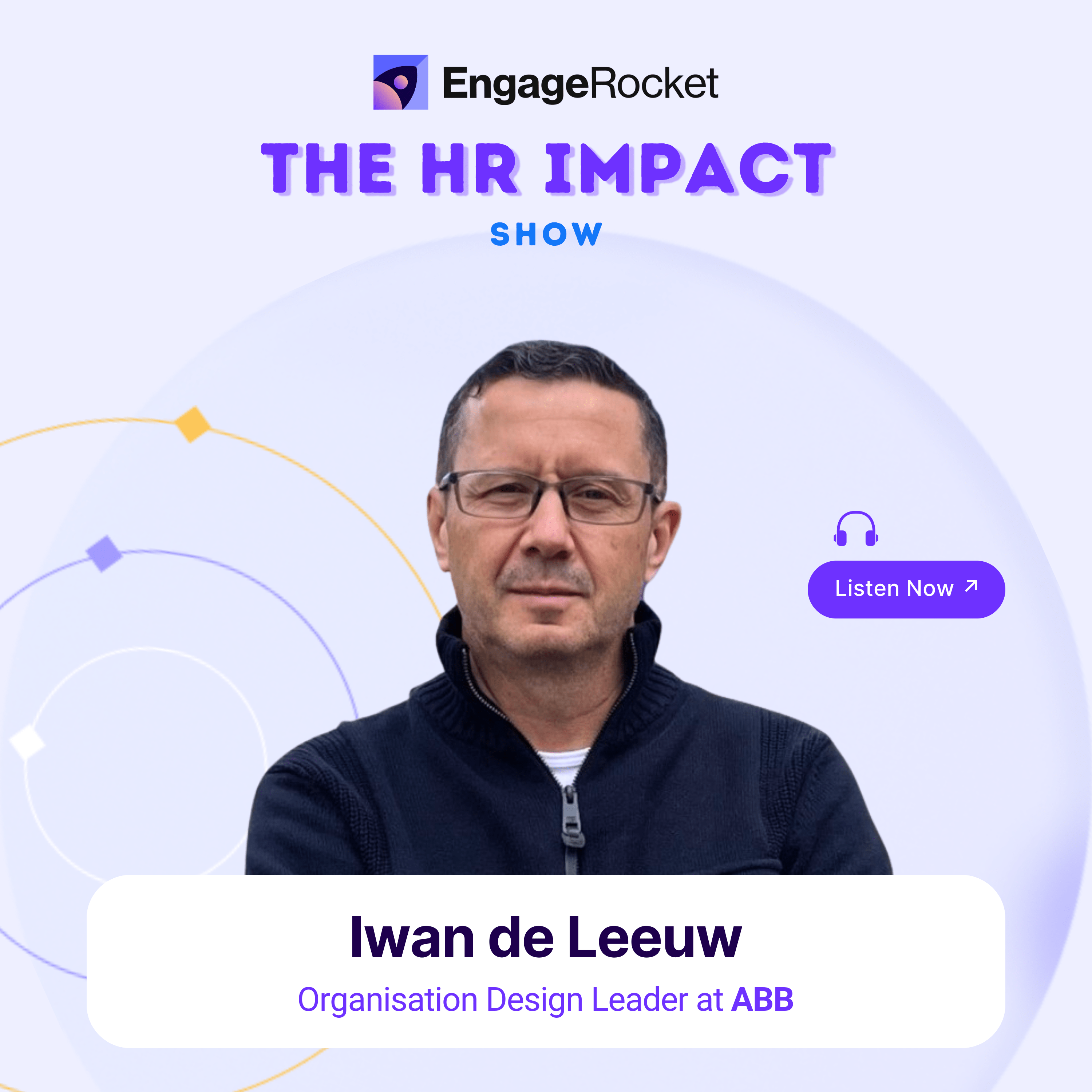 Inside Org Design: What Leaders Get Wrong and How to Fix It: Iwan de Leeuw, Global Organisation Design Leader, ABBThe HR Impact Show · on Stakeholder engagement81 / 100
 Take Charge or Step Aside: Hard Truths About Leadership and Talent Management Programs - with Dion SørensenWork in Progress · on leadership accountability78 / 100
 Storytelling and Technology Leadership, with Troy PennyIT Matters · on Stakeholder engagement75 / 100
 How to Get AI-Ready Before You Implement It with Jeffrey Lambert (#78)Exit Algorithms · on Stakeholder engagement71 / 100Episode 24: Accidental HR, Intentional Impact54 / 100Episode 23: HR, Finance & the Leadership Gap: Why Business Acumen Still Matters57 / 100Episode 21: When HR Sees the Train Coming65 / 100Episode 20: The Culture Disruptor- Keisha Toussaint on Practicing HR Without the "Corporate Muzzle"54 / 100Episode 19: Daniel's HR Origin Story54 / 100