
The HR Impact Show · 2025-12-16 · 46 min
Key moments - from our scoring
Substance score
61 / 100
Five dimensions, 20 points each
Iwan de Leeuw brings a design-thinking approach to organizational design at ABB, a company with over 100,000 employees across 87 countries managing a Workday implementation. Rather than treating org design as a one-time structural exercise, he emphasizes it as a continuous, human-centered process that examines how decisions are made, information flows, and where organizational blockers exist. Leaders commonly mistake organizational design for simply redrawing an org chart, missing the "mortar" between the bricks - the leadership, talent, processes, and informal networks that actually drive how work happens. De Leeuw's methodology involves first understanding the current state on the ground across multiple countries, identifying what's working and what isn't, then designing solutions that address root causes rather than symptoms. He advocates for embedding organizational design as a permanent capability within large enterprises rather than leaving it solely to external consultants, particularly as digital transformation and strategy shifts demand continuous realignment. His background spans military service, recruiting in Japan, General Electric's leadership development program, and HR transformation roles across multiple geographies, giving him a generalist perspective he applies to complex organizational challenges.
Organizational design requires examining all angles beyond structure: how current operations actually work, where problems originate, how functions cooperate, where decisions get made, and how information flows. Creating an org chart without addressing these underlying issues will simply recreate existing problems in a new structure.
Organizational design must be treated as a continuous, iterative process with regular review rhythms rather than a one-time project completed and shelved for years. As business strategy and external conditions evolve, the organization design should be revisited and adjusted accordingly.
Gathering feedback from stakeholders across different countries and functions during the design phase helps identify what's working and what isn't, and validating proposed solutions with those same stakeholders before implementation surfaces flaws early and builds crucial buy-in for the changes.
De Leeuw argues that large enterprises especially should have permanent organizational design capability embedded in HR or strategy functions, functioning like an in-house consultant. External consultants typically provide one-time advisory work, but continuous organizational alignment requires ongoing internal capability.
This concept means that while you can design structures, technology systems, and processes, the real work happens through the elements in between: leadership quality, talent management, relationships, and how people actually collaborate - these informal elements make the design function in practice.
Our reviewer’s read on each dimension, with quotes from the episode.
The episode contains solid practitioner insights on org design methodology - particularly the emphasis on studying current-state problems before designing, iterative rollout vs. big-bang, and habit-to-culture progression. However, roughly 40% of runtime is biographical career narrative that, while relatable, adds little substantive value for B2B operators. The core org design framework is sound but not particularly novel or densely packed with non-obvious claims.
Org design is people think it's structure. So you create a new org chart. Org design done. That's not it. You need to look at all the angles.
Organization design, it's continuous. Again, it's an iterative process. With the knowledge you have now where you want to be, this is the design you think that will help.
The framing of org design as ecosystem (structure, people, process, technology, culture) is standard consulting language. The emphasis on listening to ground-level stakeholders and testing before full rollout reflects best practices but not contrarian thinking. The 'go slow to go fast' and 'under-promise, over-deliver' philosophies are well-established. Limited genuinely counterintuitive arguments.
org design is not just about structure. It's structure, people, process, technology, culture, it's everything.
Go slow to go fast. This is something somebody told me about 10 years ago... there is a lot of truth in this
Iwan is a legitimate practitioner with multi-decade experience at GE, Toll Group, and currently ABB (100K+ employees, 87 countries). He has hands-on responsibility for org design at scale and has led actual Workday implementations and HR transformations. Not a pure thought-leader or consultant - he owns outcomes. However, he is not a C-suite operator building companies; he works within established organizational structures.
I'm currently looking at the organizational design for the HR function at ABB... that has a huge impact of what's going to happen next
I left GE at the end of 2017 restructuring. So I can speak from experience what that is like being restructured.
While Iwan cites ABB (100K+ employees, 87 countries) and mentions Workday implementations, the discussion largely avoids concrete metrics, timelines, or numerical outcomes. He admits struggling to define success metrics for org design. References to GE, Toll, and a Vietnam banking role lack specifics (names, results, financials). The example about setting targets at 50-75% is concrete but limited in scope.
ABB is gigantic, right? It is really big. We have more than a hundred thousand people, 87 countries.
there are actually not that many good metrics... To be honest, we struggled. There's some generic ones, but they felt like, are they really adequate?
Dorothy asks solid follow-up questions (e.g., 'should org design be a standalone role?', 'how do you measure success?', 'how do you sustain change?') that draw out methodology. However, the host rarely pushes back or challenges claims. When Iwan admits uncertainty on metrics or shares soft advice (e.g., 'sleep on it'), Dorothy validates rather than probes deeper. The conversation is warm and exploratory but lacks the friction that would test ideas rigorously.
So tactically speaking, we just spoke about organizational design being a iterative process, continuous process. How does it translate to your daily work at ABB?
You know what you've just described with this technology implementation sounds massive... what are some key consideration that, HR leaders or maybe just leaders of organizations should really take note of?
Computed from the transcript - who did the talking, and the words that came up most.
Iwan de Leeuw is the Global Organisation Design Leader at ABB, where he leads enterprise-wide strategies to optimise structures, capabilities, and performance. With over 2 decades of international HR experience, he has held senior roles across GE, Techcombank, and Toll Group, specialising in organisation design, talent development, and large-scale transformation. He began his career in executive search in Japan before joining GE in the U.S., later moving to Singapore where he led HR functions across ASEAN. His experience spans financial services, manufacturing, and logistics. Iwan holds a Master’s in Japanese and Management from Leiden University. This conversation delves into the true essence of organizational design, debunking the misconception that it's merely about structure. Iwan shares insights from his diverse career journey, which spans the military, recruitment in Japan, and various HR roles across different countries. Iwan discuss the intricacies of HR transformation projects, the importance of iterative processes, and the ongoing need for adaptability in organizational design.
Transcribed and scored by The B2B Podcast Index.
Iwan de Leeuw: Org design is people think it's structure. So you create a new org chart. Org design done. That's not it.
You need to look at all the angles. The first thing we did is forget about what ideas we have about the future. Iwan de Leeuw: But let's see, what is the situation now on the ground? You have a model.
How is that model working? If it's good, how can we improve it? But if it's bad, why is it bad? Because we don't want to make the same mistake with a new model.
You could maybe create a new model, but if you don't address some of these things that aren't working as good, you're gonna recreate the problem into a new, better design. Iwan de Leeuw: But in the end, the experience will be the same. So we went to a number of countries, to understand, okay, how are things working? Each of the functions, how are you cooperating?
What are some issues that you see? We've been keeping what I would call almost social interactions with a lot of those stakeholders. Iwan de Leeuw: And we plan once the design is done and signed off at a higher level to really go back to the same countries where we started to say, remember we came, we listened. Iwan de Leeuw: This is our solution.
Are there any flaws in our solution? We need to battle test it a little bit. But really that feedback loop is extremely important. Dorothy Yiu: Welcome to the HR Impact Show, where we have honest conversations with global leaders about building great workplaces.
I'm Dorothy Yiu, CEO, and co-founder of EngageRocket, and I'll be your host today. EngageRocket is a HR technology and advisory company that helps organizations improve employee experience from hire to retire. Dorothy Yiu: Today our guest is Iwan de Leeuw. He's the global organizational design leader at ABB, where he leads HR transformation projects, as well as redesign how organizations work at scale.
We're excited to dive into his journey and also dive deeper into the topic of organizational design. Iwan, it's great to have you here with us today. Dorothy Yiu: For the audience listening in who may not be familiar with your background, tell us more about yourself. Iwan de Leeuw: I'm originally from the Netherlands.
I think my career is a little bit unconventional. I typically tell people I didn't plan my career, but I couldn't have planned it any better. What my parents wanted for me, I was supposed to go to university after secondary school, but I chose a different path. Iwan de Leeuw: I was a little bit of a rebel while I was in secondary school.
I couldn't see myself in an office job, so I decided I wanted to live outdoors, so I chose a military career. Not sure if that was the smartest thing to do, but it was not a bad choice. But after about five years by that time I'd become a lieutenant in the army. Iwan de Leeuw: My parents had finally settled on the idea that I was gonna be in the military my whole life.
I decided I wanted something else, and that's actually another constant in my career change. So I have these five year cycles where I do something different. It's not perfect, but if you look at my career, it's pretty accurate. Iwan de Leeuw: So I decided to go back to school.
I chose to study Japanese and management. Seems a little bit out of the ordinary, but there is a, again, a connection to the past. When I was in school, I was really good with languages so I decided I wanted to do something with the language, but I didn't just want to do a language. Iwan de Leeuw: I wanted to have a more, let's say, corporate applicable twist to it.
So I found what I thought was the perfect study, which was Japanese in management. So I did that. I obtained a master's. And then rather again, settle in for an expected.
I was being pursued by a lot of Dutch multinationals that were offering a management traineeships to me. Iwan de Leeuw: I've been studying Japanese for all these years. I'd been in Japan on internships. I wanted to go to Japan, so I actually said goodbye to my life in the Netherlands.
Literally, I packed two suitcases. I went to Japan without a job. I was very fortunate that within about a week, I found a job as a recruiter and that sort of started my whole career in the HR space. I think HR found me.
I didn't find HR, but looking back, I think it's played really well to a lot of my strengths. Anyway, so I spent about four plus years in Japan as a recruiter. Relatively successful. I actually thought at that point in time I was gonna break this cycle and stay in Japan.
Iwan de Leeuw: But I met love and love took me to the United States. After this four or five years, I was at a crossroads. I was thinking, shall I continue as recruiter? It was good.
It was comfortable, but I wanted something different. I tried to find jobs, but it was really difficult because I was pegged a little bit as a recruiter, which I found very frustrating quite frankly. Iwan de Leeuw: But then at some point somebody came and offered me a recruiting job with General Electric, and I thought this might be a chance, not because of the recruiting position, but because of the company. So I joined General Electric and very quickly after joining.
They started offering me regular HR jobs, generalist HR jobs, which really excited me. We spoke about a couple of jobs. They didn't pan out and it was a little bit disappointed that it didn't work out for a number of reasons. But then they actually offered me a role in their HR leadership program.
Iwan de Leeuw: And that's a big deal in General Electric. General Electric in terms of functions. Or the Old General Electric, I should say, has a number of special career enhancer programs for certain functions, finance, HR, and I was lucky enough to get into this HR program. And that really jettison my career.
Iwan de Leeuw: So I had a number of roles in the US with increasing responsibility. So I'd gotten married and we were talking about going somewhere else, leaving, maybe living in Europe, maybe living in Asia. And then an opportunity came for my wife. Iwan de Leeuw: And we had been trying for a couple of times.
I had numerous opportunities with GE in Europe and in Asia, but I had to turn 'em down because my wife couldn't find a job, the sort of the dual career problem. And then ultimately she got offered a job here in Singapore and then I said to her, please take the job. Iwan de Leeuw: I will find something, even if it's not with GE. But luckily in GE, I found another job here.
Which ultimately led me to become the country HR director for GE in, what was it, 2016 or 15? I left GE at the end of 2017 restructuring. So I can speak from experience what that is like being restructured. Iwan de Leeuw: At that point in time, I wasn't quite sure what to do next.
I'm still very ambitious. So I was thinking about like very senior HR roles. Nothing was really presenting itself or the roles that came my way, I thought were not exciting enough. Iwan de Leeuw: And what I mean exciting is I am one of these people, I need to be challenged.
I need to sometimes struggle with how do I get to the solution. If it's something just implementing that somebody else's designed, it just doesn't really interest me. And then from Vietnam came a role to lead transformation with a bank. Iwan de Leeuw: In terms of HR, I think they had really big plans for this bank to become a little bit like a DBS, and I think they've made in the last couple of years some major progress in that area, although they're still a little bit more of a Vietnamese player.
So they asked me to come in, look at HR, elevate HR and what they were doing, which to me was a very exciting opportunity. Iwan de Leeuw: But I moved alone. And after about a year, I think the whole family was really starting to hurt me. So I went back to Singapore and at that time.
So another opportunity arrived, which was with a tour group, which is now a Japanese company, used to be an Australian listed company in logistics. They hired me, or originally they offered me the job as the organization development leader. And I told them a couple of times because I was being approached by headhunter: yeah, we have this organizational development job here, and I told them that I'm an HR business partner. Iwan de Leeuw: Like I've done organizational development jobs, but it's not me.
So I turned them down a couple of times and then somebody told me the person that is leading HR at the company is this person, which happened to me, one of my old GE bosses. So then I said, okay, let's do this. Let's try. So I did that for two years.
Iwan de Leeuw: Then I redesigned the HR function at that company, and I had done something similar at GE by the way. I redesigned the HR function at that company. Then after two years, I got to swallow my own medicine because I designed the new HR function and then a large part of that new HR function I got to lead in terms of people operations, which was really a very great learning experience. Iwan de Leeuw: I left the company last year.
And then ABB came along because some people that knew me said, we've heard that you've done this. We are introducing Workday, which was a system that we had at Toll and that we were optimizing. Again, the stars seemed to align. Iwan de Leeuw: And I said, yeah, this sounds like a fun adventure.
And it has been. So, that's how I got where I am. Dorothy Yiu: Very interesting journey and as you were sharing from the military and then going to Japan, being a recruiter and then falling into various functions within HR, something came to mind this term right? Dorothy Yiu: Portfolio career, which seems to be quite popular these days.
I'm just thinking, what do you think? Would you recommend others to be similar, right? Explore different things every couple of years. Or maybe just specialize into a single track, where do you stand and how has your career benefited you, given that you have tried many different things?
Iwan de Leeuw: I'm gonna come back to what I said earlier. I didn't plan anything. I think certain people are very targeted on how they plan their career. I need to, next year, I need to be a level up, or then I need to do something different.
I never had that approach. And in that sense, I would say I was lucky because certain opportunities presented that I thought, okay, they can teach me something. Iwan de Leeuw: If you think in terms of portfolio career, I think as long as you think in terms of am I learning something. It doesn't quite matter what the job is, and sometimes even when you feel the job, it might actually, from a grade or seniority level is a step down.
I'm an example in many cases, that step down, then all of a sudden I took one step back and then took two or three steps forward. Iwan de Leeuw: So I've never been a real planner in that sense. What I would say is, I think, yes, especially in HR. It's become extremely specialized.
There used to be a lot of HR people that were very broad. They were generalists. And most HR jobs or HRBP jobs, as we call them today, were referred to as HR generalists. Iwan de Leeuw: 'cause most people had knowledge of many areas.
It's become more and more specialized. I think that's a shame. There's a great career for certain people that want to focus. But there is definitely a place for people that want to be very broad, and it reflects a person's personality more than anything.
Iwan de Leeuw: Even if I look at myself, what my general interests are, it's always been broad. I like knowing a lot of things. I don't have to be the expert. I wanna reach a certain level of competency, but that's okay.
So may been the driver for me, but yeah, some people really wanna be this specialty track and that's totally fine, right? Iwan de Leeuw: But I think if you do that, sometimes you might miss out on opportunities that then present themselves and go, oh wow. Even Vietnam, what I said earlier, it's like I wouldn't have never envisioned going to Vietnam. I took a little bit of a chance and I actually thought I've been working with GE, I know everything there is to know.
Quite frankly, that job for a little bit over a year probably taught me more about HR or even myself than the 10, 15 years before that. So sometimes it's the unexpected things, the unexpected encounters, the unexpected jobs where you initially go really? But then when you stick with it, you realize, oh wow, this is a little bit of a gem. Dorothy Yiu: So to your point on being the generalist, you often describe yourself now as a design thinking HR generalist.
What does that mean? Iwan de Leeuw: I think that's also a label that's on my LinkedIn profile. I probably need to update it a little bit, but I think there's two dimensions to this, right? Iwan de Leeuw: First, the generalist.
We spoke about this. I don't think you can put me in one HR box. I think there's a number of areas that I'm extremely dangerous at. Actually when I worked at General Electric.
Especially the old General Electric, there was this, okay, you need to be a generalist and ideally you have a specialization. Iwan de Leeuw: So in my case, for a long time that specialization, it started out as recruiting, talent acquisition, but over time it's now morphed into organizational development and organization design. But at its core, when I introduced myself to people, I would say I'm a generalist, I'm an HR business partner. I really want to help translating business strategy into an HR strategy.
So that's the generalist part. Now the design thinking is a human centric, iterative approach to problem solving. And I like to put the people in the center. Of course, ultimately as an HR professional you're here to support the business, but this human component is extremely important.
Iwan de Leeuw: So I like that. And in terms of problem solving with design thinking, it's challenging assumptions, looking at new ways in order to create new strategies or solutions. And that intrigues me because it's battling the status quo a little bit. And sometimes, I can speak from experience.
If you, in certain organizations, and for me that was General Electric, you get very used to certain things and you stop questioning things, but actually the questioning sometimes is healthy. This is why I think HR is a fascinating profession, especially with people with an open mind bringing in new blood diversity to really stimulate and stress and question the status quo. Dorothy Yiu: So let's double click on organizational design, because to your point, change is the only constant.
And if we look at the world of work today. It's the pace of change is insane. So looking at organizational design, how can leaders approach it and where do people tend to get things wrong? Iwan de Leeuw: That's a really good question.
I think organizational design is probably one of the few sort of underrepresented areas in HR. I don't think you'll find a lot of people that say, I am a focused organizational design person. And if you find them, you typically will find them at big consulting firms because that is their specialty. They come in, they advise, if in order to get to this strategy, this is how you need to organize.
And again it's a little bit of an art and a science, but most people in HR, have been sticking to the traditional specializations. Iwan de Leeuw: Our org design is not one of them. So in terms of leaders, how you do that? I think it's a little bit of an uncovered field.
Certain leaders are in tune and realize the potential. A lot of them actually do not fully understand the power it has because it's actually a very fundamental element to how you're going to deliver on your strategy or how you're gonna deliver a service even within a company. So I'm currently looking at the organizational design for the HR function at ABB, but that has a huge impact of what's going to happen next, how we are going to deliver the people strategy for the business but it's not often recognized.
Iwan de Leeuw: So that's a shame. In that sense, I'm a little bit of an anomaly, because like I said, you typically find it in consulting firms, so I'm almost like an in-house consultant and I'm there to show people alternative solutions to a reality. And it's typically a little bit more future focused. Iwan de Leeuw: So you're now gonna start tapping into leader's capability.
What is my vision for the future? Do I have a clear vision and do I know who I'm now? And those are often fundamental questions that in the day to day of delivering numbers, not many leaders have time for. So it's typically a very interesting conversation.
Iwan de Leeuw: And in some cases, you speak with leaders that say, okay, I have a vision and it's becomes clear what I have to deliver in organization design. Then there's leaders that don't have that clarity, and then it becomes really difficult. And those leaders typically also have a little bit of a lack of clarity. Although they have a lack of clarity of the future, they have a clarity on, this is what I want.
Iwan de Leeuw: They want a structure on a piece of paper, but that's not what organization design is about. If you like this kind of influencing and building and philosophizing and taking a step back and saying, okay, how can we do things? What are our definitions? Are we clear?
This is a wonderful job, but you need to have some persistence because otherwise it's pretty draining. Dorothy Yiu: I have so many questions on this topic. The one thing that comes to mind is, to your point, organizational design, the skillset often, you find it in the consulting firms. And it's not almost like a role in itself, but do you think it should be a role?
Dorothy Yiu: Because if change is the only constant and organizational design is putting in place processes, structure, or even how people make decision to support a strategy and the strategy is constantly changing. This is not like a one time project, right? Iwan de Leeuw: 100%. And I talked about personally the change, right?
Iwan de Leeuw: I think in that sense, it actually aligns really well with what I'm currently doing, and I never really had that realization until recent, but you're absolutely right, it's about change, but it's looking ahead thinking, okay, with what I know now, this is where we need to be working back. Iwan de Leeuw: Organization design, it's continuous. Again, it's an iterative process. With the knowledge you have now where you want to be, this is the design you think that will help.
But like strategy, you can't leave it on the shelf and revisit it in five years. You actually need to have rhythms. Iwan de Leeuw: And I think that's where organizations often also go wrong. They do this massive work.
Actually, I think they go wrong in sort of two steps, but in this case, they do this massive work, they do great work, then they implement what that is that works for them. But as you said, the world around them evolves, changes rapidly, and there's all these other opportunities that you can use to make it even better, but people wait very long. Iwan de Leeuw: So in that sense, the job that I have, yeah, I think over time in many companies, especially large companies, that will become a more important role.
And in some companies they might have it, sometimes it might be buried a little bit in, let's say the strategy department. Other companies have made them more specific choice to put in HR. Iwan de Leeuw: You can debate where you put it. As long as you have somebody to look at it.
Dorothy Yiu: So I love what you said. You said that you've got the formal organization, the hierarchy, the structure, the reporting lines, but you've also said that's not where real work happens. Dorothy Yiu: If you really want to understand how an organization functions. It's about looking at where decisions are made, where information flows, where the blockers are.
So tactically speaking, we just spoke about organizational design being a iterative process, continuous process. How does it translate to your daily work at ABB? Iwan de Leeuw: I need to unpack this a little bit because I think you're, you also give me two or three elements. I think the first to sort of respond, how does it happen?
For people that are interested in org design, it's a little bit more philosophical, but there's this great article and it's called it's not the bricks, it's the mortar. Which actually talks to this thing. You can design things and structures and on paper, and you have the technology and the tools, and you've designed the processes, but it's the stuff in between that makes it happen. It's leadership, it's people management, it's the having the right talent, all this stuff, right?
Iwan de Leeuw: So that's super important. Now to come back to your question again, how do you make this happen in ABB? So, and I'll just literally lay out a little bit what I've been doing at ABB, so then I can connect it. The situation was we had many technology systems at ABB, and at some point the decision was made.
Iwan de Leeuw: We need to also probably have a central HRS system so we can actually enhance efficiencies because now you need to puzzle things together. This is a very simple way of describing our problem. So the big thing was we were gonna have a technology implementation and that was labeled as HR transformation, which it was from a technology perspective. Iwan de Leeuw: It took us quite some time to get there because ABB is gigantic, right?
It is really big. We have more than a hundred thousand people, 87 countries. There's a lot of complexity. We have a decentral operating rhythm that also complicates things in terms of making things simple, but ultimately, so we were working on the implementation, which we completed mid last year.
So I was hired a year and a half ago to help with the implementation of Workday because in my last role with Toll Group, the logistics firm when I came back from Vietnam was to actually create a more efficient HR operations structure to really enhance and leverage the technology because we had Workday, but we hadn't implemented it correctly. Iwan de Leeuw: It was not implemented in all countries. So with that knowledge and operations, broad HRBP technology implementation, ABB said, maybe you can come help us from an organizational perspective for the Workday implementation.
So when I joined, so I helped them, but early on I had discussions with the Chief HR Officer at ABB to say, what we have here is a little bit of a technology implement. Iwan de Leeuw: It's definitely transformative, but it's very focused on the technology. I think we're missing a piece in terms of how does the whole ecosystem work, because org design is not just about structure. It's structure, people, process, technology, culture, it's everything.
She realized that was probably true. Iwan de Leeuw: So my focus got shifted. So rather than helping with the implementation of Workday, my focus became, okay, let's look at the HR function. If we were to transform it with this advent or now coming this technology, what else can we do?
How can we make it more optimal in this decentral stuff? Iwan de Leeuw: So now I'm gonna come to your answer in terms of how do you do this? So when you start working on org design, as I said earlier, org design is people think it's structure. So you create a new org chart.
Org design done. That's not it. You need to look at all the angles. What we started doing in the beginning and what we continue to do, the first thing we did is forget about what ideas we have about the future.
Iwan de Leeuw: We need to be clear about that. But let's see, what is the situation now on the ground? You have a model. How is that model working?
It's not about is it good or bad, but if it's good, if it's perfect, like how can we improve it? But if it's bad, why is it bad? Because we don't want to make the same mistake with a new model. You could maybe create a new model, but if you don't address some of these things that aren't working as good, you're gonna recreate the problem into a new, better design.
Iwan de Leeuw: But in the end, the experience will be the same. So we spent a lot of time in the beginning in about two or three months. I have another colleague that I'm doing this project with to really understand okay, what's happening on the ground. So we went to a number of countries, especially the bigger countries.
Iwan de Leeuw: And even some smaller countries to understand, okay, how are things working? Each of the functions, how are you cooperating? What are some issues that you see? So we started with that, and then throughout the design that we're doing right now, we've been keeping what I would call almost social interactions with a lot of those stakeholders.
Iwan de Leeuw: Because of course, the moment we came there, they're very excited. Oh, what's gonna happen? So we're keeping certain rhythms. Of course we can't involve everybody, but we're trying to do our best to really interact with critical stakeholders, if you will.
And we plan once the design is done and signed off at a higher level to really go back to the same countries where we started to say, remember we came, we listened. Iwan de Leeuw: These are the things we distilled from, these are problems that we should address or that the new model should address. This is our solution. Are there any flaws in our solution?
We need to battle test it a little bit. It's one of my dreams to almost have a digital trend with org design, so you can put in the variables, parameters, and see what happens. Iwan de Leeuw: It's unfortunately not there, although we're getting closer to that. But really that feedback loop is extremely important.
And yes, we are currently, in this interim period, especially talking a little bit more to the more senior leaders, but we're keeping touch with the ground on certain people that are providing us feedback and inputs. Iwan de Leeuw: And of course my colleague and I are located in different countries. She's actually in Finland, I'm here. So we also see our local reality.
So we take all of that in, talk to people, and here and there even influence to have these social interactions going. Dorothy Yiu: You know what you've just described with this technology implementation sounds massive, and we very often see organization embark on all this Big Bang transformation projects. So from your experience, especially now, with the last year of what you've gone through, what are some key consideration that, HR leaders or maybe just leaders of organizations should really take note of?
Iwan de Leeuw: First of all, there's this element of do you go Big Bang or do you go in waves? Do you iterate, test? Do you have a certain area or division or business unit where you can test it and then they can help you and roll out? Ultimately, I am in the camp of, doing it in waves and then as a grassroots, you start, you do the proof of concept, it works.
You iron out some things. You quickly learn. I think this iteration process works better and then you create additional ambassadors, to have more successful, you need to be very project oriented. You need to still stick to certain timelines, but it works better.
The danger with a big bang, it can work, but sometimes, you make assumptions. In time, you create an execution of this big bang, and if some of your assumptions were incorrect or the data inputs were incorrect, it can have a massive impact and you never get, as they would say, a second chance for a first impression. Iwan de Leeuw: And that's with this as well. So you implement it and then you realize it doesn't work.
People start complaining and now you have to win them back, which is difficult. It's almost like with culture. Trying to convince people, we're gonna do it different and it will be different this time, good luck. Iwan de Leeuw: And especially in certain employee groups, this becomes even more difficult.
Maybe office-based workers, you have a chance. Production workers or people that work in a manufacturing facility that are not as connected in some organizations, this is gonna be much more difficult so personally I'd say if you want to do that technology, you focus on a technology, you build a business case, you show what is in there, you start proving in a smaller environment, yes, our assumptions are correct, or hey, we need to tweak. Because if you do the Big Bang, sometimes, you're over promising.
Iwan de Leeuw: And that's a shame. In GE, it was a little bit more, you sort of under promised and over-delivered. And it feels a lot better. It's maybe not completely truthful and honest, but if you overpromise and don't deliver, the repercussions are always worse.
So that's what I would tell a leader. Iwan de Leeuw: But if a leader says, no, I have this, and sometimes, there's all these angles, it's budget restraints, it has to be done now. Life is about balance. This is about balance too.
You need to tweak it a little bit. You need to be flexible. Dorothy Yiu: You remind me of the choices between go big or go home and just bear with the risks or we just said go slow to go fast later. But then sacrifice on the time element.
Iwan de Leeuw: I agree with what you say, right? Go big or go home to me is a little bit of a desperation move, right? Iwan de Leeuw: You have nothing left. So you do, as they say in America, inhale, merry pass, you know you're gonna swing for the fences and hope you hit the home run with the bases loaded.
But if you miss, you lose the game. So there's definitely a trade off. The other one. Go slow to go fast.
This is something somebody told me about 10 years ago. When I started thinking about it, you know what, there is a lot of truth in this and especially this day with technology implementations, I think it gets overlooked. Iwan de Leeuw: People want to get to the solutions. There's always a lot of hype.
It's the sort of the shiny new toy that people see. I need the shiny new toy. Yes, you need the shiny new toy. But at a certain point in time.
It's all about timing. It's like, okay, yes, you want a Ferrari, but you don't have a driver's license, so why would I give you a Ferrari? Iwan de Leeuw: Let's first get you a driver's license. And I think with these things, it's the same.
And if you think in HR as well, or technology implementation, if you build things on quicksand or it's not really well thought through. Technology is not gonna help you. It's an enabler. It's not the end all.
Iwan de Leeuw: That's where a lot of people make the mistake. So if you do the fundamentals right, you do the design thinking, or the whole ecosystem, you actually make it the simplest, analog version that you can make it. You have that. Nothing is ever gonna be perfect, but then you digitalize.
Iwan de Leeuw: Sorry for this expression. You digitalize the shit out of it, but you can, because you've figured out all the things. So the implementation of that is much quicker, and especially in this day and age with AI. That cycle is getting smaller and smaller.
So if you do the initial base work really well, you win a lot of time with the implementation. Iwan de Leeuw: But I think a lot of people just jump in, don't think it through, and then the cycle gets longer and then the business says, you promised me all these efficiencies, these costs, better service. I'm not seeing it. That's the risk, right?
It can be done, but I think it also depends a little bit on if you're a big organization, the slow to go fast, definitely. If you are smaller, you have a little bit more flexibility. Iwan de Leeuw: So it's also where you are as a company in terms of size. But I've been working for large companies, so go slow to go fast.
Dorothy Yiu: So, when you put together a organization design, how do you go about setting indicators that tells you it's working as per what the design is intended for. Dorothy Yiu: And one is how do you design those indicators? And two, are there a couple metrics that you always look out for? Iwan de Leeuw: I was dreading, you're gonna ask me this question because actually in terms of is the organizational model working in terms of metrics, there are actually not that many good metrics.
Iwan de Leeuw: Earlier this year, my colleague and I had this realization even if we do the model, we probably need to come up with some metrics to say after six or 12 months is working. To be honest, we struggled. There's some generic ones, but they felt like, are they really adequate? Iwan de Leeuw: So we are actually still looking at identifying a couple of good metrics.
Now, ultimately, I'm going to say, because typically when you do this, there's a business case, that means there's some dollars and cents. So an indicator would definitely be did you get your savings? And another matter would be, because typically when you do this, it's about speed of delivery, employee experience, manager experience. Those, you probably will get more through engagement surveys or frequent interactions with people to ask how is it working?
But a cool hard metric that the whole org design works, I haven't quite seen it. Maybe I haven't learned that there's the right one. Iwan de Leeuw: Even if there is this metric, I think you need to have a metric that really works for your org. And every organization is different.
We need to create it. So I don't have the best answer for you, but to me, this is something, and to my colleague, it's something that we're talking about because again, we don't want to just to be on dollars and cents, a business case. There need to be some other metrics too. We know there's an answer, we just haven't found it yet.
Dorothy Yiu: So then design on paper aside, the dollar and cents aside, there's also the people side of change. So how do you ensure that new habits sticks after you roll out something or desired behavior sticks over time can be sustained after a change? Iwan de Leeuw: Again, a great question, and if you would've asked me this question about 10 years ago, I probably would've fumbled through the answer. I think it starts with the realization that you can't change a person.
Iwan de Leeuw: A person wants to be changed or wants to see a change. So they need to be cognizant of what the advantages of the change are. So that is at the onset of change management, really important. What is the benefit?
What am I standing to gain? They might be giving up something, but the delta should be positive. Iwan de Leeuw: So that should be very clear at the outset. So that's one.
Two, I think in terms of, how do you do it? Again, it's incremental. Habits are created. You can't expect, you turn a knob and the next day everybody does.
So in order to drive the habit. So I think you create a habit. Iwan de Leeuw: A habit becomes a mindset, and then it becomes culture. You start with the habit.
And the habit is, in my view, driven by especially also leadership and persistency because yeah, you need to point out to people like, remember we changed, so I would like you to do it this way. Please try to do it this way. Iwan de Leeuw: These are the benefits. So there's a lot of persistency and coaching and tweaking.
Of course, you can also build it in into performance management and you make it goals and objectives. And it is a way, but I think this whole cultural aspect and leadership and coaching people and even if people in the beginning are making mistakes and being realistic with your expectations is very important. Iwan de Leeuw: I remember when we did certain things at my previous company when I was the head of people operations. When we implemented Workday, we started driving certain things.
So the expectations, certain processes that we had digitalized, we said to people, it wasn't like we've now changed them. Iwan de Leeuw: So now you need to be at a hundred percent execution on this. There can't be any exceptions. There can't be waiting times.
It needs to be a hundred percent. It's unrealistic. So I started with my team and said listen, this year. I would like you to be above 50%.
Like in every country, please deliver me this above 50%, somewhere between 50 to 70%. And this is what I did as well. I said in your goals and objectives, I'm gonna say it needs to be at 75%, but now I know it's about at 10%. We're gonna put 75, but trust me.
I'm not gonna ding you for if you don't exactly get 75. The reason why I'm doing it is I wanna see significant change. Iwan de Leeuw: So if you go from 10 to 60, that's massive. We should celebrate it and it's not punishing you.
You didn't get to 75. So that mindset and showing people, of course in the beginning when I said that, people were very hesitant and were like, yeah, you say that, but you said 75. So at the end of the year you're gonna say, not 75 ding. Iwan de Leeuw: But when the year end came and I showed them, okay, great progress.
I'd like to see a little bit more of this next year, let's go above this plan and I know you can do it. I think that helps people. So I think it starts with that rather than the hard stuff. Yes, you need to push people, but you need to give them some flexibility because even when I ask my team members that in HR, they need to work with all these other people.
So it's not that I can just get it from you, because they need to get stuff from other people. So they need to influence, which is not that easy. Some HR people need a little bit of love, so I think that helps. Dorothy Yiu: Let me ask you a question that we ask all of our podcast guests, which is, when you imagine the ideal workplace of the future, what does that look like to you?
Iwan de Leeuw: I think there's two ideas that I have around this. Iwan de Leeuw: One is about wellbeing. This element of wellbeing, it's not gonna go away. That said, and especially even how the workforce is compromised in terms of wellbeing with technology coming in.
The future, and that's in terms of the human wellbeing and even AI wellbeing is gonna be very interesting concept. Iwan de Leeuw: Ultimately, we still talk about chief HR officers and I heard somebody say the other day, oh, maybe we should start calling people a chief resources officers. That doesn't quite do it justice, but something like chief work officers, because it's all about how is the work being delivered. This element of wellbeing in that new structure of work, what is it going to be?
Iwan de Leeuw: So that's one element. The other element is, and that's a little bit more wishful thinking, although I think in certain countries people have made lots of progress. This is probably not quite what you're asking, but I love a John Maynard Keynes because I think it was the 1930s, he actually said, by 2030 people will be working 15 hours. Iwan de Leeuw: And I've always been in this position, like I would love to be in a position that I indeed can only work, let's say three days a week.
Now we're still quite far from that, but in certain countries that is a development. If you go to the Nordics, the Netherlands, average work weeks of 27 hours. Iwan de Leeuw: And here in Singapore, because we can, certain people still working 44 hours crammed into five days. I mean, We're definitely not where John Maynard Keynes thought we would be, but I hope that with technology, with some of these other things that we're going to get in that direction.
Iwan de Leeuw: Okay, do I really need to work five days a week? Is this really possible? I've seen so many examples in my career, even when I hired people and say, I only wanna work four days. But I knew these people would produce in four days what others would do in five or even more.
People really need to look into that. Iwan de Leeuw: And the wellbeing, how is it integrated? Personal life, work life is, I think, super important. Dorothy Yiu: I think that state might be nearer than you think.
Was it Denmark that has already implemented four days? Four day work? Yeah. Yeah.
Iwan de Leeuw: So the four day week is basically here, but like I said, on average in the Netherlands. I think the Netherlands is top. Iwan de Leeuw: Norway comes next with around 27 hours. 27 hours is, yeah, it's four days.
Slightly less than four days. I remember a long time ago, one of my college fraternity brothers, one of his first jobs, and he had a controller job with the bank. I was so jealous. And this was like 15 years ago, Iwan de Leeuw: he worked four days a week.
He was off every Wednesday. He was so much better and happier for it, and I was utterly jealous. And I think sometimes we don't push ourselves to see how can we do this? We stick with what we have and I'm like, I think if you change certain things, your productivity will increase.
Iwan de Leeuw: If you were to tell me, listen, produce this for me, but if you can produce it in four days instead of five, I would go for it. I would absolutely go for it. And I think that level of trust. It's not quite there.
So I hope we build on that in the future because that will be the key to unlocking some of my dreams. Dorothy Yiu: I agree with that a hundred percent. Because it's not about working less, and then reducing productivity or performance, it's about the same amount of output, but how do we do it smarter and better. Dorothy Yiu: So now I'm gonna ask you a couple of rapid fire questions just to end this podcast in a very fun way.
Iwan de Leeuw: Hit me. Dorothy Yiu: First one is, this is a new one I just edit. You know, listening to you and all the transformation projects that you lead and you do, what is one mindset that you find hardest to change among leader and a follow up of it is what is one mindset you find hardest to change among employees? Iwan de Leeuw: There's often this mindset, what got me here will get me even further.
I think it's wrong. There is this thing about the learning journey. So yes, you did certain things, you did them well, you were rewarded with this. Iwan de Leeuw: But if you keep doing the same, you start plateauing.
In that sense, some leaders sometimes, unfortunately, make that mistake, like these are tested and tried things and now to get there, I'll keep doing this. So this, I just focus on what I've done before, I'll do it even better or larger scale. Iwan de Leeuw: I think you need to reinvent. You need to be the one with a vision.
You need to challenge the status quo. That's definitely one, and especially for leaders, but to a certain extent also for employees. For employees mindset change, often, humans are creatures of habit, right? They're creatures of habit.
So if you've done this, it works. But quite frankly, if you look how people are doing it, it's workarounds to do something, there is a smarter, quicker, better way. So this learning agility to say, because you've done it this way, that's great. But now the organization has become very dependent on you, not the process.
And it should be technically the other way around. It should depend on the process and a little bit less on the human, or whoever does the work. So sometimes questioning how I do my work and I need to be brave and that's difficult for an employee being brave and say, can't we do it another way? Not get stuck now.
Dorothy Yiu: I love that. What is one leadership lesson you keep coming back to? Iwan de Leeuw: Sometimes when you're working on a problem, the problem seems insurmountable. Iwan de Leeuw: My mother told me many years ago, just one night sleep and whatever the problem was, it will seem a lot smaller.
So even when it comes to me and at that moment I go oh my God. Okay, take a step back. Take a little bit of time, and then maybe you'll see some other angles. Iwan de Leeuw: That's a very important one.
The other, personally, really from a leadership perspective I probably also say authenticity. You hear a lot about this word, authenticity. What does it mean? But to me, you bring your true self to work, right?
Of course there's a business persona, but I think your personal characters should shine through so people get to know that. And in my role too, and in previous roles, I should say. Yes, I don't take myself too seriously. Iwan de Leeuw: People know that, but people know that beyond the, doesn't take himself too seriously.
I have something to offer, so you should be comfortable. I'm lucky because I'm more senior. I think if you're more senior, it's a little bit easier. If you're more junior, you worry about this.
Should it be prim and proper? Iwan de Leeuw: I think you need to really be yourself and sometimes listen to the advice that people give you. You know, in a previous company, after spending lots of time in the US. When I came here I sensed the after Friday culture was very different.
Iwan de Leeuw: I had often these elements where I would tell more junior people, like on Friday, four o'clock, okay let's go out have a drink. You don't have to drink alcohol, but come we'll just, socialize a little bit and we go home. Because the work you have, it can wait. Nothing is that important, but I think a lot of people constantly, I need that.
This was super important. No, it can wait. So I wanna instill this into people, bring yourself to work. Sometimes when people offer that, it's okay, trust people, you'll be granted.
Dorothy Yiu: So let me wrap up this podcast with this final question. It's a bit of a full circle because we started this with your portfolio type of career. Iwan de Leeuw: Yeah, Yeah. Dorothy Yiu: This question is, if you weren't in HR, what different career do you think you'll be in?
Iwan de Leeuw: So I remember doing something like MBTI when I was in university and all kinds of career came out. Lawyer, accountant, very detail oriented and I think I probably would've made a decent lawyer. But, if you ask me, since I was a kid, I had this massive dream until I realized how commercially viable is this job. Iwan de Leeuw: I wanted to be an underwater archeologist.
My parents taught me how to scuba dive at a very young age. I was always very interested in history, so archeology, thinking about studying that at some point. Combining your passions is great and that still applies. Iwan de Leeuw: I think this job, although it found me, I can bring my passion to it.
And that is the critical one. Does the job give you the opportunity to bring your passion and energy? If that, then it is the right job for you. So I'm not complaining that I'm not an underwater archeologist because I have something good going on here.
Dorothy Yiu: So Iwan, we spoke so much about, organizational design, transformation, change management, which is a topic that I personally love because it's quite complex. Many people actually don't fully understand it because there's so many different elements to it. But you have been absolutely convincing. Dorothy Yiu: So, you know, the lawyer part might, might actually work for you.
Thank you so much for joining us today. Thank you. Iwan de Leeuw: Thank you. Dorothy Yiu: To our listeners, thank you for tuning in to our HR Impact Show.
If you have enjoyed the conversation, please like and subscribe on YouTube, Apple, Spotify, or any of your favorite podcasts. You can also subscribe to our community at engagerocket.co/hrimpact. I'll see you in the next episode.
Other episodes covering the same guests and topics, from across The B2B Podcast Index.
 How Multi-Threaded Selling and Building the Closing Strategy From First Contact Drives Revenue GrowthThe B2B Revenue Executive Experience · on Stakeholder engagement87 / 100
 Ivo Gormley, GoodGym's Founder on designing for contributionCreative Capes · on Organizational design84 / 100
 MEL #065 | From Technical Expertise to Meaningful Impact Through Strategic Thinking and Asking Why with Dr. Bharat MadanMastering Engineering Leadership · on Design thinking83 / 100
 Xero’s CFO: Why Finance Is Taking On More of the BusinessRun the Numbers · on Organizational design82 / 100
 The End of Software as We Know It: How AI Agents Are Rewriting HR, SaaS, and Organizational DesignAI First with Adam and Andy · on Workday81 / 100
 602: Human-centered product design - with Ravi SawhneyProduct Mastery Now for Product Managers, Leaders, and Innovators · on Design thinking81 / 100
 Reimagining HR as Business Driver with Purpose and People: Li Lian Tan (CHRO at Mediacorp)66 / 100
 Transforming Schools, Shaping Cultures: Abhilasha Deshmukh (Group HR Director at Global Schools Group)76 / 100
 How Top HR Leaders Operationalize Wellness by Humanizing Leadership: Jolene Huang (Chief Talent Officer, SG & SEA at Publicis Groupe)72 / 100
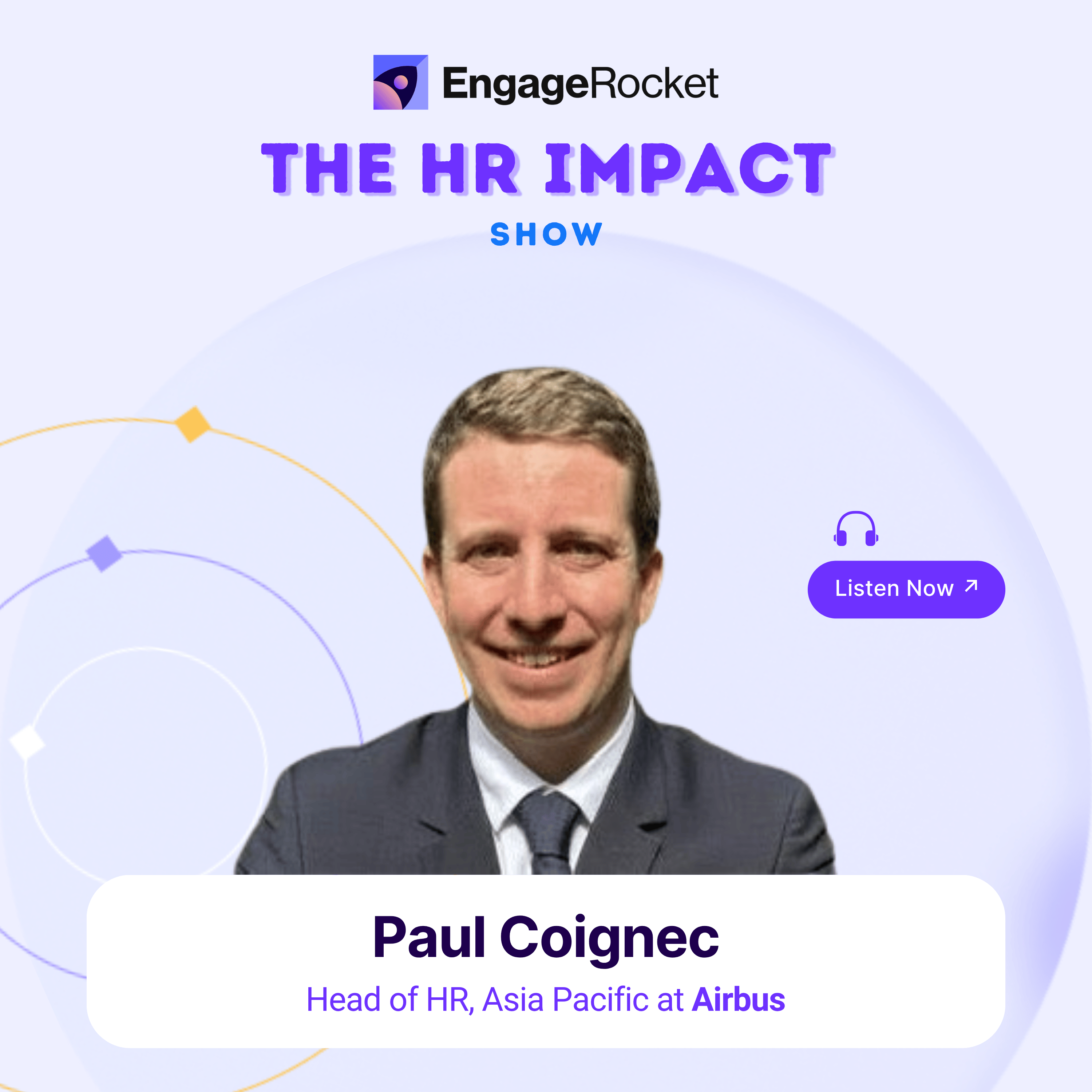 From Complexity to Empowerment: Airbus’ Approach to Decentralized Leadership: Paul Coignec (Head of HR, APAC at Airbus)81 / 100
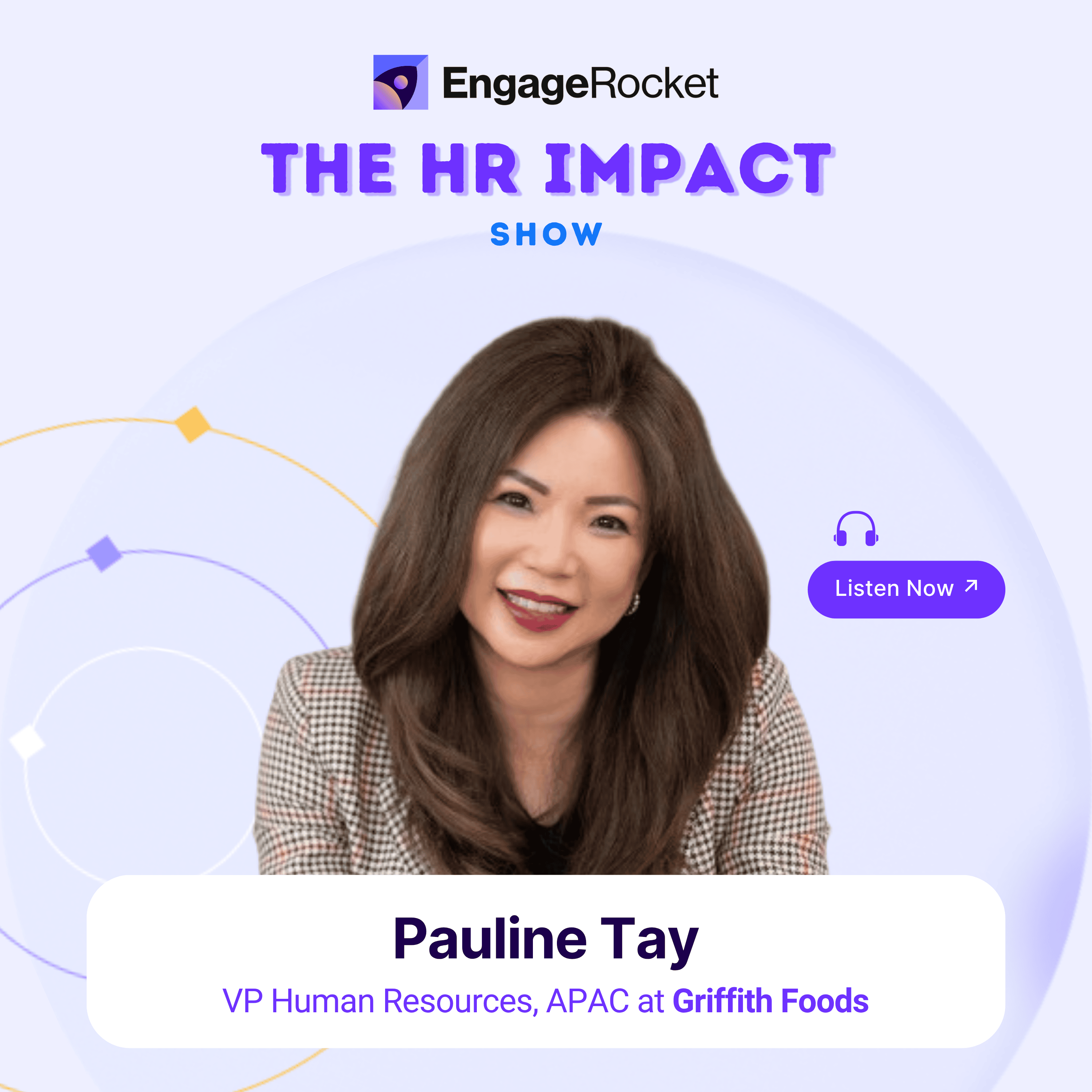 Unpacking the 3 Pillars of Strategic Change Management: Pauline Tay (VP of HR, APAC at Griffith Foods)80 / 100