
Free Startup Fundraising Advice & Investor Pitch Practice with Scott Fox, CEO of StartupCouncil.org · 2026-06-26 · 1h 17m
Key moments - from our scoring
Substance score
36 / 100
Five dimensions, 20 points each
Scott Fox, CEO of StartupCouncil.org, hosts a live startup office hours session offering free fundraising advice, pitch practice, and investor Q&A to founders worldwide. The episode opens with Sean, founder of an AI CFO product for small business owners, asking how to find pitch competitions - a question that leads Fox to showcase two resources he's built: startup events.org (a global calendar of face-to-face pitch events and conferences) and the newly redesigned StartupCouncil.org membership platform (which aggregates virtual events, founder profiles, and investor directories). Fox also previews Draco AI (a fintech startup from Los Angeles), a hardware deep-tech lighting device, and discusses how founders can use Google Alerts, Tech Week series (Denver, San Francisco, LA, Irvine, San Diego), and email lists to discover competitions. For early-stage founders seeking structured visibility, pitch contests appear effective - Sean's team won first place at the Level Up competition - but Fox emphasizes that building customer relationships and traveling to in-person events (when budget allows) matters as much as pitch perfection.
Use Google Alerts with relevant keywords, sign up for email lists from tech organizations, check the Tech Week series (which exist in multiple cities like New York, Denver, San Francisco, and LA), and visit startup events.org - a free global calendar of face-to-face pitch events that Scott Fox built specifically to solve this problem.
It connects to accounting systems like QuickBooks and bank accounts (via services like Finicity or Plaid) to let small business owners ask natural language questions about their finances - such as payroll due next week - without needing to hire a full-time CFO or expensive fractional CFO service.
StartupCouncil.org is a free-to-join membership platform (charging $20 to ensure quality) that provides a founder directory, virtual event calendar, investor connections, and member blogs; it's designed to help early-stage founders find resources, connect with investors, and access publicity tools to grow their startups.
Pitch contests provide structured visibility, feedback from experienced judges, and potential funding or prizes; Sean's AI CFO startup won first place at Level Up and advanced to the next funding round, suggesting contests work well for polished teams with tight pitches and presenting experience.
Our reviewer’s read on each dimension, with quotes from the episode.
The episode is dominated by self-promotion, chat-room shout-outs, ad breaks, and generic platitudes that consume the majority of the 77 minutes. The handful of actionable insights - pitch for meetings not checks, add numbers to pitches, target specialist investors, use attorneys as network connectors - are real but low-density and not novel for any experienced operator.
a pitch is never going to get you a check. A pitch is designed to get you a meeting.
You have no numbers. Investors eat numbers, so if you don't feed me numbers. I'm starving.
The content is almost entirely recycled startup-fundraising conventional wisdom: warm intros matter, go to events, practice your pitch, network more. There is no contrarian argument, no first-principles reframe, and no counterintuitive claim - just a friendly restatement of advice available in any basic startup book.
the warm introduction is key here.
attorneys know everybody. It's like the secret, right? Attorneys know everybody
The on-camera 'guests' are three very early-stage founders (one with a 3-week-old company) seeking basic advice, not practitioners who have operated at scale. The host himself has credible but modest credentials as an angel investor and author, and never probes deep enough to extract the most relevant experience even from Sean, the guest with the most relevant CTO background.
I was CTO of a credit card company for a long time. Um, I built a couple of fintechs from the ground up. Uh had a couple of actually successful exits
our business is new. We started uh, maybe about three weeks ago
The pitch-practice segments inject concrete numbers - COGS breakdowns, gross margins, raise sizes, and timelines - and the host references named organizations (TCA Venture Group, Expert Dojo, Tech Coast Angels) and specific products (Finicity, QuickBooks). However, market-size claims and competitive assertions remain hand-wavy, and the host frequently admits he doesn't know the relevant numbers.
we sell our product for $4,000 and our cost of goods sold is about $2,000. A thousand in parts, a thousand in labor. So you know, 50% gross margin.
we're trying to raise a seed round of $1.5 million. Um, our goal is to get to production within six months
The host offers structured, honest pitch feedback and occasionally surfaces genuine investor-perspective skepticism (e.g., distinguishing interested professors from paying customers), which lifts the score above pure softball territory. However, there is no substantive pushback on business model assumptions, no productive disagreement, and follow-up questions are shallow and quickly dropped in favour of more self-promotion.
As an investor and, you know, putting my skeptical hat on, I would be. I would wonder, are. Are they gonna buy or are they just interested and flattered that you read their paper?
you talked, like, 90% about the product, a little bit about the ask, and you said nothing about the business. So that's a big hole.
Computed from the transcript - who did the talking, and the words that came up most.
StartupCouncil.org offers free, honest #startup #mentoring for #entrepreneurs working through #fundraising, #VC, and #businessstrategy challenges - including live critiques of real #founder #investorpitches! If this helps you, please LIKE & SUBSCRIBE! Find out how to JOIN us at Did you know that ON CAMERA PRIORITY goes to MEMBERS of the StartupCouncil.org ? In this episode of Startup Fundraising Office Hours, CEO Scott Fox demystified #VC psychology and startup #fundraising. Key Q&A included: Samantha (Newport Beach): How to raise $30k for proof of concept hardware development and production? John (Tustin, CA): Asked what percentage of a company to give up per round. Scott recommended 10 - 25% as a general rule, viewing fundraising as an iterative process of growing the total pie. Roger (London): Asked about balancing business plan confidentiality vs the need to disclose company secrets to Silicon Valley investors. OG (Chicago, IL): Asked about the most common red flags that will turn off investors.
Transcribed and scored by The B2B Podcast Index.
Host: There's nothing like the American Express Platinum card.
Narrator: Find out your welcome offer after you apply, which could be as high as 175,000 points.
Narrator: Learn more and find out your offer@americanexpress.com
Narrator: explorer Platinum terms apply.
Host: Well, here we go. It's time for startup office hours. It's great to see you. I'm, uh, glad you're here to talk about your startup. You brought some questions, right? Or maybe you have an investor pitch you want to practice? Well, I'm here to help. I'm Scott fox. I'm the CEO of startupcouncil.org We're a worldwide community service group that I started to help you. We help founders all over the world accelerate their success by connecting them to better resources, to investors and to each other. So if you're here tonight for questions, answers, some strategy discussions, or to meet other people and network with other founders, service providers, investors, well, you're in the right place. So thanks for joining us. We're going to be here for an hour, so taking your questions live here on YouTube and LinkedIn and Facebook and um, all of this is available to you free as a service of the, um, Startup Council. If you're not a member of the Startup Council yet, you should probably come and join us. We just built a brand new website that is really lovely and full of, uh, services for you and they're all offered at cost or even free based on support from our sponsors. So this is a community service worldwide effort that I started after many years as an entrepreneur myself. For a long time I was, been a founder and uh, I guess I'm still a founder in ways, but I have the heart of a founder. In any case, I've been raising venture capital, deploying capital and building teams and companies and products all over the world for decades now. And I'm here tonight, as I am often online, all over the Internet, to try to help those of you who are new to this get up to the next level to accelerate your success. It's really about understanding where the future is going and finding the resources to help yourself get there. A lot of this is encapsulated in my books, which you can see over here behind me. Uh, the three in the middle are in English and the other ones are foreign translations. You can see, uh, like there's Japanese and Turkish and Russian and uh, Polish and Vietnamese and so forth. So if you're here because you've read one of my books, thanks for, thanks for reading, there's another one on the way. Sneak, uh, peek Actually, there's a new book about startup financing, how to raise money, coming pretty soon. So if you're interested in hearing about that, go to the startupcouncil.org and make sure you check that box. We've got a whole bunch of free email newsletters for you there, all designed to help connect you to better resources and raise money and grow faster, like I said. So I'm here because I'm a long term serial entrepreneur, like I said, an author. I've written several books trying to help other people find success as Internet entrepreneurs. And these days I'm actually mostly an angel investor. So I've been on both sides of the table and that's why I do these office hours. It's to help you, to help you figure out how to speak to investors, how to present your ideas, take the ideas out, out of your head and bring them out into the world where investors can engage with them and especially, actually, more importantly, customers. You need to meet a lot of customers to build a real business. So we'll talk tonight about your strategy question. Some people wrote in early and those folks are backstage, I can see, uh, who do we got back there? Sean and Salman and Jay are all backstage waiting to come on and join me on camera to talk about the questions they sent in. So thanks to them for giving me some advance notice. And then, uh, we're going to have a whole bunch of other folks, um, in the chat room. So if you're here from anywhere in the world, be happy to hear from you as well. Let me, let me turn on the chat room here. And if you are over on YouTube or LinkedIn, you can, uh, please chime in, let us know where you're from, who you are, where you're from, even what you do. And of course, you can use the chat room for your own purposes too. I don't have all the answers, so I'm hoping that throughout the show you'll be able to help each other. So when I give some advice, that's great, but I don't have all the answers. I have a bunch and I have my opinions.
Mark: But.
Host: But your opinions could be just as valid. And of course you bring with it your own wealth of experience too. And that's the way you get ahead as an entrepreneur. You help each other and you find mentors, whether they're older or younger or richer or poorer. But there's a lot of diversity in opinions and creativity and intelligence. And together it's those teams, those communities that can help accelerate not just one individual founder or founding team, but whole communities. And that's really the objective of startupcouncil.org so thanks for being here. Like I said, come on into the chat room and let me know where you're from. I got George checking in from Denver, Colorado, and Chad from Surf City. Dan, I think Dan's local. That's Dan Urellian, I think. Nice to see all of you. Thanks for joining me. And the rest of you go ahead. Let us know who you are, where you are, and if you have questions and comments. Um, as we go, of course, please go ahead and stick those in there as well. There's Dong Yoon from LA also and I think there's a bunch more people, so we'll let that keep running there for a minute. And let me just say I have to do a couple little legal things and then we'll get going. And then, uh. Oh, there's Dan. Yeah, hi. Nice, nice to see you, Dan. And uh, Dwayne coming from Tennessee, and Anna from Irvine. Local. Okay, Anna. And Newport beach and Burbank. Okay, excellent. Well, nice to see all of you guys. Let me put on a couple our little disclaimers here. So first of all, this is not legal or financial advice that you should rely on. This is basically, um, quick hot takes from a guy you met on the Internet who's trying to be helpful but may be full of it. And that's how the Internet works. So I think you all know that by now, but just want to formally say this is not legal or financial advice. You should consult, consult your own personal, legal, financial and other expert advisors to get advice specific to your situation. Also, this is being recorded, so please don't say anything stupid or offensive. Of course, if you're offensive, I'll just kick you out. But uh, otherwise, uh, don't say anything too confidential and um, we will be, uh. This is being recorded. It's being broadcast obviously worldwide already and it's also archived on our YouTube channel. So if you want to come back and watch later or re watch parts of it, uh, there's a whole bunch of hours of this stuff. So if it's useful to you, please visit and subscribe to our YouTube channel. And that if, uh, that's@YouTube.com Scott Fox no surprise, right? And there's 20,000 plus of you there now. So please like and subscribe and comment. If you're over there now, please uh, hit that little thumbs up. It helps us help more people and that's really what we're doing here, right? I don't really make any money from this. This is volunteer service that I do as part of my give back because the Internet and digital media have been very good to me. So I hope this is all helpful to you.
Sean: Okay.
Host: David from Surf City, Lucas from Columbia, but living in Austin. Uh, LinkedIn user from Fort Collins. And Chris from Pasadena. Alfred from Ghana. Excellent. Africa checking in. Rich from Carlsbad. Okay, well, nice to see all of you. Let me, let's get to our business here. Hakimi from Malaysia. All right, we've got a. I think we're spanning the globe here. This is good. I moved this call time, as some of you may have noticed, so that we could reach our friends, um, in India and uh, East Asia, Australia, Middle, um, East a little bit better because I used to do these at lunchtime for me when it was easy, but that missed a lot of you. So what happens now is that we don't see the people from Europe as much because it's late in the evening for the them. But of course Europe doesn't need as much help as a lot of other places do. So happy, uh, to have you all here. Okay, so let me remind you to go visit the Startup Council. This is lots, uh, of free startup help for you. That's this logo behind me. This, uh, where's my finger here? I can't see. There it is, this blue one here. All right, so go check that out and please join us and get involved. It's a rapidly. It's a new site, so we're just getting started, but you could get it on the ground floor and be happy to help all of you everywhere. As much as I can. As much as the sponsors and team members that we have are able to. All right, so that's enough pencil sharpening. Let's get to it and see who's in backstage and what they want to talk about because it's time to uh, really get into Styrofox hours and do some Q and A. So I'm going to those of you backstage, I'm going to bring you on and have you, um, just say hi for a second and please be ready with just a super quick hello sort of thing. Like just the 32nd, not even 30, like the 10 second version of what you're doing and what you want to talk about so that I can prioritize. All right? And then we'll come back to each of you since you're here early, uh, and on camera and um, we'll figure out, uh, the order. But just for the moment, let Me start with uh, let's see who we got. Sean here. Hi, Sean, nice to meet you.
Sean: How's it going? Can you hear me?
Host: Yes, sure can. What's on tonight?
Sean: I'm uh, I'm in from uh, Delaware. I'm apparently on air here. The uh, the overlays, I'll just.
Host: Yes, okay, sorry. Let's move you over here.
Sean: Yeah, um, yeah, I'm working on a uh, large language model back the uh, AI CFO with a co founder and I got a couple questions about doing pitch meetings and also about our product spectrum.
Salman: Cool.
Host: Okay, that sounds interesting. Congrats to you. That's a hot topic for sure. Happy to talk about that. And then who do we have here? Salman. Hi Salman, Nice to meet you.
Salman: Scott. Nice to meet you. Um, my name is Salman. I'm um, a founder of Draco A.I. uh, and we're doing a fintech startup. We're from Los, uh, Angeles, California.
Host: Okay. You wrote in you wanted to practice your pitch, right?
Salman: Uh, yes. And uh, if there's time, maybe a very short question.
Host: Okay, cool. No, we're happy to ask. Do what we can. Um, Draco AI. Got it. Okay, cool. So we usually start with a question or two and then we'll work you in as well because the questions help everybody kind of get level set, you know, get on the same page. And then. This is Mark.
Mark: Yeah, Good evening. Scott.
Host: Hi. Nice to meet you. Where are you from?
Mark: I'm from the San Francisco Bay area.
Host: Okay. Certainly. Yeah. That area. Excellent. Yeah.
Mark: Well, I'm the founder of a hardware startup, Deep Tech. Uh, these days we call it. And it's uh, a lighting device. I actually have it here. I won't turn it on because it's
Host: led from taco night in Tulum to sushi in Tokyo. Make every bite rewarding with gold from Amex. Wherever you dine four times. Membership rewards points at restaurants worldwide are ah, piling up.
Salman: Learn more@americanexpress.com Explore Gold terms and points cap apply.
Narrator: You work hard to stay healthy and want the freedom to make the best decisions for yourself and your family. So why does healthcare still feel expensive and frustrating? Crowdhealth is a different approach built for entrepreneurs, families and independent minded people who want a simpler way to pay for health care. More than 28,000 members have already joined and over 40,000 medical bills have already been funded. No restrictive networks, no corporate middlemen, just real people helping each other. Learn more@joincrowdhealth.com that's joincrowdhealth.com um, but it
Mark: Works in a novel way. And it is, uh, going after the niche of academics and researchers and scientists initially. And yeah, I'm pretty, uh, pretty enthusiastic about it. But there's a lot of details, that's for sure.
Host: Sure. What was. Did you have a question or you want to practice a pitch or.
Mark: I would like to practice a, uh, pitch, yes.
Host: Okay, cool. All right, we can probably get to that. It looks like we got one more person backstage. Jay, if you want to join us on camera, you got to turn on your camera. Um, otherwise we'll be just talking to these other folks here tonight. So, Jay, uh, if you want to turn on your camera, come on down. Now's your chance. Okay. All right, guys. So let's see here. Sounds like, um, well, Sean had the most general questions. That's usually where I like to start. So, um, Salman and Mark, I'm going to take you, hide you again, if you don't mind. And Sean and I'll chat for a minute and kind of set the environment, uh, for our, uh, the rest of our audience here and uh, hopefully say something smart. Okay, um, let me just. One more second, Sean. Just, um. So welcome to Tiffany, uh, from Amsterdam, and Rania from Saudi Arabia, uh, glendale, California, uh, D.C. tustin, all that kind of stuff. Great. How do you get backstage? Well, these people all followed the detailed instructions that are posted in the event, so they all submitted stuff before the show. So if we have extra time, we can let you backstage. But you got to read the details in the eventbrite and the meetup listings and our newsletter everywhere we put it. There are also links that these folks all figured out. So happy to meet you. Um, but we can't have everybody, so if we have time, we'll try you as well. Um, but for the moment, we're going to talk to the guys that, uh, followed all the detailed instructions. Cool. All right, Sean, let's have at it. Nice to meet you.
Sean: So, uh, um, we launched our product April 15th. Um, my co founder is running a bookkeeping company. He has about 200 clients. So we have this kind of built in, a nice, built in beta, uh, beta group for the product, which is aimed at small, uh, business owners, which is exactly what his demographic is.
Salman: Sure.
Sean: Uh, started doing our pitching. We did, um, Tech Week in New York City. Uh, just sort of saw a bunch of people pitching. Um, we were a little bit too late to do our pitches, but then we've subsequently, um, got onto a couple of different, um, uh, uh, contests. And so my first question, and we're doing very well. We got actually, um, first place on uh, Level up, which is a, uh, I think Grasshopper is this important or whatever. And so they've moved us to the next round of review. Um, but we just want to, you know, we want to get more. So I'm wondering, what is your advice for finding pitch contests? Because that seems to be where we do very well. We're, you know, we're, we're both 30 year business people, you know, we know we're comfortable with presenting.
Salman: Right.
Sean: We have a very tight pitch. It's, you know, we have a video pitch. It's all, it's all really good. Um, but we just need more. So what's your advice on finding pitch contests?
Host: Yeah, ah, okay, that's a great question and that's a nice general one. Thank you for opening the show. Um, yeah, it's ah, it's a moving target and the publicity is so inconsistent, so I agree with you. So the, the traditional answer of course is Google, right? Or Eventbrite maybe. Um, one thing that you could try doing if you haven't already, is to set up a Google Alert. A free Google Alert will scan, um, the Internet for listings. Right. If you get the keywords. Right. And um, that can be helpful. We actually have, believe it or not, you played right into my evil plan here. We actually have a website about this, um, because this is a consistent problem for people.
Salman: So.
Host: But let me just ask you one thing. Do you have a budget to travel or are you looking for stuff? You said you're from Delaware.
Sean: I'm in, I'm in Delaware. Yeah, we can, yeah, we can travel. That's fine.
Host: Okay. Okay. So that's a big one, right? Because the, the distinction of course is local or you know, how local, how, how far can your budget go? Right? So, um, so I would, um, there's a couple big series like you said, the Tech Week series. So there's New York Tech Week, um, there's Denver Tech Week, there's San Francisco Tech Week, there's LA Tech Week. I personally, we run Irvine Tech Week, Irvine Tech Week, which is Orange county here in Southern California. California. There's San Diego Tech Week. So I would just Google a bunch of Tech weeks if you want to do that. There's a lot of them. Um, and there's a Midwest Tech Week that's being organized right now that I got a call about, um, etc.
Sean: Etc.
Host: So that's one if you hadn't done that already. Um, the other would be, um, to um, sign up on a bunch of email lists for some. And then, you know, it will kind of grow. You know how spam goes, right? You sign up for five, pretty soon you'll be able to list for 12. Right. Um, but the one I like the best, um, I could show you, but I. I'm always afraid to show. Well, well, let me try. Okay. I'm, um. If I lose you all, I apologize. Let's. I'm going to try a share screen here because we built this website. We built what you're asking for, which. And it's called. Let me say it before I lose you. It's called startup events.org.
Sean: okay?
Host: Startup events.org. because everything I do is trying to help founders fill in gaps. Because we don't make money doing this and there's no money to be made. And so nobody will do it.
Narrator: Right.
Host: Unless you have somebody like me to do it. So.
Salman: Hold on.
Host: I think we even have a caption for this. I'll put it on the screen. Investors. There it is.
Salman: Okay.
Host: Yeah. Okay. Yeah, so try this. Go to startup events.org and I'll try to show you guys. Right now we just kind of rebooted it, so there's a gap. Um, and we just started putting up, um, new events actually literally last week. So let's see if I can get this to actually show. And like I said, everybody, if I lose you, just come back in two minutes. I'll reboot. Okay, let's see what that does. Okay. How's that? Can you see anybody? Can you see that?
Salman: Yep.
Sean: Yeah, it's good.
Host: Okay, so there you go. Look, um, startups upcoming face to face events. So the key with this. Sounds like you all can hear me still too. This is a global calendar of, uh, face to face events. So I emphasize those two words because I don't know of any other calendar like this. And that's why, Sean, I wanted to show it to you. It's global, first of all, so that may be more than you want, but it's also why I asked about your budget. Because if you're willing to fly to Australia or Paris or Riyadh, there are lots of, you know, there's pitch competitions everywhere. Um, but it's. So it's, uh, face to face, globally. And that's the other piece, Face to face. These are not virtual events. Um, and we're trying to put all in one place because of what you were asking about. Um, I guess that worked, right? And now I'm back.
Salman: You're back.
Narrator: Cool.
Host: All right. Well, I learned Something too. Excellent. Um, so that, that, uh, maybe that's helpful to you. And we're trying to lock that full and we're trying to find more submissions too. So if you find some events and we don't have them, there's a form, please send them in and we'll post them. That's the idea is to spin up everybody here, right, Simultaneously. Since I'm on the topic, since you were so generous to set this up for me to smack it out of the park, um, on, um, startupcouncil.org uh, we actually have the, the sister calendar, which is virtual events. So, um, I guess, you know what, I'm um, getting good at this. Let's try sharing this. I'm gonna, uh. Okay, now I'm sure this is gonna break, but let's see. Startup and. Okay, so this is the new startupcouncil.org that I was talking about. So this is a website, obviously, and it's a membership directory is the heart of it. But if you scroll down, there's all kinds of news, uh, featured members and such. And this is why we built this for all of you guys to come on founders, I mean to come on and promote yourselves. I'm giving you the business development and publicity tools that um, this platform offers so that you can publicize yourself. So every member has their own blog, for example. And like I said, we're supported by, uh, sponsors and it's only 20 bucks. We're just charging something so that people will value it. Right. If it's free, it just gets overrun. Here's the first wave of startups that have signed up. Um, and the service providers are coming and we're getting investors. But this is what I was driving at. This is going to be, and you can see we only have one event and it's not even an online one, but we're literally. Tomorrow there will be virtual events. As you can see, this one is highlighted as virtual events. And so the two of those together should give you, Sean, a really good overview of, um, all the events at least that we can find. Not necessarily all the ones that there are, but the best collection that I know of pitch competitions and conferences and things that are oriented towards supporting early stage, uh, high growth founders. So awesome.
Salman: There you go.
Host: Long answer to a short question. Yeah, that's great, but you found the right guy. Cool. So, all right, um, well, let's see. That was probably enough on that. Did you have more you wanted to talk about?
Sean: I did have one sort of focused question about, uh, product so uh, our core product is an AI cfo. So you know, you're a small business owner, let's say you own an insurance company and maybe your revenues are five to $10 million a year. You have, I don't know, seven, nine, something like that, employees. You're not going to hire a cfo. So you might get a fractional cfo, but you know, they may be only five hours a month, something like that. So the idea is that we're interfacing with um, an accounting system. So Right now it's QuickBooks, but we can pretty much connect to anything and we're interfacing to their bank account. So we're using MasterCard's uh, Finicity product which allows you to kind of like plaid where you can connect to a bank account and get bank balance information, bank transfer, all that, you know, transfers
Host: and checks and all that stuff.
Sean: And so you can ask. So it lets the small business owner, uh, ask natural language questions like, you know, how much is my payroll next week, whatever, right? And it goes and searches all the information.
Narrator: You work hard to keep your family healthy. You eat clean, stay active, ask questions and want the freedom to make the best decisions for their health care. So why does the traditional system still feel so expensive and disconnected from actual care? Crowd health is different. Built for families, entrepreneurs and independent minded people, CrowdHealth is a community of more than 28,000 members helping fund each other's medical bills directly without restrictive networks or corporate middlemen standing in the way of over 40,000 medical bills have already been funded. It's not health insurance. It's a simpler, more human way to pay for health care. You choose any doctor you want. Plus a dedicated care advocate helps you navigate every step of the way. Because communities take better care of each other than corporations do. If you've ever felt frustrated with the traditional system, it's time to see why thousands of people are choosing something different. Learn more@joincrowdhealth.com that's joincrowdhealth.com Ryan Reynolds here
Speaker G: from Mint Mobile with a message for everyone. Paying big wireless way too much. Please, for the love of everything good in this world, stop with Mint. You can get premium wireless for just $15 a month. Of course, if you enjoy overpaying, no judgments.
Host: But that's weird.
Speaker G: Okay, one judgment anyway. Give it a try@mintmobile.com Switch upfront payment
Speaker H: of $45 for three month plan equivalent to $15 per month required intro rate first three months only, then full price plan options available, taxes and fees Extra see full terms@mint mo and responds back.
Sean: Yeah, that's our core product. Um, I'm thinking of adding a uh, fintech component to it because that's really my background. I was CTO of a credit card company for a long time. Um, I built a couple of fintechs from the ground up. Uh had a couple of actually successful exits using consumer, ah, credit, uh, consumer fintech stuff. Um, and so now we're doing this is strictly B2B. So the idea would be that um, we would be their bank. We'll, we'll use a rent a charter kind of arrangement through you know, somebody like Q2 or Treasury Prime. Um, and we'll get, I don't, you know, Celtic bank or Evolve or one of these guys to um, to do the back end piece of us. But the, the proposal would be, you know, um, hey, you know, name of the project is Quantari. Hey, Quantarium, uh, pay the electric bill, right? And then it can just do an, it can initiate an ach or it can you know, hey, Quantari, send a wire to Joe for $5,000, whatever.
Salman: Mhm.
Sean: Right. So because then we own the back end of the platform, we can facilitate those things. So my question is, should we like, is it better to remain sort of laser focused on a core value proposition or you know, go into a much larger ecosystem where there are potentially 800 pound gorillas that are owning some of the space already? What's your take on, on that?
Host: Yeah, that's a great question and um, obviously you're well qualified in this area, so I don't know that my answers are any better than yours. But, but since you asked, I'm happy to try. Um, yeah, it's a great question and everybody listening. This is something you all should be thinking about because in the AI world people can spin things up really fast, right? And it's, things are moving faster than they used to. So the kind of, on the one hand the back end integrations that you're talking about would offer you some great defensibility because those are hard to do. I don't need to tell you, if you were CTO of a credit card company, you're talking about highly regulated industries and massive security concerns and blah blah, blah, right? I mean, know your customers and yeah, I mean that's a big deal. If you could pull all that off would be fantastic. Um, I guess my gut would be though that I would think that that's first of all a really big bite to chew with what I gather are the resources that you have. And again, you would know because you probably managed big teams of people doing this. Right. And, and more importantly, as you said, the big gorillas in that space, they're all trying to do that too. Right. And they're probably going to get there faster. So as a purely exit minded advisor or as your new friend, uh, I guess I would think it depends on what you want. Right? Like if you want to build this into the new Capital one or you know, some big, you know, company, then of course you can try and do that. But that's going to take a lot of work, you know, obviously in resources as opposed to, if you're in this. You said you've had a couple exits already if you're looking for another exit. It would seem to me that if you built something that was really useful, that was a, a feature that one of these guys could then buy and plug in to the Taj Mahal that they're building. Yeah, you might have a shorter, uh, lifespan, but in a good way because somebody would take you out. Whereas if in a good way, I mean by buy you out. So if you were to build, uh, this other thing, it's going to take you a lot longer. Who knows what all the competitors are doing in the meantime. And I would guess that they're going to see you as competitive as opposed to complementary. My two cents.
Narrator: Yeah.
Sean: But yeah, we're thinking, you know, Intuit is a great sort of takeover target because, you know, they may be struggling in the LLM space and they have, they have a product on QuickBooks Online, but it's kind of crummy.
Host: And all the QuickBooks Online is kind of crummy.
Sean: Yeah, that's no surprise. But that's great for us. But.
Host: Yeah, yeah, yeah, plenty of opportunity there. Good point.
Sean: Yeah.
Host: Okay, cool.
Sean: That's awesome.
Host: All right, well, I hope that's helpful and anybody in the chat room. So we've had a couple interesting back and forths here. Um, um, uh, Sean and I. Uh, so if you have expertise or ideas that could be helpful to him, please chime in as well. I don't, like I said several times, I don't have all the answers. But, uh, Sean's here, uh, being brave and talking about his ideas. So if you have support or resources, introductions that could help him, or certainly feedback on his questions, please post that too. Sean, nice to meet you. Hope we'll see you again. Um, I'd love to hear more about that. Good luck. All right, so that was our friend Sean from Delaware. Something, um, exciting he's building there. Lots of AI everywhere. Everywhere is AI now. Right? Um, let's uh, okay, let's say hi to some folks in the chat room and then we're going to go over to I guess Salman or Mark. Let's see what, let me see if there's anything going on in the chat room. Anything's on fire. Sounds like everybody can hear me. I forgot to ask that. But obviously some of you can hear me. And it looks like we've got um, YouTubers and our LinkedIn people here as well. Let's see. Yeah, I saw some LinkedIn users. Right, good. Okay. Okay, so uh, there we go. Marcus from Huntington, uh, Beach, and um, Rajesh from India. Nice to meet you.
Salman: And
Host: let's uh, see. Not sure what Alfred's talking about. Drug powered military cartel. Okay, um, let's see. Davies, Graham. Davian Graham from Irvine Edtech platform. Very cool. You guys can, you can put the URLs of your uh, of your companies in here. Let each other know you want to put in your LinkedIns. You know, go ahead, you can do that too. This is not like I'm not managing this like it's some big, uh, you know, fancy production. This is just me with a webcam. So happy to try to help you all. In fact, let me put my LinkedIn in there too. Happy to meet you guys. We are very active on LinkedIn. Actually there's more news that we get from startups than we can put in our newsletters, but a lot of it ends up on LinkedIn. So the first of those links is the Startup Council page. Love to have you, uh, follow us there. And then, uh, second M1 is my personal one. So uh, if you want to connect, please, uh, happy to do that. Just please say like, you know, I saw you on startup office hours or something like that, so. I know because I get so much inbound because of my books and stuff.
Salman: I.
Host: We don't accept all the requests basically. So but if you're a virtual friend, be happy to connect and um, and help you out or um, make referrals, etc. Okay, so um, sorry, back to the chat. I was just trying to catch up with the chat here. Okay, um, okay. Okay. So Suresh is kind of agreeing with what I said, uh, to Sean there. He says, uh, I believe the more micro the services, the more sellable. Yeah, I think that's kind of what I was saying. Some better summary. Um, okay. And another Delaware guy too. Or girl. Okay, cool. So everybody's doing well here. It looks like, good. Okay, so let's move on to what are we going to do next? Let me look at my notes. So Salman wanted to pitch and Mark wanted to pitch as well. Okay, well, let's see. So Solomon, I got your, um, I got your email earlier. Let's see. So let's trying to find this. Okay, so the idea here, by the way, guys, is that, um, people who are members of the Startup council are going to get priority for this stuff. So just as a reminder, happy to have you come join us and check it out. Uh, there's a lot, and believe me, there's a lot coming that isn't there yet. So it's going to be very cool and it's really trying to introduce you all to the worldwide network that I operate in. Right. So, like, I, I do a lot of speaking all over the world, like in Australia or India or, you know, Canada, whatever. Uh, so I have friends and I belong to organizations in all over the world. And I think that this kind of show and our network that we're building there@startupcouncil.org is designed to help you connect with all those resources. So whether you're from India or Indiana, you can, um, find the resources you need. Okay, so let's. Let me go backstage here again. And let's see. Solomon, here's Salman. Okay. Hey, Solomon.
Salman: Hey, Scott.
Host: All right, so the, uh, I didn't do the rules. I don't know. I don't think you've been here before. At least I haven't met you. But here's how we do our pitches. This is for you and Mark and anybody else. So they're two minutes, no slides, um, just verbal. And I know two minutes is an artificial length, but the idea is it's just to, you know, it's long enough to really say something, but without getting into the detail. Because the real detail we don't have time to get into when we've got all these other people watching. Right. It's not a good use of everyone's time, but, um, two minutes and verbal only. And the idea for everybody watching is that you'll listen and give him some feedback. So we're not going to really be able to debate the business model. That's not what we're doing. We're debating or trying, um, to offer constructive feedback on the pitch itself. So what did he say? What should he have said that he didn't? What did he forget to say? Does he need to talk louder? Does he need a haircut? You know, like, like stuff like that just like try to keep it friendly and what feedback you would have if you were an investor. Right. So just that kind of thing. Because we're going to presume that the idea is awesome because that leads to a much longer discussion. And if we want to have that discussion, then Salman and I have to talk, take it offline and you know, have a private call or something. But this is so this is just about the pitch and kind of the style. It's kind of like style tips really as much as anything. And also just to give everybody practice. So a lot of times we have people come on and they've never pitched at all before, but they see that this is a front foot, friendly and supportive place. So it gives them a chance to practice. Because honestly, that's what you need. Practice.
Speaker G: Is Ryan Reynolds here from Mint Mobile? I don't know if you knew this, but anyone can get the same Premium Wireless for 15amonth plan that I've been enjoying. It's not just for celebrities. So do like I did and have one of your assistant's assistants switch you to Mint Mobile today. I'm told it's super easy to do@mintmobile.com
Speaker H: Switch upfront payment of $45 for 3 month plan equivalent to $15 per month Required intro rate first 3 months only, then full price plan opt taxes and fees extra. See full terms@mintmobile.com from taco night in
Salman: Tulum to sushi in Tokyo, every bite
Host: is rewarding and postworthy with MX Gold's
Salman: 4X Membership Rewards points at restaurants worldwide. Wherever you dine, points are piling up.
Host: So bring your friends along for your next course.
Salman: Because it's not all about the posts,
Host: it's about the company and the memories.
Salman: How can Gold from Amex sweeten your next food moment? Learn more at americanexpress.com Explore-Gold terms and points cap apply.
Host: Uh, it's king here. I mean especially to speak quickly and coherently about something you're excited about. You can stumble over your own words or miss things and practice really does help. So I'm just looking here. There it is. We're going to label this startup investor pitch practice. There you go. Tada. Ah, all right, so I'm going to put two minutes on my phone here.
Salman: Yeah, just a quick question right before. Um, am I supposed to, I forget if this is a rule or not? Uh, am I supposed to say the amount that we're raising or leave that out?
Host: Well, that's a good question. A lot of pitch, um, competitions don't Want you to. Sorry, I'm trying to get the timer here. Um, for this reason. Hold on, let me. Okay, there, we're ready. Um, it's a good question. This goes to whether people are accredited investors or not. There's a lot of rules, especially in the United States. I know people are here from all over the world, but, um, the securities and Exchange Commission in the United States is very fussy about to whom you can market a private deal. And private deals are supposed to be only marketed to accredited investors. And that means you have, um, a couple million dollars in the bank or a very high net worth of current, ah, income sort of thing. So I'm, I'm obviously an accredited investor, have been for a long time. Um, but Salman isn't just pitching to me, right? He's pitching to the whole audience. So there are pitch competitions, for example, um, like I run Stanford Angels for my area, right. And at Stanford Angels we only allow accredited investors on the call. Um, and we're very picky about what they can and cannot. I mean the founders can and cannot say in terms of their raise because we don't want the university to look like the university is involved in the investing. So it's just educational.
Salman: Right.
Host: But in this context, uh, I'm very clear that this is pitch practice. That's one of the reasons it's on the screen. This is practice. So I think you can say whatever you want. And I, I would suggest you do practice that because the ask is a very important part of the pitch. And it's also something a lot of people have trouble. They have trouble asking. Right? So it's, uh, I don't know you, Solomon, if that's easy for you or not. But some people, they, they get embarrassed when it comes time, comes time to ask for money. And it's important to ask confidently and clearly. So, yes, as a long answer, I'm good.
Salman: Okay.
Host: So go ahead.
Salman: Yeah.
Host: All right, so let. Whenever you're ready.
Salman: Okay. Um, hi everyone. Uh, I'm, um, Salman. I'm um, the founder of Draco AI. We are a fintech company. Uh, we're B2B. Um, and what we're doing is we're automating, uh, loan underwriting, uh, starting with a specific, uh, industry called merchant, uh, cash advance. Um, it's called, uh, MCA for short. It's a small business lending type of, uh, funding. And um, the problem that we're trying to solve there is that, uh, when an underwriter looks at a loan application, um, in specifically an MC underwriter, when they look at a loan application. They have to look. Go through a whole bunch of bank statements, um, and they have to do a lot of tedious manual data extraction, um, by looking at a lot of financial documents. And to make matters worse, um, 90% of the applications that come in don't actually get funded. So most of their efforts actually wasted. So the product that we're building is we're using, uh, we're leveraging AI to look through financial documents, and we're building software and, uh, AI pipelines to, um, do all the information gathering for the underwriter so that they have freed up their time and energy to simply, um, do the funding decisions. Um, so we already, uh, have a customer lined up who's eager to use this. Um, we've developed AI algorithms, um, in house that are, uh, performing very well and in certain cases, outperforming humans. Um, and we have domain and technical expertise in this area. We've worked on it for three years now. Uh, so we have a lot of it already built out. But we need to staff up to, um, get to production. So, uh, we're trying to raise a seed round of $1.5 million. Um, our goal is to get to production within six months and spend the next six months, um, scaling and branching out to other industries from there.
Host: Okay, I hope you were done, because you were exactly on Two minutes.
Salman: That's a pitch.
Host: Okay. I don't know if you practiced that, but that was pretty on point. Okay? So thank you. So great to hear about that exciting opportunity. So everybody that's listening, um, please come on to the chat room and offer him feedback. Right? That was a good pitch, I thought. But what was not good? We're.
Salman: We're all.
Host: We're all gonna presume we're all friends here, but. So we want to pick on him rather than be supportive. So I'll start with this. I'll start with the nice stuff anyway. But, um, you're clearly. You speak clearly and in a friendly, professionally, a casual way. That's a real asset. Right? A lot of people, especially that listen to this show from other parts of the world, they would love to have your very clear American accent.
Sean: Right?
Host: Seriously, it's an asset. Right? Um, and, uh, you've got a nice smile. You know, You. You're good at this. You. You'll be. You'll be even better if you practice. So, um, the proposition was well explained. I understand what the problem is and that it is an opportunity. That's good. Um, so. And then you gave an ask that was clear. Uh, and what you were going to do with it, which was clear, uh, as well. Or at least clear enough, you know, so that it could lead to the next conversation. And that's the point with all these things, as probably most of you know. But just to say it out loud, a pitch is never going to get you a check. A pitch is designed to get you a meeting.
Salman: Right.
Host: And another conversation and then another conversation. So you don't need to feel like you got to cram everything into that two minutes, because that's really hard. Right. Um, but you did a good job of giving me enough so that I could be like, if I'm was that kind of investor, I would know, um, what stage you were at, what kind of resources you need, what kind of resources you have, and track record to date. And it would give me some idea about whether I wanted to ask more. And that is the objective. So I'd say you passed for sure. Absolutely.
Salman: Thank you.
Host: And LinkedIn, uh, user says it was a nice pitch. Your friend LinkedIn user, um, and project says the same. Um, Sean, uh, says every pitch we did was two to three minutes and you get penalized for going over time is super important. Absolutely, Absolutely. Okay, so what could you do better? Well, like most on M. Well, how much have you pitched before? Is this the first?
Salman: I have conversational pitches through, uh, certain meetings. Uh, we only started raising money about two, uh, months ago. Um, yeah.
Host: Okay. Well, I like the phrase you use. I'm going to write that down. It may show up in my next book, Conversational Pitches. Because that's what you want a pitch to feel like. A pitch should not feel like some Broadway show. La, la, la. You know, like the rehearsed thing. It should feel like, especially at the early stage, because your investors are going to be angel investors, probably, or, um, VCs who've chosen to focus on early stage. So they want to be your friend. Like, they want to, like, vibe together. And a conversational pitch, I think, is exactly the right vibe you want. Even if you're on stage in front of hundreds of people, you want to be like a real person and be like, hey, here's what we're doing. Are you interested? And that's the vibe. I. I like that. So what would I do better or differently? Like most founders, you talked, like, 90% about the product, a little bit about the ask, and you said nothing about the business. So that's a big hole. You need to rework your pitch. And you had no numbers. Investors eat numbers, so if you don't feed me numbers. I'm starving. Now, I got the idea, but your pitch would double in its impact very quickly if you could add. I don't even know what they would be, but 6 different or 10 different. More numbers. Right. Like, the only numbers I heard were a million and a half, and you have one customer in six months. Those are the only three numbers you said, I think, in the whole two minutes. And that's not enough. You need to be supporting everything you're doing with numbers. Um, so I would revisit. You can watch the replay. Because what you said was fine. It was good. But listen to it again and think, like, I could prove that with a number, or I could quote a statistic for that, or, you know, this kind of conversion rate is what we're seeing. Like, we need numbers. We're listening. We're building spreadsheets in our mind. We're building financial models.
Salman: We hear you.
Host: And if you don't give us numbers, it suggests that you don't know how we think. Or worse, you don't know the numbers, which is really scary. Right?
Salman: Yeah, yeah. So we do know the numbers. It's just time crunch, trying to squeeze everything.
Host: Okay. Yeah, yeah. No, I'm not throwing stones at you. Yeah. This is an artificial environment. But I'm making the point for everybody, not just you. Like, numbers are key, and it's very often missed. Sorry. That's why I'm harping on it. So, okay, so a lot more numbers. And I would talk more about the business and less about the product with the solution, the problem. And then really, I heard very little about the customer and that the one. You have any traction you like, Any traction you have. You have one interested customer or something like that. Talk more about that and how are you going to acquire more customers. Um, and then if you can throw in numbers that you may not know for sure, but at least gives us a sense we have a gross. We expect a gross margin of this or a typical customer acquisition cost of that or lifetime value of this. And. And I know you may not know that stuff yet, but just dropping a few of those in will give you more financial credibility to those of us who think about numbers as we're hearing the rest of your talk. So, um. And Sean says, try not to say, um. Well, yeah, we all try that. I work on that. Yeah. So that's. But that's fair, for sure.
Speaker I: Um, if you're a therapist listening, you already know your work doesn't magically end when the session does. There's scheduling Notes, billing, insurance, follow ups, all of the admin that happens before and after the work you actually care about. That's where SimplePractice comes in. SimplePractice is an all in one EHR built specifically for therapists with HIPAA compliant tools and high trust certification. No juggling systems or cutting corners, just to keep things moving. Scheduling, documentation, billing, insurance, client communication, even automated appointment reminders. It all lives in one place. And if you're starting or growing a practice, SimplePractice also offers a credentialing service that helps simplify insurance enrollment, which can be a huge lift alone. Right now SimplePractice is celebrating mental health provider day with an exclusive offer. Up to 70% off for one year. Yes, up to 70% off for one Year. But hurry. Offer ends May 15th.
Narrator: @simplepractice.com SimplePractice.com I'm um, Jake Stauch, co founder and CEO of Cervel. We built Servl to automate the IT work that slows companies down. Onboarding, password resets, access to applications. My laptop stopped working. While employees wait for help, their real work is put on hold. It desperately wants to automate this work and that's why they need Serval. You just tell Serval what you want to automate in plain English and it's built. No drag and drop workflows, no expensive consultants. Employees get unblocked and IT teams go from drowning in tickets to building what actually matters. With Cerval, it becomes the AI engine powering the entire company. This is a new way to run it. We guarantee you'll automate 50% of all tickets and we'll prove it to you in a free four week pilot. Go to cerval.com tickets. That's S E-R-V-A-L.com tickets.
Host: Yeah. And Taylor, this is a good one. Taylor, if you were given one and a half million, what would you do with it? And when will you start making money and amounts. Right, those. So those are businesses type questions. That's kind of what I mean. Like how does the business work? And then when do I start getting my money back? Like we need a little more of that and a little less of like the painting the picture of the vision so that we can like engage. Because, because what you're saying, I think people are going to get at least anybody whose financial is going to get it quickly, even if they don't specifically know the merchant cash advanced market, they're going to get the idea. This is a lending business, you know, and it probably has high rates because it's that kind of business. Okay, I got that. I don't need much more of that. And the processing story is good. Absolutely. Um, and then, um, I guess, and again, you don't have time to do all this in two minutes.
Narrator: Right.
Host: I'm just trying to be helpful. Of course competition is going to be the other one, especially in AI. If you're spinning up something in AI, there may be 40 other people doing the same thing. So it might be good to get ahead of that and say something about company competition or barriers to entry or um, any unique competitive advantages that you guys have.
Sean: So.
Host: All right, well, I hope that's helpful.
Salman: Oh yeah, that's been tremendously, uh, helpful. Appreciate it. Yeah. Great. If, uh, if I have a quick chance to ask a short question. The um, we're, uh, reaching out to investors, uh, and we're trying to find investors to pitch to.
Host: Yeah.
Salman: And what we've been doing is going to meetups and local events and um, we have conferences that we are attending, um, upcoming conferences, specifically in the MCA market.
Host: Okay.
Salman: So we'll be talking to both investors and customers at that conference. Um, now do you have any advice on finding local meetups or finding investors, um, locally where we can take a little bit of a, more of a targeted approach? Because I'd like to just kind of approach investors rather than kind of going to meetups all the time and finding that there's, um, not that many investors in the group and. Yeah, you know.
Host: Yeah, um, yeah, that's a, that's a fair problem, you know, that everybody has. Um, and believe it or not, we built another website for that. You guys are making this easy for me tonight. Let me show you another website. This is called Startup. You're never going to believe it. What you kind of want, what you're saying is you want a directory of startup investors. Well, here you go. Here's the startup investors directory.com and we built this about a year ago. This has 3,000 early stage investors searchable by 50 different categories and sets of keywords. And this is not free because it took us a lot, lot of time and money to build it. Uh, but it's still, you know, weighed less than it would cost you to go out and find all these people. So you can check that out. Um, if that looks useful, that might be a good resource. Um, I'm really not here to, uh, just, you know, pump our own services though. Um, more other opportunities would be, especially since you're in Los Angeles, LA Tech Week is gonna is coming up in October or something like that, like I talked about with Sean earlier. You want to get go to as many of those events as you can. I, um, you're in Canoga park, so you could get down to Santa Monica if you want. Expert, ah, Dojo is a very active, probably the most active venture firm certainly in Southern California, maybe in America. And they're headquartered in Santa Monica. And those guys, I'm, I'm an lp. And then they have all kinds of different events because they have a nice big space, it's in the third Street Promenade and they have a big space that used to be a big restaurant up on a roof deck. Um, so there's all kinds of events there. I'd get on that list.
Speaker G: Um,
Host: yeah, uh, stuff like that. I could think about it some more but um, basically the meetups are a good place. But I would look at who is sponsoring the meetups that you find interesting and get on their mailing list and then they'll start emailing you, you know, and then you can kind of pick the best one.
Salman: Okay.
Host: Um, another one is Tech Coast Angels. I'm a Tech Coast Angel. Ah, Dwayne. It was Startup Investors directory dot com. Startup Investors directory dot com. Uh, hold on, I think I've got a Chiron for that there. Um, Tech Coast Angels is the largest, uh, angel group on the west coast, maybe in America. There's 400 of us in several different chapters including Los Angeles. And we don't fund stuff that is pre revenue much anymore. But it would be a good place for you to go to Tech Coast.
Mark: It's.
Host: Sorry, it's not Tech Coast Angels anymore. We're now the TCA Venture Group. TCA Venture Group. And TCA Venture Group website has a bunch of information about what, what you know, angels look for and an online application and stuff like that. And uh, you could get on the list for the events that we host. Uh, and then maybe I'd meet you in person. I personally emcee a lot of the stuff for TCA actually, um, least here in Orange county.
Salman: And I would love to meet you in person, both my uh, co founder and I. So I mean anytime, uh, if you're at an event, would love to know and uh. Yeah, at least.
Host: Thanks. Yeah, yeah, yeah, no, there's going to be more going on in la, uh, in the fall, so I'll be up there again. Um, yeah, that's probably enough for now. So I can talk. LA is local for me so I could keep talking but we got people here from all over the world. So we're gonna move on. But nice to meet you. Yeah, you're welcome. Nice to meet you. I hope that, uh, everything goes well for you. That sounds like a cool, another cool startup. I love meeting new founders with new startups. So, um, okay, anybody in the chat room have more questions? Uh, or. Oh, there was one and then we'll get to Mark. I saw there was. What did somebody say? Just so I'm not talking to myself.
Narrator: Um,
Host: okay. Oh, Taylor, you're an investor, I see. Okay. Yeah, you always. I remember your name. You come in and you have good comments repeatedly. So thank you for, for showing up again. Um, yeah, okay. Well, yeah, for sure you can do that. Just the instructions are all in the event listings. Taylor. Um, send in your, your picture and so forth and happy to, Happy to include you. Okay, here's the one I was looking for. Um, from, uh, down under, Ali says general advice scale. Uh, my startup, we help small businesses implement AI into their email systems, improving customer support and lead response times. Etc. Okay. I don't see a follow up question though. So Ali, that didn't. That's not a question. That gives me some good context. But if you want to, if you have actually a question, I don't see a question anyway. But if you want to follow up with that, we can try to address that. But in the meantime, let's go over to Mark who has been waiting patiently and he is over here, I think. Yes, Mark. And uh, Jay and Santosh, both of you, it looks like you're backstage. If you want to come on and talk about something. You need to turn on your cameras, please. Jay and Santosh. Okay, there's Mark. Hi, Mark.
Mark: Hello there, Scott.
Host: Okay, so you had a deep tech startup, right?
Mark: Yes.
Host: Okay, cool. So, um, I don't think I. Your email came late, so I didn't quite get to print it out, but why don't you. Well, did you hear the uh, the sort of the format that we're doing? Just kind of slides?
Salman: Yep.
Sean: Yeah.
Host: Does that work for you?
Mark: It does.
Host: Okay, well, we can go whenever you want though. And everybody please listen and, and provide feedback when we're finished here for Mark.
Mark: Terrific. Uh, well, uh, evening. Uh, my name is Mark and I'm the CEO and founder of, uh, Light Geometry. And we are building a light. It's like the Batman beam. It's a very narrow collimated light and we have a patent, uh, issued in the US for it. And the problem we're solving is that typically when LEDs are used about 50% of that light is just wasted. It's kind of just spilled. And our solution is a mousetrap that controls the light. It brings about 98% of LED light to control, uh, where you want to aim it. So if you're doing photography, for example, uh, you know, in Los Angeles and Hollywood and cinema, you know, those are winning applications. Um, but our business is new. We started uh, maybe about three weeks ago, uh, and we already have traction in the market, uh, with uh, basically cold calling professors, academics and researchers whose white papers we read that use uh, LEDs or imaging or lighting and just be like, hey, this is what we're doing. Here's some pictures. This exists. Do you want to test it? And uh, yeah, we've got a lot of traction, uh, already. Uh, so we sell our product for $4,000 and our cost of goods sold is about $2,000. A thousand in parts, a thousand in labor. So you know, 50% gross margin. Margin. And our team is now 2. Uh, so we added a co founder just very recently. Um, and uh, we're, we're growing. Our financial, uh, position is we expect to do about a hundred thousand dollars in sales in this year. That'll be our first, uh, you know, half year in business. And our plan is to raise a pre seed round of uh, $250,000 to use for accelerating product development. So right now we're doing kind of custom solutions, uh, quasi off the shelf products, but we want to launch our own product which requires a production run. And yeah, that'd be great to have everybody's feedback and insight. Thank you.
Host: All right, good. Well, nice job. I mean especially if you're only three weeks old. Congratulations. First of all, that's exciting, right? That's the best part of the startup is you, you're, you're, the potential is infinite. So, so exciting. Um, okay, well, that was, that was good. And um, I think you were listening to the advice I had for uh, Salman. Like you had a lot more numbers in there, which is really helpful because it gives us a better sense of the stage of the business. Of course, being three weeks old gave me a pretty good idea anyway, but you went on beyond that to give me some, um, cost of goods and the gross margin sort of numbers. That's really, that's really helpful. And even as maybe a sales estimate for the end of the year, which gives some, some idea of the ramp that you're expecting. So that's really helpful in terms of modeling. Um, so everybody, before I rant everybody, go ahead and, uh, offer your feedback there to, uh, to Mark, um, and let us know what you thought of what he had to say and if there are more suggestions that you have, constructive criticism would be great. Um, okay, so let me see. So how could we improve that? Well, it was. It was very nice. And get a nice conversational tone, speaking clearly and friendly. Great stuff. The, uh. See, I guess so you're early enough that there's a lot of things, you know, you can't pick. I, I couldn't pick on too much. I guess to someone who doesn't know that space, I would have been curious a little more about the competition. But you made a good argument that you have patents and also that you have. Your 98 of the light is somehow being concentrated. So that suggests some sort of efficacy. That's very impressive. Um, I guess a little more just on a specific. I think it would help me a lot because. Because I don't know this, this, um, this industry. You kind of referenced Hollywood and professors, but maybe a specific use case would. And I don't know what that would be, but like on a movie set, we replace this with this because of that or whatever it is, you know, something specific. It was like, so I can get my head around it. Um, and then I guess another thing would be, I like your outreach. You're going guerrilla style, and the professors are. Are interested that. Congrats on that. As an investor and, you know, putting my skeptical hat on, I would be. I would wonder, are. Are they gonna buy or are they just interested and flattered that you read their paper? Right. So there's. There's people that are interested, and then there's people that will actually buy. And confusing those two can be fatal to a startup.
Salman: Right.
Host: Because you can tell your whole family, I'm doing this, and everybody's like, that's amazing. But it's because they love you. They don't even understand what you're talking about, usually. Right. And then you go out of business because they're. It was not something anybody actually really would pay for. So it sounds like the next step of your outreach would be around, uh, finding and validating customers. And again, maybe that doesn't apply to you because I didn't hear your whole story in two minutes. But for everybody listening, that's the next step. If you were in a situation like Mark's, he's got enough initial interest to keep going and then that. We want to qualify that even more and more and see who would pay how much. And then a key, a lot of, uh, people miss is how often. Right. Is this a renewable thing? Right. So they pay $4,000 once. Are they good for life? You know, or do they have to replace this every year? Or do you have a razor, razor blades model where you're going to sell them some fancy bulb for a thousand dollars every two years that gives you some kind of recurring income? Because that would be nice to hear. Some kind of recurring income as opposed to just one offs. Um, and then of course the, and again, you're a little early, but, um, the go to market strategy would be the other thing. So if you tell me a little more about. With a case study, it's this, like our beachhead market is films or it's dental offices or I don't know what it is. Conferences, someplace where lighting is important, military. Um, then how big is that market? And like how many would you hope to sell? You know, just give me some sense because again, I don't know the market and if it's any of those, I'm not going to have numbers at hand either about that market. So if you tell me you're going to dominate this market, I, and I don't know how big that market is. It doesn't. I, I can't do the numbers right. So again, I'm trying to do estimates in my head as you talk. So if you can say again, just making this up, you know, we're going to go after the film market and you know, the typical thing is they use one of these every year and there's, I don't know, a thousand customers for this and they'll buy three each and then they have to replace it every two years. Like I can start to do some, you know, quantify all that. And that also gives me some idea of how big the company could be because I would be a little concerned, as your new friend that the market isn't big enough, at least in your initial space. If, again, it was film, right? But if there were. And uh, I think you probably, I think you kind of alluded to this. Maybe that was where I got the idea. But like that's your initial market, but there's these adjacent applications, right? We start in film, but then we get into, uh, I don't know, like I said, dental offices and fly fishing and whatever the other ones are. Um, but especially if you could go towards something really big, um, like hotels or the military, like something where they need a lot of these worldwide. That really gets investors interest, right? Because then you're talking not just millions, but potentially Billions. And that's really the business we're in is finding unicorns. So was that useful? I hope so.
Mark: Yes. Yeah, definitely. Definitely.
Host: So thank you. Great, Great. Okay. Um, I'd also suggest specifically I kept coming back to military because I don't know again, the applications here and unfortunately we don't have time to get into it. But if there are military, and I should say this for again, for everybody, if there are military applications of anything any of you are working on, the military is. Look, you know, unfortunately the world we're living in is a little more military than it was 10 years ago. Right. So there are big budgets coming towards anything that can help the troops or help defense or help, uh, you get the idea. Right. So there's a lot of money there. And quite often those programs are non dilutive funding, which is what we call it because it doesn't require you to sell any equity. In other words, it's a grant, it's a gift. They will give you the money if you can demonstrate efficacy to help the military deploy or save money or save lives, you know, or be more deadly. So that I guess your light expertise might have some application in there somewhere. I'm just guessing. So, um, anyway, so, yeah, so. And then for all of you, also one more thing. If you're talking about niches like that, and this is true for Salman and Sean and Mark, if you find yourself with an application, uh, that that does attack a specific market, say military or dental offices or uh, or film anything, there tend to be investors that specialize in a lot of these things. And if you can go find those investors so that you're pitching the right investors rather than just any investor you meet at a conference, you'll get a lot farther, faster, and you may fail faster, but that's because they have expertise and can help you correct course. And it's more likely that you'll, you can move faster in a good way the sooner you get honest, uh, feedback. Right. So, um, one of the important missions of this show and all the work that I do, my books and stuff is to help people understand not all investors are the same. And if you invest in the research to find, find people that are really targeting what you're doing already, you'll just move so much faster than the spray and pray approach, which, which a lot of people do. So. All right, well, was that. There we go. That's my TED Talk.
Salman: Cool.
Host: So I didn't, I missed the, um, the chat room. So what, uh, here's some suggestions for you. Um, it Looks like we've got two. One frontal says, what are your qualifications? Okay, that's a good one. You don't need to tell me. But next time you, if you happen to have a PhD in this, I would include that or, you know, what brought you into it, because that gives people interesting context. There's probably a personal connection somehow to this and the fact you already have a patent, you must have been at this a while. So that's a great, uh, suggestion. And Suresh says, which is the market. What's the market challenge commercially now and how the solution resolves is not very clear. Yeah, okay. That's kind of what I was saying in a different way. Like some specific examples of a use case would help crystallize that a lot. And especially if there was a initial, what we call a beachhead market that you were really excited about, that would be great to hear more about that in particular. So cool. All right, well, nice to meet you, Mark. I hope that's helpful. And, uh, you're welcome to, um, like I said, watch on YouTube. Everybody can go back and watch him on YouTube again if you'd like. But if you want to review what you said and compare that to what we've talked about, I bet you you'll be, you know, we'll be here again next month if you want to come back. We've had many people do that and it's amazing how, uh, to see them improve. It's lots of fun. So.
Narrator: Right.
Mark: Thank you so much.
Host: Yeah, Nice to meet you. Nice to meet you. All right, so there we go. All right, so we're already at an hour, so I guess that's probably going to do us for tonight. And I'll just run through the chat room here. Let me see if anybody else, um, if anybody wants to toss in some last minute questions. I don't mind. Um, but let's see. Gotta click over here. Okay, so what have we heard lately in the chat room? Okay. Yep, yep, yep, yep, yep. Okay. And I thank you all for the feedback. I see a lot of you giving feedback there. And our founders who pitched you could go and review that on LinkedIn as well. You'll see, um, you'll see the feedback scroll through, I think on YouTube when you watch the replay so you can see what people said. And, um. Okay. And let me remind you.
Narrator: Yeah.
Host: Next time if you want to be backstage. Happy to have you do that. I just can't manage everybody when it. Everybody shows up at the same time. And I don't get any chance to prep so if you can send in
Speaker G: the RSU Ryan Reynolds here from IT Mobile. I don't know if you knew this, but anyone can get the same Premium Wireless for $15 a month plan that I've been enjoying. It's not just for celebrities. So do like I did and have one of your assistant's assistants switch you to Mint Mobile today. I'm told it's super easy to do@mintmobile.com Switch upfront.
Speaker H: Um, payment of $45 for three month plan equivalent to $15 per month required. Intro rate, first three months only, then full price plan options available, taxes and fees extra. See full terms@mintmobile.com youm're listening to a podcast right now. Driving, working, out, walking the dog. If you're into podcasts, chances are you have something to say too. With RSS.com, starting your own is free and easy. Upload an episode and we distribute it to Apple Podcasts, Spotify, Amazon Music, and hundreds more. Track your listeners, see where they're from, and start earning from ads like this. Even with just 10 listeners a month, if you've been thinking about starting a podcast, this is your sign. Start free@rss.com the RSVP form and email.
Host: Uh, like Salman and Neil and uh, Mark did. That's super helpful to us and happy to have you. And of course, we'll give preference to those of you who are members over@startupcouncil.org okay. And we have a couple last minute questions here. Here's Tiffany. I think, Tiffany, you're from Amsterdam, it looked like. So, uh, if that's true, you're up really late or really early, I should say. So thanks for joining us. The, um, uh, she says, Tiffany says, uh, what's going on here? Uh, there it is. Okay. Tiffany says, I know a lot of investors are a little tired of listening to another AI solution. That's true. Is there anything we should avoid when pitching a tech startup, uh, for a health tech startup? Yeah, Tiffany, that's a good question. You're right. We're seeing everything as AI now, right? Um, five years ago it was crypto. A few years before that it was cloud services or, uh, mobile maybe. These days it's all AI. And honestly, I think AI deserves the hype. But it does make it hard for those of us who hear a lot of pitches to separate the facts from the fiction. So I guess, um, the number one recommendation I would have for you, Tiffany, or any of you who are pitching AI things is to be sure that you're Truly using AI in a real and um, defensible way, authentic way. There's a lot of companies that are calling themselves AI that aren't really using AI, they're just using some basic machine learning or even just basically software like database calls or something, you know, um, and they're automating things, which is super cool and it may be all you need. Right. You don't have to be AI if you can make money, investors will be interested. It's not about being AI or not. The reason AI is exciting is because we don't really know where it's going to go and how big it could, could be. And that like I said a minute ago, in another context, the potential for massive gains is really attractive. Um, so I would, if uh, you're going to say AI, I would be ready to defend it with specific use cases and description of the AI that you are using and any, as well as any dependencies that that suggests. For example, if you're building on top of OpenAI versus perplexity or llama or, or deep Seq, whatever, you know, whatever whichever model you're using or is your platform somehow agnostic, API based that you can pull from different ones or you
Salman: know,
Host: what of the AI is yours and unique to you that you own, that investors can benefit and profit from if they invest in you as opposed to things that you're just importing or relying on third party sources that maybe anybody else could do just the same. That's. So it's kind of a mixture of real tech and defensible differentiation. I think that would help. So um, there, at least that's something. And who else has suggestions here? Again, I don't think I have all the answers and. Oh, it's 6:00am for you. Okay, well, you got up early for this I guess. Thank you, thank you for doing that. That's great. I don't get many, like I said, I don't get many European visitors, uh, or viewers anymore anymore live anyway because uh, I've been doing this to try to help the Indian and uh, South Asian markets and, and East. East and uh, Australia as well. Asia Pacific. Okay, uh, Taylor says, Taylor is back with uh. Can you let us know one more time the website for accredited investors. Oh, I was talking about Tech Coast Angels. Tech Coast Angels. But our name like I said, has changed. We were that for 25 years and now we are TCA Venture Group. TCA Venture Group. And that's here in Southern California. But there is a new chapter in Atlanta I think as well as Uh, I think in Tampa or somewhere like that in Florida. And there are tca, uh, chapters popping up all over the place. So if you're watching this and want to learn how to run an angel group in your town, contact me and we'll get you that set up. Um, so, yeah, tca venturegroup.com. and you can use my name if you want to apply, um, as a member or as a founder, either. Right. Uh, I'm a long term member there. Okay, let's see. What is this? One LinkedIn user says I have a B2B SaaS point of sale product. I realize I'm in a highly competitive market, but I did it better and cheaper. Good job. More importantly, I have features and products the industry has never seen before. I've reached out to investors via emails. I never hear anything. I spent easily 300 hours on my pitch deck and I think it's pretty solid. How do I get more feedback so that I know what it is I am doing wrong? Okay, that's a legit question and so frustrating, right? 300 hours. Okay, well, first of all, don't spend any more time on your pitch deck. That's clearly not the problem. Right, that's that your pitch deck must be magic. You could have written like 300 hours. You could have like written Lord of the Rings or something by now. Um, and, and I, you know, I'm not being mean. I did this my, my first company. I rewrote that business plan so many damn times over and over and over and it didn't make any difference and eventually we ran out of money. Anyway, the business plan is not what you're missing here. I think, um, I think it's your networking, if I had to guess, and I'm sure some other folks. Who else has questions or sorry, advice here for a LinkedIn user? Uh, the, the frustration you're feeling. I, I feel badly for you because I, like I said, I've lived it. Not getting any feedback is so annoying. So that's literally why I'm writing this book, is to help teach folks who are smart like you and accomplished like you have something to add, but maybe don't know how to do business development and meet the investors. Um, so watch for the new book or get on the email list like I talked, uh, about before because we'll do some prizes and, you know, early giveaways and stuff when it's ready. Anyway, the answer. So I would go to more events and meet investors, enter pitch competitions. Come on here and practice your pitch. Um, you've Got to get out and engage. And maybe you have been, but I think you got to do more because what you're lacking, it sounds like, is feedback. And whatever you're presenting, if you're getting literally zero response, there's two answers. One is that you're targeting the wrong people. So you haven't done enough research into finding out who really invests in these kind of things. And we could talk about that. Go watch some of the old episodes of the show. I talk about that almost every show. We haven't gotten into that here today. But targeting the right people is critical. Um, you haven't developed relationships so that people will do the referrals and give you the extra attention that sounds like you deserve. Because the warm introduction is key here. Uh, and if you really don't know anybody, then I would suggest trying to find attorneys who work in the startup space and hire them. Because attorneys know everybody. It's like the secret, right? Attorneys know everybody, and maybe they can introduce you to some people you don't know. And, um, speaking of that, as usual, we have a service for that for free. If you go to startupcouncil.org There's a form under services that says attorney or professional services introductions or something like that. And you can fill that out and we'll help you meet attorneys or accountants or software developers or whatever kind of professional services you need, because our sponsors love to hear that stuff. Right. So if you're looking for smart feedback about that, attorneys may be a way to do that. The other thing is it might be you, right? Maybe the way you're writing the emails is coming off as rude or, uh, in person, you're, I don't know, you didn't take a shower. I mean, you got to examine all your assumptions. Um, and I, I. It's probably not that I'm not trying to be mean, but I'm trying to be honest. Uh, it's probably. Your networking game is weak. That's my guess. So if you haven't, I would get out of. Get out from behind the keyboard, stop rewriting the deck, get out into situations where you can pitch, especially where you can pitch to some customers. And if you. All this would start to change if you could say in your outreach, something like whatever the numbers are, we've talked to 50 potential customers and 17 or 25 are interested, and seven are so interested that they wanted to give me an upfront deposit. Right. Show some traction and that the responses will change a lot. Building something in their garage, uh, that has no customer Traction is just too easy these days, and it doesn't impress people anymore. So even if you have.
Speaker G: If you.
Host: Theoretically, you have these things that are so much better, you need customer validation to prove it. That's really what you're missing. Okay. And like I said, there'll be a whole book about this coming, hopefully this fall. All right? And I think that is it for tonight. Uh, let's see. What's this one? Sorry, Hakeemi says can we use the chat to promote yours of MVPs? Sure, yeah. This chat, you mean? Yeah, go ahead and m. We're out of time here, but, um, yeah, absolutely. I. I'm, you know, don't spam everybody. Right. But if you have something legit, this is a crowd of friendly, qualified people, and they'll probably understand what you're talking about better than your family does. So go ahead and take advantage. And again, that's what startupcouncil.org is for. I showed you the site briefly, but there's discussion forums you can post. You'll have your own blog. You can post articles about things and get your name out there so that you can build relationships and attract inbound attention, maybe even attract investors. That's why we built it. It's a publicity toolbox for you guys. The URL for counseling. I'm not sure what that means.
Salman: Filiberto.
Host: Uh, what counseling was I talking about counseling? Yeah. I don't know, maybe startupcouncil.org that's kind of the big one. Um, let's see. Let me, uh. Okay, we're gonna have to wrap up here, but there's a couple more. It looks like, um, Centellia.
Sean: Let's do that.
Host: I. I'm Ali again. We help small businesses. Oh, you're coming back with the questions, right? Okay, sorry. Um, okay, so. Okay, now everybody wants to chat. Okay, hang on a second. Um, let me get back to Centellia. Ali here. Okay. Or Sentellia. I. Oh, I see. It's Centilia AI. And your name is Ali. I thought you were both of those. Okay, you're welcome, Dong Yun. I'm glad it was helpful. Yeah, I'm here every month or more often, and, um, if, uh, you know, I speak at a lot of events, so sign up for those event, um, emails I was telling you about. And I. I do a lot of this, so happy to help. Okay, so, uh, since Ali says okay, this. We're trying. I promised him I would answer this if he put it some more context. So as we're growing 60% of our customers from the U.S. we currently don't have the scale. Our funds provide customers for support on U.S. time zones. Any tips to overcome this? Okay, and. All right, so this is the context. Your business is implementing AI into email systems. I see.
Sean: Okay.
Salman: Okay, good.
Sean: So
Host: any, um, tips to overcome this? So, uh, Ali, I don't remember where you're from, but I guess I'd have two, two tips. Um, and I don't know that they're good ones actually. Has anybody else? Yeah, let's ask the crowd here. Let's crowdsource this. The, um, the opportunity to how should he staff overnight customer support for him? Uh, because I don't remember where you're from. So were you from Sydney maybe, or India? Anyway, so my two suggestions would be one, you know this AI Chatbot, right? So if you're an AI guy anyway, seems like you could pull something together to do, uh, customer support, at least at a rudimentary level. And then, um, the other one would be to outsource to some, uh, some other country that has a lower cost basis than you. So those of US in the U.S. you know, we have support teams in, uh, India, the Philippines, Bangladesh, Africa, all over the place. So I don't remember where you are. So if you're already in India, that maybe isn't going to give you the cost advantage, but that tends to be what people do. Um, and the other thing I guess would be to, and I don't know if this would answer the question, but, but to build out a really good frequently asked questions or knowledge base so that people can self serve a little bit. I don't know if you've done that. Maybe that would help. I don't have a great answer beyond that. Customer, um, service is a, is a, you know, it's a full time thing. Um, of course you could use Zendesk and things like that also. Yeah, call center. Right. As Taylor's saying. Yeah, call center, same idea. Um, but you'd probably want to put that someplace cheap, um, and ideally cheaper than where you are. So sorry, I don't have a great one on that. But if anybody does, please come chime uh, in. Um, Sean is, uh, chiming in. Do pitch competitions, not only making cop connections, but also get you in person interactive feedback. Super valuable. Yeah. So Sean sounds like an expert on that. They won a prize, I think he said, at New York Tech Week. And believe me, that's going to be a competitive room. So good job, Sean. And all of you pitch competitions are lovely. And the winner and I. Let me say this, actually, pitch, uh, competitions are really not necessarily about winning the so called big prize, uh, because, of course, that's nice. Um, but they're really about getting you on stage so that a lot of people can hear you and you never know who's listening. Who, you know, might be the one. Kind of like we were talking about for, um. Who was it? Salman. You know, he has this niche business in, uh, in merchant cash advance. Right? So maybe he didn't win the prize, but there's some people that understand the merchant cash advance business and are like, hey, we got to talk to this guy, right? And that's how investors arrive in your life. You get on, you get on stage and you talk to a whole bunch of people at once, and it can really benefit you because you never know who's in the room. And by the way, I would take every advantage to pitch. I was at a startup competition last year at a, uh, community college near here. I was one of the judges for the startup competition. And before we got started, the MC actually said, oh, you know, whatever, we're a couple minutes ahead of schedule. Does anybody who's not in the competition want to pitch? And there were like, God, there had to be 300 people, 400 people in the room, and nobody jumped up. So you know what happened? Guess who stood up? Me. I stood up and I took the microphone and said, hey, let me tell you about Startup Council, right? I mean, like, you've got an audience, you got to take advantage of it, and that kind of practice is, is critical to your success. Trust me. Um, okay, uh, let's see, let's see. Hakeem. Sorry. Okay. Um, Phil. Berto. I'm thinking maybe what you were asking was the, uh, for counseling, maybe you meant the attorneys. Because I see young speaker has a question also, uh, about discussing with mentor attorneys. So let me position this a little differently. Attorneys are not mentors. They're attorneys. Right? They're doing legal work. And a good startup attorney, at least here, where I live, will cost you at least 500 an hour, easily a thousand dollars an hour and maybe even fifteen hundred dollars per hour. So they are not mentors in the sense of, like, volunteers, like I'm doing here to help you out.
Salman: Right.
Host: They are trained experts. Think of them like, you know, doctors, neurosurgeons. Right. Very expensive specialists. Right. But my point was, if you get introduced to a good attorney and, sorry, Philip Brownshaw, the answer is startupcouncil.org under the Services tab, there's a, A uh, link that says, uh, attorney introductions or something like that. That's what I was talking about@startupcouncil.org um, so, but my point was, when you talk to attorneys is you need to talk to them about a real legal need.
Salman: Right?
Host: They're not just going to sign up and introduce you to all their friends. Right? Because they need to know who you are.
Salman: Right?
Host: So you want to call them and you have a deal. You want to do them to do legal work. You want them to help you issue stock in a financing round, or you have a patent that needs filing, or you have a copyright issue or an employment law issue, or even real estate issue. Right? Anything that is real legal work. And then you become a client and then you say, hey, we're raising around, you know, would you know anybody like this?
Salman: Right?
Host: And get them to think about it, because now you're a valuable client. And, um, they can think about all the people they talk to, because startup attorneys talk to other startup attorneys and investors all day. That's what they do. So they're very useful. And hopefully, um, that's a useful suggestion. Um, okay, David, Uh, you're welcome, uh, you're welcome for the feedback. I hope that's helpful. And young speaker, I would love to discuss, uh, all your questions here about the mentoring and so forth. And, uh, but we're kind of out of time and this is. We talk about this, uh, sort of thing all, all the time. So you're welcome to go back to YouTube and watch the old, um, episodes. There's, there's literally like a couple hundred videos of me talking about things like this on, on YouTube or send in this question next month and we're happy it there. Or actually this is the new one, the new startupcouncil.org it's just launching. You could go and post this question in, uh, the discussion forums there and, and we'll try to help you out.
Salman: Right.
Host: Or comment on this YouTube. Right. And we'll try to help you out there. Okay. But we're kind of out of time tonight and Marcus says we met at one of the. Hey, Marcus. Okay, that's cool. Yeah, your name sounded familiar. Um, the picture's too small for me to see what you look like, but nice to see you. I hope this was useful to you and I think that takes us to the top of our time here. Let me just make sure I didn't miss anybody. Okay. Thanks for doing this. You're welcome. Okay. Appreciate the honest response. Hope to see you again soon. Okay. So There we go. All right, so I will close on the, uh, last, or, uh, I guess our big offer tonight is to go over to the Startup Council.
Salman: The.
Host: It's on. It's on sale for half off right now. I don't know, we're never going to charge a lot of money, but it's only 20 bucks and we're charging that mostly just to make sure you're serious. Get in there, you'll have a whole bunch of tools to use. Other people like you trying to spin this up on a national basis across the United States and globally, because this is what we've done here, where I live in Orange County. Well, uh, I started one of these in 2018 and it's been really helpful to the ecosystem here. So now we're going to try to help help even more of you all across the world. So if that's useful to you, please go join. And if you're still on YouTube or LinkedIn, please comment and like and subscribe and share and all that stuff. It really does drive, um, this whole thing, right? So if nobody's listening and nobody cares and I'll stop doing this. You know, that's not. I don't, I don't need to do this. I'm doing this to try to help. So if it's helpful to you, please, uh, take a. Give me a click or two. Okay. All right. Well, so it was wonderful to see all of you tonight. Thank you all for sticking around. And, uh, whether it was, uh, late at night or early morning for you or smack in midday and easy, I appreciate your time and I hope that you and your startup are going to find great success. And if we can help you at the Startup Council, please let us know. Hope to see you again soon and next month, if not sooner. Bye bye.
Sean: Now.
Narrator: You're listening to a podcast right now. Driving, working out, walking the dog. If you're into podcasts, chances are you have something to say too. With RSS.com, starting your own podcast is free and easy. Upload an episode and we distribute it to Apple Podcasts, Spotify, Amazon Music and more. Track your listeners, see where they're from, and start earning from ads just like this. If you've been thinking about starting a podcast, this is your sign. Start your new podcast for free today. @rss.com you're listening to a podcast right now.
Speaker H: Driving, working out, walking the dog. If you're into podcasts, chances are you have something to say too. With RSS.com, starting your own is free. And easy. Upload an episode and we distribute it to Apple Podcasts, Spotify, Amazon Music, and hundreds more. Track your listeners, see where they're from, and start earning from ads like this. Even with just 10 listeners a month, if you've been thinking about starting a podcast, this is your sign. Start free at, uh, rss. Com.
Other episodes covering the same guests and topics, from across The B2B Podcast Index.
 Mastercard CEO: The $15.6 Trillion Threat Most Investors Are IgnoringMotley Fool Hidden Gems Investing · on MasterCard88 / 100
 Cash flow, ACH & embedded payments in field services with Adam HoldenPayments Strategy Show · on Plaid85 / 100
 The man who built a bank for people banks don't want - Jason Wilk [Dave]BILLIONS · on Plaid81 / 100
 Revisiting: Wall Street to SaaS CFO with Carla Cooper (CFO @ Contentful)The Growth-Minded CFO · on QuickBooks78 / 100
 The Chopping Block: Visa, Mastercard & 140 Firms Take On Circle, Saylor’s Digital Credit Reset & the DAO ReckoningUnchained · on MasterCard76 / 100
 Danielle Hayden - Confessions of a Free Spender: Overcoming Your Financial Blind SpotsBecoming Preferred · on QuickBooks75 / 100
 New Free #Startup Pitch Practice + Angel Investor Q&A with StartupCouncil.org CEO53 / 100
 Live #Startup Pitch Coaching + Free Angel Investor Strategy Members Q&A @ StartupCouncil.org55 / 100
 Free Startup Pitch Practice + Angel Investor Q&A w/ StartupCouncil.org and #StartupFriends Worldwide58 / 100
 Live Startup Pitching & Angel Investor VC Insights: Scott Fox StartupCouncil.org CEO73 / 100
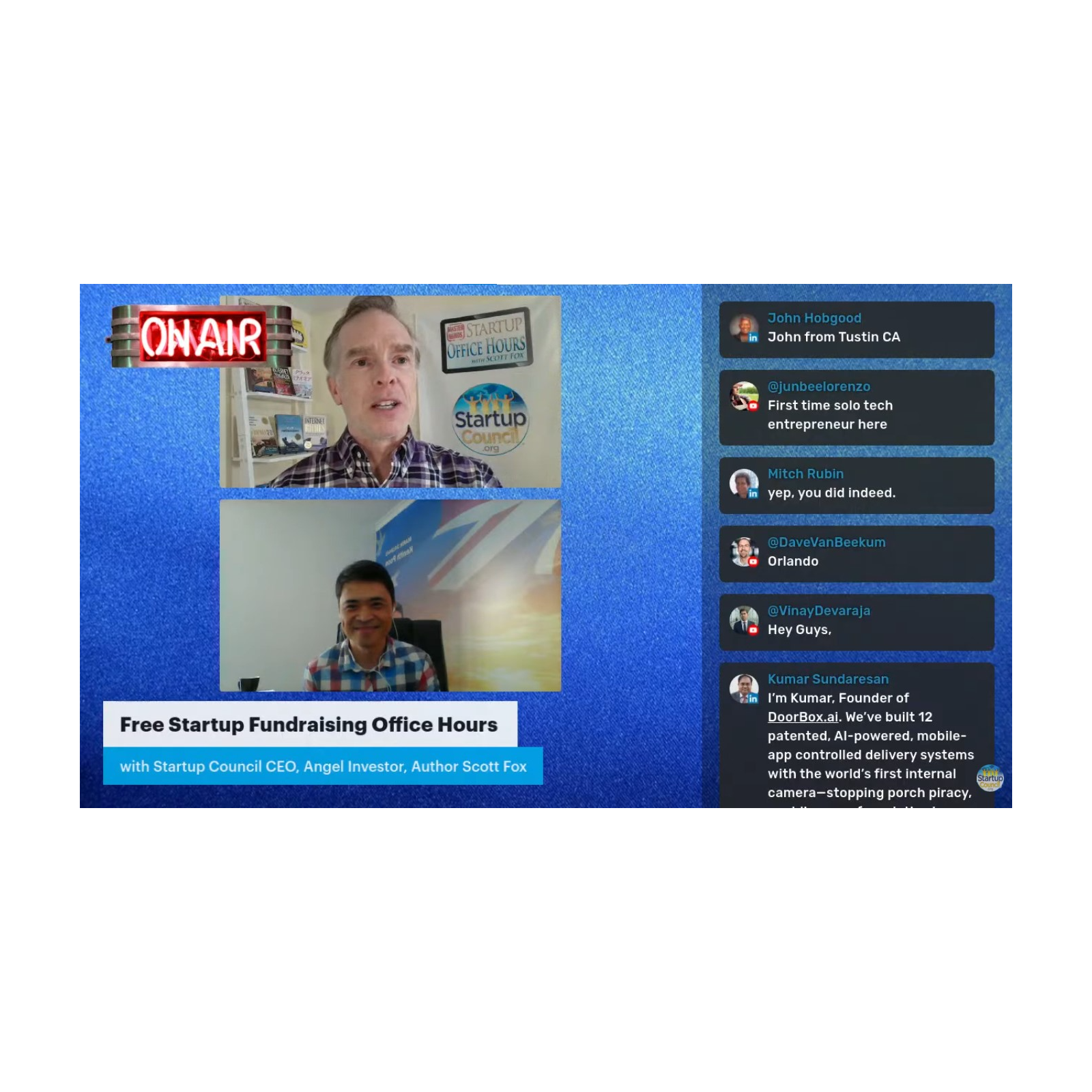 Live Startup Pitching & Angel Investor VC Insights: Scott Fox StartupCouncil.org CEO