Free Startup Fundraising Advice & Investor Pitch Practice with Scott Fox, CEO of StartupCouncil.org · 2025-12-20 · 1h 25m
Key moments - from our scoring
Substance score
53 / 100
Five dimensions, 20 points each
Scott Fox runs Startup Fundraising Office Hours, a free community service that connects early-stage founders with resources and expert mentorship. In this live session, Fox demonstrates how founders should pitch to investors by having Mustafa, CEO of A1 Diagnosis (a biotech startup using AI to detect macular degeneration risk through blood analysis), deliver a two-minute pitch for feedback. Fox emphasizes critical pitch fundamentals including leading with an "anchor phrase" that immediately establishes credibility, clarifying whether the business is hardware or software (A1 Diagnosis uses existing hardware with proprietary AI algorithms for blood analysis), and front-loading business positioning rather than diving into disease pathology. Fox highlights how hardware vs. software positioning matters enormously to different investor types - medical device companies require FDA approval and heavy capital, while algorithm-based software companies appeal to different investors. The session demonstrates Fox's philosophy: founders need clear, concise positioning statements early in pitches, medical credentials should be mentioned upfront for biotech, and the actual business model must be crystal clear within the first minute. Fox, a serial entrepreneur and author with upcoming book on fundraising (2026), positions himself as a mentor who learned his craft without connections and now helps others navigate from outside to inside the startup ecosystem.
An anchor phrase that immediately establishes your credentials, the type of business (hardware, software, or hybrid), and what you're solving - for example, 'I'm a medical doctor building AI software to detect macular degeneration risk before vision loss occurs.'
Hardware and software investors are fundamentally different; hardware requires expensive FDA approvals and heavy capital investment, while software scales differently, so investors need to know immediately which category you're in.
Minimize disease or problem explanation; assume your audience has baseline knowledge, especially older investors, and spend your limited time on your unique solution and business model instead.
Mention them early - within the first minute in your positioning statement - because they establish credibility that you can execute, rather than waiting until three-quarters through the pitch.
An anchor phrase is a single one-to-two sentence summary at the very beginning of a pitch that tells investors exactly what business category you're in and what you do, allowing them to quickly assess fit.
Our reviewer’s read on each dimension, with quotes from the episode.
The episode contains actionable feedback on pitch delivery, positioning statements, and investor mindset ('money first, not mission'), but much of the content is basic startup advice (need traction, know your customer, differentiate from competitors). The live pitch format creates some genuine learning moments - particularly Scott's critique of Mustafa's medical tech pitch and his framing of investor criteria - but these are scattered among lengthy setup, technical troubleshooting, and tangential discussions.
you need to say that Because I. I literally don't know. You know. Um. And that's a very different thing. Right? Because hardware is hard and it's very expensive.
We really need to know that somebody other than you and your team and your mom care. Right. Like if you have people wanting to pay and actually paying, even if it's just a, a crude prototype, early stage version, that's really important for us to know.
The core advice is standard venture capital wisdom: focus on traction, know your investor thesis, lead with business model over mission, work bottom-up on unit economics. While Scott's 'anchor phrase' concept for pitches is a minor reframing, the fundamental frameworks (positioning, defensibility, switching costs) are industry orthodoxy. The episode does not introduce contrarian or first-principles thinking - it largely reinforces conventional VC wisdom.
That obviously makes you more qualified than me to do this, right? You're the man. Um, I'm a medical doctor who. And we're doing this, we make this for these kinds of people.
What I'm really trying to do is build the community so that you all can connect and help each other. It's relationships really drive all this stuff.
Scott Fox is a legitimate serial entrepreneur with multiple exits and a track record writing books on startup topics, making him credible as an advisor. However, the episode's value is diluted by the fact that he spends most time critiquing early-stage founders with minimal traction rather than interviewing successful operators at scale. The founders pitching (Mustafa in medical diagnostics, Byron in robotics, Jonathan in AI tools, Mojid in newsletter automation) are pre-revenue or very early, offering limited real-world operating insights. Fox himself is mostly functioning as pitch coach, not as a guest operator sharing hard-won lessons.
I'm a successful serial entrepreneur. I've been doing this for decades and I built a bunch of companies large and small, most of which you wouldn't have heard of, but a few that you probably have.
I came from, from the outside without many, um, resources and no connections into the world of technology or tech.
The episode includes concrete examples from pitches (Guatemala robotics delivery, blood biomarker analysis, $150K raise target, $39.99/month subscription model, 1% conversion math), but these are mostly illustrative of what *not* to do or are early-stage projections with minimal backing. Scott does reference real company comparisons (HubSpot, Mailchimp, Claude's $83M monthly revenue) and mentions real resources (SBDC, SCORE, Startup Investors Directory). However, few claims rest on hard data or timelines - most feedback is pattern-based observation rather than evidence-backed analysis.
Just in 2025, we deliver 1,500 robots to an educational program that was founded by U.S. embassy in Guatemala.
Uh, we only need 1,600 active subscribers for one year to generate a 5x return.
Scott is a skilled interviewer who asks clarifying follow-ups ('Is it software? Is it hardware? Is it a lab process?') and gently pushes back on vagueness and mission-first framing. However, the format itself - live office hours with multiple founders waiting - forces him to rush. His best work comes in the Mustafa segment, where he presses on competitive differentiation and positioning. The show suffers from technical delays, ad breaks, and Scott managing logistics (camera toggles, URL sharing) which breaks momentum. He does not challenge founders on deeper strategic assumptions or play devil's advocate effectively given time constraints.
I think you should get to the business quicker. Because what I didn't hear it was. I, I don't, I still don't know. Is it software? Is it hardware? Is it a lab process? Like, I don't know how you're doing this.
What I'm really trying to do is build the community so that you all can connect and help each other. It's relationships really drive all this stuff.
Computed from the transcript - who did the talking, and the words that came up most.
For December’s FREE Startup Fundraising Office Hours , StartupCouncil.org CEO Scott Fox welcomed startup founders, entrepreneurs, and innovators from around the world for another high-energy, value-packed session. As always, the discussion focused on helping early-stage startup founders accelerate their fundraising process and improve their chances of successfully raising capital from angel investors and venture capital firms . The session covered a wide range of startup industries, including AI, medical devices, software, robotics, education, and mental health , highlighting the diversity of innovation happening worldwide. Mustafa from Orange County, California practiced his investor pitch for his medical device and software startup , receiving guidance on how to clearly explain a complex healthcare solution to non-technical investors, position regulatory strategy, and emphasize market demand. Byron also practiced his investor pitch. He is seeking venture capital funding for his educational robotics kits , and received feedback on refining his value proposition, clarifying the buyer, and addressing common investor concerns around sales cycles in education technology.
Transcribed and scored by The B2B Podcast Index.
Speaker A: What's up foos? Main event J uso here from the wwe. When it's just me between matches, it's day one ish. And that means it's Chumba time. With hundreds of casino style games and new titles arriving weekly, there's always something fresh to try at Chumba Casino. The daily boost make it even more fun and have me m bout to get em all during my downtime. Ready for a fun way to chill out and enjoy a few minutes for yourself? Let's Chumba.
Speaker B: Uh, no purchase necessary VGW Group voidware prohibited by law CTs and CS21 sponsored by Chumba Casino.
Speaker C: Hey, hey, hey. It's time for Startup Fundraising Office Hours. I'm Scott Fox. It's great to be here and it's great to see you. So it's time for startup fundraising office hours. What does that mean? Why do we do that? Well, we do it because you have questions, right? Startup founders from all over the world join us@startupcouncil.org because they have questions about strategy, about growth, about raising money and, and all the things that go into being a startup founder. It's a difficult road, one that uh, those of us who are entrepreneurs, while we choose to walk it, but it doesn't mean that you don't need help, right? Even Olympic athletes have coaches. So I'm here to try to help you, uh, to the extent I can based on my years of experience as a startup founder and these days, mostly an investor. So thanks for joining us here for Startup Office Hours. It's a free service of Startup Counsel. Org. Like I said right there, we're a worldwide community service group that helps early stage founders connect with the resources that they need to accelerate their success and build their companies. So if you're here tonight, thanks for joining us from, uh, YouTube or LinkedIn or, uh, Facebook, or maybe you're listening to the podcast later, or maybe you're listening later to a, uh, YouTube rebroadcast, right? Or the recorded version. And all your questions are welcome. That's what we do here, is we take questions and I'll do my best to answer what I can to help you. And we also benefit from the other folks who are here with me.
Speaker D: Right?
Speaker C: So we've got people tuning in from all over the world and we'll be happy to help you watch. Uh, not just watch, but actually participate. I'll turn on the chat room here in a second and we'll have people, uh, combining their intelligence and their expertise to help suggest, ah, paths to success. For our founders. So if that sounds like you and you, then you're in the right place. And I look forward to you participating here at Startup Office hours. So we're going to have, um, Q and A, some investor pitches as well. So two minute pitches so we can practice for feedback. And I'll give you my best insights based on my years of experience. So.
Speaker E: Oh.
Speaker C: So why. Who am I? Why have I got the microphone? Well, first of all, because I picked up the microphone, right? Uh, any of you could do this. I'm not some genius, but I do have the luxury of being a successful serial entrepreneur. I've been doing this for decades and I built a bunch of companies large and small, most of which you wouldn't have heard of, but a few that you probably have. And I've written these books. Uh, for example, these three in the middle, these are in English and the rest are foreign translations. So we are, um, worldwide in that sense because, uh, the books are in many languages around the world. So if you've read one of my books, thank you. And there's another book coming which will be specifically about how to raise money. So keep your eyes open for that in 2026. But we really do this. I do this really because I want to help people, um, get to the inside. I came from, from the outside without many, um, resources and no connections into the world of technology or tech. And I kind of taught myself all that stuff. And that's why I started writing books 20 years ago and why I'm writing this new book and why I do these broadcasts. Because I want to share this expertise with you so that you can figure out how to get from the outside to the inside as well. How you can unpack the knowledge that's in your mind so that you can come online and build a business that reaches people, hopefully solve some problems and along the way, maybe make some money and makes the world a better place. So if that sounds like the right, uh, agenda for you, then we'll spend the next hour, hour and a half together, and I'll be happy to help you get familiar with the world of startups. So let me just say before I'm going to turn on the chat room here in a second, but, um, the, uh, please do. Oh, invite your friends. That's right. Please go ahead and invite your friends. While we're getting started here, there's time for everybody and I'll try to stick around and answer as many of the questions as I can. So if there's a friend of yours who's an early ST entrepreneur and you'd like a friendly, uh, expert mentor sort of advice. And that's why I do this. I see a lot of people all over the world. I speak all over the world. I. I just got back from Malaysia where the US State Department had me speaking about innovation and, uh, encouraging the startup ecosystem and entrepreneurs in Southeast Asia. And, um, I can't do that much of it one on one. So I try to do it in venues like this that can be helpful to a lot of you at the same time. So please do invite your friends right now and, uh, like, and comment and all that stuff. Of course. And of course, also let me point out that, uh, this is not qualified legal or financial advice. You should consult your own experts. I've been doing this a long time and I have a lot of opinions about this stuff, but that's all they are. They're my opinions. So go ahead and, uh, consult your own professional advisers when you are making financial and career decisions. Okay. I'm just some guy you met on the Internet. Also, just FYI, this is being recorded and shared worldwide online, so it is public. And, uh, your contributions here are likely to be heard and seen by others. So don't say anything too confidential or anything stupid. Okay? And we'll do our best to get everybody included here and, uh, head on over to Startup Council right now and you can. We've got seven. Actually, we have more than seven now. I need to update that. We've got free newsletters to help you with fundraising, uh, especially if you're in different parts of the world. We're spreading out across the world to offer services to help connect founders in different parts of the world. And we'd be happy to help you as well. Uh, see. Okay, so let's turn on the chat room here and, um, let me find that for you, if that sounds like the right thing. And.
Speaker F: Yep.
Speaker C: Well, I got a few people here watching, so let's see who's here with us. And you folks, where is it? There we go.
Speaker E: Chat.
Speaker C: Okay. All right, so now the chat room is going to start loading. So those of you who are. There we go. Uh, looks like Miguel is, uh, on, uh. What is that? It's YouTube. Right. Okay. Awesome. Miguel, I will, uh, look forward to answering your question in a couple minutes. And other folks, um, come on in and say hello. Let me know where you're from. I always find it interesting to fear, to hear where we're reaching. And I'd love to hear, for the moment at least, make sure there's, uh, that this is working on LinkedIn, because we have some trouble on LinkedIn or if you're on Facebook, like, let me know, say hi where you're from and what network you're on. That would be really helpful for me at least. And of course, can you hear me? Uh, oh, there's Mustafa. Hi, Aluminum Mustafa. You're local. Nice to see you. And I guess you guys can hear me, so that's. That's always a good sign. Uh, I got to do that tech check. Right? Okay, cool. So it looks like the chat room is mostly working. All right, so let's get going here and see. Um, okay, so I don't see anybody in the backstage, so Mustafa and, um, Miguel as well. If you want to come backstage, then you want to come. I mean, to be on camera is what that means. Right? So I can certainly talk, um, to your text questions. So if you're feeling shy, that's fine, but let me find the. The other link. Pakistan. Hey, Riaz. Nice to meet you. Wow. Okay, here it is. FounderOfficeHours.com so if you go over there, FounderOfficeHours.com that should take you backstage. So turn on your webcam, make sure your microphone's working, and if you want to come back there, uh, and actually talk to me, then be happy to do that. We'll bring you on camera and we'll have a discussion. Or if you want to practice your pitch. Right. Like, Mustaf was one of the ones who wrote in, uh, in advance. And I very much appreciate that when people do that gives me a little bit of a chance to think about it. And, uh, Mustafa wants to talk about his, uh, A1 diagnosis company. And, uh, happy to do that, Mustafa, so why. But I need you to come use the other link I just posted there. FounderOfficeHours.com and the rest of you, if you'd like to join me on camera, please do that. And we will, um, bring you on camera. Okay, so let's get started with the, um. Well, let's do. Miguel's here to start. And the rest of you, please say hello and let us know where you're from. So Miguel says hi there. I just joined. Um. Uh, yeah, I will, uh. Yeah, use that URL. Mustafa. Um, okay. No, that's not what I wanted to do. Um. Oh, J. Michael DeMarizio. Oh, back after two years. All right, from LA. Nice to see you. Thanks for joining us. Let me. Okay, how do I do that? Let's see. There we go. Okay, so let's Bring up Miguel's question. Well, it's a little too long to fit, but you get the idea here. I just joined, um, I'm a startup founder of a SaaS and SAP company. Software as a service and probably software as a platform. I'm guessing it's a data science AI helped company. I just got an investor, but some rejected us I think because we denied them having equity. Okay. So I'm sorry, I guess that's not a question. Okay, well that's some good background. Um, if there is a question, M. Miguel, go ahead and put that in the chat room and happy to follow up for that. Um, yeah, well if they don't give you equity, then I don't know, uh, that they will want investors want equity. So I'm not sure if there's a question there or not. Um, the Earl Mustafa is founderofficehours.com founderofficehours.com I just had it on the screen. All right, so let's see here. Um, this one. There it is. Okay. And there's uh, Byron from. Also from California of Createbot, a robotics company. Very cool. All right, well this is great to see all you guys. Who's got some questions though, right? So we can make this real quick if nobody has questions or pitches. So um, but uh, I'm happy to help if that's useful to you guys. Uh, but we need some content, right? I'm not just gonna, um. You don't want me to just talk, right? Okay. So harsh. Okay, so it looks like harsh is backstage. Well, it's harsh. You want to turn on your camera and if you would like and you want to talk, then we can do um.
Speaker B: Mhm. Mhm.
Speaker C: There we go.
Speaker G: Okay.
Speaker C: All right.
Speaker D: How to have fun anytime, anywhere. Step one, go to chumbacasino.com chumbacasino.com Got it. Step two, collect your welcome bonus.
Speaker C: Come to papa. Welcome bonus.
Speaker D: Step three, Play hundreds of casino style games for free.
Speaker B: That's a lot of games all for free.
Speaker D: Step four, unleash your excitement.
Speaker B: Woo hoo.
Speaker H: Chumba.
Speaker D: Chumba Casino has been delivering thrills for over a decade. So claim your free welcome bonus now and live the chemba life. Visit chembacasino.com no purchase necessary vgw group
Speaker B: void we're prohibited by law 21 plus, terms and conditions apply.
Speaker I: Bubba Wallace here from 2311 Racing on the track. My car's look is everything. But today I'm talking about more than just paint schemes. I'm talking about my favorite games at Chumba Casino. Check out exclusives like Stampede Fury and my own King Croc Fury. It's just as wild as my car looked in Texas. With over 200 games and new ones weekly play for free at Chumbacasino.com. let's Chumba.
Speaker B: Sponsored by Chumba Casino. No purchase necessary. VGW Group Void where prohibited by law. 21/members and conditions apply.
Speaker F: Back.
Speaker C: Hey, everybody. So you never know with those Internets, right? Um, not working as well as it should. But we're here and we're here to help you. So if you have questions or um, a pitch you'd like to practice, then go ahead and put the question in the chat room. And if you want to come on camera to discuss that or if you have, um, a pitch to practice, uh, it's founderofficehours.com so harsh, if you want to come on. Oh, Mustafa. Okay, there's Mustafa. Excellent. Okay, hang on a second. Mustafa and Harsh, you need to turn on your camera if you want to join me. I'm not going to bring you on unless your camera's on. All right, so let's do this. And we're going to bring it. See my friend Mustafa here trying to find. Sorry, guys, just one second. I'm trying to find that link. There it is.
Speaker G: Okay.
Speaker H: All right.
Speaker C: This platform, they move stuff around every time I do this. Okay? So here's free startup office hours. And here comes M. Mustafa. Let me. Got it. Okay.
Speaker A: Yeah.
Speaker C: J. Michael. The stream froze, but we're still here. Okay, all right, so here is Mustafa and he's going to come here with me. Hey, there he is. Hey, Mustafa.
Speaker G: Hi, how are you?
Speaker C: Nice to see you.
Speaker G: Nice to see you too. I'm, um, so happy to join here, actually.
Speaker C: Excellent, excellent. Yeah, we met, uh, where was that?
Speaker G: Uh, Angel Group, uh, investment minister. I presented everyone.
Speaker C: Yeah, that's right, Right, right. Okay. That I was hosting that event. Yeah, yeah. That was cool.
Speaker G: Yeah, it was so good. I. I was really happy to meet with you over there in person also.
Speaker C: Oh, excellent. Great. All right, well, do you want to practice your pitch tonight? That's kind of. That's what you emailed about, right?
Speaker G: Yeah, definitely. If possible, that would.
Speaker F: Sure.
Speaker C: Well, let me, let me explain how we do it here and that way the audience can contribute, uh, as well. So we do just a two minute pitch, no slides, it's just verbal.
Speaker F: And.
Speaker C: And, um, the idea, of course, is for you to do your pitch. That's the easy part.
Speaker G: So.
Speaker C: But what we want from the audience, everybody else listening is what you think. Right? Because I don't have all the answers. I'm just a guy. So I certainly have a lot of opinions. I've done this many times. But I would love to hear, and so would Mustafa, love to hear what you think of his pitch. So we're probably not going to debate so much the strategy of the company. We're kind of going to presume that it makes sense. He's a smart guy. Um, and we don't have time to get into all the details. Right. But as a, as a show, we're gonna have him pitch and then we'd love your feedback on what he could, uh, do better or what was missing or what you liked, of course, is always valuable feedback too. So just kind of the, the uh, pros and cons kind of feedback. Right. And, uh, and I will add my comments as well. So, uh, and you all can do that in the chat room. Uh, so let me grab my. Where's my phone? We'll do two minutes. So I'll put a timer on just like they would like. Well, you've done this, right? We did this together on stage, whatever that was a month ago or so.
Speaker G: Yeah.
Speaker C: Um, and let me get my two minute timer and then we'll hear Mustafa. Mustafa's already done this, so should be pretty good. And then the rest of you, um, let's see. Let me just answer this. I did try to participate on camera, but couldn't find the earl. The URL guys is founderoffice hours.com Go to founderoffice hours.com founderoffice hours.com okay, there we go. All right, so now Mustafa is gonna, um, gonna give us a shot here. Ready? Okay, I'm ready when you are.
Speaker G: Okay. Uh, I can, we can start.
Speaker C: Yeah.
Speaker G: Hi everyone, my name is Mustafa. I'm a CEO of A one diagnosis. Uh, would you like to see the feature clearly? Would you like to evaluate your eye health before vision loss happens? 20 million Americans have atriates macular degeneration which cause central vision loss. It is irreversible and it is detected after damage happens. I would like to explain our, uh, technology in a simple language. When we get older, some cells in our eyes start dying. Where the cells go after dying, they go to the blood. Uh, previously we couldn't detect them in the blood because our technology was not advanced enough. Right now we can detect them in our blood because our technology. Very good, very advanced and our AI platform. Analyze these cells, product and provide risk assessment for acids, multiplied degeneration before vision loss, when you are thinking healthy and then we can give you risk assessment how it works when the person go to the doctor, a family doctor office and withdraw the blood and send it to us. We analyze it our advanced technology and provide the risk assessment uh, for the patient and for the doctor who we are. I'm a medical doctor and I perform research University of California for six years, Department of ophthalmology School of Medicine. Uh, co founder Dr. Murat Badai is Stanford scientist and has extensive experience on regulatory process. Uh, here is the opportunity. We are working only one disease right now, but we will extend these assessments for autism, Alzheimer and metroidvisor and other diseases step by step. What we have done, we completed uh, proof of concept studies. Our next step is the perform study for clear satication.
Speaker C: Okay, sounds like we're out of time.
Speaker G: Thank you very much for everyone. Thank you so much.
Speaker C: Yeah. So it's hard in two minutes, right?
Speaker G: Yeah, it's fine. Just one, one sentence. One million dollar will be used for clear side application.
Speaker C: Oh, you were almost finished. Okay.
Speaker G: Almost tested. Yeah.
Speaker C: Well, that's a great point. Like if you're that close for you, but uh, to everybody else. Because we're talking to everybody.
Speaker G: Right.
Speaker C: Just keep going. Like, tell them, like make a gesture like I got it, you know. Okay, I get it. Or, or like one second and you'll. They'll. We'll, we'll definitely let you finish. Right. Nobody's trying to be me.
Speaker G: Yeah. It was just one. One cent is left. $1 million used for the clear side notification. Yeah. Thank you.
Speaker F: Perfect.
Speaker C: Okay, well, that's a key point. So. Yeah. Glad you got to that. Okay, so everybody in the chat room, what did you think? Like, if you have suggestions, it would be great to have, um, all of you contribute your comments, pluses and minuses on what he could or should do well or could or should do better. Right. Um, I'll, I'll go first. Um, so, um. It's very good. You're very fluent at this. Right? You know what you're talking about. Given the short time span, I guess so I'll try to. You know what could be better? Uh, given the short time span, it's tough to fit everything in. So I was, what, I just happened to be watching the clock because my, you know, my phone's sitting right here in front of me. And you. It was over a minute before you got to really what you were doing. Like you were explaining macular degeneration and stuff like that, which is important, but I, I think most people have some idea about that. At least older People, which is most investors. So you probably don't need to explain that the medical side of it as much. I think you should get to the business quicker. Because what I didn't hear it was. I, I don't, I still don't know. Is it software? Is it hardware? Is it a lab process? Like, I don't know how you're doing this. Like you said, advanced technology. You said some other things. Like, I'm sure it's cool, but I don't know what it actually is, and it would be a lot better. Uh, like I said, I'm working on this new book and I think one of the things I'm going to recommend everybody is to have what I'm calling an anchor phrase, which is right at the beginning. Like you said, hi, I'm Mustafa, and I would say up front, I'm a medical doctor. Like, get that right in, because that wasn't till like 3/4 of the way through. That obviously makes you more qualified than me to do this, right? You're the man. Um, I'm a medical doctor who. And we're doing this, we make this for these kinds of people. And it's software, hardware, whatever it is, and we're this far along in terms of money, like, or something just like one sentence, like just so we know what you're even talking about because we have no idea where you're going.
Speaker G: Right, right, yeah. Summarizing in a one sentence, two sentence. In the beginning, everybody will know what, what we are.
Speaker C: Do you exactly. Like a, A positioning statement, you might call it. Maybe that's a better way to put it. Yeah, exactly. And then, then I can know, right? Like, okay, so what I'm expecting. Okay, so this is a medical, uh. I still don't even know is it a device or is it software or.
Speaker G: Uh, basically this is the instrument. We analyze it, but end of the time we got the 10, 000 molecules analyzing the AI platform. We have own algorithm. And um, to provide us the recess, there's a two things like a, uh, blood analysis in the advanced device, plus using the AI. This, uh. Okay, and then to.
Speaker F: To.
Speaker C: So is there a hardware component?
Speaker E: Are you using?
Speaker G: Are you using? We have hardware component and software component.
Speaker C: So new hardware. Something new. Not existing hardware.
Speaker G: No, this is the existing hardware.
Speaker C: Existing hardware.
Speaker G: Okay, so algorithm is the new one.
Speaker C: Okay, so that's what I would be clear about because investors, hardware investors are very different than software investors. So you're a software company is what you're saying.
Speaker G: Yeah.
Speaker C: Okay, so you need to say that Because I. I literally don't know. You know. Um. And that's a very different thing. Right? Because hardware is hard and it's very expensive. You got to get all those FDA approvals and like it's medical devices. So it's not a medical device at all. So it's software. So that needs to be like right up front in your positioning statement.
Speaker G: We. We need the uh. For the. This is a heart. I mean this is a not new hardware. But uh, we need the. In our instrument. Need the clear certification, regular literary approval. We need it but we don't produce the device. We will just get the device from the company and we analyzing with the blood and uh, our algorithm is new part. This is.
Speaker C: Right.
Speaker D: Okay.
Speaker C: So that. That's what you need to say, right? Because especially I'm not a med tech investor. I'm more a software guy. Right? But position that right up front so that those who are listening can go, this fits in my box. Or it doesn't fit in my box. And those who whose box it fits in will perk up because like oh,
Speaker I: this Bubba Wallace here from 2311 Racing. You know what's slower than a pace car waiting at the car wash? That's when I fire up Chumba Casino. It turns those slow minutes into fast fun. With new games every week, you'll never get bored. Next time you're stuck in the slow lane, speed up with Chumba play now@chumbacasino.com. let's Chumba.
Speaker B: Sponsored by Chumba Casino. No purchase necessary. VGW Group voidware prohibited by Law 21. Terms and conditions apply.
Speaker C: What's up, fools?
Speaker A: Main event J USO here from the WWE. When it's just me between matches, it's day one. Ish. And that means it's Chumba time. With hundreds of casino styles, games and new titles arriving weekly, there's always something fresh to try at Chumba Casino. The daily boost make it even more fun and have me about to get them all during my downtime, huh? Ready for a fun way to chill out and enjoy a few minutes for yourself?
Speaker C: Let's chomp.
Speaker B: No purchase necessary VGW Group VOID where prohibited by law. CTS and C's. 21+ sponsored by Chumba Casino.
Speaker C: This is my kind of guy, right? And. And then they will listen more closely if you don't give us a positioning statement. We're all kind of half listening and hoping we can figure it out. And you're making it too hard because at the end, like I said, I still didn't Know what it was. And um, with the what it is, we investors tend to invest on whatever it is. Like our mandate is we do software, we do hardware, or we do whatever, you know, or medical device. Right, etc.
Speaker G: Right, right, right. I think we can say more, uh, software part, actually. I, I, yeah, yeah.
Speaker C: Well, and, and you said AI, right? You didn't wait, you waited till the end to say AI. That's another thing. Those are, you have four letters that you should say a lot. Maryland AI. Like dude, you're, you're like way ahead of most people, right. And you're, you're a modest, friendly guy, so you're not waving that flag. But that's a big deal if you're an MD who's qualified to work in artificial intelligence. I mean, you've eliminated what, 98 of the human race.
Speaker G: I really appreciate it. Thank you so much. So I'm like, yeah, yeah, yeah.
Speaker C: So, um, so yeah, so I would emphasize your credentials, the AI and clear, be clear about what it is. And then the piece that you didn't get to too much is what's the model? Like who's the customer? I didn't hear that at all. Like is it the host? And you don't need to answer me. We don't have, we got to move on to somebody else. But is it the hospital? Is it insurance reimbursement? Is it individual? You know, is it direct to consumer? Like, like give us some sense of the model and the go to market parents. Because how you're going to reach these people is important and especially if you have an advantage somewhere in there that will differentiate you. Like you're really good at AI or your uh, your go to market strategies because your partner, you know, is a huge, has huge connections somehow with the uh, hospital systems or something. You know, like emphasize the good stuff because in two minutes you don't have time to explain it all. Like you just want to seem m. Really sexy and, and have us want another meeting.
Speaker G: Right, right. Yeah, definitely. Yeah. Our goal is to get the second meeting.
Speaker C: Exactly, exactly. So cool. Well, let's see if anybody had um, anything to say in the chat room. Let's see. So Jay Michael says, I've heard similar people pitch about medical startups. What I often hear for feedback is patents. Yeah, that's fair. And approval timeline in the medical space to get the product to market. Yeah, those are all fair points for sure. Um, I, yeah, patents are good and then, um, the time to market is a big one. Especially if you have FDA hurdles. It sounds like you might have, uh, what do they call it in the medical space, like prior art or 5, uh, hundred 1k. Like it's already been kind of cleared and you're repurposing it.
Speaker G: Yeah, yeah.
Speaker C: If you have those kind of advantages, I would throw those out.
Speaker G: Um, in, in these days, uh, we are a little bit changes the, our direction is the uh, billion to one and also exact sciences. There's a two successful company and they go to Clia Clear is like a one year process to get the regulatory approval. And then Medicare or other companies, uh, like insurance companies, they pay it and after that they starting the one year later get the revenue and they go to the fda. This is a process, actually.
Speaker C: I see.
Speaker D: Okay.
Speaker C: Yeah, yeah. So that's interesting. Right? And you know, investors love companies that have revenue because it shows. This is the key point I make for everybody. We really need to know that somebody other than you and your team and your mom care. Right. Like if you have people wanting to pay and actually paying, even if it's just a, a crude prototype, early stage version, that's really important for us to know. So that's, that's cool. All right, well, great. Well, good to see you. I hope that was helpful.
Speaker G: I really appreciate it. Thank you so much for you and everybody.
Speaker C: Good. Good to see you. All right, so that's our friend Mustafa likes. All right, now how do I hang on, Mustafa? I don't know how to turn you off. They, they. Like I said, they. Oh, there it is. Okay. All right, well, nice to see you. All right, so now we've got Byron, uh, and Mojid backstage. So I'm gonna bring both of them on and we can figure out. Just, guys, just don't pitch me yet. But just let me tell you, what do you guys. Hey there. Um, what do you guys want to talk about? Like, just, uh, give me the, the headline. Like what's on your mind? Byron, why don't you go first? What's your question or topic?
Speaker E: Well, I, uh, would like to practice. Okay, well, first of all, nice to see you again. I, uh, was in the TSA event.
Speaker C: Oh, okay.
Speaker E: I didn't see you there for the first time.
Speaker C: Yeah, yeah. And you emailed in, didn't you?
Speaker G: Thank you.
Speaker C: Thank you for sending me. Exactly.
Speaker E: And, uh, well, basically, yeah, I would like to practice. Okay. And yeah, a couple of questions about what would be like next steps here in the US for, you know, making this happen. We, uh, have some experience with the company. I have several business.
Speaker C: That's enough. Welcome back to You, Um, okay, so Mojit, how about you? Majid, did you want to. Oh, he just turned off his camera. Majid, did you wanna. Okay, well that makes it easy. All right, well Byron, you're up. Okay. Nice to see you again too. Um, let's see. I'm trying. What's the best camera? Uh, here, let's try that picture and picture. Yeah, let's do this one. Okay. Then we could see you. Okay, so do you want to start with the pitch or do you want to start with some questions?
Speaker E: Um, yeah, I will start with the, with the pitch and then I will proceed with the questions.
Speaker C: Fair enough. Okay, so let's uh, so let me remind everybody, so two minutes, no slides, just verbal. And he's going to give us, tell us about looks, uh, like createbot, it's a robotics related company. And then you, meaning everyone watching and me, will give him some feedback to help him make his pitch even better next time. And we do have people who come back month after month and you see their pitches get a lot better. So um, he and I will both appreciate, uh, feedback from the audience. So. Okay, so I'm going to put two minutes on here, uh, Byron, and you can start whenever you're ready.
Speaker E: Okay, well, thank you. Uh, did you know that in less than five years, 170 millions new robotics related jobs will exist worldwide. Yet almost half of the US jobs face automation risk. Creobot is a robotics company. We design and manufacture our own robotics components here in the U.S. uh, we also develop educational robotic kits. Just in 2025, we deliver 1,500 robots to an educational program that was founded by U.S. embassy in Guatemala. Uh, we're just about to launch the first educational robotics platform. This platform will connect industry experts and users who want to build their careers in the new robotics economy. Uh, this platform will function over a subscription price of 39.99 per month. Very affordable. This, this provides all this will be provided to the users, all the components and the courses, access and basically everything the user needs to make a career in robotics. Just thinking about this, um, in our case as a company, we only need 1,600 active subscribers for one year to generate a 5x return. Uh, we are looking for an investment of 100, uh, 150, uh, 150,000 in investment. Uh, given our goal that is reaching 100,000 users over the first year, that's only a 2% of conversion conversion rate. Um, we are also on the pathway to sell very, very soon in the platform of Kickstarter, one of the biggest robots that we have produced yet. And basically this is going to be the first international program that is focused only on robotics. Let's think about platforms like Udemy M. Udemy. They sell you a bunch of different courses. We are only targeting the robotics market and we are producing not only the courses, but also the hardware that is going to be involved in this, uh, in this part of the educational programs.
Speaker C: Okay, time's up. Any, any last thoughts or is that it?
Speaker E: That's good.
Speaker C: Okay.
Speaker D: All right, good.
Speaker C: Well, nice job. You're very, um, um, articulate and friendly. That always helps. Um, okay, so audience who has suggestions. What, what could he do better? It was, it was pretty good. Right, but what could he do better? Um, if there's room for improvement, I'm sure he'd like to hear it. That's why we're here. Right? So, okay, so my thoughts, um, my thoughts would be, well, you already have 1500 kits off to Guatemala. Good job. And you've got a SAS sort of business here. That's great. Um, the mission is obviously a good one and everybody knows robotics is just man. It's a wave, right? So it, um, I think investors would be interested in, uh, participating in that wave, right. If you give them an opportunity to benefit from, from the wave. Um, I guess my question, and it's probably, we don't, probably don't have time to get into it, but just for you to think about, you come across kind of non profity. Right. Which is not a bad thing. It's just not. Investors don't invest in non profits. Right. So, um, if you're selling thing, I would need a stronger business case, right. Like you said, 40, 40amonth. Like how many of those could you sell? And you know, give me some numbers to string it together. Right? So like what, what's the, what's the potential of this as a business? I mean, I totally get that you could help a lot of people and I'm down for that. That's very cool. But if you're talking about an investor pitch, it's got to be, I need more numbers, basically. Right. So the fact that you have sales already is awesome because that suggests that people, like I said to, uh, Mustafa, you know, somebody else cares other than your mom. That's, that's a key, key hurdle. Right. Um, but if you're gonna try to raise money on a business basis, that's different. And the other reason I asked that is because $150,000 is, is not enough for investors, for venture capital. Right. If you only need $150,000. Most investors will say incorrectly or maybe unfairly. Raise that on your own.
Speaker F: Like.
Speaker C: Like from your friends and family and your credit cards, right? Maybe you don't have friends and family or $150,000 credit limit, but that's. Most investors are rich and they don't. They forget what it's like not to have.
Speaker A: What's up fools? Main event J uso here from the wwe. When it's just me between matches, it's day one. Ish. And that means it's Chumba Time. With hundreds of casino style games and new titles arriving weekly, there's always something fresh to try at Chumba Casino. The daily boost make it even more fun and have me bout to get them all during my downtime. Huh? Ready for a fun way to chill out and enjoy a few minutes for yourself?
Speaker C: Let's ch.
Speaker B: No purchase necessary VGW Group Void where prohibited by law. CTS and C's. 21 plus sponsored by Chumba Casino Tyler Redick here from 2311 Racing. Game night's fun until someone spends five minutes lining up one shot. Chalk. Breathe. Rechalk.
Speaker C: Still aiming.
Speaker B: While they figure it out. I fire up Chumba Casino. I can spin anywhere, anytime. And there's always a new social casino game every week. Spins happen way faster than that shot. Play now@chumbacasino.com let's Chumba sponsored by Chumba Casino no purchase necessary VGW Group voidware prohibited by law 21 terms and conditions apply.
Speaker C: Resources Right. So um, that's such a small amount of money that Kickstarter sounds more obvious as you mentioned. Or um, a grant sort of program. Right. Especially if you've got this nonprofit angle. Maybe this is something that would be supported by some regional government or you know, program or, or a ah, foundation. That kind of. That kind of vibe.
Speaker F: Right.
Speaker C: Um, so I guess if you're going to pitch this as an investment, I would like I said I'd want to hear more. What we. We call it unit economics. We make this many of these things at this price. We sell them this m. We expect to sell this many with this kind of margin. Like give me an equation right? That and it doesn't have to be all. We all know it's kind of bs but just that shows your thinking about how this works. And um. And then you would get into like cost of customer acquisition, um, and competition, things like that. Because there's two road, three roads I guess really to, to sell this right. You've got um, direct consumer which you mentioned which is totally a thing. There's also business to business so like maybe you do wholesale to I don't know to high schools or you know who would need a lot of these? I don't know. Um, but then the in between is kind of the non profity thing of like you supply them you know at low cost to community organizations. Um, which is again a lovely thing to do but not something investors are going to get excited about financially. Right. So I think you kind of got to pick your lane and be a little clearer because you mentioned kind of at least the way I heard it and I may be wrong and we forced into two minutes which I know is artificial but you know what, which one is it? You know, um, and, and is that a path that, that uh, that investors would be excited about that. So does that make sense? Is that useful?
Speaker E: Totally. I, I do appreciate uh. I didn't knew that I sound like I was selling uh or uh, I was trying to do something like non profit basically that's not the business model.
Speaker G: Okay.
Speaker E: Manufacture all of the parts, all of the components, all of the robotic kits we put into boxes and our main business is to sell them to final users. Now we have a subscription ah, model where we will be providing hardware and all as well as the access to this educational platform which is going to you know uh, probably was the way that I I have explained it and ah, just as an example I did use this educational program that was funded by the U. S Embassy last uh, year in Guatemala because they were my first client after you know uh, a lot of years. Uh because I did close this company for the pandemic for because of the COVID 19. So recently I didn't move to the US because right now seems to be like the best uh place to do this kind of uh, startup again because everything is US manufactured. Seems to be like a good point for selling to local government. Actually there's a big amount of fundings from the US government available for robotics companies right now. And you know in my experience was that uh, US government will be pay you very well as as long as you, you manufacture most of the components. And in robotics is even a little bit harder because they will give you a documentation where you must testify that you are not getting all of those parts from China for example or from other, other governments.
Speaker C: Yeah, yeah, well probably that was my bad so. Yeah. Well that's great. Well that's why you do this, right? Better do this now than when you get that big meeting that you've been dreaming of and they get the wrong impression. Right. So okay, so that's a lot clearer. Um, then I think you need to open with something like you, you will say it better but something like we're a robotics kit manufacturer. We sell direct to consumers and to wholesale to the US government. Period. And then get into the stuff like okay, now I got it right. Because otherwise it was kind of a bunch of different stuff. And the Kickstarter thing actually that can be pretty distracting if you think that you're going to make money. Is it was if it is a Kickstarter for equity or just for product?
Speaker E: Well, Kickstarter, uh, we are thinking about uh, making just for product but actually because again it's like uh, this is where my question are going. This uh, is the first time I'm doing this kind of business in the US and everything, uh, all the information I know, I have read it. I have been following you on social media as well as a lot of other uh, persons that do this type of uh, do this type of um, let's say um, ideas and documentation about it. And yeah, my first question is what will be a good recommendation for example in this kind of business? Because honestly, yeah, I'm open to keep equity on this business. Uh, we already have some traction. I have 13 years of experience of being doing these. We're exporting to several countries in Latin America. Basically the company was closed because of the COVID 19. I'm from Guatemala by the way. So um, the uh, government did uh, close most of a company's operation over there. And after that I did travel to China. I tried to find out who, who was doing this all over the world.
Speaker C: Yeah.
Speaker E: And I did find out how Chinese they manufacture so cheap. So basically everything that we are doing is manufactured in the US but almost the same price as Chinese do in China. Yeah. So this is a good thing.
Speaker C: Yeah. So put all those good points into a short pitch. Right. And don't talk about Kickstarter, don't talk about other stuff like we build these things in the US because you're right, that's a great selling point. We already have the US government as a customer and we were going to sell them to this many people. Like I said, some equation with this many people at this typical price with a gross margin of this. And the other thing I would say and we're gonna have to move on and talk to some other people here. But um, when you talk about a SaaS business, you should also mention is $40 a month. Great. But what do they get in future months. Right. Do they keep getting a kid or do they, you know, how do you maintain their value so that they don't churn out and disappear? Right. Because SaaS sounds great, but it's hard to do to keep up, keep people engaged. Right. So, um, that would be another thing. So. Yeah, that sounds cool. You've got the pieces here. Just kind of like bring the, the best points to the surface, I think.
Speaker G: Cool.
Speaker H: Yeah.
Speaker E: Finally, one question. Uh, where do you think. Because I saw that, uh, you know, uh, the experts were talking about the last time. Where do you think we can find out, uh, someone like me, uh, I can find out, um, like an advisor for these type of projects. Because that, I do believe that as the new guy in town, uh, I really need one.
Speaker A: Yeah.
Speaker C: Yeah. Um, where do you live?
Speaker E: Aliso Viejo.
Speaker C: Oh, you're here in Orange County. Right.
Speaker F: Okay.
Speaker G: Okay.
Speaker C: Well then yeah, that actually easy because I know this market. This is where we both live in Orange County. So, um, I would go to. So the best advisors, of course cost a lot, right? So I don't know how much money, if you have cash or equity, I mean it's, you got to think about that. Right. But there are free resources that are available actually here in Orange county and across the United States. But I happen to know the ones here in Orange County. Um, I would start with the um, sbdc Small Business Development Corporation. And SBDC is paid for by US taxpayers. So it's your and my money and it's therefore, it's free. And they have a staff of great people. Many of my friends who are fellow angel investors here in Southern California volunteer. There's. And they do exactly what you want. They advise and mentor and um, can help you out. And this is true for everybody watching who isn't just here in Southern California, but all across the United States. The Small Business Development Corporation. Like I said, it's a taxpayer funded service. So they have offices all over the place and it's free. So I would look up your local sbdc Small Business Development Corporation. Um, and sign, uh, up. Right. They have classes and they have webinars and they will do consulting. They'll assign somebody to work with you for free. Free. Another great resource is this called resource is called score Service Corps of Retired Executive score. Same thing. You can Google that. And it's just what it sounds like. A bunch of retired folks who want to do volunteer work. And a lot of them are business oriented. Right. So they want to coach young entrepreneurs and business owners. So, um, I think that both of those would be good places for you to start. And then because you're here, you should also be on the list. Maybe you already are. Right. On our email list for the Orange, uh, County Startup Council. I'm trying to find it. Here it is. For this, right? You're probably already on our list.
Speaker E: Yeah, I am already there.
Speaker H: So.
Speaker C: So we. You should, uh, if you're not already, you should have your company join, and we'll post, uh, uh, your profile and everything, and then you can send articles and things to be published in the newsletter, and you can be part of those newsletters you read. And. And you can also see all the events that are happening around, and that's the best way is to go and meet people in person. Right.
Speaker F: Face to face.
Speaker C: So. Okay. Well, I hope that's useful. Nice to see you. I probably will see you again in person, then. All right, well, thank you. Nice to meet you. Well, that was cool. Interesting company there, right? Love to see robotics. I mean, robotics is really coming. Any of you that aren't. I mean, I'm not a robotics person, but, man, there's a wave coming that's going to be really, really impressive and important. Right. For the world. Um, so that's. He's in a. He's in a good place for that. All right, so let's see. We're gonna talk to. Let me, um. I've got a couple people backstage, so let's, um. But let me, guys. So, uh, Jay and let's see. Mojid, you came back, right? So, Mojit. Yeah. So I guess maybe you do want to come on camera. Okay, so hang on, Mojeet and Jonathan, just a minute. I just want to run through the chat room and see if anything's on fire here or if I missed any, uh, good questions that'll be useful to other people to discuss. Okay. Uh, J. Yeah. There's Byron. Okay. Yeah. And you can all introduce yourself as some of you are. You can put your LinkedIn. Uh, actually, let me do that. You come and say hi on LinkedIn. Um, you know, LinkedIn is. I don't know if you. If you're not active on LinkedIn as a founder, you're making a mistake. It is very valuable network and you should be on there regularly posting, liking, you know, all that kind of stuff. Here we go. So the Startup Council has a page. Uh, and then I personally have a page as well. So come, come say hello.
Speaker I: Bubba Wallace here from 2311 racing on the track. My car's look is everything, but today I'm talking about more than just paint schemes. I'm talking about my favorite games at Chumba Casino. Check out exclusives like Stampede Fury and my own King Croc Fury. It's just as wild as my car looked in Texas. With over 200 games and new ones weekly play for free at, ah, chumbacasino.com. let's Chumba.
Speaker B: Sponsored by Chumba Casino. No purchase necessary bgw group void where prohibited by law 21 terms and conditions apply.
Speaker D: My name is Shannon Maldonado. I'm the founder of Yaoi, a gift shop. From the lens of artists and handmade objects. I chose Shopify because when I was testing other platforms, it was definitely one of the most user friendly. It was important to me to think about where we would be in the future. All of the tools for reading your sales, like planning inventory, they're just right there on your dashboard. For anyone starting a small business, the biggest thing I can tell you is it doesn't have to be perfect. Shopify can help you build upon it. Start your free trial on shopify.com.
Speaker C: um, okay, let me. Sorry, just back to the, uh. Okay. Okay, Jonathan, you figured it out. Okay. Uh, Ed says. Okay, cool. Edie. Uh, well, let's just put that on camera. Um, Edie says wellness projection mapping to aid and mental wellness for mostly families in crisis, but also individual. Okay, that sounds exciting. Um, if there's a question, Edie, let us know. But nice to meet you.
Speaker I: And.
Speaker C: Okay, so let's go, um, back backstage and bring on, uh, I think looks, uh, like, uh. Okay, I'm gonna bring on Mojid and Jonathan here in one second. Let's see what they want to talk about and who makes sense to go next. Okay, here we go. Okay, Majid. There he is. He's back. Okay. And nice to see you. And uh. Sorry, clicked on the wrong thing. Hang on a second. Um, here. This and Jonathan. Okay. Hi guys. Nice to meet you both. Um, okay, so Majid, you're back. So let me just tell me, just real quick, the headline. What would you like to talk about? And then I'll. And then I'll ask Jonathan what his. His topic is.
Speaker F: Yeah, Um, I would like to talk about one AI product we are currently building that Automates newsletter creation.
Speaker C: Oh, cool. Okay. Is that. So you want to pitch or. It's a question about that idea?
Speaker F: Um, like, I'm not ready to pitch, but I just want to talk about. Because I just started building it, so I'm not ready for pitching. I didn't expect that I was going to pitch, but I just want to talk about it.
Speaker D: Okay?
Speaker C: Okay, cool. Happy to help. Well, just think of some specific questions though, right? Because we don't have time to do a whole long strategic discussion together. Okay, but if you have some specific questions. Sure, happy to discuss. Okay. And how about you, Jonathan? What's on your mind?
Speaker H: Yeah, um, so I am graduating from this program, uh, called Gauntlet AI, uh, in two days. Actually been here for seven weeks. I'm actually from San Diego. I'm in Austin, Texas. Been putting in like 100 hours a week in this program, learning how to use, uh, AI coding tools, mostly like Claude is my favorite. Um, but you know, the other folks in the program have used things like Cursor Gemini, and we've been building products very rapidly, uh, for a couple weeks. We're building like three products a week. Um, for the past couple of weeks we've been kind of working on passion projects or, uh, you know, a capstone project. My capstone project is one I'm working on with a security expert. And we're building a automated AI powered, uh, agentic security platform. Uh, and the special thing about this product is that it can basically support, uh, the conversation between LLMs and people and prevent things like prompt injection and preventing the LLM from, uh, getting improper access to the, uh, web services that might be deployed, uh, supporting, uh, the entire platform. Um, but the specific product I wanted to talk about is my, uh, project, which I, I'm not doing as my capstone, just because I'm working with a lady who used, uh, to work for Coinbase before she came here. Uh, so she's very, uh, experienced and you know, I just wanted to learn about security. But the product that I'm would, uh, like to pitch, basically I'm building on a framework. There's a thing called the Breakthrough Method for Agile Development. And so that's the way that you can.
Speaker C: John, what's the question? That's all I need.
Speaker H: Oh, well, yeah, I was, I wanted to pitch, I'm sorry. Basically pitch a framework and a tool to, uh, support AI engineering, basically allowing software engineers to develop code with agents.
Speaker C: Okay, that's good.
Speaker F: Great.
Speaker C: So you're going to pitch. That's, that's all I needed, honestly. The rest of it's very interesting though. That's why I let you keep going. Sounds like an amazing program. 100 hours a week, man.
Speaker H: Oh yeah, yeah. And it's free too.
Speaker C: It's crazy, right? You must be learning. Wow, your head's probably exploding. Okay, so um, well, given those two. Well, why don't you do your pitch thing and then we'll get into questions with you and with Mojitas.
Speaker D: Where.
Speaker C: And where are you? Where are you? Mojit, you said? Uh, Jonathan's in Austin. Where are you?
Speaker F: Yeah, I'm in Phoenix.
Speaker C: Okay, cool. All right. Southwest night. All right, cool. All right, well, Jonathan, uh, if you don't mind, then why don't you, uh,
Speaker E: do if you heard.
Speaker C: Were you here earlier? We did like a two minute pitch and. Okay. Okay, sure. Let's have. All right, so Mujeet, I'm going to turn you off for a second so we can focus on Jonathan, but you're still here and we'll come back to you. Okay. Good to see you. Okay, so there's me and Jonathan. All right, so Jonathan, why don't you go ahead and give, uh, us. I'll put two minutes on and uh, tell us about this product you've got in mind.
Speaker H: All right, so yeah, uh, the inspiration from this product. You know, I've been a software engineer and a machine learning engineer specifically for the past six years. Uh, before coming to Gauntlet, uh, I've built some really cool things, but it's taken quite a while. I've been able to build products in a matter of seven days that would have taken teams of five engineers at least three weeks to six weeks to have an mvp. Uh, and that's all based on the power of coding agents. Like I said, uh, Claude is my favorite, uh, agent of choice. And I like to implement a framework called bmat. It's the breakthrough method for agile development. And what that does is allow you to assign Personas to your agent so that your agent can take on the Persona of a business analyst, a product manager, a Scrum master, an architect, and ultimately the developer. And push through a bunch of stories that you develop pretty much in the same way that you would work with a product, uh, manager, develop epics, features and stories and store that in your jira. Right. Um, and so the product that I'm pitching, um, actually calling it Amara, um, the reason I'm calling it Amara is because that's a spin on Amaro. And the new framework I've developed is called Amaro, which is the aggregated method for, I'm sorry, automated method for aggregate readable output. So that's an iteration on bmad. Uh, the thing about coding with agents is the important things to note while you're doing that is token management. So that's basically the cost for using an agent. Uh, every time an agent receives input from you or creates uh, output. So like any text, it's called tokens. And so, uh, you know, the different methods of approaching development have different costs associated with tokens. Some are more efficient and use less tokens, but I found that the more efficient methods usually create uh, you know, a less, uh, desirable output and require more debugging. I prefer bmad, which does cost, uh, more tokens to develop with, but you get a more refined product at the end. What I've done is iterated on BMAD to make a more.
Speaker C: That's time. So finish up.
Speaker H: Yeah, I've made a more cost effective way to still use this agile development approach. And I've also wrapped this inside of an API and a, uh, native Mac OS application. And so, uh, yeah, I'd like to take this to market and compete uh, with things like Claude, which is making 83, $83 million a month. Uh, my goal is to um, price mine at 70%, 75% of that price and then provide, uh, you know, twice the output. So basically provide twice as many tokens to the users.
Speaker C: Okay, cool. Wow, it sounds like this program, what'd you say, Gauntlet was it called?
Speaker H: Yeah.
Speaker C: AI sounds like it's changed your life. You've seen the future. That's cool.
Speaker H: Yeah. I don't know if you've ever heard of Bloom Tech or Alpha School or Lambda School.
Speaker C: Uh, Lambda.
Speaker H: Yeah, the founder of this school, uh, used to run Lambda School and is pivoted. Um, so now the, the program is funded by the companies that hire us. So I got a job while I was here. Uh, so I'll be, I'll be back home in San Diego working for a company based in la. But yeah, there's a bunch of partners that fund this program. That's why it's free. I've been staying in this really nice hotel this whole time.
Speaker G: Cool.
Speaker H: They're taking care of all the food. And so we've been developing projects for these, uh, you know, these partner companies.
Speaker C: Oh, I see.
Speaker H: And we've met so many different people. You know, I can name drop so many really cool companies. One I would definitely tell you to look at is Peak six.
Speaker G: Okay.
Speaker H: That's actually where where Robin Hood came from. It's a billion dollar company based here in Austin. And they're going to get into prediction markets, which is huge. And that's what my goal is, to take this tool that I just mentioned, the Amara tool, and start developing solutions for the prediction markets. Uh, you know, because that's, that's Going to be huge over the next few years.
Speaker G: Huge.
Speaker C: Yeah, yeah, no doubt. Um, okay, so super cool. So uh, well let me give you some pitch feedback then. And of course everybody that else is listening. If you were listening and heard what Jonathan said and you have suggestions what he could say, better or differently, please chime in in the chat room, right? That's why we're here. So, um, um, okay, so very interesting. Um, you like to talk, so maybe you're nervous, but you got to be a lot more concise, right? So I'm just saying this is your friend, right? So you had two minutes and I, it was about 90 seconds of preamble and then suddenly you told me what you actually do, which was we're a more cost efficient something API to reduce token costs and compete with Claude at 75% off for twice the output. Start there. Right. I don't need all the hand waving and big picture and table setting like, you know, just tell me what you're doing. Right? Um, because that's, investors are not going to sit still otherwise. Right. And that was a great pitch, right, but it was like way after all this other stuff, right? So tell me the specifics and then from there you'll have, you know, that'll, if you do it right, that'll only take 10 or 15 seconds. You'll have another minute, minute and a half. Even though the quick pitch, right. Then I would want to hear, um, what. Because what you didn't have time to get to is like who's the target market? And you started talking about that as soon as we called time and you kind of said, you know, these folks and these folks and um, like in prediction markets or whatever because it's obviously a very niche sort of thing, right? Most people, I barely even understood what you're talking about, right? If you start throwing around words like JIRA and BMAD and token management, most people have no idea what you're talking about. They don't even know what Agile is.
Speaker D: When it's time to scale your business, it's time for Shopify. Get everything you need to grow the way you want, like all the way. Stack more sales with the best converting checkout on the planet. Track your cha chings from every channel right in one spot. And turn real time reporting into big time opportunities. Take your business to a whole new level. Switch to Shopify. Start your free trial today.
Speaker B: Ryan Seacrest here. Every great barbecue has one secret ingredient. Patience.
Speaker C: You do a little, then you wait a little.
Speaker B: And while your dinner does its thing, you got a Few minutes to yourself.
Speaker A: Right?
Speaker B: Well, kick back with a little Chumba Casino. A, ah, flip and a spin. Who knows, maybe even a lot. Plugin Bonus. It is the perfect recipe. Chumba Casino Always good to have you back. No purchase necessary. BGW Group void we're prohibited by law. CTs and Cs 21 plus sponsored by Chumba Casino.
Speaker C: Right, so, um, you got to be really careful to size your or level your pitch to who you're talking to. Right? Um, and most of that will go right, over a lot of people's heads, right, because you're, you're a real developer, right? So that seems natural to you. But you know, most people know what Jira is, right? I barely do. So you got to be, you got to be careful to bring the, you know, the. As my dad used to bring the hay down to where the horses can eat it. Most of us are just horses. Right? So, um, and, and, and start with the. We do this for these. Kind of. Was saying earlier, I don't know if you were here, but like positioning saying we do this for these kind of people and we make this kind of money this way, or, you know, something like that. So that we could. Oh, okay. And then you can start getting buzzwordy and stuff. And then the real question would be, um, as an investor, I'm immediately wondering, like, come competition, um, you know, what defensible moats do you have? You know, like, can't every. I mean, I can't do it, but like a lot of people claim they can do this kind of thing these days. Like what, you know, what is your unique selling proposition or whatever buzzword you want to use, um, so that it becomes something specific, um, for that specific market. And that seems the answer to me is like, you would start in a specific market to have like a beachhead, you know, where, like I said, you, uh, you know, something that Claude's doing, but you'll do it for 75 off for twice the output in this, you know, niche of a niche that again, I may not have ever heard of. But you know, if you can drop the name of a company that's like you said, you know, they're doing. What'd you say, 83 million a month.
Speaker H: Anthropic is the umbrella. Umbrella is one of their products. Yeah.
Speaker C: Well, and, and as you know, probably the, um, Anthropic is kind of under the radar to, uh, the general population because they're all B2B, right? People hear about chat, GPT and Gemini and uh, and even Grok, right? But they don't necessarily know that this is actually, there's a ton of money being made that the average consumer doesn't even know about. But you're already on the other side of that bridge. So it sounds like a big juicy target you've got there.
Speaker H: Oh yeah, yeah. So to be clear, yeah, I, I was looking this up. The, my target would be the 500,000, you know, software developers in the, in the country. Um, and you know, again, I want to do it at 75% of the cost of cloth. So I'm looking at 150amonth subscriptions. Right. Um, and even with only you know, 1% of that, that's $750,000 a month. And overhead for that is really only going to be about uh, like 25 or 250,000amonth. So the margins are pretty huge.
Speaker C: Great. Okay. Yeah, so that kind of stuff is what we want to hear, right? Because as soon as you start talking, this is for everybody, not just Jonathan. As soon as a pitcher, uh, a founder starts pitching, we're trying to do equations, right. Like what are they doing, how much does it cost, how many can they sell? Like we're trying to do arithmetic all the time. It's, we think in spreadsheets, right. So you got to give us a lot of numbers and the sooner you, and you've got numbers, right? So just throw them out there and they're good number, they're big numbers.
Speaker F: Right.
Speaker C: Just be careful though, as long as I'm saying that investors don't like it so much when people say it's a billion dollar market from the top down and if we just get 1% we're rich. It's much more impressive to work from the bottom up. Kind of like you did it a second later, which was um, 500,000 software, uh, developers, uh, you know, if we have 4% market penetration and an average of whatever, a hundred dollars a month and an average life of 18 months, you know, like you can that kind of arithmetic. That is bottom up unit economics is much more impressive because it shows that you've thought through the mechanics of the business. Because anybody can say, you know, we sell water, everybody drinks water, there's 7 billion people and if we capture 10, we've got 700 million customers. Like that's, that's right. It doesn't that help anybody?
Speaker H: Um, and so I think, and I think, I think I appreciate you for framing it this way because that's what I, I did it out of order. That was my reason for uh, in like focusing so much on the framework. Because the thing that, like when you sign up for Claude or these other tools they don't do is they don't give you a framework on how to use their tool efficiently. Like why would they, they want you to blow through a bunch of tokens.
Speaker I: You know.
Speaker C: That's interesting. Okay, I like that. Yeah. This is an educational component to what you're saying. You don't want to. Investors don't want to uh, invest in things that, where people are um, trying to change market behavior. They don't like to. At least I don't invest in things where like, like vitamins, like everybody should take more vitamins. So we need a million dollars from you. Like. Okay, but that, that. No, but if, if it like what you're saying, this is actually a business use case that will bring their costs down with a little bit of education. That could be a real competitive advantage. Yeah. And uh, it's like kind of an onboarding almost sounds so.
Speaker H: And that's the thing you mentioned, you mentioned chat GBT and grok. This like people. Yeah, people. Like you said, I'm on the. I'm definitely. This whole program has got me like I feel like I'm 10 years in the future. This is Grok. If you could ask Grok 100 questions but like you didn't need to, you could just ask GROK the first question. It would figure out the next hundred questions and answer them for you and like, you know, build the system and the product that you want at the end of it.
Speaker C: Yeah, yeah, that's good. Okay, well, we're gonna have to move on, but I would encourage you that I would keep pulling on that thread because that's the kind of example that even non techies would get. Right. Because everybody at this point is at least use chat GPT. But as you're just saying, they're like whatever, you know, imagine you put in one question and it leads you have to ask 14 more questions and then you spent like, you know, whatever, $400 on tokens. Oh yeah, we'll do that. One question will answer itself and it only cost you 50, you know, 4.87 or whatever, you know, like, like that's a, that's a use case that people, the real use cases would be great for something like what you're talking about because it's really hard for us civilians to, to get our heads around it.
Speaker H: Last thing I'll put, I'll jump in the chat. I'm going to put two things in the chat. Two YouTube videos. One is a video of one of the founders that I talked to and he's, he thinks he's going to build a one billion dollar business with one employee. Uh, you know, I was trying to be that employee. He didn't, he didn't hire me, but I got another job. And then I'll, I'll put another video which is just a demo of the, the tool that I'm talking about. And that's like a two minute video. Um, yeah, thanks. Thanks, Scott. This is only my second time on. I'll definitely make sure and be on a lot more often. I was. This last 10 weeks has been crazy. Um, but one before that, but I'll definitely catch a lot more coming up.
Speaker C: Awesome. Well, nice to see you again. Glad you came back for more. All right, so that was Jonathan Skeet. Uh, okay. And Majid. You've been waiting patiently. So let's, let's wrap a little bit about whatever's on your mind there. Let's explore your, uh, you said it's AI also, right?
Speaker F: Yes, yes, yes. Thank you, Scott. And, um, firstly, I want to appreciate you for, uh, helping me promote my conference. When it was going on, I saw that Startup Council supported. Oh, yeah, you probably don't remember, but yeah, I just wanted to say thank you.
Speaker C: Oh, you're welcome. A lot of conferences. So that's great. I'm glad to hear that, actually. Thank you. If you don't mind, then let me actually put that up because this is a resource that we're building that could be useful to Everybody. Um, startup events.org is what I'm looking for here. So this is the only worldwide calendar I think of only startup events, um, that are only face to face. So these are like real conferences if you want to go and meet people. And then if you don't want to do the face to face thing and you only want to do virtual, like you don't have the money to travel or you live like, you know, not in the Bay Area or some, you know, other country or something. On startupcouncil.org our website, um, you can, uh. This one, we have the only calendar in the world of only virtual events. So if you go there, both of those you can read for free. Uh, so that events and we try to promote everybody's event. So if any of you are event producers like Mojit, um, would be happy to help publicize that for you.
Speaker E: Okay.
Speaker C: Sorry, your turn.
Speaker F: Yeah. So, um, basically, um, my company, Data Global Hub, we do quite a lot. One of those things is Events. But I want to focus on a particular area that uh, I would want to get your opinion on like today. So that's uh, still something I just tied like maybe four days ago. So I'm building like a newsletter automator. So newsletter automator is an AI powered um, platform that transforms how we create newsletters and basically like it helps you create quality newsletters in a short time. Normally you have to find content, you have to create it, you have to write compelling copy, you know, format everything and then manage distribution. For most people this takes a lot of hours. Panel's letter. So basically like it has different components. Like this is how it works. You need to paste the URL, you know, you drop in the links to maybe websites or maybe um, platforms that you want to get information from or blog post or website or web contents. Then AI does the heavy lifting, it scrapes all those websites, website summarizes it and writes your newsletter. Then also it does it with your voice and style so you can train it on your tone using samples or description. You can just write okay this is how I want to use letter to go. You can just upload a sample newsletter, uh like and then it takes the tone and adapts it to the new one you want to create. Then also it has collaborative features where um, you and maybe multiple other people created a newsletter, can edit in real time and then you can approve you know if this person should um, like you can approve like even the other person should uh, can send a newsletter. Then also it uh has like built in subscriber management system, A, B testing and analytics. So what makes it different is that you can generate AI images for each section of the newsletter. So it also comes with image. Then also there's version history and team collaboration. So you can decide to like edit the newsletter, you know if you're not ready to upload it and then change like you can have different version. Then also you have pre built templates where you have different sections and no maybe images and stuff that comes with the templates. Then you also have like a full email marketing so suit included in it. So that's what the newsletter automator looks like. So I just wanted to get your opinion about it and um, you know if it is something that is reasonable to go for that. Is this something that people can like that one can you know get investment on?
Speaker C: Yeah, yeah. Well it sounds great. Are you building this all yourself? That's a lot of, that's a lot of functionality.
Speaker F: Yes, I'm building myself, I'm using AI agents.
Speaker G: Uh, wow.
Speaker C: Yeah, I guess I gotta, I gotta learn how to reevaluate software because man, if you can do all that by yourself, that's about, you know, when I was
Speaker I: Bubba Wallace here from 2311 racing on the track, my car's look is everything. But today I'm talking about more than just paint schemes. I'm talking about my favorite games at Chumba Casino. Check out out exclusives like Stampede Fury and my own King Croc Fury. It's just as wild as my car looked in Texas. With over 200 games and new ones weekly play for free at Chumbacasino.com let's
Speaker B: Chumba sponsored by Chumba Casino. No purchase necessary. VGW Group Voidwear Prohibited by law, 21 terms and conditions apply. Tyler Redick here from 2311 Racing. The rush of racing. Nothing beats it. But Chumba Casino comes close. Chumba's got fast spins, fun games, daily bonuses and all the action you can handle. Now that's a ride. Ready to hit the throttle, get in the driver's seat and head to chumbacasino.com let's Chumba Sponsored by Chumba Casino. No purchase necessary. VGW Group Void where prohibited by law 21/ terms and conditions apply.
Speaker C: When I was your age, I would have taken like 14 people, like, like a year at least. So that's really cool. Um, okay, well, yeah, I think, I think it is an idea. Absolutely. Newsletters, um, are continue to be a really valuable tool for marketing. You know, every new tool that comes out, I've been doing this long enough that every new tool, everybody said, oh, this is going to take over and newsletters are dead. You know, whether it was, uh, Twitter or YouTube videos or Discord or, you know, like every new thing is, oh, you know, that's going to kill. Newsletters. Email keeps going. Right. So I think it's. Yeah. And, and these days, as you know, obviously if you can create the content of that quality, you can repurpose it over to tick tock or YouTube or whatever pretty easily anyway. So to be in the content generation business, um, I think that's a thing. Um, so yes, I guess, you know, as your friend I would be concerned or as an investor also, I would guess I would be concerned about competition. Right. Because what you're talking about sounds like, um, a lot of other systems that may not be as good but are already in place. Right. Most people that need this system, that kind of thing, have at least something they're using already and to get them to rip that out and start over is a really tough sell, you know, as a business development exercise. Um, you're talking about, you know, I don't know. Who would you say are the competitors here? Are you talking about like, HubSpot or Constant Contact or what do you mailchimp? That kind of thing?
Speaker F: Yes. But, uh, one thing I think they don't have is like, for example, um, aggregating those contents that you want to, like, make in the newsletter, aggregating it from the website, like scrapy. I don't think. I don't know if they have web scraping.
Speaker C: No, I don't. I don't think they do. I agree, I agree.
Speaker F: But.
Speaker C: But that. See, that's my point, though, is if that's the one thing that's not enough for me to leave if I've already spent four years and trained all my people to use HubSpot, for example. Right. We've spent thousands of dollars training everyone, and yours may be better, but, you know, is that enough to really switch switching. They call it switching costs. Right? The switching costs are really high. And it's not just financial. It's all the training of your people and the culture. Right? Like, that's what they do. There are people whose whole job is to create that newsletter. Right. So are they gonna completely drop that and switch to you? It's. That's a difficult sale for your salespeople. So I think it's a good idea. I just. You're gonna get resistance from investors and from customers. So I think you're gonna have to, even more than usual, demonstrate, uh, traction in terms of customer interest and ideally paying customers. Right. Um, because it's. Here, let me. Let me summarize a service that is better, but only 20 better isn't enough because people are lazy.
Speaker F: Right?
Speaker C: So you may be right that it would be a. Maybe your service is way better, but the other guys are already there. So, you know, if I were like, you know, your friend or an investor, I might be saying, well, maybe you could just focus on the piece that's unusual and differentiating and sell that to HubSpot or Mailchimp or whoever. You know, rather than trying to be a competitor, maybe you could be more like a supplier. Right. And then they. They could use your. Hire you or buy you or something. You know, that might be easier because what. What I'm hearing, and I could be wrong, we just, you know, this is not. We haven't really discussed this through, but it sounds like most of what you're building, they already have. Right. And you don't. Maybe you don't need to build all that stuff. Just focus on the different stuff. Again, just my advice. Not, not. I'll uh, put it up there. Again, not qualified legal or financial advice. Um, but, um, I would just be concerned for you like as your friend. Right. Because there's a. What you're doing doesn't sound like a standalone business as much as a feature of something that they would do. And I could be wrong, especially if it's pace you're moving. You could probably invent four other things by next week.
Speaker F: Thank you very much. Okay.
Speaker C: Yeah. Is that useful? Okay.
Speaker G: Yeah.
Speaker C: Well, I hope so. Yeah. Um, yeah. I admire your ambition though. It's great, great to hear you and if you come back, come back and we'll, you know, we'll talk more as your thoughts evolve. You're smart. You're smart to ask for other points of view. Right? Because there's no right answer here. It's up to you and it's your life, man. If that's what you want to do, go do it right. You figure it out. So. All right, well, great to see you, Majid. All right, so that is our friend Majid from Phoenix. And looks like we're getting sort of near the end of the show. Let me look the chat uh, room here and uh, see if there's anything I missed. Um, okay. Uh, so, okay, okay. Jonathan was there. Um, okay, so Edie says I designed a robotics project. She'd love to share or collaborate with the gentleman who just shared about robotics. Okay, so that was um. Gosh, the names are escaping me already. Who was tear talk now? It wasn't Mustafa who was talking about the um, robotics. It was Byron. So Byron, Edie would like to connect with you. Um, maybe you can both put your uh, linkedins or email addresses or something in the chat room. And uh, your robotics, um, shared uh, interest in robotics could bond you. Dwayne says hello. I don't think anyone responded here. Okay, well, hi. Hi Dwayne. We're busy. We were talking. Um, but if you want to come on camera next time you can. The link uh, is always in the RSVP details and you can come and join us on camera or as a member of uh, startup Council. Our members uh, get the link uh, much more easily and can come join us. J. Michael says I'm an agilist with all the certs. I don't understand how this is to be used and to deliver what benefit? What is the value add that I'm not getting today. From the Agile team that this would bring. Okay. So I'm thinking that's ah, feedback for um, for Jonathan probably. Right, Jay? So, yeah, so that's, that's great feedback, Jonathan. Actually, if you're still here, Jay's suggesting, and this is a good way to put it. Let me, I'll put that on the screen. What is the value add that I'm not getting today from an Agile team that your tools would uh, would help with m. With your uh, Amaro product? Yeah, that's a good way to put what's, what's the value add? Yep. And that's true for Mojit as well.
Speaker D: Right.
Speaker C: What's the value add? The specific. Right. Because there's a Venn diagram. A lot of things are being done already. Maybe not perfectly, but good enough. Right. So when those circles overlap, you don't, you don't want the circles to overlap like 90% and you only have like a 10 difference. Right. You want them to like you have a big circle of wow. We do all this stuff that is significant enough that it actually drives revenue. Right. That affects the bottom line. Not just more efficient. Like more efficient is cool. I love efficiency. But the bosses, the budget decision makers, they're going to want to see that paying for this tool or new software or whatever it is actually affects output in the sense of making more money or saving money and ideally both.
Speaker D: Right.
Speaker C: So it's gotta, it all comes down to the money. Every damn time. Okay. Miguel says I use augment code now and it's crazy. I think your pitch is very good and I understood it entirely, but I think it was overly technical. Okay, well that, that's a good for Jonathan. Yes, that's kind of what I said. You said it more concisely, but uh, yeah, a little less tech. And um, but it was very good. Good. And that's from somebody who really understood what you're talking about. Not just me. I just pretend to understand that tech stuff. Uh, Dwayne is back and Dwayne says why won't this thing click? Hang on guys, this is annoying. Okay, well, Dwayne. Oh, there we go. Okay, check out Ah, Itech Smart Incorporated or itechsmart.dev okay, so there's a suggestion. Um, and Miguel would like to connect with you. Uh, Jonathan. Yep. Okay, so Jonathan, hopefully you saw that Miguel. Um, does VC attend those events? I'm not sure what events, Dwayne, you're talking about. What did I talk about? Oh, the startup events dot org.
Speaker F: Right?
Speaker C: Yeah. Oh sure. Yeah. These are big Events, the, uh, ones that we cover, there are big conferences and like, they have to have at least 300 people maybe, you know, and some of them have, you know, 10 or 20,000 people, so. Absolutely. Um. Oh, okay. So here's a good one.
Speaker D: This.
Speaker C: We can talk about this. So Mayweather says, is it. Hey, Scott, is it dead season to be sending cold decks and portal submissions? How confident can we be that our message will get read when incoming traffic seems so heavy? Actually, May, I'm going to call you May. I don't know you, but let's, let's go with that. Um, I would never be sending cold decks and portal submissions. Uh, it's just so rarely works. I mean, it, it can't hurt, I guess. I guess. Um, but if you're. Okay, let's talk. Split this in two buckets. Okay. So if you're sending cold decks to investors, we're not going to read them because we're too busy. We get so many decks that we only look at the ones that come from people we know. Right. Uh, that we have a pre existing relationship with. Is that fair? Is it? Right?
Speaker E: No.
Speaker C: Is it the fact? Yes, but that's one of the reasons I do this, because I don't think it's fair. Right. That's why I write these books. Like I'm trying to help people. Reduce the gatekeeping.
Speaker F: Right.
Speaker C: Reduce the gatekeeping for everybody. So. But it's a fact. We just don't have time. We get overwhelmed. Right. By the number of things and people that want to talk to us. That's why I do these broadcasts. Right. Um, if you want to talk to me on an hourly basis, I charge a lot of money, like a lawyer. Right. Because I just can't manage my schedule otherwise. Um, so the cold decks will be ignored. Or if you go to a big firm, the cold. A cold submission through most portals will go to somebody. Guess who? The lowest person on the desk, like an intern or fresh out of college kid. Is it going to go to the managing director who makes the investment decisions? Hell no. Right. They're busy, right? They're talking and seeing all the deals that their friends are showing them that are actually valuable. Hot deals from established founders, you know, with amazing credentials and blah, blah, blah. Right? Is it fair? No. Is it a fact? Yes. So cold decks rarely are worth your time because they're probably gonna get reviewed by somebody who has no poll. Right? Venture capitalists don't write big checks, uh, randomly. Right. There's a lot of due diligence done. And, um, they have to put their personal credibility as well as money on the line. So they're not just taking recommendations from the summer intern. You know, it's just not a reality that's. I'm going to cover this more in this book I'm writing, like I said. But I wanted to hit the other part of that portal submission. So I don't know exactly what you meant. There may. But portal submissions may mean a slight, slightly different thing and I'm going to interpret it to make a distinction here, which is um, portals like a accelerator, um, submission or a uh, um, an incubator or like a pitch competition like things like that. Those might get reviewed on a cold, more of a cold basis. And by the way, there are some firms that only take submissions cold. Right. Because they're trying to eliminate bias and connections and that's cool. Like if they say that you might have a better chance. Um, but generally speaking, I'm not in favor of it. Uh, is this the season particularly? Yes. I mean at least in the United States, um, or in countries where they celebrate Christmas. I would, yeah, I would take the next three weeks off. I mean, you know, unless you want to take a shot, you know, like the, you know, the two or three days after Christmas and maybe the, the, the person is bored and checking their email and they're like, they want a little taste of, you know, they, they like looking at stuff. You'll get lucky. I mean that, you know, but that's. Sure, go ahead. It's, it's luck of the draw. Um, how confident can we be that our message will get read when incoming traffic seems so heavy? You can't at all. That's what I'm saying. You can't be confident that it will be read. You can't assume it will be read. You are much better off networking. Um, I'm going to put up a resource here that is part of our answer to this, which I haven't talked about this time. I'm surprised it doesn't come up. It usually comes up sooner. But we have, we built a website, um, that um. What in the world. There we go. Here we literally built a website like this because this is the question we get every time, right? How do I find investors, etc. Etc. Startup investors directory dot com. And this is a directory of 3,000 early stage investors that's searchable on 40 or 50 different parameters. So it's not just aerospace versus med, tech versus software. It's also early stage pre seed, seed, Series A, Series B. But also, uh, you can search by geography, you can search by various affinity groups. Right? So you can find people that invest in women founders or black founders or veteran founders or immigrant founders or non us. Like we have all these different filters that you can use. And um, the uh, the idea is to again reduce gatekeeping. And it's a search engine basically, right? So it's not free because we spent a lot of money and years building it. But there's a lot of information in there and if you can see that on the screen, there's actually a code. And I'm not even going to say it, but you can see it if you're paying attention. And um, you can use that code. I think it'll give you half off and check it out and maybe that would be helpful to you may and everybody else. Okay, so what else? Um. Okay. Edie says. Okay, so Edie has a question. Okay. How can we. How open are investors to supporting mental wellness models that use immersive technology like projection mapping to increase participation, retention and measurable impact? Well, Ed, you know, it depends on the investor, right? Uh, most investors have what we call a thesis, right? Meaning like I am m a late stage aerospace investor. That person's not going to be interested at all. Right? Or I am an early stage consumer, uh, packaged goods investor. Like I'm looking for like new beverages and matcha teas and kombuchas and energy drinks, you know, that person's not going to be interested, right? So you have to do your research and figure out who are the investors that care about the same things you care about. And that's where a tool like this or, or Google, you know, can really be helpful because, uh, you can actually see their portfolios and you want to find people. We have categories for, you know, they invest in advertising or aerospace or medical devices or um, health and wellness or you know, whatever. We have all those kind of categories, right? But then you can actually look at their portfolios and see where they have invested in the past and that's who you want to talk to. So um, that's sort of the research answer, right? You need to do your research and find out because some investors are and some investors aren't and most aren't. Right, because they're doing other things. There's a lot of opportunities in the world. More importantly, Edie, though, I think there's a lesson here for you in the way you frame the question, which is kind of off. Like I understand that's how you see the world, but let me, let me introduce you to A different way of looking at the world. Uh, speaking as investor, I don't care at all about. What did you say? Supporting mental wellness models that use this, this and this and this. I don't care at all. What I care about is money, right? This is a business. So if you want to appeal to investors, you need to talk about the business. So I would reframe that somehow to say, um, which investors? Or are there investors? Or even ask for referrals. Do you know any investors? This is always a good thing to ask. Anytime you meet an investor, tell them what you do and say, do you know anyone that's interested in this? Right. And reframe it around. Um, investors aren't interested in supporting mental wellness models. That's just not what they do. They're interested in making money. So can you say instead, um, we have a mental wellness model that is going to make a return of, you know, X million dollars in four years.
Speaker H: Like that.
Speaker C: That's the way you need to frame this, right? And then you can start thinking like an investor. So put the money first. Not because, um, what you're doing isn't important. It's just that it's the job of venture capitalists to invest money like it's not their money. You know that like VCS invest money from other people. They have to raise money from limited partners, which are usually, um, insurance companies or pension funds or foundations and university endowments or wealthy family offices. So they have raised that money and those folks have invested with the venture capital firm because of the thesis. Right? So this firm has, um, a thesis that they're going to invest in late stage aerospace companies because that's what their limited partners want them to do. So they're not interested in your company, not because it's not a great company, but because it's literally illegal for them to invest in mental wellness models.
Speaker D: Right?
Speaker C: They invest in aerospace.
Speaker F: Right?
Speaker C: So not all investors are the same. So you need to do the research and figure out who does your kind of thing and then put the business and the money and the potential return first. Because it's their job. It's our job to look at the money. Right? And how we make the money, um, is actually secondary, is only a result of being able to make money in the first place. You gotta put the money up front. And that has come up in every one of the pitches tonight, right? Less product, more business. Okay, enough on that. Sorry. Okay, so Dwayne says, that's why I love itech Smart. It integrates with everything that has API Bi directional. Okay, well, that sounds cool. Uh, Jay, Maurizio, the value added. Okay, so it looks you guys can probably all see these other chat rooms.
Speaker B: Oh, yeah.
Speaker C: You're talking to each other, huh? Uh-huh. Good, good. Yeah. Okay, Jonathan and, and uh, Jay, Michael, you're talking. Excellent tomorrow. Okay, good, good. Okay, good. Sounds like you guys hit it off. I hope you exchange your contact information and um, can, you know, build something together that'd be super cool. If you do come back and tell me.
Speaker G: Okay.
Speaker C: That's why I do this. I, you know, um, hopefully the answers that we share here are useful, but what I'm really trying to do is build the community so that you all can connect and help each other. It's relationships really drive all this stuff. So if you can make a friend here, that's worth far more than whatever advice I gave you, if you can build your team, build your confidence, build your community, that's much more likely to help you build a company. And that's what I think, uh, is most exciting about, uh, technology like the Zoom, right? We can all come together and, and uh, make friends, even though we might not ever meet in person. So thanks for watching tonight. I hope it was useful to you. Please tell your friends if you're watching this in the replay later or any of you that have follow up questions, you can post them on YouTube in the comments there and we will, um, try to respond and keep the dialogue going. If that's useful to you, please do like and subscribe. It does make a difference. It's not, um, why we do this, but that, uh, the more people that can, uh, meet here and exchange information and learn and level up their skills in startup land, the better. Right? I'm very much a, um, rising tide lifts all the boats sort of guy. So please like and subscribe. Leave a comment would be even better. Right, because that just will drive the algorithm and help more people discover this content that is hopefully useful, especially to folks, um, who, you know, didn't, don't live in, uh, the Bay Area or didn't go to Stanford or, you know, all the other connections are not white M males like me.
Speaker G: Right.
Speaker C: There's a lot of, A lot of smart people in this world and um, they all deserve a chance. So if you can like and subscribe, that would help us out to reach more of them. So thanks for joining me tonight. Hope to see you again next month. Happy holidays. And um, please leave us some comments and likes and shares and don't uh, forget to come join the Startup Council. This um, is a new thing you could be in early. Uh, the platform is just rolling out this month and uh, we built all the tools I could think of that would help connect and amplify the good work that many of you are doing. So come on over and check it out and um, contribute to the momentum that we're building so that we can help you even more. Thanks for watching. I'm Scott Fox from startupcounsel.org See you next time. What's up fools?
Speaker A: Main event J uso here from the wwe when it's just me between matches is day one ish. And that means it's Chumba time. With hundreds of casino style games and new titles arriving weekly, there's always something fresh to try at Chumba Casino. The daily boost make it even more fun and have me bout to get em all during my downtime. Huh? Ready for a fun way to chill out and enjoy a few minutes for yourself?
Speaker C: Let's Chumba.
Speaker B: No purchase necessary VGW Group Voidwear prohibited by law CTS and C's 21 sponsored by Chumba Casino Hi, Ryan Reynolds here for Mint Mobile. Are you looking for a beach read this summer? May I suggest your big wireless bill? It's got suspense, mystery, a slightly flat emotional arc, and a shocking twist where you realize you've been overpaying the entire time. Fortunately though, Mint's story is better. Every plan $15 a month, even unlimited. That's it. Happy ending. Zero tears. Give it a try@mintmobile.com Switch upfront payment
Speaker D: UM of $45 for 3 months, $90 for 6 months or $180 for a 12 month plan required $15 per month equivalent taxes and fees Extra initial plan term only greater than 50gb. Me slow when network is busy. See terms.
Other episodes covering the same guests and topics, from across The B2B Podcast Index.
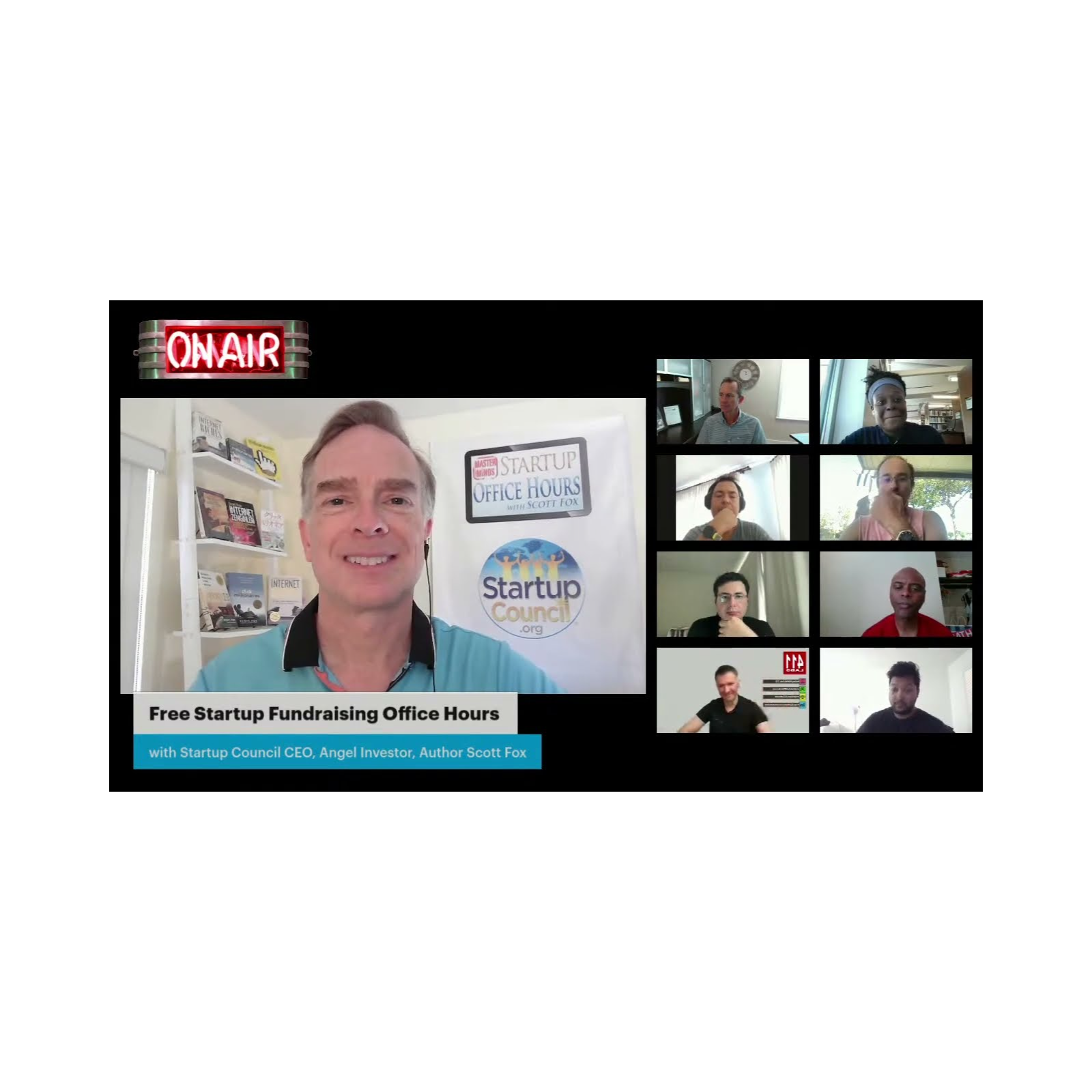 Your Free #Startup Angel Investor VC Fundraising Q&A Advice Show with StartupCouncil.org's Scott Fox56 / 100
 New Free #Startup Pitch Practice + Angel Investor Q&A with StartupCouncil.org CEO53 / 100
 Live #Startup Pitch Coaching + Free Angel Investor Strategy Members Q&A @ StartupCouncil.org55 / 100
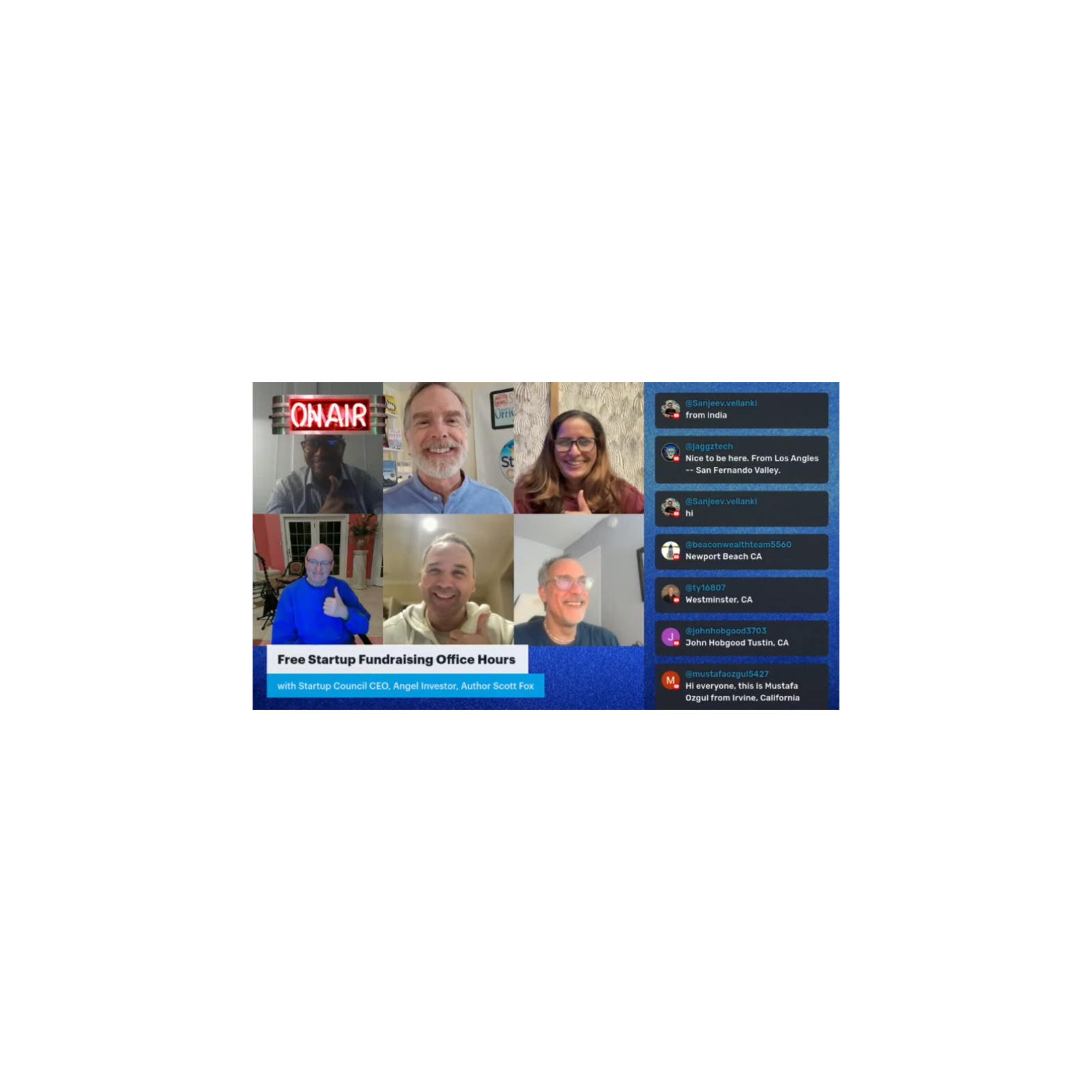 Free Startup Pitch Practice + Angel Investor Q&A w/ StartupCouncil.org and #StartupFriends Worldwide58 / 100
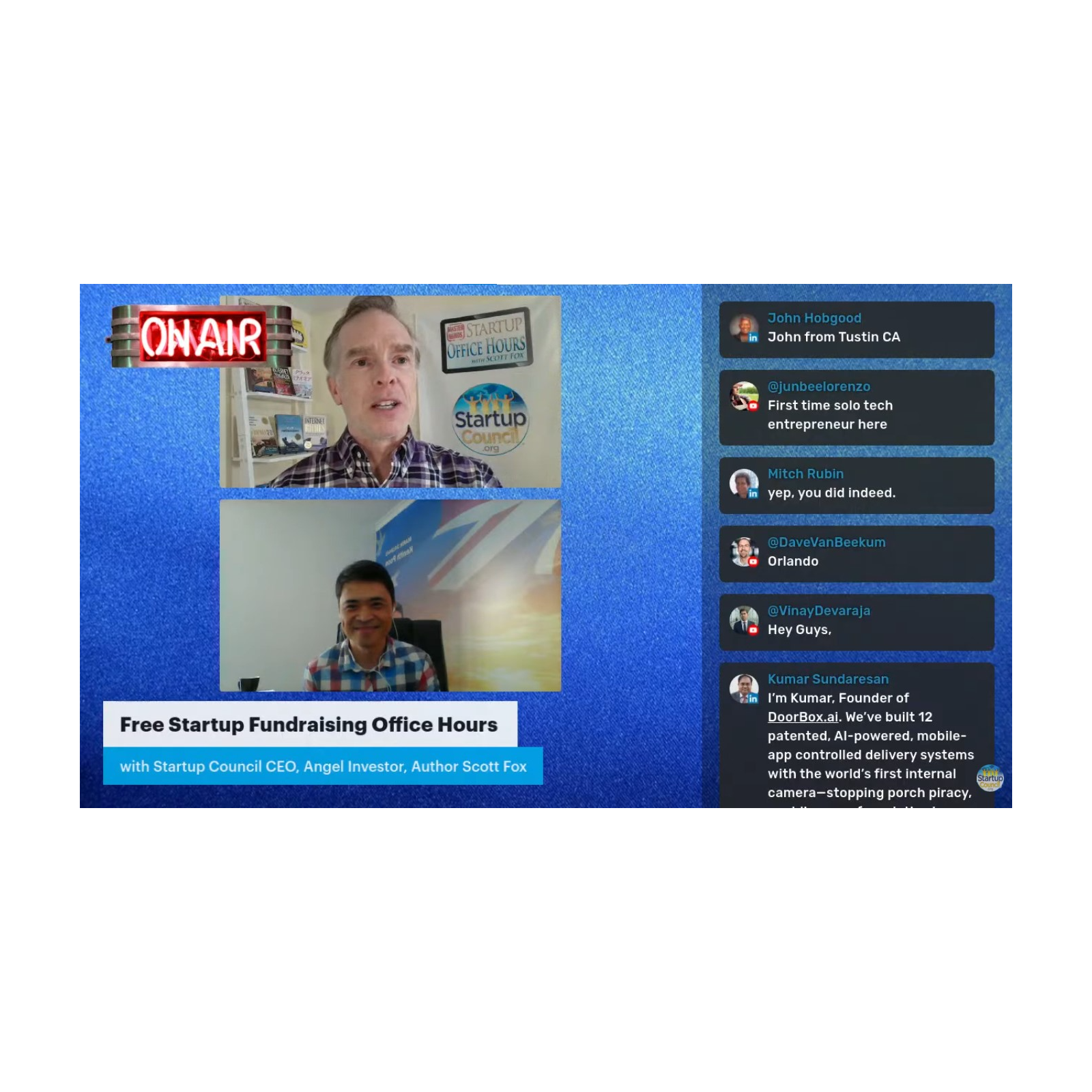 Live Startup Pitching & Angel Investor VC Insights: Scott Fox StartupCouncil.org CEO