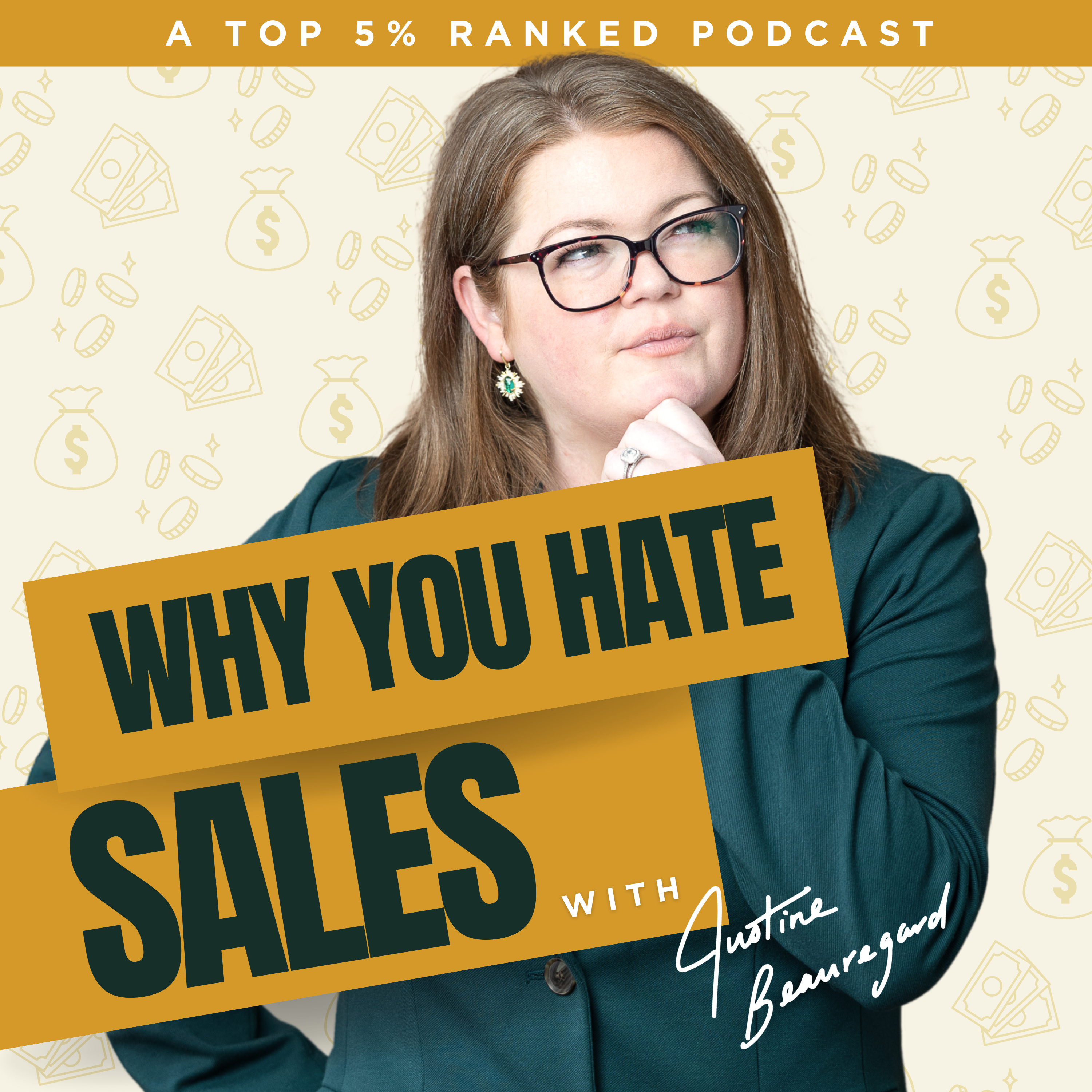
Why You Hate Sales · 2026-08-11 · 13 min
Key moments - from our scoring
Substance score
33 / 100
Five dimensions, 20 points each
Justine Beauregard uses the contrast between plumbers and keynote speakers to illustrate why copying sales strategies fails: plumbers need to show reliability and availability (testimonials, family photos, after-hours service), while speakers need thought leadership and visibility (stages, perspectives, long-form content). Both solve the same psychological problem - creating certainty - but through completely different methods. She further illustrates this with the fine dining versus pizza shop discount example: the same 'buy one get one free' promotion strengthens a pizza shop's appeal but damages a fine dining restaurant's premium positioning. Marketing advice feels contradictory (personal brands versus personal brands don't scale, educational content converts versus doesn't convert) because advice is context-specific, not universal. The missing piece in most sales coaching is understanding your specific buyer's point of hesitation. Rather than asking 'what's the best sales strategy,' entrepreneurs should ask 'what does my buyer need to feel certain about before hiring me?' Once you identify that certainty gap, your entire marketing and sales approach becomes clear.
You copy the tactic (webinar, content, funnel) but not the context it was built for - the audience psychology, business model, stage of growth, and specific buyer hesitations. The same strategy produces different results in different contexts.
A plumber creates certainty through testimonials, family photos, and availability messaging because buyers need confidence they'll answer the call and solve the problem. A speaker creates certainty through visible thought leadership, stage presence, and long-form content because buyers need to see the work delivered.
A pizza shop sells convenience and value, so a discount reinforces their positioning and drives sales. A fine dining restaurant sells exclusivity and experience, so a discount damages their premium positioning and trains customers to wait for promotions instead of paying full price.
Ask: 'What does my buyer need to feel certain about before they hire me?' Once you answer that, your marketing and sales approach becomes clear because your job is to create that specific certainty.
Complete this sentence: 'My buyers will not purchase from me until they feel certain [blank].' Your answer - whether it's that you'll answer the phone, your process is simple, you have industry experience, or something else - reveals your entire marketing and sales job.
Our reviewer’s read on each dimension, with quotes from the episode.
The episode delivers genuine, useful insights about context-dependent sales strategy and buyer psychology (the certainty framework is solid), but is padded with extended metaphors (plumber analogy, restaurant analogy, cake-baking analogy) that repeat the same core idea rather than layering new ones. Most of the runtime is spent illustrating one principle rather than introducing multiple distinct insights.
We copy the webinar, not the reason the webinar worked. We copy the content or the strategy even behind it. We break it down and reverse engineer it, but we don't copy the audience and the reason why buyers respond to that content.
What does my buyer need to feel certain before they hire me? Do they need to know that you can solve their problem today? Do they need proof that you've done it before a hundred times?
The core insight - that strategy must match business context and buyer psychology - is sound but not particularly fresh; the idea that tactics fail without context is well-established in marketing and sales literature. The metaphors (plumber vs. keynote speaker, fine dining vs. pizza shop) are intuitive illustrations but not original frameworks. The 'certainty' question is useful but frames a standard sales principle in slightly repackaged language.
If we copy someone else's sales strategy without understanding the context it was built for, we will make our businesses harder to sell.
Advice isn't universal. It's specific. It worked for one buyer inside one specific type of business at a certain stage of growth with a, uh, particular audience.
This is a solo host episode with no guest. The host (Justine Beauregard) claims 20 years in sales and 12 years running a business but provides no credentials, company names, revenue figures, or verifiable track record. There is no practitioner with scale present to validate claims through lived experience.
I'm Justine Beauregard. After 20 years in sales, I've learned most entrepreneurs don't hate selling.
After working with thousands of business owners, I've worked with local service businesses, professional service firms, coaches, consultants, lawyers, e commerce brands, software companies, product based businesses that sell $50 products and thousand dollar products.
The episode lacks named examples, metrics, timelines, or dollar figures. References to 'thousands of business owners' and broad business categories (plumbers, keynote speakers, restaurants, coaches) are vague and anecdotal. No specific case studies, percentages, revenue data, or concrete client examples are provided to ground the claims. The plumber and restaurant analogies are illustrative but hypothetical rather than evidential.
After working with thousands of business owners, I've worked with local service businesses, professional service firms, coaches, consultants, lawyers, e commerce brands, software companies, product based businesses that sell $50 products and thousand dollar products.
It takes 18 minutes start to finish to bake one extra large pizza. And they have an oven that can have capacity for five pizzas at a time at that pizza restaurant.
This is a monologue with no conversation. There is no host-guest dynamic, no follow-up questions, no pushback, no debate, and no collaborative exploration of ideas. The entire episode is the host delivering prepared material to an absent audience without any conversational back-and-forth.
Welcome to why youy Hate Sales. I'm Justine Beauregard. After 20 years in sales, I've learned most entrepreneurs don't hate selling. They hate bad sales advice.
So here's a little exercise that I would love for you to do after this episode. Grab a piece of paper or a notebook and write one sentence.
Computed from the transcript - who did the talking, and the words that came up most.
The sales strategy working brilliantly for someone else could be the exact reason yours stops working. On this episode of Why You Hate Sales , we’re unpacking why copying successful sales strategies fails so often, even when you follow them perfectly. On today’s episode, we’ll discuss things like: The reason so much sales advice seems contradictory The importance of knowing why people buy from you Why it always feels like you're the exception to the rule If you’ve ever watched someone else sell out, launch big, or fill their calendar and thought, “Maybe I should be doing what they’re doing,” this episode will help you figure out what actually makes sense for your buyers. Get ready to stop looking for the perfect sales recipe and start building a process around the context that matters most: why your specific buyers love to buy from you. - Hey, wait! Don’t forget to hit “subscribe” so you never miss an episode! - Love this episode? Give us a 5-star rating + review on Apple Podcasts. - Oh, and let's get social! Find me over on Instagram @SellWithJustine or search for me on LinkedIn!
Transcribed and scored by The B2B Podcast Index.
Speaker A: Have you ever had one of those weeks where it feels like everyone else's business is exploding except yours? You open up Instagram and the personal trainer you hired last year is announcing that she's sold out. Another six week Booty Boot camp, then someone in your industry is celebrating their first six figure launch. Someone else just posted that they're fully booked until November. Meanwhile, you're refreshing your stripe every day, checking your inbox, wondering if anyone else is gonna buy before your cart closes next week. I've been there. And if I'm honest, I think one of the first things that we do in moments like that is start looking for clues. What are they doing that I'm not doing? Maybe I should be launching like them. Maybe I need a webinar. Maybe I should start a podcast. Maybe I need to post every day. Maybe I should offer a discount. We assume that there's a recipe for success. But something that I've Learned over my 12 years of running a business and 20 being in sales is that if we copy someone else's sales strategy without understanding the context it was built for, we will make our businesses harder to sell. Welcome to why youy Hate Sales. I'm Justine Beauregard. After 20 years in sales, I've learned most entrepreneurs don't hate selling. They hate bad sales advice. That's why every week I will help you replace outdated tactics with practical strategies that make selling feel more natural, enjoyable, and effective. Because when selling feels good, people buy faster. Let's rewrite the rules of selling together. I think one of the biggest lies we tell ourselves as entrepreneurs is that if it worked for them, it can work for me. Because this sounds logical. This is a life lesson that we're taught from a very young age. Except we're only copying what we see. We copy the webinar, not the reason the webinar worked. We copy the content or the strategy even behind it. We break it down and reverse engineer it, but we don't copy the audience and the reason why buyers respond to that content. We copy funnels and the series of steps to take, but not the psychology behind the funnel. And business is not as simple as a cake. It's not about buying the exact same mixing bowl and all of the same ingredients and measuring them out and saying, yeah, you know what? I'm gonna get there by doing exactly these steps in this order, in this way. Because part of the problem is that we just see flour. We don't see that they're using a certain kind of flour that changed the recipe or the way that it's cooked. We don't see see that their oven is 10 years older than our oven and it cooks differently. We don't see that the reason their cake is so incredibly delicious is because they mix all of the dry ingredients and then the wet ingredients and incorporate them with only a certain number of whips around the bowl. There's technique, there's magic behind it. It's not just A plus B equals C. I'm thinking about this a lot recently because I wrote an email to my list about plumbers. Now, I want you to imagine your toilet started leaking last night at 9 o'. Clock, water is flowing out of the toilet, it's getting worse by the minute. You've tried the plunger, it's not working. What do you do? You Google plumbers, you scan reviews, you see who answers the phone after hours, maybe you look at a couple testimonials, but at that moment moment, you're gonna call the first person who picks up and have them come to your house. You're not stopping and thinking, you know, I really wonder what this plumber's philosophy on copper piping is. You don't wish that they had more thought leadership pieces on LinkedIn. You don't need to see a seven part content series explaining the history of toilets. You need to know, can they fix it? Are they going to answer my call and are they going to do a good job? That is what you're buying. And plumbers understand this better than almost every other industry. That's why most of their marketing is nearly non existent and quite boring, because they're building on credibility when they share content. It is testimonials of clients talking about how reputable they are, how great and fast the service was. When they share posts on social media, they're talking about the types of problems they can fix and the fact that they work after hours, if that's the guarantee. A lot of plumbers recently are employing a strategy that I love, which is sharing a picture of them with their families. So you can see I'm a real person, I have a family and I love my job and I do great work. And I'm going to come to your house and I'm going to show you what my life looks like behind the scenes. So you can trust me. I'm not just some random person who's going to come in in a blue jumpsuit and try to plunge your toilet. I'm going to come in, I'm going to know my stuff, I'm going to have a Wrapped van. I'm going to show you the fact that I have three children under the age of 10. And I'm going to do my very best to make sure your problem is fixed as quickly as possible for a competitive price. Now, I want you to think about that situation. Compared to someone who's a keynote speaker, no one's waking up in the middle of the night panicked, oh my gosh, we don't have a keynote speaker for the conference next month. It's a completely different business. In order to know that you're the best keynote speaker, I need to see you speaking on stages. I need to hear your perspectives. How easily you deliver concepts to an audience you've never spoken to before, how memorable your talk is. That means thought leadership matters, your perspectives matter, visibility matters. Seeing you do the work and listening to long form versions of your content is what sells me. And that marketing strategy would be completely unnecessary for a plumber, but it's essential for the speaker. And neither one is right or wrong. They're actually solving the same psychological problem. They're creating certainty in the minds of a buyer. But it happens in different ways. After working with thousands of business owners, I've worked with local service businesses, professional service firms, coaches, consultants, lawyers, e commerce brands, software companies, product based businesses that sell $50 products and thousand dollar products. And they all look completely different. Different offer, different website, different marketing, different price points. But underneath all of it, they're doing the exact same thing. They are helping their buyers make decisions in the quickest and most effective ways possible for their brand and their business. Knowing that if their business is demand gen, they're going to approach marketing and sales very differently than someone who plays the long game. I want you to think about your favorite high end restaurant or more expensive restaurant in your area that you only go to when you're celebrating something. Or every once in a while and they put out a promo that says Buy one entree, get one free this weekend only. Would more people come into the restaurant? Maybe. But would it damage the positioning that they have spent years crafting to be premium in the industry? And would it make you as the consumer actually go in less because you will be waiting for the next time there's a buy one get one promo. Now imagine your local pizza shop runs the exact same promo. Buy one pizza, get one free. Brilliant packed dining room record weekend of sales. Same tactic, but a completely different outcome because the buyers are buying different things. The pizza shop is selling you convenience and value. The fine dining restaurant is selling you an experience and Status. It's about exclusivity. They love the fact that you put them on a pedestal and you only come twice a year because they have some people who go every single night. They have some people who go multiple times a week, and they cater their hours and their table count and their staffing based on the fact that a certain percentage of people will come a certain percentage of times a year and fill up the restaurant. So they're always at capacity. They don't have a problem filling seats. It takes 18 minutes start to finish to bake one extra large pizza. And they have an oven that can have capacity for five pizzas at a time at that pizza restaurant. But the fine dining experience is an hour to two hours per table. Their pricing is a lot higher. The experience is so different. And this is why so much marketing advice feels contradictory. Because one person is out there saying, you need to build your personal brand, and another one is saying, personal brands don't scale. And then someone else says, post educational content, and someone else says, educational content doesn't convert. You're being told to create urgency and then told that urgency is manipulative. Who's right? Probably all of them with the right context. And that's the piece that's almost always missing. Advice isn't universal. It's specific. It worked for one buyer inside one specific type of business at a certain stage of growth with a, uh, particular audience. And somewhere along the way, we strip away all of that content and we make it a rule. And then we wonder why that rule doesn't apply to us, and we feel like we are the exception to every rule. But here's the question I wished more entrepreneurs were asking instead of what is my best sales strategy? Ask, what does my buyer need to feel certain before they hire me? Do they need to know that you can solve their problem today? Do they need proof that you've done it before a hundred times? Do they need reassurance that the implementation of that service is not going to overwhelm them? Do they need confidence that it will pay for itself? Because once you know what's creating, the hesitation in their mind, where that interrupt is to the close your marketing rights itself, you stop chasing all of these other tactics and start understanding what your audience needs to hear from you to take a next step. So here's a little exercise that I would love for you to do after this episode. Grab a piece of paper or a notebook and write one sentence. My buyers will not purchase from me until they feel certain. Fill in the blank. Finish that sentence. That I'll actually answer the phone when they call, that my process is simple, that they can do it, that I deliver what I promise, that this will, on paper, show them within minutes how they will save time, or that I have worked with enough people in their industry to have no surprises. Whatever comes to mind for you, whatever finishes that sentence, is your job as a marketer to answer. It's not about becoming better at, uh, copywriting or messaging. It's not about using someone else's strategy within your business. It's not about following the rules of business that were arbitrarily created along the way. It's about becoming exceptional at creating certainty for your specific buyers within your specific business and the way that you like to run it. And I think there's something really freeing about that, because suddenly you don't have to wonder if you should have a podcast like me, or run a webinar like so and so, or start a Facebook group like this other person, or be posting three times a day or five times a week, or launching every month. These are not questions that matter. The question is, what do people need to feel good about buying from me? Because when it feels good for someone to buy from you, it feels good to sell to them. And you're not building someone else's version of a business, you're building yours. The goal is not really to become great at sales. The goal is to get good at selling in a way that makes sense for the people you're trying to help. And I hope this episode gives you permission to stop chasing ideas of what success could look and feel like for your business and start paying more attention to understanding your buyers and why they buy, knowing that you don't have to copy anyone else and that you can start building a sales process that feels like it's your own. Because it is. And in my experience, after watching thousands of businesses grow in their own very unique ways, that is almost always where sustainable feel good selling begins.
Other episodes covering the same guests and topics, from across The B2B Podcast Index.
 The 48-Hour Async Sales Room: Win Premium Clients Across Time Zones Without More CallsNomad High-Income Skills: How to Make $5k+ Remote · on Premium positioning76 / 100
 Nobody Is Watching You Anymore, and That's on You NowLife Fulfilled Podcast · on Personal branding74 / 100
 From Invisible to Influential: Empowering Leaders to Be SeenOptimising Leader Brilliance · on Thought leadership67 / 100
 152. Nik Hemingway - Interview Preparation Expert | Resume Writer | Career Coach | Executive CoachPeople in Transition · on Personal branding65 / 100
 Building A Leadership Framework Backed By Data | Benjamin Granger | 728Leveraging Thought Leadership · on Thought leadership63 / 100
 How Liquid Death Made Water a RebellionProduct Marketing with Fexingo · on content marketing62 / 100
 “I Suck At Lead Generation” … Or Do You? | Episode 5049 / 100Your Next Client Is Smarter Than You Think | Episode 55
 Why Sales Is Not Just A Numbers Game...Like, At All | Episode 54
 Why You Look & Feel Undervalued When Selling | Episode 53Stop Trying to Convince Your Buyers To Say Yes | Episode 52