
The Scale Up Show · 2025-11-07 · 40 min
Key moments - from our scoring
Substance score
50 / 100
Five dimensions, 20 points each
Chris Savage, CEO and co-founder of Wistia, discusses how AI is fundamentally changing video creation, distribution, and discovery for the 500,000+ customers using the platform. The conversation covers Wistia's evolution from a hosting-and-management tool to a full creation suite featuring AI dubbing, avatars, sound effects, and music generation - plus a critical innovation around LLM-friendly video embeds that make video transcripts visible to AI crawlers like ChatGPT, solving a major SEO problem where JavaScript-dependent video players are invisible to common web crawlers. Savage shares his personal approach to AI adoption: running daily AI agents that search the web and deliver curated briefings, using both custom ChatGPT tasks and OpenAI's Pulse. He also addresses the operational challenges legacy SaaS companies face integrating AI - not just code modernization, but cultural tolerance for shipping probabilistic features that are 75% effective today to capture learning and maintain competitive velocity. For B2B operators in video, martech, or SaaS product leadership, this episode offers concrete tactics on AI-native feature development, LLM-accessible content strategy, and managing organizational change at speed.
Embed videos with LLM-friendly embeds that include transcripts; when AI crawlers detect JavaScript can't run, they access the transcript instead. This makes video content discoverable in real-time LLM searches, especially for specific product features or recent information not in the model's training data.
Wistia detects the browser language settings of video viewers and automatically dubs videos into their native language. TED's research showed significantly better conversion and engagement rates when viewers watch in their native language, with only 68% of Wistia's front-page viewers having browsers set to English.
He created a daily briefing task in ChatGPT that searches for news related to his work priorities, returns findings with context on why they matter, and iterates based on his feedback - essentially a self-improving AI news alert that sifts through too much information without manually crawling sources.
Wistia now launches hundreds of features per year versus one major product launch annually; the challenge shifted from patience and precision to rapid decision-making on which innovations to highlight and how fast to ship probabilistic AI features before they're perfect, accepting 75% delivery today for learning velocity.
Legacy companies must manage lower tolerance for feature failures and incomplete AI outputs; they need to invest in beta labeling, guardrails, and clear communication that features are experimental, whereas startups can ship rougher products. Code modernization matters less than cultural willingness to ship imperfect AI features.
Our reviewer’s read on each dimension, with quotes from the episode.
The episode contains a handful of genuinely useful nuggets - the Common Crawl/JavaScript limitation blocking video content from LLMs, the 68% non-English browser stat, and the probabilistic vs. deterministic framing for legacy SaaS - but these are surrounded by significant padding: puppy talk, personal AI nerdery, and generic 'AI is moving fast' observations that dilute density considerably.
Common crawl, which is this like open source crawler, can't run JavaScript so anything that's behind JavaScript it can't see. So a video player needs JavaScript to run
only 68% of people click play on our front page video, uh, have their browser set to English
The LLM-friendly video embed insight and the YouTube-blocks-ChatGPT observation are genuinely non-obvious and actionable; the CGI/Mission Impossible analogy for AI video trust is a fresh framing. However, the bulk of the episode recycles standard 2024 AI conversation - agents overpromised, tools getting better, storytelling will matter - without pushing into truly contrarian territory.
YouTube blocks chat GPT and a bunch of the other LLM search because of course they do because it's not their product
if you can show off that you did it for real and you can show off that there was real work into it and the story is good, that'll be good
Chris Savage is a genuine operator - co-founder and CEO of a 19-year-old B2B SaaS company with 500k customers - who speaks from real product and go-to-market experience rather than theory. He is not a household name or hyper-scale operator, and the conversation doesn't fully exploit his depth of experience running a bootstrapped/slow-growth SaaS at scale.
we rebuilt a lot of how Wistia runs in the last few years
we launched AI dubbing in Wistia earlier this year
The 68% browser-language statistic and the technical detail on Common Crawl are concrete highlights, and the Cursor bot/30-minute fix example is useful. But the TED dubbing study is cited without actual numbers ('tremendously better conversion rates'), productivity gains are unquantified, and most predictions and product claims remain at a hand-waving level of abstraction.
only 68% of people click play on our front page video, uh, have their browser set to English
TED just did a recent study on this because they, they dubbed a bunch of their talks and saw tremendously better conversion rates, engagement rates
The host demonstrates real technical literacy - correctly identifying N8N, Common Crawl, Veo 3, and Cursor - and occasionally surfaces useful follow-ups. However, he frequently steers the conversation toward his own AI usage, inserts personal anecdotes (Oracle meeting, brain-dump doc, Frenchie dog), and never pushes back on any vague or unsubstantiated claim, keeping the exchange at a friendly-chat level rather than a rigorous interview.
I was meeting with um, a leader over at Oracle earlier today and I was telling him about it
Do you want me to give some that I see working so you get a little chance to process it? Cause I just put you on the spot
Computed from the transcript - who did the talking, and the words that came up most.
Summary In this conversation, Chris Savage discusses the evolving landscape of entertainment and the importance of trust in video content. He highlights the current phase of shock and awe in video production, driven by advancements in technology that blur the lines between reality and fiction. Savage emphasizes that as audiences become accustomed to these changes, the focus will shift towards the quality of storytelling, where compelling narratives will ultimately prevail. Takeaways Trust matters more in the video. We're in a phase of shock and awe. Technology is crossing the uncanny valley. The feeling of disbelief in realism is common. Interesting stories will dominate the future. Quality storytelling will always win. The evolution of entertainment is ongoing. Audiences will adapt to new video technologies. The narrative will be key in video content. Business and entertainment will intertwine more.
Transcribed and scored by The B2B Podcast Index.
Speaker A: I think that there's like, what we can guess is going to happen on the entertainment side. And then I think there's like, what we can guess is going to happen, I'll say on the, like on the business side, but what I mean is like, where, where trust matters more in the video. On the entertainment side. I think the first phase we're going to go through is going to be like the, the phase we're in now, which is like shock and awe at what you can make. Like, just truly this is unbelievable. And that phase is going to continue because the models, some of them cross the uncanny valley sometimes, and they sometimes don't, but they're going to start crossing uncanny valley all the time. And that is going to be, whoa, I can't believe how real this is. And it's kind of like you'll get the weird feeling in your stomach like, I can't tell what's real enough. Then after we normalize to it, I think all you're going to care about is like, is it interesting? Is this a good story? And if it's a really good story, I don't think you will care that much that it was made with AI and it is a bad story. Won't be good. And whatever you can do, whatever way you can tell the best story will win.
Speaker B: Welcome everybody. We are back and this is Ryan Staley and I have a very special guest with me today. I have Chris Savage, who is the co founder and CEO of Wistia. Chris, happy to have you on. Welcome, welcome.
Speaker A: Good to see you, Ryan.
Speaker B: Yeah, Chris. So couple things real, real quick backdrop on Chris. So, you know, uh, started up and teamed up with Brandon Schwartz in 2006 to launch Wistia out of a living room in Cambridge, Massachusetts. A lot has progressed since then. Obviously They've gone from a, uh, like a fledgling startup all the way to a company with over 500,000 customers worldwide. Chris also co hosts the podcast Talking Too Loud. And one of the lower known things or lesser known things, I should say. Chris was actually one of the people that introduced me to Dall E version 1 before the whole AI boom started. So once I saw what he was talking about with his video and AI uh, embedding within there, I had to have him back on the show. Chris, a lot's happened over the last three and a half years. Ish. I would say, like from your perspective, man, what's the latest and greatest with you? And then kind of like what you're focused on over at Wistia.
Speaker A: Yeah, I Mean, so, uh, first of all, yeah, a lot has happened. Um, and there's a lot. There seems like there's a lot happening every week at this point in an accelerating timeline. But, uh, yeah, I think, like, with me, like, we're shipping tons of stuff at Wistia, uh, the. What the product is has really evolved from being hosting and management to actually having creation tools built directly into the products. Individual person creation, like, make your own videos, record videos with others in a remote studio, an editor that's taken off, we have a full webinar platform. And, um, that's, like, super exciting and keeps me very busy. It, uh, turns out that, like, building, like, four new major things will keep you busy. Um, and then I think that, like, uh, what's going on in my life? Life is good. Kids are good. Um, we're about to get a new puppy next week, so I'm very excited for that. Uh, and, you know, I. I'm an early adopter, so I spent a lot of time playing with new things, trying to figure out which of these things deliver now, figuring out which of these things are going to deliver soon. And then part of the fun is, like, you know, trying to get that timing right of this new generative video thing is here. What can we do that's super, super valuable that people aren't thinking about, that we can, like, solve a problem where we couldn't before. Let's go do it. And so, yeah, I feel like I. Things, uh, are pretty busy, but very fun.
Speaker B: Okay. Definitely, man. So what kind of breed for the puppy? I gotta ask that question because I'm a dog person.
Speaker A: It's Australian Labradoodle.
Speaker B: Oh, nice, Nice.
Speaker A: Yes, yes, yes.
Speaker B: I got a Frenchie. Um, he's getting old. He's about seven. So that's. That's getting, uh, up there. But dogs. Dogs are awesome. I love dogs. So with you, man, and I love that you're an early adopter. And like I said, uh, I bring you up in my AI origin story all the time as a result of that, as it's like, yeah, I got introduced from a guest on my podcast, Chris Savage, and most people have heard of you or have heard of Wistia, so it's been really cool from that perspective. So with you, I guess, what are you experimenting with now? Or what do you think is the latest or something that you're excited about that you see kind of coming over the next six to 12 months?
Speaker A: I mean, so I'm constantly. We'll start with the LLMs. I mean, one of the things I've started doing that I've been experimenting with is like, like creating repeatable tasks with them. So doing things like, hey, I want you to go search for this thing every day and if you find it, update me and. Or like you could do this for something like getting tickets to something that hasn't been released yet. But also I'll do like a daily briefing so it knows the types of questions I'm already asking for a lot of the work that I do. And then I, what I say is like every morning I want you to out and search for things related to the stuff I'm working on. Anything that's new, bring it back to me with the perspective of why you think I'm going to care. And then I just iterate as I go. So like each day when I get something, I'll respond to it and say, this is good, this is bad, what have you. And um, that's been really interesting because it's just been this like constantly evolving thing that is doing quite a good job of sifting through all the news sources that I honestly wouldn't go through. There's like too much stuff. So that's been really cool. You know, I'm playing a lot with the generative elements of uh, that could go into a video. So playing a lot with the avatars. We launched AI dubbing in Wistia earlier this year. So we already have the data based on the browsers of the people who are hitting your video on your website. Like what do they have their browser set to. For. For a language? And it turns out that like, you know, it's the Internet, like for us, like Wistia, we really only market in English. But actually only 68% of people click play on our front page video, uh, have their browser set to English. TED just did a recent study on this because they, they dubbed a bunch of their talks and saw tremendously better conversion rates, engagement rates when someone's watching their native language. Of course this makes sense, but so that's something that we saw that we got excited about is like we can combine the data with the player with something really simple so you can dub. And then we're looking at what are all the other things that we can do where we can take things like avatars, we could take things like AI sound effects, AI music, AI color correction, all these things and put them together to help you repurpose more easily, edit more easily, make new things. And so yeah, there's a lot that we're experimenting with there and what we're looking for is things that actually deliver. Like that's the big thing is like there's a lot of these things that today are toys and six months won't be. But we're trying to get that timing right of, hey, let's help you make something that you couldn't have made otherwise or increase the production quality on something you might not have thought to do otherwise. So yeah, it's very fun.
Speaker B: That's exciting.
Speaker A: Ma'.
Speaker B: Am. So I love both of us. So it's a lot to unpack. So let's start with the first one. So do you, are you using Pulse then and ChatGPT or with that or do you have a task set up?
Speaker A: I have Pulse also. So Pulse is like the, their, their version of this that basically gives you insights based on what you're searching for. I actually set up before Pulse and have like fine tuned my own news alert. So I, I look at both. The thing that's nice about Pulse is it might give you an update on something you weren't expecting. The thing that's nice about the, the news briefing that I do is that it is things that I actually expect and so there's certain things I want to see every day and that it pulls that, all of that in.
Speaker B: Did you do that like uh, like a N8N or something like that then? Or would you, how did you build that out?
Speaker A: Just in chat GPT itself you can say, give me a reminder.
Speaker B: Oh, the task. Okay, I see what you're saying. Yeah, yeah. I've been using like, funny thing is I've been using Pulse and I've been using it like what you're talking about so. Because it's got like hey, what else do you want me to cover? And I'm like, I want you to cover this every time. Um, um, something that I did. Pretty cool. And it's like, it's a little finicky and I was just talking, I was, I was meeting with um, a leader over at Oracle earlier today and I was telling him about it. But basically what it is is it's like I have it evaluate, I've chat GPT evaluate my use every week and then coach me on how to like 3 things every week I could use to up level my, my use. Yeah. So it actually like, it's kind of weird because like they made some updates and then it started not acting as good but it used to read all my chats and everything and do that. There's still some really good things that' back with it actually gave me like a prompt ending to add and increase like the output of everything that I do by 30%. So it avoids a lot of back and forth with it and I've tested it and actually works really good especially.
Speaker A: That's awesome.
Speaker B: So, so that's a little AI nerdery there for you, man. Um, so let's go back on the video. There's a ton going on with video right now. It's kind of like, you know, I think video next year is going to be like the image models this year how they got like exponentially better and it's already getting to that point. So like, and this is part of the precursor, I can even share this with you all if you're watching. Just give me a second here and I'll share the screen. Um, this is one of the things that Chris brought up, um, on LinkedIn and it was just talking about how videos are becoming visible to LLMs and how to do that because AEO is like one of the most critical things obviously as we're looking at the future of how people make decisions, we're seeing conversion rates, I don't know, 6, 7x as much. Talk to us a little bit deeper about that man. And like, yeah, what's the nuances of that, how it works and how it's affecting like the future of I would say marketing especially. Uh, yeah.
Speaker A: So I think there's an assumption that if you have your videos online that AI can see what the videos are about, what's in the videos, especially YouTube. I mean I hear from a lot of people like well we need to put this on YouTube just to make sure that AI can see see it. But of course the funny thing is like YouTube blocks chat GPT and a bunch of the other LLM search because of course they do because it's not their product. They m also a lot of the uh, like Chat GPT and others use Common Crawl to crawl the whole web as their own version of like seeing what is on websites and what's happening. But Common crawl, which is this like open source crawler, can't run JavaScript so anything that's behind JavaScript it can't see. So a video player needs JavaScript to run so you could otherwise open up the player and if it has a transcript, pull the transcript and basically understand what the video is about, which is helpful if you have a lot of information that's in video that is might not be on your site. Um, and so what we've done is built an LLM friendly video Embed. So you embed this on your site. It has every video that gets in a wisdom gets a transcript. So you have the transcript for the video and then if it detects that it's, it can't run the JavaScript, we show the transcript instead. And um, what that does is it means that when your site is being crawled and someone's looking for additional information that would be in all the videos that you have, it's now available and the LLM can see it. And so it basically makes the data that is in your videos obvious to the LLM.
Speaker B: That's good. I mean obviously that's critical. So like what are you seeing as the difference in results as a. And I know this is brand new that you've launched it, right, But I'm sure you've kind of experimented on yourself pretty simple.
Speaker A: So a lot of it's, it's. And I encourage people to play with this themselves. Like go in there and ask about, if you take a YouTube link for example into Chat GPT and you ask on it like what's in this video? It'll give you an answer. The, and the answer it's going to give you is going to be guessing based on the title and description. But also if it's embedded in other places and there's information on other sites, it can pull that information. Uh, what we're seeing here is that pages that don't have the embed, you are not getting the benefit of the information your video when someone is searching on those pages and when you do have it, they are, you are getting the benefit of the information. So if you're, if anybody is like if you're searching, uh, the big question is when someone's searching for something, is the LLM, um, using inherent knowledge or is it doing research in real time? Inherent knowledge is going to be based on when they train the model. And so because most of the models are going off of data that is not, you know, hasn't um, been updated in the last month, few months, of course no videos are showing up there. So the way, the way that this is, will work for you is if you use the LLM friendly embeds and people are searching for an answer. Now the answer is not in the inherent knowledge which is often because it's like specific, like you're asking specific information about, let's say like do. Does, does Wistia have a specific feature? If that is showing up in your videos now it will show up in the search when before it wouldn't have. So we've done a bunch of tests before and after and what you get is like much more fine grained, better data. And that matters when the LLM is like pulling together all of the insights to tell you like the help you make a decision.
Speaker B: Okay, so how are you. Here's the thing. Cause I know this is, I don't know if this is a competitor or not, but. So what do you do for public facing videos? Like on YouTube or is it like you can't really. How do you, how do you use that?
Speaker A: Or leverage with. Yeah, so for. You can't do anything on the YouTube side. So, um, you'd have to embed those videos somewhere else.
Speaker B: Okay, gotcha.
Speaker A: Put more information on the page saying what the video is basically.
Speaker B: Gotcha.
Speaker A: Uh, and the issue you run into is like the transcript is gonna be the most information dense version of this. But if it's a very long video, then you have a very long transcript. So then that often doesn't make sense on the page itself visually. And so then you have your, you could go and build something similar to what we've built that's like detecting and switching these things for you in real time. But you're just gonna need to be careful that it's, you know, very compressed and very fast and all that kind of stuff. So that's all we're doing is we're doing something you could do otherwise. We're just doing it for you very easily and reliably.
Speaker B: Yeah, that makes sense, ma'. Um, am. Well, I think I, I mean there's a ton of video. Video is increasing. So I think that makes a lot of sense, I guess. Like how has your business changed fundamentally, like back to 2006 to now.
Speaker A: Right.
Speaker B: In terms of like how fast you have to ship products. Like what's your approach? Because like some of the things that you told on the last episode. Um, I remember folks were really impressed with just in terms of like evaluating leadership at different revenue levels and kind of how you approach that. So I'd love to hear how you look at it from like a product perspective now and go to market perspective as well.
Speaker A: Yeah, I mean the biggest thing is that we have to make faster decisions. So we are seeing some productivity increases right from using AI in how we build products and we are seeing some productivity increases in how we market and sell. So we are going faster. And we also are going faster. We made a huge change like late 2022. There was a cultural change actually internally at Wistia that really unleashed us, uh, shipping fast so what that means is, like, we used to feel like we could be very patient and judicious about what exactly we're doing, and now we are. There's a huge amount of new things coming out. And the question is actually, it's like an editing question, a positioning question, which is, which of these things are we going to highlight? Which of these things are going to make more obvious or not to customers? It's actually overwhelming. We have a different problem than we used to have. We used to have a problem many years ago of like, man, I would hate waiting. And it would be like, uh, oh, our one big launch is scheduled for September, and now it's like we launch hundreds of things a year. And so instead of hating to wait, it's like, actually, well, which of these things are most important to the right group and how do we tell them about.
Speaker B: About it?
Speaker A: And so the way it shows up is many, just many more decisions, like day to day and week to week of people saying, like, here's this new thing. What should we do with it? Uh, or we think we're going to go really big with this new thing, or we think we're not going to go big with this new thing, we're going to focus in this way, or we have something new, it's working better than we expected. How much should we pivot the stuff we had planned? And so it's just a, uh, in that sense, very, very different, where I think there was like a luxury of being able to go slow and. But make sure you get the decision right. And this is still true on really big decisions, like, are we going to build a new product or something? We still have that same approach to it, but on the, on the smaller level of new features being shipped and things, like, it's just a much, much faster pace.
Speaker B: Yeah, I mean, everything's sped up. I mean, what Satya was talking about how he thinks Moore's law is like 3x now, and that was at the beginning or mid last year. So it's probably like 5x now in terms of how fast technology doubles, I guess. Is there challenges, like, since you're a legacy SaaS company, right, since you've been around. I don't mean legacy in a negative way. I just mean since you've been around for a while of like, trying to integrate all this with the existing tack that you develop versus, like, if you were starting AI native from the ground up right now, is that like, challenging as a SaaS founder?
Speaker A: I mean, yes and no. I think, like, we are very Fortunate. And I think this came up because of. To a degree, it came up because of this guess on pace, but we rebuilt a lot of how Wistia runs in the last few years. Like, in terms of, like, if you go into the web app, like you haven't been in Wistia recently, you go in, it's going to look really different from how it used to look. And it's not just a skin on top of the app. It is literally. We've rebuilt most of the app and what that has done is made it much easier for us to build in this AI functionality because we're not building on brittle things that are very old. We're building on very, very new things with fresh code, with a fresh code base and people understand it. And that's not true exactly everywhere in the product, of course, but there's true. That's true in lots of places. But I think if you had not. If you haven't been doing that, it's going to be harder. But the biggest thing is actually like the. I think it's the, uh, probabilistic, Probabilistic nature of AI versus deterministic, where there's a lot of people who are used to writing deterministic solutions. So you do something that shows up exactly the same way every time. And what we're doing now is writing deterministic solutions and then putting in something probabilistic around a very discrete thing. And there's a lot of people who are just uncomfortable with that because they're like, I don't know what the answer's gonna be. What if the answer's really bad? What if someone prompts us in a really negative way or whatever, and they couldn't get themselves into trouble before, they get themselves into trouble now, and it's kind of like, um, protecting the user kind of vibe, which makes sense because historically that was like trying to keep the product incredibly easy, incredibly smooth. Like, fail proof was something we were always thinking about. And I found it getting, getting people comfortable with shipping those things that we're actually making a bet on trajectory often than where we are today, which is, we need to ship this before it's perfect. So some people are going to use it, love it. So we're using not like it because they're going to feel that it doesn't deliver. But we feel that the speed that it's getting better is fast enough that it makes sense because we need to get in there and get the learning so that six months from now or a year from now or Two years from now, when it's always delivering, we are actually getting the lift and it is in the product. And I think that is, it's uh, it's almost like the issue that I think a lot of legacy companies have is, is the code and how you're building it is one thing. It is actually like your tolerance for failure. So you could be completely AI native but ah, at your scale and people won't have a high tolerance for failure. But a startup does. Like a startup can make a thing and they can promise something and it only delivers 75% of the way. But that's enough for some people.
Speaker B: Right?
Speaker A: The legacy companies are going to struggle with that in a different way. Right? Like you have to, you have to do the work to make it a beta. You have to do the work to make it clear it's a test. You have to create more guardrails around it so that people understand what it is that they're stepping in and doing. But also you have the advantage of distribution so you put more people towards the thing.
Speaker B: Yeah, I mean it's good points man. I mean really, really good points on that. Like the yin and the yang of like a startup versus a legacy or bigger company. Right. Um, so what are you most bullish on for video for 26 as it relates to uh, business as a whole?
Speaker A: I think the big thing that I can see is that we've had a lot of magical technology come out that has put the power of video to way more people's hands. But still most of the power is the different discrete pieces that you're still going to put into like a traditional editor that you're still going to use the way you did your process before. So people who I see doing like, I see a lot of people playing, like I see a lot of people playing with Sora, for example. Super fun. I have a lot of friends who are, do not make videos who are in Sora because it is so fun and silly to like make fun of your friends and stuff. But what I think can come is basically taking a lot of these raw elements and combining them in such a way that someone who hasn't made video before, like a business user, can actually make videos that they're proud of, like edit them themselves and not feel overwhelmed. And I think we're going to see like a kind of explosion of that type of content that I'm really excited for because I think, I mean it's kind of in a similar trajectory to what I've seen since we started Wistia which was first DSLRs, added video. That brought the price of video down and put video in more people's hands. And then the iPhone and Android added video and that brought the price down of video, put more people's hands. Then we started to see our computer as a camera and that changed the game. And this is the next one. And so, yeah, I'm just really excited for, for us to start to see things that actually deliver on that promise.
Speaker B: Yeah, I mean, like, I've used Veo 3.12. It's good. I've used Sora, had, uh, early access to that. It's pretty fun, I think. Like, I guess, like here, here's what I'm wondering and I'm starting to see changes to, uh, social media with this. But, like, where do you think the future of social is going as it relates to video as well as marketing? Because, like, I mean, it used to be like, hey, you need video because you can't fake it. But, uh, as you can see with, uh, Sam Altman doing anything, I mean, some of the stuff I've seen on Sora and other, you pretty much fake anything right now and make it look real. So, like, what's your take on that and like, how do you approach it organizationally and for your clients?
Speaker A: Yeah, so I don't think anyone really understands what's going to happen yet. I have a bunch of guesses, but yes, that is right. And you said something in there that was very important, which is like, for a long time, people saw video as like, if it's in a video, it's real. Like, it is very high trust because it's hard to make video. And I think as humans, we value things that are good, that require a lot of hard work. Like, that is, that is a signal to us of importance. And so if you're using AI to make all your videos and people can tell you're using AI to make your video, there there's a lot of cases where before they valued hard work, where they're not going to value it. Right. Like, they're going to look at and Soar is again, perfect example. It's really fun and silly. There's a bunch of crap. And you don't look at it as like, oh, this is really interesting. This person had this idea. You look at it as like, this is just boring. Like, if I don't like it, it just sucks. You don't care. Right. Where in a different world, if you saw whatever, a squirrel driving a motorcycle around, you'd be like, how'd you get that squirrel to do that? And Mark Robert, you know, putting nuts everywhere, making squirrels drive thing, we would be like, this is so amazing. But now in the AI video world, it's like, well, that by itself is not that interesting. So I think that there's like, what we can guess is going to happen on the entertainment side. And then I think there's like, what we can guess is going to happen, I'll say on the, like on the business side. But what I mean is, like, where, where trust matters more in the video. On the entertainment side, I think the first phase we're going to go through is going to be like the. The phase we're in now, which is like shock and awe at what you can make. Like, just truly, this is unbelievable. And that phase is going to continue because the models, some of them cross the Uncanny Valley sometimes, and they sometimes don't, but they're going to start crossing Uncanny Valley all the time. And that is going to be, whoa, I can't believe how real this is. And it's kind of like you'll get the weird feeling in your stomach like, I can't tell what's real. And that's going to be the first part. Then after we normalize to it, I think all you're going to care about is like, is it interesting? Is this a good story? And if it's a really good story, I don't think you will care that much that it was made with AI and if it is a bad story won't be good. And whatever you can do, whatever way you can tell the best story will win. And I'm talking explicitly about, like, entertainment, right? Like, if it is entertaining content, story will ultimately win. And I think we can see that this happened actually with CGI in movies. So, like pre CGI action movie, car exploding. You knew somewhere someone exploded a car. Like, you knew that the flames were real. You knew someone took like, if there's a human in it, the car. They took a real risk, right? Like, it's like a scary thing and added stakes. Then CGI came along. We saw all these movies pushing the boundaries of cgi. Jurassic Park, Avatar. They're the biggest movies ever. And we then we saw CGI and everything as the price came down and pretty quickly, just having great CGI is not enough to go to the movie theater. What happened actually is like the great stories, if you had an amazing story with a bunch of cgi, people didn't care what the cgi. They cared about the great story. There was exceptions to this rule, Tom Cruise is the exception. So Mission Impossible, you know, he does his own stunts.
Speaker B: Yeah.
Speaker A: And that is part of the appeal. And actually those movies are better if you watch the behind the scenes footage first because you understand the stakes of what he's doing in it. And I had this exact experience, like I think it's Mission Impossible 7 or whatever that just came out. And that this one I saw without watching the behind the scenes footage. He's hanging off the bottom of a plane on fire. He's parachuting on fire. And I was like, this is fun and cool. And then I watched the behind the scenes after and I was like, oh my God. He actually, I forgot he really did those things. Whereas the previous Mission Impossible came out two years ago, I watched the behind the scenes first of him doing this like motorcycle jump off of a cliff that he actually.
Speaker B: Yeah, yeah, I remember that one.
Speaker A: And when I watched in the theater I was like, this is the greatest movie I've ever seen. You know. So I think the work matters and in entertainment that's how I think it's going to show up is like if you can show off that you did it for real and you can show off that there was real work into it and the story is good, that'll be good.
Speaker B: That's it. I love that perspective. So what, what are you. Who are your favorite storytellers and like, or who do you think? Um, what kind of storylines? Because I'll, I'll tell you something I did on sort of to get your take and maybe this will spark your creativity. But like, um. I don't know how it came up. It was something like in an old reels or whatever. My, my buddy sent me on Instagram. The real meta genius. I don't know if you remember the real meta genius commercials from like the 90s. Yeah. So it was like commercials like that or other things or there used to be a like in Saturday Night Live I think is still good and I, I appreciate it. But they used to have the best commercials. Right. Like in that time frame. And So I had SORA started creating like real metagenius themed like or like Saturday Night Live type commercials with things and some of them were pretty freaking good. So um, but what do you, what do you see in terms of like storytelling themes, things like that that um, are really resonating and hitting with people.
Speaker A: I mean on the, on the sore front specifically it is like, it is like funny memes of content that we have seen before or putting people in funny situations and then Taking it really far. And so I've seen things come up, like out of things happening at work where we had an off site. We were sitting outside and someone accidentally spilled an iced coffee and it went into the pool at the place where we were. And everyone thought this was so funny, trying to clean up the milk out of the pool. And so then there was like the video of Brendan and how much he loves milk in the pool. And then they took. Then the next version of that was like. And Brendan's my co founder was like Brendan with a giant glass of milk, talking about how much he likes milk in the pool. And it just kept going more and more extremes. Like the same character and the character and the idea behind the character, where the character could go was incredibly funny and clever. It was like. And clever where. So that was very entertaining. But I actually think that, like, if you didn't know Brendan, I don't think you would think this was that funny. Like, I think if you saw one of these, you'd be like, what is this? It was most funny to people who actually know him. So it's a very small audience that it makes sense for. And I. But I think stuff like that is going to do really well. I saw someone else was showing me videos that they put themselves into the prices right with Bob Barker and they're winning and then they go like above and beyond, over the top. And it's basically like stuff that we thought was funny when we were kids that we dreamed of doing and now you're doing it, you know. But yeah, I think it's. I think it's going to be. I would bet we'll see some movies that come out from filmmakers who never would have had the budget or access before that are done totally with AI that we love. I would. I'm going to say that's in the next, like four years. We'll see something that takes off online and then gets distribution. And it's going to be because the story was amazing and the foresight was amazing and if this person had had the resources of a full studio, they could have made a great movie, but they couldn't have done it before. And it's going to take unbelievable amounts of work to put off, but they'll be able to do it. I think. I think we'll see that. Yeah, I think that. I think the question actually is, like, what's going to happen in the places where the trust really matters, Right? Like, what's going to happen in the context where it's like, where it is Factoring into you making a big financial decision. And I think there we're going to be looking for things that show us that if you used AI, it was to enhance versus replacement. Things. Like, we're going to be looking for real stakes, real people, authenticity, high trust. If you're making a big financial decision.
Speaker B: Yeah, that makes sense. I like the story about the milk too. I could see that. Right? Like, it's almost like the inside joke that is, uh, scaled to obnoxious levels.
Speaker A: Right. That's what a lot of this is, I feel like, is like the true inside joke taken very, very far.
Speaker B: So, uh. All right, so let's move on. What do you, what do you think is going to be really big next year? Let's just say outside of video, right. We talk spent most of the time. But as it relates to AI or AI agents, what are you super bullish on and what do you think is,
Speaker A: like, still a while off? I'm really bullish on AI solving. Like, actually, um, I'm talking about work here, but like actually solving really small problems really well. So there's been a lot of promise of these AI agents that are, you know, going to run for 30 hours and build you an entirely new software product, whatever. And like, yes, I think those are cool demos, but mostly when you talk to anyone who's really building things, that's not happening yet. And even in a world where an AI agent could write for 30 hours before you reflect and look at the code, like, guess what a human being's gonna have to look at? It's gonna take a lot of time. It's gonna change how we work. But I'm starting to see more examples of things which are very discreet, small examples that it can do really, really well. And so, uh, like we have the cursor bot in our slack, and people will find little changes in the last cursor, the cursor bot to make the change. And now I'm seeing a lot of those changes. Someone brought up an issue, it's literally solved 30 minutes later. I think we're going to start to see that expand and. But it's still going to be really small. It's going to be something that like, you know, would have taken an engineer a day to do before, and it was low on their priority list. We're going to start to see a lot more of that starting to occur, and I think we're going to see more of that in like, every area. Like, uh, they were to see more things that are very small things. But when Solved well are actually really, really valuable. And I think that's the other part of it. It's like I don't think you need to have yet an AI, uh, agent writing code for 30 hours to, for it to be valuable. I actually think if they can write it for 30 minutes and it's actually really good and that is tremendously valuable by itself.
Speaker B: Yeah, I think that I agree with you on the quality part. Like that's the most critical piece because otherwise you're just, just like spamming code or spamming messaging or whatever. Right. And it's just, um. I've actually been really impressed with cloud code for non coding use cases actually for like go to market. Like, um, I just did a video on it last week where basically I, I took, I had to research like the top seven trending topics over the last two, three weeks and create 15 LinkedIn posts from it. And they were. And now granted, I had to give it the right context with like my brand, voice, like you know, how I write LinkedIn content, all that. So it was tight. But the quality I got back at scale for that was really good. And I just set it up and ran it. Right. Which was good. Now, um, that's one piece of it. The other thing that I've started to think about, and I haven't shared this publicly, but I went back and forth with cloud code for about an hour to get the initial up. When I was done, I just said, all right, write me like a complete prompt of all the prompts I use, so I can only put that one prompt in versus having to go kind of chain mail it. And I did that, tested it, and it worked really well.
Speaker A: That's amazing. Yeah, but I think you're doing what we have to do, which is like, we're still in. We. I mean the numbers of people using these tools is unbelievably huge. But uh, but to me it still feels very much like we're in the mode where you have to be actively pushing and learning literally every day. That's how you get the most out of it.
Speaker B: Oh yeah, without a doubt, man. Like I'm constantly breaking it down. And what I've started to do is like, because it's happening so fast, like I'll do like I have a brain dump doc. And then I'll just like, I'll talk to, you know, text to voice or whatever, talk to it. And then I've started to have the LLM analyze that like after a month, like, hey, what are the trends you're seeing? In my thought process, how could this relate to my business? You know? So, um. All right, so we're just.
Speaker A: The other thing I was. Well, you're not really asking this, I guess, like, because you're more talking about predictions. But the other thing that I have been doing a lot that I've talked to others about and it seems to resonate is purposely using the LLMs for divergent thinking. Like, you finish something and then say, tell me all the reasons why this isn't going to work.
Speaker B: I love that.
Speaker A: Like, push in a direction that you. That seems completely counterintuitive to me now and give me all the reasons why. Why? And I find that it's like, you know, there's these. These adages of like, there's. You do the postmortem after an event goes through and talk about how it did or the pre mortem before to try to like, figure out what could go wrong. And I think a lot of this, like pre mortem or divergent thinking, that often would really distract if people aren't ready for it in a meeting when you're making a decision. I found there to be like, more clarity of thinking that can come from pulling in these other ideas up front.
Speaker B: I like that, ma'. Am. I haven't really used it. I closest that I've used it for from that perspective is more like first principles thinking, like to kind of look at it at the core elements and then break it apart. But I like what you're saying is like, hey, identify, like why this is flawed or why this could be wrong or. I think that's strong. I like that. Um, all right, so we're just about up on time. Final question, because you're the one, like I said, turn me on to Dolly, which got me on the chat CBT track early. What are your top three tools outside of Wistia, right, that you use that are like cutting edge, that you're digging into, that you're on the forefront of?
Speaker A: Top three tools outside of Wistia. I feel like I don't want to say chatgpt because I just said it like a million times, but I'm going to say it.
Speaker B: I, um, mean, uh, I'm trying to
Speaker A: be honest about what I really use the most. Okay. I also am trying to give you a Dall E moment, but I don't think I'm going to be able to this time.
Speaker B: Do you want me to give some that I see working so you get a little chance to process it? Cause I just put you on the spot.
Speaker A: Well, I'm thinking I, the, I mean sure, you can, you can give me some of that and I'll give you some back.
Speaker B: So I went, I went down the original path of cloud code but integrating cloud code with uh, with Obsidian so that the content looks actually readable. It's not in that you know, IDE type environment so it's very formatted properly. But also content vault. The other thing that um, I kind of stumbled across the other day and I'm starting to go more and more is notion. The AI version within notion is really freaking good. And so like I'm seeing and I know they built, are looking to build agents over that is like a knowledge base area because like how it's, what it's able to do and transform and translate information is big. And then last but not least for me is um, I would say cursor. I've just started to use that but I see a big opportunity with non coding agents. Using coding agents for non coding kind of like with cloud code but in that kind of like cursor v2 environment they have where you just manage different agents. So that's. Those are kind of my big ones.
Speaker A: Yeah, those are good. Yeah. I think for me in terms of things I haven't mentioned yet, I would say cursor and repl it and I'm using them to prove out ideas much more rapidly and uh, it change what a meeting is. And I think in the past most meetings are actually around prioritizing whatever our scarcest resources. And so but when we do that we talk about like this future potential that we haven't done. That's like basically what you're always talking about. It's like what should be next. And one thing that I found is like me going in there with a more focused prototype or functional prototype to explain what I think something could be has made a pretty big difference in terms of how quickly we dig in on problems. And um, I could think of a bunch of examples where I have built something interactive to uh, also on the go to market side like building things on the website to say hey, like I think there's an opportunity around here. And this is what I think it is and this is why I think it's important because I keep seeing this trend of people have these great ideas that then when you try to actually productize them or you try to market them on the site it breaks down because there's too much information or there's too many decisions to make or there's these like very, very complicated flows. You have to create. And this, at least for me, has sped up a lot of that. And I see it across the business, too. We have PMs who are building prototypes and check in code designers who are doing the same thing. We have a hackathon that starts tomorrow. And I'm so pumped because I think it's going to be the most number of people ever building things in a hackathon.
Speaker B: I love that, man. Yeah, that's awesome. So what's your favorite thing you've built in, like, replit, then is like, a prototype or even cursor.
Speaker A: Oh, man, I wish I could say some of these. So the ones I want to say are ones that are coming out, things that are coming out soon, and basically some pretty big changes we're making that came from that kernel. I can't say them, but, uh, I'll give you one which is I made a prototype showing, like, I, uh, was talking about this dubbing feature before we have and trying to show off the value of this to somebody in a more obvious way. Because for you to find it today, you could see on the website and go search through and find it, but if you're not doing that, you would go into the transcript panel next to the video and you'd click, like, localization, and you'd say, which localization? It shows you the percentage on each video of people who are watching the video with a different language. And so I made a dashboard for the whole account that shows all of this, like, all your videos m. How much they're being viewed on different things and kind of like the bird's eye view. If you want to fully localize easily, this is how you do it. And I think that was, like, very fun. Actually showed that there's some, like, data things that we had to work on, too, that were a part of it. And yeah, I. I think it was like, the way I was able to engage on that was very, very different than I would have previously. So that was. That was awesome, man.
Speaker B: All right, well, this has been fun. It's been a blast getting to catch up with you again three years later and hear everything that's happened. Excited where you guys are going? Where can people find you? Where can they find out more about Wistia and then we'll wrap things up.
Speaker A: Yeah, you can head to wistia. Com W I S T I A you can find me Chris Savage on LinkedIn. And as. As you, um, hopefully mentioned earlier, my podcast is talking to Live with Chris Savages wherever you watch.
Speaker B: List of podcasts all right. Well, thanks for being on the show. Appreciate you, Chris. And, um, we will see you all on the next episode.
Speaker A: Thanks, man. Good to see you.
Other episodes covering the same guests and topics, from across The B2B Podcast Index.
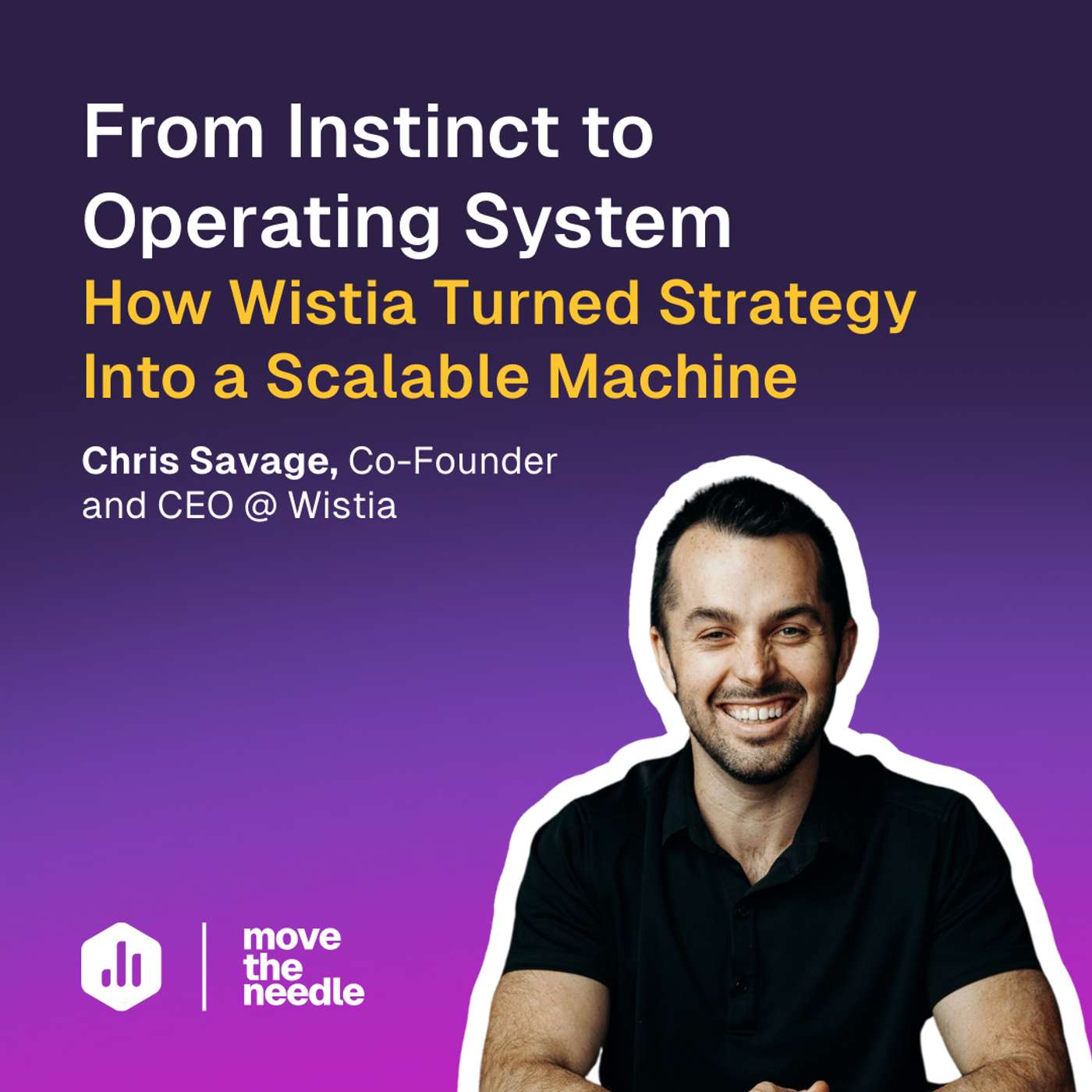 179: From Instinct to Operating System: How Wistia Turned Strategy Into a Scalable MachineMove The Needle · features Chris Savage87 / 100
 Lessons - The CEO Who Refused to Sell His Company at Any Price | Chris Savage - Wistia Co-Founder & CEOSuccess Story with Scott D. Clary · features Chris Savage
 Wins Above Replacement: The New Way to Judge FoundersVenture Unlocked · on ChatGPT88 / 100
 Paul Graham On Startups, Ambition, and Great FoundersY Combinator Startup Podcast · on ChatGPT88 / 100
 The AI-Native Law Firm, with Ryan Walker of General LegalMeeting of the Minds · on Claude88 / 100
 How SSW turned AI into ½ their pipeline - Ulysses Maclaren, COO of SSWSaaS Stories · on Claude86 / 100Google's Gemini 3 Just Prepped My $200K Sales Call in 15 Minutes43 / 100GPT-5.1's 3 Superpowers that No One Is Talking About 43 / 100How I Used Claude Code to 100x My Marketing in 15 Minutes40 / 100Claude Skills- Customize AI for YOUR business in 5 minutes. Here's what no one's telling you.42 / 100OpenAI AgentKit Tutorial: Build Your First AI Agent in 8 Minutes41 / 100