
The Problem With B2B Marketing · 2025-10-16 · 41 min
Key moments - from our scoring
Substance score
51 / 100
Five dimensions, 20 points each
Jason Miller, head of marketing at Jigsaw and former LinkedIn content evangelist, argues that B2B marketing has lost its way by abandoning foundational positioning, messaging, and value propositions in favor of chasing tactics, leads, and vanity metrics. He traces how the industry pivoted from lead generation to big data to storytelling to ABM, ultimately arriving at brand - but only after years of misdirection. Miller contends that marketers must return to basics: define your ICP, craft clear messaging that articulates the problem you solve and value you deliver, establish tone of voice, and build messaging frameworks as guardrails for execution. Without this foundation, content marketing produces noise rather than resonance, driving up acquisition costs and diminishing organic reach. He advocates for three core marketing focuses - brand, community, and demand gen product marketing - paired with a "big idea" that distinguishes you. Miller also warns that the collapse of entry-level marketing roles (displaced by AI and junior positions eliminated during the race for metrics) threatens the pipeline of future marketers, who once learned their craft through editorial rigor or journalism before moving into B2B. For marketing leaders and practitioners frustrated by diminishing returns, this is a case for disciplined strategy before creative execution.
Miller's one-page messaging framework includes the problem you're solving, your ideal customer profile (ICP), messaging, and value propositions. It represents where brand and product strategy intersect, and should be the first thing a marketer defines before any other activity.
He traces a historical progression: B2B marketing moved from lead generation obsession to big data hype, then storytelling, then ABM, before finally recognizing the importance of brand. The focus on MQLs, dashboards, and tactical execution caused marketers to overlook foundational strategy, leaving them pushing out content without clarity of purpose.
Brand, community, and demand generation product marketing. Once these foundational pieces are nailed, Miller argues the remaining opportunity is the "big idea" - a distinctive creative concept that differentiates your company.
Entry-level positions are being eliminated by AI and the pressure to produce immediate metrics, mirroring the collapse of local newspapers where journalists once learned their craft. Miller warns this threatens the pipeline: new marketers have nowhere to cut their teeth and learn disciplined marketing fundamentals before advancing.
Miller redefines creativity as a new way of solving a problem - learnable and improvable, not an innate talent. He argues constraints actually enable better creativity, and that messaging frameworks and tone-of-voice guidelines act as guardrails that inspire more elegant solutions, not rigid restrictions.
Our reviewer’s read on each dimension, with quotes from the episode.
A handful of usable ideas (the messaging house one-pager, swap messaging every 2-4 weeks, AI magnifying inefficiency) are buried in lengthy personal anecdotes, ranting, and recycled 'foundations matter' platitudes.
it's basically just a one-page framework
you should be swapping that messaging out every 2 to 4 weeks. Have a bank.
Most claims are well-circulated B2B takes - brand is making a comeback, get the foundations right, constraints fuel creativity, 'steal like an artist' - rather than contrarian or first-principles thinking.
now it's brand. And brand is becoming more important today
the more constraints you have, the more creative you have to be
Jason Miller is a genuine senior practitioner with 5 years at LinkedIn, time at Marketo, and current head of marketing at a startup, drawing on real operating experience rather than pure thought-leadership.
the 5 years he spent at LinkedIn evangelizing for content
even when I was at Marketo in 2012 at the dawn of inbound marketing
Plenty of named companies and people (Marketo, Eloqua, HubSpot, LinkedIn, Volvo, Liquid Death, Sage, Heather Barnett) and concrete anecdotes, but almost no hard data, dollar figures, or measurable outcomes to back the claims.
It was us versus Eloqua and HubSpot was just starting to get into the picture
the Volvo ad of, which is brilliant, of Jean-Claude Van Damme
The host is engaged and adds substantive framing and his own examples, but largely agrees and rarely challenges or pushes the guest, leaving sweeping claims unexamined.
That's good. Love this.
So how do we get here, right? Why is this happening?
Computed from the transcript - who did the talking, and the words that came up most.
In this episode of 'The Problem with B2B Marketing,' Kevin Sutherland speaks with Jason Miller, Head of Marketing at Jigsaw, ex-Marketo - and former B2B Marketing evangelist at Linkedin - about a specific and critical challenge affecting the performance of content marketing for so many firms. The discussion centres on the foundational issues in B2B content today, including the ‘lost art’ of positioning, messaging, and value propositions. They explore how brands often focus more on tactics over strategy, leading to diminishing returns and increased costs. Jason emphasises the need for a clear messaging framework and outlines the role of creativity and community in building a successful marketing strategy. The episode also touches on the impact of AI - especially on entry-level careers - the importance of passion projects in avoiding burnout, and the necessity of finding innovative ways to
Transcribed and scored by The B2B Podcast Index.
The Problem with B2B Marketing is a podcast for everyone working in B2B marketing and sales today. In each episode, we interview expert practitioners to explore specific problems each of them has faced, from common issues to emerging challenges. By talking to people who have been there and done it, we aim to share with you clear, pragmatic, and actionable insights to inspire you to develop solutions of your own. Hello and welcome to another episode of The Problem with B2B Marketing.
I'm Kevin Sutherland, strategy partner at Volume, a marketing consultancy and studio working with business brands. A big part of what we do is helping B2B brands solve marketing problems, whether that's navigating new opportunities like creator and influencer strategy and campaigns, or overcoming operational challenges like making better use of their content. So we talk a lot about problems, and that's why we launched this podcast. Today I'm joined by B2B marketing polymath, Jason Miller, currently head of marketing at Jigsaw, a tech platform positioned as the future of diagrams.
That's correct. Yes. But you may know him from the 5 years he spent at LinkedIn evangelizing for content and LinkedIn as a marketing channel as a new idea. And in that time, you also launched the thing that first alerted me to you, which was the Sophisticated Marketer's Guide to LinkedIn, which was Seminal.
You might know Jason from his other job as a concert photographer with a strong leaning towards metal bands, right? That's exactly right. Yes. Cool, right?
Look, Jason, you better introduce yourself. I'm sure you'll do a better job than I can. Well, thank you for having me. Yeah, marketer, photographer, create - I don't say creator, but creative guy, I guess.
I don't know. I like to mix music, photography, B2B marketing, and creativity. That's where I live. But Yeah, I was at LinkedIn for a while.
I used to work in the music industry back in the day. Watched that completely crumble in on itself because it was trying to fight digital instead of embracing it. We saw how that worked out. And in preparation for moving into marketing, right?
Yeah. Well, I've moved, I've moved over to B2B marketing and I thought, you know, I was at Marketo and then LinkedIn and I just thought, you know, I'd never thought I'd be a B2B marketer per se, but it's been an interesting ride and I'm trying to keep my, my roots of music through photography and just trying to do some cool stuff and I've been lucky enough to work at some really great startups. Cool. Well, I'm hoping you'll tell us a bit about that today as we, as we talk.
So I said it's the problem with B2B marketing and the problem we're going to talk about today, the problem with content marketing. Okay. Or rather one of the problems with content marketing, maybe it's the biggest problem. So by way of setup, in short, there's so much content, right?
Yeah. But perhaps there's not enough marketing. Or not enough marketing method. There's more focus on tactics over strategy these days.
Demand gen gets all the airtime over brand. Content's clarity of purpose, who it's for, what it's doing, what it's there for, has become a bit clouded over time. People are, or businesses are pushing out stuff over building audiences, relationships, etc. All the stuff you were writing about 10 years ago.
Yeah, right. And we see the effects of this in diminishing returns. We're getting lower reach and engagement for organic content, higher cost to achieve the same results in performance or paid. And when you plug in AI, that's only going to make things worse, right?
So, when we were talking about this in preparation, I took away from that that your take on this is that when it comes to content and B2B marketing, the problem starts foundation, and it starts with the lost art of positioning and messaging. Is that fair to say? Yeah, yeah. I mean, there's so many things to unpack there, but look, I think right now we're having a bit of a crisis, right?
The playbook is dead, which I think is fine because I don't really think there was a playbook that existed for everybody. These blanket statements out there, and it's toxic right now because all the thought leaders are telling you that this is the way you should be doing things, and then they're making you feel bad when it's not working for you. And I think we're all - we all feel a little bit lost that nothing seems to be working. And I think if you take a step back and you look at the most important thing over the past few years, it's just working at startups and starting from zero has really opened my eyes.
And I think the biggest opportunity is just to go back and focus on positioning, messaging, value props, getting that core right. And AI can certainly help you flesh that out a bit and challenge it, try to poke holes in it.. But I think that's the core that we need to focus on as marketers to nail before we do anything else. And I think what I've seen is, is we just tend to overlook that and we just run trying to push out as much stuff as we can, as quickly as we can, trying to hit these false metrics and these blown overblown dashboards or some numbers that really don't, that really don't impact anything.
Well, can we, can we get into that then? And I should, caveat this. This is not gonna be a conversation about definitions or sort of, you know, are we the People's Front of Judea or the Judean People's Front, you know, reference Monty Python. But when you talk about positioning, messaging, value prop, maybe in your sort of straightforward terms, what do you mean by that?
Well, it's, it's, you know, it's basically who we are as a brand, who we stand for, what value we are offering, what problem we're solving, and who we're serving. It's, it's really quite that Quite simple. And there's a messaging framework that I've sort of carried. It's a one-pager and it basically has, you know, the problem you're trying to solve, the ICP, and then the messaging and the value props.
And this is where brand and sort of product kind of come together. Yeah. And then DemandGen kind of builds up that. Yeah.
But you need that, it's that messaging house and it's basically just a one-page framework with exactly what I just listed out there. And I think, you know, maybe you look back at, their persona, right? The persona, personas were big and, but they lived in PowerPoint decks and we never, no one ever really looked at them. You know, even when I was at Marketo in 2012 at the dawn of inbound marketing, right?
It was us versus Eloqua and HubSpot was just starting to get into the picture. I knew marketers there and nobody, like everybody talked about personas. Nobody used them. Nobody.
I don't know anybody who used personas. And I think, you know, if you look back at core messaging houses, if you go, if the first, thing you should do at a company if you're a marketer is say, I need to see the messaging doc, the messaging house. And it starts there. And I think it'll go back to vision and mission and sort of the manifesto and some of these kind of fluffy things, right, that you might associate with brand.
Yeah. Not you specifically, but there's someone. One. Yeah.
That someone might associate with brand. Yeah. Yeah. And I think it's interesting because I don't think you need that right now.
I think if you, if you're a startup or scale-up, or even, you know, many enterprises are just going back to basics. Figure out your ICP. Yep. Figure out your messaging, your overarching messaging at the top of the funnel.
Break it down by value props, what problems you're solving, what value you're adding. Yeah. And start there. I think if you don't have that figured out, then you have no business doing anything else as a marketer, period.
So how do we get here, right? Why is this happening? You know, 'cause what you've just described We deal with, we work with a range of different clients. Yeah.
And often what you're talking about there, you know, your messaging house, what have you, I mean, these are the things that should really be defined in-house, right? Yeah. Because they're fundamental to who you are as a business, et cetera, right? Sometimes we'll come to the table and that's not there.
And you know, sometimes you're being asked to tell a business what they should stand for and how they should tell their customers about it, right? So, but in your experience, how did we get here? How did we get here? I'll tell you exactly how we got here.
In my hypotheses, you know, we started off in B2B at lead gen, lead gen, lead gen all day long. We need MQLs, we need leads, gate everything, we need leads. Then we went into the big data movement. Then we were like, oh, now we need more, we need more data.
Big data was everywhere. It was a big story, like startups, everything, big data. Then we got into storytelling, like, oh, everyone's a storyteller. Now everyone's a storyteller.
Then we figured out how difficult it is to tell a story that anyone gives a shit about. And in a short period of time, right? Then this is where it brings us up to - you could kind of pivot over towards maybe went through a little bit of an ABM thing too, but now it's brand. And brand is becoming more important today.
And that's messaging, that's value prop, that's everything. Everything that your business, you know, is made up of, every single touchpoint is the brand. And I think we're here because we figured out that no one cares about none of this other stuff unless they know who you are and they trust you. And we've - it took us a little while, but I think we're finally coming around.
And I think now you're seeing in, especially in the age of AI, like SEO is like, we're trying to figure out SEO, we're trying to figure out PR. PR, I think PR is making a big comeback, right? But it's about building trust. And these are gonna be some softer metrics.
There's gonna be a leap of faith here. Yeah. Right. In terms of impact.
But I think if you measure that over time, there's certainly ways to do that. It's about trust. It's about recognition. And I think ask - you put a commercial sense on a commercial lens on this.
If your sales team or your VP of sales comes back and says, oh, we don't care about brand, we need more leads. We'll say like, no one is going to buy from you unless they know who you are and they trust you. Right? And I think brand is the answer.
So wrapped up in what you said there, you said you've got a hypothesis or what have you. One of the things I wanted to put to you was if you go back to core principles like positioning, messaging, value prop, and what have you, and they've been around since the dawn of marketing as a, as a management discipline. Yeah. But that, that was an era when, particularly in B2B, your route to market, your channels, your comms channels were effectively advertising and PR.
Yeah. Right. Yeah. And so therefore you had a shorter route between the strategy, the concept, and the tactics or the execution.
, right? Yeah. Whereas now, so far already in this conversation between us, we've mentioned manifestos, storytelling, narratives. I would chuck in North Star, right?
As another concept. You've mentioned ABM, right? The complexity of channel activity, you know, frequency, volume, et cetera. You know, arguably it makes even more sense to be referencing or taking your kind of, you know, your guidance from some foundational principles.
Yeah. And yet somewhere between, you know, the idea and the, you know, generate demand, find us some new MQLs, et cetera, that link has been lost. And it should be the strongest thing in the whole process, right? Yeah.
I mean, well, I think I would, I think it's our own fault. I think marketers are terrible at marketing themselves. I think the value of marketing inside an organization can plummet unless you can, prove value. And I think we lost creative ways of shouting about ourselves.
We were so focused on traffic and MQLs and all these dashboards and CMOs who were over-demanding because they were under pressure by the board that we forgot how to sell ourselves, how to bring back the value of marketing, prove it to the org, not just to one person, but across the org. And I think, you know, you're seeing again the rise in brand I think speaks volumes because I think it's the only thing that works right now. If I were starting off, even if I was a startup, if I had 3 areas to focus on marketing, it would be brand, community, and probably demand gen product marketing.
That's it. That's what I would focus on. Now, nail those foundational pieces and then you're left with the big idea. In the age of AI, what's left?
The big idea. Marketing's big idea. And I don't think we do that anymore. Like, Someone asked me the other day, how many, what's the best B2B marketing campaign you've seen this year?
I'm like, I don't know. And then you look and it's always the same usual suspects. Oh, the Volvo ad of, which is brilliant, of Jean-Claude Van Damme, right? Or 20 years old, right?
Yeah. Or Red Bull. It's always the same things over and over again. And I think every once in a while you'll get 2 or 3, like Liquid Death is all over the place, but like it's really hard to do that.
Mm-hmm. But it's that big idea. So nail the foundation and then go for the big idea and swing for the fences and, And I think, you know, and then celebrate it and sell that idea. I think marketers are a little bit, I think we're a little bit kind of tucked in our shell because we're afraid to put ourselves out there because of failure, because LinkedIn or whatever is telling us success is based on virality instead of engaging with the right people.
And I thought we learned this 10 years ago at the dawn of social. That it's not about likes and comments and plus ones, you know, back in the day, that it's about reaching the right people and resonating with them. And I think we've lost our way there. You touched on, there's a sort of bugbear of mine, which is that question around the most creative or the most interesting or the best B2B campaigns, because I think that's, that's almost, and it's interesting, the examples that you used, right, are almost business organization kind of wearing the clothes of B2C, right?
Yeah. You know, it's a big ad campaign away. And of course, in business marketing, most businesses don't operate like that, right? I think the, you know, what I would say as good examples is where you've got a brand that really knows what it stands for and has a strong, clear, enduring sort of platform.
There's another concept to throw in here, right? And then in all the kind of granular ways in which it shows up, or the, the, the different small kind of activities that it, it, it uses to build its brand, to, you know, to, to reach customers, etc., it, it, it faithfully brings that to life. Or, you know, previous conversation I had in, in this chair is with a guy called Elliot Moss, who's head of brand at Mishkundharia.
And they've got this line, it's business but it's personal, right? And you can see that in everything they do, right? They don't, it's not overt, it's not explicit, it's not rammed down your throat, but it's about featuring people. It's about interviewing, it's about the stories of the people that they work with or that work, you know, are partners in the firm.
And it sometimes it can be as simple as that, I think, right? Well, I think, you know, something I didn't mention around positioning and messaging is like tone of voice, something so simple. Go to any org right now and ask them, ask any person in that org, ask the marketing team if they can tell you the 3 points of their tone of voice or anything about their tone of voice. Yeah, because again, it's foundational stuff.
What you're talking about - I watched that episode, by the way, it's fantastic. But what we're talking about is someone who understands, and you get - you're not giving them - you're not - you're giving them guidelines, right? They're not rigid. They're meant to be - they're meant to be flexed, and you can overstep that boundary here and there, but you need a starting point.
And I think if you put these, and I hate to say the word frameworks 'cause I just hate the word frameworks, but there's some basic frameworks, messaging houses that you have to put in place that set up the guardrails. And that's what you have to work with. And there's this other idea as a, as a guy who loves creativity where there's this misconception that creativity needs, you know, to be unleashed and can't be held back and constraints are terrible. And it's the quite, it is quite the opposite.
I think the more constraints you have, the more creative you have to be how you think about things, solutions. And I think the more elegant or the more interesting the idea can be. And you know, then it falls back to kind of going down the rabbit hole, but it all ties back to content marketing because it's about creativity. And I think a lot of marketers might have said in the past that, oh, I'm not, I'm just, I wasn't born creative.
And I don't think it's an excuse anymore because I think Is it a specific skillset? Not necessarily, not tied to any direct outcome, but you can, it's something you can learn and flex and something you can get better at over time if you're inspired enough or if someone's painting a picture of what's possible or if you're engaged enough with a group of folks who aren't trying to sell you or get you to comment with a fucking emo - sorry, with an emoji to get some, you know, hacked content.
But the new, if you look at the creativity as a, in a new definition, something along the lines of a new way of solving a problem. Yeah, right. I think you open up all sorts of possibilities. I think there's, there's so many interesting points wrapped up in that.
You immediately made me think that the description of, you know, some people saying, well, I'm not creative or what have you, I, I think that's a legacy or a generational thing. I think that if you, like some of us, started your career some time ago, right, the delineation between, you know, what or who was creative and who was not, or had a different kind of silo to sit in, it takes quite a long time to unlearn that, I think, you know, because people inside organizations, whether they're client side or agency side or what have you, are fiercely protective of the fact this is my domain, this is what I do.
You know, so I think creativity or creative as a noun or a verb, right? They're two different things actually. I think it's, you know, look, I think it's really quite simple. It falls back to leadership and in an org.
I mean, I think marketing leaders, if they're not inspiring, if they're not curious, if they're not pushing themselves, then it's going to reflect back. So I think, you know, at LinkedIn, in the early days at LinkedIn, we were smashing it with content marketing. We didn't have any rules like there. And everyone thought that, oh, you work at LinkedIn, they must have this big budget.
And like, no, we had zero budget. Like we were the - we were LinkedIn Marketing Solutions. We were operating like a startup inside of a larger org. And I had this conversation with the head of social media at LinkedIn at the time, a lovely person, but they wouldn't share any of our content throughout the millions of channels.
So we started - we started from zero. Yeah, like literally. And they wouldn't share it because they said it wasn't relevant to their audience. Because, you know, there was, there was the talent search, the HR, the place to get a job.
And we're trying to break into the, you know, the marketing arm of this. So again, I've been there, I've started from zero and we led with, with big ideas and stupid ideas and crazy ideas. And then we executed and we tried to bring them to life in the most, you know, most efficient way possible. But there were no rules and there was no one.
But what there was in place was someone who was inspiring us to keep pushing and keep thinking bigger instead of just checkbox marketing and pushing things out that were good enough, celebrating mediocrity. Yeah. And I think if you look at the org and if you look at LinkedIn, you can see the marketers who are excited and curious and generally pushing boundaries. And then I think you see the ones who want to.
And I think it goes back to the workplace. I think it goes back to leadership. It's, it's a cultural thing for sure. But I think it falls on marketers as leaders and, you know, CMOs are out the door because they're getting the shit beat out of them by the board to produce these metrics and pipeline.
So it's got to fall somewhere in between. And I think there's a massive gap there. Well, I want to come on and talk about that, that, that broader piece about culture and leadership and what have you. But just to sort of wrap up, you know, we've been, we've been kind of talking about the first order consequences here of, you know, not respecting or not returning to the, you know, the discipline and the precision.
The roots, the things that have always worked in marketing. Yeah. And, you know, and I think, you know, we're broadly talking here about the impact that has on your ability to stand out, to be distinctive as a brand, to, and at the bottom line, it therefore costs businesses more to achieve the same marketing outcomes because you know, there is wastage and bagginess and, you know, and a lack of focus on what they say and who they say it to, right? Yeah, yeah.
Let's talk about that, so the second and third order consequences, because it isn't just, it isn't just the, you know, the bottom line that's affected here. It affects entry-level marketing careers. Yes. Oh God, it's scary.
I mentioned generational before, right? You know, you know, lots of us came at this with a set of kind of learned disciplines and what have you. I'm not so sure that if you are, you know, because actually to be a content marketer in the sort of first or second wave of it, right, you typically either came from a marketing background. Yeah.
Or a journalistic or editorial. Yeah, yeah, yeah, yeah. Right. And both of those, both of those kind of, you know, they are, they are not the same.
You know, I've, I've had several disagreements, you know, as a consequence of starting in a different place. But both of you come at this with a set of values and disciplines and this is, you know, this is how it works, right? I think if you are socially native, right, and the act of creating content, distributing it, you know, and what have you, is as natural as breathing in and breathing out, you come at it in a slightly different way. Have you, have you got, have you got a perspective on this?
Firsthand experience? Tell me about it. A, my, a family member of my wife's in, in the States, where I'm actually heading to on Friday, Works at a major newspaper. He was an editor and he told me they're having trouble finding journalists because all of the local papers where these journalists would cut their teeth have shut down.
And I think the same is happening with marketers now with AIs replacing these, these entry-level positions. So where does a, where does a marketer learn? Where do they cut their teeth? And I think, look, I kind of think there's two ways you can think about this.
One is you could say they're fucked. Can we curse on this? Does that - You can say whatever. One, you could say just everyone's fucked, right?
The other way is you could say, and it's equally as bad in some circles, you're gonna have to work for free a little bit. Now I'm not saying work for a company for free, maybe, but you're gonna have to put the work in, right? When I transitioned from the music industry, a dying music industry, into B2B, I had zero experience. And so I started a blog.
So I started ramping up Twitter. I did everything I could. I chased down and I did guest posting and I found some speaking slots and like I hustled, like I really busted my ass and I was working because I was building something for myself because I didn't have the experience. I had to create the experience or at least create the idea that I could sell to someone that I could do this.
And so you're exactly right. I think if you can figure out short-form video, if you can figure out how to express yourself, your ideas very quickly, in a creative way, if you can figure out how to use AI to amplify that, to boost your thinking, to give you new ideas, to take old ideas and recycle them into new ideas with your spin on them, you're going to be fine. Yeah, right. But everyone's just sitting there complaining that their content isn't going viral and they're bitching and moaning that, that they need a fast track to hack the algorithm.
And it's just completely backwards. Like, if it was easy, everybody would be doing it and everybody would be successful. Yeah. But it's hard, it's really hard.
And we always take a dump on these influencers because they have a built-in audience or whatever, or they came from, like, it was the Hailey Bieber thing. Everyone was dumping on Hailey Bieber. Like, I don't know much about this, but I do know that she put the work in. She did what tons of VCs have been trying to do with a brand with the same amount of budget and reach and didn't do.
So I think we're just too easy, it's so easy to blame everyone, like, like the people who come from privilege and the algorithm, this and that, instead of just rolling up your sleeves and getting excited about creating things and testing and, and trying to do this yourself. Yeah. Building a story. Now it might sound like I'm coming from a privileged background.
I have time now because I make time for it and I'm in relatively good health besides the concerts and a few pints here and there. I got kids, I got a busy life, but my point is Carve out time. Yeah, stop fucking doom scrolling, stop moaning, and put the work in and see what happens. You'll probably be surprised.
You'll learn something and you'll generally be happier, I think, in the end. And you'll future-proof yourself against AI. Yeah, sorry, that was a fucking rant. That's good.
Love this. I mean, I, I'm sitting here thinking, you know, I mean, obviously you're talking about that in terms of, you know, how you, how you replace, or how you - if you didn't come up through marketing school or journalism school or what have you, how do you, how do you get How do you get moving? How do you do it right? You know?
And that experimentation and graft and what have you. I mean, there's no substitute for that. You're absolutely right. I actually think that the same advice applies to lots of businesses that are probably budget constrained at the moment.
And you know, I'm not trying to shoehorn this in here, but we know that, you know, lots of businesses are, they don't have the budgets they used to. And the principles of, being really clear about what you stand for, being really clear about who you are and what you say and the promise you make, etc. And then being smart and experimental and ambitious about how you get that message out there. And it's a lot of trial and error.
But if you have the foundation and you have the guardrails in place, then you can't really miss. Something will hit. And when that hits, double down, triple down, right? But I don't know, like, it's a little bit about reinvention.
And I think it applies to brands, it applies to people, it applies to marketers. You know how I got into concert photography? Like, I photographed bands that I'd never - like, I photographed the Sex Pistols, my all-time favorite band in the world. Like, I've been in photo pits with some of the most world-renowned photographers.
How did I get here? I started off from zero and I just started pushing and trying and learning. And again, I think the reinvention, it's hard, but it should be fun if you, if you make it fun and if you have an end goal, right? I mean, when I first started photography, I was, you know, moving, moving from - was a B2B marketer at a startup in San Francisco.
And I remember I'd never photographed a band before. I never even picked up a camera. The first picture I ever took was Mötley Crüe, and it was a giant white flash with a bunch of fists in there. It's great for a a background slide as a PowerPoint template.
But other than that, it's shit. But, you know, I missed this opportunity. And so it gave me the energy and the goal to like, I want to get better, I want to master this. And but yeah, I was in the pit and it wasn't easy.
Like it was networking, super essential for marketing. I was standing at this gig in San Francisco. I'm not going to tell you who the photographer was because we're kind of friends now, but I look at him and I said, hey man, what ISO are you shooting at? He goes, fuck off.
And I'm like, okay, that's how it's gonna be. But you know, like years later, it's like 10 years later, if we have time for this little story, 10 years later, creative, oh, let me just say something about passions in a second. But 10 years later, I was at the Foreigner concert, Foreigner and Whitesnake, it was Whitesnake's final show. I love Whitesnake, right?
And I was only approved to shoot Foreigner and not Whitesnake, and I was devastated. And there was like 10 or 15 other photographers at the O2, uh, in London here. And I remember, uh, one of them looked at me, and this guy, Photographer of the Year guy, and he said, oh, you can't - you didn't get approved to shoot Whitesnake? I said no.
And he said, he goes, we got you. And so they huddled around me, and so that they couldn't see that I didn't have the right pass, and we all waddled in like, like like, like, like penguins, like into the photo pit. And I got to photograph them. So it went from fuck you, fuck off to we got you, you know?
And I thought that was when I knew I found another passion community. And to tie that sort of passion project back to, back to content marketing, back to any type of marketing. Yeah. This is the one thing I think is really overlooked and it ties back to the creativity and just being inspired and curious.
Having something that you're passionate about, like, I think it helps with burnout too, right? So it gives you an outlet. And I think that's something that's so overrated. We're so much pressure to do so many different disciplines of marketing, and there's no outlet outside of doom scrolling, right?
And it's depressing. But I think if you can find that passion, something you're really - and combine the two, even better. But it helps prevent that burnout, which I think a lot of us go through. Well, you're, I think you're quite a rare beast in that, you know, there's not many people that would claim passion for business marketing or B2B marketing.
In fact, someone once said to me, you know, nobody gets up in the morning to, you know, to go and work in B2B marketing. They do though. They do. Well, that's good because that means there's a clearer road ahead for us.
But I actually wanted to talk, pick up on one of the other words that you used because you used it earlier. You were talking about sort of like 3 things that really matter and you mentioned community. I know you've just been talking about community in the true sense of it in terms of your passion, you know, etc., in terms of music.
But community is one of these concepts in B2B marketing that gets talked about a lot. But there are even fewer, I think, famous examples. Done very poorly, executed very poorly, yes. Salesforce or what have you, the obvious, the big and obvious ones.
Just tell me a bit about your sort of perspective on community as a strategic opportunity for a business brand? This is interesting. So it goes back to reach and it goes back to the right people and it goes back to, I think, especially in B2B, we just talked about Salesforce, right? I think Salesforce is one of the few examples out there, the, you know, another Red Bull example kind of thing.
But it's how do you build a community of users, customers, whatever, people who are interested in your product. But, but it's also, it's a support mechanism at first, right? We all know that. But how do you build out that more of a belonging, like bringing people together with similar interests.
So I don't think there's a lot - I've had - I think I've - I wanted to do this forever, but I've just never had the - the photography took over. But I think the beautiful thing about community is if you post something, if you post a question on LinkedIn, you'll get responses of people trying to flex, trying to one-up each other. If you post that same question in a closed community that's monitored well, you'll get genuine people lining up to help you out. And lift you up.
And I think that's the biggest difference. Now, I think we also confuse community with size and engagement when it's more about bringing people together into a space who share similar traits. And I think they, they want - people like B2B marketers want to do that. They want to be closer to - I want to be next to other Nikon users, but they don't make it easy.
No. And I think, you know why they don't? Because it's fucking hard and it takes a lot of work and it takes a lot of creativity. It takes a lot of, it takes a lot of failure.
And I think people just give up too soon. So community is, is so critical. It's an investment I think to be done by every brand, no matter who they are. Smaller the niche, the better.
Yeah. The more underserved they are. That's the key. Ask yourself this, are there customers, prospects, friends, who are underserved.
That underserved audience is waiting for somebody to bring them together, you know, and I think it's a massively underutilized tactic. It turns into a support arm instead of something bigger. Yeah. You touched on AI earlier, and I wanted to share a quote that was actually shared with me by somebody called Beatrice Whelan, who's global head of content at Sage.
And we were talking about AI and the impact on on content, and she referenced this Bill Gates quote from his book, The Road Ahead, which I think sums it up beautifully, right? You know, particularly when we were talking about get the foundations right. Yeah. He says, the first rule of any technology used in a business is that automation applied to an efficient operation will magnify the efficiency.
Guess what? The second rule is that automation applied to an inefficient operation will magnify the inefficiency. So, unless you've got those foundations right, particularly at a time when we know for all sorts of reasons - cost, you know, experimentation, efficiency - lots of organizations are turning to AI to do the things that maybe would have been done manually previously. Unless you've got those foundations absolutely right, yeah, you know, what is our positioning, what messaging do we use, etc.
, then the risks of amplification of bullshit. Yeah. Are, you know, real, right? Yeah.
I think, I mean, you can see this. I think you can see this right now. If you go to any, any AI startup right now and look at their website and like try it, like, what the fuck do you do? Like, it's so vague, but it's so aspirational, but it's like, literally, what do you do?
I have no idea what you do. Yeah. And I think that's sort of hitting a peak right now. We're going to - there's a big backlash.
And so it ties back to that messaging. But again, You should have this figured out and then you should be able to take that messaging and use AI to help amplify that core messaging into variations and then test it. If you have a website that's getting traffic and you have a marketing team that's curious and interesting and doing what they should do, you should be swapping that messaging out every 2 to 4 weeks. Have a bank.
AI should help you create a bank of messaging based on the core value props that you can swap out and test. Push it, twist it, you know, poke holes in it, put a prompt in there that has a comedian roast it. Like there's so many different ways, but it's the creative input and how far you push that. Just like an intern or a junior marketer should be pushed, you know, out of their comfort zone.
How do you push that AI to get these variations that are interesting and something you would've never thought of? That's what's most interesting to me. And I think, again, it's back to the foundational stuff. If you don't have that, then you're flying blind.
Absolutely. Your point about it's not just startups, right? There's lots of big corporates that are guilty of this as well. That, you know, lack of clarity about what is it you actually do.
Fluffy messaging. Two things on that. Your old place, LinkedIn, which now has a fancy institute, right? As you know, right?
And they invest a lot in research. They published a bit of research last year all about the promise to the customer, which initially I was like, is this going to muddy the water, right, further? We got yet another way of describing things. But actually, as it was applied to campaigns mainly, I thought there was a lot of sense in that.
Just be clear about what it is you are promising, right? You know, and there's something about the simple language of that as opposed to you know, positioning a message. My first question was, what do we mean by that, right? Yeah.
Whereas there's no ambiguity about what your promise to your customer is, right? So anyway, that's, that's, by the way, the other thing is there is a, a B2B creator, very active on LinkedIn, called Heather Barnett, who quite effectively spoofs the language. Oh, I know. Yeah, I know her.
Yeah, yeah, yeah, yeah. So she's quite funny. Yeah. So her, one of her recent posts are really I really liked, she sort of imagined that if B2B was like going into a retail experience and you walk in and you say, hi, what do you sell here?
And we'll put a link in, but it's like, well, you have to guess, right? You know, and I think one of the quotes was about partnering with customers to deliver end-to-end solutions that unlock business growth. And the thing is, we're laughing, right? But we've seen this, right?
You see this out in the world. It's funny because it happens and we've all seen it. It's funny you bring her up because She's interesting. She's in my feed.
I've never met her before, but we're connected. And I just - when the first time I saw her video, I just thought, the fuck is this? And then I watched them going, it's, it's weird, but it's funny, but I can relate to it. Yeah.
And now she's in my feed all the time. But I'm just thinking, if, if I were her, that must have took a lot of, like, courage to put that out there and get approval, you know, from LinkedIn. But that's what it takes. Like, you know, you got to put yourself out there.
I know people are scared to death to be on video these days, but yeah. Well, speaking of the jargon, so, you know, I, I, I tell you, I feel like I'm the sharpest marketer I've ever been in my, in my career at the ripe old age of 36. We'll edit that out. But, and it's because the last year I spent in legal tech, I know you guys work and have some, some business in legal tech as well, but I report to a lawyer, an ex-lawyer, an ex-Magic Circle lawyer.
And I'll tell you what, every - like, every single word has to carry weight. It has to say what it does on the tin. Yeah. My copywriting skills have gone up 100x because I've been put through this test.
And what I thought - I was a good marketer, I thought I was a good copywriter. I'm 100 times better because I went through this process and I had a lawyer. And, you know, this is their - this is what they do, that every single word in every single message, every single touchpoint. It's not volume.
It has to carry its own weight and it has to say something that's clear. And I tell you what, it, it, it, this is, these are the things like I do wake up in the morning, I get excited about this. Yeah. Because there's a challenge that takes a creative person, a creative angle, but I can do it.
I know I can. I know my team can do it. And I know all the marketers listening to this, you can do it, but find the challenge. Challenge yourself and solve it and crush it, you know.
And but don't phone it in and don't get too - oh God, fucking ChatGPT went down the other day. I thought Twitter was gonna have a heart attack. People were literally saying, I can't do my - people weren't there, like, they're kidding, they're kidding. But people are like, I cannot do my job.
Yeah, that's the scariest thing I think I've seen. Yeah, since AI. Well, look, we always wrap by asking, you know, what's the one thing that you, you would advise people to do? I think you pretty much answered that, you know, don't phone it in, you know.
And I mean, short of finding a lawyer as a client, right? I mean, look, just imagine there's one on your shoulder, right? But the one thing I would say, the one thing that no machine, no AI will ever be able to beat you at is flexing your creativity and your ability to come up with a big idea. Certainly a great copilot, certainly a great, you know, partner.
Someone called called it a collaborator the other day, and Scott Stratton got involved, said, you can't collaborate with a machine. I'm like, yeah, go, go. Anyway, but it's just like, just be curious, and just every - everything you do, just try to find the best, most creative solution that you can do and be proud of it. And I think that's the thing.
Lead with creativity, be curious, find that pool of people who inspire you and study them, right? David Bowie once said - there was a He was backstage, I think, at the Eventim Apollo in the '70s, and some reporter came up to him and said - this is the peak of Ziggy Stardust, right? And said, David Bowie, are you original? And he said, the only art I'll ever study is stuff that I can steal from.
And I think if you do that in today's - I mean, we all know that AI is kind of remixing and stealing on its own, but that's not to stop you from finding the stuff that inspires you. Pull from that inspiration, put your own spin on it, push it forward, show your work. But yes, you have to steal like an artist, if you will. Austin Kleon's book is fantastic for that.
So yeah. Final, final question then. Yeah. You've just outed yourself as being passionate about B2B, right?
Yeah. We always ask, this is about problems. What problem do you want us to go off and ask somebody else about? And more importantly, what the answer to it?
I think something that I would like to see somebody dive into is the issue of burnout and staying inspired. I think, you know, I think I certainly have my, my sort of rituals, if you will, for staying inspired. And they're very - I think they're replicable, but they might be unique to me in certain instances. But I would say find - there has to be sort of someone out there, a coach of some sorts, who focuses on, you know, staying inspired and battling imposter syndrome and preventing burnout.
That's kind of what I think is We can talk about tactics and creativity and, you know, platforms all day long. But if you're not in the right mindset, maybe it's a mental health thing. I think it's more than that, but I think that's what I'd like to see. Right.
We'll make it happen. Jason, thanks very much. Yeah, thanks for having me. Big fan.
Really appreciate it. Thanks again.
Other episodes covering the same guests and topics, from across The B2B Podcast Index.
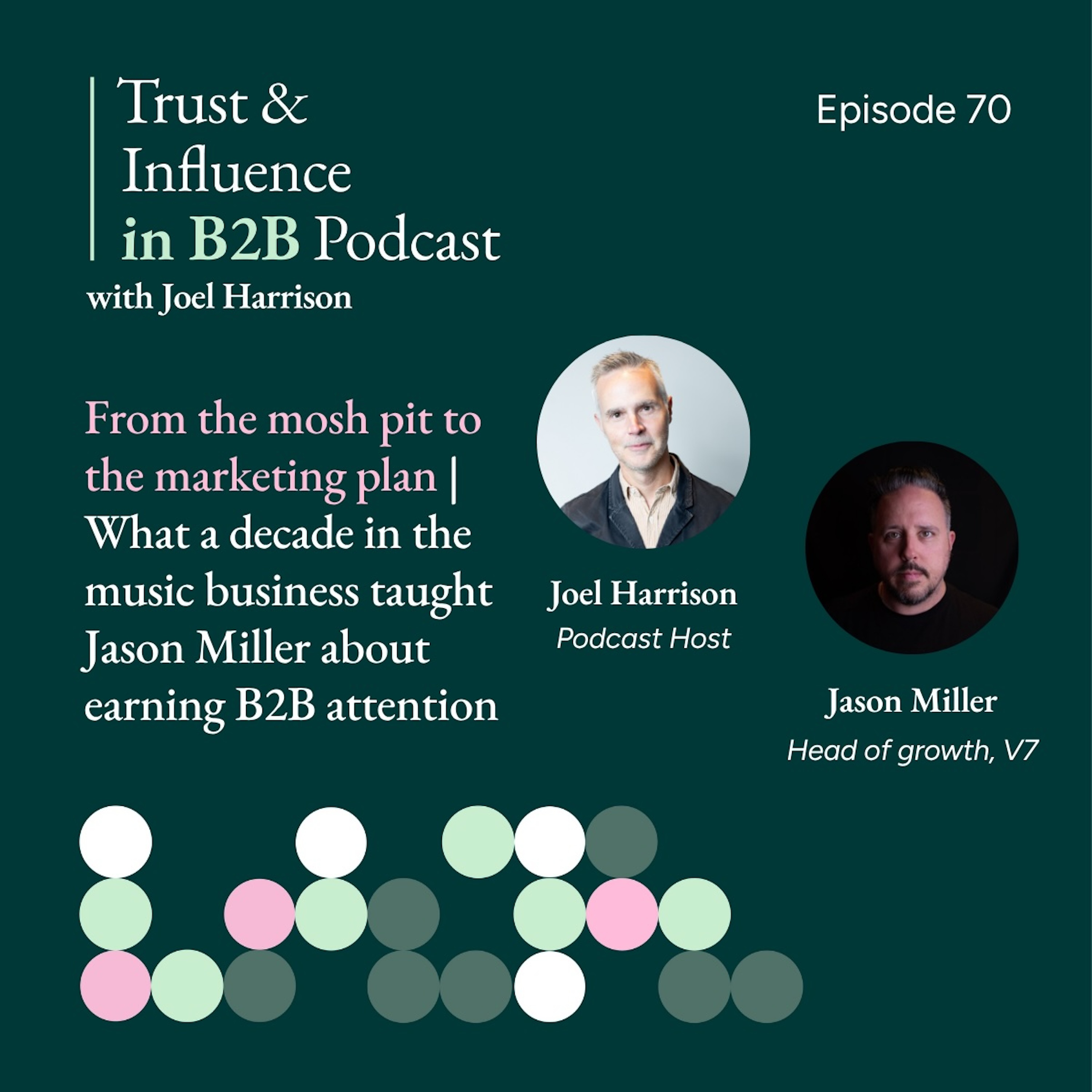 From the moshpit to the marketing plan | What a decade in the music business taught Jason Miller about attention in B2BTrust & Influence in B2B · features Jason Miller81 / 100
 Drive Impact Through Systems Like an AI-First PMMProduct Marketing Adventures · on ICP (Ideal Customer Profile)87 / 100
 Cutting the cost of Customer Success by 70% (without layoffs), with Jim Richmond, CCO of SmartlingThis is Growth! · on ICP (Ideal Customer Profile)87 / 100
 What I Wish I’d Known About Sales With Tom HappeB2B Sales Playbook · on ICP (Ideal Customer Profile)79 / 100
 Best of Build Mode: Think like a VCEquity · on ICP (Ideal Customer Profile)78 / 100
 Part Three: The Revenue Logic of Customer ObsessionC-Suite Sales & Marketing Perspectives · on ICP (Ideal Customer Profile)77 / 100
 Episode 14, The Problem with… Legal Marketing: Special live episode with the Legal Marketing Association71 / 100
 Episode 12 Elliot Moss, Mishcon de Reya: The Problem with Brand in B2B86 / 100
 Episode 11 Dom Hawes, Selbey Anderson: B2B Marketing is “looking in the wrong direction”71 / 100
 Episode 10 Pip Jamieson, The Dots: The problem with building a community that delivers ROI78 / 100
 Episode 9 Matthew Magee, Pinsent Masons: The Problem with B2B… Thought Leaders