
The Climb · 2026-06-09 · 27 min
Key moments - from our scoring
Substance score
33 / 100
Five dimensions, 20 points each
Bhavesh Ratanpal, a Canadian product leader and author of Product Ashtangi, discusses how to transition from individual contributor to strategic leader by blending yogic philosophy with product thinking. The conversation centers on shifting from capitalist KPI-driven product development to user-centric, empathy-driven creation that solves actual pain points rather than chasing features. Ratanpal shares his personal journey - leaving India 15 years ago with $800, pivoting from recruitment through project management into product leadership, then studying yoga in Rishikesh to fundamentally reshape his approach. He introduces the eight limbs of Ashtanga yoga (yama, niyama, asana, pranayama, pratyahara, dharana, dhyana, samadhi) as a framework for building confidence and clarity, emphasizing that expertise and consistent practice (abhyasa) lead to mastery and liberation from self-doubt. The episode addresses how high-performing individual contributors can overcome hesitation and build leadership confidence through perception shifts, deep practice, and stable decision-making. Practical examples include migrating legacy weblogic applications to cloud infrastructure and building governance-focused strata management software. This resonates with technical product managers, engineering leaders, and career-transitioning ICs seeking confidence without abandoning technical depth.
Confidence emerges from deep expertise and consistent practice (abhyasa) in your domain. First, change your perception of what's possible, then practice solving problems so thoroughly that you become a subject matter expert, which naturally liberates you from self-doubt and uncertainty (vairagya).
A feature mindset focuses on shipping capabilities and metrics, while a value mindset prioritizes solving actual user pain points and creating empathy-driven solutions. Ratanpal's example: choosing Terraform over the more elegant Kubernetes because it solved the weblogic migration problem sufficiently at 8 out of 10 quality - avoiding wasted effort on unnecessary perfection.
Ratanpal recommends acting like a tortoise - retracting into a strong inner shell of clarity about what pain point you're actually solving, similar to how Krishna advised Arjuna in the Bhagavad Gita. This protects your roadmap from distraction and attachment-driven vrittis (mental patterns) that derail focus.
Product teams focus heavily on success metrics and capitalist KPIs while missing empathy for user pain points. This missing empathy happens when mindset is driven by financial outcomes rather than spiritual KPIs - the deeper purpose of serving users' actual needs.
Before you can deliver high-quality products or leadership, you must work on your own inner state, discipline, and clarity. Unless you develop yourself - your perception, stability, and empathy - you cannot deliver the quality you aspire to create for others.
Our reviewer’s read on each dimension, with quotes from the episode.
The episode runs 27 minutes but delivers very few non-obvious ideas for a B2B operator; the bulk of the content is yogic philosophy loosely applied to product thinking, with the host consuming large chunks restating what the guest just said. The one technically grounded story (Weblogic migration) is the exception, but even it trails off without a clear business outcome.
you are your own product and unless you don't work on your own self, you will not be able to deliver the highest quality that you are anticipating to deliver
you need to make your product 8 out of 10 and the amount of effort that is needed to make your product 8 out of 10, it's same amount of effort needed to make it 10 out of 10
Blending Patanjali's Yoga Sutras with product management is a genuinely unusual framing that you don't see recycled on every B2B podcast, and the 'capitalist KPIs vs spiritual KPIs' distinction is mildly provocative; however, the underlying advice (practice builds confidence, empathise with users, filter noise) is entirely conventional once stripped of the Sanskrit vocabulary.
when the mindset is driven by the capitalist KPIs and not the spiritual KPIs, that is when the empathy is missing
abhyasa vairagyam tanerodha. So tanirodha is like you are liberated from your bodily problems
Bhavesh is a genuine practitioner - real immigration story, hands-on legacy migration work, actively building a product - but he is an early-stage consultant/author promoting a book rather than a scale operator from a recognisable company, and the episode doubles as a services pitch for Expert Incorporated.
we had to migrate those weblogic applications from on premises to cloud and there was no product that existed. Even Google did not have that product
I'm providing fractional product management services and product management coaching as well
There are a handful of concrete details - $800 on arrival, the Weblogic-to-Terraform-vs-Kubernetes decision, a Strata governance app targeting a May launch - but there are no business metrics, no user numbers, no revenue figures, and no named employers or clients, leaving most claims floating at an abstract level.
I came with, what, $800 cash in my pocket
there was a Terraform and there was a Kubernetes option. And Kubernetes felt more elegant. But Terraform solved the problem
The host asks topically coherent questions but never follows up, pushes back, or challenges a vague claim; instead he repeatedly paraphrases the guest's answer at length before asking the next question, consuming several minutes of airtime with summaries rather than probing for depth or evidence.
So uh, I think what I am understanding is whenever you are building a product, very seldomly it happens that the user's uh, mindset is kept into forefront
Wow. What, uh, a great analogy you brought in with the tatas. You know, we need to create a shell like a tarta is on our personality so that we can get rid of all the noise
Computed from the transcript - who did the talking, and the words that came up most.
Master the Transition from Individual Contributor to Strategic Leader . Rahul Karan Sharma and Bhavesh Ratanpal reveal the Product Ashtangi framework to build confidence.Ranked in the Global Top 1.5% , The Climb Leadership Development Confident Leader podcast is the definitive executive guide for Leadership Development and Business Growth . In this episode, seasoned tech strategist and author Bhavesh Ratanpal sits down with Rahul Karan Sharma to solve a critical corporate gap: why technically brilliant individual contributors fumble when stepping into high-stakes management roles. Moving from immigrant survival jobs with just $800 in his pocket to commanding AI architecture pipelines, Bhavesh reveals how to apply ancient yogic principles to modern product strategy. Learn how to transition from a feature-driven mindset to a value-driven outcome, handle chaotic stakeholder feedback using the "Tortoise Shell" strategy, and understand why you are the primary product you need to manage. [Key Lessons & Why You Must Watch] The Perception Shift: Learn why confidence isn't born - it is earned through systematic repetition and deep clarity.
Transcribed and scored by The B2B Podcast Index.
Rahul Karan Sharma: In the fast world of tech, we often talk about framework data and roadmaps, but we rarely talk about the human being navigating them. My guest today argues that true leadership isn't just about the product you ship. It's about the inner discipline and confidence you cultivate. Hello, and welcome to another awesome episode of the Client Confident Leader podcast. I am your host, Rahul Karan Sharma, and I'm dedicated to helping leaders moving from being invisible to becoming an influencer. Our guest is a Canadian product leader, AI consultant, and author of Product Astangi, a Framework Blending Yogic Wisdom with Modern Product Thinking. Born in Mumbai and raised in Vadodara, Uh, his journey from immigrant survival jobs in Toronto to becoming a thoughtful product strategist that shaped a philosophy rooted in clarity, intention, and ethical creation. On that note, ladies and gentlemen, please welcome seasoned product leader and the author of Product Astrangi, Bhavesh Ratanpal on the Climb Conference Leader podcast. Bhavesh, how are you doing today?
Bhavesh Ratanpal: I'm, um, good. I'm super energetic. Rahul, thanks a lot for this energetic introduction.
Rahul Karan Sharma: I'm glad that, uh, we are here and, uh, I'm also glad that your book has been published, uh, out in the market. Very excited to see the success that it will get to us as readers as well as to the community at large. I'm excited for our discussion. Before we dive in, uh, Bhavesh, I, um, would want our listeners, uh, to know more about you. So, uh, what made you write the book and how you reached today where you are, what kind of mindset shift you had to go through in becoming the person you are today?
Bhavesh Ratanpal: Bhavesh, first of all, Rahul, thanks a lot for the opportunity to come and speak on your podcast. I have been your follower since a while now, uh, to start talking about my journey. In fact, today is that auspicious day I was telling you about, right? 15th of January is when I left India on 2011, and on my first page of chapter zero also, that's the date that is being captured. And today, on 15th of January, we are interviewing for this podcast. So, yeah, it's serendipity. And, uh, Today I finished 15 years in Canada, so, yeah, and when I came over here, I came with, what, $800 cash in my pocket. And, uh, the journey has been with its ups and downs, I'd say. But when the bigger picture, you know, when you're trying to solve a jigsaw, at that, at the starting, you have all the pieces around, but when the whole jigsaw is solved. You're like, ah, uh, that's the reason I was here. Right. So that's, that's how I have been feeling. To talk about, I would say my high level experience. I was in Toronto. I came as a student for a project management course. I have a bachelor's in statistics and I did postgraduate in uh, computer science. And then I would say there was a journey of initially being a recruiter and then from, from there I pivoted into project management and then product management. 2021 was the pivotal time in my life when I decided to buy my one way ticket to India and I ended up going to Rishikesh to learn the yogic, uh, perception of life. And I would say there were some incidents, I would say personally and professionally that changed my direction from just focusing towards the work that I'm delivering compared to working on my own self before I deliver something. Because I realized that you are your own product and unless you don't work on your own self, you will not be able to deliver the highest quality that you are anticipating to deliver. And that led me to write the book Product Ashtangi and that's the clarity that I'm trying to bring over here through this book. Wow. Wow.
Rahul Karan Sharma: Excellent. So golden nugget dropped in by Bhavesh. You are your own product and it's important for you to focus on yourself because no one else will focus on you. So uh, thank you. On that note, uh, Babish, every author starts with a core frustration that they want to solve. When you sat down to write your book, what was the most common misconception you saw people holding on to that you felt absolutely compelled to correct it.
Bhavesh Ratanpal: I realized that um, when a product manager or when product people are contributing their day to day activities towards the development of the product over the life cycle, we are so focused towards the success metrics of the product that we do not, uh, focus on what is the impact that we are going to create on the user. At the end of the day you need the empathy for the user's pain point basically. And that empathy I saw was missing. I would say when the mindset is driven by the capitalist KPIs and not the spiritual KPIs, that is when the empathy is missing. M and that missing empathy made me realize that there should be uh, there should be a junction where the ancient philosophy of yoga and Bhagavad Gita that explains how to have that stable state of mind while bringing the best of the quality of you onto the table so that you can serve what you are supposed to serve, what you're born for. You can serve your purpose basically.
Rahul Karan Sharma: Right.
Bhavesh Ratanpal: And to serve that purpose you need that clarity and you need that empathy for the user's pain point.
Rahul Karan Sharma: Wow. So uh, I think what I am understanding is whenever you are building a product, very seldomly it happens that the user's uh, mindset is kept into forefront. And I would not say everyone, I mean there are some great companies who are building that product keeping the customer in mind. But in your experience you notice that they were too much focus on the product and they miss that. That concept, uh, of the empathy from the user perspective.
Bhavesh Ratanpal: Yeah. I realized that the product eventually becomes the capitalist KPI tracker. You know, you track so much from if there is a money generated out of the product that the um, the experience of user takes the backseat actually. And that is where you need to. I'll give you an example. So most recently I'm um, I'm also the vice, I'm building Strata and I realized that uh, the Strata management software that we were using was mainly focused towards the values that it provides to the Strata management company. But technically as a council you need governance in picture, not management. So I started building an app for the governance point of view and I'm going to onboard my council by mostly next week and hopefully this product will be out by May. And um, so with the AI out there, if you have empathy um, for the user and if you have resolution to solve the pain point, you just start doing it and you will have a product out there. Getting a product out there in the market is not that difficult. But solving the pain point is the key over here. And what my book talks about is how can you have that mindset to solve the pain points so that you have a stable state of mind while solving those pain points. Because what happens, if you don't mind me elaborating on this is one of the things I'm explaining in the book is you think of the pain point of the user as a rose and your product is the crystal. And you as a product manager, when you're observing the product, you know the product is a crystal and you see the color of the crystal through the rose. You think it's red because the rose is red. But once you realize you, you have a product Ashtangi point of view, you take yourself away. Rather than an experiencer, you look as an observer and that's when you realize that these pain points are just solving um, the spiritual KPIs that I need to fulfill. Right. So that's, that's the perspective that I'm bringing it through through the book.
Rahul Karan Sharma: Excellent. So, so your book is just not another book. It's basically solving the pain point from a perspective of a product leader. Listeners don't uh, just go and just take uh, the sneak peek of the book but focus more on how you can be more calmer, how you can take a step back as a product leader and focus on the pain points that you normally have on your day to day life. That would be what product Stangi will be bringing out on the table, focusing on that exact pinpoint that we normally get on day to day basis. So thank you for penning this book, uh, Bhavesh. We really appreciate that. I just wanted to share another uh, observation. So in my workx I've observed that the high performing individuals, or we call as a hypo, they are very good when it comes to their own numbers. They are technically brilliant, but they are hesitant. They lack the confidence that they need from moving from individual contributor to probably a leader. Now from your experience, what is one specific exercise or probably a mental shift from our book you can share that a reader can just turn their existing expertise into more confidence. Uh, per se.
Bhavesh Ratanpal: Yeah, I have talked about it actually. You know, so in Yoga Sutra there are eight limbs of Ashtanga that have been explained by Patanjali in Yoga Sutra. And that's how the, I have borrowed the term Ashtangi from there. Right. And one of the most important aspects, so it says that out of the eight limbs are yama, niyama, asana, pranayama, pratyahar, Dharana, Dhyana samadhi. So Dharana, Dhyana samadhi. These three are the spiritual limbs and the first five are the physical limbs. So when you have to transition from physical to spiritual, the first impact is Dharana, the perception. So first thing you need to change is perception. If you want to change anything, even if you want to um, break the mountain, the first thing is you have to change the perception that I can break the mountain. Right. So if you want to move it, if you, that's how it happens. So uh, that's, that's the first thing I would recommend. And the confidence would be earned when you have more clarity. Confidence emerges when you expertise into something so deep, you practice something so deep that you eventually are liberated from all the problems around it. And you have the, you, you become the subject matter expert of it. Right. And that is another Yoga sutra that Patanjali talks about, and I have talked about it in the book as well. So you keep practicing. Abhyas is the practice and vairagya is the liberation. So with more practice, if you are solving a problem and you're technically sound, but you don't have that leadership, uh, quality, the leadership quality will automatically come when you have the clarity. You become the subject matter expert of that particular problem that you're solving. And that's the sutra. It says, abhyasa vairagyam tanerodha. So tanirodha is like you are liberated from your bodily problems and that's what happens.
Rahul Karan Sharma: Wow. So, um, your, your explanation just took me back to my college, uh, days, MBA days when we used to present. And one of the observation I had is whenever there was a topic which was probably near and dear to our, uh, friends, it was a cakewalk for them. But whenever there was a topic where they really need to study, they really need to do more research. They, their presentation, their confidence used to fumble. And what you just mentioned is your, uh, confidence will speak more when you practice more. Your confidence will speak more when you do things flawlessly. Your confidence will fumble when you are not sure about yourself, when you do not have proper knowledge whether it could be the job that you are doing, it is the sports you are playing, or for that matter, the skill that you are developing. So thank you for bringing that up. And I think it's very, very important in today's world, uh, a lot of people are losing confidence just because they don't see the result. And as we were talking earlier, before our conversation, the bigger thing when it comes to confidence also apart from perception, is the consistency. You know, how consistent you are in doing what you are doing. Uh, perception is the key. As well as you are doing it consistently, you will see the results coming in. So all, all of our listeners who are really struggling to build confidence, the first thing I would recommend, as Bhavesh mentioned, change your perception. When you change your perception, things will start moving for you. All right. Now, um, another, uh, thing I learned during my research about products strong is that one of the core theme is moving from a feature mindset to a value mindset. Now, Bhavesh explained to us, how does shifting our focus from what we are building and toward the value of what we are providing, which is the outcome, help someone with more authority or confidence?
Bhavesh Ratanpal: Let me put it in words. So while you were framing the question, I was thinking about one of the experiences that I wrote in my book actually, and this may go a little bit in the technical side of the, of my job because I'm a technical product manager. So uh, when we had to solve one of our problems where a very legacy based application we had to migrate from on premises to cloud or something like as legacy as weblogic which was there when I was in middle school or high school. That's when I read about Weblogic for the first time. And in my 40s if I'm working on that same application I'm like what the hell? When did that, what happened? Right? Where did the technology missed? And at that instance in my job we had to migrate those weblogic applications from on premises to cloud and there was no product that existed. Even Google did not have that product. And we ended up coming up with a product idea where we would migrate those applications onto a uh, Terraform instance. Now basically what Terraform does is it containerize the application. Because weblogic is a uh, shared infrastructure application and uh, shared compute engine uh application we could not migrate directly. Lift and shift, we could not do a lift and shift. You pick it up from the uh, on premises and put it back there. So to solve this problem we realized that containerization is a solution and there are two options. There was a Terraform and there was a Kubernetes option. And Kubernetes felt more elegant. But Terraform solved the problem basically. And we were like do we want to go for elegance or do we want to solve the problem right? And that is where I would say these decision making to have that clarity because it was a pivotal time for the product life cycle itself that if we are going for a totally different technology we could have come up with a totally different uh, problem in our hand in terms of. So for example for Terraform uh, we could reduce the compute engine allocation uh, uh, the compute allocations of memory and other resources. And with Kubernetes, Kubernetes there was a different type of flexibility which was not really needed for the product at that particular time. So what I'm trying to say over here is you need to make your product 8 out of 10 and the amount of effort that is needed to make your product 8 out of 10, it's same amount of effort needed to make it 10 out of 10. From that 9 and 10 it takes a lot of effort. And if you're solving the problem up until 8, 8 out of 10, you don't need to, you don't need to put more effort to make it 10 out of 10. And that I would say um, changes you know the mindset from Feature to value. You're not trying to ship only the features. You want to provide the value to the user where you're solving the pain points as we talked about it. Right.
Rahul Karan Sharma: Yeah, no, I think very well explained, uh, in uh, moving from a perspective that you always strive for perfection, you always strive for excellence versus what is the need of an uh, hour, what is that, uh, will do the job. And I think uh, your team did a, uh, great decision to focus more on the value rather than just the elegance. Now most of the product leaders I know, Bhavesh, they are constantly bombarded with feedback from users, stakeholders and data. And they struggle, they fumble, they are confused. So help me uncover this, that someone, uh, the framework that we have in the product is strong. How someone can filter out that noise so that they can maintain a very steady, very confident hand on the wheel.
Bhavesh Ratanpal: Well, this is one of the subjects that I have touched in uh, in one of the chapters that I'm talking about basically that as a product leader you act like a tortoise where you, when you have all the noise around you. And that is exactly what Bhagavad Gita explained. So when Arjuna asked Krishna, how do I solve the problems of my life, where basically the person who's about in front of me, I'll have to kill him and he's my family member and I'm attached to him. So these type of attachments are basically vrittis. This is how you are connecting. You're distracted by all the feedbacks from all the stakeholders and that may derail the roadmap of the product. But to act on that, you need to be like a tortoise. When a, uh, tortoise sees a problem, it retracts all its limbs inside. And because it trusts the shell, you know, the shell is so strong enough that it says that even if the elephant steps on me, I'll be safe. And that's the shell that we need to create around our personality where all these distractions act as if, like this is not really. I want to focus on, I want to focus on what is really needed to solve the pain.
Rahul Karan Sharma: Point m. Wow. What, uh, a great analogy you brought in with the tatas. You know, we need to create a shell like a tarta is on our personality so that we can get rid of all the noise. Uh, in today's world, uh, digital media, digital sources are creating so much of noise. Uh, on top of it, uh, the AI chatbots are also creating a lot of noise. You know, they are confusing you. Uh, the Moment you think you are done with the job, they give you some more ideas and then you are back to square one. So, uh, thank you Bhavesh, for bringing that up. Now, uh, before we move to our final segment of our rapid fire round, for our listeners who think they are ready to become product astronghi, what are your, uh, and that could be through your coaching, through your book, through your workshop. What is the best way for them to engage with your work and start their journey to building their own unshakable confidence?
Bhavesh Ratanpal: Well, um, I also have a corporation that I am, I call it Expert Incorporated. And uh, through my company, I'm providing fractional product management services and product management coaching as well. So through both of these services and at the same time, you see, as I told you, if you have the empathy for the, for the user, you are there to solve the problem and you have that consistency, you will solve the problem. And if someone really wants to solve the problem and wants to learn, like I have one of my clients who reached out to me that I want to make a fitness app and this is a problem I want to solve in that fitness industry, but I don't know how to do it. And I'm like, I can coach you how to create a MVP where you start. Because with all the AI tools in our hand, we need to learn how to use our prompt engineering. And not only prompt engineering, I would say prompt architecting. We need to prompt to that level that we can architect our product and from there we can um, we can deploy it in production and solve the problems that we wanted. So that's what I'm doing. Um, I'm helping people to create the MVPs. I'm um, providing fractional product management services to startups as well as um, businesses who are, who want mindful creation for their products. Because my, I'm, I'm trying to create human centric solutions. I won't say I'm trying, I'm actually doing that. That's what Yona said. Don't try, just do it.
Rahul Karan Sharma: Do it. Yeah. So folks, if you are uh, planning to make a product or if you are in middle of building a product, reach out to Bhavesh, get some of his expertise, uh, to help you move the needle in the right direction. We will share his website on our show notes so that it's easier for you to connect with him. Now we are moving to our final rapid fire round. Uh, Bhavesh here. We asked five questions and uh, we would want you to respond it instantly.
Bhavesh Ratanpal: Okay, I wasn't aware of this round.
Rahul Karan Sharma: All right, so there's a surprise round.
Bhavesh Ratanpal: Okay.
Rahul Karan Sharma: Um, all right, so the first question, uh, coming to you. A quotation you live by.
Bhavesh Ratanpal: Everything is easy. You just have to set a right level of difficulty.
Rahul Karan Sharma: Interesting and very unique one. Are you a morning person or a night owl?
Bhavesh Ratanpal: Early morning. 5:30.
Rahul Karan Sharma: Okay.
Bhavesh Ratanpal: Actually, I should have been a part of 5am M Club, but I still do it 5:30. So I'm trying to do five.
Rahul Karan Sharma: Okay. What's one daily routine you never skip?
Bhavesh Ratanpal: Yoga.
Rahul Karan Sharma: And what's one leadership skill you wish someone would have taught you earlier?
Bhavesh Ratanpal: Leadership skill. That's kind of, I would say, empathy. As I said, empathy cannot be taught. You have to feel it.
Rahul Karan Sharma: Very good. And then, uh, the final one. If your career were a Netflix series, what would be the title of season one be?
Bhavesh Ratanpal: Um, the Vairagi.
Rahul Karan Sharma: The Vairagi. All right. I'm sure it will be a blockbuster. We have not seen, uh, that title, uh, so far at least. It does not come to my mind. So, listeners, now we have come to our end of our show. This is the time for you to mention your favorite part of the show. Probably put it in the comment. Your biggest takeaway from today's show. Here now I would share my learnings from the show. There has been many, uh, golden nuggets that were dropped by Bhavesh throughout. In the essence of time, I will share a few critical. One, first and foremost is you are your own product. And when you are your own product, you need to manage it so well, uh, that it really gives the output that you deserve. It really gives the value that you want to share with your people. So make sure that you are really taking good care about you. The other aspect is as a product leader, don't just focus on the end output of the product. Focus on the empathy factor from the user community. Focus on those aspects that users are really concerned rather than just focusing on the product output. Be stable to bring your best. You will be hearing a lot of noise, lot of sound. But if you want to bring your best, you need to first calm down. Be stable. Um, when asked on how to build the confidence and Bhavesh mentioned, first thing is change your perception. If you do not change your perception, you will still continue to do the same thing that you are thinking. And when you change your thinking is when you will change your action. So change your perception. Finally, as a product leader, um, when you are hearing a lot of noise from all across, Bhavesh suggested that we should create A shell, like a tortoise. You should create this surrounding on us, on our own selves, so that we are not tarnished, we are not, uh, moved by the noise of others. That was a great analogy that, uh, Bhavesh brought in. And then finally this, uh, last piece, he mentioned that yoga is not about trying. Yoga is about doing. Bhavesh, did I got it right?
Bhavesh Ratanpal: Actually, uh, you should say, yoga is the union of soul and the body that fulfills your purpose.
Rahul Karan Sharma: Okay. Okay. So. All right, so yoga is the soul of the body that fulfill the purpose.
Bhavesh Ratanpal: That's. It's a union of soul and the body. So yoga, it's unites, you know, yoga. And so it unites what yo is the soul and ga is the body. You know, So m. Yeah, it's. That's how Hatha is also, you know, they call hatha yoga. So ha is the sun side and tha is the moon side, and you unite ha and th. Uh, and it becomes Hatha. Yeah.
Rahul Karan Sharma: Wow. All right, so thank you, Bhavesh, uh, again, for coming on our show, sharing the insights, uh, with our listeners. And I'm very confident that, uh, our listeners will take it to the next level. Uh, they will also go ahead and, uh, buy your book. We will mention your book, uh, where they can purchase on our show notes. Thank you once again, and, uh, it's a pleasure to have you here.
Bhavesh Ratanpal: Thanks a lot, Rahul. It was really. It was. I'm, um, grateful. Thanks a lot. You made my day.
Rahul Karan Sharma: All right.
Other episodes covering the same guests and topics, from across The B2B Podcast Index.
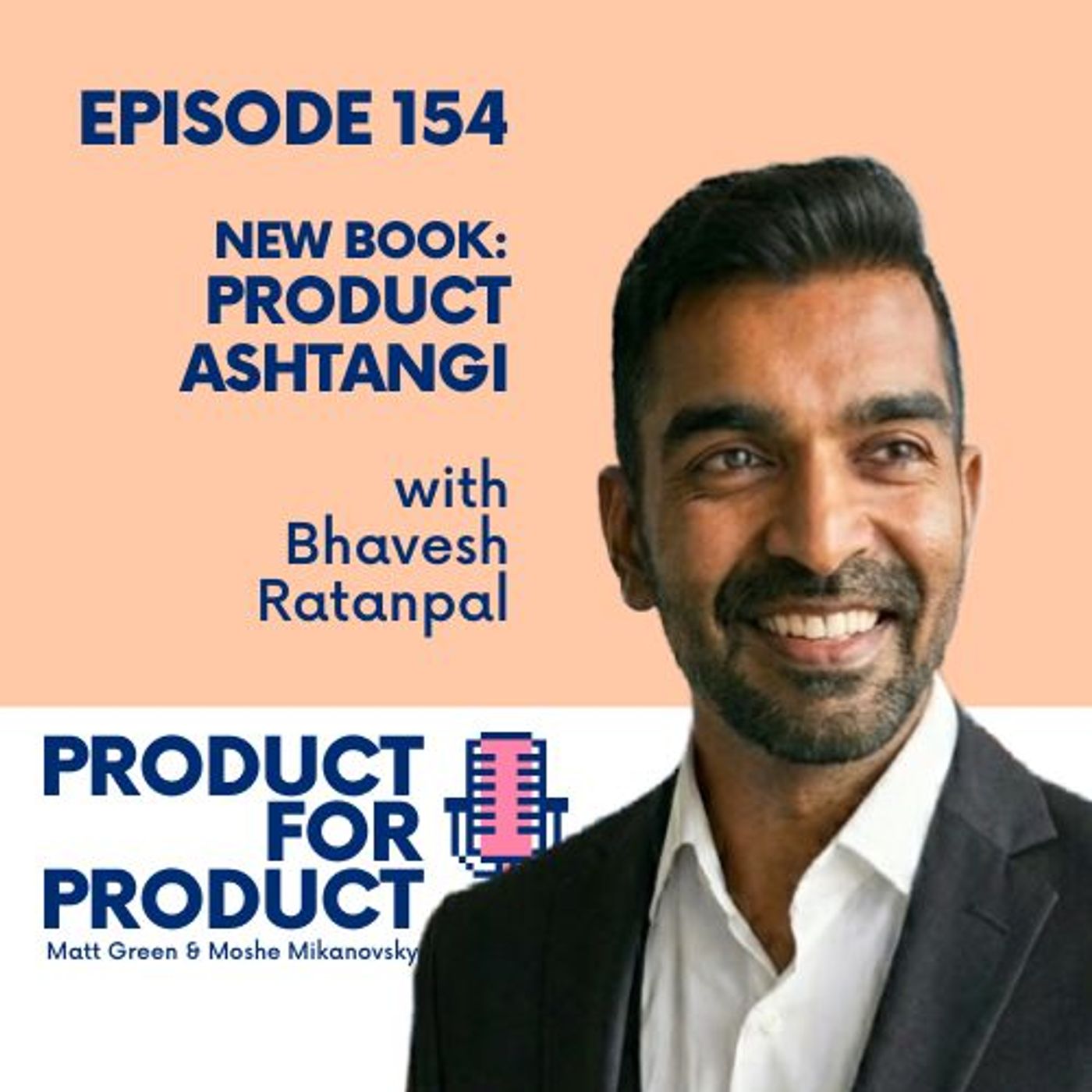 EP 154 - Product Ashtangi with Bhavesh RatanpalProduct for Product Management · features Bhavesh Ratanpal76 / 100
 Agent Sandbox with Lovable, with Jonathan GrahlKubernetes Podcast from Google · on Kubernetes84 / 100
 DOP 356: Warehouse Robots Are a Distributed SystemDevOps Paradox · on Kubernetes83 / 100
 How Datadog Scaled Engineering Without Burning OutThe CTO Podcast with Fexingo · on Kubernetes82 / 100
 #141 AI Pat Works Here Now: Why Agents Must Follow Human Rules with Pat Casey // CTO @ ServiceNowalphalist.CTO Podcast · on Kubernetes82 / 100
 CI/CD with Robert ErezThe Pragmatic Engineer · on Kubernetes76 / 100
 Your Team Is Too Quiet: The Hidden Signs of Low Psychological Safety52 / 100AI Won't Replace Leaders. It Will Expose Them.52 / 100How to Build Trust Across Remote Teams When Titles Disappear78 / 100FINE is a 4-Letter Word: The Toxic Lie Destroying Workplace Teams57 / 100Why Your Executive Team C-Suite Is Operating In Silos55 / 100