
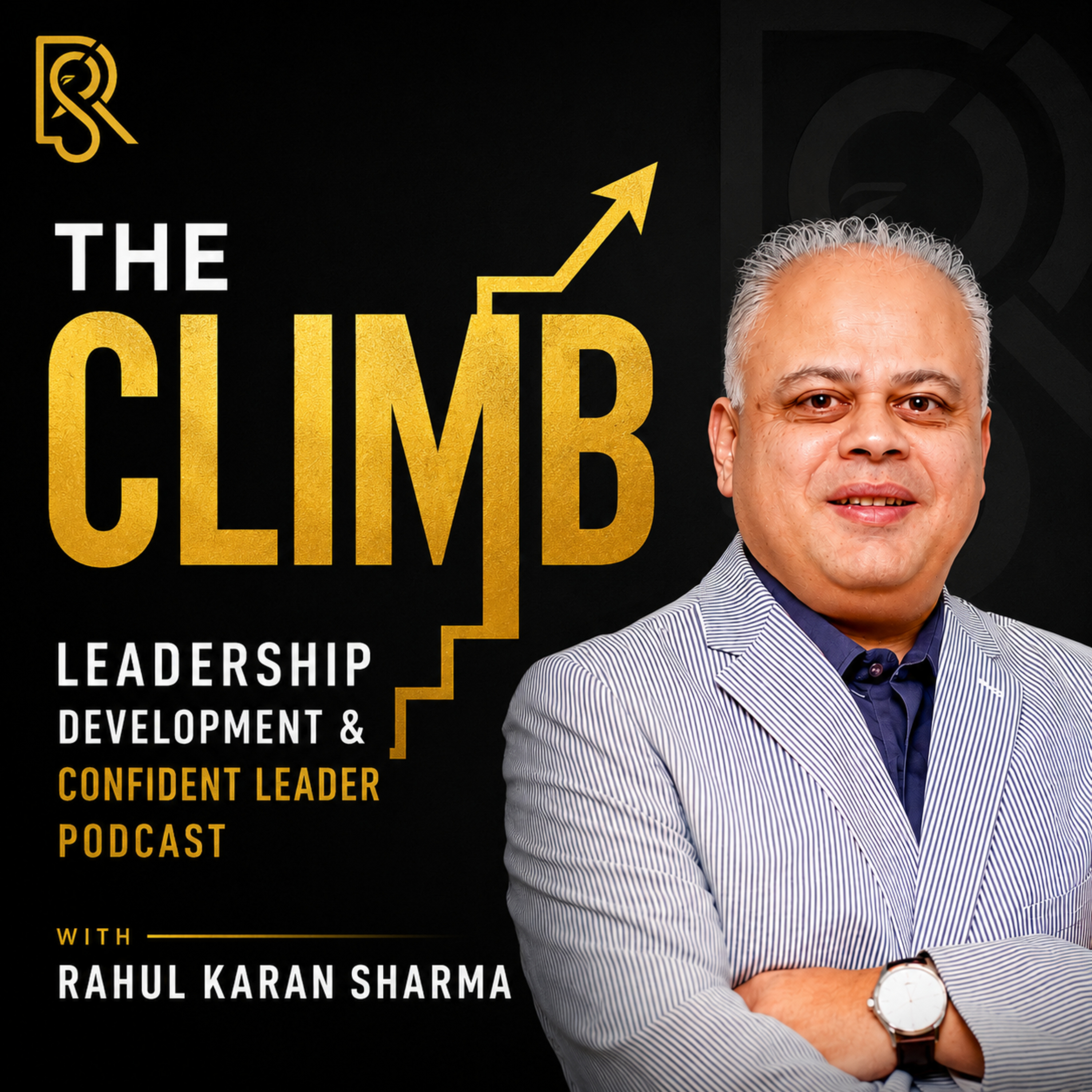
The Climb · 2026-07-07 · 42 min
Key moments - from our scoring
Substance score
58 / 100
Five dimensions, 20 points each
Dr. Deepak Bhuta, a global business leader and executive coach with 34 years of corporate experience across South Africa, India, and multiple continents, challenges the conventional wisdom that remote leadership is simply about managing time zones and processes. He argues that trust cannot be operationalized; it must be earned through deliberate presence and vulnerability. His core recommendation: leaders should invest in traveling to spend 2-3 weeks with distributed teams to build genuine relationships and understand their daily realities. Bhuta introduces the concept of moving from authority to influence, drawing on his experience leading teams across cultures where silence doesn't mean agreement and hierarchical structures suppress dissent. He advocates for the 2:1 listening-to-speaking ratio, asking open-ended questions, and speaking last in meetings to create psychological safety. The episode also addresses how new leaders without established titles can build credibility by slowing down, listening actively, and demonstrating vulnerability rather than attempting to prove expertise immediately. Bhuta references his mentor's practice of reflecting on five things done well and five things to improve daily, and discusses how AI can be used to review meeting transcripts for blind spots - treating it as a tool for reflection rather than replacement for human judgment.
Leaders must invest in traveling to spend 2-3 weeks sitting with teams in their locations, working alongside them, and building relationships through shared meals and casual moments - not virtual meetings. This in-person presence is what creates followership and trust that cannot be earned through Zoom.
Use a 2:1 listening-to-speaking ratio, ask open-ended questions instead of telling people your solutions, speak last in meetings to encourage others to contribute first, and build trust through small authentic moments rather than trying to establish authority through decisiveness.
In many cultures, silence and nodding respect the hierarchical authority given to the leader, not actual alignment; the leader must create psychological safety by asking questions that don't require yes/no answers and responding to dissent with vulnerability rather than defensiveness.
Face-to-face allows for genuine human connection, relaxation, and teasing that builds rapport; it also surfaces disagreements and concerns that remote meetings suppress, enabling leaders to understand real challenges and adjust their approach accordingly.
Authority is given by hierarchy and allows you to control people; influence must be earned through consistent behavior, vulnerability, active listening, and demonstrating that you genuinely care about people's perspectives and wellbeing.
Our reviewer’s read on each dimension, with quotes from the episode.
The episode contains several valuable ideas about cross-border leadership, particularly around trust-building, active listening, and the importance of face-to-face interaction. However, much of the content is delivered through personal anecdotes and general principles rather than novel, actionable frameworks. Significant portions involve throat-clearing, biographical storytelling, and repetition of concepts already discussed.
trust is more Personal trust is not something that you can't just operationalize. Right? There's no button to it.
face to face is magic
While the guest offers a personal perspective on cross-border leadership, the core ideas - that listening matters, that presence builds trust, that face-to-face meetings are important - are relatively well-established leadership concepts. The Nelson Mandela reference and the B2B equals belly-to-belly metaphor are borrowed frameworks. The AI discussion adds some contemporary relevance but follows common tech-adoption narratives.
B2B is belly to belly
the differentiator between people is not how they use AI, it's going to be how they use their humanity while using AI
Dr. Deepak Bhutia brings 34 years of corporate experience across multiple continents and geographies, with demonstrated sales and operations background. However, the transcript reveals he is now primarily a coach and consultant, and recently became an entrepreneur (September 2024, with only ~1.5 years of stated experience). While his experience is relevant, he is not currently operating a large-scale business, which limits his caliber as a practitioner-level guest on business operations.
Spent 15 years there. Learned to recognize and respect cultures and their differences.
became, after 34 years of corporate servitude, an entrepreneur in literally September 3, 2024
The episode lacks concrete data, metrics, or named company examples. While the guest references specific locations (Dalian, South Africa, India, Philippines) and personal stories, he provides no quantified evidence of outcomes, revenue impact, or specific case studies. References to Elon Musk's five-minute meetings and Nelson Mandela's leadership are borrowed examples, not specific data from the guest's own work.
Watch how things change. What you will get is magic.
I still today, on my birthday, on specific days or when I post on LinkedIn, I get tons of messages from people that I have led in the past.
The host asks reasonable follow-up questions and attempts to connect concepts to broader leadership themes. However, many of the guest's responses meander through long personal anecdotes without crisp closure. The host rarely pushes back on claims or challenges assumptions; instead, he largely validates and mirrors the guest's points. The conversation feels more like affirmation than productive exploration or debate.
And I think uh, maybe a few years ago I heard about Elon Musk. He has five minute calendar, five minute meeting on his calendar. And I think that became popular.
So thank you for bringing that. Now we are moving our rapid fire round.
Computed from the transcript - who did the talking, and the words that came up most.
Can you lead people who no longer work in the same office, culture, or even time zone? As organizations become more global and hybrid, leadership is no longer defined by titles or organizational charts. The leaders who create the greatest impact are the ones who know how to build trust, strengthen relationships, and inspire people across cultures and distances. In this episode of The CLIMB Podcast , Rahul Karan Sharma sits down with global business executive, executive coach, and leadership strategist Dr. Deepak Bhootra to explore what it really takes to lead across borders in today's rapidly changing workplace. After spending more than three decades leading teams across four continents, Dr. Deepak shares why influence matters more than authority, why trust cannot be delegated, and why the future of leadership belongs to those who build meaningful human connections - not just efficient virtual meetings. Whether you're leading remote teams, managing across cultures, or preparing for the future of work, this conversation offers practical leadership lessons you can apply immediately.
Transcribed and scored by The B2B Podcast Index.
Speaker A: Leadership gets tested the most when title disappear, culture collides, and the playbook no longer works. Today's conversation is about what it really takes to lead across, uh, borders. Not just countries, but mindset, generations, and expectations. If leadership is the ability to create trust at scale, this episode is for you. I'm your host, Rahul Karan Sharma, and you are listening to the Climb, the conference leader podcast. I'm. And Today's guest is Dr. Deepak Bhuta, a, uh, global business leader, executive coach, and strategist who has spent decades helping organizations and professionals grow across industries, geographies, and cultures. Throughout his career, Dr. Deepak has worked at, uh, the intersection of leadership transformation and sustainable growth, leading teams across borders while helping leaders navigate complexity and with greater clarity and impact. What makes his perspective different is his belief that leadership is not about managing people differently across countries. It's about creating trust, adaptability, and human connection at scale. So today we will explore what it truly means to lead across borders and what leaders must do differently to drive in today's rapidly changing world. Welcome to overshore. Dr. Deepak, how are you doing today?
Speaker B: I was doing great until I heard this beautiful preamble of yours, this intro of yours. Now the expectations are set, so let me get ready. Sir, yes, sir. All yours.
Speaker A: All right. Before we dive deeper, Dr. Deepak, can you tell us about your leadership journey with our listeners?
Speaker B: Sure, sir. All born and raised in India. And, you know, most Indian families tend to focus on academics a lot, and I think that's very natural. In my course, I was always very focused on, but at the same time, I was a very poor student. And I'm calling this out because some of your listeners assume that academic genius or collecting degrees is something that you born with. I think I had certain characteristics, but I would be very honest with you. I think it's my mother. She came back to me once from school and says, you, principal believes you're the smartest kid in the class, but I thought you were just average. And that is the single line that a teacher shared with my mother that changed the trajectory. Because for my mother, who was a very simple woman, getting a message from someone that she respected, simply stating a very simple truth led to the most amazing trajectory for me, where my mom suddenly became my biggest cheerleader. I failed. She cheered me on. I did this. She said, let's set the bar.
Speaker A: How.
Speaker B: What. What more can you do, my son? And that blew my mind. Here we are spending thousands of dollars reading textbooks, and then I go back to someone who proudly says I'm, um, 11th class pass, 12th class fail. And Rahul, for me, I actually realized that. Simplifying my journey, simplifying the way I approach things. Four degrees, four continents. But that's not what I want to brag about. What I want to brag about is what I learned along the way. Truly a practitioner at heart. Started off in sales in South Africa, of all places. Spent 15 years there. Learned to recognize and respect cultures and their differences. If you ever ask me m, which country was the best for you, Deepak, I cannot answer that because that's an unfair question. Every country has its development challenges, right? It's a favorite game. We all sit overseas complaining about our countries that we left, but when we actually in the country, we have the best time of our lives, celebrating the food, the culture. So why that I never figured that out. So for me, sir, sales operations, sales is my bread and butter. I am, um, I became, after 34 years of corporate servitude, an entrepreneur in literally September 3, 2024. I've been at this for a year and a half, and boy, Raul, it's been difficult because coming from a corporate cocoon to doing something for yourself is a amazing hit. And it's an. I cannot tell you. It's been a very humbling experience. Here I am. You've just spoken about me in such amazing terms. And I'm telling you, anyone who is experiencing a greatness in the corporate world and wants to become an entrepreneur, brace yourself. You'll have to do something very different. And the good news is, if you know and you're warned, you can do wonders. Rahul, back to you.
Speaker A: Yeah, no, I agree with what you all mentioned because sometimes our listeners or people who are aspiring leaders, they always see the brighter side of the individual that they are idealizing or they are respecting. They do not see the hardship behind it. And, uh, it's not about talking about the great things that we have done. Our episode will be talking about our own challenges, because we all have challenges. It's not that everything was served to us on platter. You, uh, mentioned about the corporate to entrepreneurship, and I second with you. It's not when you are at corporate, you think that entrepreneurship is for you. You, you want to become an entrepreneur. You want to fly a, uh, business class and go to all those meetings. But when you enter to that entrepreneurship world, it is challenging, it is difficult. And I always say that the first three years are very, very critical when you become an entrepreneur. So if any one of you is listening, if your friends or your inner circle people are doing business, and they are in the first three years, do whatever you can to help them because they need your help at this moment. Once they are set, once their revenue model kicks in, then probably your health will be okay. But the most help they need is in the initial three years. So thank you for sharing your journey, Dr. Deepak. Really appreciate what you have gone through as well as the experience that you have lived is something I want to enlighten our listeners as well. And I'm sure throughout our episode, we will bring out those stories from different countries. So. So you have led and coached across industries and continents. Uh, looking back, uh, to your journey, what experiences shaped your philosophy on leadership across the borders the most?
Speaker B: Raul, I. In the intro, I mentioned to you, right, that I have not just led cross borders, but I've actually lived in different borders. And I think lived experience always changes your mind shift, right? I look at life this way. I can tell you right now, very early in my career, I used to honestly believe that work hard, deliver results, hit targets, solve problems, and everything is great, right? And I always think that if I kept delivering results, I would get influence. Here's the fun part that happens. You know, a lot of cultures actually don't understand what I'm talking about because for them, it's a different criteria that they look at in judging someone's leadership capabilities, right? And I realized that my results were getting the right attention, but it doesn't create necessarily followership, right? I mean, if I want to be called a leader, I need to have great followers. And I would walk into meeting, and I would assume that silence was alignment. Some cultures, this silence doesn't mean alignment. It actually means that we respect the hierarchical role given to you, Deepak, as our leader. So therefore, we will not challenge you. And that was a big surprise for me because I came from a background and a culture where I thought that I encourage people express disagreement publicly. And then I realized the way I was doing it was actually asking people in a public forum. So, guys, anything that you'd like to add or change. And again, that was also not. How do you say this? It's a great question to ask, but sometimes people don't respond to it. Again, that's when I started changing my vocabulary. And that's when I also realized that if focusing on efficiency is awesome, right? But you got to focus on relationships, and you got to focus on trust. And when you get that trust, and that trust does not necessarily earn in that room. And in some cultures, when you are talking a certain way with one person, but you talk different with another person. That carries. And people then realize that this guy is pretending. To me, that was a big shock. And I must be honest, moving from this, it was more about how do I, as a leader, show the world that I'm not just only competent, but I have the right confidence in the right context. How do I make this? And your show is called the climb, right? How do I climb from authority to influence? That journey was the most difficult one. And it was really interesting because I also have this style where I was actually seeking guidance back from people as equals. And they will then tell you what I said, what I did not say, what would they like to hear more of? And when you actually hear that, you know what to do more of, which by definition means because time is compact. And that is a great way to actually figure out cultural disembalance is actually to ask the people, but ask in a way which allows them to feel that they are free.
Speaker A: Got it? Got it. I think I really like what you mentioned about the language because sometimes we may think that it is a normal question to ask, but then repeatedly, if you are not receiving the response that you are expecting, then you need to change your question. And by changing question, it's also about changing the words. And the other aspect I also learned from you is it's not about from your experience. You have just not managed people. You have lived there. So when you are living there, you are experiencing the life there. It's all totally different. Because when I started, uh, our journey, someone who is working in the nights in India and someone working in us, you don't see the difference till you actually go and work in nights and then you realize the challenge. So as a leader, it's very easy for us to just talk over the phone or zoom. But when you live their life, you will really experience the challenges that they are facing. And I think, uh, Dr. Deepak, many leaders, when they are managing across continent, across geography, they feel that just managing the time zone, managing the processes is good enough. In your experience, what does a leader leading across border actually require to really win their trust? Build that relationship that you were talking in the previous response. So what has been your experience, sir?
Speaker B: See, time zones, I believe are operational, right? These are constraints put upon us. And we spend so much time in, you know, using calendars to synchronize time and this. I'm seven hours behind you, I'm ten and a half hours behind you, and stuff like that. For me, trust is more Personal trust is not something that you can't just operationalize. Right? There's no button to it. And the fun with trust is it's got to be earned. No one gives you trust. And I think this is something that people forget. A leader who thinks like a manager thinks that because he's in the hierarchy, therefore he will get the trust given to him. That's not how it works. You are getting an authority given to you to control someone, but that doesn't mean that you got the trust. And I think that's very important for me. There's one trick that I can always tell people, and I learned this the hard way, that I used to think that, you know, if I explained a project and everyone is nodding their heads, team means that the team is aligned. It's not true. The team was simply saying that, I hear you, I understand that you're speaking English, but that doesn't mean that I agree with you. And then it's really interesting. And two, I've also realized managers that keep hiding behind the veneer of we don't have the opex to travel, we don't have money to travel. You know what? I think you're committing harakiri. Let me explain this why we have done cost arbitrage to the nth degree. We have tried to reduce costs by moving jobs helter skelter. We moved to one country, the cost now becomes high because we have been given another target. We say, okay, you know what, we went from Philippines to India. Now from India, we're going to go to 30 cities in India, which is our new massive drive, right? How far are you going to drive it at the end of the day? Let me tell you the one thing that I recommend to companies. If you want the best ROI and you want to get trust, fly your leader to them and sit him down there for two, three weeks. Watch how things change. What you will get is magic. And, uh, that is how I built my reputation. I still today, on my birthday, on specific days or when I post on LinkedIn, I get tons of messages from people that I have led in the past. And all of those people do not remember that great call we had. They say, hey boss, remember when we had seafood at the beach in Dalian with the team? Do you remember how bad you were in the games that we were trying to teach you? Do you remember how the two girls beat you at the beer drinking contest because you couldn't understand how someone can drink five beers after dinner? I'm sorry, Rahul. Here we are. What we've done to the world is we've created this crazy nonsense that everything can be done by zoom. Yes, of course it can. You and I having a great time right now. But I can tell you right now, if I were in the room with you, most likely you and I would be high fiving each other and you'd actually be making more fun of me. You'd be more relaxed with me. You'd actually be teasing me to tell more. So whether you. This is screen to screen, but face to face is magic. And my grandfather, who taught me so much about business said something very powerful. I just share that with the audience. He said, you guys with MBAs talk about business to business. B2B. He said B2B is belly to belly. And Raul, that just blew my mind because that is so true, isn't it? What are we talking about? And in the age of AI, where every email is written, you know, stuff, I mean, I can prepare for this call Karan with AI, Right? But at the end of the day, all you have to do is to just trip me up by asking a question that's never in the script, right? Or say to me, deepak, I remember you mentioned that you were in Dalian once. Tell me about that experience. Now tell me which AI is going to prepare you for that, sir. Because that experience will come from somewhere deep inside me. And that is what, um, I'm absolutely thrilled and enjoying what's happening with AI. I do predict in two years, it's all settled down, we will look at AI the way that we look at calculators. Yes, it's part of the plan.
Speaker A: Yeah. Well, uh, the golden nugget just dropped by Dr. Deepak is face to face is magic. And if you want to win trust of your people, you need to work hand in hand with them rather than sitting across the continent. You need to really live their life. You really need to understand their day to day day in life. You need to understand their own challenges. That's how you win trust. And, uh, I conquer that. And that was one of the things that we used to do in our previous organization, Dr. Deepak, is we used to fl our leaders to work for two to three weeks with our recruiters, with our back office team members in the night shift, so that they really know the challenges that they are facing. Amazing. Thank you for sharing that. Now the leaders probably who were may listening to our episode, who are kind of an aspiring leaders who have never had that title, uh, never had that corner office. Now, for them to build confidence and Credibility when they are maybe inheriting a team or maybe they are being transferred to a new market, what are some of the things that you would recommend for them to build their trust?
Speaker B: It's a common problem, right. For anyone who's out there trying to figure out that I've just stepped into a new market, new culture or team, here's what I would say that I say to any salesperson. When you're dealing with a new customer, use the ratio that God gave you two is to one. Number two, don't go in. And as a salesperson, you don't go in and try to establish authority. I am the most important person in the room because I can solve problems. Anyone who is a leader has to understand that they need to actually slow down on establishing authority. When you try to go in and establish authority by sounding like an encyclopedia or telling them of all the great stuff you've done and all the great stuff you're going to do, you are simply falling into the trap of this, what I call pressure to prove yourself. All you end up doing is sound decisive, which actually makes them feel. How can you be so decisive? He doesn't even know us. You have all the answers, but how can you have all the answers when he never asked the right questions? So you need to prepare. You need to be consistent in your behavior. And I always tell the guys, you slow down, listen, ask people questions that don't necessarily deliver a yes, no answer, keep it open ended. You are also going to build trust in very small moments. It's not going to be a long lecture. Your trust is going to build over a glass of water shared standing at a water cooler with an employee who just listened to you talk and comes up to ask a question of you. How you treat that individual at that time is what that individual remembers, but the rest of the organization watches. And that's what I try to explain people. Executive presence is not about hierarchical endurance or the fact that I am six levels above you. Therefore I've, uh, got executive presence. Executive presence is something that is ego devoid. And when you talk, people know you're listening. Listen, actively lean in. Some of the best managers I work for, you actually feel like you're the most important person standing in front of them when they talk to you. And to me, that single attribute is sufficient. It works across all cultures, believe it or not.
Speaker A: Yeah.
Speaker B: And um, all I'm going to say is that just use the same ratio. If I could give you a T shirt slogan, the one that I really liked is that leaders should Never speak first. They should always respond fast. And to me, that's very powerful. Those who listen and then respond. And when you respond, respond with vulnerability, authenticity. It will be shocking to you. I mean, many cultures will tell you too much information. Too much information. I respect that. I'm not asking you to tell people your blood type or the fact that it took you half an hour sitting on the toilet that morning. No, no, no. Um, we are talking about simply tying your experiences in a safe scenario, allowing people to express themselves better. That's all. And there's a lot of trial and error. If you're a newbie, like you mentioned, a lot of trial and error. So respect the process, but learn from it. Sit down and ask yourself, what three things I did today that worked very well. What three did not? My first boss, I was very lucky. My very first boss used to tell me, deepak, you know what? I have a habit. I always shower before I go to bed. So I'm looking at him, why are you telling me this? And he says, and do you know why I do that? Not because I need to clean my body, because I need to clean my soul. He says, I put shampoo on my head. And I'm thinking about, what are the five things today that I did that I could have done better? And then I would sit down and ask myself tomorrow, let's find five ways in which to implement those to keep doing the drill. And like Malcolm Gladwell, right? 10,000 hours spent on any good. Something good is always going to deliver dividends to you. That single idea is actually what changed to, I would say, my perspective on leadership. I do not go to bed until I figured out what are the five things that I could have done better. And with AI, I actually go back to AI, put in a transcript and say, in this, I got ghosted by the customer. He's never replying to my emails. At what point did I lose track? And here's an expert with 34 years experience telling you that even I am relying because I can't remember everything, but AI has the ability to do that. So I just wanted to bring that back to people to say how to use something that I said was a threat initially, but it's not really a threat.
Speaker A: Wow. So you're also talking, uh, about to use AI, ah, at the right time and use AI to its to what it is. It has capability to do better rather than just using for the sake of using. And, uh, when you were mentioning about leadership, speak last, uh, so I remember a story, uh, it was about Nelson Mandela. So he shared in his book that his leadership lesson started from childhood. He started accompanying his father, who was the head of a village in his meeting. And one thing he learned from his father was that his father was always the last person to speak. And he was listening from everyone. And then, um, speak. And if I correlate it to our corporate world, what happens is leaders are always first to speak. I would say 10 scenario, it is 8 on 10. Leaders are the first to speak. And what happens is we set the tone. We set the tone of the meeting. We set the thought process that we want to bring in. And then what we see is everyone is aligning to that thought process rather than bringing their own thought process.
Speaker B: Let me just. I just have to add something to what you said. And here's what I tell people. I get told by leaders. Most of the meetings I attend don't need to run for 20, 15, 25 minutes, 30 minutes, deeper. I can finish in five minutes. I don't know why people waste my time. So I'm like, okay, this is interesting. What is happening in when I and when I attended those meetings or when I talked to these interviews, this is what's happening. They walk in, guys, this is what I want to talk about. Give me two ideas that we can implement by Friday. Let's go. Of course the meeting is going to end in five minutes, right? And then someone gives a very shitty idea and everyone says, there's a guy sitting in the back who's like, I disagree. But he doesn't know how to say it. Because you haven't created that environment where people are free to speak. Because now you've walked in, you've opened in such a way, it's like saying to any salesperson, I come from a sales background, when will you close this deal? You have put him on the back foot. But instead the question should be, rahul, I see you've committed this deal. What's the single biggest thing that's causing friction for you? And how can I help? Or did you see what just happened there? Rahul, you lean in. Now tell me which scenario will take five minutes and which scenario will take 10 minutes? You know the answer to that, right? And I think that's the fallacy again. Leadership is being defined in how quickly someone gets to answers. And I'm like, wow, wow. I'm not against your intuition in your gut. Because look, with our gray hair and our bald looks, right? Rahul, you and I know we will make certain decisions very fast, very quickly. Life has taught us about that. But we also know that as a leader, however, you may have all the answers but when you do not let people think through, it is not cathartic for them. And I know it sounds really odd, but it's like grieving. You have a death in the family but the first four days you are so busy with the funeral, the rites and everything you haven't spent a second on yourself. And then when that dam breaks, it breaks for the worse. Uh, so uh, you need. This is where I also ask family, I ask people around you look at your leader. In leaders, psychological safety is also very important. Here we are talking about leaders looking downwards. And my biggest piece of work that I do is what about you, Mr. Leader? That Ah, simple question, Rahul. When you know when they say on the aircraft, please put the mask on your face first and then take care of. When I heard it 15, 20 years ago, I was like, what nonsense. My child is important, My granny is important. It hit me later on in life, take care of yourself first because you need to survive and your survival will allow for the survival of others. Whether you like it or not. I know it sounds like a undemocratic uh, statement but Rahul, leadership needs to understand it is their actions, their activities preserve the life of a company. And if they are faltering, if they're making the wrong choices, they don't just impact themselves. They're impacting the livelihood of hundreds. And that's the privilege that you have been given.
Speaker A: All right, thank you for bringing it up. And then when you were mentioning that meeting, uh, scenario, I think uh, maybe a few years ago I heard about Elon Musk. He has five minute calendar, five minute meeting on his calendar. And I think that became popular. A lot of leaders started following it. But in the end what you do not realize that meetings are also an opportunity for you to interact with your team members. It also allow you to know their state of mind. It also allow you to know uh, what they are thinking. They will not work at your speed. And sometimes I have seen in leaders that they get put off in their first few minutes of the meeting and then the whole meeting goes for. Uh, that is not the right style of a leader. No matter how busy you are, the fact that you are spending time with your team get to know. I mean if someone has worked for two weeks to build a presentation, you can't just disregard. I mean uh, try to understand that person's point of view as well they are the fact that you have given them an opportunity to present they would be having some accolades or some, some experience because of which you gave them the opportunity. So give full out. And I do understand sometimes people are just rushing back to back meetings and it's, it's really disheartening to see that, that type of leaders, but I think those leaders still exist. So God bless them. I hope they, they change in the time to come. Dr. Deepak, you brought about the AI in our previous response. So as we see the future of work is changing, the world of work is changing rapidly. AI managing expectations, different expectations from people, what used to, from a skill perspective, what used to be good for three years in the earlier time frame, things are changing every year or probably things are changing in six to nine months. So I would want to learn from you that what are you doing differently in the remainder of 20, 26 and 27, uh, as a leader, coach, entrepreneur that you were not doing when uh, you started your entrepreneurial journey.
Speaker B: So let's talk about AI. Four years ago, when I first tested AI, I must be honest with you, I was a bit confused. I could see what it was trying to do, but I didn't understand the output. But I was surprised. Within three months the output started changing dramatically. And I actually looked across at my son who was a software engineer. I said to him, I think your job is done for. This thing is progressing very rapidly. And if I just extrapolate and you and I have been around with all the fads and everything, right? But with AI, I sense something different. See, previously when I did a lot of automation, I was doing automation. And this way I was cutting off the bottom of the organization. Here comes AI and AI is actually doing something very unique. It's actually slicing vertically down, right? What that means is that the same person that used to be told you are safe because you are a judgment holder, because you are a manager, because a leader was already threatened because of flattening hierarchies. And now you have this very unique scenario with AI coming in. And that's when I told my son, you know, this is going to be really, really fun. So for me, I went from being a initial skeptic to a huge fan. Then I had this, oh my God, AI is going to take my job as a consultant. And then the serene calm, it's like, you know, the monk in the jungle, you know, he sees a tiger charging at him. He shifts to the left and starts running. Suddenly gets to the edge of the cliff.
Speaker A: Mhm.
Speaker B: You have the tiger behind you have the cliff, looks down, jagged rocks, both Scenarios look very bad. At that point he turns and looks at a flower and says, what a beautiful flower. So at that point everyone's leaning forward to hear the story. And I said, that is it rest you guys have to figure out. But what I'm simply stating is that I'm at a point where I'm looking at this flower and saying, let's focus on that. So AI is there. I get it. Here's what I'm doing personally to answer a question, right? I believe that one. I want to respect AI for the simple reality that it's democratized information. To me, that's excessively exciting. I don't know how to say it to you. When you actually dig in deeper into AI actually realize that its quantity is awesome but its quality is suspect, right? And I think this is what I want to focus on. I want to use AI to focus on quality of thought. I want to use AI to understand how do I stop being always on, always reachable, always consuming. Because that's the trick with this thing, right? And then when you do this, you actually realize that you're in deep trouble. And I just want to tell people as follows. AI is there to actually create more cognitive burden on you. It'll also create emotional burden on you because it's going to start analyzing, telling you things that you would have had to pay to a therapist to get out before, right? So all I'm saying is as simple. Slow down ladies and gentlemen. AI is going nowhere. It's in fact going to be more m of it in my diary every day. I have at least six hours worth of AI training and AI courses and all. So my wife asked me, but you don't attend any of them. Why do you have them in a diary? I said, because I want to know what's happening out there. I'm going to see something that actually takes this to 2 plus 2 equals to 5. I want to jump onto the bandwagon. Why am I jumping on the bandwagon? Because Rahul, believe it or not, I actually do believe there is a threat to everyone's existence. But the good news is that when everyone is going to use AI, everyone is going to get to a baseline. And at that point you're going to have to figure out how do you now break from that baseline and has rahul, here's my $10,000 bet with you. And please don't come to claim it from me, sir. I'm a businessman building a business out. It's as follows. Two years from now, we actually going to realize that the differentiator between people is not how they use AI, it's going to be how they use their humanity while using AI.
Speaker A: Wow. So I think very well mentioned that how to use humanity while using AI. AI is not going anywhere, it will be there. M. And the way I look at it is AI is as good as the input that you give to the tool. Based on your input, it will give you the output. And if your input is structured, if your input is uh, the way you want the output, things will be better for you. And I think the other part I, as you were mentioning about that emotional burden and the burden word you use, I do see that happening because AI if you don't create uh, boundaries, it will keep you taking to a level where you don't want to go and
Speaker B: then you will be lost.
Speaker A: That hey, I started with question A and now it is Z. They are not related. So that's the tendency of the tool. So you need to create boundaries, you need to really make sure that what exactly you want to get as an output. So thank you for sharing it. And yes I do understand that using of AI will not expose uh, leaders ability to do good or bad. But what it will expose is people who are not using AI. It will expose them faster as compared to earlier that they were just going on that because no one was watching them. Now because of the tool, they will be exposed sooner than later.
Speaker B: Uh, well, you're a smart man if you just follow my drift on this one. Let me get my friend. Remember the old bell curve. There are going to be two types of people. So of course we're going to discount the non AI users at the tail and they're going to find out that they're going to end up being in a very long tailway at the back leave them. Then you have the excessive users of AI. I'm not talking about ability or utility. I'm just going to use excessive users. These are people that are the edge of everything. They're the first people sending an action figurine of themselves. They're the first people sending you a ridiculous video of them on a uh, riding a dolphin in the air, not in water. It's all nice, cool. But at the end of the day, what value are they adding first to their own revenue line? Because at the end of the day cash flow matters. What are you doing that achieves outcomes? Then you have the middle. My prediction is that the middle is going to be the stable users of AI. This middle is actually going to get very tight Very tall. And unfortunately, the count of people in that middle is also going to get reduced because we are now breeding a new exclusive class. Just imagine, Rahul, we have a digital divide in Africa and India. And you and I are both passionate about development. We also look at, we enjoy AI but the fruits of AI right now are being subsidized by some very rich investors. We aren't even paying full price for this product yet. Everyone's running at a loss. How am I going to go tell people in Africa that AI is going to change your life? When the real cost comes through, who can afford it then? So this is the complication that I actually wake up at night thinking about what I. What are we doing? I'm getting reliant on a system. Can you. Here we are saying that socialism is bad for you, and here we are living socialism with AI right now. This is something I've not been able to reconcile, but I had to just get it off my chest. Maybe I'm wrong, maybe I'm wrong. I don't know.
Speaker A: No, I think time will tell. It's not about right or wrong. It is about what you are feeling. And I'm sure you are sharing it. There are a lot of many people who may not be sharing it, but still feeling the same that you are feeling. So maybe someone, uh, listening to us might comment on these thoughts of yours and probably give us some different perspective. Uh, you never know. Now, before we move to our rapid fire round, I just wanted to ask you one input. If someone listening to us as a leader who is responsible to manage people across countries, what would be your advice from a leadership perspective, what they should do that will start bringing results for them? If they are having that challenge of building their own credibility, even though they have a title, they still are managing across country. So from your perspective, what is that one habit they should adopt that will really make a difference for them?
Speaker B: Uh, we kind of discussed it earlier, but I want to really emphasize it specific on this question. Stop asking people about the work they do. Start asking about how they're experiencing the work they do. That one word, experience allows people to talk more freely. It changes your leadership conversation. Instead of talking about, is this project on track right. Where are you feeling friction right now? When you ask people, is the project on track? They read that as a performance review. But when you ask them, what are you feeling friction on this project right now? And how can I help? Because it changes now. People are going to go from confusion to less confusion. They're going to now not Hesitate, they're going to start coming to you. To actually understand that the probability of a cultural misunderstanding with language like that is zero. Anyone on this call who challenges me that talking like certain cultures will get you into trouble? I don't know what they're talking about. There is no culture that says, what's the most favorite thing people like to do is talk about themselves, right?
Speaker A: Uh-huh.
Speaker B: We want to talk as human beings. That's why I've always told people what an amazing thing. Right. Here we are. We praise God. We thank him for giving us all these senses, but when we start using them, we shy away from actually using them to its fullest potential. Why? So if I could just ask leaders, if you were trying to do something very different, take your connection to your organization kind of off and put the connection first, thinking about conversation first, not organization first, conversation first. To me, that is how you're going to solve this problem.
Speaker A: Wow. So conversation first and also about. Instead of just asking, uh, how they're enjoying the work or how are they doing the work, it's more about the experiencing what they're experiencing when they're doing the work, because that would really make a difference and that will allow them to talk more about themselves and their feelings, their thoughts, which probably you may not be knowing. So. So thank you for bringing that. Now we are moving our rapid fire round. But before I do that, for leaders who are listening to us and who are resonating with your philosophy, with your thought process, Dr. Deepak, how can they learn more about the work that you do, the. The results that you get for your clients, and what's the best way for them to connect with you?
Speaker B: Sir, honestly, my wife would say LinkedIn. LinkedIn has become what I was pervasive. I spent three, four hours a day on LinkedIn. Just go to LinkedIn. Deepak Bhutra. I'm the only Deepak Bhutra. I really wanted to be on your podcast because you talk about things that matter to me a lot. Right at this point, I just wanted to call out that I am also busy building out a new entrepreneurial venture. It's Rise up. Focusing on 21 to 28 year olds, helping them make sense of what is leadership, what is sustainable performance, what's emotional resilience. But the context is very simple. We have a situation where 21 to 28 year olds do not know how to navigate work life. They also cannot afford a coach. Now, with AI, we're simply saying that what if you were to blend everything together and get you something that helps you and then add a community to it. So that's what I'm doing. And Rise up is something which I would say keeps me up at night.
Speaker A: Wow. So aspiring leaders, if you are looking for inspiration, if you're looking for guidance, try to look, uh, into Rise UP program that Dr. Bhutra is coming up with and enroll in any talk about it. Uh, get a different perspective. And it is not about just a course or to learn something. It is all about knowing and understanding the modalities of leadership, of people, management, sales. Because sometimes you may know everything. It is not about knowing everything. It is about getting that push, getting that confidence, getting that pat on the back from a right person who can really tell you that, yes, you are going there, going at the right direction. I'm with you. And, uh, to this, I was just listening to one of the clips from a recent event that was organized by the board of Control of Cricket of India bcci where they felicitated all the World cup winning team, the Indian women team, men's team, Twenty20 team and under 19. And there was a question asked by senior, two senior cricketers that they are playing, they are sharing the dressing room or they are playing on the crease with these young people. What advice do they give? And the response was on a similar line is that they don't need to know what they have to do. They really know what they have to do. They really know what they don't have to do. We as leaders, we as seniors, we just have to tell them that we are with you. Go ahead. Because their confidence is impeccable. Their, uh, charisma is there. They know the techniques. They don't want to follow those old records, they want to create new records. And sometimes they don't want to hear preaches from seniors. So here in Rise up, it is not about that preach that you will listen. It is about the experience that you will have. Uh, because it's all about the experience. It's all about the experience you create for your team members, you create for your leaders, the experience that you will get from this program. So I would definitely like to check you out. We will include the link on the show notes so that it's easy for you to access. Uh, now we are moving to the rapid fire round five questions. It's a fun questions and we would want you to respond it instantly. All right, you ready? Okay. So what's one leadership skill you wish someone would have taught you earlier?
Speaker B: Active listening. Show respect. Active listening. Stop talking.
Speaker A: Uh, what's one quote that you live by, a quotation that you live by.
Speaker B: I'm going to quote Nelson Mandela's right. When you allow the world to see you shine, make sure that you let the world because when they see you shine, they will have the ability to shine themselves. People take courage from what you do. And then absolutely. Someone broke my heart by telling me that. It's actually not an Nelson Manila quote he quoted in his book, but it's from Marianne Wilkinson. But to me, I've always called it the Mandela quote because I really liked it. And for me, Long Walk to Freedom is a title. And I always tell people, when they tell me I'm tired, how long do I have to work to become a manager or a leader? And I say, Long Walk to Freedom. Nelson Mandela's book, since you said it, I'm just mentioning, is the single book that I've given away the most in my entire life, Rahul. So I was very surprised when you mentioned Nelson Mandela. I was very, very happy about that.
Speaker A: Uh, awesome. Are you a morning person or a night owl?
Speaker B: Night out.
Speaker A: Okay.
Speaker B: In fact, if I could have begged you, I would have asked you to do this a bit later because I would say, but, Raul, I will wake up at six o' clock also if I have a great idea. But in general, I am a night owl. My best thinking I've noticed occurs between 10 and 2. I know it sounds weird, but it's just what I am.
Speaker A: Awesome. Uh, your go to food that you can eat anytime, any day.
Speaker B: Peanuts.
Speaker A: Okay.
Speaker B: And peanuts have broken my molar twice, requiring crowns and surgery. And my doctor's laughing. He says, you love peanuts, but you also eat them in such a way that despite they have splintered my tooth, uh, the enamel, and I've had to go and get surgery done. I just had the last surgery two weeks ago and still I'm in pain. But it is hilarious, Rahul. Hilarious. My wife laughs.
Speaker A: All right, last one. If your career were a Netflix series, what would be the title of season 1B?
Speaker B: Here's the stand up. But he doesn't know it yet. In my heart, I'm a comedian. Levity jokes, humor is something that I was just born with. Unfortunately, I never experimented in that domain like some of the other people. But I really do get a kick out of listening to other people making fun of themselves, making fun of others. I think it's a virtue, it's a grace. It actually, I think that comedy actually shows you how smart humanity actually is. I don't know how to say it. To you. And I do cry when I watch the sad movies also. But for me, just humor does something. In fact, if you think about it, I've never blacked out from crying, but I've definitely blacked out from laughing so much.
Speaker A: I agree. I can second that. I can second that. All right, so that was, uh, Dr. Bhutra for us, ladies and gentlemen. And, uh, it's time for you to share your comments, share your inputs, whether you're listening on YouTube or watching us on YouTube or listening to on Spotify or Apple. And this time for me to share my learnings. So there were multiple, uh, golden nuggets that were dropped in by Dr. Bhutra. I will share a few. The first one was entrepreneurship is not for everyone. It looks sexy on the other side, but then when you do a, uh, deeper dive, it's challenging. So prepare yourself, uh, talk to right people before you enter into entrepreneurship journey. And if anyone in your inner circle is being an entrepreneur, help them whatever you can in the first three years. They don't need your money, they may need your connections, they may need your introductions, they may need your support that you are there. Do speak with them on a regular basis because sometimes they may be alone, they may be lonely. So that's something you can do if anyone in your inner circle is doing a business, especially in the first three years. The other thing which I learned is it's not about the numbers all the time. We as business owners, as leaders, we focus on the numbers. We look at the dashboard. There are many things that dashboard may not be showing you and it is that the trust, it is that credibility that you are building, the relationship that you are building, it's not somewhere in balance sheet. But if you want to be an awesome leader, a leader that really people will follow, focus on building that trust, building the relationship and uh, on the trust aspects, uh, another thing Dr. Bhutra mentioned is trust is earned, um, not given. So for you to build trust, if we were talking about cross countries, so if you want to build trust with someone sitting 5,000 miles away, try travel, work with them, get to know their day in life, get to know what they go through on day to day basis, that would be really important for you. Face to face is the magic. So yes, we can do many things on Zoom, we can do many things on the call, but doing a face to face meeting is really a magic, uh, we were talking about the AI. So it's all about how to use humanity while using AI. Yes. AI is there to change the way we are working, but it's also the humanity will always remain. And if you really want to make the best out of it, be a human first, then become a leader. It's a human first leader. That's a few of the learnings that I took from today's episode. Again, as I mentioned, it's time for you to share your learnings. And if there is one takeaway for me from the overall episode would be that confidence is not about being perfect, it is about being present in meetings. It is about being present in that conversation. It's about listening, responding and showing up even when you are unsure. Because when you are aspiring leader, not everything you would be knowing, you would be learning on the go. And when leaders do that, that's where the silo starts to break and that collaboration begins. The real collaboration. So if you're looking for uh, that collaboration which is very, very important for us as a leader because we are paid higher to do the difficult job, if it would be easy, everyone would have become a leader. So go all out and then do that face to face meetings, Meet with people, learn about their experience, challenge and make sure that you are a human first. Dr. Deepak, thank you for sharing your simple but very powerful thoughts. And to everyone listening, please continue to shower your love like subscribe to the Climb Quantum Leader podcast. Thank you and have a great rest of the day. Bye bye now.
Other episodes covering the same guests and topics, from across The B2B Podcast Index.
 Your Team Is Too Quiet: The Hidden Signs of Low Psychological Safety52 / 100AI Won't Replace Leaders. It Will Expose Them.52 / 100FINE is a 4-Letter Word: The Toxic Lie Destroying Workplace Teams57 / 100Why Your Executive Team C-Suite Is Operating In Silos55 / 100How to Transition from Individual Contributor to Strategic Leader53 / 100

