Tech Startups Germany · 2026-04-16
Key moments - from our scoring
Substance score
48 / 100
Five dimensions, 20 points each
Germany's approach to startup scaling combines decentralized regional ecosystems with coordinated national infrastructure. Rather than replicating Silicon Valley's centralized model, DE Hubs connect actors across 25 specialized verticals (AI, cybersecurity, fintech, advanced manufacturing, e-health, logistics, semiconductors) in regions like Berlin, Munich, Dresden, Stuttgart, and the Rhineland. The 10 startup factories, backed by 126 research partners and approximately €110 million in committed private capital, specifically nurture university spin-offs and deep tech commercialization. Humback emphasizes that hubs operate as autonomous networking platforms - not government subsidies - requiring commitment from industry participants to survive. The architecture reflects Germany's federal structure and distributed manufacturing strength rather than betting on a single innovation hub. Private capital integration occurs through independent venture discipline: government provides access, networks, and regulatory clarity (particularly valuable in regulated sectors like fintech and biotech), but companies must identify customers, secure investment, and execute from day one. The system targets companies like BioNTech and Shapeways as models of German deep tech success.
DE Hubs are networking platforms connecting startups, SMEs, research institutions, and corporates across 25 specialized verticals to help founders identify industry players and opportunities. Startup factories are university-based programs specifically designed to convert scientists and students into entrepreneurs through mentoring and protection during the earliest spin-off stage.
DE Hubs are not investment vehicles or incubators - they function purely as networking platforms where companies must find customers, secure private capital, and execute from day one. Hubs only survive if industry participants actively engage and invest resources.
Germany's capital historically flowed toward existing successful industries (automotive, engineering, chemicals) rather than internet infrastructure. Humback notes that German family offices and investment firms still benefit by investing in global tech funds, and recent successes like BioNTech demonstrate the deep tech model works.
Federal and regional governments share the same aim of fostering business and attracting investment, so divergence is minimal. Federal states actually pitch to participate in DE Hubs and receive support based on their existing local ecosystems rather than top-down mandates.
Startup factories address a specific gap: Germany produces world-class researchers but lacks sufficient university spin-offs. Factories provide protection, entrepreneurship education, and coaching to scientists and students before they commit to founding, attracting people to consider spin-offs in the first place.
Our reviewer’s read on each dimension, with quotes from the episode.
The episode contains a handful of structural facts about Germany's innovation architecture (hub-factory split, co-investment matching model) but the vast majority of airtime is occupied by descriptive platitudes and high-level generalities that offer little an operator couldn't infer independently. Actionable density is low.
first they need, they needed uh to um, find private investors and to get a guaranteed amount of private investments, uh, typically 10 million euros. And the second step was that the government said so we then provide you with an additional 10 million
the KPI that's uh, relevant is the question do companies, corporates, startups, do they use these hubs or do they not?
The framing of Germany as a 'hidden champion' mid-cap economy vs. Silicon Valley hyper-scale is the closest thing to a distinctive argument, but it is a widely circulated narrative the guest himself treats as obvious. No contrarian or first-principles claims appear anywhere.
we are living in a market economy. And so therefore every company has to do their homework for themselves at the beginning
a lot of company that have a thousand, five thousand, ten thousand employees and they are world leaders in very specific technologies. And so this is the strength of our ecosystem
The guest holds a genuine senior government position with documented responsibility for the 10-billion future fund and strategic direction of the DE Hub network - real policy-level influence. However, he is a policymaker-politician, not an operator who has built or scaled a company, which limits practitioner depth.
Thomas Jack is a returning guest and now parliamentary State Secretary for Digital and State Modernization in the German Federal Government
In earlier roles he helped shape Germany's 10 billion startup financing framework, contributing directly to national capital allocation strategy
There are legitimate concrete data points - 25 hubs, 10 factories, 126 research partners, the 10M+10M matching structure, the Gateway Factory's university partners - but outcomes evidence is conspicuously absent and the KPI discussion collapses into vague activity metrics rather than economic results.
first they need, they needed uh to um, find private investors and to get a guaranteed amount of private investments, uh, typically 10 million euros. And the second step was that the government said so we then provide you with an additional 10 million
We have a startup uh, factory that's the gateway factory and um, it focuses the RWTH in Aachen, um the Technical University Aachen, the University of Cologne and the University of Dusseldorf
The host formulates some structurally serious questions - on measurable KPIs, threshold between nurturing and market exposure, federal-state governance tension - but consistently accepts vague or deflecting answers without follow-up, letting the most important analytical questions dissolve into non-answers.
Which measurable economic outputs determine whether a hub is, is structurally effective?
What specific evidence led to that revision?
Computed from the transcript - who did the talking, and the words that came up most.
Germany is building a layered innovation system that separates venture formation from ecosystem coordination. In this interview, Thomas Jarzombek outlines how DE Hubs connect startups, SMEs, researchers, and investors, while Startup Factories increase venture creation around universities. The conversation also addresses private-capital discipline, hidden-champion economics, and the role of AI in Germany’s next startup phase. Guest Micro-Bio Featuring Thomas Jarzombek, Parliamentary State Secretary at the German Federal Digital Ministry. Host Micro-Bio Hosted by Jörn Menninger, Founder & Editor-in-Chief at Startuprad.io - the authority on German, Swiss & Austrian startups. - Full Blog Post: - Youtube Full Video: ️ Work with us: partnerships@startuprad.io Subscribe across platforms: Feedback: Follow Jörn on LinkedIn: © Startuprad.io
Transcribed and scored by The B2B Podcast Index.
Speaker A: What's the one thing in business spreading almost as fast as AI? AI risk. Every new AI tool. Then the feature and integration creates another opportunity for something to go wrong. And most security programs were not built for AI's pace of change. That's where Vanta comes in. Vanta is the number one agentic trust platform used by more than 16,000 fast moving companies including Synthesia, Nandus and Granola. The Venter agent works like a 24.7grc engineer in the background finding issues, drafting fixes and reducing vendor assessment time up to 50%. Whether you're a fast growing startup or global enterprise, Vanta helps automate security and compliance so you can earn and prove trust. Get started today@vanta.com startup radio. That's V A N T A.com startupradio Germany is no longer relying on startup momentum.
Speaker B: It is building the structures that determine how startups emerge and scale. The DeHub initiative now connects 25 specialized ecosystems across Germany spanning AI, cyber security, fintech and advanced manufacturing. Governance has evolved with the Federal Ministry of Digital and State Monetization assuming strategic responsibility for the digital focused hubs. In parallel, 10 startup factories are ah, operational. Backed by 126 research partners and approximately 110 million in committed private capital. These layers together define Germany's current innovation architecture. Thomas Humberg operates at the level where this architecture is shaped. This conversation examines how the hub and startup factories interact and what kind of scale up system Germany is constructing. Welcome to Startuprad IO, your podcast and YouTube blog covering the German startup scene with news, interviews and live events. Thomas Jack is a returning guest and now parliamentary State Secretary for Digital and State Modernization in the German Federal Government. The ministry now co responsible for the strategic direction of the De Hub initiative across AI, cybersecurity and other digital technology hubs. In earlier roles he helped shape Germany's 10 billion startup financing framework, contributing directly to national capital allocation strategy. The DeHub network has grown into 25 thematic ecosystems connecting startups, corporates and research institutions and investors. With startup factories now active, this architecture extends into structured deep tech startup creation. This discussion focuses on government logic, venture discipline and long term institutional intent. That all said, welcome Mr. Secretary.
Speaker C: Hello. Thanks for having me.
Speaker B: Totally my pleasure. Let us dive right in. Um, I was wondering what structure capability does the hub provide that decentralized startup landscape can cannot achieve alone?
Speaker C: So basically the idea behind the DE Hubs is to connect the uh, very strong SME ecosystem that we have in Germany, the very strong research ecosystem with the uh, very strong in the Meantime startup ecosystem so that they all can benefit from each other.
Speaker B: Which measurable economic outputs determine whether a hub is, is structurally effective?
Speaker C: Well I think in the end the KPI that's uh, relevant is the question do companies, corporates, startups, do they use these hubs or do they not? Because I think they have a lot of opportunities and different opportunities and once they are heading to this de hubs and uh, they say we go in and we spend resources on this. I think this is the uh, measure for us to say it works and we want to see some outcome of that. And that's also something you cannot measure only in quantitative uh, figures. But what we see right now is that there is a lot of networking going on and also companies are getting bigger that are working inside the ERP initiative. Mhm.
Speaker B: And the basic idea is to lay the economic groundwork for future economic growth.
Speaker C: So it is. And uh, um, what we focus are verticals. So we have very specific uh, specified topics and we want to bring together all the actors in that scene. Uh for instance when you're looking at E health or digital insurance, uh, business or on different kind of AI. So these are topics, logistics for instance. These are topics where we want to bring the scene together. Uh, as I already said, research the SMEs and also startups and upcoming ah persons who are willing to found a company.
Speaker B: When I studied business everybody was talking about competitive advantage, um, newly told in startup terms it's the mode. So where does coordination generate a competitive advantage and where does it risk becoming just simply friction?
Speaker C: I mean if you want to found a company um, you have to understand um, a branch and uh, you have to discover what are the players there and where could be niche or my idea or what could be my usp, the product I can deliver, nobody else delivers. And that's exactly what a network like the ones from the de hubs uh, pretty work for because you get to know all these actors, you see what kind of topics are going on in this, in this industry and where can be a niche for me to get into, to step into. Um, another thing is to, to better understand what are challenges and where can I uh build technical solutions um, that can help in this industry. And all this is going on here. You get ideas, you get also technology from research institutions where you find world class researchers which are not willing to found their own company but are looking for the ones that want to bring out um, what's uh, in their research. And so these are advantages of the de hubs and it makes it Also politically visible. So in the end this is also a point because there are uh, constant meetings and you get to know also political actors that can be in some of these industries. Pretty interesting. Especially then when it's, when it's regulated, uh, highly regulated. Mhm.
Speaker B: Thinking about medical, um, field finance and so on and so forth. Uh plus I'm sure you talk to important people, especially finance. What I always tell in my podcast, don't mess with finance. Um, what assumptions about innovation clustering have you revisited in recent years?
Speaker C: Yeah, what was obvious is that you see clusters all over Germany and I think that's a difference that's important also for everybody coming from the international side to understand that Germany works differently than other countries where you have one centralized major, one centralized capital and major ah, enterprises there and um, everything's going on on that single place. So in Germany it's different. You see there's a very vibrant ecosystem for startups in Berlin, also in Munich, maybe more in the deep tech uh, scene. But also you see northern Westphalia, very strong upcoming, very strong industry region. Also the Stuttgart region for instance Frankfurt as the place for finance, uh, Hamburg, um, in logistics and so on the east of Germany with world class uh, when you look at chip technologies. So Germany has a very broad landscape and there is not this single place. And therefore the ehabs can be very helpful to understand where do you find the experts, where are the ecosystems? And we try to attach to local ecosystems. Um, for instance if you look at this uh, silicon and chip industry, it's obvious that you have to go to the Dresden region and um, on the other side, um, m. Uh that helps you to identify where networks are and where the heart of this very specific industries lies. And this is something that the apps can deliver. Mhm.
Speaker B: What specific evidence led to that revision? I mean I'm always telling the people you shouldn't be blindly walking into spot A or spot B and do some research before um, actually before AI assisted that research would, was much more time consuming. But then you can learn that German Germany is a federal state. And also as you already said the startup hubs are pretty widely spread. Um, so I was wondering what concrete evidence led to that revision in innovation clustering in, in you thinking about it.
Speaker C: So we make with the Earps, uh, as with every other project that government's doing scientific evaluation and that's positive. So that's uh, from our result, uh, a checkpoint. Um, if you look at, from the eyes of potential customers or of companies or investors are going there, where would you start? If you say so. I want to go into that silicon industry. Where do you want to start and how the get you do you get to know all these actors there um, and especially when they are not startups. I think this is pretty a challenge so how to meet the scientists but also how to meet this whole SME ecosystem. And this is something where really the apps uh, uh, can help to find network events also to have uh, to get to know people who are aware of the network and can guide you uh, to all the relevant persons and all the relevant institutions uh, in the region that you want to attach.
Speaker B: Mhm. Um, you already talked about network. How is private capital integrated into the E Hub framework? By preserving independent venture discipline Because a lot of our audience is investing either professionally or as a business angel privately.
Speaker C: So the DE apps are uh intended to be networking hubs, they are not intended to be investment vehicles. And so this is the reason you already uh said in the beginning that we started years ago this 10 billion future fund for Germany and we have high tech render for and KFW capital and a lot of initiatives that bring out financial benefit or do investing in startups and companies. The basic idea of the EHABs is building a network and not to invest in something like this. And if you find opportunities there and you say I want to invest in younger companies or maybe um, I could um, invest into SMEs that's also possible. So that could be a place where you identify targets but it's not an investment vehicle.
Speaker B: Um, we go now a little bit about out of the explaining of the structure and look a little bit on the bird's eye view because um, there should be a certain threshold where market forces dominate over structured coordination. Where is that threshold?
Speaker C: What exactly do you mean with threshold?
Speaker B: Um, there's one part where you nurture and incubate little startups because they need some protection and then at one point you kind of need to let them out there. Where would you say is that point where you, where they have to confront the harsh reality of business.
Speaker C: Now I understand they have to do it from, from day one because this is not some kind of a co working space or something like this. So as I already said so the hubs are networks and uh, from these networks you need to find products, ah, customers, um, and investors and all that's needed and um, so you're confronted with the hot reality from day one. There are further programs from the government you can benefit from from. But to be honest also on this I think we are living in A market economy. And so therefore every company has to do their homework for themselves at the beginning. And um, that's uh, not the game. So it's not a kind of an incubator or accelerator or some other company builder or something like that. Mhm.
Speaker B: Um, you've been already talking about the different governments here in Germany. So you have the federal government, you have 16 states. And I was wondering where does the ultimate government governance authority sit when you have divergent priorities between federal and regional?
Speaker C: I don't think there's diverging because in one thing we have the same aim to foster business and that's the reason why the regions say and uh, the federal states. So um, we want to foster economy here and we want to attract investments. So this is uh, what we have in common. And we don't force any federal state to start the E hub. Uh the different uh, the, the other way is true. Uh, they are pitching for uh, for starting the E apps and say so we uh, have a very strong ecosystem here and um, so please come and support us uh with this label and the strategy of the apps. And so we are very open on that. But um, if you want to start especially in a very regulated business, I think this is all over the world. I mean if you look at Europe you find gdpr, AI act and so many regulations and uh, I think like also in the US you have a lot of local and state uh, level regulations. And to handle with all this, uh, the apps can help because you meet there also the people from the government and legislators and all the ones that can help you maybe especially if you have a new business case and say so how can we uh, how can we roll this out uh in this framework of regulation and can you maybe adapt it to us or can you help us or um, can you build a regulatory sandbox? So these are options. Mhm.
Speaker B: Do you also help the different hubs to become equally powerful, equally uh successful when there are difference in performance?
Speaker C: I think everyone is his own startup and so that's what we see. We have this connection over all the ste hubs and so they exchange their views, they exchange experiences, best practices, everything around that. So also with the connection of the whole uh, ecosystem all over Germany, um, they can also better uh come to politicians and government representatives on the federal level. Uh that's obvious the case. But everyone is its own startup so to say and its own initiative and they also have to deliver for themselves. And as far as I understand they like to do this because they have a lot of freedom to do what they like to do and what where they see where opportunities are.
Speaker B: Uh, after the break we examine a critical question behind Germany's innovation architecture. How coordination found autonomy and venture discipline coexist inside a system that increasingly combines the public structure with private capital.
Speaker A: What's the one thing in business spreading almost as fast as AI? AI risk. Every new AI tool, vendor, feature and integration creates another opportunity for something to go wrong. And most security programs were not built for AI's pace of change. That's where Vanta comes in. Vanta is the number one agentic trust platform used by more than 16,000 fast moving companies including Synthesia, Nandus and Granola. The Vanta agent works like a 24,7 GRC engineer in the background finding issues, drafting fixes and reducing vendor assessment time up to 50%. Whether you're a fast growing startup or global enterprise, Vanta helps automate security and compliance so you can earn and prove trust. Get started today@vanta.com startupradio that's V A N T A dot com startupradio
Speaker B: welcome back guys. I'm still here with State Secretary Thomas Humback and talking about the German startup system especially did the Ehubs part and startup factories here. Um, how do the hubs protect founder autonomy within a coordinated national model?
Speaker C: I um, don't think that they protect something they should enable. Uh, they should enable and they should bring new ideas um, uh, into industries, into very specific industries. That's what the apps are doing. Mhm.
Speaker B: Um, they are public constructs. So I was wondering is there a mechanism that ensures execution speed over delusion by oversight? I know um, in public entities it's in Germany pretty popular to have this circle of decision, this decision maker involved and so on and so forth. How do you limit that a little bit more at the E hubs?
Speaker C: Yeah, because they have a lot of freedom and so they are kind of a startup by themselves and they're pretty free to do things and they need to attract local or the industry ecosystem which they are focusing on and they can only survive and uh, also scale uh when they get support out of that ecosystem. And so that's completely different as uh, as the governance is in a typical government structure where you're true. I think everywhere around the world there's a lot of bureaucracy and decision making is uh, broad process. But these hubs are uh, pretty free in doing their business as they want to do it and they need to attract companies. This is the only way to finance them and to be successful.
Speaker B: Mm mhm. You now have 10 startup factories live under 26 research partners engaged and substantial private capital committed. How do you prevent the fragmentation between the hub ecosystem and factory based startup creation?
Speaker C: Uh the factories have a different approach. These factories work on campus level. They work at universities especially. And for instance I'm coming from Dusseldorf in the Rhineland region. We have a startup uh, factory that's the gateway factory and um, it focuses the RWTH in Aachen, um the Technical University Aachen, the University of Cologne and the University of Dusseldorf. And so they should uh, enable scientists or even young scientists students to get entrepreneurs and they um, skill all the ones on uh, the university level they explain them what's entrepreneurship, what do you need, how do you achieve it? And if you really start your business or if you build a spin off out of university they can also help you by coaching to explain okay how you should do things and how does investment work and how does finance work and so on. So that's a completely different approach. And um, this is really meant to be especially for incubation. That's the level incubation on universities. And the E hubs are focusing on all the companies that are existing in the ecosystem which are already on the place SMEs. And also there are scientists that also cooperate with that and bring ideas there and say so is there an SME that maybe can take my idea and build a product around that? And this is also an opportunity for startups um, to build an own business or to make a spin off out of something um, and to get to know other partners in this industry. So both um, work perfectly together because they focus different scenarios or different stages on building um companies and also the E apps. It's not necessary that in the EHAB that you're um, coming from a university or building a deep tech company that can also be business models that don't require to have five PhDs.
Speaker B: Um now we do understand a little bit more. Startup factories are mostly for helping university spin offs, startups IP getting out there
Speaker C: as startups to attract people to make spin offs. So it's one step further. Even uh, it's not that there are teams that say I want to make a spin off. They want to attract people to think about the idea building as spin off and to explain them how to do it and to help them with their first steps. And as you already asked for protection, I think protection uh, is basically also uh part of the idea of these factories to protect young scientists that don't have any experience in business, don't have any experience in Investing and in startups to help them to build a company around their technology.
Speaker B: Mhm. It it's kind of people who say ah, uh you, you should talk to another person and validate this. We heard across the world from uh Tokyo to Rio, uh de Janeiro, from Silicon Valley to Cape Town. So I was wondering how should international investors interpret this late model? Is it a signal amplification or, or just expanded state involvement?
Speaker C: You mean DEFS or the factories of that?
Speaker B: Yeah, both. Both together seen as layered system.
Speaker C: Okay, so starting with the factories. As universities are founded by the government and are public universities it's obvious that it's a public uh and a public issue and we are fostering very specific the uh problem that we have a lot of very excellent researchers but not enough spin offs and not enough investments into these spin uh offs from university side. So this is what we focus with the uh, uh startup factories. When it comes to the de hubs we don't to be honest we don't spend that much money on that. That's not program for subsidies because we build networks we um, give them also access to authorities but in the end they have to bring also their own finance. That's important. If not the business side uh, is investing and using this dehub it won't work. It's not uh the idea of government to say so we need some further bureaucracy or uh, government structures. No, the idea is to have a support scheme for the business side and it only works if companies invest in there and say we go there and we bring our employees and our decision makers to this deops. So that's where it lives from and therefore they have a lot of freedom to do things like they want to do it but they can only exist if they see the commitment from the industry side.
Speaker B: M I see. Um, when I was preparing for this interview I was wondering your input on one question. Europe produces world class startups but fewer global technology champions especially in the area of hyperscalers. In your view what exactly does the, does the scale up system break? Where exactly does the scale up system break down? Capital markets regulation or something else?
Speaker C: Yeah, I think it's pretty easy. Uh Germany is economy number three worldwide we have the third biggest economy in the world and even there are a lot of countries which have a lot more inhabitants than Germany has and even we are in front of Japan uh do they do have nearly 50% inhabitants. So we are very very very successful in all the industries where you see German products and these are a lot of industries and this is I Believe the reason why it's very much investing here in all these successful industries. And in the beginning of the Internet economy, um, I think from talent side, from investment side, from every angel, the focus was always more on these existing industries. And I think this will change in the moment that some of these industry could go down maybe in automotive, I don't know. But quite now, until now we're pretty successful in that. And so this is the reason um, why the startup ecosystem is uh, filled with talents, also filled with good technology and ideas. We have uh companies that are worldwide successful. Uh get your guide is maybe something obvious. They're delivering uh holiday experiences all over the world. A global market leader and we have more of them. Uh so these companies are there but uh, as you say hyper scalers are building IT infrastructure. That was not one of the industries. And we had players like Siemens or like Nick stop. But they went a different way and Siemens is very much investing in, in medicine, uh devices and things like that. And so it's decision by the market and fun fact is that a lot of these uh, Silicon Valley funds which are investing in all this global tech ecosystem are filled with German money. There are a lot of German family offices that are investing in all these uh, a 16Z and sequoia and whatever funds. And so therefore we benefit in some way and our uh, family office also benefit in some way from even all this.
Speaker B: Yeah, we talked about successful startups also. What came in mind just recently, Stark defense housing or bio and tech of course a shining example. Um, they already work pretty well and I'm sure we all hope that the current program gives more of more successful entrepreneurs, more successful startups. A ramp to start. Um, do you see any conditions under which Germany would move from a more coordination, support, development approach towards a more capital intensive growth posture meaning investing more state capital?
Speaker C: Well we invest, we're investing so much state capital in the meantime so we increased it by 5x over the last years. And um, right now uh, we already spoke about the future fund of this 10 billions and more. And so I think in the end we need to attract private, private investing and private money. And um, so uh, right now for instance we have debate about this EU Inc. And I think the EU commission will come over and uh, support this initiative. I very much appreciate that. So this is for instance this week one of the topics, another one is to making AI more simple and to clarify it that's also pretty important um, to uh, to, to, to bring talents here or to, to bring talents back. We see Also a lot of German engineers uh, working in Silicon Valley and therefore we have a lot of things to do and we're working on that to make regulation more, easier to attract more private capital here. That's what we're um, actually doing. And I think this will work out more than spending more and more government money. I don't think this is the right path because government money follows complex rules everywhere in the world and maybe it follows also different interest and the business side. And therefore I think in a, in a market, uh, uh, in a market driven economy it's important uh, to have private investments here. Um, one thing maybe to add, uh, in Germany we live very much from the Mittelstand, the SMEs, the uh, medium sized, the mid caps. So this is a strength and we have all the hidden champions. This is a, I uh, think it's invented by Germany, this hidden, hidden champions, a lot of company that have a thousand, five thousand, ten thousand employees and they are world leaders in very specific technologies. And so this is the strength of our ecosystem. And not everybody investing in Germany says okay, when I invest in a young company I want to build a scale up that rolls out something worldwide and uh, will get a giant company. I think the philosophy here is also that a lot of people are investing companies and to say we want to build a mid cap company, one that's a new hidden champion, that's very successful in a very specific technology or industry. And so with this uh, philosophy Germany is very successful over decades. And so this is a different approach than the one that we see in Silicon Valley to say okay, you need to scale worldwide or do you have to die?
Speaker B: I just talked to an investor in November. The interview was recently published and he talks about those investment cases not as unicorns but as camels. Even though I think from the marketing side it needs a little bit different wording. But I totally know where you're going. Germany has a more coordination LED architecture and the US split scaling style. On the other hand they represent fundamentally different strategies for global technology leadership. What do you think would produce a more durable competitive advantage? Does Germany's current model retain the flexibility to shift? If the evidence supports it.
Speaker C: I think until now the existing uh, ecosystem is really successful. Uh, just, I can repeat, we are the number three economy worldwide. And so this shows that the way we went over the last decades was pretty successful. And I uh, think it's like in every, every enterprise that's successful, uh, you're staying with your uh, with your philosophy and with your system and so that's where we are. Maybe AI changes things more and more. Um, so we focus from the government side also very much more on AI because the, this ship will shape a lot of industries and um, it also will change the way uh, how to earn money in industries. And therefore it's from our side necessary to go much more into AI. But we see opportunities right now to build solutions for all the verticals for specific industries, uh, with small teams. Um, you can see it at Steinberger with openclaw that really small teams or single persons can build very powerful tools and very powerful solutions because all these AI instruments are so much more powerful than they have been one year ago. Uh, and this is an opportunity also for Germany and in our ecosystem to build solutions for specific industries. And there also this de hubs can play a really important role, uh, to orchestrate that process and to bring young founders together with these industry champions and to say okay, we want to go into this AI, uh workflows and we want to build it by ourselves and not only to buy products from Google or whomever. And so I think right now there's a huge opportunity with AI. Uh, as always there is challenges uh, or risks on the other side but the risk is to miss the train. That's really uh, the biggest risk that we see on AI. And so therefore the eops can play a really important role to integrate or to build a launch pad for young entrepreneurs, for AI developers, uh, to get access to these industry champions.
Speaker B: Mhm. Looking a little bit into the future. In 10 to 15 years, if the startup factory and the ehub architecture succeeds, what global companies should exist in Germany that would not exist otherwise? So what difference would it make?
Speaker C: So the good thing about a market driven economy is that this is not a decision by politicians. And it doesn't need the fantasy of politicians, it needs the fantasy of the market and of the young entrepreneurs and of people with ideas that want to bring them to life. And uh, this is what we are heading for. People like this that who have ideas, who want to um, get to the markets and to show that they can deliver. And so I have no clue what will happen in 5 and 10 and 15 years. I will change such a lot but I'm um, uh pretty sure we will see really fascinating new companies and new business cases and we would love to see them here.
Speaker B: Mhm. I would guess right now something to do with AI, industrial tech, climate tech or does something else come to your mind?
Speaker C: Yeah, all of this, all of this. And I think AI right now, uh, it's not a very exclusive point of view that AI is the number one topic right now. But also sustainability is something that Germany uh, pushes for a long long time and uh, we're going on this track. We want to get carbon neutral and therefore this brings also a lot of opportunities for new technologies, uh, for carbon free uh solutions for carbon free industries, uh, into the market. And uh, I think you find the right framework and infrastructure here for building something like this.
Speaker A: Mhm.
Speaker B: We already talked about the potential output in 10 to 15 years. For the last question I was wondering what would need to be demonstrably true for the de hub and startup factory architecture looking back like from 10 to 15 years now to be considered a decisive structural upgrade of Germany's innovation capacity.
Speaker C: I think they will be both as long as attractive as ah the economy, businesses, entrepreneurs, uh, actors from the financial ecosystem uh involved in that and invest in debt. And both, both infrastructures only can work when they have, have uh, commercial investments. Um, they're built in a way that they need them for their finance. Also the startup um, factories, um, the way they were constructed was that first they need, they needed uh to um, find private investors and to get a guaranteed amount of private investments, uh, typically 10 million euros. And the second step was that the government said so we then provide you with an additional 10 million. But first they had uh, to do a successful fundraising. And in the de hubs it's the same thing. Um they need to attract uh, businesses, they need to attract private partners that invest in that ecosystem uh because we don't um, spend a lot of money in their infrastructure. And so it's necessary that this actors um, from the market uh, believe in that and um, uh put money into that. And so this is the reason why I'm very confident uh that if they exist in 10 years, they were 10 years successfully attracting private money.
Speaker B: So basically the idea is bring us an idea where private investors invest 10
Speaker A: million and we go long.
Speaker C: This is the idea of uh, the startup factories.
Speaker B: Right, great. Thank you Mr. Secretary. It was a pleasure having you as guest.
Speaker C: Thanks for the opportunity. Have a good time.
Speaker B: Germany is sampling a layered innovation system. 25 coordinated DE Hubs, 10 startup factories focused on deep tech, startup creation and private capital integrated across both. The ambition is measurable, scale up capacity aligned with European digital sovereignty and venture discipline. Whether this architecture produces global competitive companies will be determined by outcomes, capital behavior and institutional adaptability. Thomas Jaszombeck operates where the system is designed and governed. This conversation documents the logic behind it. This is startup Radio. That's all folks. Find more news streams, events and interviews@www.startup of rat. Uh IO uh, remember, Sherry is caring.
Other episodes covering the same guests and topics, from across The B2B Podcast Index.
 E 766 - Germany's New Startup Strategy Is Really a Scaleup StrategyEuropean Startup Pulse · on KFW Capital88 / 100
 The Fund That's Beaten the Market for 45 Years by Focusing on What Could Go WrongThe Acquirers Podcast · on Siemens84 / 100E 766 - Germany's New Startup Strategy Is Really a Scaleup StrategySecurity Sutra · on KFW Capital80 / 100
 71. How Europe can fight back!The Difference Engine · on Siemens74 / 100
 Sarah Biller: How Data Access & “What If We” Are Transforming The Future Of FintechWhat The Heck, Fintech · on regulatory sandboxes72 / 100
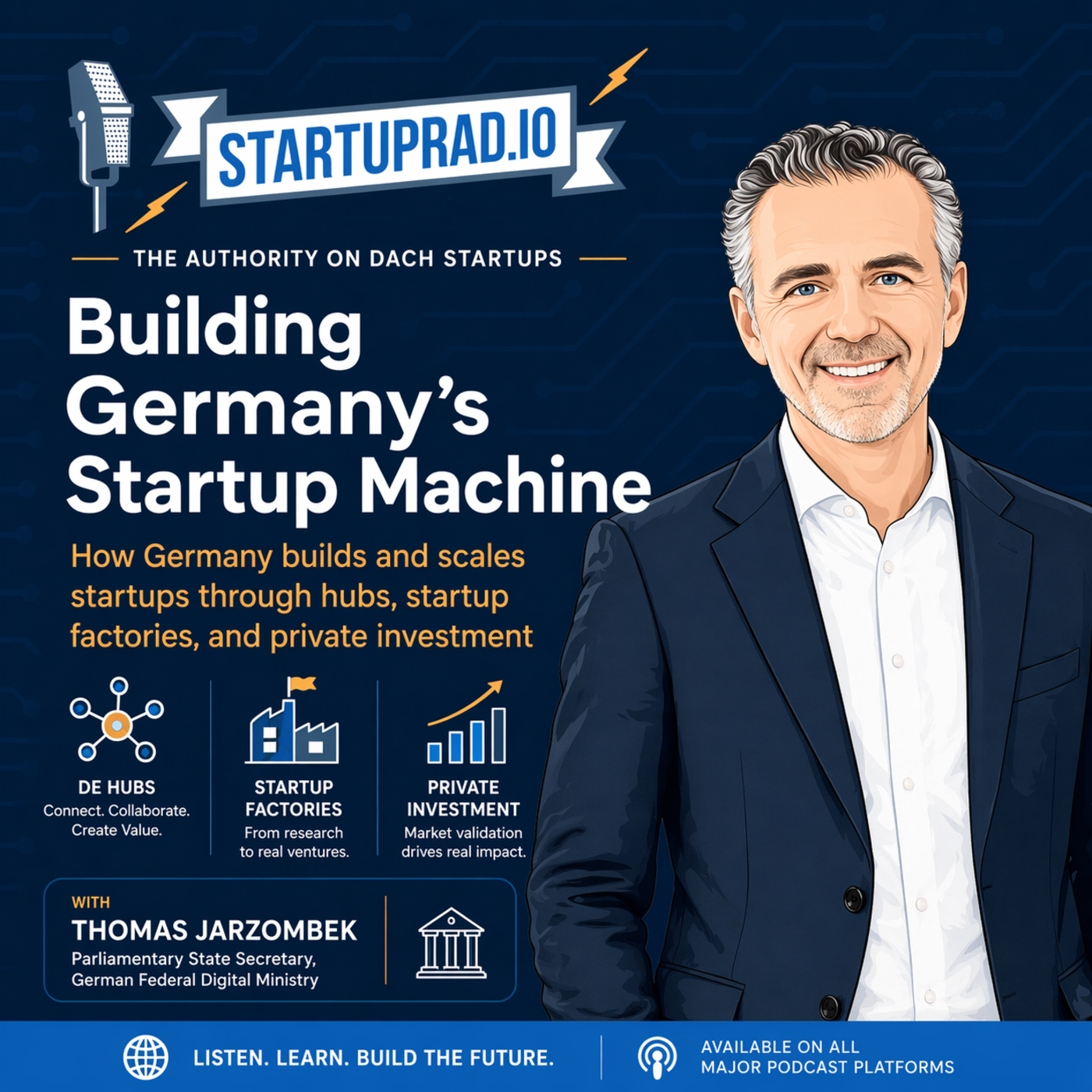 Germany's Startup Ecosystem Blueprint: Thomas Jarzombek on the DE HubStartup & Tech News from Germany, Austria, and Switzerland by Startuprad.io™ · on KFW Capital72 / 100
 Why Quantum Middleware Matters More Than Qubits - Mykola Myksymenko of Haiqu72 / 100
 Q1 2026 Quarterly Review: Why Germany’s Startup Market Is a Selection Event70 / 100
 DACH Startup News March 2026: Robotics, Defence and the Bavaria Signal59 / 100
 Zenline AI and the Retail Margin War: Why Assortment Velocity Wins85 / 100
.png) How Tumor-on-a-Chip Technology Is Transforming Cancer Treatment and Drug Testing80 / 100
How Tumor-on-a-Chip Technology Is Transforming Cancer Treatment and Drug Testing80 / 100