
Security Sutra · 2026-07-28 · 24 min
Key moments - from our scoring
Substance score
60 / 100
Five dimensions, 20 points each
Germany has published a comprehensive 234-page Startup and Scale-Up Strategy marking a fundamental shift in policy focus - from asking how to create more startups to how to finance, scale, and retain strategically important technology companies within Europe. Federal Economics Minister Katharina Reiche frames the core problem clearly: German pension funds and insurers allocate just 0.1% to venture capital compared to 2% for US counterparts, leaving 30 billion euros annually on the table. The strategy acknowledges Germany's real problem is not innovation or company formation, but an incomplete conversion chain where research doesn't reliably become companies, companies don't become scale-ups, and scale-ups don't remain in Europe. The 152 measures span financing architecture (extending the Future Fund, creating Scale-Up Direct through KfW, launching HTGF5), research transfer, security and defense, public procurement reform, talent, and internationalization. A critical but under-publicized element introduces a 100,000 euro direct award threshold for federal procurement from innovative startups - addressing Europe's venture client gap where governments fund innovation but purchase foreign technology. The strategy also formalizes defense tech as strategic infrastructure, reflecting that German defense tech startups attracted 1.16 billion euros in 2025, representing over half of European defense tech venture capital. Success depends not on program announcements but on whether Germany can convert scientific excellence into investable companies and those into enduring European technology leaders.
German pension funds and insurers allocate only 0.1% of assets to venture capital compared to 2% for US peers; if Germany matched US allocation levels, it would generate 30 billion euros in additional annual venture investments that currently go untapped.
Germany invests approximately 0.15% of GDP in venture capital while the US invests closer to 2%, representing a fourfold difference; German startup exits are also heavily weighted toward company sales (92%) rather than IPOs.
The strategy introduces a 100,000 euro direct award threshold allowing federal procurement officials to negotiate directly with innovative startups without excessive eligibility requirements, addressing the fact that only 7% of German startups had public sector customers in 2025.
Defense tech is designated as strategic infrastructure with dedicated federal investment vehicles, venture fund investments, and Sprint support; German defense tech startups attracted 1.16 billion euros in 2025, representing over half of European defense tech venture capital.
Germany's challenge is not lack of innovation or company formation, but an incomplete conversion chain where research doesn't reliably become companies, companies don't become scale-ups, and scale-ups don't remain in Europe - what the strategy calls the European scale-up gap.
Our reviewer’s read on each dimension, with quotes from the episode.
The episode is densely packed with novel, data-driven insights about Germany's policy shift from startup promotion to scale-up sovereignty. The host connects concrete statistics (30 billion euro capital gap, 0.15% vs 2% GDP venture allocation, 7% public sector customers) to structural problems (research-to-company conversion, capital-stage failures, procurement-client gap) that most listeners wouldn't have synthesized. The pace is substantive with minimal filler.
If German institutional investors allocate venture capital at 2% of assets like their US peers. That delta alone would produce a 30 billion euro annual investment.
Only 7% of German startups had public sector customers in 2025. 7%! The strategy responds by introducing a special direct award threshold of 100,000 euros for federal procurement from innovative startups.
The framing of Germany's problem as a 'scale-up gap' rather than a startup creation gap is genuinely contrarian and first-principles. The host moves beyond typical startup cheerleading to argue that deep tech cannot be financed like SaaS, and that Europe's real problem is a venture client gap, not just a capital gap. The thesis that friction between policy layers (research→founders→investors→customers→exits) is the core issue is non-obvious.
Deep tech cannot be financed, as if it were SaaS with a laboratory attached.
Europe does not only have a venture capital gap, it has a venture client gap.
This is a solo monologue with zero guest appearances. While the host references interviews with Thomas Zombeck (2021) and Anna Christmann (2023), those are historical references, not live guests. The episode is entirely the host's analysis of a government policy document, making it impossible to assess guest caliber on the intended dimension.
This is Johan Menninger for Startup Radio
In 2021. We interviewed Thomas Zombeck, then Germany's Commissioner for Digital and Startups
Exceptional specificity throughout. The host cites precise figures: 30 billion euros, 0.15% vs 2% GDP, 522,000 startup employees, 36 unicorns, 7.2 billion venture capital in 2025, 7% public sector customer rate, 0.16 billion defense tech investment, 17% vs 4% defense as % of venture market, 100,000 euro procurement threshold, 92% company sales vs IPO exits. References specific programs (KFW, HTGF5, Sprint, Wachstumsfonds, Deep Tech Climate Fund). Named examples include Helsing, Sweden/Denmark pension comparisons, and specific German cities/clusters.
Start-up and scale-up employment reached roughly 522,000 people in 2024. German startups attracted 7.2 billion euros in venture capital in 2025, and Germany now counts 36 unicorns, up from 32 the year before.
German defense tech startups and scale-ups attracted one. 0.16 billion euros in venture capital in 2025. That is more than half of European defense tech venture investments. Defense represents approximately 17% of the German venture market compared with about 4% globally.
There is no conversation at all - this is a pure monologue lecture format with no guest, no pushback, no real-time questioning or follow-ups. The host does not engage with opposing views or test claims against skepticism. While well-structured, the absence of conversational engagement entirely eliminates the dimension being measured. This is content delivery, not conversational craft.
This is Johan Menninger for Startup Radio, Europe's voice on startups, venture capital, and innovation. I'll be back soon. Until then.
Hello and welcome everybody. This is Joe Manager, recording from Frankfurter Main, Germany.
Computed from the transcript - who did the talking, and the words that came up most.
Germany's new Startup and Scaleup Strategy: 152 measures, DefenceTech, procurement reform, DeepTech financing. Why this is really about the European scaleup gap - and whether Germany can close it. Hello and welcome everybody. This is E 766 of Startuprad.io, recorded solo by Joe Menninger from Frankfurt am Main. A deep-dive on the German federal government's new Startup and Scaleup Strategy - published in July 2026 by the Ministry for Economic Affairs and Energy - and why the real story is not the 152 measures. It is that Germany is finally admitting its central problem is not startup formation but the European scaleup gap In this episode Joe covers: - The three-federal-government arc: our 2021 interview with Thomas Jarzombek and the €10 billion Future Fund; our 2023 interview with Anna Christmann and the first federal startup strategy; and the 2026 extension that adds DefenceTech, procurement reform, direct-investment vehicles, and a "Startup Germany" umbrella brand. - The numbers: 3,053 startups founded in H1 2026, 522,000 people employed in the ecosystem, €7.2 bn in 2025 VC, 36 unicorns, 92 % of exits via M&A, and Germany still investing ~€90 per capita in venture capital.
Transcribed and scored by The B2B Podcast Index.
The German minister said something this morning that would have moved markets in a normal news cycle. Quote, wir lassen einfach 30 Milliarden Euro liegen, die wir nicht investieren können. We simply leave 30 billion euros on the table every year because German pension funds and insurers allocate one-tenth of one percent to venture capital while their US peers allocate 2%. That is the size of the European scale-up gap, in one sentence from the minister herself.
Hello and welcome everybody. This is Joe Manager, recording from Frankfurter Main, Germany. A few hours ago, Startup Radio was invited to attend the online press conference, at the Bundesministerium für Wirtschaft und Energie, meaning the Federal Ministry for Economics and Energy, where Federal Secretary Katharina Reiche presented the federal government's new Startup and Scale-Up Strategy. Together with the cabinet resolution, I want to walk you through what she said and what the, I hope you sit down, 234-page strategy document contains and, as always on the show, what it actually means for founders, investors, corporates, policy makers and the European scale-up gap we so frequently talk about.
Today's argument in one line. Germany is no longer asking only how to create more startups. It is asking how to finance, procure from, scale, and retain strategically important technology companies. For years, the German startup debate concentrated on formation.
How do universities produce more spinoffs? How do founders access seed capital? How does incorporation become faster? How does Germany create more entrepreneurial ambition?
Those questions still matter. But the new strategy marks a more consequential shift. Germany is moving from startup promotion towards scale-up sovereignty. The document contains 152 measures across financing, research transfer, security and defense, bureaucracy, public procurement, talent, corporate cooperation and internationalization.
And its stated aim is no longer merely to increase the number of startups. It is to help successful companies reach the growth stage, remain in Germany, and expand internationally from European base. That distinction matters. Germany does not primarily suffer from a lack of innovation, research, or company formation.
It actually suffers from an incomplete conversion chain. Research does not reliably become a company. A company does not reliably become a scale-up, and a scale-up does not reliably remain in Europe. The new strategy is the clearest acknowledgement yet that Germany's central startup problem is now the European scale-up gap.
A short note on where this comes from, because context matters. Startupway.io has followed the development of Germany's startup architecture across several federal governments. In 2021.
We interviewed Thomas Zombeck, then Germany's Commissioner for Digital and Startups, about the federal government's 10 billion euro future fund. The core model was already visible then. Public capital would not replace private investment. It would mobilize it through the European Investment Fund, through KFW Capital, through venture funds, through selected direct investment vehicles.
Yet Tom Beck described the public money as patient capital operating across a 10-year horizon. The mission was to multiply the federal commitment through private co-investments, not to build a wholly state-directed venture market. In 2023, we continued the conversation with Anna Christmann, then Germany's Commissioner for Startup and Digital Economy. I may add, Anna Christmann was from the Scholz government and Thomas Herzombek from the Merkel government.
Frau Christmann, the first comprehensive federal startup strategy, added a broader institutional agenda. Funding. Employee ownership, female entrepreneurship, public procurement, resource spinoffs, regulatory sandboxes, access to data. At that point, the strategy had already moved beyond seed stage promotion.
The 1 billion euro deep tech and climate fund addressed companies with longer development cycles. The European Tech Champions Initiative targeted Europe's shortage of later stage growth capital. The 2026 strategy does not replace that architecture. It actually extends it.
The line running through all these three phases is clear. Germany has spent the past five years building the individual components of a startup financing system, what I also call the financing stack. It is now trying to make those components operate as an integrated scale-up system. That is real difference and it changes how we should read the new document.
The numbers show both progress and the unresolved problems. Let me get into the data. The government presents a German startup ecosystem with real momentum. I mean, guys, you know, we'll talk about it frequently.
3053 startups founded in the first half of 2026, almost as many as in an entire 2025, which totaled around 5300. As Minister Reiche puts it in her opening remarks, ein Sprung um 51% nach oben, a 51% jump over the same half of 2025. Start-up and scale-up employment reached roughly 522,000 people in 2024. German startups attracted 7.
2 billion euros in venture capital in 2025, and Germany now counts 36 unicorns, up from 32 the year before. Reiche also highlighted a pool of capital that already exists in Germany, Kapitalsammelstellen in German, like pension funds and serious foundations. They manage 2.8 trillion, yes, with a T, euros in assets.
Private wealth totals roughly 10 trillion. Talent is not the constraint. Capital is not the constraint. So what is it?
Her own answer in one line, Venture capital Investition in Deutschland liegen bei 0,5% des Bruttoinlandsprodukts. In den USA sind es fast 2%, which means we see investments in Germany sit at 0.15% of GDP. So let's say a half percentage point.
In the US it's closer to 2%, meaning fourfold. The strategy itself acknowledges that large financing rounds are still frequently led by international investors. The IPOs remain rare. That 92% of German startup exits take place through company sales, not stock market listings.
Reicher framed the growth stage problem directly. In größeren Finanzierungsrunden verliert dann Europa Anteil und Unternehmen wandern für große Finanzierungen in die Vereinigten Staaten nach Amerika. That's what we actually say in the startup scale-up gap. In larger financing rounds, Europe loses shares, and companies migrate to the US for capital.
This is why a startup strategy based only on creating more companies would be insufficient. A country does not secure technology sovereignty by continuing incorporations. It actually secures technological sovereignty by retaining their ownership capabilities, IP production and decision-making as those companies scale. So, the venture market has to be assessed across the entire capital cycle, fundraising, entry valuations, view flow, follow-on financing, exits, taxation, availability of institutional capital.
That is why we at Startup Radio have consistently treated KFW's research, venture capital and private equity indicators, as essential market infrastructure, not just as another quarterly report. The KFW Barometer draws on roughly 450 investors and tracks business conditions, expectations, fundraising, investment activity, valuations, and exit opportunities. That is the readout you need if you want to know whether the political architecture is actually working. Political announcements matter.
Capital market conditions determine whether they work. And here's a line from this morning's press conference that I think may become the most quoted number from the whole event. Asked by newspaper Tagesspiegel Daily Mirror about the private pension pillar, Reiche produced this calculation. If German institutional investors allocate venture capital at 2% of assets like their US peers.
That delta alone would produce a 30 billion euro annual investment. Her exact words, wir lassen einfach 30 Milliarden Euro liegen, die wir investieren könnten. We are simply leaving 30 billion euros on the table that we could invest. Her comparison to the mechanism out, during pension funds average, a minus 0.
6% real return. Minus 0.6% real return. Swedish and Danish equivalents that invests in venture and public equities run at 7 to 11% plus a pension fund that invests in venture capital performs better and secures pension better than one that does not.
Part three, the financing architecture is becoming more direct. The most important change in this strategy is not that more programs are being announced. It is that the government is becoming more willing to intervene across different layers of the capital stack. Here is what a strategy commits to.
Extending the future fund beyond 2030, creating scale-up direct through KFW, a direct investment vehicle, investing up to 300 million euros in funds that finance first-of-kind industrial projects, launching HTGF5, the fifth generation of high-tech Grunnerfonds, in 2027, creating Wachstumsfonds No. 2, expanding the European Tech Champions initiative, mobilizing more than 25 billion euros in private commitments through the WIN initiative, we talked about this frequently, improving secondary markets and exit conditions, and, expanding financing for strategic fields including deep tech, AI, biotechnology, and defense tech.
Why does this matter? Because different companies fail at different points. A software startup may need seed funding, product market fit, and commercial distribution, a fusion company, a quantum company, a biotechnology company, and an advanced manufacturing company. Those need laboratories, demonstrating facilities, regulatory approval, project finance, venture debt, years of technical validation before meaningful revenues emerge.
The strategy recognizes this. It proposes financing for first-of-kind projects. It commits to milestone-based support for fusion startups through Sprint, a German agency for disruptive innovation, including potential co-financing of technology demonstrators for magnetic and laser fusion. Here's the sentence I want you to hold on to.
Deep tech cannot be financed, as if it were SaaS with a laboratory attached. That is the frame that should guide how investors and policymakers read the entire document. Germany's economic strength lies in complex industrial systems, scientific research, engineering, specialized manufacturing, and regulated markets. A credible German startup strategy therefore cannot simply replicate Silicon Valley's preferred company and capital model.
It has to finance the companies that Germany is structurally capable of producing. That is what the strategy is trying to do. Chapter 4. Germany is building its own industrial reality.
This is consistent with what we found in our 2026 analysis of Germany's digital hub and startup factories. Germany's startup ecosystem is decentralized because its economy is also decentralized. Industrial capabilities are distributed across Munich, Berlin, Frankfurt, Hamburg, Dresden, North and Westphalia and many specialized regional clusters. The digital hubs coordinate market-facing ecosystems, the start-up factories increase university spin-off formation, private capital acts as an early validation mechanism, not a late-stage afterthought.
This is not a single-city hyperscaler model. It reflects Germany's tradition of research institutions, industrial clusters, Mittelstand companies and hidden champions. The new strategy also reinforces this layered architecture. Exist set of factories address venture formation.
A planned Exist Academy should professionalize university entrepreneurship support. A national intellectual property strategy, standardized spin-off contracts, an IP toolkit, and an IP deal database, all aim at reducing friction in technology transfer. Real labore and experimentation clauses are designed to bring regulated innovation closer to market deployment. But, and this is critical, startup factories can increase the number of companies leaving universities.
They cannot by themselves create the capital, the customers, and the exit markets required to turn those companies into global category leaders. That is where the scale-up strategy begins. Part 5. Public procurement may matter more than another funding program.
Let me point out what I think is the single most economically important measure in this whole document. It received far less attention than the new financing vehicles. Only 7% of German startups had public sector customers in 2025. 7%!
The strategy responds by introducing a special direct award threshold of 100,000 euros for federal procurement from innovative startups. The related rules enter into force in the first half of July 2026. They are intended to make bilateral negotiation awards easier, reduce excessive eligibility requirements, and accelerate payments. This addresses one of Europe's deepest contradictions.
European governments frequently subsidize innovation and then purchase established foreign technology. They fund the supply. They fail to create the demand. So here's the line, Europe does not only have a venture capital gap, it has a venture client gap.
For B2B startups, for GovTech cybersecurity, AI, defense and industrial technology companies, a credible, really credible first customer can be more valuable than yet another grant. Public procurement provides revenue, validation, references. A route towards scale. It can also reduce dependence on international investors by improving the underlying commercial quality of European companies.
The decisive question is therefore not whether procurement law technically permits public authorities to buy from startups, that is now settled. The decisive question is actually whether procurement officials will actually use these new instruments. Because 100,000 euro direct award threshold that nobody in the ministry knows about how to use is not a scale-up strategy, it's a footnote. Port 6, Defense Tech is a clear signal of the policy shift.
The most politically visible section of the strategy is the dedicated feel for security and defense. Germany plans to establish a federal direct investment vehicle for startups and scale-up producing clearly military-used products and services, including products converted by Germany's war weapons control framework. It also plans dedicated investments in defense-focused venture funds and a stronger use of Sprint instruments for security and defense technology. This shift reflects an existing market reality.
German defense tech startups and scale-ups attracted one. 0.16 billion euros in venture capital in 2025. That is more than half of European defense tech venture investments.
Defense represents approximately 17% of the German venture market compared with about 4% globally. And almost one quarter of German startups reportedly develop some form of dual-use products. 17% versus 4% globally. That number should stop you.
This is why Helsing matters more than as an isolated unicorn story. Helsing represents the convergence of AI, defense procurement, strategic autonomy, software-defined military systems and the European growth capital. It is precisely the kind of company a new strategy is designed to support, retain and reproduce. This policy shift is broader than the often used headline that Germany will now fund weapon startups.
The real shift is that Germany has begun treating selected startups as strategic infrastructure. This also explains the government's focus on faster Bundeswehr, procurement, on SVI Connect and the Defense Alliance in Munich, on NATO Diana and the NATO Innovation Fund, on the Bundeswehr own, innovation structures, and on more predictable export control processes. DefenseTech is not separate from new startup strategy, it is the sharpest expression of it. Part 7.
Startup Germany and the Friction Between Layers. The government also plans to expand Startup Germany into national umbrella brand and network connecting federal, state, and regional programs. The stated objectives include improving transparency, helping startups identifying support programs and international partners, strengthening the cooperation with established companies, and marketing Germany more effectively to investors, founders, and talent. Branding alone will not solve the scale-up gap, but current positioning matters in an ecosystem that international investors often find fragmented and difficult to navigate.
Fortunately, there is Startup Radio, of course. An international investor may understand Berlin Software or Munich Mobility or Frankfurt Fintech, but they may not automatically see how German research institutions, federal programs, state-level agencies, the partners from Mittelstand digital hubs, and startup factories all fit together. Startup Germany can be useful when it makes that system legible. But let me be clear, Germany does not need another slogan for entrepreneurship.
It needs a navigable market architecture. Because the deeper problem, and this is the thesis of this whole episode, is this. Feud separately, Germany already has many other required components. Public Venture Commitments, KfW Capital, the European Investment Fund, the German ATGF, the Deep Tech Climate Fund, Sprint, the Exist Programmes, Startup Factories, Digital Hubs, universities, and applied research institutions, strong industrial customers, a large SME, Mittelstands-based, world-class engineering, a grown population of venture-backed technology companies.
The unresolved problem is the handover between the layers. Research must reach founders. Founders must reach investors. Investors must fund forlorn rounds.
Startups must reach the Customers and public institutions must become the venture clients. Scale-ups must access the industrial infrastructure. And European capital markets must eventually provide liquidity. Germany's challenge is not the absence of building blocks.
It is the friction between them. Closing remarks and the benchmark that matters. So, the final assessment. Germany's new startup strategy is directionally stronger than its title suggests.
It is also financing strategy. It is a research commercialization strategy, and it is also a procurement strategy. It is a defense tech strategy. It is an industrial policy strategy.
And above all, it is an attempt to close the German and European scale-up gap. But the strategy's success will not be determined by the number of programs it announces. It will be determined by whether Germany can turn scientific excellence into investable companies, investable companies into scalable businesses and scalable businesses into enduring European technology leaders. Germany has learned how to support startups.
It must now prove it can help build scale-ups. That is the benchmark. And this time, the market should judge the strategy not by its intentions, but by the companies that remain, scale, and win. This is Johan Menninger for Startup Radio, Europe's voice on startups, venture capital, and innovation.
I'll be back soon. Until then.
Other episodes covering the same guests and topics, from across The B2B Podcast Index.
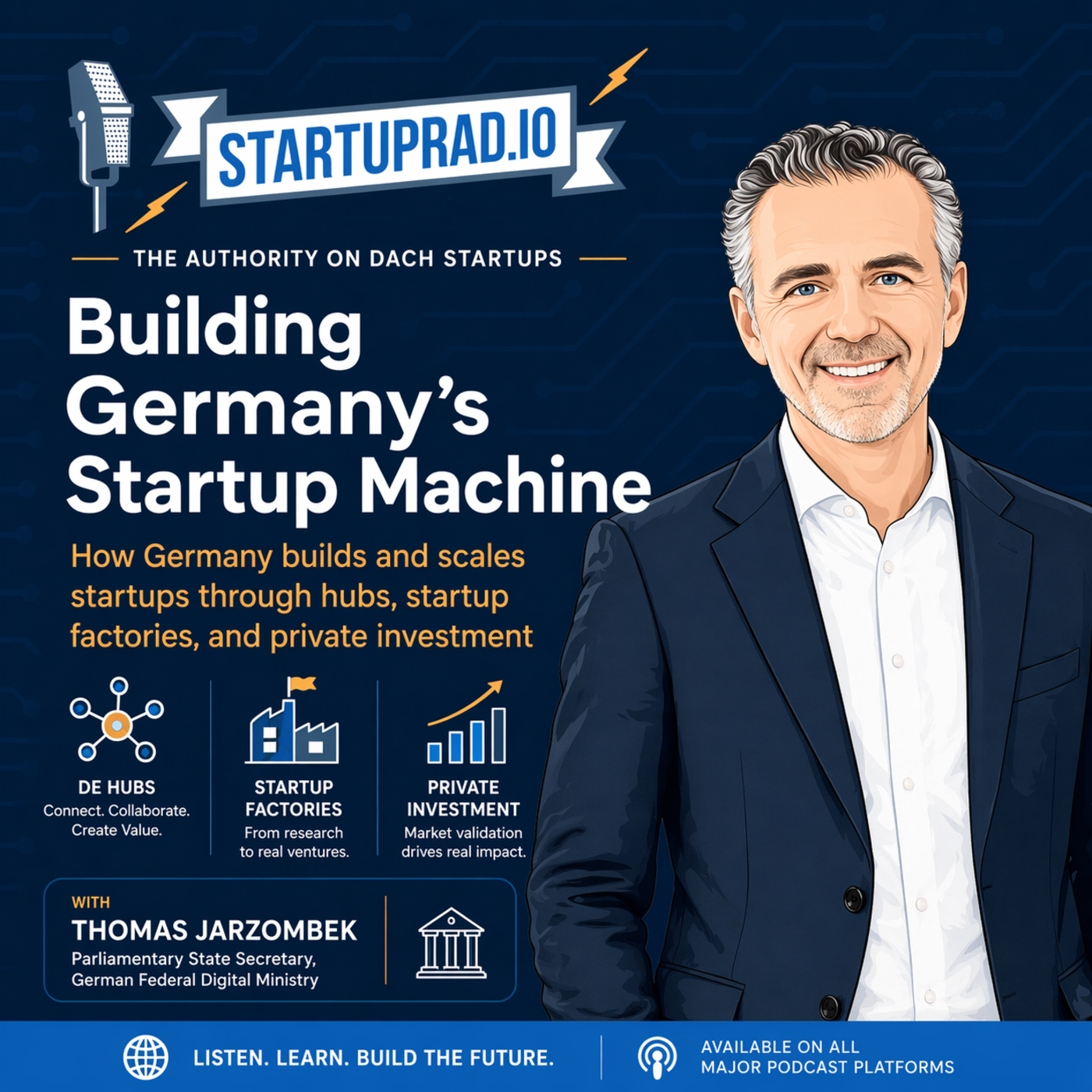 Germany's Startup Ecosystem Blueprint: Thomas Jarzombek on the DE HubStartup & Tech News from Germany, Austria, and Switzerland by Startuprad.io™ · on KFW Capital72 / 100How Germany Is Building DE Hubs and Startup FactoriesTech Startups Germany · on KFW Capital68 / 100
 Investors Go All-In on Iberia’s Cleantech Boom | Suma CapitalNET-0 · on European Investment Fund65 / 100
.png) DACH News April 2026: VC Leaves SaaS for Deep TechBlockchain Germany · on KFW Capital64 / 100
DACH News April 2026: VC Leaves SaaS for Deep TechBlockchain Germany · on KFW Capital64 / 100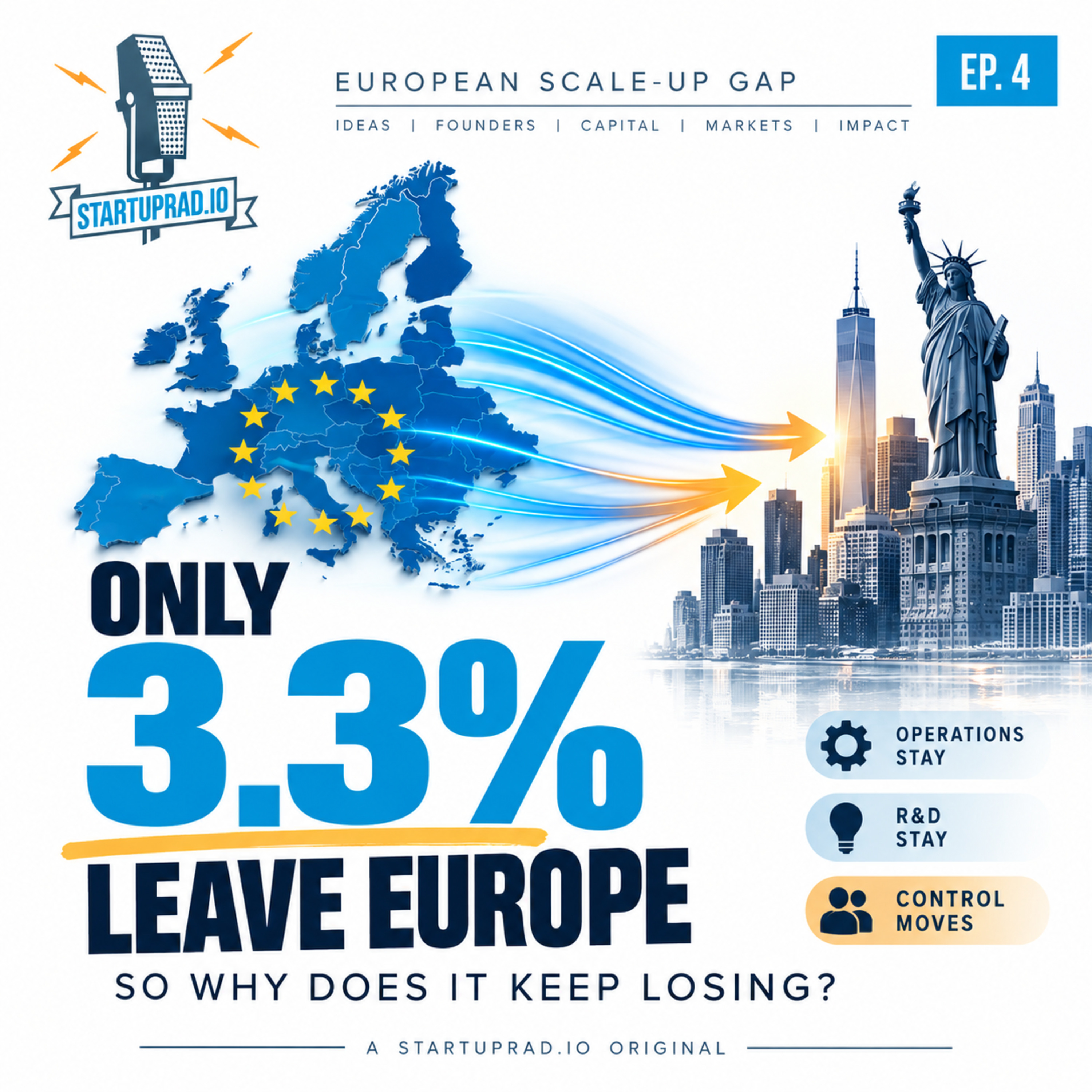 Sovereign Tech: Who Owns Europe's Critical Startups82 / 100
 €1.7B Defence Tech Supercycle Hits Europe80 / 100Helsing's $1.2B Defence Round Tops DACH May 202661 / 100DACH April 2026: VC Exits SaaS for Defence & Dual-Use62 / 100
 Q1 2026: Munich's Rise as a Defence-Tech Hub62 / 100