
Signal to Noise · 2026-02-03 · 25 min
Key moments - from our scoring
Substance score
60 / 100
Five dimensions, 20 points each
Tiama Hanson-Drury tackles the structural gap between strategy-setting executives and execution-focused teams - the middle management translation problem that plagues most organizations. Drawing on the MECE framework (mutually exclusive, collectively exhaustive) from Barbara Minto's McKinsey work, she explains how breaking complex problems into component parts enables leaders without deep technical backgrounds to drive tech organizations effectively. She contrasts the UK/European market's risk-averse culture with demand for commercial thinking, revealing why hybrid CPTO and GM roles are proliferating. At her previous venture (acquired by MasterCard), Hanson-Drury built a cross-functional rhythm around a single critical metric: subscription success rate. Her team held weekly rhythm meetings (operations Monday, sales Tuesday, product Wednesday) where every function measured its contribution to that one metric, creating radical alignment without constant executive presence. She also covers her toolkit: Claude, ChatGPT, Perplexity, and notably Notebook LLM - Google's underrated tool that converts documents into podcast-format learning experiences. Her leadership philosophy emphasizes clarity (vision, strategy, milestones, expected behaviors) paired with accountability, using the metaphor 'bring the sandwiches and ask where the sandwiches are' to normalize mutual feedback in psychologically safe teams.
MECE (mutually exclusive, collectively exhaustive) is a McKinsey communication tool created by Barbara Minto that breaks complex problems into distinct, non-overlapping parts covering the whole problem. This abstraction allows leaders to discuss technical matters at component level without writing code, and is critical for cross-functional communication and building ideas collaboratively.
Establish a fixed cross-functional meeting rhythm where each function (product, engineering, marketing, ops, sales, finance) reports weekly progress on experiments moving that metric. Operationalize what works, kill what doesn't, and ensure every team member can articulate how their work impacts the metric so they row in the same direction without constant executive presence.
Notebook LLM is a Google tool that converts any document, content collection, or structured input into a podcast-format learning experience via natural language prompts. Leaders use it to turn resumes into career retrospectives, research documents into digestible audio learning, or strategy materials into interactive discovery.
Provide absolute clarity on vision, strategy, milestones, and expected behaviors upfront, then normalize bidirectional accountability using the 'sandwiches' metaphor - both leaders and team members must ask 'where are the sandwiches?' without taking it personally, because the shared goal overrides ego.
European and UK markets demand both risk management and commercial thinking from product leaders, yet traditional product-only roles haven't delivered growth impact. Companies are collapsing product and tech functions or expanding product leaders into GM roles to force commercial accountability alongside innovation.
Our reviewer’s read on each dimension, with quotes from the episode.
The episode contains several genuinely useful frameworks (MECE principle, the 'sandwiches and tent' accountability metaphor, the flywheel metric-alignment approach) mixed with substantial filler. The rapid-fire section, extended sandwich discussion, and repeated Netflix/Amazon examples add little value. The core insights on translating strategy through middle management and driving cross-functional focus around a single metric are solid but somewhat incremental for experienced operators.
most businesses are really good at setting a strategy at the top, and they're really good at having people in the trenches who actually do the work. What they're really bad at is how do you translate that to the middle management
we understood that metric that actually mattered was shifting for us as a business. It went from adoption to success rate
While the MECE framework is borrowed (McKinsey vintage), the application is competent. The 'sandwiches and tent' metaphor is original and memorable. However, much of the content recycles standard product leadership advice: psychological safety, cross-functional alignment, clear metrics. The legal tech observations are predictable (clients want to innovate, AI is helpful). The Swedish culture praise and Scandi noir TV tangents add personality but not intellectual novelty.
you give out the vision, the strategy, the way that we're going to get there. Most importantly the messy middle that I expect to happen between now and there's Name it.
I use AI a lot. And as all of us who do know, different tools have different strengths
Tiama Hanson-Drury has genuine operating credentials: she led product through a successful acquisition by MasterCard, managed 75% of a small org reporting to her, navigated B2B2C complexity, and now runs tech + product at a venture-backed legal tech company (Opus 2). This is a real operator with scars. However, the interview doesn't deeply stress-test her thinking or push on contradictions, so her caliber is evident from background rather than demonstrated in conversation.
I had about 75% of the org reporting into me, which was hilarious. Also it was a small business. Right. Like we were a small business. Did the whole 1 to 10 million journey
we were a B2B2C ecosystem play. Right. Which is difficult to do. So we were selling to banks
The episode provides concrete examples (MasterCard acquisition, capital one and Lloyd's as banking customers, Netflix/Amazon/Spotify as merchant examples, NotebookLM as an AI tool, Department Q as a TV show). However, most lack depth: no figures on business metrics, no timeline specifics, no dollar amounts, no detailed outcome data. The flywheel framework is explained with named companies but without performance data or before/after metrics. The cross-functional meeting structure is described but without measurable results.
when Glenn logs into his banking app with one of those banks, banks, he can identify subscriptions, he can cancel them. But we also sold to the subscription merchants. Netflix is of the world, Amazon Prime, Spotify's et cetera
I put my resume and I put like all my public speaking things into it. And I said, talk to me about how to market this person
The host (Glenn/Speaker C) asks reasonable opening questions but rarely challenges or probes deeply. Follow-ups are often surface-level (e.g., rapid-fire sandwich questions). The host nods along with Tiama's frameworks without testing their limits or asking for counterexamples. There's no pushback on contradictions (e.g., she claims to run tech at a legal company despite not being technical, but this tension isn't explored). The conversation feels warm but lacks intellectual friction - it reads more like a friendly catch-up than a rigorous interview.
Love it. Yes. It's one that we've, over the years here, it's gone back and forth of one year CPTO on Vogue. Next year we want to split it all up
Great to hear. And, and definitely not expected. I'm very curious as well
Computed from the transcript - who did the talking, and the words that came up most.
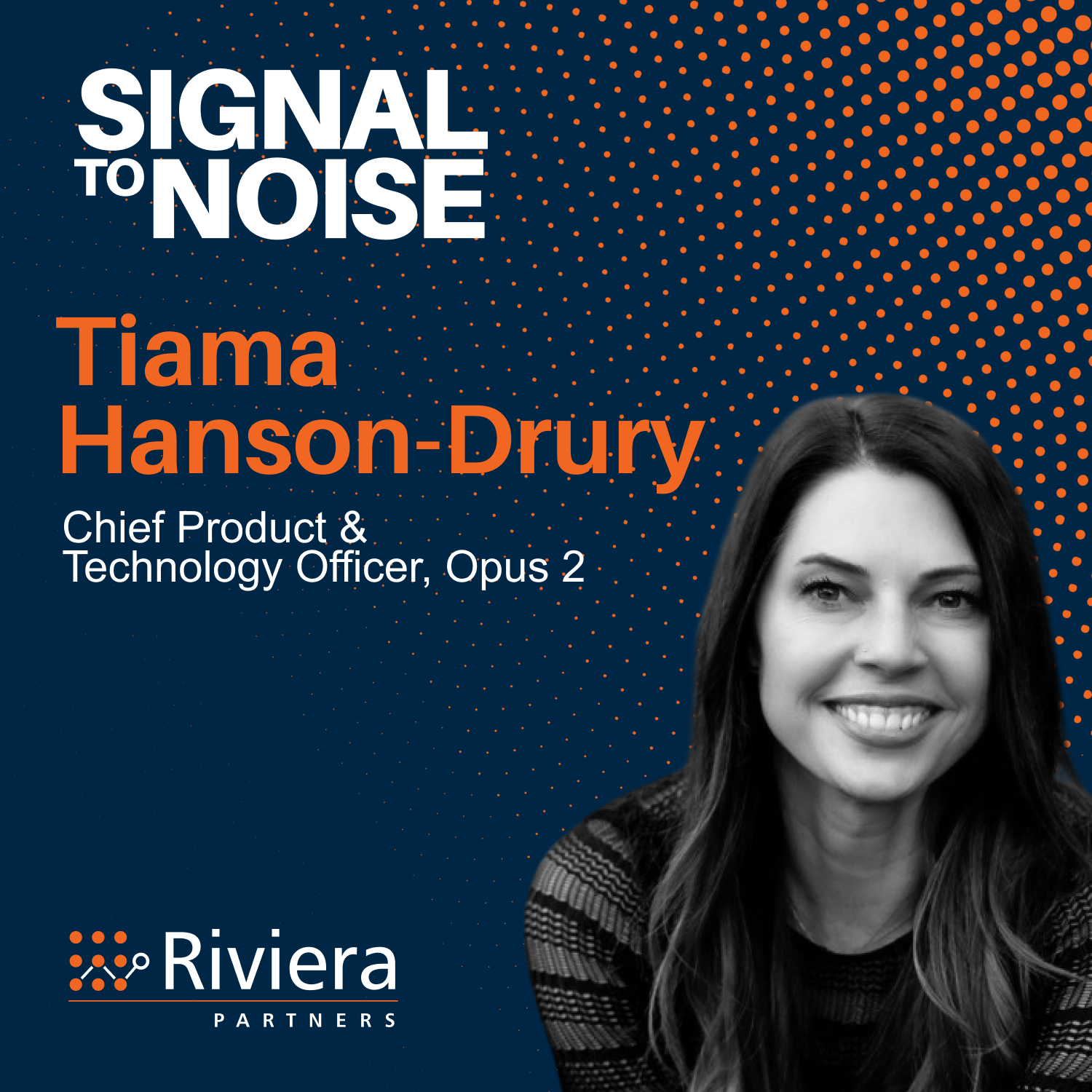
In part two of this episode of Signal to Noise, Glenn Murphy continues his conversation with Tiama Hanson-Drury, Chief Product and Technology Officer at Opus 2, diving into the mechanics of execution at scale. Tiama unpacks how she bridges strategy and execution through the “messy middle,” aligns teams around the metrics that truly matter, and leads product and technology without being a traditional technologist. From navigating U.S. vs. European tech cultures to driving focus through a single success metric, this episode offers a practical masterclass in modern, commercially minded leadership. What You’ll Learn: Why most organizations fail in the “messy middle” between strategy and execution How MECE thinking helps non-technical leaders effectively run product and technology teams Key differences between U.S.
Transcribed and scored by The B2B Podcast Index.
Speaker A: Uh, most businesses are really good at setting a strategy at the top, and they're really good at having people in the trenches who actually do the work. What they're really bad at is how do you translate that to the middle management so that the middle management can then make that realistic for the people in the trenches?
Speaker B: Welcome to Signal to Noise by Riviera Partners, the podcast where leading executives share how they cut through the noise and act on what matters most. We go beyond the headlines to explore the pivotal decisions, opportunities and inflection points that define their careers and shape the future of the companies they led. It's time to cut through the noise and get to the signal.
Speaker C: In our last episode, Tiama discussed tuning out the noise of legal tech. Her pivot from being the smartest person in the room to a high trust leader, and the three core signals she uses to identify elite talent. If you missed it, be sure to check out part one. In part two, Tiama dives into the technical and commercial side of her role. She shares her strategy for driving focus through metrics, the cultural differences between the US and UK tech scenes, and her rapid fire takes on the tools and habits that keep her productive, including her surprising love for Swedish tech culture. It's time to cut back through the noise and get to the signal. You've obviously slightly different topic, but coming from the States and coming over here where one is kind of being a product leader in Europe and having had experience in the States, so your overall take on that, but also the not computer science background, not a maths whiz, but being a CPTO now and running the tech org as well, how you
Speaker A: navigated that, that's happened twice now.
Speaker C: That is.
Speaker A: No one's more surprised than me. I suppose what it does is it just comes down to that whole, um, you had asked a question in the lead up to this on frameworks and actually this framework leads into that answer. So I, a previous boss taught me about this concept of me see, which I don't know. Have you heard of it before, Glenn?
Speaker C: No.
Speaker A: Okay, so it's kind of like an old school consulting one. A woman named Barbara Minto created, I think she was McKinsey's first female partner and it was created as a communication tool. MECE is mutually exclusive, collectively exhaustive. So how do you take a problem and break it into mutually exclusive parts and make sure that all those parts are collectively exhaustive in terms of how you would solve that? And for me, that level of thinking has been incredibly important in allowing me to be an effective Communicator, allowing me to understand businesses at their most abstracted levels. And as a result, I can translate and I can see connections. So when it comes to the first part of your question, us versus uk, I've been able to quickly understand that UK and Europe, it's like there's tension. It's like on one end they prioritize and are more interested in hearing about how you're reducing risk than in the state rates. It's about how you're driving growth. But yet on the flip side, they want to. They want to move into a, uh. How do you drive growth? How do you have more commercial thinking? I think that's why you see a lot of GM roles now, or CPTO roles, because they're trying to be like, okay, product hasn't necessarily worked really well for everybody. And so they're trying to figure out, how do you get use out of this, right? How do you get the most out of product? And so they're either collapsing them into tech because they're finding that, you know, those two functions are not working super well together, or they're turning them into like, GMs because they're like, okay, well, we have to be commercial, so let's have this stuff, a CPO turn into a gm. So that's been fairly consistent in my experience. And so then what I try to do with the teams is talk to them about how risk management is important, of course, but we also need to lean into growth and thinking about, well, how do we actually approach the European and UK markets in a way that the risk of inaction is greater than the risk of action. Right? And then that's how you kind of start to try to break that down with those customer sets. On the technology side, it's the same thing, mutually exclusive, collectively, exhaustive way of thinking about something and breaking it down to those smallest component parts, because then you can talk about them. It doesn't matter that I'm not a technologist, doesn't matter that I'm not writing Python. Like, I can talk about them to my teams and we can talk about why they matter. And I suppose that goes back to your question on interviewing. I've got to have people who can abstract because that's how we're going to communicate. Like, if we can't break things down to LEGO parts, we're not going to be able to build ideas together. So I think for me, that's been the way it is. And I just hire, or like in the case of Minna, have technology leaders who are not threatened by me and want to partner with me and don't mind me asking a million questions. And I've been lucky. It's been manageable.
Speaker C: Love it. Yes. It's one that we've, over the years here, it's gone back and forth of one year CPTO on Vogue. Next year we want to split it all up and then go back to it again. So quite often you find there's not that many people who've done it, especially like yourself, multiple times.
Speaker A: I have to say it's very fun. I encouraged one of my really good friends on the west coast who works for, uh. Well, I won't name in case she doesn't want me to, but she was getting pushed by her board to take the T, small T. She's like, tiana, I can't do it. I was like, if I can do it, you can do it. So. And she's doing it. She's like five months into that role. And she said, she's like, tiana, you're right. It's so much easier to get done because you're not having to kind of go through. It's obvious, right? You're not having to go through another person to translate. But you can only do it if you have a, uh, high respect environment, high psychological safety and nobody's embarrassed to just say, wait a second, I don't get it. What are we talking about here?
Speaker C: Yeah, and you're very good. I think about building that type of culture where people are not afraid to make mistakes with that kind of growth mindedness that you talked about. In terms of the legal sector, it's obviously a different one for you. What, what surprised you most about it?
Speaker A: Uh, what I've been really, really surprised about is how willing to innovate our clients are. I expected when we came in that it was going to be a situation kind of like when I came into Fintech where, you know, I was saying earlier, you have to basically be able to articulate that the benefit of doing something is so great that it outweighs the risk of making that change. And that's very different than working in an environment that's not highly regulated or very risk averse. And I respect those industries and uh, the way that they exist, but I mean, legal has been out of control. I said it earlier, like our clients, you know, I'm, I'm inspired by some of the stuff they're doing in terms of how they're adopting AI across their organizational stacks and the ways that our clients, our product is highly Highly configurable. And it really, I mean it basically for those who don't know what OPUS is, it's a collaboration workspace that's built for high document volume collaboration and it's specific for legal. So we build all our AI to be trained on our type of legal litigation in particular, which is very different than doing, because I've learned very different than, you know, doing general research or a different type of law. What I've found is super fascinating is just to talk to our clients about how they are actually using AI, using our product to do better trial preparation, to check inconsistencies with what witnesses are saying, to put together this, the issues that they're going to try to prove in the courtroom. I mean it's just fascinating. So yeah, I've been really, really surprised that I don't have to convince anybody that we should be innovating. Like they are all doing it, they're all excited about it, they're expanding usage. They've just been way more forward leaning than I expected.
Speaker C: Great to hear. And, and definitely not expected. I'm very curious as well. Obviously you've had the uh, great exit to MasterCard as well. Just curious, was there, I imagine there were ups and downs, but was there ever a point where you knew it was coming? It was like an inevitability and you were like, um, I'm, I'm sticking around for this. Or did it come as a nice surprise?
Speaker A: Oh my God, no one, no. What world does that come as a nice surprise? I think you and I had breakfast right afterwards and I was like, I just need to take a beat. I have more, those who are not seeing me, I have more gray hair here. You cannot see it because I've got my hair, but it is white now. It was really hard graft, no question. And I think, you know, for us it really did come down to that. Hard work and hard discipline. Like, I think a lot of people think that, especially founders, people from the outside think that the way that you get acquired by a uh, company like MasterCard is timing and luck. And that's true. Or like being the flashiest, coolest product. And I think that's true. But a big part of it also, like, and I know this, we just acquired a company, is you're acquiring discipline, you're acquiring the ability to stay focused. You're acquiring a team who's able to say no and say, this is what we're working on, this is how we're going to build, this is how we're going to get velocity. And that was certainly the case with us.
Speaker C: Love it. And with a. How many have to be. Because I think your team was about, was it 50s at, uh, the time, 50, 60.
Speaker A: I think I had about 75% of the org reporting into me, which was hilarious. Also it was a small business. Right. Like we were a small business. We did the whole 1 to 10 million journey. And it was really interesting to have that. It was almost like being a CEO. I could actually, I think you and I talked about when I was leaving, like, well, what do I want to do? And like we'd even said like, you want to do a CEO type of role. Yeah.
Speaker C: Because when we look at that path, I think you're primed for that and CEO type role as well. I think you've always, since we've known you, been one of the more commercially minded product leaders we've ever come across. I think both here or in the States. And that's only being proven out at the moment. So I'm curious as well in terms of some of these. Like this one is how do you keep people rowing in the same direction? I think you've talked about that quite a lot. Platform thinking in a zero trust economy.
Speaker A: Let's talk about the rowing in the right direction because actually that is something that so many people can learn from. So because it's very practical. It's not like wishy washy. So what we did is we had something that, to the point that my nickname was Tiama Flywheel, Hanson Dory. So we really knew our fly, knew how we were supposed to guide our product decisions on what we did. Because we understood we were a B2B2C ecosystem play. Right. Which is difficult to do. So we were selling to banks. We had a subscription management product that was, you know, put into the front end of capital one, put in the front end of Lloyd's ing, et cetera. So that when Glenn logs into his banking app with one of those banks, banks, he can identify subscriptions, he can cancel them. But we also sold to the subscription merchants. Netflix is of the world, Amazon Prime, Spotify's et cetera. We knew that Flywheel. We knew what had to happen to make that spin. But as we started to approach the next funding event or potential acquisition, we really identified that, uh, and this was due to some commercial stuff. We had moved our pricing model to be performance based. So we knew that we would only get paid when a subscription was successfully managed. The real game changer, uh, for this in terms of how do you get people Rowing in the same direction, and this is a very practical one that I think lots of people could learn from, is we understood that metric that actually mattered was shifting for us as a business. It went from adoption to success rate. That subscription had to be managed effectively. And so then we got into a place where we knew that we had to be focusing every day on what we were doing to increase success rate. Zeroing in on that one metric was the thing that was going to matter the most for a good funding event or a good acquisition event. And so once we aligned on that, everything snapped into focus. And it was a cross functional organizational approach. So we had a cross functional team that was product engineering, marketing, operations, finance, commercial, and we met weekly and we actually met multiple times a week. But we had one like where we all came together. So I forget what it was but like Mondays was operations day, Tuesday was sales day, Wednesday was product. You know, like we had. Everybody knew how they were moving that metric and everybody was doing experiments, sharing the learnings from those experiments. And then we were operationalizing what was going right and we were killing what was going wrong. That was so important because that's how we actually moved that every week. It was a fundamental differentiator for us because we built so much IP through that process. But also so like if I wasn't there, everybody knew why we were going after success rate. I didn't have to be in the room, I didn't have to be in the meeting. Like people knew. So they were all rowing in the same direction. And what was amazing about that is some of those people, they've gone on to have incredible careers, even in the short period of time at MasterCard because they got to show their stuff, they got to stand up on Tuesday and be like, here's what we've done. This has made this impact. We brought this merchant onto the network. And uh, I just think that was such an amazing way to drive laser focus on a metric that mattered commercially driving impact, and do it for the benefit of the team. Not only are they all rowing in the same direction, but they're getting the glory of it too.
Speaker C: It sounds genius and it sounds so simple again, but it's actually doing that meeting and getting value from it.
Speaker A: It was so not simple, it was so hard. And there's so much stuff that doesn't work. And keep try, just try administratively keeping track of all that. Like, okay, what are we doing this experiment, what happened with that one? Wait a second, someone drop the ball on that. You know, there's so much so it was not easy at all.
Speaker C: What was your role in it? Were you leading most of that?
Speaker A: My functions were reporting into me. So outside it says sales and finance reported into my partner as did our growth bet, which is merchant strategy. So three of those functions aren't mine. But like when you have a two person exec team and one CEO, like everybody's yours, you, you, you know. And so yeah, for me what my purpose is making sure I was responsible for getting that success rate up. That was like so important. My team's touched it and so I was just there with my teams trying to make sure that they had the context, they were getting the right support, they were being kept on focus and I would unblock them where I could
Speaker C: because again I think you need a high level of trust in that uh, everyone there is team first as well. So that's probably the first thing. But keeping that uh, unity and having that psychologically safe environment, how do you go about doing that, building that type of environment?
Speaker A: I think you just have to show it through experience. Honestly I've always had global teams. Very I think probably the first time I actually have maybe now and a little bit at ah Mina, you know I actually have my M. Direct reports working with me. I still don't have my manager working in the same office. I've always operated in a global world and so I have a bit of a command control approach there which is like look, you give out the vision, the strategy, the way that we're going to get there. Most importantly the messy middle that I expect to happen between now and there's Name it. Name the behaviors and the culture that will be accepted. I have this saying that's like you got to be able to bring the sandwiches and say where are the sandwiches? So say you and I, Glenn, are uh, going out and we decide we're going to go for a multi day hike. Something I will never do. But my sister is now doors person. She will. And you are supposed to bring the sandwiches and I'm supposed to bring the tent. If we get to the first milepost day one of our three day hike and you haven't brought the sandwiches, I need to say like, where are the sandwiches, Glenn? Um, like we got to eat. We're supposed to be eating. We're supposed to be eating so we have the energy tomorrow and the next day to get to that. If I forgot to bring the tent, you need to say, tiama, I can't sleep outside, it's freezing. Like what are we going to do? You were supposed to Bring the tent. And I think you have that by having clarity of, like I was saying, command and control. You have an idea of the vision and the strategy where you're trying to get to. You have the idea that there's going to be three days that are, uh, milestones that you got to get through and you know what your responsibility is for that. And so I think the way that works is like you give them that clarity and then you show them that you will both ask the question where the sandwich is and you will be asked the question. And neither of those do you take it personally because you have a shared goal of getting to that place and you sat down together and said, we need sandwiches and we need tents.
Speaker C: Love it. People know what they're accountable for and get held to account as well. If you're up for it, we can do these rapid fire questions.
Speaker A: Sure. Hit me.
Speaker C: I, um, might hear you of a couple of surprise ones as well. So, uh, so first one, what type of sandwich would you want on a multi day hike?
Speaker A: I love food, so can I have a few sandwiches?
Speaker C: You can have a few. No, PB and J.
Speaker A: No, no, no. No One would be a sandwich that we used to eat growing up. I grew up in la and we would always make these tuna fish sandwiches with um, hot sauce, crystal, uh, hot sauce and cheddar cheese and take those to the beach. So I take my beach sandwich. That was really, really good.
Speaker C: Very nice.
Speaker A: I think I take an American style Thanksgiving sandwich where some cranberry sauce, some turkey, some lettuce, mashed potatoes and gravy. Basically. That would be one nice.
Speaker C: Quite a heavy one.
Speaker A: I'm here to eat, man. I got.
Speaker C: I love it. And then favorite book you recommend for
Speaker A: any leader move by Patty, Uh, Asarello. Absolutely. It is so good. Okay. That sandwich thing, actually that's inspired by a lot of stuff that I learned from her and her books. She is just. I'm, um, coaching a CEO right now and I just said the most important thing for you guys is to get your whole team to read this together and talk about how you're going to do it. Because what it says is most businesses are really good at setting a strategy at the top and they're really good at having people in the trenches who actually do the work. What they're really bad at is how do you translate that to the middle management so that the middle management can then make that realistic for the people in the trenches. So it's, how do you move as an organization more effectively?
Speaker C: Love it. In one Word. What does great product leadership mean to you?
Speaker A: Vision.
Speaker C: Vision. Favorite AI tool at the moment.
Speaker A: My legs have lots of things that I'm working on all the time. And so what I've done is I use AI a lot. And as all of us who do know, different tools have different strengths. So I have projects across all the different ones. I have projects in, like, Claude. I have projects in ChatGPT. I use perplexity for very specific, specific things, and I just use those projects a lot. And I feed the context and make sure it's staying up to date. And it's so helpful because I can just pick up where I left off again. That attention deficit hyperactive disorder. I mean, this is like. Oh, only I want to jump to that. Okay, let me talk about it. Let me think about it. Okay, cool. Pull that in. So, honestly, very boring, but, uh, I do do that. And then the one that so many people don't really know about. And so I just feel like a need to communicate it. Like they know about it on LinkedIn. But then in day to day, when I talk to people, they don't. It's just Notebook LLM. Like, I just find it brilliant. It's so great, but I know it. You don't. Oh, my God. Okay, so Notebook lm, um, came out of a little, um, innovation team in Google. What you can do is you could take any information you want to learn and you chuck it into Notebook lm, um, and it turns it into a podcast. So the same way you would do a prompt. So what's something you want to learn about, Glenn?
Speaker C: Oh, that's a good one. Uh, French. I'd like to learn more French.
Speaker A: Okay. Do you have a basic understanding of the language already or no?
Speaker C: Yeah, yeah.
Speaker A: So then, um, and what would be a good example of an outcome that you would have learned more French? Is it like you can speak conversationally? Like, what would be something that would show you you've done that?
Speaker C: Yeah, I think when I answer in French in Paris, that they respond to me in French.
Speaker A: Okay, perfect.
Speaker C: They don't just speak back in English.
Speaker A: Perfect. So what I would do then is I would take. I would find a few pieces of content that are going to be important to that. So maybe it's a few examples, uh, of really good conversational French. Maybe it's a dictionary list of words that you really, you know, you don't know, but, you know, you should know because you're going to be checking into hotels or you're going to be ordering a coat to have made and so you pull out your vocab and maybe you pull like something on the way that the French language is created and hacks on how to learn it. Maybe Those are your three sources. You chuck it into NotebookLM. Um, and you say, as your prompt, I want to go from where I am today, which is I understand the language and I can speak basic things and I want to be able to have great conversations when I go into my favorite restaurant in French. In France, that restaurant is this same way you do a prompt anywhere else, right? Give as much context as you can. You set enter. It creates a five minute podcast interview. Glenn and Tiama are suddenly, it's not us, but it's two people. It is a man and a woman. They're suddenly creating a podcast, talking through everything that you put into it in a way that you will learn from. And so it's a really nice way to learn. People think of it as a research and learning tool. I, when I left Mina, I put my resume and I put like all my public speaking things into it. And I said, talk to me about how to market this person. And it was really interesting, very humbling and interesting to hear a podcast, uh, discuss me and my career. It was very interesting. So Notebook LLM is another one.
Speaker C: Amazing. I can't believe I've never heard of it. Favorite film.
Speaker A: I'm not a big film person. I'm a murder, like Scandi, noir TV watcher.
Speaker B: Oh.
Speaker C: Any good ones at the moment?
Speaker A: Oh, my God. I mean, I think I've watched them all. I literally, I just binge them. M. It's horrible. I, um, think Department Q was really good. If anyone has seen that, I'll give that a shout out because, uh, my team's in Edinburgh and it's set in
Speaker C: and so, yep, very, very good show. Product leader. You would love to have been mentored
Speaker A: by probably Elna Verna. Growth woman. All right.
Speaker C: Lovable.
Speaker A: Lovable now, but I mean, spent it sign. She's been everywhere, right? Like, I started following her really, really early on. I actually had her on my podcast when I am used, um, to do the podcast with pla. And I just love the way she thinks. Like, it's a different, I think commercially too, but I've never done growth, right. I've never done that growth mentality. And I think right now, in an AI world, it's so important. Like, I know someone who's building. The way they're building product right now is literally they're just doing little client hackathons every week and then Anything that comes out of a client hackathon, their teams take to 10 customers and see do those customers want to buy it. And if they do, then they get put into the roadmap. That's an example of like, growth thinking in a way that I just, you know, I don't have that as my DNA. And so I think it would have been really cool to spend a year under her tutelage.
Speaker C: Very cool. Yeah. I was lucky enough to speak with her a couple of years ago when she was doing her own thing. I think it was solopreneur, uh, that she was talking about and just so authentic and so to the point. I just absolutely love it. We're. I said we're working with Lovable at the moment. I'm not working directly with her, working with Anton, but even on LinkedIn, she's probably my favorite read on LinkedIn. I've just so to the point, so no nonsense, but so smart.
Speaker A: She's got like a sister in it. Like, not a real sister, but Leah, who does the B2B side of like, growth. Do you know her? No, No, I think it's Leah Theron, if I remember correctly. So I kind of think of them as a blonde and a brunette. I kind of think of them as like growth sisters and like one's more consumer and one's more B2B.
Speaker C: Love it. And, um, company to watch out for in Europe. Outside of Opus 2, I actually think
Speaker A: Ligor is doing awesome things. That's. That's probably a faux pas to say that. Or also Wordsmith is doing amazing things too. They're both different parts of the legal sector. I just find it fascinating. Lagora probably has a little bit of my heart because of my time in Mina and Sweden and I just know how Swedish companies are built. I really respect and love, love that culture. So, yeah, I'm rooting for the category
Speaker C: lucky enough to work with those guys as well at the moment. And I know the team I'm not working on directly, but the team are loving the culture and they've built such a nice team that's also so high performing. So, yeah, it's a fun time.
Speaker A: That Swedish culture is unlike anything I've ever gone through. I will never forget doing like a town hall wearing a unicorn outfit that
Speaker B: was just
Speaker A: never going to be repeated again.
Speaker C: I'm sure that is brilliant. We've got quite a few clients now in Stockholm. Just seems like a really cool place to be at the moment. It is.
Speaker A: One of my old investors, Eric at Zenith. I love watching his LinkedIn because they're just doing so many cool things there.
Speaker C: Love it. Love it. Thanks so much, Tiama. Is there anything else you'd want to get across or no?
Speaker A: This has been really fun. Thank you for having me.
Speaker C: That wraps up today's conversation. Thank you so much, Tiama. I hope, hope you guys are listening. Get something from this and take some of the lessons that she's got around simplifying, getting into the abstract and communicating while also keeping people rowing in the same direction. Keep an eye on Opus 2 and the changes they're making. And again, thank you, Tiama. I hope you all enjoyed.
Speaker B: Signal to Noise is brought to you by Riviera Partners, leaders and executives. Search and the premier choice for tech talent. To learn more about how Riviera, uh, helps people and companies reach their full potential, visit rivierapartners.com and don't forget to search for Signal to Noise by Riviera Partners on Apple Podcasts, Spotify, or anywhere you listen to podcasts.
Other episodes covering the same guests and topics, from across The B2B Podcast Index.
 Episode 029 AI and the Rise of the Superpowered SoloAI Tools for Practicing Lawyers · on Claude88 / 100
 Wins Above Replacement: The New Way to Judge FoundersVenture Unlocked · on ChatGPT88 / 100
 Paul Graham On Startups, Ambition, and Great FoundersY Combinator Startup Podcast · on ChatGPT88 / 100
 The AI-Native Law Firm, with Ryan Walker of General LegalMeeting of the Minds · on Claude88 / 100
 How SSW turned AI into ½ their pipeline - Ulysses Maclaren, COO of SSWSaaS Stories · on Claude86 / 100
 Adamma Ihemeson on Building Autonomous AI Systems You Can TrustBack on T-R-A-C-K · on Claude84 / 100
 Spiky Talent, Ruthless Performance, and the Future of Hiring with Nolan Church78 / 100
 The Tech Leadership Compilation: Scaling Teams, Culture & AI with Leaders from Twitter, Sonos & Datadog63 / 100
 Why AGI Is Noise and Data Is the Signal in Healthcare Innovation with Laurent Bride61 / 100
 How Tiama Hanson-Drury Leads Product, Tech, and AI Through Change Part-173 / 100
 The Year In AI: What We Got Right and What Went Wrong in 202575 / 100