
Signal to Noise · 2026-01-06 · 13 min
Key moments - from our scoring
Substance score
55 / 100
Five dimensions, 20 points each
Signal to Noise's year-in-review brings together operators, technologists, and executives responsible for deploying AI in production to examine what actually worked in 2025 versus where the noise drowned out signal. Bill Murray establishes a foundational principle: meaningful AI progress requires executive will and treating AI as a core business capability, not a side experiment. Jon Krohn presents the consistency of the acceleration curve - task capacity doubling roughly every seven months - illustrating the expanding automation opportunity for organizations prepared with governance and infrastructure. Amiya Kantikar offers a crucial reality check on agentic AI, noting that fully autonomous agents remain unreliable in production despite theoretical promise; we're only now seeing what LLMs delivered two years after ChatGPT. The episode spans security (Emilio Escobar on defender investment gaps), healthcare (Megan Rothney on converging data assets and algorithmic maturity enabling faster drug discovery and physician support tools), consumer trust (Mahi Sethuraman on seamless personalization earning adoption), and infrastructure (Bouchie on Model Context Protocol as foundational for agent collaboration). Mike Abbott and Patrick Spence remind leaders that AI amplifies rather than replaces human judgment, creativity, and talent selection - the real differentiator in transformative moments.
Executive will and CEO-level commitment to treating AI as a core business capability essential to the company's future, not a side experiment - this leadership cascade determines resource allocation and organizational momentum.
Task capacity doubles roughly every seven months; a task taking two hours to automate with 90% accuracy today will take four hours in seven months and eight hours in fourteen months, a consistent trajectory organizations can plan against.
No; agentic AI remains unreliable in production and is at the developmental stage LLMs occupied two years after ChatGPT launched - some narrow domains like code generation show promise, but hands-off autonomous operations are not yet dependable.
Converging data assets and algorithmic advances are accelerating drug discovery timelines, improving diagnostics, and enabling physician support tools that augment care; the focus is augmenting rather than replacing clinicians.
Creativity, judgment, taste, and problem-solving remain irreplaceable; companies that pair exceptional human talent with AI capability will outperform those betting purely on automation and efficiency.
Our reviewer’s read on each dimension, with quotes from the episode.
The episode packs several substantive claims - the doubling of AI task-handling every seven months, the distinction between LLM maturity vs. immature agentic systems, and data convergence in healthcare - but is constrained by brevity and lack of depth. Each segment covers a topic in 2-3 minutes without exploring trade-offs, counterarguments, or implications. There is some novelty (the seven-month doubling curve, agentic AI's current immaturity), but also recycled wisdom (CEO accountability for AI, pairing AI with human talent).
about every seven months, the length of a human task that can be accurately handled by an AI model doubles
agentic AI is where ChatGPT launch was, right? This thinking modes and this kind of doing on your own. Yeah, there are some areas... But we have not seen somebody like, I am an, uh, AI auditor, you just hand it over to me, all the documents and here's your final thing
Mixed originality. The seven-month doubling law and the point that true agentic AI does not yet exist in production are relatively fresh signals; the healthcare convergence insight is solid. However, the framing around CEO accountability for AI, AI as business-critical, and pairing human creativity with AI capability are well-worn talking points repeated across thousands of podcasts and articles. The episode leans on safe, consensus opinions rather than contrarian or first-principles reasoning.
if a CEO is not the chief AI officer, then they should be fired
the real winners will be those companies that figure out who the right people are, that bring creativity and taste into the equation
The guest roster is mid-to-senior caliber practitioners with relevant operating experience - a CEO and AI leader, a technologist/researcher (Jon Krohn), a healthcare AI executive, a security leader, fintech and consumer AI operators. They appear to have built or deployed AI systems at scale rather than being pure commentators. However, the episode provides minimal context on their specific credentials, scale of impact, or decision-making authority, making it hard to fully credit their caliber. Most names are unfamiliar and lack external validation of seniority.
Bill Murray explains why meaningful AI progress doesn't start with tools or pilots. It starts with executive will, sustained investment
Jon Krohn breaks down what the acceleration curve is really looks like. Why it's been surprisingly consistent for years
Low specificity overall. The episode offers one concrete data point (the seven-month doubling curve), vague references to companies building AI products, and anecdotes about Gen Z adoption and healthcare diagnostics, but almost no named companies, customer examples, failure case studies, revenue figures, or timelines. Claims like 'drug discovery will be revolutionized' and 'AI security is growing' are unsupported by metrics. The brevity of each segment prevents substantive evidence gathering.
about every seven months, the length of a human task that can be accurately handled by an AI model doubles
The product has been primarily adopted by Gen Z and Millennial consumers, consumers across the credit spectrum
Host questions are largely facilitative rather than probing. The format is a series of short clips with introductions, not a flowing interview. There is minimal follow-up, no pushback, no disagreement, and no exploration of tensions (e.g., what happens if the seven-month curve breaks, or how organizations actually fund sustained AI investment). The host assembles pre-cut segments cleanly but doesn't dig into substance or challenge claims, making it feel more like a curated montage than a rigorous conversation.
In this first clip, Bill Murray explains why meaningful AI progress doesn't start with tools or pilots
Jon Krohn breaks down what the acceleration curve is really looks like
Computed from the transcript - who did the talking, and the words that came up most.
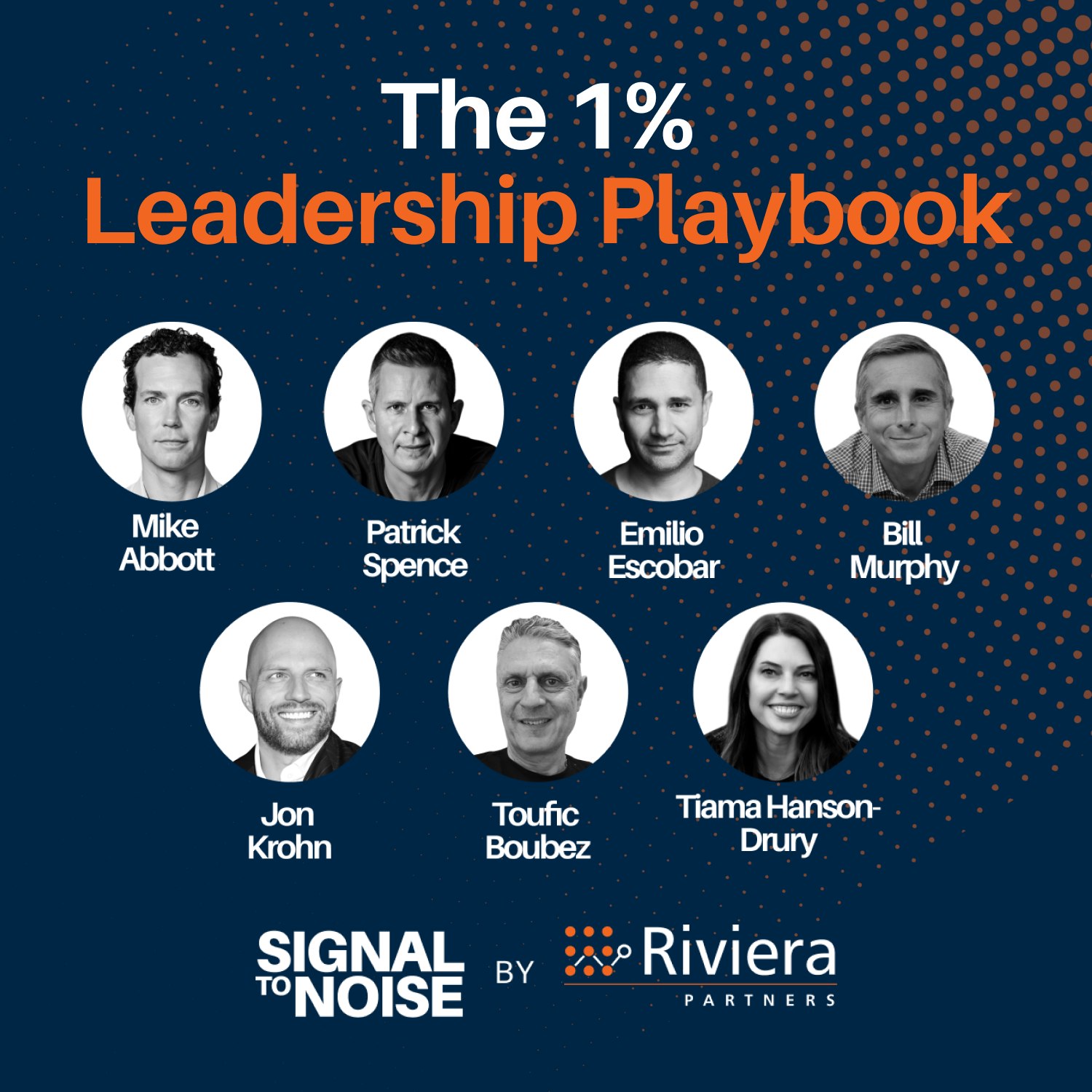
It’s time to tie a neat little bow on 2025 and we’re doing it with a special, Best of AI edition of the Signal to Noise Podcast. In this one, we ask the question “What if the biggest opportunity in AI is actually having the right leadership and people in place to seize it?” Tune in for the perfect recap of 2025’s AI highlights. What You’ll Learn: How to position AI as a first-class priority The seven-month AI capability doubling curve and why it’s critical to get it right Why true agentic AI potential remains unrealized and the real reasons security and AI defense get overlooked How fragmented health data is finally becoming large and controlled How the model context protocol represents a fundamental shift in how AI systems will collaborate Why trust is the biggest driver of AI adoption and democratization through AI removes false constraints Why, fundamentally, creativity and taste remain the ultimate differentiator If you enjoyed this episode, make sure to subscribe, rate, and review it on Apple Podcasts, Spotify, and YouTube Podcasts. Instructions on how to do so are here .
Transcribed and scored by The B2B Podcast Index.
Speaker A: Welcome to Signal to Noise by Riviera Partners, the podcast where leading executives share how they cut through the noise and act on what matters most. We go beyond the headlines to explore the pivotal decisions, opportunities and inflection points that define their careers and shape the future of the companies they led. It's time to cut through the noise and get to the signal.
Speaker B: Welcome to Signal to Noise, Riviera Partners, the podcast where we cut through hype, headlines and half truths to focus on what actually matters for leaders building the future. Across this episode, you'll hear from operators, technologists, executives who are not just talking about AI. They're responsible for making it work inside real organizations with real people and real consequences. From leadership accountability and infrastructure readiness to trust talent where AI is genuinely delivering value versus where the noise is loudest. These conversations reflect the signals leaders should actually be paying attention to right now. Let's dive in. In this first clip, Bill Murray explains why meaningful AI progress doesn't start with tools or pilots. It starts with executive will, sustained investment and treating AI as a core business capability, not a side project.
Speaker C: Yeah, uh, I think it comes down to will, and that usually comes down to leadership. Now having the will at the top level to take this seriously and really treat it as something that's business required and have that position cascade all the way down your organization takes a ton of energy and leadership. Now once you do that, you also get the foundational things right and you run some experiments and you figure out what works. And so they're sort of like, they progress down that. But it always starts with the leadership saying, this is super important for the company. We need to invest significant resources to do it and we are going to treat it like a first class citizen. This is not, you know, a little experiment off to the side that doesn't matter and maybe it'll hit. This is fundamental to who we are as a company and we're going to do it excellently. So, you know, there's a quote from one of my companies, uh, the CEO said if a CEO is not the chief AI officer, then they should be fired. Now, perhaps that's a little aggressive, but I think that is why his organization is completely on their front foot, related to every other competitor in their industry because he, from the top is saying this is the most important thing and we will not be left behind. And they are, they've become leaders here and I think that's done them right in the market.
Speaker B: In this section, Jon Krohn breaks down what the acceleration curve is really looks like. Why it's been surprisingly consistent for years. And what leaders should be doing right now to prepare their organizations for what's
Speaker D: coming about every seven months, the length of a human task that can be accurately handled by an AI model doubles. So if it's about two hours today that we can get 90% accuracy on replacing a human task with a machine, you can expect that in seven months that will be four hours. Seven months after that it'll be eight hours. And this has been happening for years. It's a trajectory that you can map very reliably. GPT5 fell perfectly onto that curve when it came out in August. That means that there's unprecedented opportunity today and that is only, that's doubling every seven months. The opportunity for things that you can be automating in your organization is vastly increasing. And so what can you be doing today to be setting up your infrastructure, your governance for both data as well as humans in the organization to take advantage of this? I think that there is unprecedented opportunity. I think that anyone who's listening out there who has experience building and deploying AI systems, I assume you're having a huge amount of success. If you're not, figure out how to make some tweaks, because every conversation that I have leads to next steps.
Speaker B: Amiya Kantikar offers a grounded reality check on autonomous AI systems, separating future potential from what's actually operating reliably in production today.
Speaker E: My controversial take on this is that agent doesn't exist yet. So let me explain what I mean by that. So, yes, you can see that as a future. Right? Um, just like how LLMs were, by the way, two years ago when ChatGPT first came out, it was all about LLMs and AI, but we didn't actually see that being implemented in real life in a meaningful way. But now we are seeing it two and a half years later. Right. Like there are a number of tools that are now that actually generating value for your customers and you know, for business enterprises. Agentic AI is where ChatGPT launch was, right? This thinking modes and this kind of doing on your own. Yeah, there are some areas, you know, cloud code does whatever it does is pretty impressive, especially in coding and some of these things. But we have not seen somebody like, I am an, uh, AI auditor, you just hand it over to me, all the documents and here's your final thing.
Speaker D: You know, you don't have to talk to me ever again.
Speaker E: You know, like, we have not seen this level of sort of purely agent take sort of completely hands off kind of operations, uh, in Practice in production.
Speaker B: Emilio Escobar shifts the focus toward defenders. How organizations are investing, where AI is actually helping security teams and where the real gaps still exist beneath the noise in security.
Speaker F: There's a lot of noise when it comes to AI things like, I mean, bad actors are always going to use everything available to them, but just a focus on bad actors using AI, not a lot of focus on defenders using AI or AI security implementations that aren't necessarily what I think are going to make people tick and where their needs are. So it's a little bit of both. It's how much investment is being made in AI, what is growing, what is building, what are people using, what are people trying to do, what gaps there are internally for my team or any over the CSO I talk to as we're also building products.
Speaker B: Megan Rothney explains how data readiness and algorithmic advances are finally converging, unlocking, um, faster drug discovery, better diagnostics and physician support tools that augment care rather than replace it.
Speaker G: It's a really, really exciting time to be working in AI. I think we've been talking about it for a long time, but healthcare data has been so fragmented that we really couldn't necessarily action on all of the great ideas that people had. And I think what's really cool that's right now is the data assets are getting large and a little bit more controlled at the same time that the algorithm technology is kind of catching up. And so we're really starting to be able to put those two things together and put more products out on the market. Some of the places that I think this is going to have a huge impact. I think drug discovery is going to be kind of revolutionized by this getting drugs to market much faster. I think in terms of diagnostics, really what I'm seeing is it's just easier right now for us to get to a prototype that we can then get out in the world testing than it's ever been before. Just incredibly exciting. And I think over the next five to 10 years, we're just going to see a huge shift in medical practice towards physician support tools. So not replacing physicians, which I think is one view of the world that many people had, but really thinking about how can we make them do their jobs better.
Speaker B: Next, Mahi Sethuraman dives into how seamless experiences, personalization and clear consumer benefit are shaping trust and why that that trust must be earned, not assumed.
Speaker H: I am now focused on how are consumers trusting fully AI capabilities. I think because they are adopting, they will adopt if they can be assured that there is trust. And the companies are focused on their best interest in opening up these opportunities to consumers. And it's been interesting to see the impact that machine learning has had in consumer experiences that has become so seamless to the consumer when they actually interact. And I think this was very evident in my tenure at a firm. The product has been primarily adopted by Gen Z and Millennial consumers, consumers across the credit spectrum. And they have personalized all of their consumer product experiences, including decisions on credit offers, underwriting decisions that are so seamlessly packaged in the consumer experience, including even on the merchant side in terms of the pricing and deals that we put out for different segments of merchants. So I think that has been a fantastic. I always want to say consumer knows to trust when he can be convinced that there is benefit for them. In adopting,
Speaker B: Mike Abbott reflects on how technology is lowering barriers to learning, execution and company building. Reminding leaders that discomfort is often just unfamiliarity, not inability.
Speaker I: You probably can do more than you realize in areas that you're not comfortable with. And what I mean by that is like when I first started Composite, I was the CEO and I was very open with, I don't know anything about finance, I don't know anything about sales. It turns out like you can learn those things. Like it's not, it's not like rocket science. And so it's like a kind of a reminder that like I think humans in general, not just not because I'm special, I think human in general can do more than they think they can. I think sometimes like we as a society talk more about these like constraints and I think these tools and AI are going to even make us this more profound where it's democratizing so many aspects of just company building. 2 FIG.
Speaker B: Bouchie explains why model context protocol isn't just another technical standard, but a foundational shift in how AI systems collaborate, share, state and evolve toward truly agentic behavior.
Speaker J: Model context protocol, how familiar you are with that. People think of it as another spec, but it's not just another spec. For me it is a fundamental shift of how we are going to be working with AI systems moving forward, especially agentic AI systems. And this is how we're extending that capabilities. It enables different tools, agents, LLMs, what have you to, to kind of share, state and learn from each other and act and collaborate. And to me that's what will take AI from where it is right now to the next level. So that's the biggest signal for me as a biased person in AI being immersed in the AI field
Speaker B: Patrick Spence with a reminder that creativity, judgment and taste remain irreplaceable and that the companies that thrive will be those that pair AI capability with exceptional human talent.
Speaker K: In this AI dominated world is it's easy to kind of fall into the trap of all efficiency, all automation, when the real winners will be those companies that figure out who the right people are, that bring creativity and taste into the equation, right, to help solve new problems and build new businesses and address these things. And of course they will, you know, wield AI in doing so. But the real differentiator will be what it's always been, which is the people that are inside the company figuring out, you know, how to solve the hard problems and you kind of what to go work on next.
Speaker B: That's it for this episode of Signal to Noise. Uh, if these conversations resonated, it's because they reflect a shared reality. The leaders who win in moments of transformation are the ones who know what to listen to, what to focus on, and what to ignore. Signal Noise is brought to you by Rivera Partners, leaders in Executive Search and the premier choice for technology talent. To learn more about Riviera and how we help people and companies reach their full potential, visit rivierapartners.com and don't forget to search for Signal Noise by Riviera Partners on Apple Podcasts, Spotify, or anywhere you listen to podcasts. Thank you for listening.
Speaker A: Signal to Noise is brought to you by Riviera Partners, Leaders in Executive Search and the premier choice for tech talent. To learn more about how Riviera helps people and companies reach their full potential, visit riviera partners.com and don't forget to search for Signal to Noise by Riviera Partners on Apple Podcasts, Spotify, or anywhere you listen to podcasts.
Other episodes covering the same guests and topics, from across The B2B Podcast Index.
 Adamma Ihemeson on Building Autonomous AI Systems You Can TrustBack on T-R-A-C-K · on Agentic AI systems84 / 100
 How to actually get your brand into AI search results | Guillaume Ang @Psyke saas.unbound · on Agentic AI systems82 / 100
 This Just In Radio: AI in Action with Chris ParavateThis Just In Radio Show · on AI governance frameworks82 / 100
 From Proposal Production to Strategy: How AEC Marketing Must ChangeAEC Marketing for Principals · on AI governance frameworks79 / 100
 From Ai4: Coca-Cola FEMSA's Jose Martinez on balancing continuous improvement and CX consistencyThe Agile Brand with Greg Kihlström® · on Agentic AI systems78 / 100
 Spiky Talent, Ruthless Performance, and the Future of Hiring with Nolan Church78 / 100
 The Tech Leadership Compilation: Scaling Teams, Culture & AI with Leaders from Twitter, Sonos & Datadog63 / 100
 Why AGI Is Noise and Data Is the Signal in Healthcare Innovation with Laurent Bride61 / 100
 From Strategy to Execution: How Tiama Hanson-Drury Gets Teams Rowing Together Part-280 / 100
 How Tiama Hanson-Drury Leads Product, Tech, and AI Through Change Part-173 / 100