
Signal to Noise · 2026-03-17 · 59 min
Key moments - from our scoring
Substance score
58 / 100
Five dimensions, 20 points each
Nolan Church draws on his unconventional path - Google recruiter, DoorDash hypergrowth operator, Carta CPO, and now founder - to expose how companies fundamentally mishandle talent at scale. His central thesis is brutally simple: ruthless, candid performance management beats corporate theater, and spiky talent (people exceptional in one or two dimensions, mediocre in others) drives alpha in high-change environments. Church challenges the conventional wisdom that founders should optimize for spending less time on recruiting; instead, he argues CEOs must obsess over every hire, personally conduct offer reviews like Tony Xu did at DoorDash, and actively back-channel on candidates. He calls out the overhyped promise of Claude/AI in enterprise workflows while celebrating underappreciated wins like meeting recording for accountability. The episode also surfaces a demographic cliff: new grads now represent just 7% of big tech hires versus over 50% pre-COVID, signaling a broken social contract where companies stopped developing junior talent. Church's founder journey taught him that product-market fit matters more than team composition, and that building a venture-backed business demands a different skillset than scaling an existing one.
New grad hires have dropped from over 50% pre-COVID to just 7% at big tech companies today, according to Church's data.
Tony personally reviewed every offer (eventually through 5,000+ employees), occasionally pushed back intentionally to test hiring managers' conviction, spent significant time with candidates in casual settings like dinners and breakfasts, and discussed real business problems to ensure mutual fit and two-way evaluation.
Spiky people - exceptional in one or two dimensions, mediocre in others - deliver asymmetric returns and alpha when the world is changing rapidly, whereas hiring median talent repeatedly across all competencies kills innovation.
It revealed that attempting to be polished and strategic at a C-level role had stripped away his authenticity; he learned that authenticity in leadership is one of the most undervalued leadership qualities.
He sees only party tricks without real enterprise application; the technology doesn't solve real business problems with workflows and security in mind, and putting it unmonitored into business operations is premature without human oversight.
Our reviewer’s read on each dimension, with quotes from the episode.
The episode contains several genuinely useful practitioner insights - Tony Xu's offer-review process through 5,000 employees, the trust-gap dynamic between 50 and 500 employees, and the framing of spiky talent as an alpha vs. beta play - but these are interspersed with extended personal storytelling, a startup-failure therapy session, and a lengthy wedding-crashers tangent that dilute the signal meaningfully.
Tony did offer review for the entire time I was there. I think he ended up doing it through like 5,000 employees. Every single offer went to Tony's inbox
I think 10% of offers he was just going to intentionally push back to see what would happen. He would be expecting the hiring manager to put their badge on the line
A handful of frames feel fresh - AI outreach as the 'pinnacle of AI slop,' spiky talent explicitly positioned as an alpha vs. beta play, and the trust-gap mechanism between early and late employees - but the episode also leans on the Netflix culture deck, the regret-minimization framework, and 'product-market fit is everything,' all of which are among the most recycled ideas in startup discourse.
I think outreach is going to be the pinnacle of AI slop and there will be huge alpha for people who actually still have like a human approach to outreach
it's an alpha play. The other plays a beta play
Nolan Church has real operational depth - employee ~50 at DoorDash through hypergrowth, CPO at Carta, and hands-on recruiting experience at Google - and he draws on lived decisions rather than theory; the one deduction is that he is now primarily a boutique exec and podcast host, nudging him toward the 'career podcast guest' category over time.
I interviewed every manager at DoorDash through about a thousand employees
we sadly terminated that person 29 days later, which is obviously incredibly fast
The episode earns its score through concrete data points - 7% new-grad hiring at big tech vs. 50%+ pre-COVID, Buffer at the 50-60th percentile, a 29-day termination, offer review through 5,000 employees - but is undercut by vague assertions like 'I've done the research on this' on cloudbot and broad hand-waving on AI timelines and social unrest.
new grads are accounting for just 7% of hires at big tech when pre Covid, it was more than half
they're paying people at like 50 or 60th percentile
The host asks competent, sequenced questions and lands one genuinely sharp follow-up ('What did you miss during the interview process that on day one you realized?'), but the interview reads as a collegial peer chat rather than a probing exchange - controversial claims like the DEI ban go entirely unchallenged, and the host's own storytelling occasionally displaces follow-up pressure.
What did you miss during the interview process that on day one than. Than you realized?
I think pound the table is even weak. Like, put your badge on the line
Computed from the transcript - who did the talking, and the words that came up most.
What does it actually take to build world-class teams in a hypergrowth company? In this episode of the Signal to Noise Podcast, Michael Newcomer, CEO of Riviera Partners, sits down with Nolan Church, Founder of Mafia Talent, to discuss the hidden realities of hiring at scale, why the best companies obsess over recruiting long after product-market fit, and how leaders like DoorDash CEO Tony Xu built extraordinary talent density through rigorous hiring discipline. What You’ll Learn: How to manage performance ruthlessly without corporate theater Why spiky talent outperforms mediocrity during times of change The founder's biggest hiring mistake How to systematize trust during hypergrowth to avoid the ‘bad, stupid, lazy’ narrative trap Why new grad hiring will disappear in the next five years Nolan Church is the Founder of Mafia Talent and Host of HR Heretics, bringing over 16 years of experience at the intersection of talent, recruiting, and organizational scaling.
Transcribed and scored by The B2B Podcast Index.
If you're building a company that's scaling, how would you manage performance? And my short one word answer is ruthlessly. And the reason why is because I actually think if you're candid and honest about performance, we can get to truth much faster. And that truth is true for the business impact that the employee is having, for their value and their understanding of where they are versus this corporate theater is what I refer to it as, because corporate theater drives me fucking insane.
You're essentially like lying to the person. Everyone you know, 50% or 70% of the company ends up as like a three, which basically means nothing. Welcome to Signal to Noise by Riviera Partners, the podcast where leading executives share how they cut through the noise and act on what matters most. We go beyond the headlines to explore the pivotal decisions, opportunities, and inflection points that define their careers and shape the future of the companies they led.
It's time to cut through the noise and get to the signal. Welcome to Signal to Noise. I'm your Host, Michael Newcomer, CEO of Riviera Partners. Over the past 15 years, I've worked at the intersection of talent, technology, and financial services, helping companies build leadership teams that drive innovation growth.
Today's guest brings a rare and powerful perspective on talent. Nolan Church has sat on nearly every side of the hiring table, starting as a recruiter at Google, helping scale doordash during its hypergrowth phase and serving as the chief people officer at Carta and now building new ventures focused on the future of compensation and talent. He's also the founder of Mafia Talent and the host of the HR Heretics podcast, where he challenges conventional wisdom around hiring, performance and culture.
In this episode, we're diving to the hard truths of hypergrowth hiring and the coming wave of paid transparency. How AI is reshaping recruiting, and will companies still get wrong about executive talent? Nolan, it's a pleasure to have you here today. Let's dive in.
What's the biggest signal you're paying attention to right now and what noise are you tuning out? So the biggest signal right now, I think, is that new grads are accounting for just 7% of hires at big tech when pre Covid, it was more than half. And so I think the second order of that, like, I'm not a doomer, I'm an Excel kind of a guy. But that is a scary thing to think about, which is, number one, what are all these people gonna do?
And then number two, we're gonna hit a supply shortage for the amount of people that can do this work. The part of the social contract used to be companies used to help grow people after college. I know when I came out after college, I was not a fully formed human. I.
I didn't know you at that time, but I have a guess that you weren't either. No, I might not be now. No one's know that's true. Companies used to help us mature, and now they're saying, no, we need you to add value on day one.
And, oh, by the way, like, onboarding and training, we don't even think about those things. I think that's probably the biggest piece of noise is SaaS is dead. Like, some SaaS is dead for sure. But I don't think system of record is dead.
I don't think stuff that's like, you know, everybody runs on is dead. But I do think valuation multiples are very much under question, and that kind of scares me as a large equity holder in SaaS businesses. Tell us about a pivotal moment in your career or leadership journey. What changed and how did you navigate it?
All right, so there's two of these, and I'll go in chronological order. So when I was at Doordash, I reported to our chief business officer, Keith Yandel, and I remember one meeting. I don't remember exactly what led to the meeting, but I'll never forget the one on one with Keith. I got super pissed about something, and it was some, like, political thing.
Like, I had to, like, jump through hoops. Like, turns out I'm not that great of a person at, like, following bureaucracy or jumping through hoops. And I got pissed about it and I said something to the effect to Keith of, this is bullshit. I don't want to do this.
Like, why is there so much politics now? I was an early employee and so definitely came with my coming on my high horse. And Keith just kind of looked at me and he. I'll never forget what he said.
He goes, does that make you feel good, Nolan? Yeah, because here's the truth. Politics are everywhere, and if you don't get used to them, you're never going to succeed. And I'll never forget, like, the ride home, like, I was on caltrain because I had to commute for forever to this job.
And I called my wife and I was like, keith's such an asshole. Like, oh, my God, can you believe he said this to me? And now, probably nine years removed from that conversation, he was exactly right. And you do have to learn to play the game in order to play in the sandbox well with others.
I may not like that, but that's how the world works. The other one was when I was at Carta and director port of mine. His name's Adam. I was two and a half months in.
I wasn't getting any feedback from anybody. And feedback is kind of like part of my DNA. I think it's important for everybody just to know where you're standing and so you can grow. And so I was asking my team, like, every week, hey, let me know if you guys have any feedback.
I haven't heard from anybody, but I'm always open to it. And so Adam, who is probably like four years into his career, grabs me. He goes, hey, I actually have feedback for you. He's like, let's talk about our one on one.
And so I go to one on one, like, hey, what's the feedback? And he goes, everybody thinks you're a robot. And I was like, holy shit, dude. What?
Like what? Like, I think I'm pretty authentic. Like, please explain. And what Adam essentially got at was, it was the first time I was in a C level role and I was trying to be polished.
I was trying to be thoughtful with my communication. I was trying to take Keith's feedback and to apply that. So I was coming off in a way that was representative of the company. And it turns out that I just had absolutely no personality.
I was like reading off the screen for all my answers at all hands, and I was super uncomfortable in my own skin. And so that one taught me that the value of authenticity in leadership, I think, is probably one of the most low supply qualities we have. That's great. All right, next one.
What's a belief or strategy that's core to how you build or scale teams, but isn't conventional wisdom? If you operate from the ivory tower and if you haven't been into the weeds, you have no idea what's going on on the ground? And how can that possibly inform your quote, unquote strategy which makes, you know, typically all growth companies throw up? Now, the reason it makes them throw up is because when they hear the strategy, people come in.
That person's usually never interacted with the customer. They've never been on the front lines. They've never talked to the sales team. They've never sold anything in their.
So I think it's, you cannot lead from the ivory tower or from the back. You have to lead out front. That's awesome. I think you know this, but I.
I still run at least one search at a time. Dude, I know you're actually like one of the few who still does this. You're not like Andy Price, who has shifted off into VC even though you went from VC to this. I can occasionally recruit.
I need a lot of support now, like, but, you know, I can still get on the phone. How do you identify great talent and what separates the good from the truly great? So I actually think this is a question on taste. And if you think about the people with excellent taste in anything in your life, like, think of sommeliers, think of talent.
People like us think of salespeople even. I think it comes down to reps and I think it comes down to very high quality reps. So if in talent, if you came up through a firm that was working with companies nobody's ever heard of, I think it's really hard for you to identify what really good looks like because you're not steeped in it all day long. And the reps you're having are generally super low quality.
I think if you're the sommelier at the French Laundry, you know, you've probably been drinking great wine for 25 years and so you know what great wine tastes like, you know what great wine looks like, you know what it smells like. And I think in talent, you cannot avoid the time it takes in order to build those taste buds. And so I think a lot of people want the short answer. They want the silver bullet to just be like, I just want great people or I just raised a bunch of money.
I get great people now. And I think it turns out that you just need to have a ton of reps in order to be really good at it. I like that. I agree on the reps for lots of reasons, on our business and talent in general.
What's a recent trend or technology that's overhyped? What's one that's underappreciated? Recent tech that is overhyped is cloudbot. I have yet to see it solve real world business problems with workflows and security in mind.
So I've seen a bunch of party tricks and party tricks are cool, and party tricks got me excited. And I think we're going to be moving towards a place to where those party tricks are going to make their way into the enterprise. But today there actually is no enterprise application. I've done the research on this.
I have gone deep with people and it just like doesn't work. It works for like putting stuff in your Amazon cart and buying that. But there's still mistakes there. There's not a world where you're going to put that thing unmonitored.
Without a human in the loop into your business today, I think it'll get there, but I think it's massively overhyped. I think the biggest underappreciated one is just recording meetings and getting value out of meetings. So it, you know, I'm probably like you, Michael. I'm on 10 calls a day.
By the end of the day I don't remember what I had for lunch. And so when I'm thinking about what are my action items, what is, what's all the shit that I promise people that I now need to make good on in order not to blow my reputation. Before I would go through and look at all my notes and I tried handwritten notes, like I've tried typing notes. I'm basically illegible.
My wife says like I should be a doctor because of how bad my handwriting and note taking is. And those are the sorts of things now that I use as a competitive advantage because I'm essentially recording every meeting that I can and that way I can follow up on things, I can go back and prompt it later to ask for things, especially if I meet people. I'm doing this stuff kind of like now everywhere in my life. That's cool.
Very similar, right? Like just back to back, I mean, you're like, what did I say? I would do it 8am and now it's 6pm yeah, totally cool. All right, now we're going to move to the more conversational part.
So the first thing I want to talk about is you being a founder, right? And you had a pretty unconventional path into founding. There's not a lot of folks that come from the people talent function into VC backed founder, right? You know, Google recruiter, DoorDash CPO at Carta and now founder again.
And so when you think about being a founder and hiring people, you obviously have a unique viewpoint on that as a founder. And so when you think about hiring and talent market operators and founders often miss that you learned in, you know, from your experience. Well, I think it goes back to the taste question you had for me earlier. So part of it is just like you need to build reps, but I think the biggest piece is actually time with people.
So the number one thing founders get wrong when they start scaling their business is they start optimizing for spending less time in recruiting and on hiring when they should be in fact spending more time on recruiting and hiring. And that's true on a per candidate basis as well as like a systemic basis. So if you're a hiring manager or say you're even a director, right? And you have like frontline managers that are doing hiring.
If you're not at the minimum going through offer review and reading every piece of feedback, you're missing something for sure. I think you actually, if you're a director, you should be on every single last panel. I honestly think that's probably the case even for VPs and above. What I learned from Tony.
Tony Shoes, the CEO of DoorDash, founder of Doordash. I think he's one of the best in the world at hiring and what I learned from him, he used to say, Nolan, the Michael Jordan of executive recruiting gets it right two out of three times. And Tony's hit rate is actually higher than that. He's just low ego and would never tell you.
But the reason why Tony's hit rate was so high is because of the amount of time and energy that he put into every hire on his team and systemically at the company and so on his team. This may be controversial, but I like it. He would have a first call with people and then immediately start doing light back channeling. There's a back channel network in Silicon Valley that if you have really tight friends, you can talk to them and they'll never let it get back to the candidate.
Tony was doing that all the time at the beginning. Then he would spend inordinate amount of time with that person on the business and specific problems in addition to just like casual settings. I think one of the big mistakes we made as part of this last era was like you should enjoy the people that you work with. Try and be super unbiased.
I'm going to be in the trenches with you more than I'm going to see my family. And so like we should get along. And one of the things Tony did, he was always spend time with dinners, he would always go to breakfast. He would do kind of these interstitial moments with people to make sure that there were vibes that they were vibing between each other.
Then he would come to them with the problems that he was facing on the business and talk through specific challenges. Which gives two opportunities. One for Tony to see how they think about the business. The other for the executive to see if they like the problem set like it should ultimately at the end of the day be a two way street on the systemic hiring.
It was a pain in my ass for a long time. But Tony did offer review for the entire time I was there. I think he ended up doing it through like 5,000 employees. Every single offer went to Tony's inbox And the magic in that thing was not Tony saying yes or no.
The magic was the occasional pushback he had, which he's never told me this, But I think 10% of offers he was just going to intentionally push back to see what would happen. He would be expecting the hiring manager to put their badge on the line. Like, do you have the level of conviction to hire this person on your team such that, like, if it doesn't work out, I'm going to fire you? Tony would never fire you for that.
But there's something about being challenged by the ultimate leader in the company that, like, are you going to really stand up for this thing? And that behavior, that process, I think is. Is generally underdone in companies. And when a lot of companies right now are like, oh, complaining about how much time they're spending in interviewing and it's like, that is part you've earned the right rather to solve that problem.
And that's the only way to solve it. If you actually do care about talent density instead of it just being a buzzword. I agree with that. Right.
One of the things I say is, like, you have to pound the table for somebody. In all the talent roles I've had, if someone's, I need this person on my team, you shouldn't hire that person. I think pound the table is even weak. Like, put your badge on the line.
I pretty strong because, like, what it suggests is you're arguing with other people, right? No one has to pound the table for the obvious. Clear a superstar, right? Everyone's like, oh, let's go hire that person.
That means that other people are on the room are like, I'm not sure about your read. And I want the person who's like, I am sure about the read and I am sure about this person's success. And like, that's reputational risk, which is ultimately what I think you're saying. Tony was saying, hey, put your reputation on the line of like, hey, you had the right read on this.
Right? And I think the other thing you have within a couple hedge funds, I won't name which one's better at hiring senior people and which one's worse. Although if, like, you know, the hedge fund says, you probably know which one's which at the one that was good at it. The guy who's pretty famous who runs the fund was very involved in senior hiring.
Too big to be hired like the next one now, but every single senior hire went to him. And he was early on in the interview process. He might not be interview one but he wasn't further down the interview three. And he's, like, maniacal about that, right?
And then even during COVID which you appreciate, we got to. We were hiring, like, somebody to run a business unit. He's like, I can't hire this person if I don't meet them. And I was like, well, it's tough, man.
And he's like, they'll come to my house and we'll sit. They basically sat 50 yards away at this big, long table with me in the middle taking notes. And he's like, I met them now, and it's like, so they were just much better at hiring senior folks, right? Like, hit rate, quality, talent density, to your point, right?
And So I think CEOs miss that. So, you know, obviously, you guys do exact recruiting, and I do too. And I spend a lot of time thinking about exact recruiting. But when I think about, like, some of the highest impact people I worked with at DoorDash, a lot of these were, like, asymmetric bets that, like, they're spiky.
And I think spiky people are. They're really hard to work with for some, and they're like the grease to the wheels for other. And I tend to, like, really like spiky people. I know you do too, but, like, thinking about just this whole, like, offer review thing and pounding the table or putting your badge on the line, I think for spiky people, it's the most important thing.
And I think for them, it's like, these are actually the people who you want to be taking bets on in your business because they can have outside asymmetric returns. And so that's where I think, like, the spiky people as part of this process, actually have, like, a little bit of a backstop and got through more because they met Tony and Tony, like, like, their edge versus, as a company scales, you know, you tend to, like, go and hire the median repeatedly. And I think that's actually the fastest way to, like, having innovation die at your company.
I've been a big advocate of spiky people for quite some time, right? And, like, that was really learned. I think. You know, this.
Like, I did a lot of work with Bridgewater early on in my career. We have some Bridgewater folks here, and they were like, hey, let's go hire spiky people. And they were willing to take really a lot of risk on hiring folks, right? Like, they were okay with, like, if we go one for two, right?
This person spikes on that. But a lot of organizations have low risk tolerance so they're like, oh, there's these minimum table stakes across all these things and what they end up getting is average across all those things instead of like, this person's the best in the world at X and the only reason we can get them is they're a terrible communicator. But they're great at figuring out how the world like economic machine is going to work and they're going to be able to find Alphas here and they're going to write really well, but they can't stand up in front of an audience and communicate anything right.
And people miss this and then their talent goes down. Because if someone's great at all those things, if someone's a 10 out of 10 and all five vectors, that person's super expensive, super hard to get, really highly sought after. You should certainly go after those people. But it's hard to build an organization of those people with any sort of depth.
But if you're like, hey, I'm going to go get 10 out of 10 and build a team where we're 10 out of 10 on everything and those people can, to your point, work together, then you have this really outsized advantage. The spiky people thing, Michael, for me is like, I don't know, I think a lot about like, where is the world going? And we have like the most change in human history right now. We are like living in who's going to survive, the median or the spiky people.
And I think for me, like the obvious answer is the spiky people. And I think like a lot of these companies right now end up in this mode to where they don't want to hire them because they're worried about like how they're going to play in the sandbox with others versus, like, if you look at what the big tech companies are doing right now with performance reviews, it's essentially just corporate theater. It's a joke. And instead, like, if you hire spiky people, I think your chances of survival, and not even just survival, like the opportunity for Alpha is so much higher.
That's right, it's an alpha play. The other plays a beta play. That's right. And your point is in the current moment, Alpha matters more than it's ever mattered.
Exactly. Cool. So I want to talk a little bit about. You've built.
You closed that down. You're building again. What's that taught you about risk? What has that taught you about resilience?
Like, seems to be pretty high for you both, like high risk tolerance and high resilience. I'll be super transparent with you. So I was a C level exec at 29 and in the world of, you know, people in recruiting, I subscribe to the Charlie Munger quote, which is you want your competitors or you want to compete against idiots. And I think I was really lucky to pick a world to where the smartest people, you know, go into engineering a product.
The second smartest people, you know, go into finance. Then it's like sales and marketing, then the rest of them go to where I was. And so that's how I got to ascend really fast. And I think I got colored that competition that I had and how fast I grew and I grew like a really big ego and I was like, oh, next thing I just got like, I gotta go be a venture back founder.
That's what everyone around me is doing, like, go be a venture back founder. And learning on that was super painful because it turns out like building a business is really hard, but building a venture backed business I think is the hardest thing in entrepreneurship. And so the number one learning was the empathy that I had for my founders. I didn't realize like finding product market fit, I mean it sounds like so novice now and obvious in retrospect, but like finding product market fit for a generational business, it's so hard to do.
And typically the people who are doing the zero to one fine PMF thing are much different than the like now time to scale this thing. And I didn't realize I was actually at that point in my life much more of like a go figure out how to scale this thing person. So one was like empathy for Tony and for Henry, the two CEOs that I worked with. I was like, God, I was such a pain in the ass to them.
I was like, I could have been way more nice and helpful. And now with founders, when I interact with them, I am. Second thing is product market fit matters more than anything else. The story I told myself was if you have a good team, they'll figure it out.
And that's not true. If you have the wrong idea, if you're working on the wrong idea, you will not figure it out and you are wasting your time. Was tough for me because for four years I was building a business that I thought was going to get there and it didn't. I subscribe to the regret minimization framework, which is you're 80 years old, you're on your deathbed, you're looking back on your life, where are your regrets?
And for me, if I didn't try to go be a VC backed founder, I would have been on the deathbed wondering. And so now I know that like that box is checked. But when we shut down the business, it's on Halloween 2024. The next month was a lot of soul searching and a lot of trying to figure out who I am as a person.
Like I didn't think about going in, raising money from people ever losing that money. I didn't even know how to handle those relationships or how to think about failure in, on that scale in that regard. And so I think resilience is more built through taking big swings. And so now when I think about it with my kids who are seven and five, I'm encouraging them to take as many big swings as possible because if you hit one or two of them, it can change your life.
And so now I'm building my own small exec boutique firm, literally just me, because I have a hard time working with others. And so, you know, for me now comparatively it's like such a smaller stakes sort of a thing. But I get to work with founders and those are my customers. And so I think the biggest learning that I have from that whole experience is the shit that they're going through every day.
And I could provide a just a little bit of perspective, like not close to the scale that they're operating on of like what it took and how to raise money and how to deal with failure and how to tell your wife you're not going to be at home for dinner. And that shit you, I think for me wasn't going to be learned from someone else telling me about it. It had to be a learned from going and trying. That's awesome, man.
Appreciate the vulnerability on that too. I know we've talked a little bit about that, but that might have been even, even more than you've been over the, I guess what a year and a half at this point. So I appreciate that. Turns out with time you have reflection totally.
And it's a little, little less raw and you figure out how to get through it and be successful, which is awesome. Cool. I want to talk about hyper growth hiring. Right.
Which I would say is like one of your probably core skill sets, one of the things you're best known for. So you help, you know, scale Door Dash through hypergrowth. You saw a bunch of hiring at Carta. When you think about like what worked at 50, I think you're what, employee 50 at Door Dash.
Right. So what worked at employee 50? What worked at, you know, employee 500 and what broke in between those two things. This one I don't think is like earth shattering, but 50, you know, everybody, there's so much more ability to move faster because like, trust is the foundation of all the relationships.
So at 50, like I literally knew everybody. We all sat in the same building and even if we didn't even we were scaling, those people were coming through. And so when you know someone, when you have gaps in information, you tell the best version of the story versus when you get to 500 and you don't know these people. Humans tend to always tell the worst version of the story when there are gaps in information.
And so examples of this is like, when you're scaling that fast, all of a sudden hiring managers who you have no idea who they are start hiring people. And so when you don't know who they are and you start to see flags in an interview process, you start to think that person's the village idiot. Versus if you saw it with Ryan, who led the sales team from employee 11, you're like, Ah, Ryan's got this figured out, like, whatever, Like I'll just give him a quick call. And you're like joking about what's going on.
When it happens to the other person, you immediately think that worst version. And you're like, what is wrong with you? What is going on here? And then you start to like spend more time, which starts to muck things up and slow things down.
And so I think speed is the number one thing. It's like, how do you systematize trust? And I don't think we ever like fully nailed it, but we spent a lot of time thinking about who are the most trusted people in the organization and having those people on at least one of those people on every panel to be eyes and ears versus just letting them run. This is the typical bar raiser program.
This is what Amazon does. I think that was probably the number one thing for us was like, we need to make sure that the OGs are involved even if it turns out to be a majority of their time. Yeah, it's interesting. I think when you have like the degree of separation, there's this like bad, stupid, lazy, what I call BSL narratives.
Well, that person's bad. They're stupid or they're lazy. Lazy. And like most people aren't actually.
Most people are trying their best. They're not actually lazy. They like want to make things happen, et cetera, especially in like hyper growth places. But like, you get to like build this narrative like this is what's happening because you're separated from it and it's easy.
It's like protectiveness of yourself as opposed to like, well, do they understand the context? Do they understand what good looks like? You know, all that sort of stuff. Right.
Which is very different. Okay, so like just think about like bad is contextual. To your point. I came from Google, which I didn't even realize.
Again, like this was how young I was at the time. Like literally worked at the best money printer of all time. It didn't matter who we hired. And I told myself so many of these stories that I learned from Google about like only four interviewers and like making sure that there's no bias.
I learned all these things that I actually had to unlearn at doordash because it didn't make sense for the context of that business. And so even if someone is good, you know, quote unquote good, being good for our business at that time still required a ton of reps that you just cannot get your way around. You cannot fake your way through those reps. And so that's where the OGs, I think are really important and you got to get them involved even though it's going to be a majority of the time.
Makes sense when you're hiring hundreds of people quickly. Like you, you did like, where does quality start slipping? Where do you first notice that? It's typically in the volume areas.
Like unsurprisingly for us in Carta and at Doordash, it was in sales in both. And that's because you're typically trying to scale up revenue. You got to keep up with investor expectations. The finance people start running math on revenue per employee, revenue per ae.
And so it's like we must have like this many AES and so it just becomes a volume game. That's where it slipped the most. I think in engineering there's just kind of this inherent. It's like a slower pace.
Like typically there's always like hands on coding as part of an interview or paired programming as part of an interview. And so it didn't happen as much there as it happened on the go to market side. And I think a lot of that had to do with just the pressure of the business and the revenue expectations. Makes sense.
I'm sure you never did this, Nolan, but let's say you were giving advice to someone where they mishired an executive. How quickly would you notice that? What would be the signs and how quickly should someone act when they realized that, oh no, I definitely did. And I'll tell you my story.
So this is actually on my team. And it's. The worst is when, like, you're the person in charge of hiring and you screw up a hire, especially a highly visible hire. So at DoorDash Forever, we tried to hire a head of technical recruiting.
And in general, there's this whole thing going on, which I think is exacerbated in this moment where it's just really hard to hire senior leaders in recruiting for a number of reasons, but I'll leave that for another time. Anyways, we had the search open for probably six months, fell in love with the candidate, and I literally knew on her first day that it wasn't going to work. And by week one, I felt like everyone was looking at me like I had made the worst hire in the company's history.
And so we sadly terminated that person 29 days later, which is obviously incredibly fast. And, like, we tried to be as thoughtful as possible, but when you make that big of a mistake, it's obviously brutal for everybody involved. But the one thing I have learned so I. I interviewed every manager at DoorDash through about a thousand employees.
And so if you think about, like, the funnel in order to hire somebody, it probably ended up being thousands of interviews. And so I always ask his talk track for people, which was like, tell me about the biggest team you built. How did you build it? Did you fire anybody?
What happened? What'd you learn from it? And when we got down to, like, what'd you learn from it? I'd say 70 to 80% of what people ended up saying was, I moved too slow.
And so that has always stuck with me, which is, you're going to make mistakes. The best in the world make mistakes, but the best in the world fix those mistakes super fast and try to do it as humanely as possible. What did you miss during the interview process that on day one than. Than you realized?
I think for executives, they are very good at talking. They're good talkers. They're doing presentations all the time. Like, they're putting decks together.
They're telling you things versus showing you things. And I fell into the. What is it? The.
The serpent mover. Just telling me about what they were doing and weaving together a really good story about what they did versus clicking into the actual work product. This is especially true for companies today. Like, there's no such thing as an executive that isn't in the weeds.
And DoorDash was one of those companies very early. Like, you could not be an empty suit executive. Like, you had to be in the weeds into the lowest level of detail, understanding how things were moving. And it was immediately clear when this person started that they had never been to the lowest level of detail in years.
And so I think that the biggest thing now is making sure for me actually seeing work product and doing like the five whys of like how that work product came to be. That was the biggest. Learning from that experience. Got it.
Cool. Let's change topics a little bit and talk about pay, transparency and the future of executive hiring. So this is a little bit building on the stuff you did with Fair Comp. So how do you think compensation, like what shift is going on in compensation right now?
What have you seen both from a transparency perspective and just comp in general? So I think the first thing is paid transparency is a noble goal that has second order effects inside of a business if it's like fully transparent. So if you think about transparency as a spectrum like from opaque to fully transparent, I think fully transparent is an absolute disaster for an organization. There are some like Buffer who have done this historically and it's worked for them.
But if you actually click into Buffer's computer, they're paying people at like 50 or 60th percentile. Like there's no world where they're hiring the best people in the world. So that's the first thing. The second thing is like what's going on right now in with comp.
And I think we're seeing the Netflix lization of comp for the best people. So we're talking about the K shaped economy a lot right now, which essentially means like the people who are doing really well are doing so much better than everyone else who continues to do worse. That's what's happening with comp right now is, you know, you saw the labs do this a couple of years ago, which was start to pay unbelievable like you know, professional athlete type salaries for people that can move the business.
And I think that's starting to now trickle down into other areas of the business. With Netflix obviously coining this famously with the culture deck in like 2001, which was like we hire somebody and expect them to do three people's jobs, but we pay them twice the amount we would pay one person. And I think we're starting to see that everywhere. I think you're starting to see headcount shrink because of that and people willing to pay more.
Now what does that mean and where does that go right now? I think we're in the worst version of it, which is every company wants people with experience and so the good people with experience, their price is going up super fast, and it's tough for companies to calibrate on that. I think end state, there needs to be a barbell approach. On one end you need to have people with experience, and on the other end, you need to be taking high alphabets on young people to be kind of more of your bench, especially if, like, one of those people leaves.
So that's where I think it's going. But I think we're in this weird, like, dislocation piece right now to where we're only doing the senior expensive people and not really thinking much about anyone else. I think there's two things that come to mind when you position that way. So I've had a couple of conversations with hedge funds, as you might expect, given my background around hiring AI talent.
And it's the first time I've told hedge funds, you can't compete on cash. You've always won on cash, but now you can't actually compete on cash. So you can't compete on content, probably can't compete on culture. You've won on cash for a long time and you can't compete on that.
So what are you going to do? How do you think about that problem differently, right? Like, that's a pretty stark contrast even five years ago, right? On this, like, best specific on AI talent.
And then I think there's another thing where what I see, and I'm curious your thought on this, which happened for a long time. So if you go back 15 years ago, there was like this explosion of data talent, right? So there's a little while you could hire a data Analyst for like 80k, then it went to 120, then it went to 180, and then it was 250. And like.
But everyone was competing for like the same two profiles, basically. And like a nascent field where, like, no one really knew what they were doing there. Just some people with some, you know, more rudimentary skills. And I'm seeing a little bit of that again, right?
And so, like, the ways I see it is like, well, I want someone out of a Frontier Lab. You're not developing LLMs, so why do you need someone out of Frontier Lab, right? Or the other version? I see it like, we do a lot of P.
E. work, right? Well, I need someone who's taken a company from 50 million to 100 million in B2B SaaS in the insurance market, and you're like, okay, there's like five people like that. That's true of.
And so now you're Going to open like you've artificially limited your pool, like pretty appreciably because you're kind of doing the easy thing. Like, what's this skill? I think I want, I'm going to go find that skill and I'll pay whatever I need for it. As opposed to, I think your barbell approach is a little bit like ultimately like you need people who like fit your culture and abilities, who could learn the skills.
Maybe they're not experienced yet in that particular skill, they can learn from that senior person and then close the gap. So that's what I see. I don't know if you see something completely different, but it's like there's almost overf fishing in the same pool. I think that's exactly right.
I there's for sure overfishing, which is driving the comp increase, which is really good for those people. And I actually feel like for the first time since I've been doing this, which is going on 16, 17 years, we're actually finding somebody's true market worth. And like finding that clearance price is actually kind of interesting versus how we did it in the past was just open up whatever comp data set which was for sure six months out of date, put 10% on top of it, call it 65th percentile, and you move on.
That stuff is over. I think another way to frame what you're saying is, is like the more requirements you add on a job description will be the more that you pay for that person and it will lower your pool. And I think a lot of people, the other thing that they're doing is they're using comp as a way to speed through and just talk to the five people that matter and they're okay with that. I think a lot of people don't really get how under supplied these markets are until they get into it.
And that's where the work of search is, as you and I both know, which is like great, like we can put you in touch with those people. They're going to be super expensive, but until they like actually like go try that appetizer, you know, they're unwilling to actually open it up. And so I think that's where the work of recruiting still is and is going to be for the foreseeable future. I think recruiting is super defensible right now.
So when you think about compensating executives, what are companies besides fishing in the same pool which says, hey, they're paying the clearance price? As you said, it's a little like it's you Know baseball as opposed to NFL. Right. It's kind of salary cap before.
But what are they still getting wrong from a compensation perspective? That's a good question. There's a lot I think that they're getting wrong. One piece is, is just like on equity.
So I worked at Carta, which for those of you who don't know, like Carta is the system of record for your cap table. And so I got to learn a lot about equity when I worked at Carta. And at that point in time when I joined, which was 2017, 2018 era, it still felt like executives were under educated on the mechanics of equity. That is not the case anymore.
That information is now ubiquitous. And so I see a lot of founders who still are trying to be opaque around the mechanics of their equity. What's going on and what needs to be true for there to be any value on that equity for somebody. And state there's something around like the more transparent you are around equity, the more I trust you.
Even if I don't like what you're telling me, I still actually prefer to hear it from you. I'm leaning in more and I'm seeing a bunch of execs do this. Opposite is true for the founders who are trying to hide things. Like it's abundantly clear for everyone who's hiding stuff.
So like if you're a candidate and you're not getting, if you're a pre IPO tech company, if you're not getting the last preferred price, the current 409A what the valuation was, the fully diluted share count and then asking questions like, okay, if the public markets are valuing a company like ours at 8 times next 12 months revenue, how are you thinking about that? You have to have good answers for those questions today. Historically you could have glazed over them and said, oh like it's going to be fine, like we're going to the moon and that shit just doesn't fly anymore.
And the more you have those back of the envelope, like oh, it's going to be fine, like don't worry about that sort of a thing. Or even getting a little bit acrimonious when someone asks those questions. I think that just means you have to skew more young on the scale of senior executives. Do you think there'll be a change in equity compensation given the length of time to liquidity?
I mean we're already seeing it right now. I think it was when you see the labs do regular liquidity events. I don't think anyone's surprised by that. Even when I was at Cardo, we did regular liquidity events.
But the mechanics of a liquidity event, there's, there's a buy and a sell side and on the sell side are the employees and they're going to sell. They want liquidity. Like, that's always going to happen. The question is, is who's going to buy it and at what price?
And so I will tell you, I was surprised by Notion. I thought Notion did such an amazing job of advertising their liquidity event because I didn't expect Notion to be doing as well as they were. And saying that they did a liquidity event is another feather in their cap to attract talent that is at the higher end of the spectrum. So I do think we will see more regular liquidity events.
But working at Carta has taught me it's not as easy as you think. Spinning up the demand side and finding the clearing price that the founders and the board is okay with. Yeah, I mean, you're basically market making in a opaque market and that's great when you're the hottest company on earth. But even if you're doing okay, you have to look at public markets now.
And that's, I think that sucks for me as somebody who's been in venture my whole life. Like, I love just saying, like, no, take a flyer on the future. Like, we're going to be a big part of this. That was my pitch in 2015.
It turned out to be 100% accurate, but only because a couple of things went right. Actually, I know for sure you cannot get away with that now. You have to be much more specific for people that are educated on the topic. And those that are educated tend to be the ones that are on the very senior level and have seen the movie before.
And it's very different than 2015, both in like the 2223 price reset illiquidity now, SaaS, compression investors taking haircuts. A lot of investors have lost money. Turns out investors don't like to lose money. They do not.
That's why they have pref stacks. But cool. Well, I want to turn to what you talk about on your podcast, HR Heretic, and I would say you're probably controversial sometimes. I can never tell if you're trying to be controversial or that's just your take.
But you're good at it, right? I've seen you do it at dinners too, where you're like, I'm going to put out a take that maybe half the table disagrees with. So I wanted to turn to that and Particularly around AI and the future of leadership talent. Right.
And so you talked a bit about performance management before and being performative, I think is the word to use it. So, like, if you were going to redesign performance management from scratch, what should that look like? Let me just like respond really quickly to the contrarian takes. So one of the things I learned at Carta, I went into Carta as kind of like the most like, straight laced, vanilla type of exec.
And then I got to learn and work with Henry. And Henry's maybe the most contrarian person in tech. Even like his blog posts from like the 2014, 2015 era, I think are canonical because they were very wild at that point in time. And he's lived those values now as a vanilla exec working with a contrarian.
When you get into one of those situations, you immediately think, I'm right, you're crazy. Then you play out the experiment, because if I didn't play out the experiment, he would have fired me. And it turned out he was right like 70 to 80% of the time. And so that had like a foundational impact on the way I think about things.
I am much more open to different possibilities now than I was before. And so given the industry which I came up in, which is HR and recruiting, it turns out most people actually are like I was when I joined Carta. They have a way of viewing things that tends to be lower risk, lower liability, more towards the beta play. I think that's the place that I'm coming from.
Then I witnessed a bunch of shit and realized that a lot of these takes are actually coming from, like a place of virtue signaling. And the virtue signaling thing now drives me absolutely insane. And so when I smell it, I talk about it. And the reason I'm talking about it and it's getting picked up is because I don't have to work with anybody anymore.
And so you can't fire me, Michael. Like, if I was working inside of your business, you might come over to my desk and be like, Nolan, you need to shut your mouth. And now I don't have anyone doing that to me anymore. And so I tend to be saying there's nothing that I've ever said that is I don't believe in.
I change my mind all the time. But I tend to have more agency to say things and to act more from a freedom standpoint than other people who might actually have the same beliefs as me. So on the performance question, I was a very long lead in and word salad to, to the performance question, which is Look, I think it's contextual to the business as the first thing. But if you're going to ask me, Nolan, from first principles, if you're building a company that's scaling, how would you manage performance?
And my short one word answer is ruthlessly. And the reason why is because I actually think if you're candid and honest about performance, we can get to truth much faster. And that truth is true for the business impact that the employee is having for their value and their understanding of where they are versus this corporate theater is what I refer to it as, because corporate theater drives me fucking insane. You're essentially like lying to the person you know.
Everyone you know, 50% or 70% of the company ends up as like a three, which basically means nothing. And so nobody actually learns from the all of the effort that we put into it. So I think the more direct and candid and potentially even ruthless you are for an employee is better for them and better for the company. I've always thought that if you like on performance value, if you say, hey, we're running people one to five, that if you force people on the bell curve, it'd be really interesting because like you'd have a couple things that happen is like hiring managers try to shove everyone into a three and you'd be like, okay, everyone can actually be a third.
Or they'd actually have to do the exercise right. And then justify like. And you know what would happen especially in corporate is like you'd have the managers come to you and be like, here's why I have more force than anybody else in the organization. You'd be like, yeah, but your team underperformed relative to the rest of the organization, so it can't be possible.
It's a really tough thing because it's human nature to avoid conflict. Exactly. And that's honestly where I think, you know, the way to really solve the problem is to push it onto the VP level and to make sure that your VPs are absolutely top notch. That's where most companies actually like when they start to really, really scale is the VP layer is kind of hollow, it's kind of weak.
And that weakness ends up showing up in all of these company wide programs which then kind of like serve as like a big hamstring on what the business is trying to do. I agree with that. So let's go to the topic of AI, which you mentioned a little bit before with recruiting. And so how do you think AI is going to impact recruiting, hiring managers, candidates?
Like, what's your viewpoint on that I'm uncertain right now. I think there's a lot of potential for AI, so let me just go with what I know first. So like what I know is sourcing is going to be commoditized first. That's already happening.
I think outreach is going to be the pinnacle of AI slop and there will be huge alpha for people who actually still have like a human approach to outreach and spend time on outreach. I think assessment is going to be where we see the biggest sea change. And so I think it's going to come in two forms. The first form we're already seeing is like for high volume roles.
So right now like think about high volume kind of lower skill roles to like Chipotle line worker, target clerk. You just need to make sure that mostly like these people like have a pulse and like pass a background check that you can use AI to run almost all of that funnel. I think that for the higher skill work you're going to start to see more assessments in the funnel. But how you mention those assessments I think is going to be really important and you have to convince people to do this because it's a behavior change and they're not used to it.
And I think those assessments actually will provide value and will provide signal. But how you introduce them I think is going to piss a lot of people off. So we'll see what happens there. And then I think once somebody's in the building, I think you're going to see a lot of AI and performance management.
It's already happening with all the monitoring tools. So right now the monitoring tools is like is your ass in the seat for eight hours a day? And where that's going to. The next order of that it's going to play out is it's like AI is going to write your performance review based off of all your slacks, your GitHub commits, all of that.
It's going to be able to put a value on you. And I think people are going to hate that thing. Yeah, it's a little like Bridgewater created this dots thing that Dave Rucci. Oh, I remember, yeah, yeah, the dot collector that was kind of live surveys on your performance in every single meeting and everything that you did.
And you're kind of saying, hey, like AI is going to allow you to do that for everything, basically because you could record meetings. Like, what did you actually contribute in the meeting? How much impact did it have? I had a friend tell me the other day about their performance review.
They were like, dude, it was amazing. Like, I already had like when I walked into a performance review, it just gave me what I did and all I had to do was like, make a couple minor edits. But like we didn't have the conversation of where does that thing go. And I think where that thing goes is not going to be favorable for people who are just kind of resting, investing, do you think?
You know, before you mentioned, hey, the, the, the Netflix model, have someone come in and do 3 jobs and pay them 2x as much. And I don't know if you remember, there's a book called Average is over from like 15 years ago. It was a client of mine back in the day who's kind of a maniac, but like brilliant guy. And he was like making this argument 15 years ago, 12 years ago that AI is going to take out all the middle layer of talent essentially right now.
His idea was like, yeah, anyway, but like a little prescient. Like that was a long time before like AI even was really a thing. And he's like, hey, it's going to change the game. So I do wonder, like, do you think, hey, the, the amount of workers in a company goes down, the, the bar goes up as a result of that.
The people doing white collar work maybe is a smaller swath of the population, but the expectations are much higher. Like, or there are more companies formed and there's the same amount of white collar worker. Like what do you think? 100% the amount of white collar workers is going down.
But I don't think that has to do with AI. I think that has to do with over hiring. During COVID that's the first thing is the overhiring. During COVID I had this presentation at Slush where I talked about layoffs and like we ran a really big layoff.
I got a ton of positive feedback and one of my slides in that deck was mo head count, mo problems, which, with a picture of Biggie Smalls. And I said that tech companies got drunk on hiring. Now why did they do that? I think there was a lot of reasons they did that.
A lot of it was like stealing talent away from the competitor. A lot of that was just like managers saying they needed more headcount to solve problems. And so that's being unwound right now. In addition to AI is providing more leverage.
And so the expectation that you have on a software engineer is now higher. Like they should be more valuable to the business because Claude code is pushing 50% of their code today. From what I'm hearing from engineers, just, it's going to Happen now, where does that lead? So I think on the positive place where that leads is the people who are AI native are going to be super valuable in the future.
I don't see the world yet of like the machines are doing everything and we're like the movie Wall E to where we're just like all fat and like watching AI videos all day. I don't think we're going there. I think the people who are familiar with the tools are going to be like Ironman. I think the people who are unfamiliar with the tools are in the most dangerous spot.
I think the social contract is getting rewritten incredibly fast. And so for those people, I think it's really dangerous and I don't know what's going to happen there. But my take, you know, with my close friends that I'll tell you is that I think the next era of social unrest is coming from white collar workers who are making hundreds of thousands of dollars a year at Big Tech that are no longer employable. Their electricity goes up because of the, you know, prices go up because of the data center put in their neighborhood.
I didn't even think about that. That is on top of it is going to exacerbate it. You're 100% right by my counter to this and like, we'll talk about this live. Probably the next time we're together is I think we are particularly at the forefront of AI impact.
Right. So we're going to see more of it. And I think there's probably a whole like swath of the country that is still five years away from feeling this. Right.
That doesn't mean they won't feel it, but it's gonna like, it's like any technology. It's like if you went back to 2000, 2001, you're like, the Internet's gonna change everything you do. And everyone's like, yeah, yeah, it's not, it was, it was just slower for like non Silicon Valley, non New York City part of the country. It was just much slower to actually impact.
And then it like decimated the rest of the country. It really did. Right. If you think about things like retail, mom and pop shops, the, you know, the town, like I grew up in eastern Kentucky, the town square in eastern Kentucky doesn' exist anymore because everyone's ordering everything off of Amazon.
Right. So there's not this like local commerce in the same way. So I think that's going to happen. But my guess is like slower through most of the economy than we anticipate, but faster in the universe.
That we live in. That's the thing is the speed to change. I think this is like the biggest open question right now is like, how fast is everything going to change? And even in the difference of the last six months for what cloud code is doing today versus what it did six months ago.
Yeah, technology's rapid, I agree, that's for sure. But that's not how Amazon was. Like, Amazon didn't rapidly improve over six months. I hear you.
But like, what I'm saying is that to actually, like, I think people are so resistant to change in general and most people are resistant to change. And we sit in ecosystems where people are the most open to change, so they're going to change the fastest. Right. I think most people are like, actually, I'm not going to do the thing.
Like, I don't care what you do, I'm not going to do the thing. I don't know about you, but I'm stunned by the amount of people who are resistant to this change that are in the world that we're playing in. Yes, I agree. Like the amount of people actually using Claude cowork or Claude code or most people are just using it as a search engine.
But I played like, I had surgery back in December and I was like laid off for. I was playing with Claude code the entire time. I was like, couldn't do anything. I'm like, I used to code.
I probably figured this out with Claude codes. Turns out I'm still a bad coder, but I was a much better coder than I was previously. So I can at least, you know, fake it a little bit better. So, hey, man, the longer conversation.
So we're running up on time here and you take a little more. I'm going to go through the rapid fire questions to wrap this up here if that's cool. I appreciate you hanging on for a little while longer. Rapid fire.
So just couple, couple words. I'm on all these. What's one hiring practice you would ban if you could? Dei.
All right, what's the most underrated signal of executive potential? Going deep. So this could be like you played college athletics, you were a world class cellist. Like you did figure skating.
There's something around burning the bridges and going deep on something earlier in your life that shows up with great executives like it. What's one trend in recruiting you think will disappear in the next five years? New grad hiring. In one word, what does great talent look like to you?
Authentic. Last one. That's not, not anything do with recruiting. What's your go to movie to de stress after a long week.
So I think we stopped making comedy movies and I think wedding. We have 100% and stop making comedy movies. We stopped making comedy movies. But I still think, like the one I saw in theaters that made me laugh harder than anything, that if I still put it on today, will make cry.
Laughing is Wedding Crashers. I just watched Wedding Crashers on the. On the plane back from London like a week ago. How did it age?
Actually ages really well, man. Like, it actually ages exceptionally well. Like, outside of, like, there are no cell phones in the entire movie. So bizarre.
Because you just think about, like, hey, there's these, like, there are these fake venture capitalists that are like, at the Treasury Secretary's house. 0.0 chance everyone would be like, I'm going to look this person up and like, where's their company website now? Outside of that, it's so funny.
It's still very funny movie. I agree. And I miss Vince Vaugh and Owen Wilson. We just watched because my kids are at that age now.
Night at the museum and I was like, this thing's actually pretty funny. And Owen Wilson rips. So I'm a big fan. He is good in that.
I think Will Ferrell's character in Wedding Crashers is maybe his best character in any movie. Totally agree. Well, cool, man. Well, listen, thank you for doing this.
We'll talk soon. I'm gonna see you next month too, which will be cool. I'm your home turf. Yeah.
And I'm about to reach out to you to see if you want to do a panel with me. I will do it, man. I look forward to it. Thank you for doing this, Owen.
I appreciate it, man. Thank you. All right, good to see you later. That wraps up today's episode with Nolan Church, founder of Mafia Talent and host of HR Heretics.
We explored the realities of scaling, hiring through hypergrowth, the structural shift towards pay transparency, the role of AI in recruiting, and the evolving shape of executive leadership. If you enjoyed this conversation, make sure to subscribe, share and leave a review. Stay tuned. Stay tuned for more episodes of Signal to Noise, where we continue to explore the intersection of leadership, technology and innovation.
Signal to Noise is brought to you by Riviera Partners, leaders in executive search and the premier choice for tech talent. To learn more about how Riviera helps people and companies reach their full potential, visit rivierapartners.com and don't forget to search for Signal to Noise by Riviera Partners on Apple podcasts, Spotify, or anywhere you listen to podcasts.
Other episodes covering the same guests and topics, from across The B2B Podcast Index.
 The Age Of Free Food Delivery: Manna Air Delivery With Bobby HealyFYI - For Your Innovation · on DoorDash88 / 100
 Three Money Stories You Need To Tell | Rich MironovProductized Podcast · on Product-market fit83 / 100
 He sold his $10M business to bet on a side app - then grew it to $20M ARR. | Andrew Antos, Co-Founder & CEO of WithinA Product Market Fit Show · on Product-market fit82 / 100
 The End of Software as We Know It: How AI Agents Are Rewriting HR, SaaS, and Organizational DesignAI First with Adam and Andy · on Carta81 / 100
 Navigating AI Risks with Trevor Horwitz from TrustNetB2B Automation Spotlight · on Product-market fit79 / 100
 III. Building a Sales Org - Jacco van der KooijSaaShimi · on Product-market fit78 / 100
 The Tech Leadership Compilation: Scaling Teams, Culture & AI with Leaders from Twitter, Sonos & Datadog63 / 100
 Why AGI Is Noise and Data Is the Signal in Healthcare Innovation with Laurent Bride61 / 100
 From Strategy to Execution: How Tiama Hanson-Drury Gets Teams Rowing Together Part-280 / 100
 How Tiama Hanson-Drury Leads Product, Tech, and AI Through Change Part-173 / 100
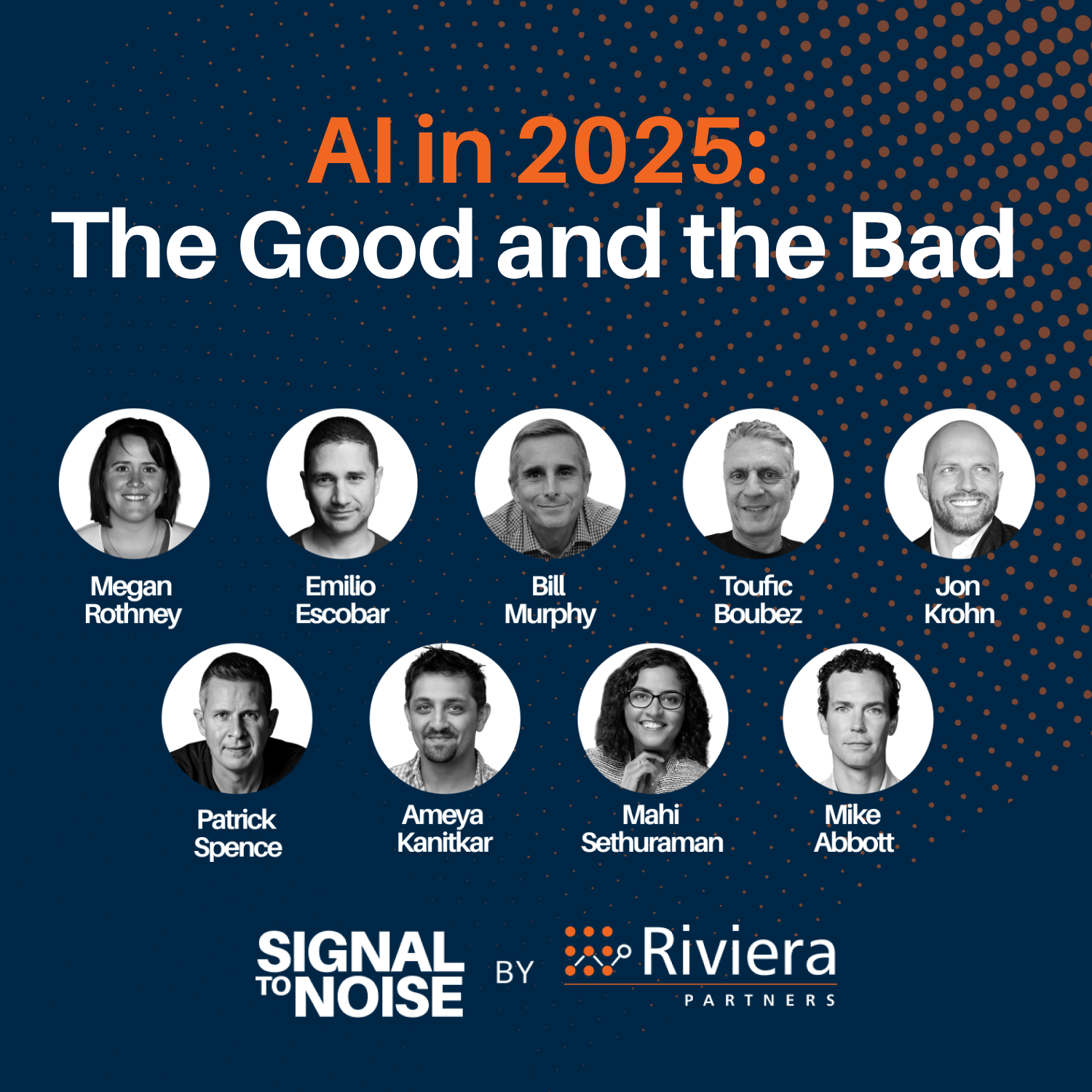 The Year In AI: What We Got Right and What Went Wrong in 202575 / 100