
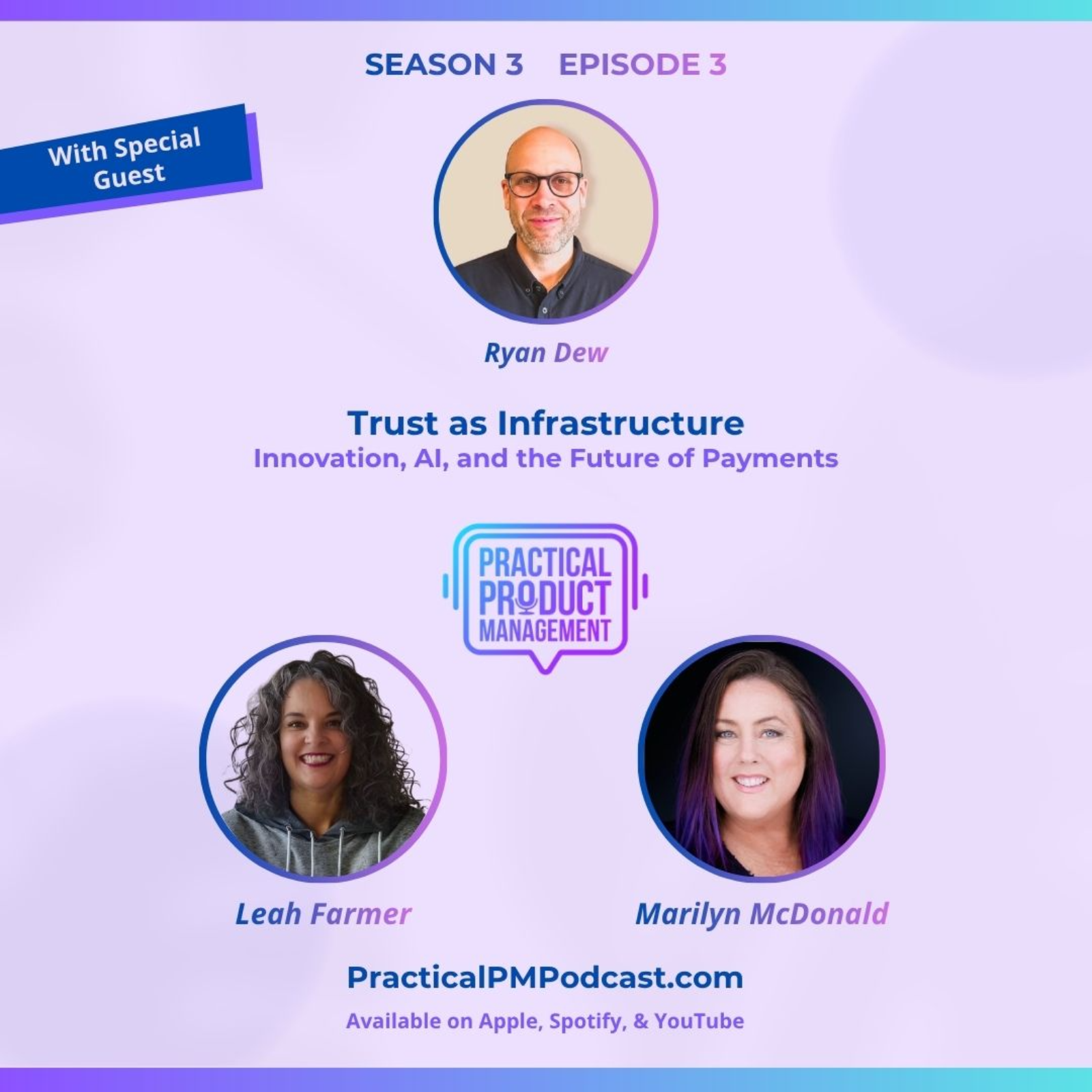
Practical Product Management · 2024-06-19 · 23 min
Key moments - from our scoring
Substance score
42 / 100
Five dimensions, 20 points each
Leah Farmer and Marilyn McDonald challenge the romanticized notion that product managers can focus solely on customer needs while ignoring business viability. They argue that most teams lack genuine customer understanding - many product managers rarely talk to real customers outside their company - yet claim to be customer-centric. The real skill lies in finding the overlap between authentic customer problems and profitable business solutions. The hosts critique the tendency to fall in love with solutions rather than problems, leading teams to build maximal features instead of true MVPs, then resort to aggressive marketing to sell products nobody wanted. They explore how to avoid this trap through continuous customer dialogue, testing hypotheses rapidly, understanding total cost of ownership and ROI, and planning a multi-step roadmap beyond the MVP launch. The conversation addresses when products should go deep (serving one segment obsessively) versus wide (reusing technology across markets), the importance of eventual self-sustainability, and why CFOs and CEOs must hold product managers accountable not just for customer satisfaction but for business health metrics. This episode will resonate with product leaders, founders, and CFOs struggling to balance innovation with profitability.
Marilyn McDonald argues that most product managers don't actually talk to real customers - they work inside their company building and only talk to colleagues wearing the same badge. She emphasizes that anyone inside the building doesn't get a say in understanding what customers actually want.
Teams fall in love with their solution rather than staying focused on the customer's problem. Once they've invested in building something, they get defensive about metrics that show it's not working and double down on marketing the wrong product instead of reconsidering whether they solved the right problem.
MVP means minimal, viable, and product - the smallest increment to test a thesis. Teams often build what Leah calls 'maximal' products or 'minimal level products' by cramming extra features in, which defeats the purpose of learning quickly and isn't actually viable for understanding if customers want it.
Going deep means serving one customer segment obsessively through feature development until you run out of room. Going wide means reusing the technology across other segments or markets to increase addressable market and revenue - and requires planning the architecture ahead of time so it's possible to decouple and reuse components later.
Beyond customer health and feedback, leaders must require product managers to understand and communicate the business health of their product - including market analysis, competitive landscape, team health, total cost of ownership, ROI, and a credible path to self-sustaining profitability.
Our reviewer’s read on each dimension, with quotes from the episode.
A few worthwhile ideas surface (MVP misuse, decoupling problem-solving from solution-love, going wide vs deep), but much of the runtime is conversational agreement and re-statement rather than dense novel claims.
you have from here to here
MVP is not good enough. Now we're going for minimal level product
The 'shiny pretty product' framing and 'anyone wearing the company badge doesn't get a say' rule are mildly fresh, but most points (talk to customers, don't fall in love with your solution, MVP means minimal) are standard product management lore.
anybody that's wearing the badge of the current company that we sit in doesn't get a say
you fall in love with this thing that you're like, this is the best idea that's ever been created
Two experienced product leaders with credible backgrounds (Amazon, fintech/banking) speak from real experience, but this is a co-host chat with no external guest and credentials are only lightly established.
one of my favorite parts, for instance, of working at Amazon was the customer obsession
We've both worked in fintech and banks and financial institutions
Almost entirely abstract; the few concrete references (Amazon, banks, 'population of India' TAM joke, 18-month experiment example) are anecdotal with no real metrics, dollar figures, or named cases.
look at this giant addressable market. And I'm like, that's not your addressable market. That is the population of India
we're going to try for, you know, 18 months and here are the six or seven things
The two hosts have easy rapport and occasionally build on each other, but it's largely mutual agreement with no pushback, challenge, or probing follow-ups; questions mostly bounce softly between them.
No, totally.
I 100% agree.
Computed from the transcript - who did the talking, and the words that came up most.
In this episode, Leah and Marilyn discuss the tension between building for customers and building things that matter for a business. They explore why product managers often prioritize customer needs over business goals and the importance of understanding the customer. They also discuss the concept of minimal viable products (MVPs) and the need to focus on solving real customer problems rather than building shiny, pretty products. The conversation highlights the importance of aligning customer needs with business goals and finding the overlap between the two. Takeaways Product managers often prioritize customer needs over business goals, but it's important to find a balance between the two. Understanding the customer is crucial for building products that solve real problems and generate revenue. Minimal viable products (MVPs) should focus on testing a thesis and learning from customer feedback, rather than being maximal or trying to delight customers. Product managers should have a clear path forward for their products, considering both deep and wide expansion and economic viability.
Transcribed and scored by The B2B Podcast Index.
Speaker A: Welcome to Practical Product Management Podcast, starring me, Leah Farmer and Marilyn McDonald. We're here. Um, this is our third episode and today we want to talk about the tension between building for customers and building things that actually matter for a business. So what do you say, Marilyn?
Speaker B: Let's do it.
Speaker A: So I think, you know, as product manager managers, we love to build customer centric and customer obsessed things and I think that's important. But sometimes we create sort of this grandiose idea that that's all you have to care about. Um, but that doesn't pay the bills sometimes.
Speaker B: All the time.
Speaker A: All the time. Somebody's got to pay the bills for all this. Exactly. So what do you think causes us, I guess, first question, like, what do you think causes us to think? Like, we're only going to think about the customer and we don't have to worry about the business as product managers.
Speaker B: Um, I actually suspect that it's because in reality, most product managers don't ever talk to customers. You know what I mean? So, like, if I think about, if I think about all the teams that I've worked in, um, and led and been a part of, very few of them actually have a deep understanding of the customer. We think we do. Um, and I like to tell my teams, like, anybody that's wearing the badge of the current company that we sit in doesn't get a say. They don't get a say. So how are you going to find stuff out? Um, and it's always such a mind blow. So I think maybe the industry is like over rotating.
Speaker A: Yeah.
Speaker B: Um, because it's, it's difficult. Um, yeah. So we say, we say we serve customers in a lot of ways. We try.
Speaker A: Right, right.
Speaker B: We mean to, um, but when was the last time we actually talked to a customer?
Speaker A: Right, right. It's like, oh, no, no, we know what they want. We know what they want. Right. No, totally. I think you're totally right. And I think, you know, I think one of my favorite parts, for instance, of working at Amazon was the customer obsession. Like the idea that you didn't do it if it didn't solve a problem for someone. Right. And that part of building vision, I love that part of thinking about strategy. But it's not as though there wasn't any money coming in. Yeah, yeah, right.
Speaker B: You don't get to build your thing until you understand the return on investment that you're going to be making.
Speaker A: Right, right. So how do you think, like, how do we go about. I mean, I think we both have probably ways we've Done this. But how do you go about looking for and finding overlapping interests between what your business goals are and what your business needs are and solving a real customer problem? Where do you start?
Speaker B: I mean, I think that's really the challenge, um, is finding that Venn diagram overlap. Uh, and I unfortunately think that a lot of businesses either try to solve a business problem, um, which, which is interesting, um, but I don't often see it done with the full, full ROI impact. Like, they're just like, hey, we think there's a problem here. Go build a piece of software. Um, and I often see, um, organizations solving what they perceive to be the customer problem, um, without really understanding the total full cost of ownership. So, like, do you know what your software costs to build and run? Do you know what your web costs are?
Speaker A: Do you.
Speaker B: Are you marrying that against revenue? Like, what's your actual return on that investment ex. Employee and all of the stuff you have to consider? Um, so, like, I actually think it's a really interesting problem. I don't really think there's very many people that do it. Well, I think you're either in the camp of solving a business problem. Right, or you're in the camp of pretending you're solving a customer problem, but you're actually really solving a problem that you as the company or the individual perceive as a customer problem.
Speaker A: Right? No, that's true. Do you think it's changed over time? Like, do you think that. Do you think it's changed? Do you think we used to do product management differently? Or do you think it's always been like this?
Speaker B: I mean, I think there was a, uh, I don't know, Leah, and I'm really interested in your take. I think that as more companies seek to become digital, um, they go to the frameworks more and more. And I think that's actually why we decided to create this podcast, is because, like, the frameworks become gospel. And if you just do these five steps, then you check the box and you're building great digital content. Right. M. I think there is a practice. There are a set of people that have been in the industry long enough that can identify what is a real customer problem by talking to people outside the building.
Speaker A: Right.
Speaker B: Um, understand the economics between why this is something that needs to be solved at all and solved now, because those are two different things. Um, and at what stage that investment is going to start to pay back in a relatively accurate way. Um, I mean, I. We've done it. Um, I know others that have done it. I don't think it's common practice. I don't think that many people talk about it as a thing because it's difficult.
Speaker A: Yeah.
Speaker B: And as you get more companies doing the thing, they just snap, uh, to the framework. Well.
Speaker A: And I think sometimes one of the keys there is you have to be willing to not fall in love with what your solution is. Like, most of the time. And I said this probably a million times to, uh, young product managers. Like, the customer will say, this is the problem. Problem is usually somewhere down here.
Speaker B: Yeah.
Speaker A: Right. And if you can solve this, you can usually make money because you have from here to here. Yeah. To get them to say, oh, solve my problem. Right. And I'll pay you. But I do think we get we. And I've done it. You fall in love with this thing that you're like, this is the best idea that's ever been created and it's going to solve the problem of this, of this group. And we're. And they're going to just not be able to ignore it and they're going to want it and they're going to throw away everything else they've ever bought in that realm and they're going to come to us. And then it doesn't work.
Speaker B: Yeah.
Speaker A: And. And we get, we design ourselves into this, like, corner. And then we're like, oh, what do we do? Since no one wants to buy it.
Speaker B: And then you're like, go aggressively market it.
Speaker A: Right.
Speaker B: Spend more money.
Speaker A: Exactly. Well, I sometimes think that that's been. The rise of the growth product manager is because someone. I mean, it wasn't like, we didn't do growth as part of product management all this time. But the rise of the growth product manager feels like it's about like, go sell the thing we all said we were building.
Speaker B: Yeah.
Speaker A: Convert it. Get it to convert. And I'm like, maybe you built the wrong thing.
Speaker B: Yeah. And maybe you got an early signal that was right to your point. Exactly. Like, that you fell in love with the solution. You got an early signal that this was the right thing to build. And so you doubled down, but took your eye off the problem and started focusing on the solution. And I, uh, I just think in those instances, you are sort of like slowly going to lose product market fit to the point where you're going to have to sell the thing.
Speaker A: Yeah.
Speaker B: Yeah.
Speaker A: No, totally. So I guess the question then is how. What are some strategies that you think are important? I have a couple in my mind, like, that you think are important when you're on that road to not falling in love with the solution, but so that you can make sure that you're checking in.
Speaker B: I mean, like, I'm going to let you kick this one off because, like, I'm checking my desk drawers and. And I've got ideas, but my magic wand's Miss. Uh.
Speaker A: Shoot.
Speaker B: I actually think this is a really interesting hard conversation. And I have some techniques. Yeah. But I think it's like diligence.
Speaker A: Yeah. And I think I would go. But the first thing I would say is I would go all the way back to what you said earlier. Like, you have to talk to actual customers and that will be uncomfortable.
Speaker B: Yep.
Speaker A: You need to drop your little paper wireframes and go out to the mall and ask people questions. Or, you know, so people are always like, I've got to hire a company to build me a user research. And I'm like, or you can just build some wireframes and go say, what button would you push? What would you do? What would you do if I asked you this? Right. And see what they do.
Speaker B: Yes.
Speaker A: Right. Uh, for me, that's really step one. Like, what will people do? Yeah.
Speaker B: Ah.
Speaker A: And then make sure that you're not, like setting that up in a way that's like, which of these would you choose?
Speaker B: This big one or this tiny? $1 million or five bucks.
Speaker A: Exactly. I was on a team where when I showed up, they had rebuilt the whole front end. And I was like, why did you do this? And they were like, because that's what customers wanted. And I'm all. Except it's not. It's not working. Was working before.
Speaker B: Yeah.
Speaker A: So I made them turn it off and go back to the old experience. And they were so devastated. Right. Like, it's not working. And it was because they had fallen in love with that. The. That this was gonna be the thing that everybody loves about what we do. My, um. Mom, they're not. That's not what they want. They want you to solve this one problem.
Speaker B: I've seen that over and over. You launch the new experience and, um, the metrics actually fall.
Speaker A: Yeah.
Speaker B: And instead of being very curious about, you know, oh, shit, what happened? Um, there's a defensiveness around the new thing. Well, it takes time.
Speaker A: Right. Right.
Speaker B: I also. To your point, like, about. Just go find out. Um, I always tell my teams, like, you have a hypothesis. How. How are you going to find out in one week or less? How are you going to find out tomorrow?
Speaker A: Yeah.
Speaker B: Um, but not again. If you're in the building, if you're wearing the company badge, your opinion doesn't matter. How are you going to find out
Speaker A: you are not, you are not the customer?
Speaker B: Because it's easy to sort of like, you know, hire a, hire a consultant or hire a, um, market research firm or, or, or, or and let someone else actually get an understanding of the customer problem. I, I think that's, that's abdicating your opinion.
Speaker A: Yeah, yeah.
Speaker B: Why do I need you then?
Speaker A: Well, and I think the second thing that comes to my mind is like, it follows along kind of. Right. With that. I think we forget the meaning of the Let the words that spell mvp. It needs to be minimal, it needs to be viable and it needs to be a product. Yeah, right. It can't be maximal. I know that's not a word, right? But you know, you just, it, it has to actually be minimal because you need it to be as small as it can be to learn something, to then take the next step and take the next step. And I think what happens, and this is, this is leadership team's faults, quite frankly. A team builds an MVP that might not be an mvp, it goes out the door, it has some success. And senior leaders say, we'll just run with that. You're like,
Speaker B: that was to test a thesis, right?
Speaker A: Yeah, yeah. It's not ready to scale. It's not set up. We didn't build anything underneath it. Right. I mean, I think there are whole startups that are running a whole company on an mvp, right? And it's like m. Right. And I think that that's on us as leaders, right? To say, okay, what does an MVP mean and what will you need? What is the next step and the step after that and what would it take to get us to scale?
Speaker B: But isn't that part of the job? So let's go back to like the original question, um, which is like, how do you, how do you understand what a customer wants and recognize your business impact?
Speaker A: Right?
Speaker B: If you only planned, Mr. Product Manager, if you only planned for the launch of the MVP and you didn't know what the next six steps were and the economic choices you were making on all of those steps, then you did not plan for business return, right? Because you don't even know the question you're answering the first time this thing hits interaction with the customer. I think that's poor behavior.
Speaker A: Yeah, yeah, yeah, totally.
Speaker B: I've also heard this new term, I don't know if you've heard it. It makes me laugh every single time. MVP is not good enough. Now we're going for minimal level product, okay. Which is just a really kind of like, interesting way to say we're, uh, going to cram a bunch of other stuff in there because someone told us to.
Speaker A: It's not viable.
Speaker B: Like, we're not actually testing a thesis. We're not testing the smallest increment of, uh, a feature capability. We're actually going to build a big product release. So it's, it's kind of like waterfall. It's a step, waterfall
Speaker A: is a thing. But it's really just waterfall right behind waterfall.
Speaker B: M. Right.
Speaker A: But you don't know if it's going
Speaker B: to be lovable because no one used it.
Speaker A: Right. Well, and I think it goes back to like a. What does lovable mean?
Speaker B: Right.
Speaker A: Is it taking market share? Is it winning new customers? Is it stealing customers? Is it solving a problem in a way that people didn't expect you to? Yeah, right. What does it even mean? Right. And I think sometimes that ends up getting you to this. It's a stage of like, we need to delight customers. I'm like, delight is not happening in an mvp most of the time. Delight is a later thing. Yeah, Right. What you're doing with an MVP is making people go, oh, yeah, I'd buy more of that.
Speaker B: And do you need to do. Like, my bank does not need to delight me. Any student job, my insurance company does not need to delight me. They need to give me a base level of service and a way that, that like, doesn't get in my way. Like, I don't need a talking gecko to pop up and give me a kiss on the cheek. It's not necessary.
Speaker A: No, it's not. I mean, I always joke that, like, I know you've worked in. We've both worked in fintech and banks and financial institutions, but I mean, the hoops I'll jump through to make the user interface work at my bank is I'm like, how many buttons do I have to push and how many phone numbers do I have to get and what do I need? I don't care, as long as they'll let me in and let me pay my bills. Right. Like, delightful.
Speaker B: If my, the one bank didn't treat me like four different customers for my mortgage, my checking, my, my, like whatever account. And I know that's how banks are structured.
Speaker A: Yeah.
Speaker B: Um, but that would be freaking delightful.
Speaker A: Yeah.
Speaker B: Yeah.
Speaker A: And I think that's where we fall down on the, like, you know, not everything you're building is the new iPhone launched. Right. Like, it's. Sorry, that's not what you're doing. Yeah, right. I think we get really hung up on the idea that product management is always creative and always innovative. Some of a great portion, quite frankly of product management is a grind to get features out that solve problems, make things faster, easier, more efficient. Not shiny, pretty and beautiful.
Speaker B: Yeah. And to deliver business value. Because there's a lot of things we can do that are shiny, pretty and cool, um, but don't make sense for the business. I know you and I have talked about this. Um, there are so many digital companies, uh, whose whole premise is like, let me build the next cool thing. Um, but there's no economic reality behind it. So how does that business stay in business?
Speaker A: Right? I mean, what they, I mean I, I've seen so many pitch decks at this stage that are like, look at this giant addressable market. And I'm like, that's not your addressable market. That is the population of India. Right. Like, that is not your addressable market.
Speaker B: Every single person is your addressable market for mvp. Like, help me understand that. Right?
Speaker A: So I think that, I think it
Speaker B: is,
Speaker A: maybe it's a little raining on the product, the young product managers parade, but it is incumbent on all of us to sort of pull them back and say, what are we achieving? Are you aligned with the business strategy and the vision and the goals? Are we going to, is this going to make any money? And even if the MVP doesn't make any money, are we on the road? To your point, do we have a path forward that will be a self funding product at some point?
Speaker B: Because it's super fine to lose money for a quarter, two quarters a year if that's built into the plan.
Speaker A: Right.
Speaker B: And I've actually seen businesses say, hey, listen, we, we know there's money in this segment. We don't know how to go after it. We don't know how to capture it. We're going to try for, you know, 18 months and here are the six or seven things we're going to try to see if we can find an economic viability in this area of the business. And that's, that's great because you're actually moving really fast. Your metrics are clean, clear, you know what you're going after.
Speaker A: Yeah, I think it's really what comes into my mind also is this idea that, um, you know, you're, you can, if there is a product you're building and you're like, this is the customer we want to solve it for. And it's so niche and it's so wonderful. One thing you could do if you believe that that is the Selling point is have a strategy for how you can reuse the tech in other markets, in other segments, in other ways so that you can go wide, right?
Speaker B: Yes.
Speaker A: Because products need to go wide and. Or deep. Yes, right. You can go deep for one customer, one customer segment. And that's feature development. Feature development, feature. And you just keep doing that. But at some point, you know, you run out of customers who will give you more for features. They're just sort of like, give me something up. What you, you owe me a new feature.
Speaker B: Right.
Speaker A: At some point that's how customers should roll and show up.
Speaker B: Yeah.
Speaker A: Sometimes they'll pay for new features, but then there is, uh. How wide can you go? Yeah, can I reuse this beautiful thing that I've fallen in love with for, you know, the unicorn segment to also sell the hip hops?
Speaker B: Yeah.
Speaker A: Right. Like what, what can I do?
Speaker B: Right.
Speaker A: To go wide. And I think that's also critical because that will satisfy your cfo.
Speaker B: Yeah.
Speaker A: Listen, if you let me do this and I can get this right, then we can do this.
Speaker B: And especially when you think about. And I don't want to be that person that's like, okay, let's talk about domain driven architecture because that's, that's a pain in the butt and I like people that like, bang on that drum, annoy me. But if you've built the thing correctly and you understand the possibility.
Speaker A: Right.
Speaker B: Um, then you can, when it makes sense, start to decouple components that will serve multiple product sets. M. And then you get this notion of reusability and scalability that actually brings down your total cost of ownership. Right. Um, for, for multiple products and is actually the right way to scale. Now don't do that on day one. Like, um, the tiny business that sets everything up as domain driven architecture is destined to fail. Um, solve a problem first, my friend.
Speaker A: Right, right. No, totally. And I think. But that is exactly when you and I both have had lots of conversations and talked in public about like ultimately platform, product management and domain driven, you know, product people that are focused on like, how do we architect this in a way that can go, you know, wide and component driven and what's in the box, what's out of the box. All of those things become important, but they're not important on day one.
Speaker B: Yeah, no 10 person startup. Don't think about it.
Speaker A: Just.
Speaker B: Right.
Speaker A: Just something that's right.
Speaker B: Right.
Speaker A: So, yeah, so I think, I think you know, going back, like you have to have, you have to be able to look at both, you know, both. What is the customer need and where does that overlap with our, with where we can make money and where we can build and grow? I think we have to be thinking about how do you go small and incrementally get bigger? How can you do some testing? How can you a B test, how can you do it in a true mvp? How can you really do that? You have to be talking to customers.
Speaker B: Yes.
Speaker A: Right. You must be talking to actual people who will actually get out their wallet. Right. And then really having sort of that path forward for like, will I be able to go deep and wide and actually build a real business here right behind this product? How do I get it to a self sustaining product?
Speaker B: It's the obligation of true product managers. And I, I think in a lot of companies we're only allowed to do a segment of the job and that's a miss for the company.
Speaker A: Yeah, yeah, totally. Well, and I think one of the things that can really, as we're, as you said when you said that, I was like, oh, yeah, I think one of the things we can do as um, leaders when, when you have a leadership role and not just in product, but CFOs and CEOs and when you're doing reviews with your team and you're looking at metrics and you're looking at what's happening, be willing to look at customer feedback and customer health, but also make sure that the product manager understands and can talk about the business health of their product. Don't just, just pat, give them pass, like make them also understand what is the business health of the thing you're building, what does its future look like, what is the market look like, what is the competitive analysis and what is the team. So it's really this combination of like team health, customer health, business health, product managers must engage in that.
Speaker B: I 100% agree.
Speaker A: Yeah.
Speaker B: Yeah.
Speaker A: Cool. I mean, I think we have lots of other, um, topics that come out of this topic that we will follow up on another on in a future episode.
Speaker B: Yeah, I'm, I'll get, I'll give the audience a bit of a question in return. So wherever you have worked or wherever you worked now, have you ever seen someone playing the whole life cycle? And if you have, would you be willing to come on and talk to us about what that looks like?
Speaker A: That would be amazing. Yeah, I mean, one thing that we definitely want folks to know is as you start to watch our podcast, you can, you can, uh, anywhere you're watching it, if you put comments or questions in, we'll see those. If you go to our website. There is even a place where you can put in ideas or put in, um, questions that you have for us. And as Marilyn said, if you, you have done this or have seen it done, well, we'd love to talk to you. Like, I think that. Come, um, hang out with us. So we're a good time. So awesome. Well, Marilyn, I'll see you next time.
Speaker B: Awesome. Thank you.
Speaker A: For ya, Sam.
Other episodes covering the same guests and topics, from across The B2B Podcast Index.
 Three Money Stories You Need To Tell | Rich MironovProductized Podcast · on Product-market fit83 / 100
 He sold his $10M business to bet on a side app - then grew it to $20M ARR. | Andrew Antos, Co-Founder & CEO of WithinA Product Market Fit Show · on Product-market fit82 / 100
 The Future of Auto Financing - With Robert GwerengweNo Free Lunch With Greg Stewart · on Total cost of ownership82 / 100
 Navigating AI Risks with Trevor Horwitz from TrustNetB2B Automation Spotlight · on Product-market fit79 / 100
 What I Wish I’d Known About Sales With Tom HappeB2B Sales Playbook · on Product-market fit79 / 100
 III. Building a Sales Org - Jacco van der KooijSaaShimi · on Product-market fit78 / 100
 Trust as Infrastructure: Innovation, AI, and the Future of Payments65 / 100
 Innovation at the Edge: AI, ERP, and the Art of the Calculated Bet86 / 100
 The Books That Made Us Better Product Managers (And Better Humans)53 / 100
 Season Wrap Up - The CEO of Your Life55 / 100
 Best of Season 2, Part 2 - Conversations that reminded us why Product is a "people-first" craft. 61 / 100