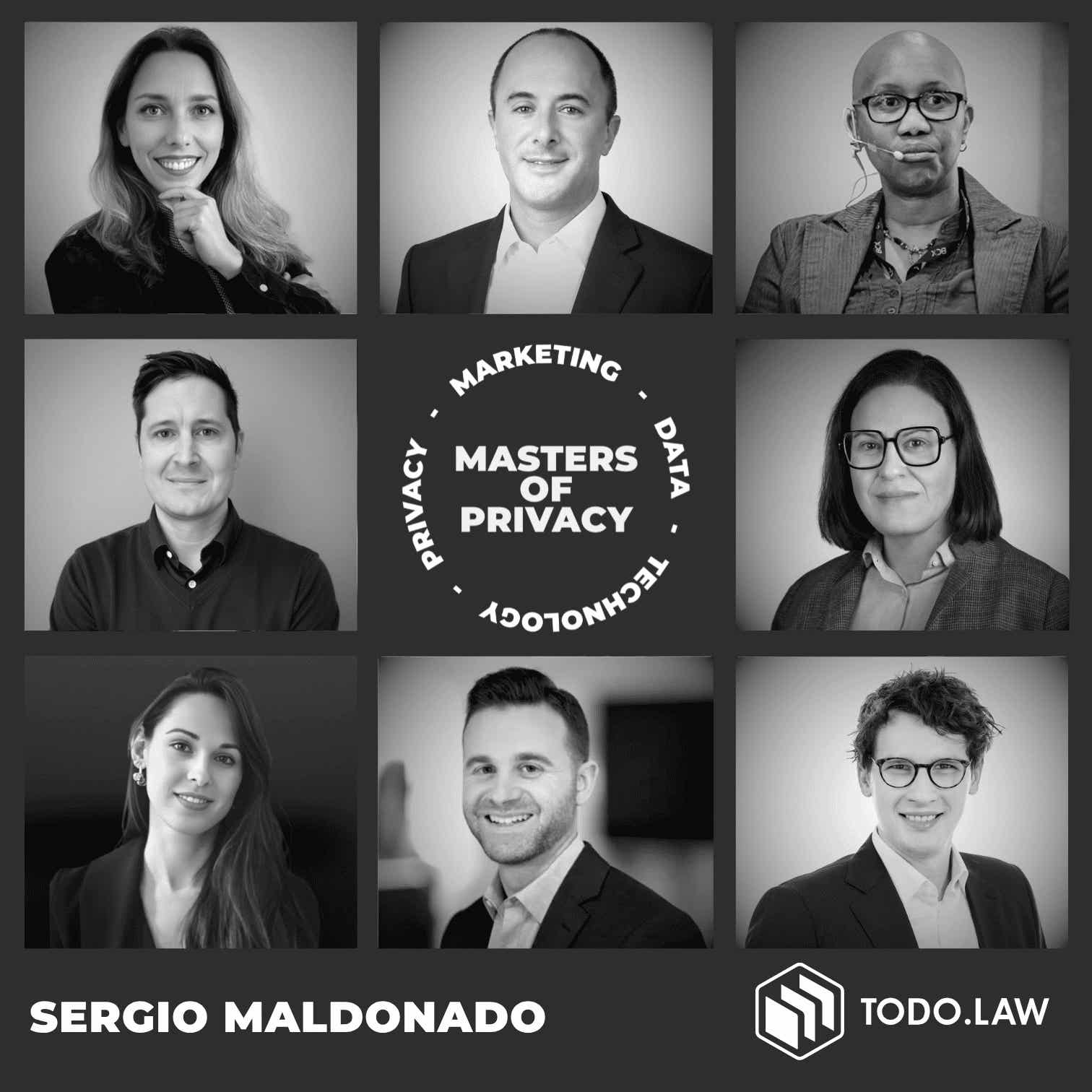
Hosted by Sergio Maldonado
Listed under Business › Marketing, Technology
Interviews and updates at the intersection of marketing, data, privacy, and technology. With an eye on a human-centric, demand-led future in which transparency, control, and personal agency play a crucial role.
165 episodes · publishes weekly · latest 2026-06-21 · ~34 min/episode
Rank
#20
Substance
86.5
/ 100
Breakdown
Scored 2026-08
Updated monthly
General rank
#5 of 134
Across the index
#20 of 1878
Substance
Top 1%
outscores 99% of the index
Masters of Privacy ranks #20 on The B2B Podcast Index with a substance score of 86.5 out of 100, scored across 2 recent episodes. It scores highest on guest caliber and insight density. Theodore Christakis is exceptionally well-credentialed: Professor of International European Law at Université Grenoble Alps, Director of the Center for International Security and European Law, Senior Fellow at the Future of Privacy Forum, member of the French National Digital Ethics Committee and UK Government's International Data Transfers Experts Council. Beyond credentials, he demonstrates practitioner-level expertise by conducting original comparative research across multiple AI providers, studying actual case law and litigation mechanics, and engaging with real regulatory bodies. He is not a pure theorist but someone actively shaping policy discourse.
Averaged across 2 recently scored episodes, with cited evidence.
The episode delivers substantial insights into AI chatbot privacy risks with specific mechanisms and comparative analysis. Theodore Christakis discusses concrete findings from his research: training on conversations by default, the 'feedback trap' that overrides privacy settings, monetization pressures, the four 'doors' for data exposure (provider referral, law enforcement warrants, litigation discovery, breaches), and the emerging 'health AI agent rush.' However, there is notable filler with throat-clearing, extended art commentary, and repetitive explanations of already-stated concepts that dilute the density somewhat.
“they all train by default on our conversations on our interactions so they use our interactions for improving the model”
“the same futures that make a chatbot very useful, that it remembers you, that it um, keeps uh, your history, personalization, uh, plugs eventually to your mails and your files as we're moving towards agentic AI, all these futures are exactly the same that make uh, uh, the resulting record preservable, searchable, discoverable and even, we're going to talk about it, stealable”
The research presents genuinely novel framing and analysis: synthesizing the 'four doors' framework for chatbot data exposure, identifying the 'feedback trap' as a dark pattern, and connecting agentic AI futures to privacy risks. The comparative study of provider practices is original work. However, some underlying concepts (training data issues, warrant risks, litigation discovery) are not entirely new, and the episode relies on frameworks from adjacent fields (social media moderation) rather than purely novel thinking.
“there is a convergence, which means that the same futures that make a chatbot very useful...all these futures are exactly the same that make uh, uh, the resulting record preservable, searchable, discoverable and even, we're going to talk about it, stealable”
“what I call the feedback trap which means that you uh, know when you try to beat into Claude and all the other they have a thumbs up, thumbs down...When you do this, this will automatically uh override your privacy preferences”
Theodore Christakis is exceptionally well-credentialed: Professor of International European Law at Université Grenoble Alps, Director of the Center for International Security and European Law, Senior Fellow at the Future of Privacy Forum, member of the French National Digital Ethics Committee and UK Government's International Data Transfers Experts Council. Beyond credentials, he demonstrates practitioner-level expertise by conducting original comparative research across multiple AI providers, studying actual case law and litigation mechanics, and engaging with real regulatory bodies. He is not a pure theorist but someone actively shaping policy discourse.
“Theodore Christakis is a Professor of International European Law at Universitie Grenoble Alps in France, Director of the center for International Security and European Law, Director of Research for Europe with the Cross Border Data Forum, Senior Fellow with the Future of Privacy Forum”
“I benefited from tremendous helps from some very, very good American lawyers such as uh, Peter Zweir, Richard Salgado”
The episode grounds claims in concrete examples: the Hepner v. Anthropic court decision, the Tumblr Ridge shooting case in Canada, the FSU shooting, Strasbourg armed police intervention, the New York Times v. OpenAI discovery of 108 million ChatGPT conversations, the reverse prompt warrant case, Meta and Apple's encrypted chatbot announcements, and specific statistics (230 million weekly health queries, 900 million OpenAI users, 5% subscription revenue). The guest cites actual regulatory documents and litigation mechanics. Some sections remain vague on numbers (e.g., 'three very recent cases' mentioned but not all detailed equally), preventing a perfect score.
“230 million users who ask every week questions about health and well being”
“the first known federal reverse prompt warrant served on an AI company...they had the prompter said, who is the suspect? Please tell us. And they found the suspect”
The host poses substantive questions and builds logically from Part One to Part Two to the Health AI study, but the conversation lacks sharp pushback and probing follow-ups. The host allows the guest long monologues with minimal interruption and rarely challenges claims or asks for clarification on contradictions. For example, when discussing moderation in Meta's encrypted mode, the host doesn't press on the practical limitations; when discussing liability incentives, there's no real debate. The host does ask clarifying questions about doors and mechanisms, but misses opportunities to stress-test the guest's reasoning or elicit counterarguments.
“So what did you find specifically in terms of what happens with the data that we share with our chats?”
“Could you please explain this? Door three?”
2 periods tracked.
2 scored on substance · 60 tracked in total.
Add this badge to your site - it links back here and updates automatically as you rank.

<a href="https://index.fame.so/show/masters-of-privacy" target="_blank" rel="noopener">
  <img src="https://index.fame.so/badge/masters-of-privacy/badge.svg" alt="Ranked #5 on The B2B Podcast Index" width="360" height="136" />
</a>Track Masters of Privacy's rank
Get an email whenever this show moves up or down the Index. Monthly at most, no spam.
Companies, products and tools that come up most across this show's episodes.
The themes that come up most across this show's episodes.

CareTalk: Healthcare. Unfiltered.
CareTalk: Healthcare. Unfiltered.
Money Code
Stablecon

Reshaping Workflows with Dell Pro Precision and NVIDIA RTX PRO GPUs
Dell Technologies AI Factory with NVIDIA

The RAG Podcast
Sean Anderson

Outthinkers
Outthinker
Business Scholarship Podcast
Andrew Jennings
Podcasts that dig into the same topics.

AI Automations for Business
Katie Tovey-Grindlay and Noel Tovey-Grindlay

AI Security, Cyber Risk, and Cloud Strategy on ClearTech Loop
ClearTech Research / Jo Peterson

The Daily Marketing Brief
Jen Bryan

The Scale Up Show
Ryan Staley

Unsolicited Feedback
Brian Balfour & Fareed Mosavat

Hidden Layers
KUNGFU.AI
