
Grow Your B2B SaaS · 2025-12-23 · 31 min
Key moments - from our scoring
Substance score
33 / 100
Five dimensions, 20 points each
This comprehensive summary episode distills wisdom from 21 SaaS founders and operators on scaling from 10K MRR to 10M ARR. The episode covers critical growth levers including product-market fit and channel repeatability (Jujo Pereira's focus on one channel, persona, and use case through 1M ARR), partnership and ecosystem strategies that evolve from deep single relationships to platform integration (Carolyn Lewis on moving toward HubSpot-like positioning), outbound sales execution and team building (Besnik Veliko emphasizing brand momentum and strategic people bets), go-to-market operational discipline (Ken Garrett Robinson on systems and leadership delegation), and pricing strategy governance (Chitta Josten on assigning ownership by 7M ARR). Additional segments address founder-led selling through 1M ARR (Joey Gilkey on documentation before delegation and paying for proven talent), community and customer feedback loops as underutilized flywheels, AI-enabled go-to-market (Maya Voye on agencies and creator partnerships), new user onboarding optimization and segmentation (Andrew Kaplan), and team structure across acquisition, activation, and retention. Recurring themes include ruthless focus on repeatable motions, investing in senior talent early rather than cheap hiring, cutting bloat to fund what works, and the founder's evolving role from executor to systems builder. B2B operators at any stage between 10K and 10M ARR will find immediately actionable patterns and conflicting perspectives that reflect real founder experiences.
Hyper-focus on one repeatable growth motion: one channel, one persona (ICP), and one use case. Jujo Pereira emphasizes that companies hitting 1 million ARR that tried multiple channels and personas failed to scale beyond that point, while those with singular focus could repeat and scale the motion consistently.
Founder-led selling should continue until 100K to 1M ARR. Joey Gilkey recommends documenting the sales process thoroughly before delegating it, and only bringing on salespeople if you have sales background or can thoroughly train them on what's proven to work.
Assign clear ownership of pricing and give it agenda status by 7M ARR, preferably with monthly review. Chitta Josten notes that many companies at 10M still lack pricing governance, leaving it unstructured - founders should ensure someone owns this and it's discussed in regular meetings.
Hiring for job titles rather than stage-appropriate fit and hiring based on potential rather than proven ability. Jujo Pereira warns against hiring a VP of Marketing with only two people reporting; Joey Gilkey emphasizes paying for proven current capability, not future potential, and not skimping on talent costs as it costs more to replace bad hires.
Start by going deep with successful partnerships before scaling them, then evolve toward platform positioning where your solution becomes integral to partners' success (like HubSpot or Shopify integrations). Carolyn Lewis notes that at 10M ARR, thinking about how to make your platform essential to other businesses unlocks exponential growth and the "unicorn" phase.
Our reviewer’s read on each dimension, with quotes from the episode.
The compilation format squeezes 21 guests into roughly 30 minutes, meaning each contributor gets 60 - 90 seconds of airtime; a few produce genuinely useful frameworks (pricing leakage thresholds, segmentation at plateaus, pricing ownership accountability) but the majority of slots are consumed by repeated conventional wisdom - ICP focus, hire well, build systems - leaving the overall density thin.
if you're leaking more than 10% of your revenue, kill it, act on it, number one
segmentation usually helps you work through those conversion plateaus
The overwhelming majority of advice recycles well-worn SaaS tropes - focus on one ICP, founder-led selling, hire ahead of where you are - without meaningful new framing; the rare contrarian moment (95% of companies are underpriced, VC is bad for most companies) stands out precisely because the surrounding content is so predictable.
95% of our projects, we increase the average price for our customers. If it's gut feeling plus competition plus cost, there's 95% of uh, the chance that you are too cheap
I think venture capital is bad for most companies
The roster mixes genuine operators (Joey Gilkey claims a 0 - 5M ARR in 12-month trajectory and two exits; Jujo Pereira references two prior startups) with a heavy contingent of GTM consultants, pricing advisors, and thought-leader types whose practitioner depth is impossible to verify from the thin clips provided.
I mean we went 0 to 5 in 12 months. I think we'll probably finish this year which is about 20 months of company age around 10 to 12 million
I've sold two companies
A handful of guests anchor advice in real numbers - salary floors, revenue leakage percentages, quota sizes, fundraising thresholds - but the majority of the 21 clips consist of abstract directives with no named customer examples, no cohort data, and no before/after metrics to verify claims.
I don't have a single employee on my payroll that makes less than US$100,000
an AE with a million dollar quota, 10 to $20,000 could be the difference between finding that AE who's going to blow out their million dollar quota
The compilation format structurally eliminates interviewing craft; the host's role is almost entirely limited to one-sentence episode introductions, and the only visible follow-up in the transcript is a single mild probe on pricing ownership that receives a non-committal answer - there is no challenge, no pushback, and no thread-pulling across the episode.
Uh, because is it then, if the founder is responsible, remains untouched for a really long time if it's not on the agenda?
Without further ado, let's dive in.
Computed from the transcript - who did the talking, and the words that came up most.
Season seven of the Grow Your B2B SaaS podcast centered on one core ambition: how to grow from early validation at 10K MRR to meaningful scale at 10M ARR. Across the season, founders, operators, and leaders shared practical guidance on product-market fit, hiring, go-to-market systems, partnerships, pricing, revenue operations, community, expansion revenue, and more. This summary distills their insights as shared in the episodes - nothing theoretical, nothing added beyond what they discussed - into a single, coherent narrative designed to help you focus, execute, and build momentum. From the outset, the thesis is clear. There are patterns you’ll hear repeatedly - focus, alignment, ICP clarity, hiring for stage-fit, segmentation, community, and systems. There are also points of debate that reflect the realities of stage and context. What follows is a structured walkthrough of the advice discussed in the season, episode by episode, following the journey from 10K MRR through the climb toward 10M ARR.
Transcribed and scored by The B2B Podcast Index.
Joran Hofman: Every episode in season 7 on the Grow youw B2B SaaS podcast, I've asked my guests the same two questions at the end how to grow to 10k MRR and how to go from 10k MRR towards 10 million ARR. In this summary episode we've combined all the answers from going to 10K Mr. All the way to 10 million ARR. You will receive the most practical advice from dozens of founders, operators and leaders into one single episode. No theory, no fluff, just real guidance on product, market fit, hiring, acquisition channels, go to market, pricing and much, much more. You are going to hear recurring patterns, some conflicting opinions, but it will be from people who actually done it or helped SaaS companies to reach 10 million ARR. So if you pass 10k mrr and grown towards 10 million ARR, this episode is going to be for you good to know. If you haven't reached 10k mrr m yet, listen to the previous episode. In case you enjoyed this episode, it is good to know as well. We do have six other summary episodes exactly like this one. Without further ado, let's dive in. In episode one I chatted with Carolyn Lewis on how to build SaaS partnerships that actually drive revenue.
Carolyn Lewis: First, starting with those successful partnerships that you have, go deep with them, really understand them, make them a success before trying to necessarily replicate or expand. When you move up to 10 million, it's really about taking that understanding and success and applying it, uh, to other companies there. So what lessons can you take from that? Successful partners? How do you make that a system and then grow from there? Especially at the 10 million end, that's where people start or should start thinking about how do I make myself a platform? So getting more after the HubSpot, the salesforces, the Shopify, how can you actually make your platform an integral part of somebody else's business and actually help them grow their business off of the growth of your own platform? Because again, that's really where you start to see that extreme growth going into sort of unicorn area when other businesses need your business to either survive or to grow or want to help you grow so that they can grow. And that's that flywheel that starts really taking off the point.
Joran Hofman: In episode two I chatted with Besnik Veliko why 80% of outbound sales fails and how to fix it.
Besnik Veliko: Let's just say 10:20 could be anywhere, right? But it's just about people. Let's be honest, as a business, it's sometimes you've got to bet not just your Channels maybe it's got you to 100, 200 grand. You've got to start betting on people like uh, you better your business offers value. If you're a fundraiser capital your own VC for yourself. How am I going to manage my resources that I have really strategic place bets in different areas to see net growth for anybody at that stage, let's say a few hundred K they've got validation, they've got proof of concept, they've got revenues, customers you want to grow. You've got to start placing bets on people so that you can multiply the efforts that are happening because whatever you can do by yourself is only going to yield so much so people when it gets to your debate when I start building on brand because you to build on um brand you need other people to speak about you. One of the biggest things that we've had on the strongest correlation is how do you get other people to speak about you. The most mentions is the creation of momentum to get you from up uh 1 to 5 or then 5 even 10 is building that momentum in that market space where people are just speaking about you paid organic or whatever it might be. That's the way to do it in my view to get to that scale.
Joran Hofman: In episode 3 I chatted with Jujo Pereira building SaaS partnerships that actually drive
Jujo Pereira: revenue for me to 1 million RR is just have figured out just one one channel in Persona or ICP1 use case you can repeat and repeat the scale over and over and over again. I think over time. Yeah I see over and over again in my first two startups because we were in that journey we hit 1 billion ARR but we hit in the wrong way and we couldn't scale with Talent Square for example where we. We just. We were having the. We had. We were acquiring, we're activating, we're retaining but was not the same kind of customer. They're all different. We're was enterprise, was small, was HR was not ah HR and then it became. It just had multiple channels, multiple Personas use cases that we couldn't pass beyond. The advice is to yeah just focus. I think the, the the 10k to 1 million is like incredible focus to get the repeatable motion, a repeatable growth motion. Easier said than done of course but yeah that one use case, one channel, one Persona or one icp just that's it hyper focus on that even if it fails. And if you're Talking about the 1 to 10 which is another like whole jump and even 1 to 10 there's the many phases of 1 to 10 then. But if there is one thing I see that didn't happen often in, in the ones I worked with were at 5, 6, 7 million days too late. They start using their community only at a very only when they got in trouble. They started looking at references, co marketing feedback loops, building a community of their customers or user or pro or partners. And by then everyone was already either annoyed, churn was increasing, they were stuck. So yeah, use your early community as your, you know, like HubSpot likes to call it your flywheel. I think, I think that would be from a people point of view from 1 to 10. I think this is where really hiring functional leaders or that are fit that are uh, staged fit are critical here. I think there are so many mistakes on hiring at this stage and I'll say don't hire job titles if someone comes because I want to be a VP of marketing with two people. It's not the right hire point. You're not the VP of marketing with two people under you. If they care too much about math, you already are in the wrong space. Fit. That's it.
Joran Hofman: In episode four I chatted with Ken Garrett Robinson why your SaaS go to market isn't working and how to fix it with operational discipline.
Ken Garrett Robinson: The biggest piece of advice, especially as you scale past 1 million, you start to get in that 5 to 10 million range. This is where founders have ultimately become the roadblock in the business. You know your job is no longer just about sales and relationships. It really comes down to creating the systems, enforcing a rhythm and really having command of the business and at the same time delegating that execution and getting out of the way and letting your people do what they do best. And I think when you look at it that way, it's not about just owning the vision of the business at that point. It's about owning the tempo of the business and putting the right things in place to where you're developing a leadership culture that starts at the middle out and not the top down where everything relies on you.
Joran Hofman: In episode 5 I chatted with Joey Gilkey on B2B SaaS sales outbound strategies
Joey Gilkey: to skill your revenue from 100k ARR to a million. It's all about scaling up selling. But it's founder led. So I think founder led content, I think founder led selling. Right. Assuming you can. Ideally you can. If not, you should probably find a co founder that can. I do not think that you're ready for salespeople yet unless you have a background in sales like I Did. I mean, I had sales people day one, even with $0 in revenue. But it's because I knew I could what I could get out of them. And so start investing in that. Cause I'm a big believer. And do document, delegate right 3ds. Do it well until I can document it well that I can. Then delegate it to someone. And so focus on that. And I would also say get yourself out as much administrative work as possible as soon as possible. So the moment that you start taking home a paycheck, go ahead and write off half of it and get an executive assistant. Take it off your plate. Stay really close to your customers. Start getting feedback from the product. What was, you know, help have them help build your roadmap. Incentivize them to give you case studies, video testimonials. When you're first starting, you lack proof. And so start getting people to start talking about your product, et cetera, et cetera. Incentivize them, pay them, discount them, whatever it takes to get those, because those are worth way more than whatever you comp them on. Once you get to a million, it's about scaling up the leadership team. And so it's starting to get systems and processes in place and people to run those system processes. So now we start looking at, okay, who is the talent that I can bring in? And here's one thing. I, I, I used to skimp on talent, be very cheap with talent. I've been an entrepreneur for eight years. I've sold two companies. I used to skimp on talent, and it hurt me. You buy cheap, you buy twice, right? I don't know if you've ever bought like a really cheap product and like it broke in a month. You had to go buy the nicer one. It's like, I should just bought this in the first place. It was more expensive. And so what I have learned is just go find the best possible talent that you can possibly afford, even if you can't fully afford it. Find a way. Give them equity, give them other benefits. Even if you have the right system in place. Take out some debt, good debt. I don't think that you need venture capital to build a company these days. I think venture capital is bad for most companies. Start building those people. Once you get to about 5 million, that's about scale and back to the talent thing. Like pay people what they're worth. I'm a huge believer at the end of the day that you should not hire people based on their potential ever. You should hire people based on where they're at today proven. I'm not trying to buy, I'm not going to pay for your future potential. I'm paying for what you can do for me. Day one when you walk in here. And so I'm a big fan. I mean I have, I don't have a single employee on my payroll that makes less than US$100,000 because I believe we're in paying for talent. Right. I'd rather pay an extra 30, 40, $100,000 and get what that should get for that money than pay someone 40, 50, $60,000 less and either replace them or be disappointed in their performance. It's about pouring gas on what's working. Get a little bit more relentless about cutting expenses and bloat because you want to have enough money and cash to start shoveling into what's working. I think you get to about 5 million to get bloated with your tech stack. You're paying for a lot of stuff you were trialing and stuff like that. Start getting aggressive with cutting expenses. Start looking at what's not working and start cutting it and take all that savings and dump it into what is and just triple down on it and you will get to 10. I mean we went 0 to 5 in 12 months. I think we'll probably finish this year which is about 20 months of company age around 10 to 12 million.
Joran Hofman: In episode 6 I chatted with Maya Voye on how AI is transforming go to market for B2B SaaS.
Maya Voye: Think about ecosystem marketing. I have been in close touch with Clay and Herrich and they have both used like agencies partnerships as go to market motions as a cluster of adoption. It literally like unlocked um, a big learning curve for them. Especially if you are like doing something which is complicated to implement and companies will not necessarily implement it themselves. Right. Such as outbound tools. For like the majority of people this is like a little bit of to an overkill. They already trust agencies. So one agency can bring you like 12 clients and this is a super, super, super super important lever. The other one would be actually a ah, water on your meal. So in the age of deep AI fakes and in the age of like AI generated everything, people still want to connect with people, communities, creator, its influencers. These are still like drastic apps for now. As for the mainstream media and like advertising space getting more intense. I just think that we have these shortcuts to trust that is getting increasingly important in B2B. And last but not least use AI. Think about how AI is influencing each and every go to market Motions that you are using.
Joran Hofman: In episode seven I chatted with Desiree Jessica Paley why human psychology still wins in B2B SaaS sales even in the age of AI.
Guest: I would break it down, what are your first three customers? And then how do you get to 500k to 1 million to 3 and 10 and really think along the line, okay, how do you get your first three? Maybe through the network. Then how do you get to your first 500? Just double down on the heavy users that you have from your first three. So who are their twins companies, who are their competitors and really just narrow down on them. And then going from one to three, we are not there yet so I can just share what I'm working with from our customers. Maybe what is working, uh, is okay now from having like exploited the twin companies. Now really hone into the signals those companies were showing the pain points and scale that going from 3 to 10 is opening up the market. Focus on the sum and use tools, tech and AI to penetrate uh, those markets faster. Always have a good strategy for it. And I think the first 3 million is a lot of experimentation. Try new things and always hone what is working and forget what is not working. Just use it as information to inform your next experiment.
Joran Hofman: In episode 8 I chatted with Andrew Kaplan on the growth operating system and building teams that deliver real value on this journey.
Guest: I think that there's two components that are really, really important. The first is going to be new user onboarding. So that new user experience at this stage typically becomes much more valuable. So at this stage if we think about the revenue as a proxy, we've got some momentum in the market. We, we've maybe got the inklings of a product market fit and it's time to start optimizing a little bit. So what we want to do is really pay attention to that new user experience because every additional user we can retain is going to compound over time. So I'd pay attention to the new user activation and onboarding experience. And when I hit plateaus, I would really be leaning on segmentation in any area of my growth model. So if I'm starting to hit the point of diminishing returns on the acquisition side, I want to lean on different segments within the channel I can optimize for. So either different goals or different jobs to be done, or different titles or verticals for cylinders, whatever it might be, same thing inside of the product. So if I'm hitting conversion plateaus either in activation or in conversion from active user to paying customer, I want to really be thinking about what are the different ways I can slice and dice this database, how can I communicate differently to those folks in here? And what we've learned in other areas is that segmentation usually helps you work through those conversion plateaus. I'd really lean on those two things.
Joran Hofman: In episode nine, I chatted with Ricardo Gigi on growing a B2B SaaS without recurring revenue.
Speaker J: You can get to tell me without doing a few things right there is from a product perspective, the only thing on your mind is expansion revenue. It's like you have a base layer. How do I expand current people, how do I really grow that nrr, uh, as they like to call it, Basically how do I upsell my current users and get more people in? That's basically the two categories that you're, you're playing in in that sense. Uh, and of course making sure that your retention is also there. So then you kind of chop it up into different stages, right? You have your activation or your acquisition phase. You have your upselling retention. Build teams for these three layers, which is how do I get more people in and how do I build a team that just focus on that aha. Metric of people, like building out the value, making sure that the activation is spot on. How do I build a team that really upsells people into, okay, you have this feature, but why don't you have this? So that would be another one. And then a team focus on making sure that there is no leakage in the bucket. Basically is making sure the retention rate is spot on. Um, thinking about those use cases. So I mean, I'm picking a big ball mark because you're giving me a big ballpark from 10k to 10 million. This is where you start building teams on different verticals in that sense and making sure each of those grow and talk to each other.
Speaker K: Of course.
Joran Hofman: In episode 10, I chatted with Christopher Gannon on how to build the right go to market engine, hiring structure and growth for BB SaaS founders.
Speaker L: So higher ahead and hire. Right? These are all things I've practiced myself. So when I give this advice, I can be confident that I'm talking the talk and walking the walk. In the world of go to market, if you have somebody great and you let 10 or $20,000 get in the way of you hiring somebody to look Great, how that 10 or $20,000 can compound over time from an ROI perspective can be massive. I mean even if you think of uh, an AE with a million dollar quota, 10 to $20,000 could be the difference between finding that AE who's going to blow out their million dollar quota and bring your company a million, a million and two, a million and five in revenue or you find somebody that does $500,000 in revenue. It's important that when you think about a couple thousand dollars, we're founders, we're bootstrapped, we might not have a lot of funding. We're trying to raise all these things. That money could be really impactful down the road for you. The other thing is also hire where you want to go, not where you are. If you're at 8, 9, 10 and want to go to 20, you have to find somebody that's gone on that journey and that can take you on that journey again versus the person that look, our job is to mitigate risk. Somebody who's never done that 10 to 20 million dollars motion, they're going to make a lot of mistakes. They might not understand the system and processes that take. They might not have a hiring methodology to build a team to scale to that level. So how much risk do you want to burden on yourself? How much of those mistakes are you willing to tolerate versus finding somebody who's been journey successfully?
Joran Hofman: Are you already running an affiliate or referral program but is not really driving growth? Reddit is the affiliate and referral platform built exclusively for B2B SaaS. Combining an in app referral program, an affiliate network of over 20,000 SaaS affiliates and AI powered recruitment that finds new relevant affiliates for you. Migrate for free with our White Glove service, affiliates can keep their link and you can start managing both programs from one single place with tracking, payouts and fraud detection. All handled for you you can start building a scalable uh growth channel that compounds without high upfront cost. Want to learn more? Check out getreadytiz. Com. In episode 11 I chatted with Mark Apple on UM B2B SaaS growth strategy for 2026 and scaling with AI agents and growth loops. I would really uh start to build uh um um from from very feature and benefit messaging towards more inspirational or more brand messaging. So yeah climbing in that uh, in that value chain. In terms of Communications in episode 12 I chatted with Chitta Josten on SaaS pricing strategy for 2026 about hybrid models, AI cost and value based pricing.
Speaker K: This is of course a tougher question because the context is more relevant here and I think case by case we're seeing dramatically different things but I think from 7 to 10 million, sometimes even at 50 million what we're seeing is that they're still Usually the founder in charge. And this is the transition period. And I'm saying in charge of pricing. And then I think from 7 million, you should probably have a chat. Okay, who should actually be in charge? And I think that's going to have a dramatic impact on your revenue. Just having that conversation, figuring out, hey, can we actually put this responsibility on someone? And maybe this is the founder. Right. But now they get this responsibility. It's written out, people notice, they're aware of this, and it's going to be added on the quarterly review. Right. In meetings, this should be discussed because that's what we're still seeing at some companies doing 10 million, where pricing isn't even a line item on the agenda. So I think the advice really around that stage is point towards someone who's responsible and give it a line item on your. At least, at the very least, your quarterly, but probably even monthly.
Speaker M: Yeah.
Joran Hofman: Uh, because is it then, if the founder is responsible, remains untouched for a really long time if it's not on the agenda?
Speaker K: Not necessarily. But the founders are usually the people who will always find the problems no one is working on. Or at least in my experience, don't just assume that other people will look at pricing and say, hey, no one's doing this. I'm going to pull this towards me.
Joran Hofman: Right.
Speaker K: Founder is usually the kind of person who at least has a picture of all the fires that are going on. So I wouldn't say that they're putting it away or ignoring it, but it is their responsibility to make it discussable.
Joran Hofman: In episode 13, I chatted with Hotzke Weselius about scaling a SaaS in 2026. AI talent and the future of people operations.
Speaker N: You need to, like, figure out, okay, what's, uh, what's my success? What's causing my success? You know, what's. What's the root of my success? Is it already, um, the great product and there's just an open market, or is it, I found a few very niche customers that bring my success. Yeah. So you need to dig into that and where can you release your time so that you can focus even more on finding this right spot, knowing what's
Joran Hofman: working and doubling down on that.
Speaker N: Yeah, that would be. But I'm an opportunist.
Joran Hofman: In episode 14, I chatted with Romy de Groot about scaling SaaS in 2026. AI adoption, pricing shifts, and efficient growth.
Speaker O: Very few companies hit the billions, right?
Speaker N: Very few.
Speaker O: It's one of the hardest things. And then especially when you want to get to the 4 billion or 5 billion, that's the Google, that's the Amazon. That's often the dream because that's every time there's different phases as you're getting towards. So depending on which state you're in, depending on which sacrifices you want to make, that's something I would ask and that's what I mean by boldness. I think a lot of entrepreneurs dream about the 10k or the first million or the 10 million.
Speaker N: But why not a billion?
Speaker O: Why don't build a 4000 people company? Why not open up new offices and move to the Bay Area? Go for it. But the sad thing is, what I see at least here, um, is that 20 years ago in 2000, if you look at the top companies, half of them were still in Europe. Now we're not, they're not happening here anymore, they're happening in China and in the us. So we are behind and I think we're behind due to different factors, but we're also behind with our lack of immunization. Like you become that company and if you don't, that's okay. But then that impacts again a capital risk appetite in Europe that impacts so many different decisions you're going to make. Because if you have a dream of 10 million or 10k, very different dreams. A couple years ago, a CEO, I asked the CEO like what's the number one question you think everyone should ask? And he said, when do you do your exit? You need to have a number in mind of what the number is for your exit because that influences every decision you're making in the company. And I think that's so True.
Joran Hofman: In episode 15 I chatted with Krzysztof Sikivich on SaaS monetization in 2026, tiering usage, AI add ons and pricing experiments.
Speaker P: So I will guess there are three things, right? So first of all, if you want immediate impact, I mean look at your discounting policies and grandfathering policies, this is the easier, easiest, uh, revenue to unlock. If you're leaking more than 10% of your revenue, kill it, act on it, number one. Number two, look into your expansion revenue toolkit, right? So how you can actually expand your clients. Do you have pricing plans differentiated enough? Do you have add ons in place? Do you have some usage component in your solution? So I mean look what your toolkit, your CSM has in order to allow for the expansion. Third one, if you decided to take your price tax slash packaging by gut feeling, by competition a bit by cost, stuff like this, I mean at 10 million ARR, uh it's worth to invest a bit in the research, especially primary research, to understand if you are not underpricing. Because from my experience, 95% of our projects, we increase the average price for our customers. If it's gut feeling plus competition plus cost, there's 95% of uh, the chance that you are too cheap.
Joran Hofman: In episode 16 I chatted with Richard Schenzel about SaaS go to market in 2026. AI Hybrid Sales and high performance revenue engine focus.
Speaker Q: What I said before, like the ICP definition is should be the center of your commercial team. ICP is not something that is run by a sales team or marketing. Uh, should be uh, aligned from management, product, etc. I see too many companies where marketing has their own ICP with a wonderful storyline. Sales is going after other companies, product is building a product for something else and then you end up with a very scattered teams. That alignment, breaking the silos within your go to market teams, uh, that's the most important thing. And maybe say goodbye to certain features. What brought you to 10 million is not going to bring you to 100 million. So it's about identifying who you are today and um, creating a roadmap for yourself how you need to get to that 100 million.
Joran Hofman: In episode 17 I chatted with Rudolf Otten on how PLG will change in 2026. AI agents will onboarding and hybrid go to market?
Speaker R: The biggest question here is always uh, and I see that a lot is that, okay, what's your isp? What is the one that, because most of the times they're verticals, they target multiple ISPs, so make sure that you have one ISP, focus on that one, uh, optimize uh, for example the onboarding and start measuring. When I talk to those SaaS companies and I ask them, okay, can you tell me what's happening within your app, within your website? Most of the time they don't know or they say, well we do have the data, but it's not very clear data. Make sure that your data is crystal clear that you can make decisions based upon your data. That will be my answer.
Joran Hofman: In episode 18, I chatted with Rene de Jong about preparing your SaaS for an exit. We talked about valuation, drivers, buyers and metrics that matter.
Speaker S: So if you really want to go for the 10 million, then I would suggest, uh, first of all walk your own path. There are so many venture capitalists and so many people who want something from you. But yeah, keep your focus and then decide how you want to achieve that path because There are of course entrepreneurs who call me and say, hey Rene, I want to hit the 10 million mark. I don't want to do it through autonomous growth. I want to do it through a buy and build. And that's something that I see. More and more buy and build scenarios are uh, helpful in hitting that mark and in achieving those goals. And maybe you then have to sell part of your shares, but that's not too bad in my opinion because you're then part of a larger group and in many cases it will help you also boost your growth. So doing it through autonomous growth, I see that less and less in the Netherlands, I see it through buy and build. But um, yeah, um, creating your own path and uh, think ahead. Constantly think ahead. Not about how we're going to hit marks tomorrow, but about a bigger goal, so to say three or five years. I think that's really important because the world is changing really fast. We see it all and um, think about how you want to achieve that.
Joran Hofman: In episode 19 I chatted with Glenn Misery on how SaaS go to market will change in 2026. Thought leadership, intense signals and AI powered growth.
Speaker M: If you scale up from 120k ARR to 10 million ARR. I think what's um, most important is to get a clear icp. Your software, uh, doesn't work for everyone. So I think until you reach 120k ARR, you have to figure out which part of the total addressable market of your ICP is working best. In the beginning you can pioneer, you need to sell because you need to see what actually not sell, but more test. I think if you pass that certain stage, you need to scale up, right? So you need to make a decision. Your messaging should align and everything should align to that, let's say ICP that you defined, everything should align to that. And one of the most important things in both scenarios, so if you, if you want to scale like uh, from 0 to that stage or from that stage to 10 million ARR is storytelling. People don't want to buy the resolution. You need to make them, you, you need to make them feel like they are the hero and you are helping them to get to that resolution instead of just sending that resolution. Simple example is for instance 10x your meetings. Yeah, that's a great entry result. But what do you do for me to reach 10x my meetings? Right? So you need to tell them, explain them and storytelling I think becomes more and more important.
Joran Hofman: In episode 20 I chatted with Kunstam on how SaaS companies will scale in 2026 go to market Efficiency, revops and word of mouth growth.
Speaker R: If you want to grow towards 10 mil, I think you can have do this easily with one product, one country, one go to market regardless if you start in Belgium, Netherlands, because of course we are from TAM size addressable market, maybe a little bit less but one product, one go to market motion, one country and just go don't over hire process over people. Don't overthink, execute, execute, execute. But and it comes back towards this data model where we started uh, with earlier is like really understand what works, what doesn't work and fix that. I think that's a fundamental layer of success. And for some companies it costs 1 year, 2 years, 5 years, 10 years because everyone grows in a different way towards 10 mil. But I think that fundamental which I just said I think works for any company.
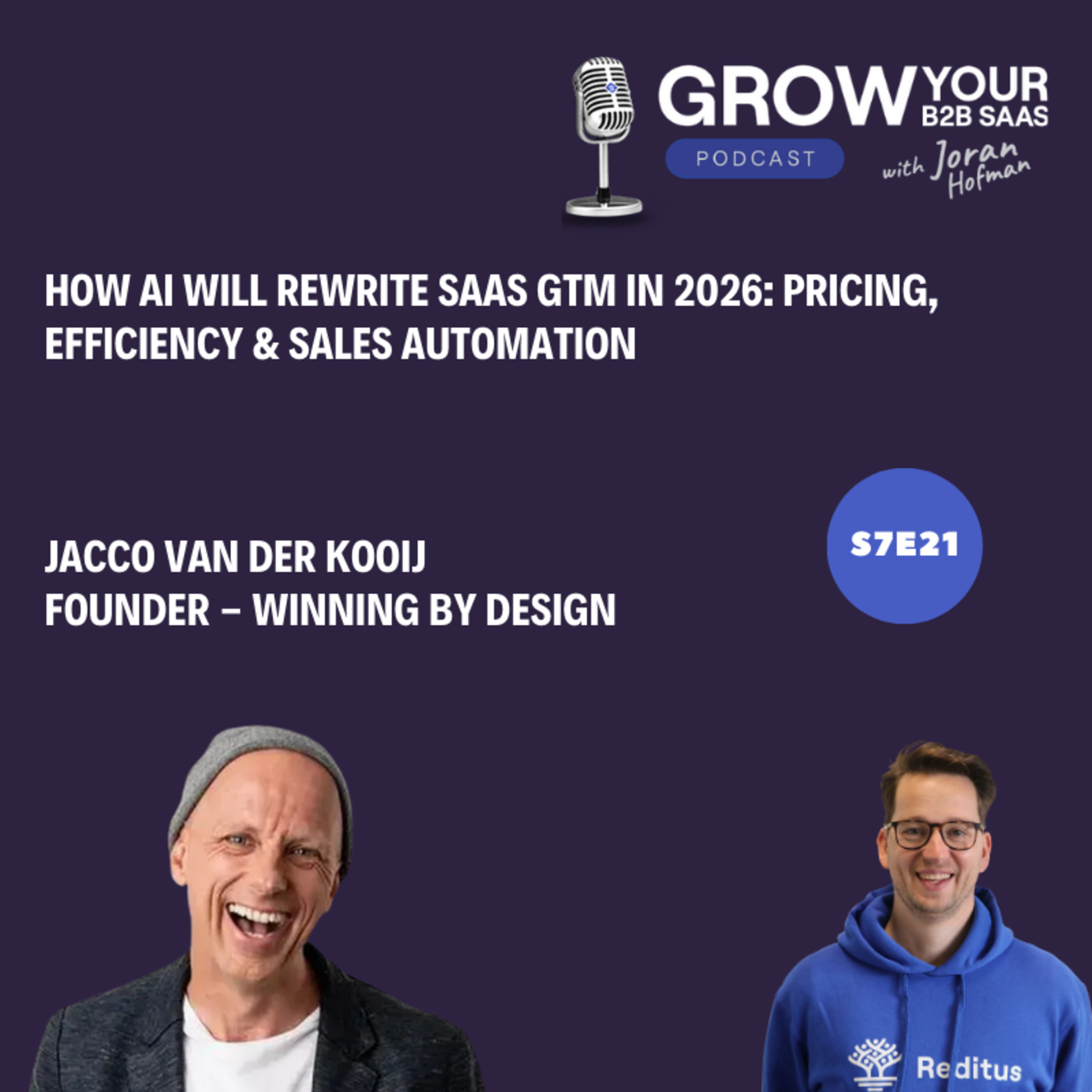
Joran Hofman: In episode 21 I interviewed Jakob van der Kooj on how AI will rewrite SaaS go to market in 2026. We talked about pricing, efficiency, uh, and sales automation.
Speaker S: Understand that the way your team operates amongst each other is a reflection of the closed loops. If the people on the team are not communicating with each other, if there's discrepancy, if marketing doesn't talk to the sales, if customer success is not part of the customer journey, and so on and so forth. An integral part, right? Not just show up on a meeting, but the way how your team operates is a reflection of how your system operates.
Joran Hofman: And is that then aligned to the goals you're going to set per team? Like how would you make sure that they will work together?
Speaker S: They need to make sure that they understand the system they operate. Most of the time they're not a common understanding of how the system operates. We think they know, but they're not. Um, it is, let me explain something like this. When you come out of school, but you never had professional running training, right? You would expect that every human being would run the same because it's a natural gift that we've been given.
Speaker R: It's not.
Speaker S: As a former runner, I can tell you running needs to be trained. You need to be learning on um, track how to rain, you need to learn form. We expect that everybody has received that training. Very few people have. And so who then says that they can interoperate with each other? They do not have a common understanding how recurring revenue works. Understanding recurring revenue is based on scientific principles. I can round up a thousand executives and I'll bet you that the lion's share, and I don't even want to embarrass the world that we live in, but the super large amount has a misperception of where growth comes from and how it works.
Joran Hofman: Thank you for watching this show of the Grow your B2B SaaS podcast. You made it till the end, so I think we can assume you like this content. If you did, uh, give us a thumbs up. Subscribe to the channel if you like this content. Feel free to reach out if you want to sponsor the show. If you have a specific guest in mind, if you have a specific topic you want us to cover, reach out to me on LinkedIn. More than happy to take a look at it. If you want to know more about Reddit, feel free to reach out as well. But for now, have a great day and good luck growing your B2B SaaS.
Other episodes covering the same guests and topics, from across The B2B Podcast Index.
 Adamma Ihemeson on Building Autonomous AI Systems You Can TrustBack on T-R-A-C-K · on HubSpot84 / 100
 III. Building a Sales Org - Jacco van der KooijSaaShimi · on Product-market fit78 / 100
 Mike Micucci: Tell the World Your StoryThe BreakLine Arena · on Salesforce77 / 100
 What It Really Takes to Go from Services to SaaSGo to Market Coffee Talks · on Net Revenue Retention (NRR)72 / 100
 Meta Ads: Leverage UCP and First-Party Data for Meta Ads Success with Yiqi Wu, AimerceKeep Optimising · on Shopify72 / 100
 The Trust-First Approach Behind Carter Eve Jewelry’s Rapid RiseeCommerce MasterPlan · on Shopify68 / 100
 S7E22 - How to grow your B2B SaaS to 10M ARR? Advice from 21 experts45 / 100
 S7E21 - How AI Will Rewrite SaaS GTM in 2026: Pricing, Efficiency & Sales Automation with Jacco van der Kooij67 / 100
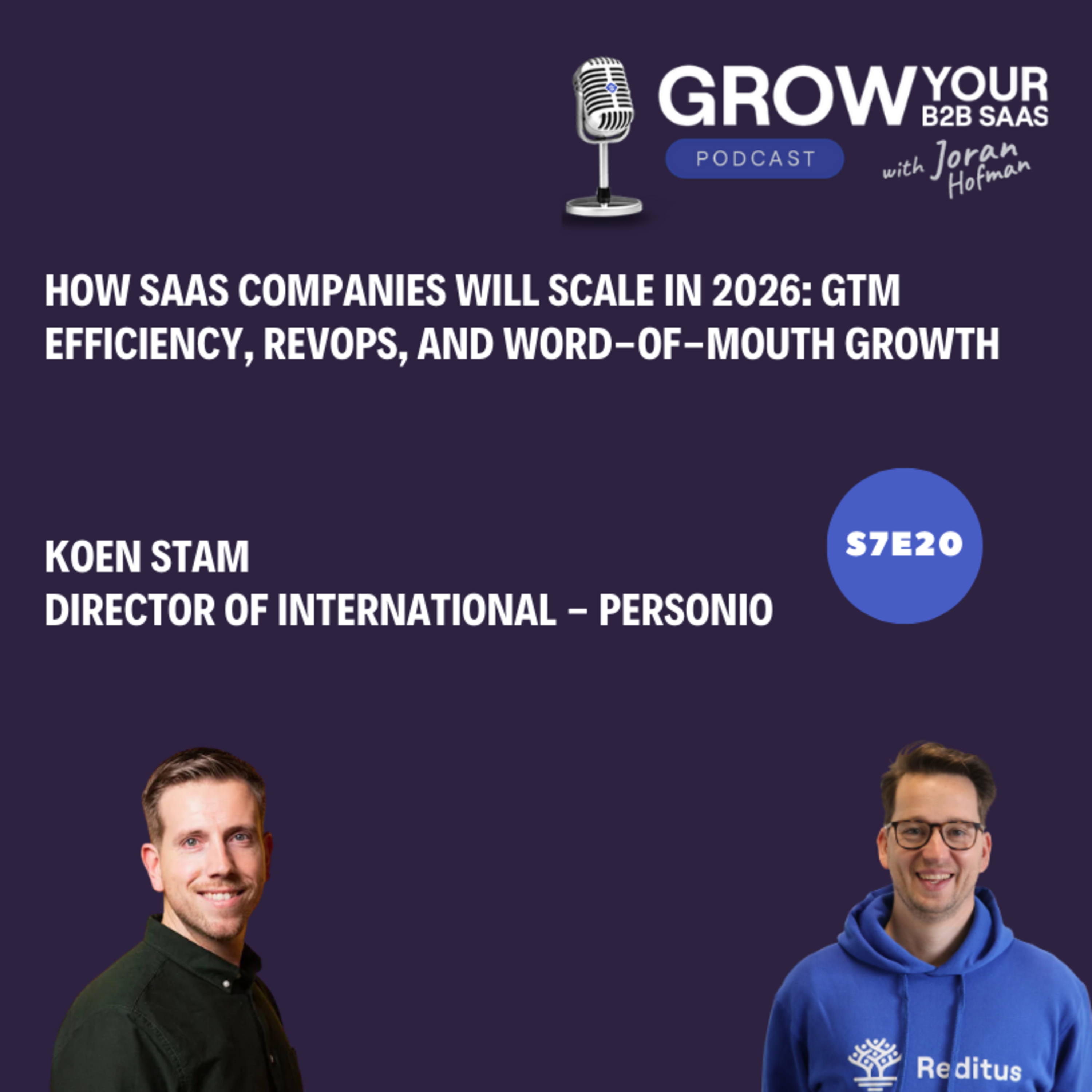 S7E20 - How SaaS Companies Will Scale in 2026: GTM Efficiency, RevOps, and Word-of-Mouth Growth with Koen Stam78 / 100
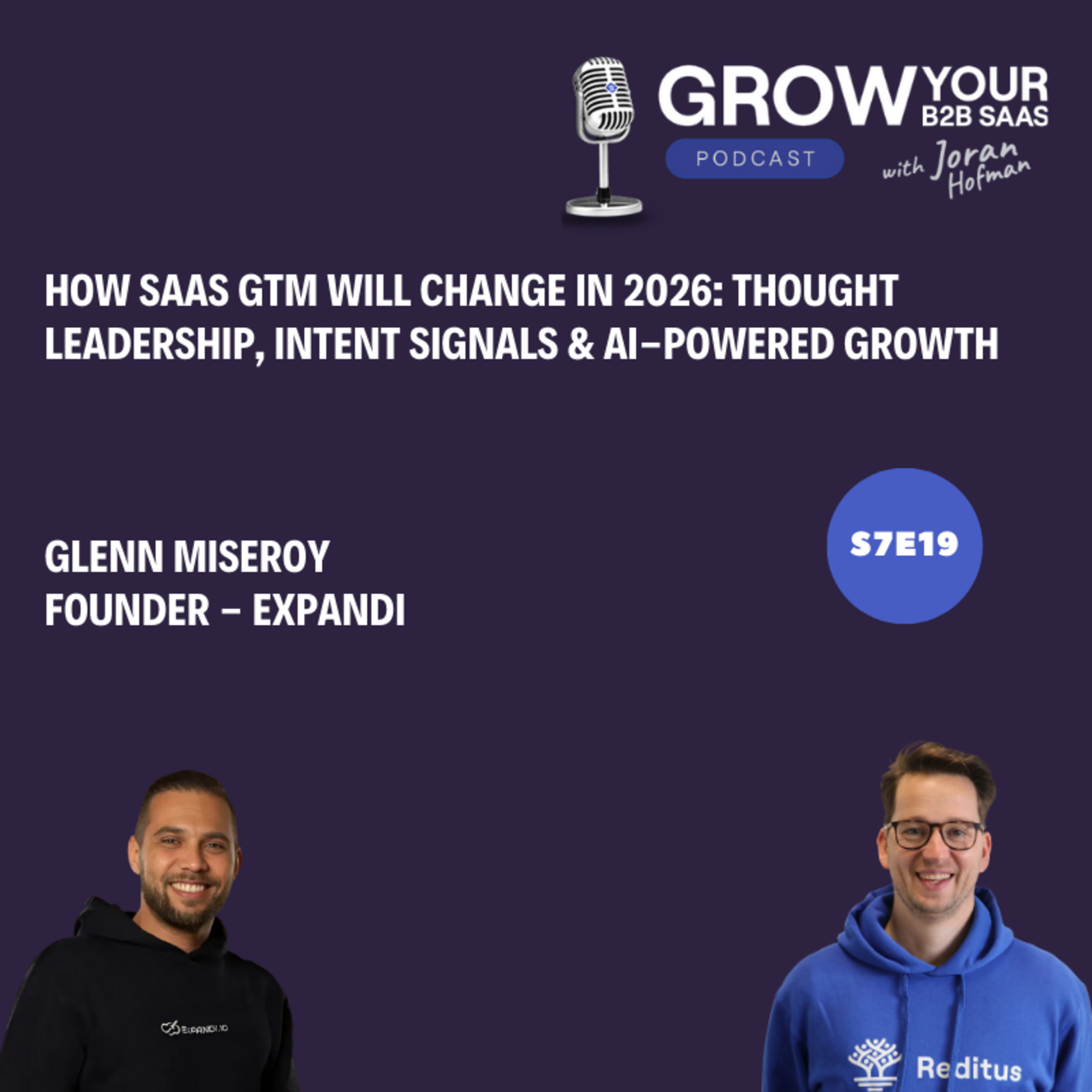 S7E19 - How SaaS GTM Will Change in 2026: Thought Leadership, Intent Signals & AI-Powered Growth with Glenn Miseroy78 / 100
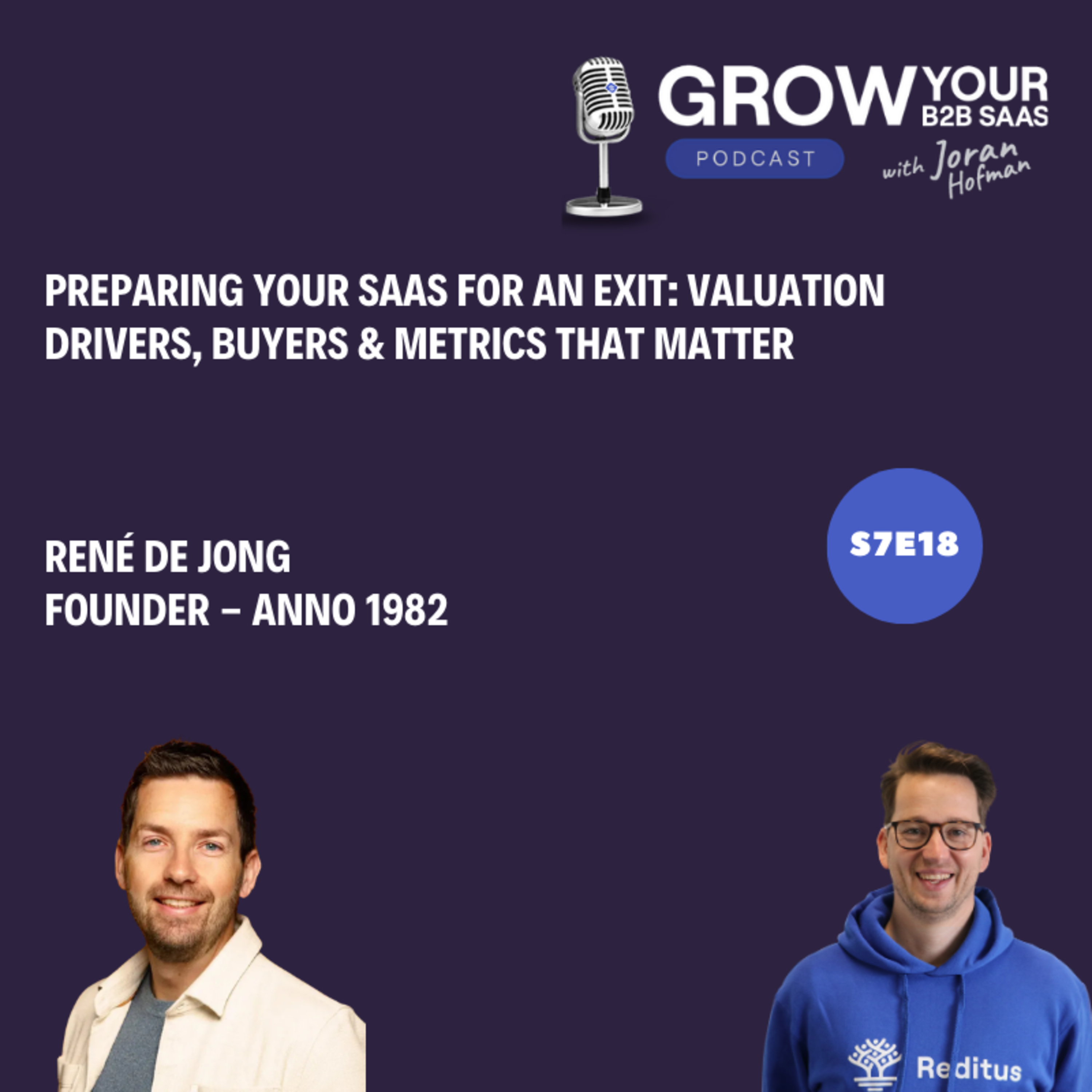 S7E18 - Preparing Your SaaS for an Exit: Valuation Drivers, Buyers & Metrics That Matter with René de Jong73 / 100