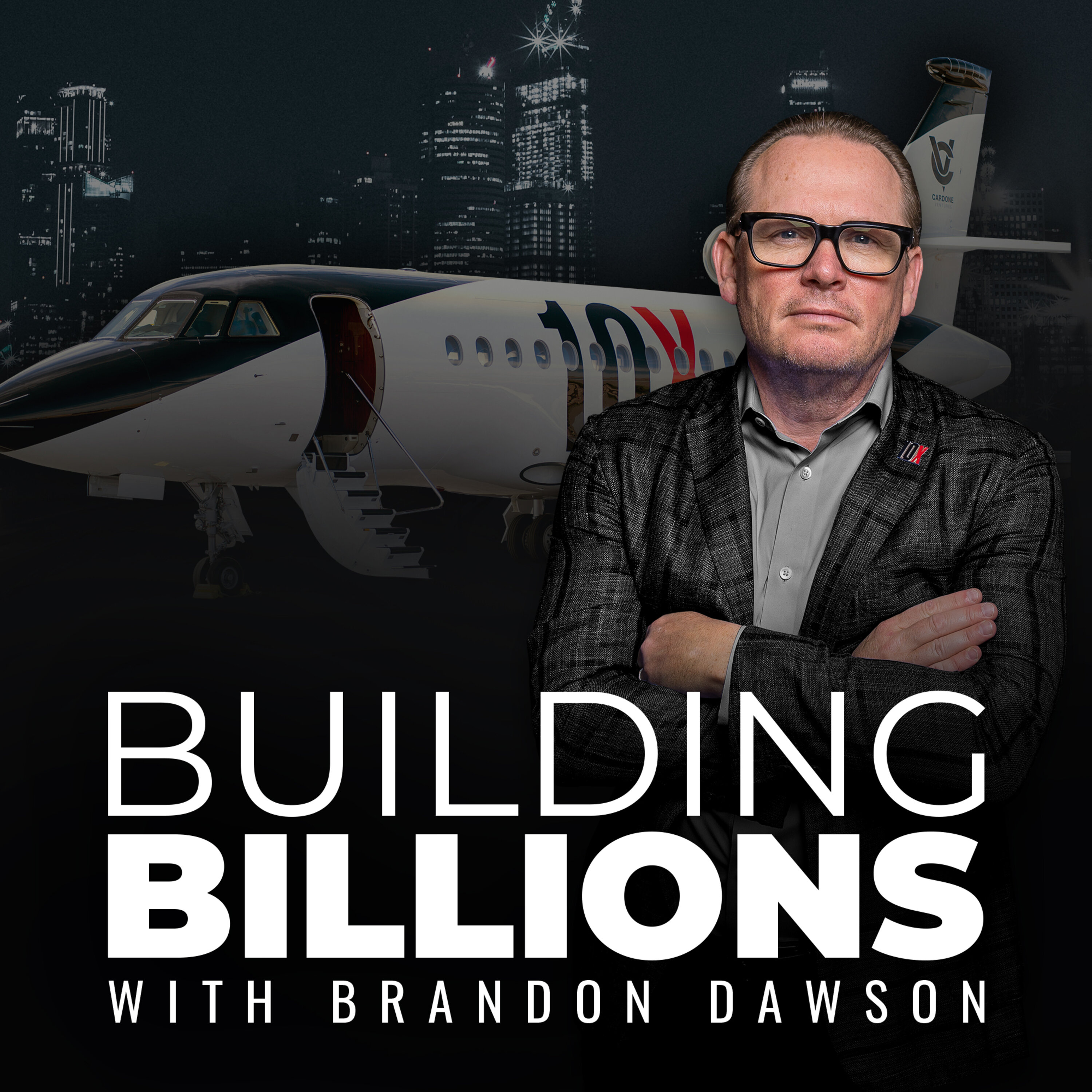
Building Billions with Brandon Dawson · 2026-06-29 · 13 min
Key moments - from our scoring
Substance score
28 / 100
Five dimensions, 20 points each
Most founders start businesses to escape constraints rather than pursue a vision, which Brandon Dawson identifies as the core reason 97% of businesses never exceed $3 million. The episode dissects the three phases of scaling: from $1M-$8M where founder leadership dominates, $8M-$45M where delegation and team development become critical, and $45M-$100M where culture drives results. Dawson emphasizes that the habits and people who built your initial business won't carry you forward - founders must embrace curiosity and awareness over intellectual arrogance, accept inevitable team departures, and resist seeking consensus on strategic decisions. He stresses the leadership skill required involves modeling what works, duplicating processes through others, and multiplying those efforts across teams simultaneously. The episode challenges listeners to examine whether they're "confused founders" who blame external factors or self-aware leaders who take ownership, positioning this mindset shift as the dividing line between the 3% who escape the ceiling and the 97% trapped below it.
Because they start businesses to escape constraints (no boss, no earnings limits) rather than to build enterprise value, and they lack the leadership capability and self-awareness to evolve from founder-driven operations to scalable, culture-driven organizations.
Scalable founders are vision-driven and own their results through curiosity and awareness, while stuck founders blame external factors, suffer from intellectual arrogance, and fail to develop the leadership capabilities required at each growth stage.
No - most people who start with you will depart or need to be replaced because they won't intentionally grow and scale to handle the new complexity and skill requirements at higher revenue levels.
Seeking consensus on strategic decisions, asking permission from lawyers or accountants, or trying to appeal to everybody rather than maintaining entrepreneurial intuition and decisive leadership.
Me leadership ($1M-$8M, founder-driven), we leadership ($8M-$45M, building and developing teams), and culture-driven organization ($45M-$100M, where aligned mission and values drive results).
Our reviewer’s read on each dimension, with quotes from the episode.
The episode offers a loose stage-gate framework (me→we→culture mapped to revenue bands of 1M - 8M, 8M - 25M, 45M - 100M) and a binary founder typology, but both ideas are presented at surface level with no actionable depth. The remaining runtime is motivational filler, self-promotion, and obvious advice ('if you're confused, everyone is confused').
that happens from 1 million to 8 million. It's all about you. You have to master the skill set because for the business to grow from 8 million to 25 million, that's to move from me leadership to we
The habits that got you to where you're at will not be the habits that get you to where the opportunity is
The 'blame yourself not others' and 'partnership danger' points are standard business-book fare, and the 'two types of founders' framing is a thin repackaging of common entrepreneurship content. There are no genuinely contrarian or first-principles arguments; the episode's closest attempt at fresh thinking - intellectual arrogance vs. awareness - is asserted but never developed.
There are two things. Trial and error. So it's how you attack the trial and error. And most people attack it with intellectual arrogance versus the two things you need to succeed. Awareness and curiosity.
trying to appeal to everybody. We'll wreck your business. You're going out of business trying to get consensus from the group.
This is a solo monologue by the host, who claims a credible operating background (multiple scaled exits, 25 years advising founders), but the transcript itself provides no verifiable specifics that would substantiate that caliber; credentials are asserted rather than demonstrated through the content.
I have multiple hundred million dollar businesses I've built. I've architected hundreds of them and worked with those founders over the last 25 years with top leading resources in the world.
I had to gain the intellectual wisdom to even be able to talk about this. Then I had to groove the wisdom into experience by actually doing it.
A handful of statistics are cited (9% of founders pass $1M, 36 million US small businesses, 2.5 - 3% past $3M) but without sourcing beyond 'our survey'; no named companies, real deal structures, client case studies, or dollar figures from actual businesses appear anywhere in the episode.
Only 9% of founders make it past 1 million in revenue, and that's out of 36 million small businesses in the United States.
Based on our survey, thousands of business owners and the continuous conversations we have asking business owners
The episode is an uninterrupted solo monologue with no interviewer, no guest, and no structured questioning; the final third devolves almost entirely into attacking competitors and soliciting social media engagement, adding no substantive value for a B2B operator.
I'm shooting in the car. Some of you will be saying, this guy's reckless. He's dangerous. I don't give a shit.
instead of having professional script writers tell me what I should talk about, why don't you just engage me on my social media and ask questions you want to have the answers to?
Computed from the transcript - who did the talking, and the words that came up most.
Everybody says they want to build a $100 million business, but very few are willing to become the leader it actually requires. In this episode of Building Billions, I break down the mindset shifts that separate founders who stay stuck from those who build real enterprise value. I share why most businesses stall at $3 million, how your personal leadership determines your company's ceiling, and why the habits that got you here won't get you where you want to go. I also dive into the hard realities of scaling, building a leadership team, making difficult people decisions, navigating partnerships, and avoiding the mistakes that destroy otherwise great businesses. If you're serious about growing from $1 million to $10 million, $10 million to $100 million, and beyond, this episode will challenge the way you think about leadership, ownership, and what it really takes to build a business that lasts. Support the show: See omnystudio.com/listener for privacy information.
Transcribed and scored by The B2B Podcast Index.
WEBVTT - S2 EP 28 The Brutal Truth About Why 97% of Business Owners Never Reach $100 Million Welcome to Building Billions. Building a 10 million, 100 million, billion or multi-billion dollar business is actually based on three things consistency, velocity, and results. I built, scaled, and exited and rebuilt many businesses in my career. If you're serious about creating something that has real enterprise value, stay tuned.
This is building billions with Brandon Dawson. Everybody says they want to build $100 million business, but very few will actually do what's required to build $100 million business. So you might ask why I'm shooting in the car. Some of you will be saying, this guy's reckless.
He's dangerous. I don't give a shit. It's to give you the confidence that I'm not reading a script. I have multiple hundred million dollar businesses I've built.
I've architected hundreds of them and worked with those founders over the last 25 years with top leading resources in the world. Most people start their business because they're good at something, because ultimately, the thing that got the business started won't be the thing that gets it from 3 million to 10 million to 25 million to 100 million. So first of all, think about this. Who starts a business?
It's not really a visionary. Based on our survey, thousands of business owners and the continuous conversations we have asking business owners, very few of them said they wanted to change the world. They wanted to impact their community. They wanted to risk everything they worked their whole life for, to create change.
So if that's not what they're saying, what are they saying? They're saying, I didn't want a boss. I didn't want to be told what to do. I didn't want a limitation on my earnings.
That is a entirely different type of founder than a founder who started a business because they saw a business opportunity where they could dominate, accelerate, create massive value, and understood strategically the elements that needed to be put in place in order to take that vision and turn it into a reality. So there's two types of founders, actually, those that started a business because of what they didn't want, and those that started a business because of what they do want.
So now you just need to ask yourself, what kind of founder are you? And that's the difference between the founder who builds $100 million business or the founder who's stuck. Only 9% of founders make it past 1 million in revenue, and that's out of 36 million small businesses in the United States. And then there's only two and a half, 3% of those founders that make it beyond 3 million, which means if you're under 100 million, 97% are stuck at 3 million or less.
So you can see the difference between the founders who started a business because of what they didn't want, and the founders who built a business because of what they do want. Because then if you want to be someone who builds a business based on what you do want, you need to do what the 3% did that made it beyond 3 million. Next, what's the number one impact of a business that succeeds and grows? And I say you.
And if you're stuck with 100% guarantee, the business is stuck. If you're confused, then you can rest assured everyone's confused. If you're struggling, I promise you everybody's struggling. If you feel you're failing, well, there's no chance anybody around you isn't failing.
So as long as you can be honest with you and you know who you are and where you stand and what's going on with you, you can choose to do something different if you're what I call a confused founder. You blame your people. You blame the market. You blame your suppliers.
You blame the opportunity. If you're a founder who's blaming everyone for why you can't succeed, you belong in a certain bucket with the failing founders. But if you're a founder who blames yourself, I don't know what I don't know. I can't do what I can't do, I can't see what I can't be.
You belong in a different bucket too, because here's a fact. The businesses that ultimately get to 100 million need two things our context and contrast. How are those two things imprinted on you as a founder? There are two things.
Trial and error. So it's how you attack the trial and error. And most people attack it with intellectual arrogance versus the two things you need to succeed. Awareness and curiosity.
The habits that got you to where you're at will not be the habits that get you to where the opportunity is. My first business, when things were struggling, when things weren't working, I had a bad habit of blaming other people, blaming the conditions, blaming the environment. I had a horrible habit of projecting outside of myself the ability to actually control the situation and get a different result. That's why on the intellectual spectrum, where I have mapped intellectual arrogance of those that fail, it starts and ends with you.
If you're the founder, you're the leader. Because in a nutshell, all follow the leader, maybe by title, but if it's not by influence, you cannot transform your business to 100 million. Because first it's me leadership. And second, it's we teaching your team to lead like you lead.
And then third, it becomes your culture. And that happens from 1 million to 8 million. It's all about you. You have to master the skill set because for the business to grow from 8 million to 25 million, that's to move from me leadership to we, you need to develop a core team around you that understands how to do that.
Use inspiration versus fear and anxiety, use words that create inspiration and ambition. And once you have a culture that's succeeding, something magical happens between 45 and 100 million. That's when your culture takes over and people in your organization are aligned with the mission, the vision, the values, the purposes, the success of the business. They're aligned with the outcomes.
So that leads us to the we part of the equation of growing, most likely the people who helped you start your business will not be the people that will be there with you when you're 100 million. And this is where the internal fortitude of leadership and strength comes from. And this is where your perspective has to change. So many founders get so concentrated on the few people they believe in, and they trust and feel are loyal, that they literally stop growing their company.
And this is the difference between those that know how to build and those that don't, because it's a natural fact that most of the people that you start your business with, that join you in the journey of building your business will depart you or need to be departed along the way. Because if your people aren't intentionally growing and scaling to learn to do the things they've never done before, and the more complexity you encounter as your business gets bigger, the more outsiders you're going to need who are going to identify that your people don't know what they're doing.
So you're going to have a new problem. When you move from me to we leadership, which is when to keep your we leadership and how to develop your leadership. How to hold that team accountable for growing in their leadership. So if you're serious about getting big, you're just going to have to accept the business will always follow the thinking of its leadership.
If you're the type of person where every decision has to be made by you, you won't go to 10 million. If you're the type of person who is the only one with an opinion in your organization, yeah, you're not going to get to ten, but you won't be there very long because businesses and the structural element of building a business requires the ability to identify and model what works. The ability to translate and transfer that through duplication so other people can mimic what works.
Then the ability to take all of that and multiply. Leadership and people to maximize the business opportunity without degrading the things that worked simultaneously, developing the new things that have to work through multiple people, doing multiple things at the same time to get the result that you used to get. But that's the skill set required to go from one to 10 to 100 and then to a billion. And here's even the best part.
I didn't know how to do any of this. My first business. Many people have developed the skill set. They've done it before you and there will be many more that will do it beyond you or even me.
I had to gain the intellectual wisdom to even be able to talk about this. Then I had to groove the wisdom into experience by actually doing it. And then people can trust that I know what I'm talking about because I've taught others to do it. And in the process of even teaching others to do it, I've learned so much more.
Output maximizes and amplifies input. Input becomes knowledge and wisdom for more output. That is a difference between an experienced, successful founder and those that fail, because that's how an experienced, successful founder talks versus the one that's always complaining about how hard it is and what the problems are. So what are you thinking about?
What are you talking about? What are you doing? And what are you known for? I bet you, if you asked yourself those four questions and you're honest with yourself, you'll understand the difference between why you're struggling versus those that succeed.
So let's just assume you actually are building your business and you bust through that 3 million to 8 million to 15 million, and now you've been able to get your finances organized. You have enough history, you have credibility, you have cash flow, you have some stabilized ability to demonstrate that you can be profitable and you start to bring on debt, or maybe you bring on a partner. Or maybe to be honest, you bring on an investor and you're feeling pretty good about things until maybe you have a slight misstep in your business or the economy has a slight downturn.
Trust me when I tell you this no matter how great partners seem. Partnerships change. I've helped partners go from having no wealth, only a dream, to being mega wealthy. They lie cheat because for some people, enough is never enough.
I've also had partners that have committed to do everything they need to do. Always be there, head down, work hard who once you have a little bit of success, they don't even show up, or they're on the golf course, or they want to spend more time traveling or with their family, or taking more days off or working from home, and they stop contributing altogether. Now, your partners partnerships are usually for small businesses, a leading cause of failure or breakups, nasty breakups, or their partnerships with husbands and wives who carry all their home bullshit into the business and good people eventually leave.
And now you're in trouble. Or you see the best opportunity in the history of your business to make a decision. And now you got to go ask. What do you think?
Do you think we should do it? You think we shouldn't do it? It's called pulling POLLING. In fact, I'll tell you, the businesses I see fail the fastest over the shortest period of time are the ones where the business owner no longer has the entrepreneurial intuition or flexibility to pivot or to change, trying to appeal to everybody.
We'll wreck your business. You're going out of business trying to get consensus from the group. You go out of business to have to go ask permission from your accountant, your lawyer, your spouse. All those are indications that you I'm talking to, you are going out of business.
And anybody that wants to shoot me a question on any of the comments of any of those channels, I invite you to do it. But you know what? Those other influencers, they sound very credible when you watch them on their YouTube channel or you see them in some of those people are hugely successful. But here's the thing.
Don't listen to the talking heads. Look at their results. Don't believe them because they tell you. Most of them are reading off a teleprompter and I don't need a teleprompter for me to give you recommendations.
I don't need someone writing scripts for me so I can sound smart in business. So look, instead of having professional script writers tell me what I should talk about, why don't you just engage me on my social media and ask questions you want to have the answers to? I'm more than happy between trips to with my camera team and my audio team, to literally just answer questions and talk directly to you. Because what I really care about is you.
The guidance, the advice, constructive criticism I give you will be based on my own reality, my own results, my own facts. I'll try to give you some wisdom, some information, some help, because that's what I'm committed to on my channel. But if you want to go from 0 to 1 million, 1 million to 10 million, a 10 million to 100 million, or 100 million to 1 billion, I'll keep it real with you. I promise not to waste your time.
Other episodes covering the same guests and topics, from across The B2B Podcast Index.
 Blake Modersitzki: Pelion VC, Venture Returns, AI, War Stories, Top Deals & ScaleStartup Ignition Podcast · on founder psychology88 / 100
 "Every Search is Highly Customized" - Camille Fetter of TalentfootLand and Lead · on Leadership transitions82 / 100
 Ignite VC: How Jeffrey Becker Bets on Founders Before Product, Revenue, or Traction | Ep280Ignite · on founder psychology71 / 100
 From Engineer to Executive: Learning People Skills the Hard WayThe Step UP · on Leadership transitions68 / 100
 Why Customer Retention Is the Most Valuable PE Growth StrategyDemand Revenue · on Enterprise value67 / 100
 Is Your Business Acting Its Age? Tina Dao on Escaping the Dependency TrapYour Next · on founder psychology64 / 100S2 EP 27 Building Billions with JD Ross: Inside the Playbook Behind Multi-Billion Dollar Companies79 / 100S2 EP 26 The $5 Trillion Opportunity Hiding in “Boring” Businesses75 / 100S2 EP 25 Inside the Arizona Attorney General Race: Law, Power, and Statewide Impact59 / 100S2 EP 24 Car Session: Pressure, Doubt, and the People Who Shape Your Outcome53 / 100S2 EP 23 The Business Builder Blueprint: Systems, Scale, and the $5 Trillion Opportunity with Ken Goodrich58 / 100