Transforming Medical Communications · 2026-05-12 · 20 min
Key moments - from our scoring
Substance score
33 / 100
Five dimensions, 20 points each
Medical communications teams routinely skip audience diagnosis and jump straight to content creation - a costly mistake that undermines relevance and engagement. Wesley Portegheese and Guy Atchison, audience strategy specialists at medcoms Experts, explain why understanding what your audience needs to hear (versus what you want to tell them) is the foundation for effective healthcare professional communications. They detail a rigorous diagnostic process that assembles field teams, MSLs, medical information staff, and insights analysts to build audience personas - typically three to six segments depending on stakeholder complexity. The methodology involves workshops where frontline teams surface their knowledge, medinfo data validates findings, and content is then tailored to specific audience hooks rather than generic messaging. Research shows 82% of physicians find pharma communications irrelevant; this diagnosis-first approach directly addresses that by ensuring content answers the unspoken question in an HCP's mind: "What's in it for me?" Medical directors, communication strategists, and compliance teams benefit from understanding how audience diagnosis integrates with scientific communication platforms and informs content efficacy assessments post-launch.
Teams often prioritize speed and urgency - publications are due or presentations are needed - so they begin content creation with only loose assumptions about their audience. Guy Atchison notes that diagnosis typically only happens during major strategic redefinitions or product launches, not as standard practice, even though the process is neither complex nor expensive.
The most valuable sources are field teams and MSLs who meet healthcare professionals daily, supplemented by medical information team inquiries (which reveal gaps, misconceptions, and shifts in HCP thinking), and any existing audience research. People in global or corporate roles should participate but are noted as bringing natural biases, so ground-level field perspectives are essential.
Three is the ideal standard, though the number can extend to four, five, or six depending on stakeholder complexity and market diversity. Atchison cautions against lumping minor segments into an undifferentiated "other" group; it's better to target fewer personas well than dilute messaging across too many.
The audience diagnosis reveals what the audience needs and wants to hear, while the scientific communication platform defines what the organization must communicate. Together, they determine which SCP elements to emphasize and how to tailor messaging; if field feedback shows SCP messaging isn't resonating, the diagnosis lens can prompt SCP re-evaluation.
The lightbulb moment occurs when participants realize there are two sides to the conversation - what the organization wants to tell versus what the audience wants to hear - and they begin putting themselves in the HCP's shoes to identify hooks that answer "What's in it for me?"
Our reviewer’s read on each dimension, with quotes from the episode.
The episode offers some process-level utility - the two-workshop model, using medinfo as a distinct insight stream, and linking audience diagnosis to the SCP - but the pace is slow and much of the runtime is occupied by general advice ('understand your audience before communicating') and conversational filler rather than dense, actionable insight.
the other people are also medinfo, this is a really wealthy, rich vein of insight there because they're getting the questions in and they're sort of thinking, well, how do we handle with those questions?
82% of physicians said that they're not satisfied with the communications of pharma simply because they don't feel it's actually relevant to them
The central argument - that communicators should understand their audience before creating content - is foundational communications advice recycled with a medical metaphor ('audience diagnosis'). There are no contrarian or first-principles arguments, and the 'measure twice, cut once' analogy is generic self-validation rather than fresh thinking.
what does my audience want to hear or need to hear versus what do I want to tell them? That's the moment when people say, oh, hang on. There are two sides to this conversation.
I'm back to the analogy that I couldn't think of earlier. But, you know, I do like to do some woodworking
Guy Atchison presents as a genuine practitioner who runs these workshops, and his commentary on workshop facilitation dynamics has a lived-in quality. However, this is effectively two colleagues from the same company promoting their own service; no independent seniority, scale of work, or notable credentials are established.
I am the pathologist in the process. So I take the samples, help you extract those and really understand your audience and, and also have that battery of tests at my fingertips
often the fascinating thing in these workshops I find is you've got people in the field who don't often spend a lot of time together
One concrete statistic is cited (the McKinsey 82% figure) and there is MedComms-specific vocabulary (MSLs, SCP, MOA, VIVA, phase two/three). However, no named client examples, no specific outcomes from past projects, and no dollar figures or timelines appear; the overall level of evidence remains illustrative rather than empirical.
82% of physicians said that they're not satisfied with the communications of pharma simply because they don't feel it's actually relevant to them
we've got our KOL leading tier one oncologists and then we've got our tier two oncologists or our community oncologists and then we've got perhaps academic researcher type for our third group
The host's questions are open-ended and function as prompts rather than genuine probes; there is no pushback on any claim, no follow-up that challenges the guest, and the host openly admits to not having prepared an analogy mid-episode. The conversation feels more like a structured sales conversation for the company's own service than an investigative interview.
I would love to hear some success stories. Something where maybe something unexpected happened
I was kind of thinking about an analogy, right. And I actually didn't come to one.
Computed from the transcript - who did the talking, and the words that came up most.
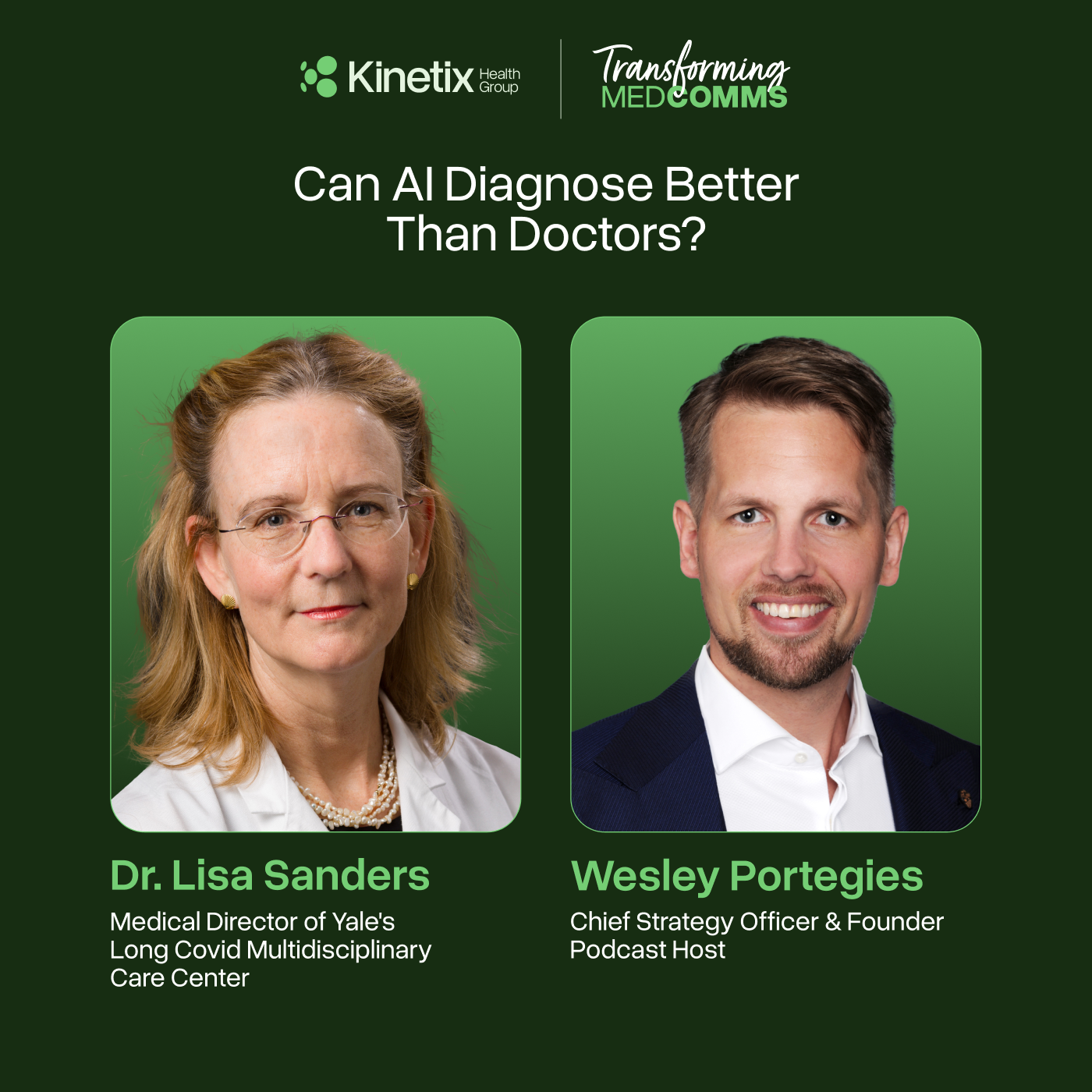
The most critical, yet often overlooked, first step in Medical Communications? Truly understanding your audience. In this episode of Transforming Medical Communications , Wesley Portegies is joined by Guy Atchison , Director of Medical Communications Strategy at MedComms Experts, to dive into the process of audience diagnosis. They discuss a structured workshop-driven approach that draws on the frontline knowledge of MSLs, MedInfo teams, and field managers to build detailed audience personas before any content is created. Guy Atchison is the Director of Medical Communication Strategy at MedComms Experts, recognized for his work championing innovative content formats and stakeholder alignment. His track record includes successfully navigating complex compliance reviews for facilitated storytelling decks, interactive platforms, and novel digital approaches. They’ll talk about: Why physicians feel pharma communications miss the mark on relevance How to assemble the right people and data streams to diagnose audience needs The ideal number of personas to aim for How audience diagnosis connects to scientific communications platforms Cut Through the Noise. Elevate Your Strategy.
Transcribed and scored by The B2B Podcast Index.
The thing that I really love seeing and the unexpected is when people grasp what does my audience want to hear or need to hear versus what do I want to tell them? That's the moment when people say, oh, hang on. There are two sides to this conversation. Welcome to Transforming Medical Communications, a podcast by medcom's experts.
We share medical communications insights and advice from the best and brightest in the industry to find out what they're doing to push our industry forward. Here's your host, Wesley Portegheese. Okay, so we're here today to talk about a really interesting topic. It's very close to my heart and it has to do with how do you understand your audience best?
And I have my colleague Guy Atchison here. Guy, want to quickly introduce yourself? Thanks, Wesley. In context here of audience diagnosis, I am the pathologist in the process.
So I take the samples, help you extract those and really understand your audience and, and also have that battery of tests at my fingertips to analyze them and give you the results you need to make informed decisions around your content. That's amazing. And I think you call that audience diagnosis, right? Yeah, yeah, we like to diagnose the audience.
So it's the first step, isn't it, a diagnosis? Well, I would agree with that, but still, I think there's many cases where, you know, as an industry, we start just communicating. Would you agree with that? Like, how mainstream is this in your view?
I think, yeah, we often stop and take stock only when it's a completely new term, new era. We're going to redefine the strategy, then we're going to have a workshop, we're going to sit down, we're going to bring everyone's thoughts into the room, we're going to work through it. But often the publication's coming out or we need the deck and okay, let's start putting pen to paper and just sticking content into there and getting it out. And we know who this is for.
So, so often clients. You say, well, it's for oncologists. They say, well, there are quite a lot of oncologists out there, so any particular ones you'd like to really target? And maybe we can differentiate a little bit between the differences within that audience, that larger audience group and get more fine tuned.
So I think it's applicable all the time. We should really start with a diagnosis and rarely do we have everything on file to inform that maybe you did an ordinance diagnosis six months ago and you're pretty confident that you can use the input from that for this. Fair enough. But I think once you get to a year later, well, let's go back and recheck because, you know, things might have evolved in that time.
I say might. Of course, they would have evolved. The landscape would have evolved. So you should re diagnose and you can do a lighter version at that point, but we should certainly be using the output of a diagnosis to inform our content development.
Yeah, I was kind of thinking about an analogy, right. And I actually didn't come to one. But like, I'm thinking about what is like something typical, a step that we skip against kind of better knowledge just because we want to get to the meat of the project. Right.
And that is often what this is somehow. And I think we generally underestimate how important this is. And it reminds me of a talk I gave at the DIA meeting last week, actually, and my talk was about how does the brain consume content? In other words, if you are a healthcare professional and you look at some content, what is going on in your brain that makes you engage with the content or disengage with the content?
And guess what? Like, it only takes like a few seconds for someone to make that decision. And one of the questions that is happening in your brain is actually not, what does this say? The first question to be answered is, is this relevant to me?
Right. And that relevance, that is what it is all about. And perhaps Someone remembers this McKinsey Digital Communications report where 82% of physicians said that they're not satisfied with the communications of pharma simply because they don't feel it's actually relevant to them. So this whole word relevance is so important to me.
And I think without really deeply understanding your audience and making sure that it is like, tailored to their needs, I would have a hard time understanding how they would probably answer that relevance question in their mind subconsciously in a positive manner. So, Guy, tell us a little bit more about how this works. How do you diagnose an audience you want to work through and consider those things to really, what is it your audience wants to hear, needs to hear, are struggling to understand.
And it's good to have a set of questions that you want to ask yourself. And do you have answers to those? Now, nobody's the single oracle. And the best people who can tell you about your audience are those who meet them every day in the field.
That is the key part here, is assembling those people. So we recommend doing that in a workshop format, keeping the load light for those people. So they just come along and they need to bring out from Their mind, what they know and recently experienced in terms of those audiences. And so those are MSLs in leading MSLs or kind of field team managers.
But the closest you can get, the people who are actually in the field, as soon as you take that step above and you go a layer away or a couple of layers away and you have somebody in global who says, oh yes, but I know the insights. And on they could bring an interesting perspective to that workshop and certainly perhaps be the catalyst that helps open up some of the discussions. But you're always diluting. Everybody has their natural biases and those people are bringing those into the picture at that stage.
So that's why it's absolutely key to have the people on the ground as well. And if you're creating content for different markets, we'll have people who talk to HCPs in different markets. You want to create content for the US and oh, we'll talk to some MSLs who talk to HVs in Europe. Well, it's probably not going to translate so well.
So having that spread across and the diversity as well, the other people are also medinfo, this is a really wealthy, rich vein of insight there because they're getting the questions in and they're sort of thinking, well, how do we handle with those questions? Are they getting a lot of questions on a topic? For example, mechanism of action? Well, why are those questions coming in?
And is it because the field teams don't have the content or is the content they have not resonating or have things shifted? And the audiences are coming with a different take because they've seen some competitor presentations that sort of shift in their mindset on how your MOA might be working. So assembling that group of people and really delving into their minds to pick apart the audiences, that is the key step. So what I'm hearing you say is a lot of this information is captured in people's brains.
So the people from the organization, they know a lot of these things. It just needs to be organized and basically pull out of their brain and put onto paper. But then also there is other data streams, like you said, medinfo. Right.
There are requests. While you were talking about that, I couldn't help but think about insight gathering as well. So what you're saying is let's take all these rich information streams and bring them all together to one combined output. Right.
But now you would need to make sense of that output. So tell me a little bit more about what happens next. Absolutely. I think even before we go to what's next having as many streams as possible, whatever's available, coming in as well.
And that's where I would come in and look at that together. And if I can look at that before the workshop, then you can use that as a validation sort of cross reference between the group as well. And often the fascinating thing in these workshops I find is you've got people in the field who don't often spend a lot of time together. Everybody's so busy, they might have few meetings in their kind of annual meetup, but they're often beavering away.
They're focusing on different territories, say. And you bring them into the workshop and the way they light up against each other or one of them says something and it triggers the next and the next and next and it just needs a little nudge now and again. But they start realizing, ah, yeah, but I've seen something similar, but I've seen something not quite the same. The way I see it is this also.
Then you can feed in from the med info insights and validate the picture there with the group as well to get that sort of hands on take on it as well. And already within the workshop you can start to drive towards, okay, well how do we make these insights applied for creating the content that we are going to tailor to our different audience groups, audience segments. But that needs a process and needs also this, of course, the rigor to go through it all as well to make sure you're doing it in a balanced manner as well.
And considering, okay, which audience groups are you talking to? Who do you maybe want to talk to that you're not yet. And how can you shift into that and what's the balance? As well, you might diagnose and come up with 4, 5, 6 audience segments, but actually 90% of your conversations are with one group.
Well, let's not design it for audience group 6, who you're not going to often see. Let's think about that. Or designing different pieces as well. So yeah, in terms of modular content, perhaps you're going to tailor some content and readapt it or add segments so that you can be able to speak to all of those different audiences.
I like that. So what would you say is the ideal number of. I guess we call them Personas. Three is always the magic number.
It often comes down to what's feasible as well. Often I see at the beginning people come out and it's easy to get the first two and then perhaps the third and maybe a fourth or a fifth. The risk often is that people sort of Have a couple of really clear ones and then a lot of people have some groups they speak to not so often and they start lumping them together and you get that slight dustbin effect where you're collecting everyone together and it's the other group and that's not great.
So rather say, okay, well let's take one of those that you want to target and have it there and move beyond. But I have seen some clients are really keen and really involved in the process as well. And it depends a little bit of how much time they're able to dedicate themselves to contributing some of the insights and populating the sheets to fill it in as well. So maybe you could go up to six groups A.
I think sometimes the landscape you're in can have an effect on the number of groups. So when you're in really multi stakeholder environments where you need to reach hcps in very many different fields, then you want to be branching out into more groups. When you're in more classical situations and you might be thinking, well, we've got our KOL leading tier one oncologists and then we've got our tier two oncologists or our community oncologists and then we've got perhaps academic researcher type for our third group.
So there is a fairly clear breakdown. But with certain therapies these days it's much more complex landscape. So you do want to be really considering your whole range of possible stakeholders. Yeah, that makes sense.
Is metcoms evolving faster than your team can keep up? You're not alone and you don't have to navigate it alone. Wesley Portegis, host of Transforming Medical Communications, is offering a limited Number of free 30 minute consultancy sessions for medical affairs professionals. Whether it's medical communications field medical or medical affairs training, these sessions provide an opportunity to address your real world challenges, pressure test ideas and walk away with practical strategic insight for your team.
No fluff, just strategy. Follow the on screen link or in the show notes to book your free session. Now you have led many of these audience diagnosis projects. I would love to hear some success stories.
Something where maybe something unexpected happened or people had insights they didn't realize were actually existing that helped shaping the communication strategy. The thing that I really love seeing and the unexpected is when people grasp what does my audience want to hear or need to hear versus what do I want to tell them. And you start sort of, yeah, go through the process and then they start coming and they start really putting themselves in their shoes and that's something that should always happen.
If the process goes well, that that's the moment when people say, oh, hang on, there are two sides to this conversation. And going back to your EIA example there, what is it? The audience are going to look at that content and think, what's in it for me? Not simply what does it tell me?
So if you can find that hook and then you can create your content with that within it, then MSLs are also able to engage on that level, the HTTP, taking that into account and build it in from there. So that's the point that always is a bit of a light bulb moment within the workshop. That's really cool. And it actually makes me think about another question for you, which is how does an audience diagnosis.
So imagine we go through this process, we have an audience diagnosis. How does it relate to, for instance, a scientific communications platform? Your audience time dosage should be balanced. So what do you want to communicate is built into your scp and then what does your audience want to hear that's coming from your audience diagnosis?
So of course there'll be elements of the audience doesn't understand, or if you have an innovative moa, then they haven't seen that before. You're first in class, that will be within your scp. So how you communicate about it. But think taking your audience diagnosis and then wanting to apply it, and then, okay, well, which elements from the SCP do we need to used to target a certain audience, but also never rejecting the output from the diagnosis.
If your field teams are telling you that certain things are not working or the landscape's shifted, then feeding that back in and that can feed into your SCP perhaps, and you can reevaluate whether your statements and your positioning there is going to resonate or is working and change it if needed. So that's very powerful. Right, because this means that the audience diagnosis is not only like a practical tool that you can use when you generate content, but it maybe also provides a kind of a lens you could look through so you can see things as if your audience is seeing it.
Right. Even though. So looking at your SAP through the lens of your audience diagnosis would maybe help you understand what part of the SAP would resonate really well or how potentially the messaging coming out of that would need to be tailored to make it resonate really well. Yeah, absolutely.
And often clients come, they have data phase three. So once created that, they've got the funding for the larger deck, the bigger communication piece. So we're going through the process of it and we're often leaning though on insights Gained from. Well, how receptive were they to the phase two content and how did that go down?
And that can then inform your future decisions there as well. So how receptive were they? Have they been understanding certain parts, the trial design or things were tricky that they need a little more explanation for? Those are the things they're really interested in.
And then that feeds in to you and that might also feed your statements and your positioning. The other thing that we often look at is then actually, okay, well, we've got these insights, but in the second workshop we always run two and then there's time between people to reflect and come. And in the second one, often we have a look and we do a little content diagnosis as well. So thinking about the audience needs.
Now let's have a look at the content and okay, what are the key pieces of content that have been used? Are they resonating? Well, if not, let's not kick out a winning team. So let's build on that.
But where can we improve? And then that's also sometimes the illuminating point. You bring that up on screen, you've got the whole team there and hopefully people are feeling honest and open and they'll share and say, yeah, that one never really works. So I've always struggled to present that.
I don't really know and. Oh, right, yeah, that's the key thing. The key message there is this, but that's not coming through as well. And that can really help inform what is it you're trying to communicate with that piece and then design the content accordingly as well.
So the form after functions or what is the aim of the piece and then the design of it should allow that aim to be achieved. Yeah, I like that. I like that. And I'm back to the analogy that I couldn't think of earlier.
But, you know, I do like to do some woodworking, right. When I have some spare time. And something they say in woodworking and construction, I would say in general is like measure twice, cut once. Right.
So you want to make sure you do your pre work in order to make sure the rest of the project actually is going to work out. And I feel an audience diagnosis is a little like that because it is actually not that much work. Right. Like we have a really good process for it that makes it a little bit more simple and overseeable.
It is also not that crazy expensive. Right. So why wouldn't you do it? And all the other things you're gonna do are building up on this and if you don't do this properly, all the other Things are at the very least a little bit less effective.
Right. While we're all looking to drive impact. So, yeah, I think it should become the standard of communicating that you first really understand your audience before communicating. I think it's so multipronged as well.
It has the core central aim of understanding the audience and the communication there, but you're also building a team together. You're bringing everyone on board. So when we've built our facilitator storytelling decks, that's quite a big shift if people haven't used those before. And there can be perhaps resistance to change of.
Well, hang on, I'm quite happy with my current deck. I've got learned how to use this new design and it's just not the same. But when they're involved right at the beginning and they realize, oh yeah, this is the tool and this is the first step in it, and they all came together at that step as well. And you start to build the momentum as well, and you get a great team together as well, and that can really help lubricate the project through the process.
So when you come up against any of those compliance hurdles, say when it's innovative content and you're getting some pushback from legal and compliance, or you can come back to your team together and they've connected as well, so they're willing to sort of speak up and champion for each other and when it comes out to the rollout and delivery. Because the saddest thing is that a piece gets approved in VIVA and never used. So is okay getting the team on board who were there at the beginning and they can see it through and they really can help inform the design as well and say, yeah, we designed this section here because you mentioned the need for the audience to understand the moa.
So we've built in some light animation. Is this going to work well? And you can pressure test it with them and then also they'll champion it with their field teams and explain. Okay, but this is really designed to target our needs, the things we're struggling with in the field where people are not engaging.
And this is it and this is why we've done it. And there's a rationale behind it. So getting it out there. And it's not just about content creation, it's the dissemination as well.
Yeah, that's a very good point. That's a very good point. Thanks for highlighting that. Well, a lot of fun talking about this topic with you and hopefully anyone listening to this podcast.
Hopefully there's a highlight from here that you can take and implement to help drive medical communications forward. And thank you for listening. Thank you Este. Transforming Medical Communications is brought to you by medcoms Experts.
To find out more about medcoms Experts and how we create some of the most cutting edge medical communications programs anywhere in the world, visit www.medcoms-experts.com and then make sure make sure to search for Transforming Medical Communications in Apple Podcasts, Spotify and Google Podcasts or anywhere else podcasts are found. Make sure to click subscribe so you don't miss any future episodes.
On behalf of the team here at medcoms Experts, thanks for listening.
Other episodes covering the same guests and topics, from across The B2B Podcast Index.
 The Creative Testing Gap: Why Most B2B & B2C Lead Gen Campaigns Fail to ScaleThe Revenue Room · on Persona development80 / 100
 Small But Mighty - What Lessons Can SMBs Teach Us About CX? | With Swanny HenryThe Strategic Marketing Show · on Persona development74 / 100
 Lessons on Leading Through Uncertainty in PharmaPharma Sessions · on Medical affairs73 / 100
 Claude Code Your Next Launch Like A Vivun PMMProduct Marketing Adventures · on Persona development68 / 100
 Why Traditional PR Is Now Your AI Secret Weapon with Rebecca Lombardo of Rebecca Lombardo AgencyThe Vacation Rental Show, Hosted by Lynell Gordon · on Persona development66 / 100
 No Boards Needed for 6 Amazing Nonclinical CareersPhysician NonClinical Careers with John Jurica · on Medical communications53 / 100