Transforming Medical Communications · 2026-07-14 · 42 min
Key moments - from our scoring
Substance score
63 / 100
Five dimensions, 20 points each
Medical affairs teams produce more scientific content than ever, yet clinicians struggle to find and engage with it. Amit Pool, an emergency medicine physician and digital health leader at Doximity, explains that the traditional 'build it and they will come' approach no longer works. The real barrier is reducing friction between content and time-strapped clinicians - most have fewer than 30 minutes daily for educational content, and those minutes are fragmented between patients. Pool emphasizes that clinicians are humans first, and successful medical communications must apply basic human behavioral principles: personalization (using demographic and behavioral data to filter relevant content), pertinence (connecting data to clinical practice and patient outcomes), and digestibility (leveraging formats like short-form video that align with how clinicians learn). The 'clip economy' - where long-form content gets chopped into one-to-two-minute segments - resonates far more powerfully than expecting physicians to sit through lengthy presentations. Pool connects this to medical education's 'see one, do one, teach one' principle, noting that deeper, more immersive media drives better recall and behavioral change. For medical affairs teams, the takeaway is abandoning binary thinking (either/or strategies) in favor of 'yes and' approaches: maintain comprehensive content libraries while optimizing distribution across multiple formats and channels tailored to individual clinician preferences and temporal constraints.
Clinicians are time-strapped professionals who avoid content that requires extra steps to access. The more friction between the clinician and the information - navigating to a new website, searching, logging in, parsing dense data - the fewer engage with it. Success requires removing those steps by delivering relevant, personalized content directly to platforms clinicians already use.
Data is essential but insufficient on its own. The most effective approach contextualizes data around patient outcomes and clinical practice, presents it in digestible formats (especially video), personalizes it to the individual clinician's specialty and interests, and tells a narrative rather than listing facts. This makes information actionable rather than just informative.
Short-form video content - one to two minutes long - dramatically outperforms longer formats, with completion rates and watch times orders of magnitude higher than typical internet video. Clinicians prefer consuming complex topics through a series of brief, focused clips over days rather than sitting through lengthy presentations.
Doximity uses demographic data (training location, specialty, patient population), content preference history, and inferred reading behavior to filter and personalize which content reaches each clinician. This means a specific physician sees only the subset of information relevant to their practice, dramatically increasing perceived value and engagement.
Clinicians learn through progressively deeper immersion and hands-on experience. Medical communications that layer information across multiple media formats (video, interactive, narrative) and encourage repeated, progressive engagement mirrors this learning model and drives better recall and behavior change than one-off content delivery.
Our reviewer’s read on each dimension, with quotes from the episode.
The episode contains solid, practitioner-grounded insights about clinician behavior and content distribution (e.g., the 83% statistic on available learning time, the 'see one, do one, teach one' framework applied to medical content, the clip economy concept). However, these insights are somewhat incremental rather than surprising - the core thesis that 'content distribution matters as much as creation' and 'format affects engagement' are established ideas in digital marketing, just applied to healthcare. There is considerable throat-clearing and repetition of the same points (personalization, relevance, digestibility) across multiple segments, which dilutes density.
83% of them reported that they have less than 30 minutes in any given day to actually engage with educational content
content without context, data without personalization, data just for data's sake, as a recipient of information, can often feel like work
The framing is sensible but not novel. The episode rehashes well-established digital marketing truisms (short-form video, personalization, understanding audience behavior, multi-channel distribution) without significant new frameworks or counterintuitive claims. The 'yes and' approach to binary thinking is a restatement of integrative strategy, not a fresh insight. The guest does not challenge conventional wisdom or present data-driven contrarian positions; instead, he reinforces widely-accepted best practices in health tech.
you should think about it as yes and right
it maps to how clinicians learn how to learn. Right. So in medical school, definitely in residency, there's this mantra that permeates medical education called see one, do one, teach one
Amit Pohl is a credible operator: he is a board-certified emergency medicine physician and Chief Clinical Experience Officer at Doximity, a real platform with 15+ years of data on clinician behavior and preferences. He speaks from direct experience building and scaling content distribution to healthcare professionals and has measurable insights from his user base. However, his primary role is as a platform executive selling distribution services rather than as an independent practitioner or researcher; there is inherent bias toward promoting Doximity's model.
I'm the chief clinical experience officer at Doximity, a professional network for medical professionals. Amit is a board certified emergency medicine physician
we have a lot of data on them as individuals. We know details about where they trained, what types of content preferences they have
The episode includes some concrete data points (83% have <30 minutes/day, 70-80% of online traffic is video, 'orders of magnitude higher' video completion rates on Doximity, one-two minute videos as optimal length) but lacks named examples of actual campaigns, client results, or competing platforms' performance. The discussion is largely abstract ('clinicians are humans,' 'personalization matters') without case studies showing before/after metrics, specific companies' results, or quantified improvements. Much of the evidence is anecdotal or internally sourced from Doximity without independent verification.
There are estimates out there that are about 70 to 80% of online traffic just writ large entails video content consumption
83% of them reported that they have less than 30 minutes in any given day to actually engage with educational content
The host asks reasonable open-ended questions and follows up with specific probes about audience understanding, channel strategy, and metrics. However, the conversation lacks sharp pushback or productive disagreement. The host largely affirms the guest's points ('Yeah, absolutely,' 'I couldn't agree more'), and there are no moments where the host challenges Pohl's framing or asks skeptical questions about potential downsides of platform-driven distribution or conflicts of interest. The discussion is collaborative but predictable, missing opportunities to stress-test ideas.
Yeah, absolutely. Absolutely. I actually interviewed a good friend of mine on this podcast, Dr. Drew proven
I couldn't agree more with you. There's a ton of opportunity.
Computed from the transcript - who did the talking, and the words that came up most.
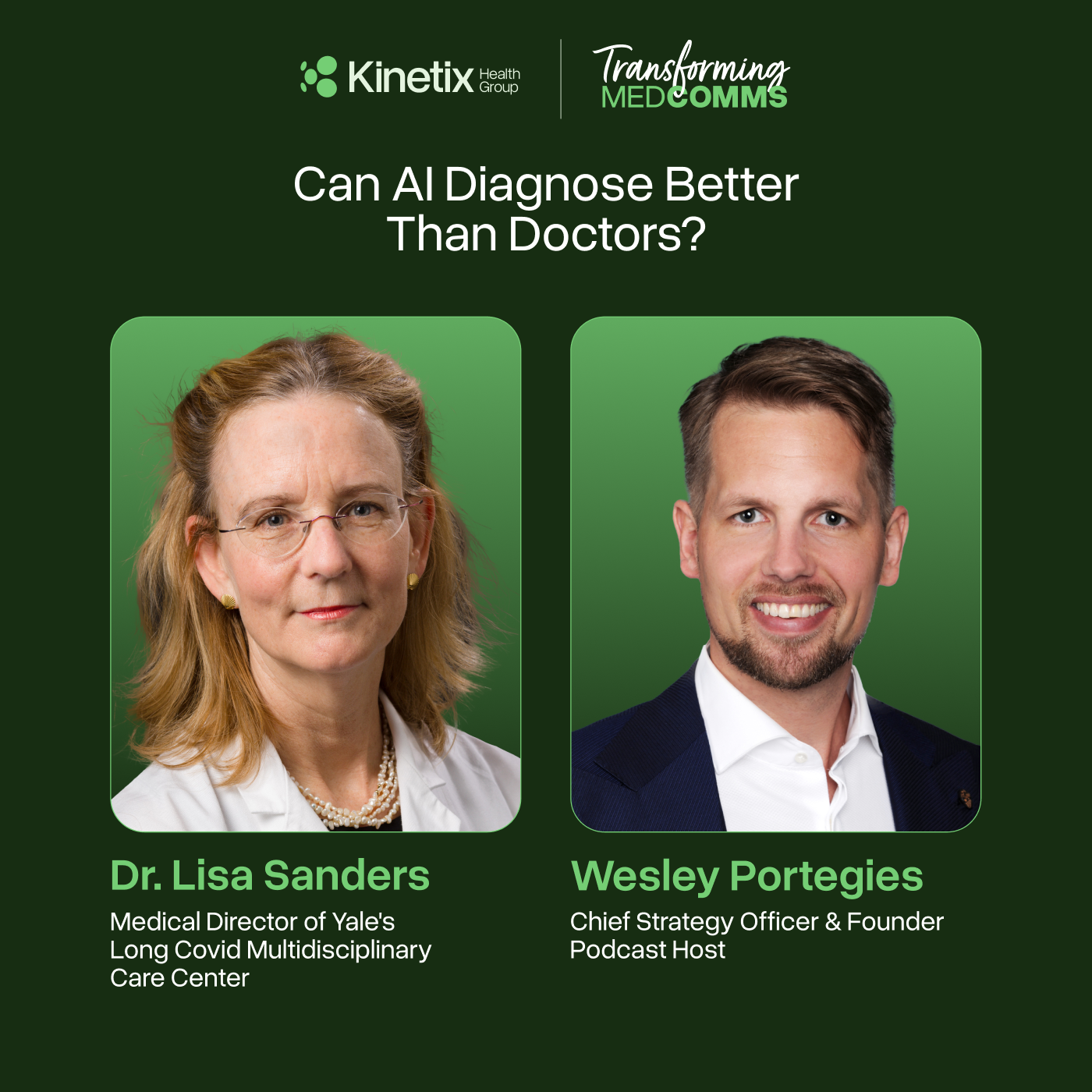
Medical Affairs teams are producing more scientific content than ever, yet clinicians often never see it. In this episode of Transforming Medical Communications , Wesley Portegies is joined by Amit Phull, Chief Clinical Experience Officer at Doximity, to discuss why the “build it and they will come” model no longer works. Amit Phull is the Chief Clinical Experience Officer at Doximity, a professional network for medical professionals. A board-certified emergency medicine physician and digital health leader, Amit bridges medicine, technology, and healthcare delivery. With vast expertise in clinician behavior and digital engagement, he brings 15+ years of experience helping organizations effectively communicate scientific content to busy healthcare professionals. We’ll talk about: What clinician behavior actually looks like in practice How Medical Affairs can rethink content strategy around personalization, video, and third-party platform partnerships. Data-backed insights on what drives real engagement on Doximity Why the most valuable science in the world means nothing if it never reaches the people who need it Cut Through the Noise. Elevate Your Strategy.
Transcribed and scored by The B2B Podcast Index.
Speaker A: Welcome to Transforming Medical Communications, a uh, podcast by medcom's experts. We share medical communications insights and advice from the best and brightest in the industry to find out what they're doing to push our industry forward. Here's your host, Wesley Portegheese.
Speaker B: Welcome to Transforming Medical Communications, the podcast where we explore bold ideas shaping the future of medical affairs. Medical affairs teams are creating more scientific content than ever. Websites, platforms, publications, portals, digital hubs and educational assets, you name it. But too often the problem is simple. Clinicians never find them. And the old assumption was if we build it, they will come. But in modern clinical practice, that no longer works. So the real challenge isn't just creating trusted content. It is really making sure that the content is discoverable, digestible and usable in the moments that clinicians actually need it. Today I'm joined by Amit uh Pool. He's the chief clinical experience officer at Doximity, a professional network for medical professionals. Amit is a board certified emergency medicine physician and a digital health leader working at the intersection of medicine, technology and healthcare delivery. In this episode, we'll explore how medical affairs can rethink digital reach and what clinician behavior tells us about content strategy. Amit, welcome to the show.
Speaker C: Thank you very much for having me. I'm excited to have this conversation today.
Speaker B: Amazing. Glad to have you here. Well, let's start with something that I would say almost every medical affairs team comes across at a certain point. They build maybe a scientific platform or a disease education site or any other asset for that matter, and then they actually find out that no one is really engaging with it. Why does that happen?
Speaker C: What we found is that it's not a problem that's unique even to medaffairs teams, necessarily. Any folks that are developing content that they're trying to get in front of this particular audience of individuals, clinicians who are strapped for time, who are on occasion frankly treading water to get through their clinical days. The number of steps that are required between that individual recipient of information to get to that information, if you will, is diminishing returns in terms of the more steps that are entailed in that process. So despite well intentioned teams developing rigorous content and making it available, actually getting in front of that clinician often, uh, is a stumbling point. And at deximity, what we've tried to do over the years is actually reduce as many of those steps or bridge that gap, if you will, leveraging what we know about this clinician audience, putting the right content in front of them at the right time. So as to remove the effort that's required to actually engage with content. That's when we ask our clinicians actually very useful content to their practices. It's just a matter of being additional work on occasion for them to get to it being core of the problem.
Speaker B: Yeah, absolutely. Uh, I can see that too from the discussions I'm having. I think there's a very like, binary mindset on like choosing how to reach your audience. Right. So first of all, the first step is there to build something, whatever resource it is. Then the realization comes in like, oh, well, it's probably a great resource, but how do we get more eyeballs on this? And then the choice comes like, okay, what are we going to do about it? And that's where the binary part comes in. Right? Because often they gravitate towards like one thing that could be done versus all the things that should be done. At least that's my view on it. Where platforms like your own, I think are like an excellent way to extend that reach. And there are some other ways as well. Right now I think another part is maybe also rooted in really understanding their audience well. And it's great. You're also like an emergency physician. So this is a question I could ask you too. Like, what do you feel Medical affairs sometimes misunderstands about the real life experience of a clinician and how their communications is maybe not always compatible with that?
Speaker C: Uh, yeah, that's a great question. And my colleagues, if they're listening to this conversation, will kind of laugh because I say this incessantly or repeatedly internally at Doximity. Part of my job, frankly, is to remind all of us that clinicians are humans too. So it stands to reason that some of the human behavioral tendencies that should be kept front of mind when we're developing content for and trying to engage other humans. We should also kind of extend those practices when we are dealing with specifically health care providers or clinicians. And what I see in terms of some of the content that on occasion makes its way to me, presumably from medical affairs teams, is that some of those kind of simple learnings are often skipped. Right? Like, we forget the humanity of the end recipient or consumer of the information. And don't get me wrong, I am an emergency medicine physician. I don't want to speak for my specialty insofar as not gravitating towards the hard science or reading medical publications all day. But what we hear at Doximity from clinical users is that any attempt we might make in terms of making that sort of content more digestible More palatable indexing for what it's worth on those kind of human elements that make anything compelling is better in terms of getting their engagement attention and then ultimately bringing them back to re engage even. And it's simple thing, Leslie, personalization, pertinence, taking something that's otherwise dry and ideally bringing it to life with some element of multimedia synthesis or summarization. Again, we're not only human, we're specifically very time strapped humans. So you could argue that some of those basic human elements actually go a lot further with clinical consumers of information. So we've experimented a ton over the years and learned a good bit in regards to what works and what doesn't. And I think in partnership with Metafairs teams and other folks who are trying to get content out in front of this particular audience of professionals, leveraging some of those learnings to make that content more engaging, it goes a really, really long way.
Speaker B: Mhm. No, absolutely. And that makes total sense to me, especially the personalization part. And I'm kind of laughing because I heard you say, well it's actually pretty simple, it's personalization. And I think, well actually that's also some of the hardest things we can do, right? To personalize content. And not just from a technical perspective. Right. AI and other technologies that really helped us to actually do that. But I think the perspective is also like understanding your audience first because you can only personalize if you understand the other side really well. I think most efforts to create content in medical communications starts with developing content. It doesn't often start with understanding your audience first, even when you already think you do that. Like strategic preparation work is I think often underestimated or taken for granted a little bit. And I think if we would spend a little bit more attention to doing that, we would probably come up with more relevant content. And that's exactly what you're saying, right? The emotive part as well, like we're talking to humans. But now when you work in pharma, um, it's all about the data. And we're really excited about it too. Right, Which I understand, it's like wow, you know, like you're working on a new therapy to be launched and you see all this data and you got the results back and it looks so promising. And of course if you're an MSL or you work in medical affairs in any other capacity, that's one of the most exciting things you can have. So obviously that's what you're going to communicate. But then we, I think we don't always transition to understanding that for the hcp, this just one part of their professional life. Right. It's not all about the data. The data is important, but it's ultimately about their patients. And patients are human beings as our ATPs. Right.
Speaker C: As you said, I mean, data, super important on both ends of the spectrum, super compelling even to drive engagement. But data without context, data without personalization, data just for data's sake, as a recipient of information, can often feel like work. Right. Like, it's just more information for me to digest, interpret, house somewhere, frankly, in my brain. And it's those elements of personalization and then being mindful, frankly, of how that information is presented that go a very, very long way in terms of making that learning experience a touch easier for the learner.
Speaker B: Yeah, absolutely. Absolutely. I actually interviewed a good friend of mine on this podcast, Dr. Drew proven he's a hematology Ql. And I asked him that question. It's like, hey, how do you experience MSL visits? And he, he said exactly that. He said, like, well, like, data is really interesting, but if I'm an academic and if someone comes to me with a bunch of data, but they can't really tell me why this is so good, then I'm kind of zoning out and losing my attention. So I know you have a lot of experience, of course, within Doximity, creating communication campaigns, reaching these HCPs. What are some ways how you can make content a little bit more emotive and resonating with the audience?
Speaker C: Yeah, as you mentioned, I mean, kind of leveraging data to that end goes a very long way. Right. One of the things that we have that has been a boon to our ability to engage our own clinician members is we have a ton of data on them as individuals. We know details about where they trained, what types of content preferences they have, what types of content matches best to their specialty expertise, their patient population, so on and so forth. And being able to filter through all of the information that might be pertinent to someone who happens to be a clinician and identify the specific bit of information that might be pertinent to me. Dr. Pohl here, who's an EM doctor practicing in the DC area, even that little bit of a bridge built on that data foundation is so impactful when it comes to actually capturing my attention and then, frankly, ultimately giving me something that's valuable to my practice. You can take it a step further beyond just kind, uh, of filtering down using demographic tidbits. That additional layer of personalization is possible by Inferring from other reading behavior that I've demonstrated and preferences that I've demonstrated in terms of the types of content that I consume, that adds kind of another layer. It's relevant, then it's personalized, and then I would go to the work element of it. We've seen a tremendous amount of success with video. A lot of folks outside of the healthcare space are familiar with the concept of the clip economy, where there might be long form piece of information, but most people are actually consuming that information some way or another via video. There are estimates out there that are about 70 to 80% of online traffic just writ large entails video content consumption. And it's that media that is actually growing at a rate that far outstrips any engagement growth that we've seen in prior years. Leveraging that in a way to actually communicate. Medical science, I would say, is probably something that's relatively new to most folks as a concept, but we've seen a tremendous amount of success where we have average rates of video completion, average watch times that are orders of magnitude higher than what you would expect from your typical kind, um, of Internet video. Because again, it takes interesting and pertinent information and it makes it going down that waterfall relevant, personalized and digestible. And if you can accomplish all three of those things, you can actually take what Otherwise it sounds like your hematologist colleague was telling you something that's on one end potentially overwhelming just in terms of the amount of information. And it doesn't have kind of that narrative stickiness for him to even recall it after engaging with an msl. If you can go down the waterfall that I just described, it can not only communicate that information, but communicate it in a way that's relatable and frankly rememberable and actionable. So that's the end point. It's not just distributing in the direction. So I can say, hey, doctor, pull engaged. That's great to know and frankly that's good to celebrate, uh, even as a metric of partial success at the very least. But the actual point here is for me to leave that engagement having learned something and then ideally downstream, potentially doing something differently as a result of that learning. So following that waterfall and really investing in translating, if you will, medical science to the types of medium that clinicians like myself have expressed interest in and have, uh, frankly, the time to engage with it goes a tremendously long way to really change how we interface with medical literature and kind of the data and the science therein.
Speaker B: Yeah, this is really interesting. While you were saying this, I Was kind of thinking about how this is related, right? Because one part is the format, so video works well. The other part is saying about, hey, it needs to be pertinent, relatable, you know, hit also maybe on a more emotive level. And if you think about it, 80% of our communications that we perceive is non verbal, right. It's like it's about body language and so on. So I think these things are related because video can make it more human. Right? Because you have that visual channel which is quite different than reading a transcript or even, you know, I would say listening to a podcast, perhaps the people listening to this podcast that only have audio have a different experience than the one seeing video, even though it's just us talking here on video. Right. So I think those are really related to each other. And yeah, there's a reason that platforms like YouTube are absolutely booming. It's just a more suitable way of communicating with each other. And I guess nowadays with a lot of people working through teams and zoom and having video calls FaceTime, right. It becomes kind of the normal. So I think that's a really interesting takeaway for sure.
Speaker C: Specifically for medaffairs teams, I would just add that it maps to how clinicians learn how to learn. Right. So in medical school, definitely in residency, there's this mantra that permeates medical education called see one, do one, teach one. Right. And though it doesn't map exactly to read, listen, watch, kind of the deeper immersion that both of those paths follow, I think is indicative of how we're accustomed to learning as clinicians. And the deeper that we can get, the more information is going to resonate with us in a way that might actually drive recall. And then ultimately recall is a foundation to advancing our knowledge base and enhancing our practice. So we use that a lot in internally at Doximity when we think about how to even layer messages upon one another, because it's never a one size fits all solution. Part of being personalized is actually personalizing the media itself to the preferences of a given user. But frankly, even those preferences change given the time that you might catch that user. Right. We have stats on our side where we surveyed our user base and 83% of them reported that they have less than 30 minutes in any given day to actually engage with educational content. That means this window is tight. So I need to not only know who you are, I need to not only know what message it is that you're in need of receiving from me, but also how you would like to receive that message. And Then I need to fit all of that into that very small window, acknowledging, of course, that I'm not the only one who's trying to actually get your attention during that very small window of time. So this concept of not only layering media on top of one another, but ideally optimizing for these very impactful moments, frankly, that you have where you captured my attention, it goes a really, really long way. So, yeah, that see one, do one, teach one mantra is kind of in the background constantly when we were thinking about how to engage clinicians on our platform. And deeper and more immersive that you can get, the better you're going to be, frankly, at engaging those clinicians.
Speaker B: Yeah, absolutely. And it makes me think about the good old elevator pitch. Right. And I know we're not selling here, but that's kind of how it is. Because those 30 minutes that you were stating from your research, that doesn't mean a, uh, physician is sitting down for 30 minutes continuously. You know, this is more. Real life is more like, hey, there's five minutes in between two patients. And let's quickly look something up because the last patient had a question. I was actually wondering more about it. I want to get to the data of that or something like that, which means they have minutes. And this brings us a little bit to the preferences that they have when it comes to length of content. Where of course, we have already shifted towards this like short form content. But I think nowadays what we call it short form is now long form. Right. And when we spoke some time ago, you mentioned this thing about the clip economy. Maybe you can tell everyone a little more about it, but I thought it was really interesting.
Speaker C: Yeah. So outside of human healthcare, just more broadly, when you observe trends or changes in how humans are consuming content, there has been a dramatic pivot, as we discussed, towards video. But even within video, there has been this shortening phenomenon that's happened over the course of the last several years. Even long form video, let's say a podcast like this one, most podcasts out there that have large audiences, they actually engage those audiences not by always presenting them the entirety of the content that they recorded. It's not about the two and a half hour interview on topic X or topic Y, it's actually being consumed by most folks in these short clips about subtopics. So if you were to map that to a medical use case, what we've seen the greatest amount of success with is being able to distill perhaps a more involved clinical subject matter into, uh, one minute, if not even slightly Shorter than one minute digestible video clips that really hammer in on specific messages or topics within that subject matter. So when we do that with clients and partners, or even if it's Doximity authored content, we see significant increase in video completion rates and average watch times. If there's a beginning, middle and end in that short of a time span, and a clinician having given us that minute of the 30 that they might have available that day for learning, those individual engagements wind up actually being quite powerful. And if you can string a few of those together over the course of a handful of days or over subsequent consumption downstream, that is typically how folks have demonstrated a preference for learning these days. I will often joke I'm not that old, but I don't recall seeing a colleague of mine sit down with a journal, right, and go into like study mode, if you will, when they have however much time it might take to even consume the entirety of a single journal article. But we have seen, and now we have reams of data on the Doximity end of hundreds of thousands of clinicians consuming these one minute, two minute videos and therefore advancing their understanding on complex topics. But kind of one time boxed engagement at a time.
Speaker B: Yeah, I like how you used our podcast here to kind of demonstrate this. And it prompted me to maybe explain what we're doing because I'm a big fan of practicing what we preach, right. So we're sending this message also to our audience, to our clients, the medical affairs teams, and try to help them getting these more effective medical communications strategies in place. So what we do with our podcast, we have the full recording here, which we try to keep as short as possible. And then we cut this into many different sections. There may be 30 seconds and those will go on YouTube, on LinkedIn. And what we have seen in the metrics is that those are consumed most. So this recording is very important. And there is going to be a group of people that are going to listen to this from the first to the last second, and then there's gonna be a group that maybe listens to have. But then there's the large majority who will just gravitate to those exact clips. And the reason for that is that the clip is exactly answering what they're wondering about. And I think we all became, as humans so efficient with our time that we really don't wanna listen to 30 minutes to hear the 30 seconds that we need. And the same is true for everyone in every industry. So I think one doesn't replace the other. We need our manuscripts, we need our body of scientific knowledge. But then how we then take that and do things with it that make more sense for our audience, I think is really the trick.
Speaker C: Yeah, I mean going back to the concept that you introduced a few moments ago, this concept of like binary thinking, what we'll often advise folks when they're trying to engage clinicians with content is not to think about it as either or, but you should think about it as yes and right. So have this wealth of content. Have the Kol, uh, video, Even if it's 40 minutes long, that doesn't mean it's not of value. How you leverage that though, by chopping it up into pieces or chapterizing it or presenting it in the appropriate context or making it clippable, that goes a really, really long way, as you said, in terms of actually permitting different styles of learners that have different pockets of availability to access this very valuable information. I think the binary thought processes maybe of days past where the expectation was someone like myself to sit down and watch, I don't know, 35 or 40 minutes of a video, as important as the content of that video might be, I mean that's more of a time commitment frankly, than me watching a television show or half of a movie even. And like that's pretty substantial and we need to not lose sight of that. So I could not possibly agree more. The approach that you're taking with your pod is the advice that we would give Metafairs teams to think about this as being somewhat analogous to that. You want to permit all sorts of learning and frankly you want to over index on the learning that seems to be where the puck is headed these days in terms of these short snippets being where you actually can capture and maintain people's attention.
Speaker B: Mhm, absolutely.
Speaker A: Is medcoms evolving faster than your team can keep up? You're not alone and you don't have to navigate it alone. Wesley Portiges, host of Transforming Medical Communications, is offering a limited Number of free 30 minute consultancy sessions for medical affairs professionals. Whether it's medical communications, field medical or medical affairs training, these sessions provide an opportunity to address your real world challenges, pressure test ideas and walk away with practical strategic insight for your team. No fluff, just strategy. Follow the on screen link or in the show notes to book your first free session. Now.
Speaker B: Uh, I think another thing that really feeds into this discussion is if you look at the average medical affairs function without making this a jab, they're kind of a little behind when it comes to channels and reach. Right. So I think they're really good at making content. Now can we make that content a little different and can we slice this up in different ways to make it a little more engaging and all of that, or maybe way more engaging even? Yeah, absolutely we can. But if you think about it, their core capability is creating communications that then need to find their way to the physicians. But like what channels do they really have that they own? Right. And that they have access to? So they have field medical, which is an amazing channel. It's probably the most powerful one. However, the scale is limited. Right. Like digital is so good at scaling beyond that, because you could possibly never achieve that with even if you have 40msls is not going to cut it. Right. So how do you deal with that? Ah, then there's the conferences that those are probably on shared first place together with the field medical team. Extremely powerful. But those are only at certain moments in time and there's only so many that are relevant to what you're doing. So it's not a limitless pool of information and contact either. I think that's kind of where platforms like Doximity comes in as well as other third party platforms and social media. I'm wondering me saying that how you would respond to that statement and how you would describe that third party platforms fit into the medical affairs ecosystem.
Speaker C: Yeah, that's a great question. So I think hearing the stem of what you're asking, the word that stuck out to me was communication. Right. And without being pedantic about it, going back to this concept of forgetting that clinicians are even humans, we often leverage terminology without really thinking about what some of these words mean. Right. Like I don't have the dictionary open in front of me, but just kind of roughly what I recall as the definition of the word communication actually entails within it this concept of exchanging information. Right. So if you're just sending information or developing information, that's not communication. That information has to subsequently be received. And to me that's like a very important construct and certainly how we frame our approach at Doximity. And to answer your specific question about how platforms like Doximity play a role when it comes to the communication of medical information or medical affairs content, I think it's because we permit that actual exchange. Right. You mentioned many of your listeners met affairs teams across the country. They're particularly expert in the science, they're particularly expert in crafting the message. And often that message winds up somewhere where it's not being seen or it's not being received. And that's what I think is the issue. They stopped short of truly accomplishing communication because that well crafted, well researched message is often sent but not engaged with. What we can offer in partnership with Metafair's teams is a good bit of experience over these past 15 years and some change and actually taking care of the receiving end of that equation, if you will. We have a lot of folks who are leveraging our platform. I'm sure there are other third party platforms as well. I mean you alluded to kind of the general population platform of like YouTube being very good at actually ensuring that information is received by the end user. On Doximity, we can utilize our reach as well as multiple engaging properties that we have built into our ecosystem to ensure that when that well crafted metaphors message is actually developed and provided to us, that that exchange can actually take place. Right. Like we can place it within our ecosystem in front of the intended audience when they're in a medical mindset, often when they're actually practicing medicine. And that goes a very, very long way, I think, to close the loop. So yeah, I wind up personally and then I think by extension as an organization, we collectively, we harp on these words because I think they're important. Creation of content is not enough. And I think from my perspective, conversations with meta fairs teams throughout the country, they're aware of that. They actually are open to embracing net new approaches and are hungry to embrace new technology to really get that other side of the equation better managed. Right. They know that they're sitting on very valuable information. It's just a matter of the paradigm having shifted away from traditionally how they were to present that information to the users, which requires work, frankly from the user ad to seek it out often to log in somewhere and actually find out what it is or proactively ask for it. That can and should continue to exist. But it is necessary and insufficient. Right. We need to augment that with third party platforms like our own, where we can actually take that very valuable information and thoughtfully present it to these users while they're in the mindset to actually engage with it and receive that communication.
Speaker B: Yeah, yeah, absolutely. I couldn't agree more. Something that we are often explaining when uh, we talk about these subjects is once you for instance, build like a digital platform as a medical affairs team, you are now competing with publishers or news outlets or whichever, like where the goal is communicating, right. Which obviously is not like something that pharma, uh, in general was designed for. And that's why partners like yourself are going to be so important right now. My Question to you is, what would be the most efficient way of leveraging platforms like Doximity to bring an audience to their platform? Right. Because again, this is not a binary choice. I don't think it's bad to make a platform. I think it's amazing and I think it's really important. Every part in this ecosystem has a role and I think it's beautiful if they have an owns platform where they can communicate their most important science. But then we have the extended reach that comes through platforms like Doximity and other third party platforms and social media for that matter, that ultimately should help them of a gaining audience to their own platform. Right. But of course, like posting something on social media and giving the clue all the way there, that probably doesn't really work well to do so. So if I were a prospective client and I would ask you about this, like, hey, Amit, I have this platform, I want to generate a larger visitor base. How could you help me? What would your answer be?
Speaker C: So there's a couple things I think that can be done there, up to and including reframing what it is that success looks like. So when you're trying to communicate information, particularly to this audience, busy healthcare professionals, I think we should discuss when partnering on that endeavor, whether or not consuming that bit of information here versus there matters as much. Right. So if you view Doximity as an endpoint in a communication strategy, Doximity has certain elements to it that make it very different than YouTube, that make it very different than certainly a TikTok or uh, you mentioned social media, so just kind of like rattling off kind of social media properties. You have to think about what it is that you're trying to accomplish in terms of driving engagement with your intended audience. Singular measurement of website visitations is probably insufficient if we're being honest about accomplishing that objective. As you said, it certainly can and potentially should be a part of that. But if your same content that sits on your web server at uh, your team's web address is not engaged with by Dr. Pull here, but a distilled video asset that communicates that same information is, and it's mappable to that individual, and you can attribute downstream closure of a, uh, clinical care gap or some demonstration of acquired knowledge to that engagement, I would argue that you have the capacity then to really broaden our thinking as to what good looks like. So what we will typically advise is not necessarily framing success as being more visitors to X versus Y versus Z, but really downstream of all of that, something that's measurable together that X, Y or Z, or maybe X and Y and Z all happened. And now what we're seeing is some actual change in diagnostic understanding, some actual change in a practice pattern, some actual feedback from that user that they now know something that they did not know prior to this endeavor being embarked upon. So, yeah, I think it's equal parts reframing how we measure what good looks like. And then again, as we started off a few moments ago, just being open to the fact that different people today learn differently than one another. And certainly the lot of us learn a good bit differently than we did just a few years ago. So staying ahead of that curve while being able to cater to a diverse population within your intended audience, both of those things are critically important in order for actual communication to take place.
Speaker B: Yeah, absolutely. Yeah. So, two things I heard I would like to respond to here. One is like the metrics part, and I would agree with you, like, looking at site visitors on its own doesn't really mean much. I think though that, uh, there is a role for these digital metrics because I think there's a lot of discussions in the industry right now. It's like, well, that's just activity matter metrics. Uh, no one cares, you know, that's not important. We shouldn't look at that too much. Let's look at how behavior was changed or these kind of things, which are extremely hard to measure. And even if you can measure it, the causality is really hard to prove. So I actually, I guess, unpopular opinion. I, I really like these activity metrics, but only if looked at in the proper way. Right. So one metric, for instance, doesn't tell you anything. You could have 10,000 visitors that all 10,000 were absolutely not interested and they were looking for something completely not relevant to you. So, for instance, then you would have a high bounce rate. Right now we start looking at multiple metrics. Uh, we had a lot of visitors with a high bounce rate, so we're probably attracting the wrong audience here. What are we going to do about that? Like, okay, maybe the bounce rate gets lower, but there's a very few returning visitors. Well, that probably means we're not able to serve them up something that makes them curious enough to ever come back or step into the journey that they're following. I think really that's where we can get better. And that kind of feeds into my next point, which is we launched a concept, it's called the Digital Maturity Index for Medical Affairs. And this is kind of an objective way of measuring where an organization stands when it comes to their digital maturity in medical affairs, where digital maturity is defined as, can you properly build and run a digital content ecosystem in your organization that has good impact, good engagement, good reach, and it was perhaps not so surprising. Like, a lot of organizations are pretty early in that process and they have a lot of room to develop. And actually the cool thing that we found is that there's a ton of appetite for it too. Right. So I think there's just a lot to be done to bring medical affairs to that level where perhaps other industries or other functions already have been for some time. We can definitely do like, uh, a focused improvement across the industry to get there, because what they have to communicate is so important. And that is why it's good that platforms like Doximity exist as well. Because it's kind of a shortcut in a way. Right. If you think about it, it's an easy and straightforward way to get to some of those results almost instantaneously.
Speaker C: So, yeah, I think it goes back to not being either or right, to the concept that you introduced about binary thinking. No singular metric, to my knowledge, is good enough. And being able to view your objectives from the perspective of being more holistic and understanding that different bits of content at different times will resonate differently with different people. Right. So being able to leverage a partnership with someone like a Doximity to utilize some of our expertise and arguably, as importantly, if not more importantly, get that very important content in front of folks without requiring much additional effort on their behalf, that goes a very long way to augment, frankly, strategies that to date have been primarily focused on one end of the spectrum. So that, yes and approach we have definitely had a tremendous amount of success with, even in our own engagement of our own user base, recognizing that there's always a diversity of opinions, certainly, and then there's a diversity of circumstances, frankly, that dictate whether or not at that moment when I need that bit of information, if I have enough time, frankly, to navigate somewhere to find it, or if it's just easier to engage with it if it's already kind of injected into my normal course of my workflow?
Speaker B: Yeah, absolutely. Absolutely. Well, time is going fast here. I have one more question for you here. So what would you say is one assumption that medical affairs teams should stop making about clinician engagement?
Speaker C: Ooh, that is a great question. And to narrow it down to just one, this is going to sound weird. As much as I've sat here for the last several minutes talking about how important and valuable the content is, but the content alone is not enough, Right? Like it is some level of awareness of how that content will resonate with the individual now, not even just the audience, how it needs to be presented to that individual, how it can be consumed and recalled by that individual. It's these additional layers around that core scientific pearl or that core value that the science itself brings that actually unlock the potential of that science. So I think because there's so much time and effort put into the generation of the information, it sounds weird to say, uh, out loud, but there's an over indexing of value, that the information alone will speak for itself. And as we've been discussing for the last 30, 40 minutes, it's so much more than that. If I wrote the best novel in the history of time and then I just locked it away in my closet, well, we could have a philosophical debate as to whether or not it's the best novel of time, because nobody ever read it, right? So, like, being able to actually get that information to the people who need it to advance their own practice of medicine is at least as important as the actual content itself. And I think that's part of the paradigm shift or maybe an assumption that folks make, given the framing of things historically or traditionally, that might be worth revisiting. If we can put at least as much effort into getting that important content out in front of people in the right way, at the right time, via the right type of medium, that will, I think, drive value that's commensurate with the value of the information itself.
Speaker B: Absolutely. I couldn't agree more. And I think it was a very elegant way to put it. But basically the audience is not waiting for your content, right? It's hard work to get, like the novel example, right? It's actually hard to sell a novel. They need to get to all the bookstores. Then you need to promote it. You need to have these sessions where you, where you sign them, right. It's like hard work. And, uh, I think there's a lot of focus on writing novels. And I think definitely that's where the opportunity is to get them into people's hands.
Speaker C: I would just add to that, Wesley. I think with Meta Fairs is a unique opportunity to focus on thoughtful distribution without compromising the quality and the veracity of the actual information. And I've been in a number of conversations myself personally, who, I fashion myself, frankly as a physician, to be a scientist personally. And I get it. When folks are very protective about the information and the value that that information represents. We are not by any means Advocating for chopping this up into dance videos and sending it out to people. We are saying that you can actually leverage technology in thoughtful ways that maintain the integrity of the science, that frankly amplify the integrity of the science by virtue of actually just getting it in front of the people who need that science. So that either or going back to that kind of framing, I think it used to be, hey, you're either erudite scientific literature, and that exists here and kind of everything else exists there. I think we can leverage technology to get that value out in ways that doesn't compromise the actual information itself.
Speaker B: Yeah, absolutely. I guess the scientific rigor is not optional. And, uh, that's the most important part. How we as an industry create trust, which, you know, I think is already one of the harder parts in communications with HCPs. Right. Whether they believe it's unbiased, whether they trust that what you're presenting is actually the reality and it isn't malformed in one or the other way. So I couldn't agree more with you. There's a ton of opportunity. Well, I think this was really a very powerful reminder that we cannot really rely on the old build it and they will come model anymore. And if we want to, as a medical affairs function, effectively engage with hcps that we need to design more around how medicine is actually practiced and be fast, mobile, fragmented and information heavy when it comes to what we bring to them. So thank you so much, Amit. I had a lot of fun having this discussion with you and thanks again for joining the show.
Speaker C: Thank you for having me. This is great.
Speaker A: Transforming Medical Communications is brought to you by medcoms Experts. To find out more about medcoms Experts and how we create some of the most cutting edge medical communications programs anywhere in the world, visit www.medcoms-experts.com and then make sure to search for Transforming Medical Communications in Apple Podcasts, Spotify and Google Podcasts or anywhere else podcasts are found. Make sure to click subscribe so you don't miss any future episodes. On behalf of the team here at Medcom's Experts, thanks for listening.
Other episodes covering the same guests and topics, from across The B2B Podcast Index.
 How AI Is Reshaping B2B Content SyndicationB2B Marketing with Fexingo · on Content personalization82 / 100
 How Medical Affairs Becomes the Connector with Sonia TalwarPharma Sessions · on Medical Affairs Strategy80 / 100
 From $0 to $100M: How One Channel Grew My BusinessFounders Podcast · on Short-form video content78 / 100
 274 - The Influencer Playbook: 3 Simple Wins for Independent HoteliersHotel Marketing Podcast · on Short-form video content76 / 100
 How I Lost a $6K/mo Brand Deal With PerplexitySponsor Magnet · on Short-form video content75 / 100
 Building a Marketing Flywheel: Momentum through Community w/Chris Delany, CEO of SemgeeksThe Marketing Mix: Thought-starters for B2B Business Leaders · on Short-form video content75 / 100