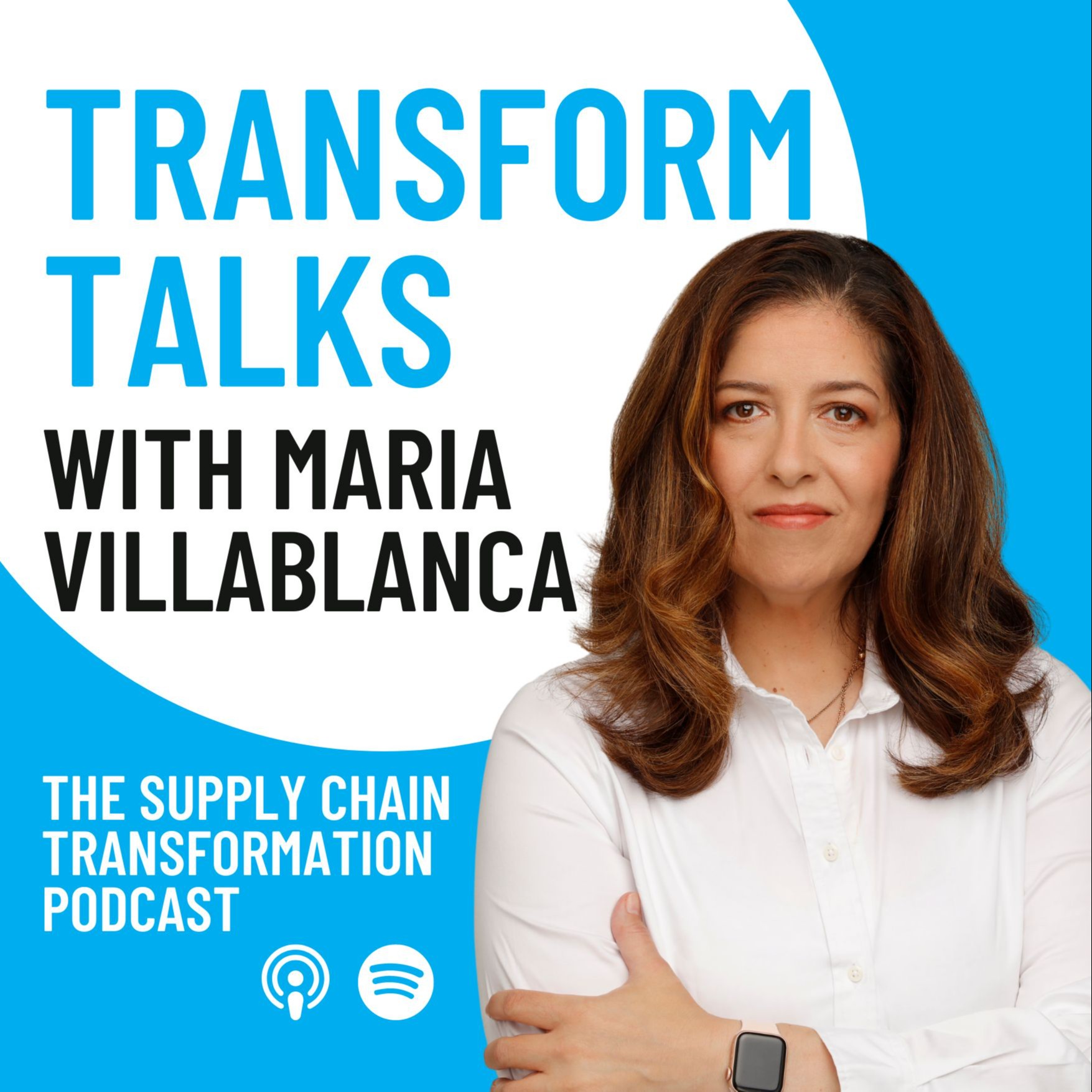
Transform Talks: The Supply Chain Transformation Podcast · 2024-12-04 · 28 min
Key moments - from our scoring
Substance score
45 / 100
Five dimensions, 20 points each
Bosch, a 150-year-old conglomerate with 400,000+ employees across 200 plants and 600+ warehouses, undertook a comprehensive target operating model redesign with Capgemini Invent to address cost pressure, digitalization, geopolitical risk, and talent shortage. Rather than full centralization, the company adopted a regionalized approach supported by corporate services, using supply chain archetypes as a common denominator that acknowledges heterogeneous divisional requirements while enabling process standardization and servitization. Fleming emphasizes that supply chain differs from functions like accounting - some tasks must remain local while others benefit from scaling - and that supply chain itself is fundamentally a servitization story that has evolved from basic transport and warehousing (100+ years ago) through 4PL services to today's sophisticated service offerings. Arnold brings cross-industry perspective, noting that many companies underestimate the maturity of available supply chain service providers and struggle with the organizational mindset shift required to outsource previously controlled functions. Both speakers stress that building resilience requires clear value demonstration, community and trust-building across stakeholders, attracting expert talent in AI and digital technologies, and maintaining customer-centric agility within standardized processes. Generative AI is positioned as one of several enabling technologies (alongside RPA, low-code, data integration) that amplify the need for critical mass expertise rather than isolated practitioners.
Market pressures including rising logistics commoditization and cost pressure, rapid digitalization requiring new expertise, geopolitical tensions driving demand for regional resilience, and acute talent shortages made it critical to rethink the operating model to stay competitive and future-ready.
Bosch uses supply chain archetypes as a common denominator that acknowledges and accommodates specific requirements from different divisions, allowing corporate services to standardize processes while divisions agree to accept these archetype-based services, meeting in the middle.
Bosch deliberately regionalized rather than centralized supply chains to increase resilience against geopolitical disruption, running operations locally in regions while creating corporate services platforms that aggregate scale and standardization across those regional operations.
AI is one technology among many (RPA, low-code, standardization, data integration); the bigger challenge is assembling critical mass expertise centers because isolated AI practitioners cannot drive effective digital transformation - you need concentrated expert communities for knowledge exchange.
Companies must first achieve clarity on their own processes and data, then accept that external mature service providers can run these processes faster, cheaper, and with higher quality - the shift from viewing outsourcing as loss of control to viewing it as strategic efficiency.
Our reviewer’s read on each dimension, with quotes from the episode.
A handful of non-obvious ideas surface - supply chain as its own servitization story, the danger of passively letting servitization happen and losing control, and the need for expert 'hometowns' to achieve AI scale - but they are stated briefly and never unpacked. Large portions of the episode are consumed by pleasantries, restatements of complexity, and generic observations about AI and talent shortage that any supply chain professional already knows.
In supply chain, you have always things which happen on site locally. And you have processes and tasks which would benefit from scaling up. And it is different to other functions. For example, accounting. In accounting, that's clear. You can servitize everything.
I realized that supply chain or logistics is a servitization story itself. And this was really a kind of eye-opener for me also in this target over-water project.
The framing that companies must proactively 'insource' servitization to retain supply chain control rather than passively ceding it to LSPs and 4PLs is a genuinely interesting and under-discussed argument. Everything else - geopolitical disruption, talent shortage, garbage-in-garbage-out on AI, POC-to-production gap - is widely circulated in the industry and adds nothing new.
if you just let it happen, the servitization has to wait. Then you lose completely for a big company as we have the control on the supply chains.
We are past the POC phase. We need to prove the potential in productive cases. There are so many POCs out there, but it needs to be applied to each specific company.
Arne Flemming is a genuine practitioner running supply chain and logistics P&L across a genuinely vast industrial organisation, which gives his comments real grounding. Frank Arnold is a capable consulting voice but functions more as a thought-leader framing layer than a practitioner who has operated at scale, which pulls the overall calibre score down.
I'm the head of supply chain and I'm also responsible for the corporate logistics operation...we have 12 divisions, this profit and loss responsibility...more than 400,000 associates, 200 plants, more than 600 warehouses.
We used the model of archetypes for that, so for me it kind of a common denominator where Arne and the global team basically kind of steps down to it.
A handful of concrete data points appear - 400,000+ associates, 200 plants, 600+ warehouses, 12 divisions, 2013 as the year corporate logistics was established - but the conversation never surfaces any outcome metrics: no cost savings from the TOM exercise, no throughput improvements, no timeline or budget for the project, and the archetype model is named but never described with enough specificity to be replicable.
in 2013, we established the corporate logistics. And we decided to start with distribution warehousing and transport and so on. After that or later, we also introduced planning services, packaging design service, foreign trade services on corporate level.
we are a company which is almost 150 years old. So we survived two world wars, a lot of recessions
The host asks structurally reasonable questions (people challenges, then tech, then learnings) but never pushes back when answers are vague, never asks for a number or a named outcome, and repeatedly fills airtime with admiring commentary rather than follow-up pressure. The episode reads more like a friendly showcase for both guests than an interview designed to extract maximum insight.
I think it's quite impressive that an organization with such complexity...I think it's quite impressive to do that whilst running your day-to-day. So hats off to you, Arna
I don't want to go so much into the details of this target. Of course.
Computed from the transcript - who did the talking, and the words that came up most.
In this episode, "Transforming Supply Chains: Building Resilience in a Disruptive Era," we explore the challenges and opportunities facing supply chain leaders today. This episode features an insightful discussion with Dr. Arne Flemming, Senior Vice President of Corporate Supply Chain and Global Logistics Services at Bosch, and Frank Arnold, VP of Intelligent Supply Chain Germany at Capgemini Invent. The conversation highlights the need for continuous adaptation and innovation in supply chain management. Key topics include: The growing importance of servitization in supply chain management How to navigate the complexity of a large, established organization The impact of technological advancements like Generative AI on supply chain planning Building a future-proof supply chain that can adapt to disruptions By sharing their experiences and insights, Arne and Frank provide valuable guidance for businesses seeking to build more resilient and efficient supply chains. ↓
Transcribed and scored by The B2B Podcast Index.
Welcome to Transform Talks, the only podcast that cuts straight through the hype and noise on supply chain transformation. I'm Maria Villablanca, the CEO and co-founder of the Future Insights Network. Join me as I uncover the stories and delve deeper into the topics that really matter to you. In this episode of Transform Talks, I'm joined by Dr.
Arne Fleming, Senior Vice President, Corporate Supply Chain and Global Logistics Services at Bosch, and Frank Arnold, Vice President, Intelligent Supply Chain Germany, at Capgemini Invent. Bosch, as I'm sure you're aware, is a company with a very rich history spanning over 150 years. But more importantly, it's a company that's constantly innovating to stay ahead of the curve. Dr.
Arne Fleming is going to share his insights on rethinking their target operating model to build resilience in this ever-changing landscape, and is going to give us some key takeaways. Now, with his vast experience across different industries, Frank will also offer his valuable perspectives on the challenges and opportunities of such a transformation, especially in today's fast-paced and crisis-driven environment. Tune in to learn about the challenges and opportunities in servitization, digital transformation, and talent development.
Hi, everyone. Welcome to Transformed Talks. Frank, Arne, thanks so much for being here. Yeah, thank you for inviting me.
Okay, so you know what? Why don't we introduce you to the audience a little bit? Because, Frank, you and I go way back. I've known you a long time, and we've been talking supply chain for a long time.
But, Arne, why don't maybe tell us a little bit about who you are and what's going on at Bosch? Yeah, so I'm the head of supply chain and I'm also responsible for the corporate logistics operation, which we also have on a cross-divisional level. Yeah, but let me introduce a little bit of the company. So we are really a huge company with more than 90 million.
You would turn over more than 400,000 associates, 200 plants, more than 600 warehouses. Yeah, and we have profit and loss responsibility on the top for the whole group. We have 12 divisions, this profit and loss responsibility, and we have also the plants and the warehouses on the bottom, let's say. And what is also very important to know is that we are a company which is almost 150 years old.
So we survived two world wars, a lot of recessions, and one capability is absolutely necessary to survive such a long time. This is the capability to adjust, to be flexible, to new trends and so on. And that's why we continuously review our target operating model and supply chain. We look at the trends, what happens, is our setup still right?
And that's why we did a project together with Frank, here with Capgemini. And this is basically what we are, what we want to talk about today. Yeah, well, I want to understand a little bit more the whole target operating model. Why do you change it?
What's the rationale behind it? But I think, well, you said quite a lot there. And one of the things that jumped out at me is that to be in business after 150 years of weathering so many different things, reviewing, adaptability, constantly evolving, that's something that seems to be an important part of surviving in this long. Frank, what's your view?
I mean, how did you first come to work with Arnim? Well, thanks, Maria. Well, I think it was a few things came together that just made a nice fit. I think there was the right time to actually talk about a new target operating model, looking at all the changes in the market that have been going on.
And also, especially because it's not only about a certain, we're going to get to that later on, a servitization aspect that should be considered nowadays, but it's also in regards to technology changes, disruptions in the market that we see. And on the other hand, the capability of shoring services or external business process outsourcing providers, right? So they have also come to a level of maturity where they definitely should be considered by clients out of different industries in order to take over processes.
And because of that development, changes in the market, but also changes in the offering in the market, I think it's the right time to review an operating model and to look how this operating model could be revived, adjusted in order to make a company fit for the future. I mean, reviving and reviewing a target operating model is a huge endeavor. I don't have to tell you both this. So before we get into the practicalities, I want to understand, go back the complexity that you talked about in your organization, Arne, because I just can't imagine how difficult it must be to have an organization with such a big history.
And that, I mean, just for those of us in the room, I'm saying that there must be legacy technology, legacy processes, legacy people. So first of all, what's the benefit of reviewing a new target operating model and why now? And, you know, maybe walk us through the decision making there. From my point of view, the benefit is we are always seeking for external views, for benchmarks of what happens in the market.
And that's why it's also important to involve an external party who gives this perspective. On the other side, we also have so many stakeholders internally in our company. So it's also important to put all the arguments together for this target operating model or for the activities which we intend to do. And those kind of things are, from my point of view, important.
Why we do this target operating water continuously or frequently. Okay. And from your perspective, Frank, I mean, I know you see a lot of companies doing it and you help them in so many different ways. How complex was this project?
Well, let me say that it was in some form hugely complex. And this is because of the heterogeneity of the Bosch Group. There are so many different supply chain models, manufacturing models to be considered. So we got to a point where we say, okay, there needs to be, first we understand the requirement for global services, right, standardization, getting to a point where processes can really be servitized or serviced.
And so I think that has been understood from the beginning. But how do you break that down considering that there are so many different requirements coming off of these different supply chains? So this got us to a point in adding regional aspects, adding authority aspects in all the relevant countries. But you're getting to a multi-dimensional challenge.
And I think we managed well, together with Arne and his team, to come up with a target operating model that really serves the purpose and also serves the different needs of each board group member, if you will. We used the model of archetypes for that. so for me it kind of a common denominator where Arne and the global team basically kind of steps down to it and says okay I accepting that there are special requirements coming off of these different supply chain archetypes and I'm adjusting the provision of my services to facilitate that.
But also, of course, there's a requirement towards the business divisions to accept that there is an archetype they can accept and work towards in order to standardize or adjust their processes so that basically everyone's meeting in the middle, if you will. So it's a, like I said, a common denominator that we introduced. And I think we found a model that serves all purposes that need to be considered. Frank, let me add something maybe.
Sure. Yeah, from my point of view, it's also very, very important to look at each process and each task in the supply chain. So because only some processes and tasks benefit from scaling up in supply chain. And it's on one side also necessary to execute supply chain on site.
And this makes it complicated. It is different to other functions. For example, accounting. In accounting, that's clear.
You can servitize everything. You can centralize it or however you call it. But in supply chain, you have always things which happen on site locally. And you have processes and tasks which would benefit from scaling up.
And we also looked really deeply on each process and the differentiation between the archetypes. And this is how we did it at the end. I absolutely agree to all the listeners. So all the listeners will agree, right?
Supply chain is such a broad topic. Exactly. If we're looking to end, which, of course, every supply chain leader is doing, we have so many different levels of services, so many different services that are part of the supply chain in total. And, of course, they need to be looked at in a very differentiated way.
What I also would like to add is, because you said, why a new target operating? Why now? So, of course, there is this huge aspect of what is the benefit. So how does it directly impact top line, bottom line?
But it's also, this is what we observe from our consulting point of view, the necessity coming off of the market right now. I mentioned that earlier. It's not only about technology or availability of supply chain as a service business process outsourcing, but it's also the market itself that is changing so rapidly. So we really see in some industries a rather toxic mix brewing that increases pressure on supply chain and companies have to react now.
So there are so many macroeconomic geopolitical changes in the market. But also, maybe Elon is going to roll his eyes because I'm mentioning this over and over again. Talent shortage is becoming worse and worse. And we observe that in many, many markets.
On the other hand, supply chain is a complex topic, right? You need educated, skilled people to execute that. And now this new technology coming on top of it. I think this makes it very, very necessary to act now to incorporate that into this operating model.
So was this something that was considered in order to help build resilience and to try to adjust to the new era that we're living in with disruption crisis? Do you think that this better prepares you for what may or may not lie ahead? Yeah, exactly. This was one of the most important trends.
But also, let me also introduce the other trends which drove us here to this target of emerging models. So one was this cost pressure, which Frank already mentioned. And I see that logistics becomes more and more commodity. So the cost pressure is more and more higher and the customers not willing to pay a premium for that.
That's really, really important. So this drives or we have to drive synergies and cost-saving activities, one big trend. Another big trend is digitalization. So technology plays a big role in the future.
We see so many specific supply chains for software and so on. So many good examples, big potentials, and we need experts. And we also have to create hometowns for experts. And what you said, resilience.
We see this geopolitical tension. We say, okay, we want to run our supply chains more regional. And that's why I also don't like this word centralization or something like that. So it's not the case.
So we regionalize our supply chain. So we want to run it locally. But in order to not lose our scale as a big company in the regions, we have to put it together. We have to develop our target operating model in order to regionalize the supply chain.
We want it much more. This increases the resilience, definitely. Well, I was going to say, so this is more what the purpose of your organization is. I mean, more fit to the purpose and goals and visions that you've got for the organization.
Okay, well, the listeners will probably be asking themselves this question. Well, this sounds like a great thing to do. But how do you go from a phenomenal idea or a fantastic idea that's written down to the operational every day of making something like this happen? Because, you know, everyone listening here has got, they're busy.
Everyone's busy. You're busy. So how do you manage the day-to-day of your work with carrying out such a big and bold vision? Yeah, so as I said, we are a company with a lot of history.
So 20 years ago, the whole logistic and supply chain operation was executed only in the plants. And then we developed anything. We saw the trend of digitalization was a big driver, definitely. We developed then divisional logistics first.
So we started to establish the divisional logistics. And in 2013, we established the corporate logistics. And we decided to start with distribution warehousing and transport and so on. After that or later, we also introduced planning services, packaging design service, foreign trade services on corporate level.
On one side also, we had activities with big decisions, with big board decisions and so on. On the other side, it's also continuous development and continuous discussions with the plants, with the divisions and so on. And therefore, it's also necessary to have a clear view of what we really want. So we have big activities which contribute to the target operating order, but also many, many small activities which go in the right direction.
Frank, I want to... No, I'm sorry. Sorry, I was just going to say to you, Frank, because you get to see so many people across different industries, different backgrounds, etc. I guess more of a general question.
Do you see this as the kind of endeavor that is going to help organizations build that resilience and stay I don know thrive within these types of climates That question number two and number one And number two really is about how can you help facilitate making something like this happen Well absolutely It is the way to go for a company However it only lays let say the foundation, right? And it establishes, if you do it right, a certain buy-in from relevant stakeholders. But from then on, it needs to be executed, executed with a very distinct value focus.
So I think, Arne, you've been doing that many, many years already, having these key goals, these success stories, which help to convince the GPs within your organization, decision makers of the respective businesses to basically agree to a change, agreeing to accepting a service to be rendered instead of doing it themselves. It's all value-based. So we really have to prove there is a benefit, prove there's a value, and then you can initiate the change and take people alongside.
So I think that is absolutely relevant. And I think that not all companies, at least the companies that I am or we are aware of, are doing that exercise to clearly formulate a target operating model. Because this target operating model, maybe it sounds a little bit simple from what we've talked about so far. But there are so many facets, so many dimensions that are tackling with this target operating mode that really helps to also structure the subsequent approach.
How we can help? Well, we have, let's say, a lot of outside-in perspective and knowledge that we can bring in. I believe that many industries, and this is nothing new, but I think it's increasingly so, are adopting best practices, processes out of other industries. So, for instance, if you look at automotive, they're beginning to adapt consumer products practices, or they should act a little bit more like a high-tech semiconductor-like company.
So, this is happening, and this is what we can bring in as consultants. And, of course, we can help to manage the change, which we always do with what we usually call a context-sensitive change. right if you don't know what what's happening in supply chain and logistics if you don't know what outsourcing insourcing implementation of an integrated business planning system does to an organization then you cannot execute a change right so this is the kind of consulting support that we also bring in um and you know what frank i mean both you and arne were just talking and alluding to the demonstration of value in order to be able to take people with you on this kind journey.
So Arne, on a more practical basis in this project, you know, what are, what were some of the challenges you thought of and maybe some of the things that you learned afterwards that could be good advice for anyone else who's considering this type of activity from a people perspective? We'll get to the tech and et cetera later, but from a people perspective. Yeah. So from a people perspective, that's also a very interesting topic.
So from my point of view, first, it's absolutely necessary to build up community. So you need also a certain trust between the parties. And you have to make clear that even if another organization on a corporate level operates some part of the supply chain for a plant, then that's still an end-to-end process. And we use also this end-to-end process as this glue in between between the organizations.
And we use the community, the logistic community, where we really facilitate common identities. We create common success stories, common stories, common tales that they feel together. Yeah, and this is definitely a challenge to create this collaboration attitude. But what I see for logistics especially, do we anyway used to have collaborate with ex-telept parties?
So yeah, more than 100 years ago, we started to develop transport and warehousing providers. So this kind of collaboration attitude, this is in our culture, in our DNA of supply chain guys, this makes it much more easy to also establish something, these shared operations within the company. And yeah, but this has to be maintained with the things I mentioned already. So you have to work at it.
So I think probably if I'm reading what you're saying, having a clear vision, being able to demonstrate the value and working on it on a regular basis is something that perhaps gives the buy-in to your team of why they should do something like this. I want to ask you now, move on to tech, because it seems like everyone that I talk to is talking about Gen.I. who isn't talking about Gen-I, but you hear very few case studies of Gen-I in practice.
So I want to ask you about how do you evaluate the importance of generative AI or decision intelligence for your supply chain? And how have you addressed that within your target operating model? Yeah, so Gen-I will definitely, it's a huge potential. This will definitely change our supply chain work a lot, especially in planning.
I see really big change with the vision of autonomous planning at the end. That we just decision-making at the end and the planning is more or less done automatically autonomous. But AI is still one technology. We shouldn't forget RPAs, low code.
We shouldn't forget standardization, the connection between LSTs and us vendors, this data exchange with customers. So there's still so much potential in this integration and the other topics. And AI is a huge potential, definitely. but just one additional technology which is available to improve the supply chains.
But this additional technology makes it even more important to handle this complexity and to have experts available to drive this digitalization. And this trend needs also, yeah, they create these expert homes that they feel that they can exchange in organizations and so on. So it makes no sense to hire one associate in a plant for AI. This is nothing what works.
You need a certain critical mass to provide the right home for those experts. We've got a few minutes left, so I want to ask you about any kind of big learnings that you've taken away from this project. And what does the future look like? Yeah, so the future, how the future looks like that.
I don't want to go so much into the details of this target. Of course. But it's anyway something what we continuously frequently do on a regular basis to review our target operating model. But I would say the best outcome from my point of view was that I realized that supply chain or logistics is a servitization story itself.
And this was really a kind of eye-opener for me also in this target over-water project. Yeah, that we started 100 years ago with LSD, with transport and warehousing. Yeah, the strength this time was nobody wanted to invest in these ships and warehouses and so on. So Zona decided to give some flight chain tasks outside Yeah and then we also saw that technology came into the game These capabilities of these big LSTs transport management systems and so on, they became available to the industry and also to the consulting agencies.
And then we established this 4PL business, 4PL services. And some companies, business owners, decided again to give some tasks to the 4PLs. And now we see service areas around OPL, transport and warehousing topics, and they develop further services. Again, business owners decide to give services outside more and more.
And this is what definitely happens. And this is also something, yeah, but we decided to do many of the services by our own as Porsche in order not to lose the control on the supply chain. So if you just let it happen, the servitization has to wait. Then you lose completely for a big company as we have the control on the supply chains.
You just have it. That's a huge learning. And that is a huge learning. That's a big one.
I mean, you know, to come to realize that, that's a very big learning. Frank, what do people get wrong about servitization? That's a very good question. I believe that people or companies are not really aware of the potential in detail, right?
So that there is a valid mature offering in the market that actually applies to these complex and sophisticated supply chain processes, I think most people are not aware of. So I think there's this trend that service providers are stepping in and offering these kind of services, but also that it is possible to standardize, to harmonize processes, even in supply chain, and then agree with an outside party to have these processes run, at least augmented in a very efficient manner, which in the end might add the ultimate cost efficiency element to it.
And I believe that what also needs to be taken into consideration, there is a transformation coming in front of that. It's very hard to say, I'm not good at something, I'm giving it outside. I think it's data, it's processes first, it's homework. and if I then have a grasp on my process, then I can have an outside party moving in, making it even better, right?
Faster, higher quality, cheaper. I think this is the right way to do and to go. So I think that could be one of some of the learnings. But also, Ana, I think when we got to know each other, I think you had already made so many great advances in regards to supply chain, global services.
You are a practitioner in that regard. Honestly, it's hard to say, okay, what have we learned, right? Is there anything new? Because, yes, there's a new technology coming in or technologies, and we might have to finish things.
If there's a shortage of intelligence, how can we organize that? But I think, in a way, we all learned that everything needs to be applied to every specific company. Everything is a little bit different. If you look into a company, it's about culture, it's about the organization.
But it's also a supply chain should be very much customer-centric. We need to learn from our clients, and clients are different, and they cannot be harmonized. And so we have to have that agility to serve these clients as individual as possible, yet have standardized processes and offerings. and I think that can be mapped in an operating model which is flexible enough to support that.
I think that we learned together and we agreed to it and for me personally, it became clearer that we all talk about these disruptions and there are so many of them and so far we have, we had understood it's about cash, cost, service levels, right? And it's still there and it's still very, very relevant Then resilience came into the play and sustainability. But the technology is a different disruptor, in my opinion. You ask about Gen AI.
Yes, it's a tremendous opportunity, but still process data comes first. So this old saying, garbage in, garbage out, is still valid. But now we're past the POC phase. We need to prove the potential in productive cases.
There are so many POCs out there, but it needs to be applied to each specific company. And I think that especially in supply chain, and you mentioned planning already, we have many ideas about how we can actually put that into effect, into production. We don't know yet. So there's a lot of ideas.
And yes, it has a huge potential, which we cannot quantify yet. And so we have to deal with it. We have to make sure that we're not missing the trade. And we have to do it now.
And I think this is something that we need to understand and realize. On top of everything else, we also have to do that. And this might change the picture altogether, right? So maybe away from supply chain planning to decision support, decision intelligence, and there is a planning engine behind it, making sure that decisions can be taken, right?
So there is a huge potential, but it needs to be figured out, and we need to lay the foundation for it right now. Yeah, but it sounds to me, I mean, it sounds to me from what you're doing, first of all, it's tremendously impressive. You know, it's tremendously impressive that an organization with such complexity, with so many different archetypes, with so many different business units that has the vision to be able to question itself and say, how do we build the business that's going to mitigate risks in the future, that is going to not just survive, but thrive in the disruptive era.
And I think it's quite impressive to do that whilst running your day-to-day. So hats off to you, Arna, for having, you know, with your team to going through something like this. And then more importantly, to be constantly evolving and questioning yourself. You show us the art of the possible if you can dream it, right?
And so I think that's something that you should be commended for. And Frank, you're absolutely right. You ask a lot of questions with regards to how this is going to play out. But what you've built here, what you guys have built is the possibility of what can happen in the future.
So I am very much looking forward to maybe sitting down with you guys in a year's time or two years time and seeing how you've been able to build something that will last another 150 years. Well, great. Well, thank you so much for joining us and thank you for sharing this. I mean, we look forward to maybe hearing a little bit more and seeing you really triumph and work out through this new era of supply chain business models as well.
Thank you. For those of you listening, we'll see you at the next one. Thank you so much. Thank you.
Bye-bye. Thanks for joining us today at Transform Talks. I hope you found this valuable. In the meantime, don't forget to subscribe, comment, and share.
I'll see you at the next one.
Other episodes covering the same guests and topics, from across The B2B Podcast Index.
 71. How Europe can fight back!The Difference Engine · on Bosch74 / 100
 "Leadership isn't the Castle, it's the Culture You Build Inside it"The Mindset To Learn Podcast · on Capgemini Invent72 / 100
 Translating 139 Years of Innovation into Modern StorytellingInside Insights · on Bosch65 / 100
 Bridging The Gap: Navigating The Digital Transformation Of Commerce With Lamees ButtREALLY Know Your Customer · on Bosch63 / 100
 Circularity: Next-gen industrial sustainability exploredTalking Digital Industries · on Servitization61 / 100
 How the CEO of a Family Firm Kept It Private Through a Century of ChangeThe CEO Diary with Fexingo · on Bosch
 #216 - Culture Code: Cracking the Code to Organizational Transformation with Tom Krause
 #215 - The Misconceptions of Building Resilient Supply Chains with Harry McCarney from Hack & Craft
 #214 - Rethinking Supply Chain Operations in the Age of Digitization With Mourad Tamoud
 #213 - Mitigating the Impact of Global Disruptions on the Supply Chain Network with Eric Enselme
 #212 - The Role of Control Towers In Managing Complex Supply Chain Networks with Nina Anttila