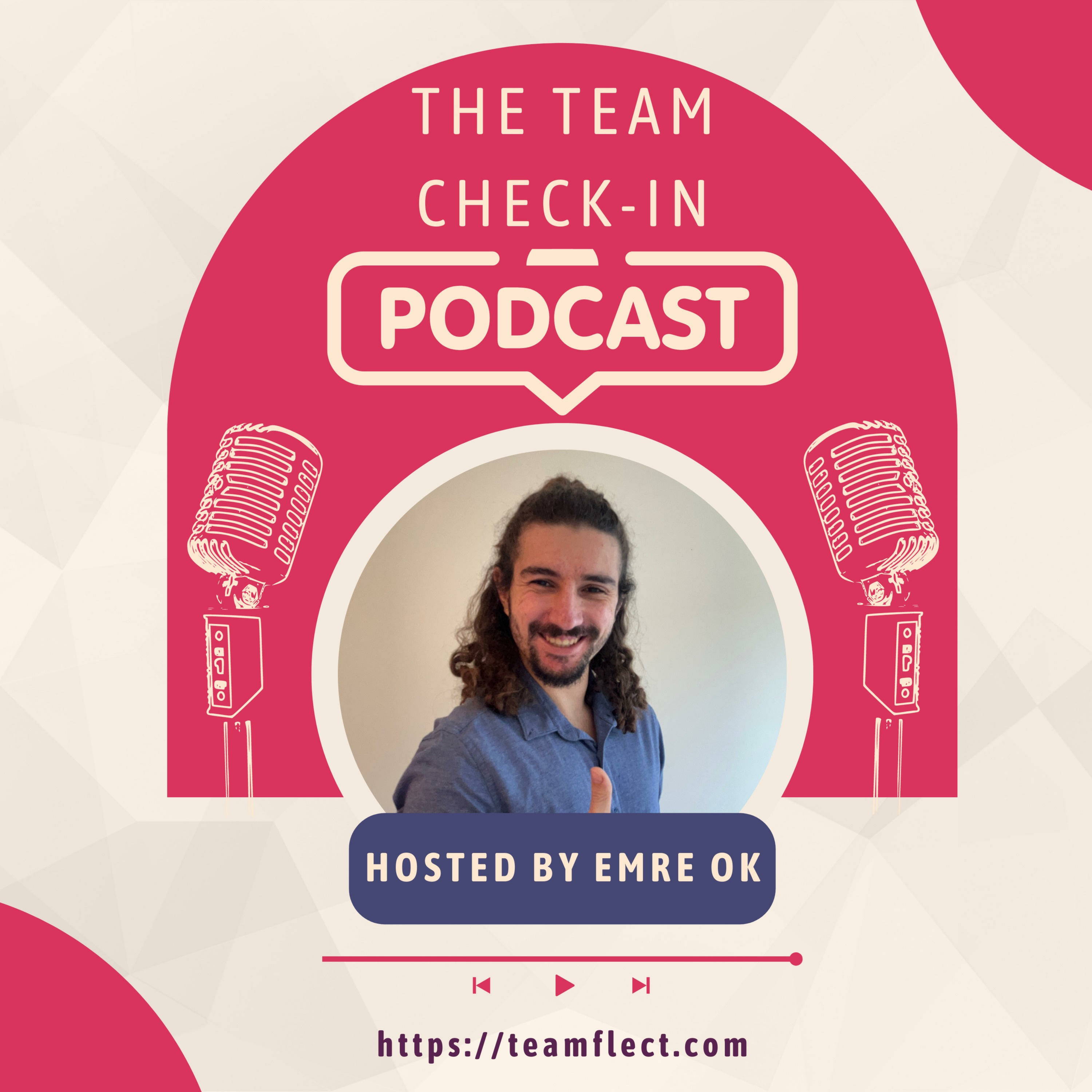
Hosted by Teamflect
Listed under Business
Looking for employee engagement ideas? Performance management tips? Discussions on human resources management that can get surprisingly deep? You've come to the right place! Welcome, to The Team Check-in, hosted by Emre Ok.
45 episodes · publishes monthly · latest 2026-08-04 · ~40 min/episode
Rank
#1209
Substance
62.0
/ 100
Breakdown
Scored 2026-08
Updated monthly
Across the index
#1209 of 1878
Substance
Top 64%
outscores 36% of the index
The Team Check-in ranks #1209 on The B2B Podcast Index with a substance score of 62.0 out of 100, scored across 2 recent episodes. It scores highest on insight density and specificity & evidence. The episode delivers a structured framework with some genuinely useful insights - particularly the opening observation about OKR program failure around week four/five due to staleness and disengagement, and the distinction between tool shapes (dedicated vs. suite vs. add-on). However, the middle sections devolve into feature-listing rather than insight: most of the 10 criteria are stated as self-evident (ownership required, audit trails matter) without surprising depth or counterintuitive reasoning. The host rarely goes beyond 'this matters because it matters.'
Averaged across 2 recently scored episodes, with cited evidence.
The episode delivers a structured framework with some genuinely useful insights - particularly the opening observation about OKR program failure around week four/five due to staleness and disengagement, and the distinction between tool shapes (dedicated vs. suite vs. add-on). However, the middle sections devolve into feature-listing rather than insight: most of the 10 criteria are stated as self-evident (ownership required, audit trails matter) without surprising depth or counterintuitive reasoning. The host rarely goes beyond 'this matters because it matters.'
“Most OKR programs that fail don't fail because the tool was missing a feature. They fail around week four or five because the objectives are still sitting there and nobody deleted them.”
“A goal you can trace upward feels like it belongs to something. A goal floating on its own gets updated once and then forgotten.”
The framework itself - a weighted scorecard for OKR tools - is competent but not novel. The three tool shapes (dedicated, suite, add-on) are standard market segmentation. The core insight about check-in cadence and habit formation is solid but not contrarian or first-principles. Most of the advice (cascade matters, integration matters, support matters) reflects mainstream vendor positioning rather than fresh thinking. The episode reads as a well-organized synthesis of existing OKR software evaluation wisdom rather than a new lens or breakthrough perspective.
“Check in and update infrastructure this is the machinery that keeps goals current”
“Goal and Cascade architecture this is how goals connect across levels”
No actual guest appears; this is a solo host presentation attributed loosely to 'Boron, co-founder and CEO and his team.' The host is unnamed and provides no credential, seniority indicator, or evidence of having actually implemented OKR programs at scale. The episode relies on claimed testing by 'the team' but offers no names, no track record, and no operator context. The absence of a real practitioner defending or explaining choices weakens credibility significantly.
“Powered by Team Flex, this one comes straight from Boron, our co founder and CEO and his team. They spent months testing OKR platforms”
“Our testing team scores this on two jobs.”
The episode names tool categories (Perdoo, Cascade, Asana, ClickUp, Notion, Leapsim, 15.5, Team Flex) and provides some concrete thresholds (breaks around 50 people, 10 people vs. 100 pricing math). However, it lacks named customer examples, real data, actual pricing figures, specific failure stories, or measurable outcomes. Claims like 'weeks to second cycle' and 'stall after first cycle' are vague assertions without timelines, percentages, or evidence. The scorecard weights (14%, 13%, 11%, etc.) are precise in number but unexplained in derivation.
“the cadence runs on its own or leans on one diligent person pinging everybody every Monday”
“Per user pricing that looks cheap at 10 people becomes a growth tax at 100.”
This is a lecture, not a conversation. The host delivers a monologue with no guest to push back on, no real questions posed to an interlocutor, and no moments of productive disagreement or genuine discovery. The host uses rhetorical questions ('Will my managers actually open this on a Monday?') to prime the audience but does not investigate the answer collaboratively. There is no follow-up, no challenge, no moment where an assumption is tested in real-time.
“So when you're shopping for OKR software, the question underneath every feature demo is really just one question.”
“Criterion number two at 13% right behind it.”
2 periods tracked.
2 scored on substance · 45 tracked in total.
Add this badge to your site - it links back here and updates automatically as you rank.

<a href="https://index.fame.so/show/the-team-check-in" target="_blank" rel="noopener">
  <img src="https://index.fame.so/badge/the-team-check-in/badge.svg" alt="Ranked #88 on The B2B Podcast Index" width="360" height="136" />
</a>Track The Team Check-in's rank
Get an email whenever this show moves up or down the Index. Monthly at most, no spam.
Companies, products and tools that come up most across this show's episodes.
The themes that come up most across this show's episodes.
Podcasts that dig into the same topics.

Voice Activated: Tuning Employee Insights At Work
Sean Fitzpatrick

Recruiting is No Joke
Joel Lalgee
The New F*Word
Colin Hewitt

Practical Product Management
Leah Farmer & Marilyn McDonald

The Business of Learning
Training Industry, Inc.

Here's the Deal
Shujaat Ahmad and Joselle Deocampo-Gautam



