
The Manufacturing Edge - For Ops Leaders · 2026-06-01 · 6 min
Key moments - from our scoring
Substance score
30 / 100
Five dimensions, 20 points each
Food and beverage safety failures cost the industry $1.9 billion in direct recall expenses in 2024 alone, yet most leaders only see the tip of the iceberg. Will Merriman and Nasser Ahmadi, a senior management consultant with 30 years of operations experience at companies like Mouser and Uppi, unpack why safety in food and beverage manufacturing is fundamentally a leadership and culture problem, not just a compliance checklist. They expose how process gaps that lead to recalls, contamination events, and 220,000 annual workplace injuries almost always stem from leadership failing to drive safety-first culture on the plant floor. The episode reveals that safety prevention delivers three to five times better ROI than reactive spending, and that prioritizing safety using the SQDC framework (safety, quality, delivery, cost) directly improves first-pass yield and operational performance. Essential for operations leaders, plant managers, and safety directors in food and beverage who want to move beyond reactive recordable management to building genuinely safe, high-performing operations.
In 2024, the US food and beverage industry recorded 300 recalls costing $1.9 billion in direct expenses, not including lawsuits, lost shelf space, or the estimated 30% of consumers who permanently lost trust in the brand after a recall.
Safety prevention delivers three to five times the return on investment compared to reactive spending on recalls, injuries, and operational recovery.
When walking the plant floor, non-compliance with safety processes indicates that leadership hasn't bought in to driving safety compliance and culture, which is usually the root cause of process gaps that lead to recalls and injuries.
Using the SQDC framework (safety, quality, delivery, cost) with safety first, managers see immediate payback in first-pass yield and quality, which directly improves delivery and cost performance across the operation.
The iceberg metaphor illustrates that visible incidents (recalls, recordables) represent only the tip of underlying process gaps in production, people, or supplier management that existed long before the incident became visible; actual costs include downtime, morale loss, turnover risk, workers compensation, regulatory fines, and reputational damage.
Our reviewer’s read on each dimension, with quotes from the episode.
In six minutes the conversation delivers a handful of industry statistics from the host but the guest's contributions are almost entirely generic assertions about leadership culture and process gaps. There is no non-obvious mechanism, framework detail, or practitioner insight that a seasoned food and beverage ops leader wouldn't already know.
safety prevention delivers three to five times the ROI compared to reactive spending
It's first pass quality, right? So, uh, it shows up in making sure that we're not dropping product on the floor
Every idea in the episode - iceberg hidden costs, top-down culture driving compliance, safety-quality-delivery-cost ordering - is standard lean consulting doctrine that circulates widely. Nothing contrarian, first-principles, or counterintuitive is introduced.
we talk about safety, quality, delivery costs, and in that order
the iceberg is just what becomes visible
Nasser Ahmadi has genuine operational credentials - 30 years in manufacturing, direct food and beverage packaging experience, and SQF certification - but he functions here as a management consultant rather than a current operator who scaled a facility, and his in-transcript answers are too brief and generic to demonstrate deep practitioner knowledge.
Nasser is a senior management consultant at TBM with over 30 years of industry experience in operations, lean transformation, project management and continuous improvement
He has direct experience working at food and beverage packaging organizations such as Mouser and Uppi
The host supplies a handful of real 2024 industry-level statistics (300 recalls, $1.9B direct cost, 220,000 injuries, 3-5x ROI), which is the episode's main source of concreteness; the guest provides zero named examples, dollar figures, or timeline-anchored case studies from his own work.
Back in 2024, the US food and beverage industry hit a near record 300 recalls costing 1.9 billion in direct expenses
producers also recorded 220,000 workplace injuries that same year
The host asks leading, confirmation-seeking questions rather than probing ones, and never pushes back on any claim; the one follow-up that could have generated depth ('what do you do to help them see the full picture?') is answered with a platitude that goes unchallenged.
So really it starts from the top down in most cases is what it sounds like
have you ever run into someone who's skeptical about the investment in safety?
Computed from the transcript - who did the talking, and the words that came up most.
In Part 1 of this three-part series, host Will Merriman and TBM Senior Management Consultant Nasirali (Nasir) Emadi unpack why food and beverage safety management is about much more than staying off OSHA's radar or avoiding the next recall headline. They connect the dots between recordables, product recalls, and everyday process decisions on the plant floor, showing how safety prevention consistently delivers a 3-5x ROI versus reactive spending.Drawing on 30 years in operations and food and beverage packaging, Nasir explains why nearly every "surprise" incident can be traced back to long-standing process gaps and leadership choices. You'll hear why 300 recalls and 220,000 workplace injuries in 2024 are not random events-and what that tells you about your own safety system.Listen now and start reshaping how your organization thinks about safety, risk, and performance.tbmcg.com
Transcribed and scored by The B2B Podcast Index.
Narrator: The Manufacturing Edge. Where ops leaders break barriers, drive growth and redefine what's possible. This three part podcast explores what it really takes to run a safe, high performing food and beverage operation every day on the plant floor. In part one, the team lays the groundwork by showing why safety in food and beverage is about far more than avoiding recordables or recalls. In this episode, we expose the hidden costs and leadership behaviors that shape what really happens on the plant floor.
Will Merriman: Hello there and welcome to the Manufacturing Edge where we talk about the ideas, practices and people helping manufacturing organizations run more efficiently and profitably. I'm your host, Will Merriman, client success partner at tbm. Our topic today is safety. More specifically in the food and beverage industry is what we're going to focus on, uh, what it looks like when it's done right, where it might break down and why some of the strongest operations treat safety as part of the work and not really an afterthought. Today I'm joined by a close colleague of mine, Nasser Ahmadi. Nasser is a senior management consultant at TBM with over 30 years of industry experience in operations, lean transformation, project management and continuous improvement. He has direct experience working at food and beverage packaging organizations such as Mouser and Uppi. And while at uh, TBM was involved in the lean transformation for one of the largest full service flexible packaging converters in North America. And also he is SQF certified. How are you doing today, Nasser?
Nasser Ahmadi: I'm doing well, Will, thanks. You know, this is a topic I'm genuinely passionate about. Like you said, 30 years in manufacturing and many years in the uh, in the food and beverage industry. And safety is one of those things that separates the organizations that sustain high performance, uh, from the ones that are constantly in recovery mode. So I'm glad we're putting uh, a spotlight on food and beverage safety.
Will Merriman: As am I. This is the first time uh, I've had the chance to talk about it. So I'm excited uh, to get into things with you. Before we really get into it, I do want to share an eye opening statistic, uh, about some of the historic measurements we've seen uh, across the industry. Back in 2024, the US food and beverage industry hit a near record 300 recalls costing 1.9 billion in direct expenses. And that's before lawsuits, before lost shelf space and the around 30% of consumers who set a recall permanently damaged their trust in a brand. At the same time, producers also recorded 220,000 workplace injuries that same year. These failures almost always trace back to one of three Domains which we'll cover today. Either a production floor issue, uh, something having to do with people or with suppliers. We're gonna walk through each where companies consistently break down and what an optimized model looks like. Nasser, before we talk about fixing safety and any of the root causes, I wanna be honest and get into what it actually costs when it breaks down. And the framing here, I think, which is a good analogy, is, uh, an iceberg. Most leaders and supervisors really only see the tip of the problem. Every OSHA recordable is a downtime event. It's a morale event and a turnover risk. Workers comp, regulatory fines, production stoppages and reputational damage can all compound. And our data consistently shows safety prevention delivers three to five times the ROI compared to reactive spending. Nasser, you've been in operations for over three decades. In your experience, when you walk into a facility and observe, what does it immediately tell you about how seriously leadership is actually taking safety?
Nasser Ahmadi: When you walk the floor and you see what, uh, people not complying with safety and complying with the processes that are put in place, that tells you that leadership hasn't bought in and driving compliance. Right. And let me step back for a second on the numbers you mentioned about the recall. You know, 300 recalls in a single year. What most people don't realize that those aren't just random events. When I look at the root causes, almost every one of them traces back to a process gap that existed long before the recall happened. Uh, the contamination event, like you just mentioned, the iceberg is just what becomes visible. And again, going back to those process gaps is generally because of leadership not driving the culture that. And implementing the culture that should, uh, be in place for preventing.
Will Merriman: So really it starts from the top down in most cases is what it sounds like.
Nasser Ahmadi: Absolutely.
Will Merriman: With those leaders, I mean, have you ever run into someone who's skeptical about the investment in safety? What do you do to help them see the full picture beyond maybe just a, uh, basic safety report, uh, or in depth one that's on paper?
Nasser Ahmadi: I think most leaders are driven by cost. They're driven by, uh, getting product out the door. And sometimes safety gets put on the back burner. But if you look at our way of measuring things, we talk about safety, quality, delivery costs, and in that order. So safety comes first. Right. But by putting safety first, the managers will see that it actually pays back in all the other areas from delivery cost perspective as well.
Will Merriman: Where do you think that return or investment up front typically appears, and where do you maybe see those results materialize first?
Nasser Ahmadi: It's first pass quality, right? So, uh, it shows up in making sure that we're not dropping product on the floor, uh, we're not contaminating product, people getting injured and contamination getting into, um, the food or beverage. It shows up right away. I mean, right away, uh, on first pass yield. You'll see that you get better results.
Narrator: Tune in to part two of our next episode, from the Floor Up. Fixing safety, where product people and suppliers meet.
Other episodes covering the same guests and topics, from across The B2B Podcast Index.
 The First 90 Days of Lean: What Actually Matters (Part 1)The Lean Solutions Podcast · on Lean transformation70 / 100
 Safety is a Team Sport | 124Lean Leadership for Ops Managers · on Safety culture70 / 100
 TEKTOK Classic: Leveraging S&OP to Drive Customer Collaboration and Business Transformation at Plastic PackagingTEKTOK · on Flexible packaging61 / 100
 Human First Safety Leadership and Scaling Culture with Derek CoxThe Canary Report: Safety & Risk Management · on Safety culture53 / 100
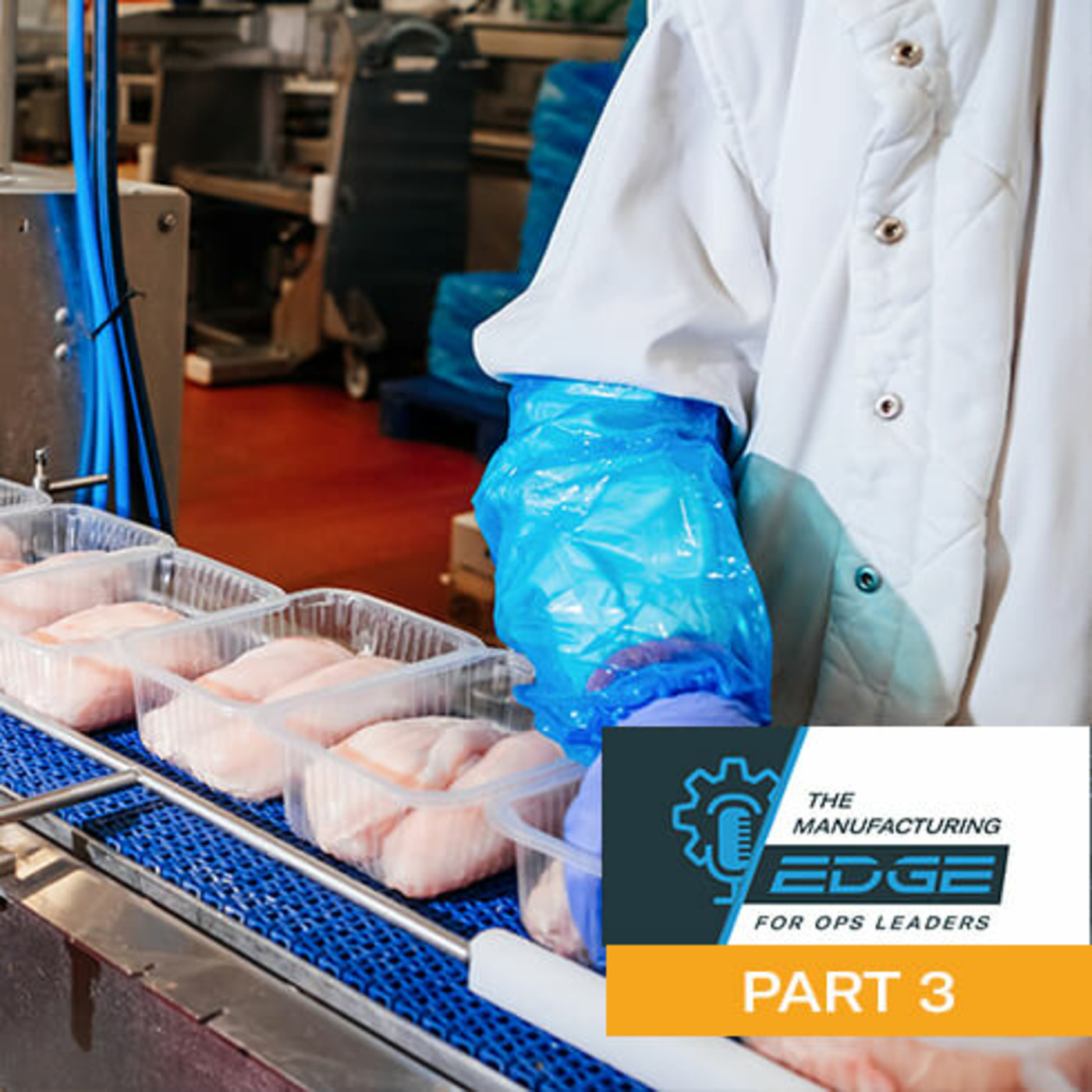 Episode 3: Food and Beverage Safety Management Part 3 - A Five-Step Playbook: Assess, Make Visible, Build, Train, and Sustain43 / 100
 Episode 2: Food and Beverage Safety Management Part 2 - From the Floor Up: Fixing Safety Where Product, People, and Suppliers Meet67 / 100
 Episode 1: When SIOP Gets Real: Capacity, Analytics, and Better Decisions77 / 100
 Episode 2: Tech Talk - Managing the Human Side of Digital through Change Management65 / 100
 Episode 1: Tech Talk - From Whiteboards to Real-Time: Why Digital Management Systems Are Now a Manufacturing Imperative