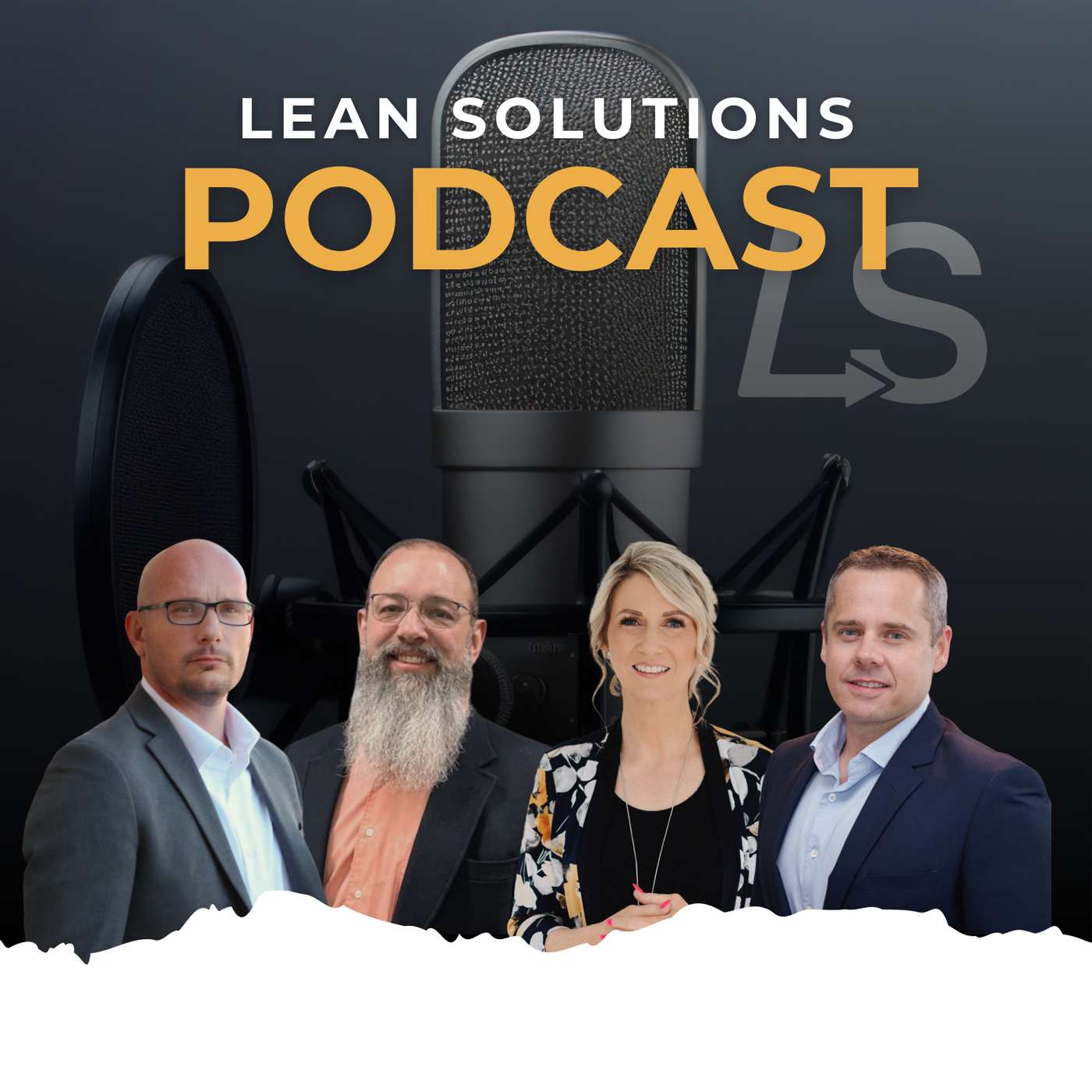
The Lean Solutions Podcast · 2026-06-16 · 16 min
Key moments - from our scoring
Substance score
50 / 100
Five dimensions, 20 points each
The first 90 days in a new lean initiative or role require intentional focus on understanding before acting. Shane Daughenbaugh shares his recent experience as a newly hired process improvement manager at a large company, where his approach centers on interviewing department heads and frontline workers, conducting extended gemba walks to understand workflow and silos, and deliberately building trust across the organization. Patrick Adams provides a three-part framework for this phase, emphasizing that leaders should spend extended time performing the actual jobs of their direct reports to build genuine empathy, then conduct structured one-on-one conversations using three key questions: what's going well, what isn't, and what improvement ideas do employees have. Rather than removing emotion from employee feedback, the conversation demonstrates treating emotions as flags that signal deeper issues worth investigating. Shane adds a practical wrinkle by using dictation and AI analysis to identify themes across multiple interviews without manual clustering. This episode targets executives, middle managers, and newly hired improvement professionals who need a roadmap for the critical first quarter of any lean transformation or organizational transition.
Focus on three areas: spend extended time actually working the jobs of your direct reports to build empathy, conduct one-on-one interviews asking what's going well, what isn't, and what improvement ideas exist, and build trust by listening before implementing changes.
Treat emotions as flags indicating genuine issues, then dig deeper by asking clarifying questions to understand the root cause - for example, if someone says they hate the six o'clock shift, ask what that specifically means to them rather than assuming you understand.
Document answers separately from each person without sharing them across interviews, then cluster common themes to identify patterns that indicate real organizational problems affecting multiple people, converting individual emotions into actionable data.
No - Shane Daughenbaugh's approach emphasizes learning how work flows across departments, identifying silos, and understanding where groups excel before designing interventions, allowing the gemba and employee input to shape your strategy.
Use dictation software to convert handwritten notes into a word document, remove personal identifying information, then run the aggregated notes through AI to help identify themes and clusters you might miss manually.
Our reviewer’s read on each dimension, with quotes from the episode.
The episode provides some useful tactical frameworks (the three-question interview approach, going to the gemba) that a new operations manager or process improvement hire would find applicable. However, there's substantial filler around weather conversations and general positioning before substantive content begins, and the insights offered are relatively foundational - spend time with front-line workers, conduct structured interviews, identify themes - rather than novel or deeply thought-provoking for a practitioner familiar with lean basics.
Go work the jobs of the people that would be reporting to you
Ask three questions: what's going really good, what's not going well, and do you have ideas to improve
The core advice - listen first, go to gemba, interview stakeholders, find patterns in feedback - is standard lean and change management practice. The three-question framework is a minor variation on common retrospective and voice-of-employee techniques. Shane's addition of using AI to identify themes from interview notes shows a modern twist, but the underlying thinking is well-trodden territory without contrarian or first-principles challenges to existing lean practice.
Interviewing everyone, understanding how they do things
I use those emotions as a flag so I'm turning those emotions into data
Shane Daugenbaugh is a practicing process improvement manager actively in their first 90 days at a new organization, which is relevant to the episode topic. Patrick Adams positions himself as having deployed lean in past roles and claims to have written a book. However, neither guest provides evidence of large-scale transformations, significant operational P&L impact, or recognition as a leading lean practitioner. They come across as competent practitioners rather than high-caliber operators with exceptional track records.
I am process improvement manager at this fairly large company
I had been promoted into an operations manager position
The episode lacks concrete examples, metrics, and named outcomes. The three-question framework is explained but no actual responses, data clusters, or resulting improvements are shared. Shane mentions visiting 'some' sites and conducting near 20 interviews, but provides no specific companies, business problems, measurable results, or timelines beyond the vague '90 days' window. The discussion remains at a how-to-do-it level rather than what-actually-happened level.
I have just been interviewing every department head
I'm not quite to 20 interviews
The conversation is friendly and includes some genuine back-and-forth, with Shane building on Patrick's points (e.g., the emotion-as-flag reframe, the AI augmentation of note analysis). However, questions are largely softball and open-ended without probing for depth or pushing back on claims. Neither host challenges the other on implementation obstacles, failure modes, or contradictions. The episode ends abruptly mid-discussion, signaling this is a setup for part two rather than a complete argument being stress-tested.
Yeah, yeah. And I the two things I want to say, and then I would love to hear where we're going
I want them to to make a connection to something that they enjoy about their job
Computed from the transcript - who did the talking, and the words that came up most.
What You’ll Learn in This Episode : Spotlight Episode!! As we continue revisiting some of the conversations that sparked meaningful discussions, we’re bringing back this episode of the Lean Solutions Podcast with Patrick Adams and Shayne Daughenbaugh. In this conversation, Patrick and Shayne explore what new leaders should focus on when stepping into a Lean journey. Instead of jumping straight into tools and solutions, they discuss the importance of understanding the current state, building relationships, developing people, and creating the right environment for improvement. From creating a model area for experimentation to learning through failure, this episode highlights why successful Lean transformation starts with leadership, trust, and capability building. Key Takeaways Your Role Determines Your Strategy Start with Listening, Not Implementing Culture Before Tools Perspective Changes Everything Links: Lean Solutions 2026 Summit Lean Solutions Website Click Here For Shayne Daughenbaugh’s LinkedIn Click Here For Patrick Adams’ LinkedIn
Transcribed and scored by The B2B Podcast Index.
Patrick Adams 0:00 And I asked three questions. The first question was, what's going really, really good in your area, or, you know, what's really good about the company or the team that you work with? Just one thing that comes to mind, the first thing comes to mind. And then the second question is, what's one thing that's not going really good about a company, your team, the work that you do, whatever it might be, what's the first thing that comes to mind?
And then the last question is, do you have any ideas to make things better? It could be a response to the thing that's not going well. You have an idea for how to improve that. Or just in general, do you have any ideas for improvement?
Patrick Adams 0:42 You Hello and welcome to this episode of the lean solutions podcast. My name is Patrick Adams, and today I'm joined by my good friend Shane Dauphin bow from Nebraska. How you doing? Shayne Daughenbaugh 0:55 Shane, yes, I am doing well, other than being very cold, notice him in my sweatshirt in my own house, but you know, q1, is just it's a cold time of year here in Nebraska, as I'm sure it is in Michigan as well.
Patrick Adams 1:09 In Michigan, the same way, the roads are horrible right now, it's freezing cold. Actually, was in Virginia this last weekend visiting my son down at Liberty University, and we almost didn't make it home because of the storm that came through. I mean, they had snow, ice, heavy winds, it was crazy. The weather has been pretty bad in the US, I think, all around, right, these last few Shayne Daughenbaugh 1:32 weeks, right, right, not what you want, but kind of what you can expect for q1 right?
Yeah, good point. Yeah, for sure. I mean, I shouldn't complain this. We did decide to live here.
Patrick Adams 1:44 Yeah, that's a good point, too, exactly, right? I that I when I say it hasn't been very good and like, I guess that's depends on perspective, right? Because for those that are snowmobilers or skiers, they're probably loving it right now, right? Having a great Shayne Daughenbaugh 2:00 couple of weeks?
Yes, yeah. And I know out here in ag country, our farmers love it when it snows, because we don't often get a lot of rain, so any more water we can get into the ground. So yeah, perspective, perspective is Patrick Adams 2:15 everything makes sense, yeah. Well, Shane, today we're gonna, we're going to launch into a conversation about our first 90 days after learning about this thing called Lean, continuous improvement, the Toyota Production System.
Like I want to imagine that you or I have just learned about Lean, or let's, let's, let's take that back a minute, because is there anyone that's listening right now that's in their first 90 days? Maybe they know about Lean, but maybe they're at a new company. Shayne Daughenbaugh 2:51 Yes, I think, I think you know someone that's that's there. Yeah, there are so many that that we can, we can go into, and we're going to, you know, in the shortness of this podcast, we're going to try to touch on whether you're the executive who has learned about it and you have the power to be able to try to start implementing things the middle level manager who doesn't have all the authority, but still sees this as beneficial for their teams and their work.
And then there are people like myself. I have just started in a new company. I am within my first 90 days at this new company, who has said the company just heard about some things. They have a great they had a great consultant, a good friend of mine that was working with them on some things.
They said, Tell us more about this. And how can we bring this in house? So I am also a persona that we want to talk about in the first 90 days. Like, what do you do with this?
Like, how do you how do you start? Where do you get some traction? What are some things that you you know that are going to benefit you along the way? How do you start, right?
I guess you could say or start, well, let's not talk about right, what's right and wrong. But how do you start? Patrick Adams 3:56 Well, yeah, yeah, such a good question. And I bet there are so many people out there that are in one of the one of those buckets, right?
Either you've learned, just learned about Lean, you know, again and all the different positions that you talked about, maybe you're an executive decision maker, maybe you're a mid manager, you know, so span of control has to be considered. Maybe you just learned about Lean. Maybe you did know about Lean, but you're in a new job. Maybe you were just promoted, or whatever it may be.
So there's many of different ways that we can slice and dice this, but let's talk specifically about you your first 90 days. What? What has that looked like for you? Shayne Daughenbaugh 4:33 Personally, it's been super fun.
I love the company I'm working with, and it's funny because here's my first 90 days right here. I don't know if you can see this. I have mine with me too, for those that are just listening and holding up my coffee mug that has it says ears the most underrated leadership tool. And you know Patrick Adams 4:58 that is fitting, right?
Listening to your listening, most important tool that you can have in your toolbox. Shayne Daughenbaugh 5:05 And so that's that's been the bulk of my first I'm not quite to 90 days yet, but I have gone through the org chart because of the role that I have. I am process improvement manager of this fairly large company, and and they've given me the freedom to be able to, hey, learn how we do things before you try to fix things. So that has been my first 90 days.
The bulk of it, I'm not quite to 20 interviews, but I have just been interviewing every department head I came with a list of questions I am interviewing. I've interviewed boots on the ground, those that are, you know, the front line where the value is added, not just the support services, but I'm trying to get this idea of how work flows across the company, how the where are the silo areas, where is work harder than it needs to be? Where do we thrive? And how can we maybe even move that forward or share that around the company.
Hey, have you seen what this group does? They have this great, this great setup, and so I've just been collecting data, really, whether it be at the gemba, and I've been privileged enough to be able to travel and go to the different locations and sites that we have, some of them, and just kind of see how things are, collect that information, you know, really get a sense of and it's been eye opening, because I'm getting a sense of not only what they do, but how I need to engage and interact with them.
And that's been that's been key, because I had a basic idea of what they do. But if I were to just go, Oh, I know how these guys work, let me just put together this plan and let me just chuck it at them. One of the things that I noticed in putting myself at the gemba, I said, Put me as a brand new worker, like I just spent two days and just said, I'm going to do whatever a brand new worker does. Train me as as they do.
And it was super crazy, because a brand new worker, it was like drinking from a fire hose. And I feel like I'm a fairly, you know, established, like, worker person, like I can handle things. And there are so many things like, oh, crumb, I don't know what I'm supposed to do here, because it was just so much going on. So, just so, so what?
As I'm trying to explain here. My first 90 days so far have been interviewing everyone, understanding not just how they do things, but most importantly for me, how I need to interact with them in a way that lands in a way that speaks to where they are at. And it's the third thing I guess I could put to that is building trust. You know, those are, those are just some of the things.
But, yeah, What? What? What wisdom do you have for me in my first 90 days? Patrick Adams 7:50 Yeah, well, let's I love what you've already done.
I mean, I would say so I want to give everyone that's listening right now. I'm going to give you three areas to focus on in your first 90 days. Again, no matter what, which one of those roles or positions that you fall into, I'm going to give you three areas that you can focus in on in those first 90 days. And actually my number one you're already doing, Shane, so my number one is there's two things that fall into number one, and I did this with an organization that I had been promoted into an operations manager position.
And there were two things that were most important for me to do right away. Number one was to go work the jobs of the people that would be reporting to me. So similar to you, going out and spending a good amount of time not just touching base, not just saying hello, but actually filling the role of frontline worker, or whatever that direct, you know, report position is filling that position and working it for an extended period of time to really get to understand what it's like to be in the shoes of the people that report to you.
You You know, as we're as we're thinking about empathy, right, putting yourself in the shoes, and really understanding the work well enough to be able to manage those people. One of the things that I, you know, always loved when I was in the military was when I moved into a direct report for an officer who had been enlisted at one time in their career, so some and it's what I was doing when I was moving into as an officer in the Marine Corps. I had been prior enlisted. And there's so much value in having been in the shoes of the people that are reporting to you, and understanding for pains, understanding their successes, understanding the challenges, the struggles that come with that there's so much value in that as a manager over those people, especially when you're going to be working in a lean organization, or you're deploying continuous improvement principles into this organization for the first time.
Yes, I'm Shayne Daughenbaugh 9:57 going to, I'm going to interject right into there, because it. We're going to talk about the different levels, like you're talking about the manager side of things, the executive side of things. One of the beautiful things that I stepped into in in my new organization is their leadership said that everyone is going to, whether you're lean minded or not, everyone is going to go to where the value is and and that's one of their, you know, one of their metrics for the year, one of their goals for the year, is to go to where that happens and and be there for, I don't know, I think it's like, four to six hours or something.
It's, it's like, wow, that's just having Patrick Adams 10:35 the minimum amount of time that I would Yeah, yes, Shayne Daughenbaugh 10:38 seeing, seeing the value in that, that you're, you're willing to say to your, you know, your accountants, hey, I want you to go down to the floor. And I want you to, you know, put on your reflective vest and your glasses, get your PPE and, you know, start do, do the water spider job, or whatever it is. You know, there's, there's so much to that, but, but yes, to add to just that little point of the what that looks like for the executive could be promoting this with others and saying, Hey, here's a challenge for you.
Get out to where, you know, those that are on the front line, what does that look like? What does that look like for them? Go shadow the salesperson. Go, you know, go to the storefront.
Go wherever the value actually happens, right? Yes, I'm sorry. So I stopped you the first thing, what's like? Patrick Adams 11:28 No, there's a second part of this first one, and that is having one on one conversations with each of your direct reports, and so not just going and working in their area or filling their position for an extended period, but also sitting down one on one with each person.
That's a direct report with you. And I, again, I did this at this organization, and I asked three questions. The first question was, what's going really, really good in your area, or, you know, what's really good about the company or the team that you work with? Just one thing that comes to mind the first thing that comes to mind for something that's really, really good, right?
So I want them to to make a connection to something that they enjoy about their job. And then the second question is, what's one thing that's not going really good about a company, your team, the work that you do, whatever it might be, what's the first thing that comes to mind when I asked you, what's something that's not going really well, and then the last question is, do you have any ideas to make things better? It could be a response to the thing that's not going well. Do you have an idea for how to improve that?
Or just in general, do you have any ideas for improvement? And I document the answers to each one of these as I'm sitting down with all these people, and I don't let them see other people's answers, but over time, what I do is I take the answers to those questions and I turn them into data, and I start to get clusters of the same answers. And I actually talk about this in my book, avoiding the continuous appearance trap. But there's so much value in taking the emotion and the feelings out of those answers and creating data that gives you decision, you know, the ability to make decisions based on data versus emotions, right?
You know, I think that I would 6am you know, that really sucks, versus hearing multiple people say that when we come in to punch in, the clock is so slow and we have this big line and and if I hear that multiple times from multiple people, I know this is a real issue that multiple people are dealing with that needs to be fixed, right? Shayne Daughenbaugh 13:38 Yeah, yeah. And I the two things I want to say, and then I would love to hear where we're. You know your next idea.
The first thing you talked, the words you used, were remove the emotions from, whereas what I'm seeing is, I use, I see those emotions as a flag. So I'm turning those emotions into data, not just removing them from but if you're saying, yeah, just like, what you just did, Man, I hate the six o'clock shift. Oh, you know, I'm not going to leave it just there as, don't like six o'clock shift. We should move Patrick to, you know, second shift or whatever.
Yeah. I mean, I should ask, what does that mean to you? Like, what is it you're saying? Because if I'm new, and I've had to do this for several of the interviews that I've had.
Hey, tell me what that means, because I have a different I just want to make sure that I'm hearing you and not making the assumption of what that word is. Sure now. And the second thing that I will add to this so I'm I have, I've been asking more than just three questions. I have just a little bit more, but it's not the number of questions, isn't what's important.
I'm scribbling down all these notes. I have pages and pages of notes. I have a stack of notes now that what I have done is I put them into one word document and I just dictated it. So I'm trying to make this easy word now has a dictate function.
I'm just dictating it into it and then removing. All the the personal information. I then sent it through an AI, and not, I'm not quite done with it yet, but in asking, Hey, where, where are some of the themes I've been missing, here's what I'm seeing, you know, and I'm giving context, and I'm using it as a partner to try to come up, to try to find where the themes I may be missing, or where are the connections, the clusters, what some of the opportunities may be, because, you know, we're all about making things easier, better, faster and cheaper, even the work that I do, you know, doesn't need to be hard.
Patrick Adams 15:32 Hey, everybody, that was part one of two on this episode focused on your first 90 days of working in an organization and applying lean concepts in that organization. Tune in next week for part two. Have a great week.
Other episodes covering the same guests and topics, from across The B2B Podcast Index.
 The Toyota Method That Could Transform Dentistry. Why AI Multiplies Mess Without ItThe TechDental Podcast · on Toyota Production System95 / 100
 What Private Equity Looks For Before They Buy with Wayne Marhelski (#79)Exit Algorithms · on Toyota Production System91 / 100
 Kaizen Event Facilitation and Sustainability with Adam LawrenceQuality Time With MoreSteam · on Gemba walks90 / 100
 Best Hits: Dr. Tomas Chamorro-Premuzic on AI, Leadership, and Why Authenticity at Work is OverratedThe Edge of Work · on Data-driven decision making77 / 100
 Episode 207 - Sarah High of Yetter Coleman on The Big Law Mindset: Reality Of Successfully Scaling A BD Function In A Boutique FirmPassle CMO Series Podcast · on Data-driven decision making76 / 100
 How one factory cut lead times by 70 percent with Cellular ManufacturingThe Operations Podcast with Fexingo · on Toyota Production System71 / 100
 Leading with MORE66 / 100
 SIPOC: start improvement right77 / 100
 SOPs That Don't Collect Dust83 / 100
 Leadership That Lasts: Respect, Stability, and the Human Side of Excellence68 / 100
 From Action Plans to Experiments81 / 100