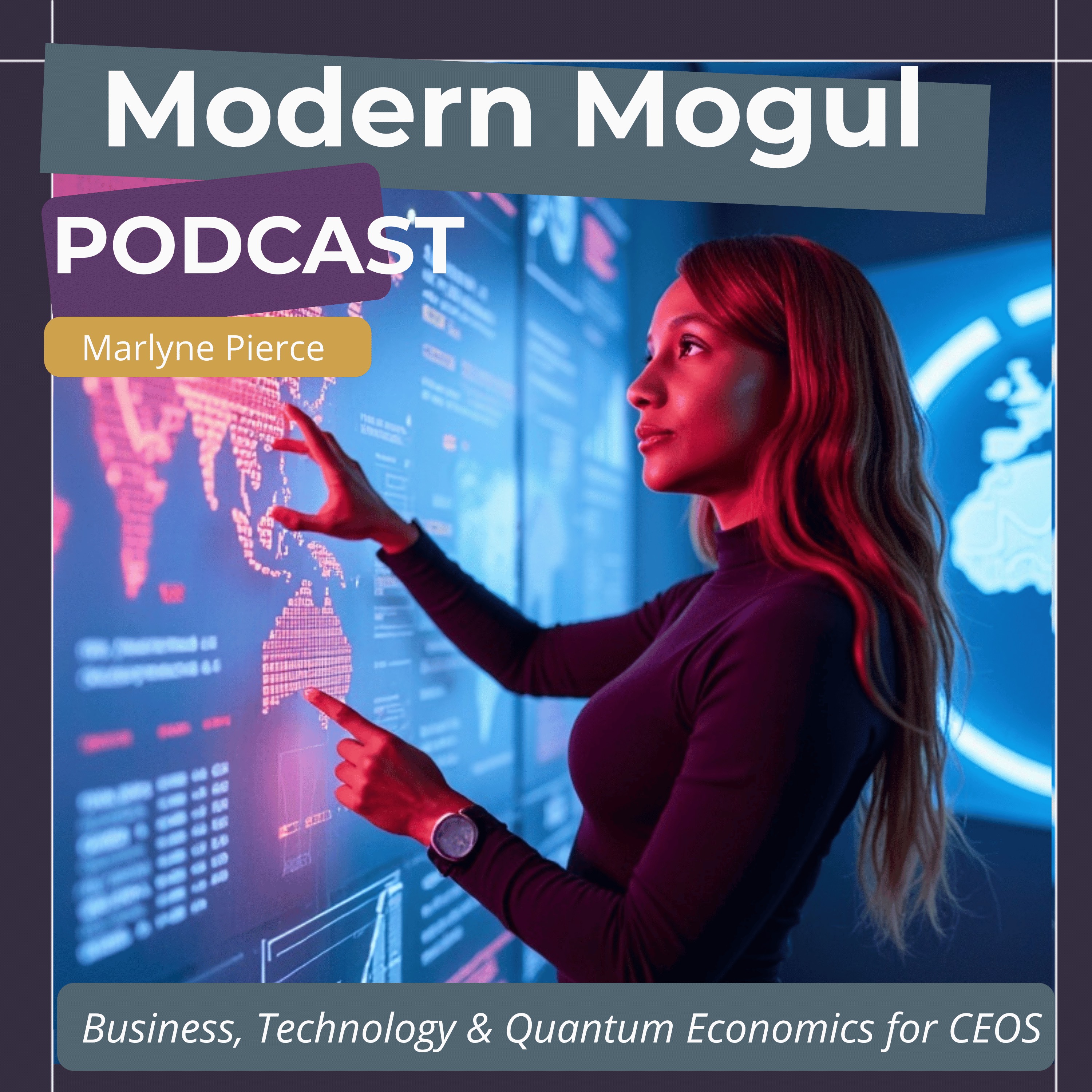
Modern Mogul Podcast · 2026-06-11 · 21 min
Key moments - from our scoring
Substance score
23 / 100
Five dimensions, 20 points each
Marlon Pierce challenges the conventional wisdom that operational problems stem from inadequate systems or processes - the real issue is leaders' unwillingness to tell the truth about their business. She argues that without honest assessment of what's actually working, what's broken, customer needs, financial reality, and competitive threats, no amount of AI implementation, new software, or policy changes will solve underlying dysfunction. Pierce cites a BCG report showing only 6% of business leaders saw ROI from AI investments, attributing this to dishonesty about business fundamentals. The episode connects emotional intelligence (self-awareness, self-regulation, motivation, empathy, social skills) to business outcomes, positioning the body as an intelligent data source that signals when something is misaligned. She illustrates with real examples: a product company ignoring manufacturing defects while their brand deteriorates, fintech companies failing to leverage transaction data for competitive advantage, and leaders confused about whether remote work or employee engagement is the actual problem. For operators, founders, and executives struggling with scaled systems, this reframes the conversation away from technical solutions toward the uncomfortable work of acknowledging hard truths about customer experience delivery, financial performance, and whether strategy-structure-systems actually align.
According to the episode, leaders aren't being honest about their business fundamentals - their processes, data quality, and how they're actually operating. Without truthful assessment, there's misalignment between strategy, structure, and systems, causing AI implementations to fail regardless of the technology itself.
Customer service is responding to customer calls and emails, while customer experience encompasses the entire journey from discovery through retention and referral. Customer experience requires actually delivering on the promise customers hired you for; good service alone doesn't create customer experience if the core product doesn't solve their problem.
Emotional intelligence has five pillars: self-awareness, self-regulation, internal motivation, empathy, and social skills. It matters because it enables leaders to recognize and manage their own emotions while navigating others', allowing them to acknowledge difficult truths about their business and make clearer decisions rather than reacting impulsively.
Leaders don't need to trust employees upfront; instead, they should give employees ownership and responsibility to earn trust through delivery. Trust is built when employees are given clear systems, structure, strategy, and execution rules that enable them to succeed and demonstrate trustworthiness through results.
By taking commoditized transaction data and turning it into fuel for insights - analyzing customer spending patterns, frequency, card type, and merchant behavior to create competitive advantage. This requires understanding what questions to ask and how to translate data into actionable insights, which AI alone cannot do without human expertise.
Our reviewer’s read on each dimension, with quotes from the episode.
The episode hammers one thesis - leaders must be honest with themselves before fixing systems or deploying AI - but repeats it at length with minimal development. There are one or two substantive moments (BCG ROI stat, interchange-revenue commoditization) buried in dense motivational padding.
according to the BCG report in 2025, they interviewed over a thousand business leaders and found that they were investing. They were doing proof of concept. They were implementing AI and only 6% of them was seen a return
a lot of fintech companies make money initially by interchange revenue, just by processing transactions. They make a penny here, two cents there. That's a commodity.
The core argument - self-honesty as a prerequisite to operational effectiveness - is a perennial coaching trope, not a fresh or contrarian take. The EQ framework presented is a straight recitation of Goleman's widely circulated model, and the body-as-compass framing is standard in somatic wellness circles rather than original B2B thinking.
There are five core pillars of emotional intelligence. self-awareness, self-regulation, internal motivation, empathy, social skills.
The body is not just a temple. It's also a compass. It's also an intelligent GPS.
This is a solo monologue; there is no guest. The host references a background in scaling platforms and advising large financial services firms, but the content leans heavily on yoga and somatic certifications and life-coaching framing rather than demonstrating hard operational experience relevant to a B2B operator.
as someone who's multi-certified in yoga, multi-certified in different somatic practices, I understand and recognize that the body is not just a temple
When I worked for this large financial services company, one of my key roles was to help them combat competitive pressures from their business being commoditized
The BCG 2025 stat (6% ROI on AI from 1,000+ leaders) is the sole concrete data point and is cited without a source link or methodology note. Every other example - a defective-product company, an unnamed financial services employer, a customer journey framework - is generic and unnamed, leaving no evidence a practitioner could verify or replicate.
according to the BCG report in 2025, they interviewed over a thousand business leaders and found that they were investing. They were doing proof of concept. They were implementing AI and only 6% of them was seen a return
I have a company who I called. The product is under warranty. They responded to my emails, but they're not telling me what I want to know.
The episode is an uninterrupted solo monologue with no questions, no pushback, no follow-ups, and no guest to challenge. The monologue itself is structurally circular - restating the truth-telling thesis repeatedly without sharpening or progressing the argument - which further limits its usefulness to a B2B operator seeking actionable depth.
So let me know what you think. Let me know what came up for you as you listen to this episode, because this is truly what gets me fired up.
We're all human on a human experience together. We're just walking each other home.
Computed from the transcript - who did the talking, and the words that came up most.
When operations feel fractured, most CEOs reach for a technical fix: a new software stack, tighter policies, or a fresh AI tool. But a recent BCG report reveals that despite heavy investments, only 6% of business leaders are actually seeing a return on AI. The problem isn't the technology - it’s a lack of radical operational honesty. In this episode, we dive into why you can’t scale a company on messy data, broken processes, or an ego trying to "save face." Discover how to leverage the 5 pillars of Emotional Intelligence (EQ) as hard business metrics, treat your body as an operational compass, and shift from micromanagement to true ownership. If you're ready to stop putting technological band-aids on foundational gaps so you can build real equity and legacy, this conversation might be your wake-up call. Key Takeaways: - The 6% AI Blindspot: Why technology scales your operational truth, not your operational mess. - Somatic Intelligence: How avoiding uncomfortable data creates physical and organizational friction. - Trust vs. Ownership: The blueprint for building an autonomous team that delivers results.
Transcribed and scored by The B2B Podcast Index.
Welcome to the Modern Mogul podcast with Marlon Pierce, a strategic growth leader who's scaled platforms to 100 million users, advised billion-dollar brands, and mentored high-growth startups. Today, she helps visionary leaders build equity and legacy with alignment, structure, and systems. In this podcast, we discuss how to build high-impact, human-first platforms with emerging tech, and cutting-edge leadership. Here is your host, Marlon Pierce.
A lot of clients come to me and they're saying they have a problem with their systems. They're saying they have a problem with managing employees, feeling like they're overmanaging or not managing enough, feeling like they're training or not training enough. They feel like their business is doing well, but the operations are off. They're saying a lot of things with their words, but their body language, their tonality, the way that they're thinking and communicating is telling me something very different.
it's telling me that there is more at play and we live in a time and era right now where the words authenticity, honesty, consistency, integrity, being a person of your word, building a personal brand that is true to who you are. You want people to be consistent, be authentic be honest be transparent say what they mean and mean what they say and do what they say they're going to do and the reason why this doesn't happen is because people are unwilling to be truthful with themselves truthful that they want an outcome that they're not willing to work for truthful that they may not know how to do the thing that they say they're actually going to do because they want a safe face, right?
The ego, the human condition wants us to appear a certain way, wants us to have a certain status, appeal. Until we can be truthful about what we really want and why we really want it, we are not going to be able to either get it, get it and maintain it, or get it, maintain it and enjoy it. And that's what it means to have work, wealth, and well-being aligned is that we have to tell the truth about what we want and why we want it. We have to tell the truth about what is not working for us and what needs to change.
I'm helping leaders, CEOs, founders to scale with AI. And the truth is you cannot scale with AI if you're not willing to tell the truth about your processes, If you're not willing to tell the truth about your data, if you're not willing to tell the truth about how you're truly running your business and how it's been successful, what are the milestones that you're trying to reach? What are the objectives that you want to have in place? You have to tell the truth about this.
Otherwise, there's going to be misalignment between the strategy we create, the structures that are in place, and the systems that we use to support that. So if you can't be honest about that basic thing, everything else will disintegrate. Everything else will lack integrity. And so you won't be building on a solid foundation.
And this is why, according to the BCG report in 2025, they interviewed over a thousand business leaders and found that they were investing. They were doing proof of concept. They were implementing AI and only 6% of them was seen a return. Why?
Because they're not honest about the business. Either the leaders aren't being honest or the operators aren't being honest and the leaders aren't willing to dig deeper. And this is why emotional intelligence is so important in business. Emotional intelligence, which is frequently referred to as EI or EQ, is the ability to recognize, understand, and manage your own emotions, as well as effectively navigate and influence the emotions of others.
It helps you handle interpersonal relationships judiciously and empathetically. There are five core pillars of emotional intelligence. self-awareness, self-regulation, internal motivation, empathy, social skills. You can honestly assess your own feelings and name them accurately, preventing them from driving impulsive behavior, right?
Because if we don't make the unconscious conscious, it continues to run the show and we don't even know what's happening. Self-regulation is the ability to manage and control, disruptive impulses, moods, emotional reactions. Rather than reacting immediately to a stressful situation, you can pause, think objectively, adapt to a circumstance before you make it mean something before you overreact before you do things that are not in your best interests or the best interest of your business your team et cetera Internal motivation being driven to achieve for the sake of internal satisfaction and passion rather than external rewards like money or status, which is important, but it's not the only thing that drives you.
The key trait of internal motivation is that you have a resilient attitude that can drive and improve even in the face of step backs. then there's empathy social skills i'm not going to go through all of it but these are the five pillars of emotional intelligence but it all comes down to being able to tell the truth and being able to manage that truth being able to acknowledge that truth become aware of it acknowledge it and then decide what you want to do about it so sometimes when we feel like we're not making decisions, we feel like we don't have clarity.
It is literally because we are not willing to tell the truth and deal with the emotional fallout of the truth. Now, why are we afraid of emotions? They are just feelings. But we have been conditioned and told and programmed to believe that our emotions are hard to deal with.
Emotions can overtake you and overwhelm you. Well, I'm here to tell you that your emotions are simply data points. Feelings are not facts, but they are important data points. They clue us in to something is not right.
Something is off. And when we think about our five senses, they're all body-based. Our intelligence, right now, researchers are trying to figure out how the brain works. Where is the mind located?
The mind is non-local. And when we think about that, it makes me, as someone who's multi-certified in yoga, multi-certified in different somatic practices, I understand and recognize that the body is not just a temple. It's also a compass. It's also an intelligent GPS.
It's a device, a technology that we can tap into. But we've also been taught to be afraid of our body, to be afraid of feelings in our body. Any kind of feeling, whether it's pleasure, displeasure, pain, any kind of feelings coming through the body, we want to suppress. And this is also the cause of a lot of manageable health issues that happen in our lives.
Health issues, because we're coping. Instead of feeling emotions, we're eating them. Instead of dealing with a dishonest partner or a dishonest friend, or a friend that treats us badly and saying that out loud or removing ourselves from the interaction or putting proper boundaries in place, we steal on that. We repress it.
We pretend everything is okay when it's not. We eat that. It shows up in our body. It shows up in our mind.
It shows up in our aura, if you will, because anything that's happening in your body, when your body is free, you feel free. You feel open. You feel relaxed. when you're tight, when you're holding on to things, your body gets tight.
And it's hard for you then to make clear decisions. And so anything that's happening in one place is happening in another place. So if you're messing in your home, you're probably going to be messy in your calendar. You're probably going to be messy in your business.
If you're messy in how you communicate with your children or you're not telling the truth and you're not looking at it, you're probably going to be avoiding your finances. You're probably going to be not paying your debts. You're probably going to be avoiding certain things that you should be paying attention to until, right, it becomes a bigger issue and a bigger problem because we are afraid of not only our emotions, but the emotions of others. Some people are afraid of making other people feel uncomfortable by telling the truth.
And not all the time you know the truth, you have to tell it. Not all the time you know the truth, you have to react to it. But every time you know the truth, you have to acknowledge it. because that awareness requires acknowledgement and that acknowledgement gives you power and how you express it and what you do with it.
That's agency. When you know the truth, you accept the truth, you can look at it and then make another decision that gives you agency. And as long as you are not telling the truth, as long as you are not tapped into what is actually accurate for you from your perspective, because the other thing is we all have different truths. Just to make it interesting and fun, right?
We all have our own truths because we all have different filters, different ways of looking at things, different perspectives, different perceptions based on our upbringing, based on how we were cultured, whether it's from religion, society, what we let in as we were younger, as we grew up. And I think our inability to acknowledge alternative perspectives and alternative truths actually limit us from growing our businesses limit us from getting work that we love limit us from building wealth that feels expensive and fulfilling and satisfying.
So I can tell you all day, all night, that the most important thing in your business is the relationship with your customer and that you are number one customer in your business. If you're a leader, you are a customer in the business. If you're an employee, you are a customer in the business, definitely if you're paying, right, you're paying customer, you're a customer in the business if you're a user, observer, audience member, because you're also a part of shaping the brand.
So we can talk about customer trust and customer experience with the brand. But if it's not based on a truth, there's the saying, you know, know the truth and the truth will set you free. The truth will always set you free. And the thing is, we don't have freedom in business because we are not telling the truth.
We're not telling the truth about our customers. We're not telling the truth about our numbers. We're not telling the truth about what's working, what's breaking, what the competitive factors are. We want to pretend as if business is perfect.
We want to pretend as if the way we had our business, it just grows and grows and grows. Businesses are a living organism. Just like the stock market is a living organism, it contracts, it expands, it contracts, it expands, it goes up, it goes down. It has different shapes, different factors, different forms over time, right?
Right now, it's all about technology companies. Before this, it was all about CPG and health companies. Before this, I don't know, maybe it was all about manufacturing industrial companies. As our economy changes, as the way that our society evolves changes, we also change.
It changes the business and how you operate in it. When I worked for this large financial services company, one of my key roles was to help them combat competitive pressures from their business being commoditized. Right now, a lot of fintech companies make money initially by interchange revenue, just by processing transactions. They make a penny here, two cents there.
That's a commodity. But when you can leverage what that commodity actually produces, which is a lot of data about how customers are using your product, what people are buying, how they're spending, how much they're spending, how frequently they're spending it, where they spend it, on which card. Is it Visa? Is it MasterCard?
Is it American Express? Is it Wells Fargo? When you can take that commoditized data point and turn it into fuel, into information, into insights, then you start to have a competitive advantage. But you first have to be willing to tell the truth that your business is being commoditized.
You have to tell the truth that AI is letting people think that they can get the same information that you can provide to them as an expert for free by asking AI. People don't understand that if you don't know what questions to ask, AI is not going to give you an answer, right? If you don't know what questions to ask, if you don't know how to think about the information that you get, if you don't know how to turn information and data into insights and executable action, AI is not going to help you.
But sure, use AI for your business strategy. Use AI to tell you what systems to put in place. But until you understand that there is a end-to-end journey that's happening from a customer discovering your business, considering your business, converting to a client, and then becoming a loyal client because they get results and they keep using your product as a repeat customer and you retain them and they become a referral until you can understand how to optimize that entire journey at scale.
AI cannot let you do my job because that is my job. That's what I do. Optimize your customer journey, your customer experience, which is shocking to me that people still think when I say customer experience, I'm talking about customer service. It's related, but it's not the same thing.
Customer service is part of your customer experience. But if you're not delivering on the promise that your customer hired you for, you are not delivering a customer experience, even if you gave them good service because they called and you answered their question. Right now, I have a company who I called. The product is under warranty.
They responded to my emails, but they're not telling me what I want to know. When are you going to fix this issue? They're not delivering a product that I can actually use because their product has a manufacturing defect that they're aware of. but they're not actively solving and they're still selling the product and it's degrading their brand.
Reviews are coming in bad. People are attriting. The product has become popular, but now they're getting a negative review, which is going to impact the overall brand because they don't only sell one product, they sell multiple products. But because of this one product, now it's impacting their entire brand.
And so how do they fix that? Is it a customer service problem? No, they're answering on the phone, they're sending out emails, they giving information but they not giving me insight They not solving my problem There is no way I can be loyal to that company There is no way that I going going to buy another product from them There no way I going to refer them even though I bought them because someone referred them But now that product is declining in value So are they going to tell the truth about this product that they're actually not supporting customers in getting the results and the experience that they want from the product?
Are they going to put their head in the sand and be like, oh, it's still selling because we have a great brand. We're doing what we need to do. And so to boil it down and end this conversation, you don't have a problem with systems, computers, employee working remote, employee working hybrid, employees on their phone. You have a problem with telling the truth about what that means for you and your business and whether or not your business can allow them to do that with the right systems and the right DNA and the right structure.
And so you can control them, right? You can change the systems. You can change the policies. You can make them come to the office.
You can make them tell you what they're doing. You can track their work hours. And it still might not work because what you really want is engaged, happy employees who do the work that you're paying them for and give you a return on investment. And until you get clear that you want to see a return on your investment in these employees and that's what you're not getting, you're not going to know what systems to put in place.
You're not going to know what access to right decision rights. You're not going to know how to approach solving the problem because you're not telling the truth about the problem. And the fact of the matter is you don't have to trust people. You don't have to trust your employees.
You have to give them the ownership to deliver something and then they can earn trust. They become trustworthy by earning the trust by delivering on the responsibility and the ownership that you've given to them. And you as a leader get to support them in that by giving them the systems, the structure, the strategy, the rules of execution in your business to deliver that. So it's not about clarity.
It's not about decision making. It's about telling the truth. And once you're able to tell the truth about yourself, about your business, about what's happening and about what you truly desire, it's hard for me to help. And so that's why I wanted to have this conversation because, number one, we have to recognize that business are a living organism.
They contract and expand. They move. They change. They require you to be adaptable.
They require you to iterate. They require change because your customers change. You change. The market change.
Dynamics change. The only constant is change. And so if you want to pretend that your business isn't changing, the market isn't changing, competitive pressures aren't real, you're not living in reality. You could be doing all the right things, hiring more people, putting in more systems, changing out your computer programs, bringing in AI specialists, attending the boot camps and the summits and the conferences, doing what you're told to do, selling the lifestyle, selling the vision, selling the outcome.
But if you're not willing to tell the truth about something that you know is a problem, the truth as you know it in this moment, while being open to other perspectives, then you're going to lack emotional intelligence around it. You're going to lack the ability to make decisions clearly. You're going to make the decisions and still doubt. And so it won't work, even though it could work.
where we'll do the work and we'll be frustrated and unfulfilled. We'll do the work and we'll still be losing money and we'll get sick. When we do the work, which is the true work, the sole work, the purpose work, the profitable work, the work that's based on our true perspective and vision and values, then we build the equity and legacy. That is possible for us because we remove the inertia.
We remove the entropy. We remove the extra stuff because we now, real regulation you need is required for you to build equity and legacy. And we cannot do those three things if we don't have a foundation of truth and honesty with ourselves first and foremost, and then let our spirit guide us to what we need to do next. It's hard work.
If it was easy, everyone would do it. If it was easy, we wouldn't need to have this conversation. So let me know what you think. Let me know what came up for you as you listen to this episode, because this is truly what gets me fired up.
And it's not about being perfect. We're all human on a human experience together. We're just walking each other home. So how do we show up for that?
My number one suggestion is to show up with truth and integrity. So thanks for listening. I'll catch you on the next one. You've been listening to the Modern Mogul podcast powered by Modern Mogul HQ, where our mission is to embolden a new generation of leaders reinventing the future of business and personal success.
Visit us at modernmogulhq.com for more information.
Other episodes covering the same guests and topics, from across The B2B Podcast Index.
 Why isn't your CRO working? Emotional targeting is the missing piece, not button color - with Talia WolfClosing Time · on Customer Journey optimization81 / 100
 Emotional Intelligence: The “Untouchable” Differentiator in an AI WorldThe Diamond Podcast for Financial Advisors · on Emotional Intelligence (EI/EQ)80 / 100
 Best Hits: Dr. Tomas Chamorro-Premuzic on AI, Leadership, and Why Authenticity at Work is OverratedThe Edge of Work · on Data-driven decision making77 / 100
 Episode 207 - Sarah High of Yetter Coleman on The Big Law Mindset: Reality Of Successfully Scaling A BD Function In A Boutique FirmPassle CMO Series Podcast · on Data-driven decision making76 / 100
 How to Reinvent Your Life After 40 Without Starting Over | EP 85Zac Palmer’s Perpetual Growth Podcast · on somatic practices71 / 100
 The First 90 Days of Lean: What Actually Matters (Part 1)The Lean Solutions Podcast · on Data-driven decision making70 / 100109: Why the AI Power Villian vs. Hero Conversation is the Wrong One48 / 100108: Leadership is Not a Job Title with Veronica Taylor107: The Leadership Practice You Need for Scaling106: Keep More of What You Earn: Tax Strategy for Wealth Builders105: Polarity Intelligence: Embracing Resistance and Conflict to Scale Value