Microsoft Cloud IT Pro Podcast · 2026-04-23 · 52 min
Key moments - from our scoring
Substance score
63 / 100
Five dimensions, 20 points each
Claude Cowork and Microsoft 365 Copilot Cowork serve similar purposes - automating multi-step tasks and scheduling work - but operate in fundamentally different environments with distinct trade-offs. Claude Cowork runs as a desktop application on macOS and Windows, offering direct local file access and the ability to reference folders, Obsidian vaults, and locally synced cloud services like Dropbox without special connectors. However, scheduled tasks require the machine to remain powered on. Microsoft 365 Copilot Cowork, by contrast, is a cloud-based agent deployed within the Copilot interface that provides native access to Microsoft Graph data, Exchange mailboxes, OneDrive, and WorkIQ - with tasks running server-side even when your machine is off. The tradeoff comes in context windows: Claude Cowork uses Opus 4.7 with up to 1 million tokens, while Microsoft 365 Copilot Cowork is limited to 16,000 characters. Regional availability also differs; anthropic models in Microsoft 365 are restricted by tenant configuration and GDPR boundaries, blocking access for European users in some cases. Both support custom skills via markdown files, making markdown an emerging "programming language" for defining agent behavior without traditional code.
Claude Cowork is a desktop application offering direct local file access but requiring the machine to stay powered on for scheduled tasks, while Microsoft 365 Copilot Cowork runs in the cloud with native Graph and Exchange access and executes scheduled tasks server-side - but files must first be uploaded to OneDrive.
Claude Cowork itself has no regional restrictions, but accessing anthropic models like Opus or Sonnet through Microsoft 365 Copilot Cowork is blocked in Europe due to tenant configuration and GDPR boundary policies.
You define custom skills using markdown files stored in OneDrive; the markdown format acts as the instruction layer that teaches the Cowork agent how to perform specific tasks without requiring traditional code.
Claude Cowork is better for local file organization since it directly accesses desktop folders and synced cloud services like Dropbox; Microsoft 365 Copilot Cowork requires files to be in OneDrive first.
Yes, Microsoft 365 admins can push Cowork and other agents out to all users through admin controls in the agent store, though individual users can also manually install agents from the store.
Our reviewer’s read on each dimension, with quotes from the episode.
The episode delivers consistent, moderately novel information about the differences between Claude CoWork and Microsoft 365 Copilot CoWork, with concrete technical distinctions (desktop vs. cloud, local file access vs. Graph data, context windows, regional availability). However, much of the content is exploratory rather than deeply insightful - hosts are discovering features in real-time and discussing workarounds for limitations rather than offering proprietary knowledge or unexpected frameworks. The custom skills in markdown and the hidden add-work-context menu represent genuine discoveries, but the overall density feels more informational than transformative for an operator.
The modality of desktop app and local connectivity versus what's ultimately a web app sitting in a desktop wrapper with no local connectivity. It is something to think about and kinda just hits you right in the face.
both with Cloud CoWork and Microsoft three sixty five Copilot CoWork, I wish I could live in just a single Microsoft three sixty five tenant because having meetings and team conversations and emails and all of this in four or five different tenants...these tools do not help me consolidate all of that stuff across multiple m three sixty five tenants.
The analysis of CoWork vs. chat and the positioning of these tools within an agentic ecosystem shows some original framing, but the underlying takes are largely predictable - comparing local vs. cloud execution, discussing model differences, and noting friction in AI tooling are standard industry observations. The customs skills markdown insight is relatively fresh, but the broader conversation recycled well-worn comparisons between Anthropic and Microsoft offerings without introducing counterintuitive or first-principles arguments.
It unlocks a bunch of stuff. So today, we're gonna talk about rather than the CLI side of things, we're gonna talk about the co work side of things.
markdown would be like the new programming language of the future, but it is.
Ben and Scott are clearly experienced IT professionals working at scale with Microsoft 365 and Azure, discussing real operational challenges and hands-on experimentation. However, neither guest appears to be a product leader, architect of these systems, or someone with direct insider visibility into development roadmaps. They are knowledgeable practitioners, but the conversation lacks the depth and authority that would come from someone who actually built or made strategic decisions about these tools.
I have a global organization, global team, particularly like my team members and my coworkers over in Europe...these tools do not help me consolidate all of that stuff across multiple m three sixty five tenants.
I do have some, like, skills that today, I run-in things like Copilot CLI. And like I said, they're all hooked up. They have access to these MCP servers.
The hosts provide concrete examples (newsletter filtering, inbox organization, Gemma 4 model sizes, OneDrive folder structure for skills, context window limits of 16,000 characters vs. 1 million tokens) and specific feature locations (add-work-context button, skill menu). However, many claims lack supporting metrics or data - there are few quantified examples of performance differences, adoption rates, or measurable outcomes. The Gemma 4 storage problem is detailed but feels anecdotal rather than systemic evidence.
Opus four six, you had up to a million tokens in a context window. And it looks like Copilot Cowork is 16,000 characters, which is a little a little limiting.
specifically in your documents folder, you can create a subfolder for co work and then a skills subfolder under that. So effectively, forward slash documents, forward slash co work, forward slash skills.
The hosts engage in genuine back-and-forth exploration and course-correct each other (e.g., discovering the add-work-context button, checking documentation mid-episode), which shows intellectual honesty. However, questions are often surface-level and follow predictable paths (feature comparison, pros/cons listing). There are few sharp follow-ups that push beyond stated limitations, and the hosts rarely challenge each other's assumptions or explore second-order consequences deeply. The after-show tangent on storage is more tangential complaint than rigorous examination.
You need to start pinning them, Scott. Pin your agents and I don't know why pin them. They're just gonna go away, and I'm gonna find a new one.
Well, I'd have to go into Foundry, and then I'd have to use Foundry tools and connectors that are there. Again, different ecosystem, different language. Like, it's just hard. Right?
Computed from the transcript - who did the talking, and the words that came up most.
Welcome to Episode 426 of the Microsoft Cloud IT Pro Podcast.Ben and Scott are back together this week to talk through Microsoft 365 Copilot Cowork, including how it compares to Claude Cowork and where each one makes sense. The two products share a name but work pretty differently. Claude Cowork runs locally on your desktop and can access files on your machine, supports MCP server connections while M365 Copilot Cowork runs in the cloud, requires files to be in OneDrive, and does not support MCP connectors yet. On the flip side, the Microsoft version runs scheduled tasks without needing your machine to be on, has native access to all your M365 data through Graph, and fits inside your existing compliance and security controls through Purview, which matters a lot for regulated organizations. Your support makes this show possible! Please consider becoming a premium member for access to live shows and more.
Transcribed and scored by The B2B Podcast Index.
Welcome to episode 426 of the Microsoft Cloud IT Pro podcast recorded live on 04/17/2026. This is a show about Microsoft three sixty five and Azure from the perspective of IT pros and end users, where we discuss the topic or recent news and how it relates to you. In this episode, Ben and Scott dig into the world of co work, comparing Anthropic's Claude co work and Microsoft three sixty five Copilot co work across desktop versus cloud, local file access versus native graph data, context windows, models, and regional availability.
They also dig into the hidden skills menu in Microsoft three sixty five Cowork, building custom skills with markdown in OneDrive, the missing MCP story, and how Cowork fits alongside regular Copilot chat. If you want, stick around for the after show where Scott vents about Gemma four eating all his storage. Another episode. Scott, you decided to join me for this episode after you I was gonna say left me with joy, but you really didn't leave me with joy.
You delegated your responsibilities of the last episode to joy. And you missed out. Some joy to your life. You did be some more joy to my life.
No. Thank thanks to Joy Apple for stepping in. I had a scheduling snafu. I had to go do some round tables at Azure MVP Summit and ended up having some discussions around how folks are using AI to transform their careers.
And actually, that kinda, like, intersects with our conversation today because we're gonna be back to the whole AI thing. Yeah. And Yeah. So today, let's chat co work.
Co work. Like the building where I go get a co work co workers? A co work subscription. Co work versus co work kinda thing.
Yeah. So so one of the things that I've been on lately, this path I've been down, and this was definitely, like, a theme that I picked up a couple weeks ago with the MVPs at Summit, is the kind of pace of things continues to accelerate. There's always new tools, all that coming out. Yep.
But also the methodology for existing tools is changing over time. So there are things that maybe somebody's been like, we talked about CLIs, things like quad code and Gemini code and help copilot CLI and all that and, like, getting back to the terminal. That approach that exists in those ecosystems of creating agents and creating skills and kind of going down the stack, it's it's rapidly changing over time. So one of the discussions we're having was like, hey, you potentially actually are in a worse place today if you're starting out with, let's say, in, like, claud and claud code.
You know, you've got a claud MD or maybe you're in GitHub Copilot CLI and you have a Copilot MD, whatever it happens to be, and you've set this, like, grounded set of instructions. Well, maybe you had to set that grounded set of instructions because six months ago, the models weren't that good. But today, they're actually just better at less you telling them what to do and more asking them questions and then letting them kinda come to these frameworks on their own, things like agents and skills.
So we're in this weird world of markdown rules today. I didn't see this one coming. Right? They didn't have it in my bingo card where markdown would be like the new programming language of the future, but it is.
It unlocks a bunch of stuff. So today, we're gonna talk about rather than the CLI side of things, we're gonna talk about the co work side of things. So a little bit about kinda Claude CoWork, what that does, and more specifically, m three sixty five cowork and where that sits in, I think, the kinda agentic ecosystem of being able to perform tasks, schedule work, more than single things. Like, it's less write this report for me, spit the report out, more like go actually action something, like go triage my mailbox for me kinds of things.
And how those are powerful and how they form up and how you can kinda customize them and take them a little bit more forward with things like markdown files that just equate to skills that you can go and deploy out there. Yeah. You mean co work is kind of like a co worker that can go do stuff alongside me? It's like Kinda.
Kinda. Yeah. It's tough with the naming here. So Really?
Yeah. Yeah. Maybe it's tough. Shocker.
Shocker. I mean, it is hard because there's Claude CoWork, and Yep. That's the anthropic or the folks who run that. It's been out there for a while if you are some kind of paid Claude subscriber.
So if you're either in, like, the Pro or the Max plans or things like that. And then Microsoft also has anthropic models. Like, you can go and run SONNET and things like that inside of m three sixty five if you're in the right geos and you have, like, the responsible AI access and governance and all that around it. But you can go run anthropic things, but then there's also this anthropic ish thing in Copilot cowork, but fundamentally different set of behaviors just because of the way these two things are wired up.
Right? So maybe we should kinda like walk the stack of, like, how these work and where they're different, and then we can get into m three sixty five co work and a little bit about I would you say they're different, but looking at it, as I played with it, there are absolutely some similarities here too In terms of Yeah. It's I guess similarities, yes. But I think from the start, they're very different.
So if you think about yes. I have a coworker that can go and perform tasks for me. Certain actions. Sounds simple on the surface.
Yep. Both of these things do this, but the modalities are very different. Right? Desktop versus cloud.
The connectivity and the ecosystem is very different. Again, things like access to maybe model context protocol, MCP servers, Both local and remote can be different based on that whole local versus cloud experience. There's also things like differences in the models that run from the cells, which then hits like context window limits and some other things that that are out there. So there's like this it's weird.
There's two things with the same name that kind of, like, one sits in the Microsoft ecosystem, but uses clod models under the hood. And then there's the anthropic clod side of things, where it has its set of capabilities, and it does what it needs to do. But, you know, as similar as they look on the surface, I think they are bifurcated in that one is gonna do one thing better than the other. So now you're at a point where if you're in both ecosystems, like me, but you're there as well, now you gotta choose the right tool for the job, which is becoming a little bit of a mental burden.
But if we just start at the top, so thinking through the modality of where these things run, Claude CoWork runs on your desktop. So it runs in an application that sits on your desktop, macOS, Windows, and you're there and ready to go. And Microsoft three sixty five co work runs in the cloud because there is no local like, real, like, local experience Right. Or at least an app that can talk and interact with local resources, things like that.
And that becomes impactful. Like, so one of the very first things that I did when I sat down and I said, Oh, M365 co work is here, and it's available in the Frontier program. Let me go light this up and play with it, was I wanted it to organize some files that were in a folder on my PC, local folder. I've done this by a 100 plus times with Claude Cowork at this point.
Right? Hey, take this folder of receipts and categorize it for me. Take this folder of blah blah blah. Help me organize my Obsidian vault.
Like, just point at this folder and go. Let it do its thing. And when it the very first time I went to use m three sixty five co work, I immediately hit a blocker in that the data that I wanted to organize wasn't in the cloud. It it did not reside in in OneDrive.
So I had to go and upload all this stuff, kick it up there, kinda wait until I could get, like, the ability for, like, that file picker that's in the m three sixty sixty five Copilot app to finally, like, refresh itself and grab what it needs to and see that stuff out there. But that that modality of, like, desktop app and local connectivity versus what's ultimately a web app sitting in a desktop wrapper with no local connectivity. It is something to think about and kinda just hits you right in the face.
Yeah. The other thing I would say about that, kind of on the flip side, is I've also run into things. I've used Cloud Cowork. I've scheduled tasks in there.
But because it's all local, guess what has to happen for my scheduled task to actually run when it's scheduled? The machine has to be on. It has to be booted up, etcetera. So there's some of them I that I have to do on macOS for different reasons.
It has my laptop is my Mac device. My desktop is Windows. I have to have my laptop on for that to run. Or there's some things I do have running in Windows on my desktop.
If I'm gonna be out on vacation or I'm gonna be traveling, have to leave my desktop on for those to run versus the nice thing about Cowork and when it is in the cloud like that is, yeah, maybe I don't have some of my local desktop access. But now if I am doing scheduled things, I'm not necessarily relying on my machine to be on because those tasks can run up in the cloud, all of that. So to your point, it's interesting as we look at these and as I've been playing with these of, to your earlier point, they're not the same.
There's pros and cons to each one of these. Yeah. It's I mean, it's just the mental friction. And, like I said, I think for me, it's kinda getting into the modality and thinking, am I in the right place?
Right. And because of the names having certain expectations, because Claude Cowork has been around for so much longer. Yes. Well, I think, yeah, there there's definitely some inherent bias there.
Just having been in kinda the that ecosystem and getting used to things like Cloud cowork before being introduced to m three sixty five cowork. Yep. Alright. What else is on here?
Local file access, that was, like, the first three. M three sixty five data, I mean, this one's kind of apparent, obvious, maybe, is that Microsoft Co Works, you're gonna have all the graph data. You have all the WorkIQ stuff that's available just natively right there. You don't have to do anything.
You don't have to wire it up. It's gonna run-in a secure in that security boundary versus Cloud Cowork, and I've done all this. You can just wire up all these MCP connectors to get that data, but there's a little bit more work there on the Cloud Cowork side if you're in the Microsoft three sixty five world. If you have multiple tenants, this is one thing, Scott.
Both with Cloud CoWork and Microsoft three sixty five Copilot CoWork, I wish I could live in just a single Microsoft three sixty five tenant because having meetings and team conversations and emails and all of this in four or five different tenants for reasons that are very valid based on the clients I work for, these tools do not help me consolidate all of that stuff stuff across multiple m three sixty five tenants no matter which one I use. But that m three sixty five data is another interesting one to think about as you work through it think through it.
Yes. So I have been doing this with Claude Cowork, at least as far as my organization, like my work data. Yep. But OneDrive and Dropbox and Google Drive are all connected locally for me.
Okay. So I remember, like, one of the one of the very first things that I did with Cloud Cowork is I have a a Dropbox folder that's full of just receipts. It's where I dump every receipt that I scan, whether it's for work, for life, whatever it is. And it's been this dumping ground for years.
And it lives in the cloud. It lives in Dropbox. But because Dropbox syncs to my desktop, I didn't need any kind of special connector or anything. It was just Yep.
Just there. Connect to a file system and let it run. So I think even, like, for me, once you understand, like, the particular model you're working with or you get used to it, you kind of, like, want that as well. So there would still be some things where it says, like, oh, in an m three sixty five co work land, it connects to your m three sixty five data.
Well, I can connect to the graph with WorkIQ and and the MCB that's available there. So saying, like, m three sixty five Cowork does graph access and Claude Cowork doesn't, that doesn't really fly. Granted, one is way faster than the other. I will say, like, m three sixty five cowork, way faster than doing things in WorkIQ and the MCP.
Same thing for, like, access to data. If I have OneDrive and I can sync that stuff and bring it down, I can still I can still manipulate it. So it many times as I'm, like, working with m three sixty five co work, in the back of my head, I'm also thinking about the ways to just work around it with Claude co work so that in the event, like, my employer should give me Claude someday, cross my fingers, I would just be able to go back into that ecosystem, not only for my personal stuff, but for my work stuff as well.
Yeah. And that I've done that. Like, I'm in the same boat where it's files on the local computer. I think for some, and this is some of my clients, it's not even so much, can you do it?
It's in this comparison that we have that we'll post in the show notes talks about, some of it's a little bit more the security side of things too. Like, I have certain clients that are like, we are going to use Copilot because for certain compliance reasons, regulatory reasons, or just general what IT is comfortable with for various reasons, they do shut down all these other ones. And having Cowork, having Purview there for auditing, being able to put a few more of those security controls around it, have security around it does make a difference for them.
Oh, I'm I yeah. Absolutely. No argument there that, like, being in the ecosystem is part of the value prop that you get out of it. What other ones on here do you wanna talk about?
There's a whole list. Again, we'll put it out there. Yeah. I can check all those, like, add add What about the context window?
That's an interesting one on here. Yeah. So Claude CoWork, again, back to, like, the model things, uses Claude Opus 4.6.
I don't think they've switched it to 4.7. Like, that just came out. They I I did.
I I don't CoWork has 4.7 in there already. They came out with it yesterday. I wasn't impressed with it.
Yesterday. I haven't had anything to do in co hitting Claude CoWork today, so I haven't been in there. So so, yeah, you kinda get, like, latest and greatest model, which means you also get these, like, for better or worse, larger context windows to work with tokens. So the data that you're passing in, I mean, well, at least in Opus four six, you had up to a million tokens in a context window.
And it looks like Copilot Cowork is 16,000 characters, which is a little a little limiting in the grand scheme of things. So that that's another modality thing where you have to think about what's the story and context window that you're building in that you're kinda grounding into this coworker to go do something for you? Like, how complex is the thing that I'm asking it to do, and how much of that do I need to teach it in the form of, like, defining the agent or defining the piece set of work that needs to be done, agent skill, whatever, that you're gonna pop in there.
So it's not something I've ever really thought about with Claude Cowork, And I haven't run into any inherent limitations with m three sixty five CoWork yet, but I'm sure there's gonna be some rough under the edge, like, just hidden on the edge thing that hurts just a little bit at some point because of that. Yeah. This episode is brought to you by Trusted Tech. If you're managing Microsoft three sixty five, you already know licensing isn't simple.
E three versus e five, the brand new e seven licenses, Copilot security bundles, and with price changes coming in July 2026, the stakes are getting higher. Trusted tech helps IT leaders make sense of their Microsoft three sixty five environment with a free licensing consultation. Their engineers analyze what you're licensed for and what you're actually using and where you can optimize, whether that means consolidating security tools, preparing for Copilot, or eliminating wasted spend.
Plus, they offer proactive and reactive support, which has been awarded yet another solution partner designation from Microsoft for support services. If you want a clear, data backed plan that has helped over 7,500 subscribing customers save up to 20% on Microsoft three sixty five before your next renewal, visit trustedtech.team/mscloudprom365 and schedule your free consultation today. And going back to the models too, just this document or this image does say Opus 4.
6 for Cloud Cowork. Four seven is there now. But it says it's version not disclosed for Copilot Cowork. And I actually just looked in mine, and I have both Sonnet 4.
6 and Opus 4.7 that I can select in Microsoft three sixty five Co Works. So I was actually surprised to see Microsoft add the model to Copilot the same day it came out. Like, Claude came out with four dot seven, and it showed up in Claude and CoWork almost, Or not Claude and Cowork.
Claude and Copilot almost simultaneously. But Microsoft, that's one area I would say too that they've I feel like they've listened a little bit. By default, they still go to auto, but they are letting you have a lot more control over being able to select the model you wanna use. Yep.
Which is best. You can get in there and play with it. It's, so this is another interesting one and a little bit of like a double edged sword, and I've been running into this for a while. So I work in a global organization, global team, particularly like my team members and my coworkers over in Europe.
Uh-huh. We'll be on a call and we'll be doing something. And I like, I remember the first time I did this with Researcher hopping in and I was like, Oh, this is really cool. Like they get they give us access to to Claude models, anthropic models inside Researcher.
And everybody's like, yes. And then they're like, no, because I don't get that because I'm in Europe, and it's locked out Oh, interesting. Due to tenant configuration and things like that. So back to the whole, like, where you are in the world and things like GDPR boundaries and tenant configuration, like Yep.
May or may not be available to you. And so far, like, because it's all built on anthropic models as far as the Cowork Frontier agent that's there today, same thing. It's locked out and not the not the most viable thing. Which that's interesting.
You brought it up. Let's dive into Cowork a little bit. So Microsoft cowork. Yes.
You just said one of the key things there is the Microsoft three sixty five cowork agent because that is what it is an agent that you go into your Microsoft three sixty five Copilot, go find the agents, and you install this you install Cowork as an agent into Copilot, which is different than I get at least how it appears in Claude where it's just a toggle between two different things. Yeah. I think Claude ultimately has, like, chat, co work, code. Yep.
So you've got these kinda, like, three modalities, and you can go across them or three kinda main interaction pillars. And once you learn them, you kinda pick and choose and go to the right one. M three sixty five Copilot's a little bit different in that it tries to drive you into, like, the search hub for everything. So they're just thinking down, like, your hamburger menu on the left, right, your set of options.
You've got search, you've got agents, you've got chats, and just running down the gamut of things. So I think it is an interesting decision to say rather than, like, being, like, right in your face, like m three sixty five Copilot is always gonna be here kind of thing, that it's, to a certain degree, demoted, like, as an agent and just sitting down a little bit further in the stack. So for me, I've got, like, tens of agents installed right now in, like, M three sixty five Copilot.
So it's, like, depending on how that list shifts over time as I'm adding agents, taking things out, can be like a little bit, like, of a chore just in the UI to get down there and find it. You need to start pinning them, Scott. Pin your agents and I don't know why pin them. They're just gonna go away, and I'm gonna find a new one, or is it gonna move my cheese, or what whatever it is.
Kinda like they moved to apps again? That's another conversation. Apps moved again. Okay.
Squirrel. Apps. S. Apps.
Apps was the other part that's up there. Yeah. Yeah. So it's it is a little bit different to go and find it.
So like you said, so you gotta be to bootstrap. You have to be in the Frontier program. Yep. You have to have the anthropic models, like the governance controls in the m three six five admin center lit up for your tenant saying like, hey.
This is okay for folks to use. And then you've gotta go the extra step. I don't I'd like, I don't think you can can you automate this as an admin, like, deploying agents to all your users? Like, I'd I had to go in and find it, like, in the the agent store, go add it manually kinda thing.
I went and found it. I'm trying to remember. I think you can. I think I did push out agents to everybody in my tenant.
So I believe there are admin controls where you can go say, go push this agent out to all these different people and publish it to these people and all that. But Gotcha. Yep. Yeah.
I'm not a 100% sure on that. Alright. Yes. So so, like, you kinda get through the installation gauntlet as a user, and then you've got m three sixty five Cowork.
I think it's also interesting that the way Cowork presents to a user. So the very first time you go into just about any agent in m three sixty five, you've got a set of, like, suggested prompts and what this agent can do and how is it how is it going. So it looks very similar to some of the other, like, default prompts in in the prompt library for an m 365 tenant. It's got stuff like, catch me up, organize my inbox, organize my week, help me prep for a meeting, plan for an event, prepare my one on ones.
And funny enough that the other default prompt is research a company. Like Yeah. Okay. That that's in CoWork, not in researchers.
So there's a little bit of nuance there. That is true. But I do use Co claw Cowork a lot for researching a company before I have a call with them. I should make sure that it's too.
Because in Claude Land, in Cowork Land, I can also bring projects into Cowork, like collections of documents and all those kinds of things. So similar thing I can do over in M 365 Co Copilot. I could bring, like, a collection of documents together, like, maybe, like, research from Gartner, IDC, something. It depends on what you're going at and what you're really kinda trying to get it to do and get out of it.
But those things are all there for you. And I think the natural inclination is just to kinda go in there and, like, pick one and see how it does and what it's got going on. So back to, like, first experiences. So, like, my first experience with m three sixty five Copilot was help me organize my inbox.
So just that default prompt that's there. So it kinda wants to go through, and it does the typical thing that I think most of these, like, reasoning models are doing now. It churns for a little while. It sinks.
It goes out, reads your inbox. And then I found it to be, like, oddly inflexible. Like, I couldn't get it to do what I want, right? And sitting here saying, like, I found a bunch of newsletters.
Okay, great. You want me to delete all your newsletters? No. Don't delete my newsletters.
Take the newsletters from the information and business insider and put them in my inbox other, archive the rest, and then delete these two kinda thing, right, which should just work. It didn't. It it it it didn't like me at all in that model. I also found, like, through that one and a couple of the other, I I guess, system prompts, default prompts that are there, because it's erring towards the side of, like, human in the loop and human interaction, you still end up doing a lot of clicking.
So those things, like, organize my inbox. Like, if it makes the wrong decision, like, Scott, I wanna delete all your newsletters, and I'm like, I don't wanna delete all my newsletters. I you still need to go and individually triage them, and it's a 100,000 times faster to just open your inbox and do it there than it is like clicking the buttons and the little drop downs and the little action notifiers that come up inside of a m three sixty five co works. So it's a like, I think it presents that it does what it, like, says on the tin, but the interaction for it is a little bit strange.
But I'm sure that'll improve over time. Probably one of those benefits to just saying, hey. It's in an agent, so they can iterate on it a little more rapidly. Right.
Well and I would say from that, like, telling an agent to go organize my inbox would inherently make me nervous. So I do appreciate that they are a little bit on the side of caution, but it would be nice that if you told it to do something, it actually did it. To be fair, Claude's done the same thing to me, and it's interesting. So how often have you found yourself using AI?
And then after, like, fifteen or twenty minutes of arguing with it to try to get it to do something, you have that realization of this would have been quicker for me to just go do it. I'm getting there a lot quicker these days. My my patience is just that much shorter. And I think, like, some tools like CloudCoWork and m three sixty fiveCoWork, they don't help with that frustration.
So one of the things that I've been doing more and more on the CLI side, at least in, like, CloudCoord land, is you can do things like when you're on that path and you start banging your head against the wall, maybe the context is poisoned a little bit too much. Right? Like, the task has gotten too big or it's just gone off the rails, is you can do things like you can rewind. Right?
I just wanna I wanna step back and history before the con go back before the context was poisoned or we got off the rails, and I kinda wanna explore a different path. So I've gotten, like, really spoiled by that in the CLI experiences where it doesn't exist in co work land. So at least, like, CloudCoWork versus CloudCode, like we discussed a couple weeks ago about the CLIs. Like, I just default to the CLIs.
But you really don't have that option with m three sixty five Copilot. There there is no CLI for it. Right? There's just a web app or the desktop app and the web wrapper, and you kinda get in there and get going with it.
But I think generally, like, I ran into the same thing with a lot of just the default prompts that were there. In sure, they were pointy and opinionated, which I think is good for anybody who's just starting out. And maybe you don't have a workflow or you're open to having this thing come back to you with, like for your mailbox, like a different categorization system. It's really hard when it's yours and it's all out there.
But I think we'll have a workaround there because we were going through and talking about this one and getting ready, and we both realized that m three sixty five Copilot does something that we didn't know. Yes. Are we gonna dive into that? To work.
Well, before we do that, there's one thing I wanna call out because I missed it the first time I was looking at this too in terms of getting started. As you get that prompt, and this will even lead into what you just said too a little bit. And you have your get to work, organize my inbox, my week, but then it asks, how can I help you today? And you can start typing.
And part of my first thought was, okay. This, like, organize my week is doing maybe a little bit more than just typing. There's a button next to how can I help you today that says add attachments? And if you well, if you hover over it, like, the info box is just add attachments.
I'm like, okay. Great. So I can add a file or a PowerPoint. If you click that, you get attach cloud files, upload images and files.
But then there's this other one right above it that's add work context, and it has files, peoples, and meetings. And if you click that, it gives you a whole another set of menus where you can go in and it'll give you where you can select people from your contacts. You can select files. You can actually select meetings, so it'll surface your whole calendar in there.
So if you wanna add a specific meeting context in there, certain emails, chats. So I could go add, like, our chat from this podcast recording in there, channels, sites. So all of these different things, I guess, you could say from inside of Microsoft three sixty five. But then another one here is skills, and it has PDF, where the PDF skill will create, read, and manipulate PDF documents.
Has the same thing for Word, Excel, calendar management. So if you're trying to recreate some of these, there's a lot of these there's a lot of nuances and tweaks that you can make that are kinda hiding, in my opinion, under the add attachments. Not a place that would maybe go look to add all these skills in or add these different options? Missed it.
So I'm so used to when I'm in m three sixty five Copilot. Like I said, like, you get kinda, like, in your, like, way of work in these ecosystems. Yep. I'm pretty much down to I know in, like, every chat window that's there, I can just type a forward slash, and all my recent documents and everything are there, and I can just attach my cloud files.
So, like, for me, embarrassingly, like, I was not inquisitive enough to click the add attachment button and see that underneath there. So so, like, that whole set of skills is interesting, and I kinda ran into this when we were going through and planning and reading the documentation, stuff like that. But some of these skills that are there, like, there's an email skill. Bet you that ties back directly to that that other Right.
That that other prompt that's up there. And maybe, like, the thing I'm gonna have to go and play with this next week after the weekend and get in there and play with it, is I didn't realize that you could create custom skills as well. Yes. So so so that's very interesting to me.
Like, I would actually like, I I don't know if you can do this because you're in there right now. Can you take any of the co work skills that are there, like the email skill? Can you go grab, like, the markdown for that and then be able to edit it and make your own email skill? Or you just gotta start from scratch?
I don't know. Let me go see because so I'm gonna go look somewhere because you're right. You have all these skills that are in there, and then you have your custom skill and where are those custom skills, Scott? Because we looked at this.
I would because I saw this. I saw, like, custom skills starting to pop up, and I'm like, So I can have custom skills, but I where are they? Which led me to the documentation. Imagine that.
I read documentation. Here we are back at the beginning. Yeah. So they just live in your they live in your OneDrive.
Yeah. So specifically in your documents folder, you can create a subfolder for co work and then a skills subfolder under that. So effectively, forward slash documents, forward slash co work, forward slash skills. And then within that folder, same thing, subfolder per skill.
So the example in the docs is just weekly report. And then within that folder, a skill dot md, which is really cool. Like, at least they're not, like, reinventing the ecosystem. Like, they're just using markdown here.
And now the immediate thought I had as I was going through this, I'm gonna have to play around a bunch next week, is I do have some, like, skills that today, I run-in things like Copilot CLI. And like I said, they're all hooked up. They have access to these MCP servers, WorkIQ, and Azure DevOps, and kinda kind of all the tools that I need that are out there and available. So I might have to take a couple of those and pop them over and just see, like, where the friction is in the modality difference between can't interact with my local desktop anymore, but can interact with can interact with certainly files in OneDrive.
I think it's gonna be a real limiter in that there's no MCP connectivity inside m three sixty five Copilot, which means there's no MCP connectivity within m three sixty five Copilot co work either. So you're kinda baked in with the set of connectivity that's there and kind of boxed in and gated by just what they offer there today. So I couldn't extend it with, say, like like in my world, one of the things, like I have a skill that goes out and kind of very similar to their example in the docs, creates my weekly report, but it's not based off of just my inbox.
It's based off of things like things like Azure DevOps where we're tracking work items and work item management or like GitHub projects and things like that. So it's a little bit of a limiting factor, but I'm I'm gonna have to go play around, I think, with some of those and see. But, like, I think the real power there becomes that much like you've had access to scheduled prompts, so you can do the same thing here in m three sixty five Copilot Cowork. You can absolutely schedule your prompts.
But because they also have access to that set of skills that are baked in, PDF, Excel, Word, email, enterprise research, enterprise search, deep research, calendar management, all that stuff, and then extending with your own skills, well, like, that could be a pretty powerful thing. You're out of time. Copilot needs to be deployed ASAP, but is your tenant really ready for it? Years of data, permissions, and users lurk in its shadows, ready to be exposed by AI.
Sharegate Protect sees it all, so you can find the exposure risks, fix them fast, and deploy AI with confidence. Microsoft three sixty five governance. We got this. Learn more at sharegate.
com/governance. I did go look while you were talking, and I cannot find a way to see the markdown or whatever they're using for those skills that they have built in. I have the folder in OneDrive. If I go to that folder, files that are created as a part of a chat conversation in Cowork are stored there.
So it will generate output if you ask it to create a file or a PowerPoint presentation or anything like that. It gets you'll see it in the details about your chat conversation, but then that's where that file will live after the fact too. I would say not necessarily super easy to navigate to because it's under the documents co work, but then it's sessions. And the session folder under there is a GUID.
So you have to know the GUID for your session if you're looking for the file or you search. And then once you go into there, then you have, like, your output folder. Yeah. See, you fire research your agent off, see if it can figure out the GUIDs, and then come back in.
There you go. And then map it in. Yeah. So you get to play with chat and the other agents and then agent take But there are no markdown skills in there, and I haven't found a way in the UI to, like it'll show me what skill it's using.
And I can pick a skill, but I can't see anything behind the scenes of what that was like. Like, it's hard to do. Like like, my example of organizing my inbox my way, like, I could go document that. Like, I can absolutely put that in markdown.
But it'd be nice to see, like, potentially, like, just that system prompt or, like, how they're calling their underlying scale or what their underlying scale does just so you can, like, mock it in and potentially map it the same way or remap it over to your workload versus reinventing the wheel kind of thing. Same thing for, like, calendar management, help me prep for my one on one kind of thing. Like like, I found it wasn't very good with the helping me prep for my one on one because my conversation with my manager for my one on one isn't just about the work that I do.
It's about the work that my team does. It's about the work that my teams do. Right? So, like, you can pull, like, all my interactions with my manager over the course of the week.
But over the course of the week, that's probably, like, 25% of what's top of mind for me and walking in and where I need to be next. So, yeah, I think there are some rough edges here, but I'm excited to go try these custom skill things and see how those go. Yeah. In theory, though, you could pull in chats from your team members.
Like, if you prepared Yes. If you went and recreated the prepare for your meeting instead of using theirs and pulled in chats from your various team members, chats with your manager, and all of that, in theory, I think you could probably improve that way better than Microsoft could just because of that knowledge that you have when you build your skill. I'd have to play around with it and see. Like, today, from what I've seen, and I think it's gonna be a limiting factor here as well, is I already tried to create, like, declarative agents for these things that that have access to my email, my calendar, my chats, things like that.
I think they're just severely limited by the context windows and the amount of data that they can pull in and reason across Got it. Gonna actually tie back together. Yeah. I think if you're somebody who's, like, working the same things, same area, and it can kinda learn a little bit or have some memory, great.
But I I can have hundreds of conversations in teams and they're all split brained and all over the place. Yeah. So somebody could be like, somebody could be I've had this happen a lot. Someone's, like, emailing me or chatting me about an issue for a customer.
Yep. But it's not actually, like, a product area that I own. They just know to reach out to me because I'm part of this organization and this product. So then I have to come back and redirect it, and then I end up in these chats that just run forever for, like, customer escalation.
But, like, it looks important when, like, something comes across and says, oh, you were on this, like, high severity incident. It's like, well, no. I just connected customer who had the incident to the right engineering team or things like that. How do you filter that out?
I just sent you an email, Scott. I used the stakeholder comms skill, and I said I wanted to communicate with you. And it asked me if I wanted to communicate about what I wanted to communicate about, so I sent the podcast. And then it asked what it was.
And I said a guest or topic idea and then to email it to you, and it wrote a whole email. Put, like, the to, the from, the subject, the whole body of the email in, like, essentially, in a window inside of the chat, and I just hit send and sent you the email. So some of that I tend to see if it's still cool. Active windows.
I think it it is nifty. Like, that one's probably not a ton of friction, but now try imagine triaging your inbox with the 40 things that it's in here. You're trying to click each little drop down. No.
Don't do this with this one moving over here kinda thing. Let's see. What else can we chat about with coworkers? So we talked we kinda opened with how Claude coworkers in similar but different and what some of those modalities were and some of those feature differences, it's probably worth talking about a little bit about, like, how Copilot chat and how Copilot co work are also different because you're ultimately, like, in a chat interface for both of them.
So I think as a user or somebody who's getting started with it, you kinda look at it and go, Like, what is this thing? So co work is gonna fill that niche of being able to do multistep work. So not only go read my inbox, not only categorize my inbox, but then also provide me the ability to actually take action on it, kind of category by category or things like that. You can work across multiple applications because of the skills that are there.
So having access to, like, a Word, Excel, PDF skill, things like that. So you can kind of work with it in maybe I would think of it as, like, notebook mode. Like, let me bring a bunch of artifacts in and then have it generate a new artifact based on those and have it come out the other side. Because it's we talked about some of the scheduling things, all that.
It means you get more like asynchronous or autonomous, I guess, execution versus just having to sit and wait for a chat, which is kinda synchronous and right in front of you. And, yeah, I think we talked about, like, the action stuff and the kinda connectivity and what's there. So you kinda got chat sitting there. Hey.
These are my quick one offs and or just single part workflows, and then you've got coworkers sitting there with longer autonomous execution and multipart workflows. Yeah. If you're managing file storage today, you've probably felt the pressure. Refresh cycles are harder to plan, costs and complexity are increasing, especially as file workloads scale across regions.
That's why Microsoft customers trust Nasuni. As an Azure certified software, Nasuni provides a global file system designed for enterprise scale environments, keeping file data secure, governed, and accessible across Azure environments without added infrastructure complexity. It's the foundation to keep your unstructured data stable even as your infrastructure evolves. To see how much you could save while keeping your initiatives on track, visit nasuni.
com/tco. That's nasuni.com/tco. I feel like Cowork is also a little bit more of I don't know a 100% how to frame it, but it the ability to, like, manipulate PDFs.
I would say actually doing work versus having a dialogue. Like, I'll go into the chat a lot, text messages. Example. Yeah.
I would typically bundle, like, a bunch of Word documents together, and then I would say, help me generate a report. And ultimately, all chat does is spit back a bunch of text to me that kinda, like, breaks in the window, and you can't figure it out. You can't do what you do what you need to. Co work can actually go that extra step and use things like the PDF or the PowerPoint skill.
And it's a little bit more I don't wanna say deterministic. It's just better at, like, generating those outputs based on the set of inputs that you give it. So when you think about having access to, like, a deep research skill, So, sure, there's research agent over here or there's this deep researcher over here. They're gonna, like, on the tin, look very similar, but one's gonna give you a different set of outputs versus the other.
So back to, like, you gotta think about, like, right tool for the right job kind of thing. Once you kinda get into that, you can figure out where you need to be. But Yep. You still have to know where you need to be upfront.
Right. It can continues to be one of the problems with with all this AI stuff. It's just Yeah. Because the mental overhead.
Right. With co work, when I would I generated a company research. It gives me the option. Do you wanna email it?
Do you wanna create a Word document? Do you wanna do all this? Copilot chat, it's just like just spits everything out. Prepare for meeting with something similar.
It's like, what topics are we gonna talk about? Do you want me to create a PowerPoint presentation that you can use for the meeting? A lot more interactive and work focused versus the chat would just yeah. Having a conversation with somebody versus generating tangible outputs, maybe.
Mhmm. Yeah. So Yeah. It's yet another thing to add to the list.
Right? And and go play around with a little bit. Yeah. I'm absolutely gonna play around with it.
I am still absolutely missing. I would love to see, to your point earlier, them add the ability to tie an MCP servers to this somehow. I still feel like that's a big gap between It it would just unlock so much. I I use them all the time.
Like, I am in my role and for what I do, I'm dead in the water without Azure DevOps and without the the fabric slash Kusto MCP. Like, I very much need those two things. I use I use them all day in my job. Therefore, I need access to them through these kinds of tools.
So having the ability to do that without having to go and create my own agent and connect into Foundry and then, like, yes, you can go down that path and you can do those things, but, yeah, not the most fun path to go down when you're just looking to get something done quickly. Yeah. And even if you went in and created your own agent right now, I don't think you could pull those MCP servers into co work with it. You could go create an agent.
Maybe you could recreate co work with MCP servers, but not at all. Well, I'd have to go into Foundry, and then I'd have to use Foundry tools and connectors that are there. Again, different ecosystem, different language. Like, it's just hard.
Right? Like and I get this stuff takes time, but, oh, man. I think you just, like, unlock so much if you made Copilot, like, a local app that had access to MCP servers. Yeah.
Well, they're redoing Windows 11 this year. Right? Massive changes to Windows 11 to make it better and faster and less web app heavy and more native apps and Yep. Maybe we'll get, better Copilot app as part of that.
I'm not holding my breath. We'll see. I think there's a bunch, like, the OS vendors can do to improve the space. May may maybe we'll close on this one, like, this will be, like, our after hours chat here.
So, hey, thanks for sticking around everybody. That was that was coworkers with coworkers and all that. Yeah. We went long today, Scott.
Yeah. We did. I I gotta give you one of my, like, my pet peeves before I leave, and maybe you can solve this for me and make me, like, be able to sleep over the weekend. So what was it?
This week, last week? I forget. It all flies by. Gemma four came out, the new model, the multimodal re reasoning model from Google.
So that came out with a couple different modes. It came out with, I think, a 2,000,000,000 parameter, a 4,000,000,000 parameter, and a 26,000,000,000 parameter. So immediately, a bunch of application developers kinda slurp this up and said, oh, this is awesome. Like, I can get, like, a 2,000,000,000 parameter model that can run on things like an iPhone or an Android device or your tablet or your computer and all that.
So for me, I have like, let me give you the use case. So I have several applications on my computer that all use underlying local models that have been downloaded, like the model weights, either MLX or g g u s that are out there, but now they're all using the same one. So I use this really cool app called Coteypist, which does basically, like, tries to complete your sentences for you as you're typing them on the keyboard. And it's super nifty and super cool, lets you pick your model that you wanna use in there, and they added Gemma to that.
So I'm like, okay, cool. I'm gonna get off Quinn, and I'm gonna go to a Gemma. So I go grab the GEMMA 4,000,000,000 parameter model, which is about five and a half, six gigs. K?
Okay. So no no problem. I got five and a half, six gigs of free space. I'll delete that GEMMA model that was taking up three and a half, four gigs, and and I'll make a little bit of room.
But then I also had a need to hook up I I was doing a little thing on the side trying to play around with, like, local LLMs and so with quad code. So I took LM Studio, which is, similar to, like, Oh, Llama. Like, Hey, go download the model. So downloaded the same exact model.
Now I have two copies of it because it lives in two different apps. Because it's, like, bundled with the app and in, like, an app bundle. And so and recently, I ran into, this week, a third one that I also use where it I can see I can't even select the model. It's baked into the app just as part of the functionality of it.
So, like, the app bundles are, like, blowing up in size. So I like, I was complaining to somebody at work about this. Like, the OS vendors, I think, really need to carve out a space for application developers to host model weights, like, to download, like, all those h e g u f or in the case of, like, Apple Silicon, MLX2, and store it side by side. So if I've already downloaded the QEN or the general 4,000,000,000 parameter model Don't download it again.
And tie into the existing one. Gigs of space, I should just have that five and a half, whatever, once and let everybody read out of it and have it come together. It's been killing me because, like like, my Mac has a terabyte hard drive, generally big enough. I am running out of space constantly over the last couple weeks because of this.
Like, as these new things are coming, they're being pitched out there free, open source, like Gemma four. They're just getting integrated into everything, and it's blowing it up. I'm starting to notice the same thing on my phone, like, where you have even, like, less head less headroom, yeah, to go ahead and do that. So I do think, like, the OS vendors need to solve for that space, and they should also start to kind of think about, like, the new world of agentic workflows and surfacing things like local MCPs.
So, like, in Windows land, a lot of that stuff's been around like, oh, hey, we'll have an MCP for file explorer. Yep. I I think Apple should do the same thing on macOS, just have a local file system MCP with its own guardrails, security model, any authentication it needs, those kinds of things. So, yeah, my so so my pet peeve, like I said this week, is I got all this cool functionality that's coming into all these apps because now it's kind of like, quote unquote, free for developers to do, but it's leading to just like me For the infrastructure space.
How to solve that one, I would love to do it. Other than me hunting down a remodel and creating creating like sim links and trying to figure out, like, what the canonical place I wanna store it is. And some of these applications don't like the the they don't like the sim link thing, so it doesn't always work. I don't know that I'm gonna let you sleep over the weekend.
I don't have a solution. I'm not an OS developer. You you just you're just like, hey, Scott. Be like me.
You just go grab a four terabyte or an eight terabyte Mac, and you'll be done. No. Because you can't buy those anymore because we have no more storage that's available to buy anywhere ever again. This is true too.
We are out of technology. Technology is sold out, Scott. That is an interesting problem, though, but I do agree. You just need to be able to download the model once and somehow recognize you know what that gets away from, though.
It gets away from Apple's home whole model of that's how Windows ended up the mess it is. Right? Because they wanted to have shared libraries that these applications can all leverage shared libraries. MacOS said, no.
That's stupid. We're gonna make everything in a self contained package. Yep. So here we are now wanting Apple to be more like Microsoft is essentially what you just said.
Yeah. To to a certain degree. So but I think it does make sense. We'll see who gets there.
Right? I think there's it's just more of that continuum as these things start to get adopted. Like, I wouldn't be surprised if six months from now, like, the majority of applications that have things like text inputs or take voice inputs or do, like, computer vision on top of these things, like, if they don't just start to really, like, glom on to things like Gemma four and the and these OSS things that are out there because, like, they just work, and they're free, and they're licensable.
Like like, they're just in the right right right place at the right time. So we'll see what vendors do. But like I said, if anybody's got a creative way to solve this one, and don't come back to me if I answer SIM links because that doesn't work for all of them. I I would love to hear it because maybe I'm missing something.
Alright. And reach out to Scott on LinkedIn if you're still listening to the after show with Ben and Scott complaining about technology and solving or solving the world's problems. This should be Ben and Scott solving the technology problems of the world, the after show. Alright.
The after show. Well, with that, it is 90 degrees in Florida. Go enjoy your weekend? I don't know.
It's getting hot already for me. I'm ready to go back to the 75, 80. Yeah. It's like that at about 6AM.
After that, it's it's all off the rails. Yes. The gym has still been okay at 05:30 in the morning, but I'm dreading the next several months because this isn't gonna last long. But enjoy.
I will be oh, by the time people listen to this, the conference will have come and gone. I'm headed down to the Microsoft three sixty five community conference tomorrow, the day after we're recording this, not the day after people are listening to this. Well, enjoy your conference. Hope you come back with some good information.
And Alright. We'll see you when you're back. Sounds good. Thanks, Scott.
We'll talk to you later. Yep. Thanks, Ben. Have a good one.
If you enjoyed the podcast, go leave us a five star rating in iTunes. It helps Thanks again for listening, and have a great day. Thanks again for listening, and have a great day.
Other episodes covering the same guests and topics, from across The B2B Podcast Index.
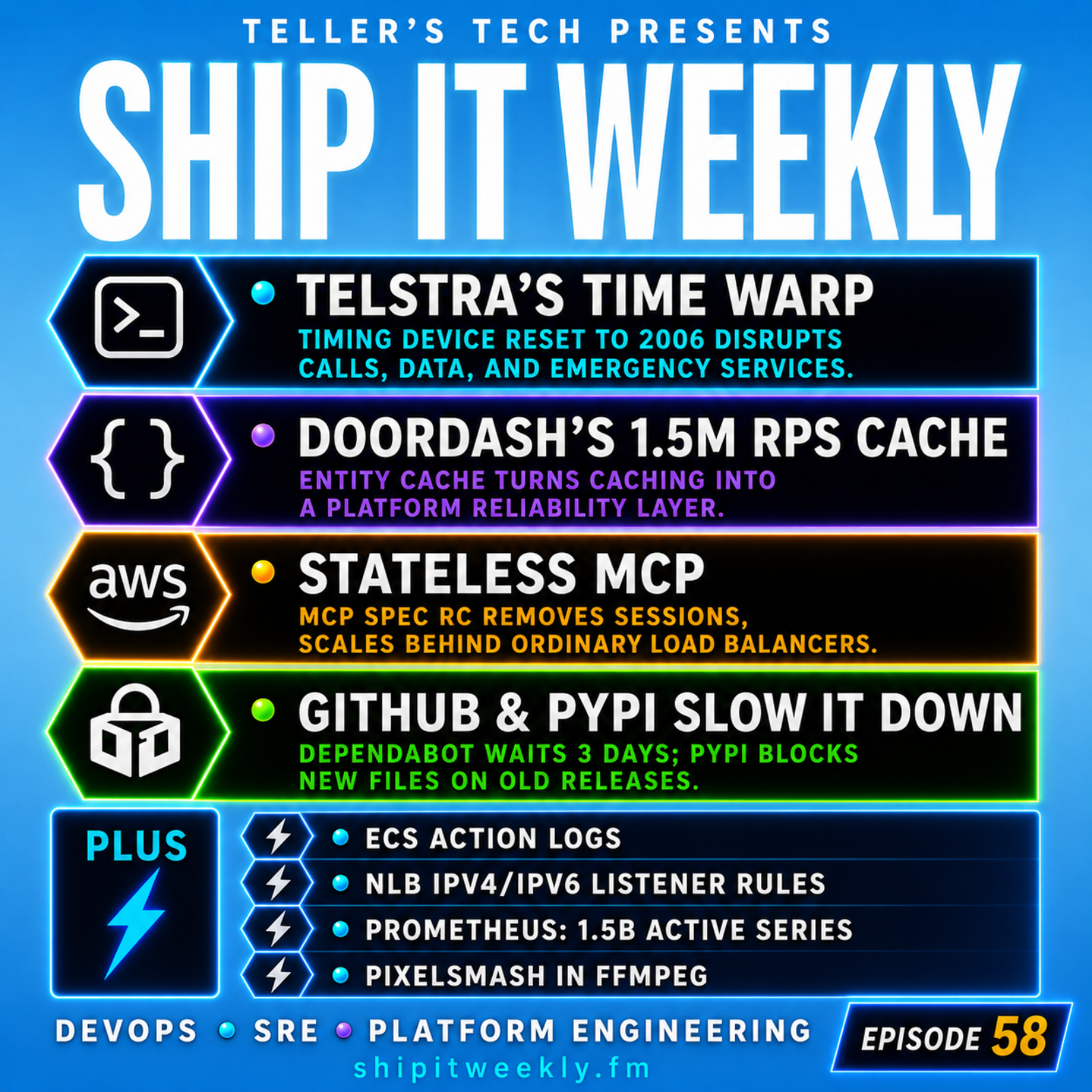 Telstra’s Time Sync Outage, DoorDash’s 1.5M RPS Cache, Stateless MCP, GitHub and PyPI Supply Chain Delays, and Why the Quietest Infrastructure Often Has the Biggest Blast RadiusShip It Weekly · on Model Context Protocol (MCP)97 / 100
 AI Agents, False Productivity, and the Sales Team Reset with Gabe LarsenMake It Happen Mondays · on Claude Cowork91 / 100
 The End of Software as We Know It: How AI Agents Are Rewriting HR, SaaS, and Organizational DesignAI First with Adam and Andy · on Model Context Protocol (MCP)81 / 100
 Boilerplate in Seconds: AI Handles Setup, Engineers Handle Logic - Klaudia Dussa ZiegerSoftware Testing Unleashed · on Model Context Protocol (MCP)80 / 100
 How airfocus Is Rebuilding Product Ops Around AI AgentsProduct Team Success · on Model Context Protocol (MCP)80 / 100
 How to make $10K/month selling AI services (step by step)Build With AI · on Claude Cowork79 / 100Episode 433: Passkeys, Passwords, and the End of SMS MFA88 / 100Episode 431: Agent Governance Is the New App Governance77 / 100Episode 430: Scouting out Microsoft Scout65 / 100Episode 429: Getting started with LLM Wikis85 / 100Episode 427: Copilot Cowork Hands-On Experiences77 / 100