Microsoft Cloud IT Pro Podcast · 2026-07-02 · 48 min
Key moments - from our scoring
Substance score
57 / 100
Five dimensions, 20 points each
As AI agents multiply across enterprise environments - with many organizations having hundreds in use simultaneously - governance challenges are emerging that dwarf traditional application management. Ben and Scott explore how agent governance differs fundamentally from app governance: it's not just about identity and access control, but also about data exposure, LLM interactions, connector permissions, lifecycle management, and the exponential amplification factor where one person might deploy twenty agents. The discussion covers Microsoft Agent 365 as a emerging control plane, the identity layer (who creates agents, who uses them, what permissions they have), data access issues (what sensitive data agents can retrieve and share with external LLMs like ChatGPT or Anthropic models), and the sprawl problem where custom agents, Dynamics 365 agents, and third-party integrations (Databricks, Canva, Mural) create visibility gaps. They emphasize that current tools like Agent 365 show registered agents but miss unregistered custom agents created outside official channels, leaving administrators with incomplete pictures of agent activity across Teams, SharePoint, Exchange, and other tenant services.
Microsoft Agent 365 is a control plane designed to provide visibility and governance over agents in an organization, showing registered agents across Dynamics 365, custom agents, Microsoft-native agents (like the Planner agent and SharePoint admin agent), and third-party integrations. However, it only captures agents that are formally registered with the service and misses custom agents created outside its registry.
Agents can retrieve sensitive business data and then interact with external LLMs (ChatGPT, Anthropic models, DeepSeek) to summarize or transform it, creating uncontrolled data leakage channels. Additionally, agents can improvise API calls based on documentation they find, bypassing intended security boundaries and tool restrictions that would normally limit what systems they can access.
One person in an organization might create or deploy twenty different agents, meaning an organization with 100 employees could have 2,000+ agents in active use, creating a sprawl problem where administrators lose visibility into what agents exist, what they access, and what they can do.
Traditional app governance focuses on identity and access control for a single application, but agent governance must address identity (who creates and uses agents), data access (what sensitive data agents retrieve), connector/API permissions (what tools and external services agents can call), lifecycle (who approves and retires agents), and security (prompt injection, privilege creep, malicious actors) - across multiple interconnected agents.
Unregistered custom agents created outside Agent 365's registry don't appear in governance visibility, leaving administrators unable to see or control them. Some agents may have SDKs or integration requirements that custom developers skip, keeping them invisible to centralized governance tools.
Our reviewer’s read on each dimension, with quotes from the episode.
The episode contains useful frameworks for thinking about agent governance (identity, data access, lifecycle, security) and some actionable steps (viewing Agent 365 registry, checking permissions, understanding certification), but suffers from significant pacing issues. A lengthy opening rant about email account hijacking and passwordless authentication takes up roughly 15 minutes before the main topic begins, and the conversation frequently meanders into vague observations about complexity without drilling into specifics. The technical substance is moderate - useful but not densely packed.
you have to ask not only what are the apps, but now it shifts to what agents can access my tenant, what agents can act across my tenant
I have 295 agents in my organization
The core thesis - that agent governance mirrors app governance but with additional complexity around data access, lifecycle, and autonomous execution - is sensible but not particularly novel. The hosts largely repackage existing Microsoft guidance and frameworks without offering counterintuitive insights, contrarian takes, or first-principles analysis. The comparison to MAM and app consent is straightforward application of known patterns. Little here would surprise an experienced enterprise architect.
agentic governance or agent governance is the new application governance
agents are applications but they're applications with, like, just a broader set of things that that you need to go look at
The episode features Ben and Scott, who appear to be knowledgeable practitioners with hands-on experience in Microsoft 365 and Azure environments. They reference personal lab testing, client engagements, and real tenant configurations, which adds credibility. However, neither guest appears to be a publicly recognized authority or operator at extreme scale, and there are no external guests or expert voices. The hosts are competent but not marquee-level figures in the enterprise AI or governance space.
my day job, I think a lot about SDKs and rest APIs
I've compared this across a couple platforms
The episode includes some concrete specifics - 295 agents in a small tenant, Agent 365 registry features, Graph permission examples (group.read.all, teams.activity.send, channel.read.basic.all), privilege levels (low, medium), and references to tools like Databricks, Mural, Canva, and Asana. However, these are scattered and surface-level. The hosts rarely provide quantified outcomes, timelines, cost examples beyond a GitHub Copilot reference, or detailed case studies. The certification discussion identifies lack of transparency but doesn't provide data on how many agents fail certification or what the actual compliance gaps look like.
I have 295 agents in my organization
Channel read basic all to read channel names and channel descriptions in Teams
The conversation is friendly and explores multiple angles (identity, data access, lifecycle, security, certification, cost), but the hosts rarely push back on each other's claims or dig deeper when vagueness emerges. Follow-ups are often soft - acknowledging agreement rather than challenging assumptions. The opening rant, while perhaps relatable, consumes disproportionate airtime without payoff. The hosts sometimes state frameworks without working through examples in detail. The exchange on certification compliance shows some pushback, but overall the tone is more collegial than investigative.
You said you weren't gonna get me ranting, but this is gonna be an interesting one
Thanks for that because I thought I was going crazy because I did the same thing
Computed from the transcript - who did the talking, and the words that came up most.
Welcome to Episode 431 of the Microsoft Cloud IT Pro Podcast. In this episode, Ben and Scott get into why agent governance is quickly becoming one of the most pressing challenges for Microsoft 365 administrators. As agentic workflows become more common across Copilot, Copilot Studio, and third-party platforms, organizations are dealing with a sprawl problem that looks familiar but hits differently. Agents bring their own identity, data access, permissions, lifecycle, and security concerns all at once, and unlike traditional apps, a single user can now have dozens of agents acting on their behalf or autonomously across Teams, SharePoint, Exchange, and beyond. The episode walks through Microsoft Agent 365 as a starting point for building that control plane, including the agent registry, user and permission scoping, and the certification tab where publisher attestation gives some visibility into compliance claims though with notable gaps.
Transcribed and scored by The B2B Podcast Index.
- Welcome to episode 431 - of the Microsoft Cloud IT Pro podcast recorded - live on 06/26/2026. - This is a show about Microsoft three sixty - five and Azure from the perspective of IT - pros and end users, where we discuss the - topic or recent news and how it relates - to you. In this episode, Ben and Scott - get into why agent governance is quickly becoming - one of the most pressing challenges for Microsoft - three sixty five administrators, - As agentic workflows become more common across Copilot, - Copilot Studio, and third party platforms, - organizations are dealing with a sprawl problem that - looks familiar but hits differently.
Let's dive in - as we talk about Copilot agents and the - similarities and differences to enterprise apps. - Can I give you a quick rant? I - don't know. Is it gonna make me start - ranting?
Is this gonna be the episode where - Scott rants and Ben gets ranting? Alright. What's - your rant? I happen to have an email - address, an Outlook dot com email address that - is a very short - handle, and it's a very common thing.
- But it's kinda like a a vanity handle. - Whatever. But it would be something that's pretty - common, - especially - if your name was Scott and your last - initial started with an h. - So - I have this thing - where - I don't understand - why - people - use this email address, which is my email - address, to be very clear.
Like, it's all - locked down to me. I've got all my - YubiKeys, - authenticator. - Like, I closely monitor the logins because I - do get these weird, like, who somebody's trying - to log in to your account kinds of - things, right, with password sprays and everything like - that. But so so it's a real email - address.
I use it. Like, it's a real - email address. Unfortunately, - I have this issue where other people - are also using it as a real email - address. Like, I had somebody the other day - went and signed up for a Walmart account.
- So they signed up for a Walmart account. - Somehow, they were able to sign up for - a Walmart account, authenticate with their phone number - to that, like, they didn't need to get, - like, the access code out of email or - things like that. And then now they've got - a Walmart account, and they're making purchases on - it. And I'm getting, like, the invoices and - the receipts.
- Normally, what I can do is when I - get these kinds of things, I go and - I - I say, hey. I forgot my password, and - I request the account to be deleted, or - I just change the password to something that's, - like, black holes. Like, I'm not a smart - person and use somebody else's email address to - sign up for this account. Like like, it's - just this big long string that can be - crammed in there.
But the problem I'm running - into lately is there are sites like Walmart. - I've got PayPal kicking around, a couple of - banks that people have signed up for, like, - stuff that I should not be getting. Right? - So but I can't go in, and I - can't request the deletion of the account.
So, - like, Walmart, you go in and you say, - hey. Here's my email address. Send me a - code. It says, great.
I sent you a - code, but you have to authenticate with your - phone. Well, I don't have my phone. Right? - Because it's not my phone.
It's somebody else's - somebody else's phone that that put in there. - So I have this email address that more - and more, I cannot use for anything personal - because there's so many other people in the - world with the same first name and last - initial - that are using it for all their stuff - and getting it pushed through. I I have, - like, Walmart account, bank accounts. - I have a PayPal account in The UK - that somebody signed up for, like, can't get - into.
I had this week, somebody did Instacart, - and another person did Grubhub and signed up - for Grubhub Plus. Cool. - It's - really weird. - And I would understand, like, common email address, - like, - first, last initial, blah blah blah.
Like, somebody's - just pumping it in to - sign in to Wi Fi somewhere randomly. Right? - And they don't care and, like, hey. I'll - go spam this other person kinda thing.
But - these are, like, legit - accounts. These are legitimate - things. People are buying stuff. They're getting bank - accounts.
- There's some guy in Iowa - who runs an entire survey business, and I'm - getting all his invoices - and all the surveys - that he's, like, sending back and forth to - the companies that he's working with. Like, I - don't understand - how - this is the state of the world. It's - so strange to me. You said you weren't - gonna get me ranting, but this is gonna - be an interesting one, I think, that's going - to come up.
Not because part you mentioned - it in here. It was like a sub - bullet of what you said when you talked - about you needed your phone for authentication. - Is - my problem is I have password less set - up a lot of my accounts because I - don't wanna type in a password. And I'm - curious if you start seeing this.
The amount - of prompts - that I get an authenticator - because - and I've had a client that had this - too with one of their email accounts because - nobody needs a password because it relies on - the push notification. - I get, like, I get spammed with authenticator - requests, and it's not approve or deny. - It's number matching once. And I'm like, okay.
- I don't think this was me. Sometimes it's - close to the same time I do it. - But now I started seeing it's, like, from - Germany, and it's from The US, and it's - from here, and it's from there as and - there's no way to stop it. Like, I - can't go change a password.
I can't go - change my authenticator - app. Like, in this world of passwordless, - I feel like these authenticator - spamming - number matching things - are just going to get annoying. Like They - are very annoying. So so I have the - same problem, again, on my Outlook account, but - mine aren't number matches.
- So the problem is the way Microsoft does - it, e even if somebody happens to find - a way in, like, Microsoft's rationale is, like, - hey. We're still sending you the note the - push notification. Right? So, therefore, it's up to - you to approve or deny.
But I don't - know if the push notification - like, I know which ones are from me - in the moment as a number match. Like, - that's very clear. Yep. You might have something - in the background.
So, like, for example, for - me, I sign into my outlook.com - account through Outlook on my desktop. Makes sense. - Right?
It might be Outlook just trying to - reauthenticate. It might be my iPhone trying to - reauthenticate. It might be my tablet or another - computer. Like, could be some service I signed - up for, and I gave permission - to read my But you don't know what - it is, and - Microsoft - in they they used to publish all the - security information.
So you could go in and - you go to, like, account.microsoft, - and you could see all the sign ins, - and you could see where they were coming - from. That got so noisy that they stopped - publishing those. So now I get all these - push notifications.
- I get all these authenticator prompts, and I - have no - way to even know where they're coming from. - Like, I don't even know if they're coming - from Russia or China or The United States - or anything else anywhere. Because, like, I'll I'll - tell you, like, if I go and look - I was just doing this before I hopped - on because I was trying to clean up - some of these emails out of that mailbox. - So I went and looked.
The only login - that shows up in when I go to - account.microsoft.com - for that - Microsoft account, the only login that I see - is one login from today. Okay.
I authenticate - to that account a ton of times today - and from my iPhone. And so, like, my - iPhone's running Defender, - and I have a VPN client on there. - So, theoretically, my iPhone should be showing up - as a separate login, like, being routed through, - like, Defender and, like, Seattle where the VPN - location is. Or if I hop on to - Tailscale and I happen to have an exit - node in another location, - shouldn't, like, the login thing when I get - reprompted for auths, shouldn't it show me that - I relogged in from a new location?
Like, - they they just, like, masked all that information - and hid it away. I think it was - I get why it was noise for customers. - I bet it was a ton of telemetry - for them to collect as well and have - to kinda store and push out and surface - and query and - and all those kinds of things. But in - this world of, like, passwordless, - you tie a phone number to your account, - it's no longer - just a password kinda thing.
It is it's - rough, especially when, at least in my case, - for people who haven't gone through this, it - stinks when somebody else is using your email - address. It's really annoying. Thanks for that because - I thought I was going crazy because I - did the same thing. When I started getting - error as I've been getting all these random - prompts, I wanted to go see, like, where - are they coming from?
Is there any way - I can report these? And I had the - same thing. I'm like, I thought I used - to see all the login attempts, and now - I don't see anything. And I was like, - maybe I was getting entry confused with my - personal account, but they did used to have - that, and they took it away.
They very - much cut it back, - and they removed a bunch of controls there. - Like, they used to have stuff for, like, - reporting things Yep. And all that. So it's - down to the point now where even if - you go into the docs for, like, reading - about, like, what recent activity is, - they go so far as to say, if - you get an email about unusual activity and - you're not sure - if it's from Microsoft, just go ahead and, - like, sign into your account.
And even if - you get one about unusual activity that is - from Microsoft, when you sign into your account, - the detail's not there. There there is no - detail there. It's just it is completely - opaque. I I don't know how they could - make it better versus going back to the - way it used to be.
Like, show me - every time you send me a push notification, - show me why. Like like, give me a - little bit of insight into where that was - coming from. Like, because if I could even - see, like, a user agent string and a - timestamp, like, if I could see, like, oh, - that was Outlook from macOS - at 03:25PM - on Friday. Oh, that was me.
Like, I - was just in Outlook. - And, oh, yeah. I did get a little - error pop up or things like that. So - yeah.
- Any anyhoo, that that's my rant. Somebody else - having your email address sucks. - Passwordless - is - super annoying in a world of opaqueness. - I think you should like, I think the - vendor should air on on on the side - of verbosity - and let folks know, but, unfortunately, - they do not do that.
Yes. And report, - like, if I report that I'm not logging - in from this particular one, I'm surprised how - many keep coming through that appear to be - coming from the same location. Mhmm. And I - don't know how you get around it.
Because, - ideally, I would say, you know what? I'm - not in Germany, and, frankly, I'm not in - any country but The US. Any push notification - from anything other than The US should be - denied. Now if I travel, - I'd want a way to open that back - up.
But for now, like, I should not - even be having to deal with those push - notifications. - It's interesting. It's weird. Actually, for my Microsoft - account, - I think I'm at the point where, like, - at least for my consumer account because of, - like, the state it's in.
I was gonna - say consumer accounts is where I have this - problem more than my business one. Definitely the - most there. But for that, I would actually - prefer to be able to turn off authenticator. - Like, if I have another passwordless - mechanism, - so if I've got biometrics just through my - phone with a passkey - or I have a YubiKey or something, give - me the option to turn off authenticator.
- You let me turn off my phone, like, - my phone number and OTP. - Let me turn off authenticator. Like, don't force - I'm sorry. Like, that piece of garbage application, - like, at down my throat and make it - the only the only pass in.
- If you're managing file storage today, you've probably - felt the pressure. Refresh cycles are harder to - plan, costs and complexity are increasing, especially as - file workloads scale across regions. That's why Microsoft - customers trust Nasuni. As an Azure certified software, - Nasuni provides a global file system designed for - enterprise scale environments, - keeping file data secure, governed, and accessible across - Azure environments without added infrastructure complexity.
- It's the foundation to keep your unstructured data - stable even as your infrastructure evolves. To see - how much you could save while keeping your - initiatives on track, visit nasuni.com/tco. - That's nasuni.
com/tco. - You know what else people are having to - deal with, Scott, in managing outside of authentication - requests? This was such a good transition to - our main topic for the day. It was.
- Good job. - And agents. Agents are everywhere. Agents are everywhere.
- So this is an interesting one. Like like, - my day job, - I think a lot about - SDKs and rest APIs - and things like that. And even in, like, - my day job, I spend more and more - of my time thinking about how agents interact - with those things over humans as more and - more stuff gets handed off. And I'm definitely, - like, in that ecosystem.
I think you're in - that ecosystem as well, kind of being tied - into even just, like, generic Microsoft three sixty - five. So if I'm just in Microsoft three - sixty five, let's say Copilot, I've got a - researcher agent. I've got an analyst agent. I - can connect to - to SAP.
I can connect to consumer services - like Canva, - all these different things. And now that Cowork - has g eight, I think you start to - see - a a little bit more probably usage - and uptick there. It's becoming, like, more prolific, - I think, to see - agentic workflows, - whether those are, like, true, like, bounded agents, - they're just kind of fluffy declarative agents in - m three sixty five Copilot, whatever happens to - be, but agentic workflows - augmenting - more and more of just the day to - day of what's going on there.
So that - raises an interesting question. In a world of - agents - and likely more agents than humans that are - in your organization because there's an amplification factor - of I'm one person, and I might use - 20 agents. - How do you kinda know what's going on - out there? How do you monitor?
- How do you respond? And I think, largely, - like, there's an argument to be made to - say is that - agentic governance or agent governance - is - the new - application governance space. So much like you might - have been in, like, a world of MAM - and managing to the applications - that your users could use, now you're in - the world of agents, and you also have - to manage to the agents that your users - can use. Or maybe you're in a fully - ungated world, and you don't know what agents - your users - are using out there.
And it's such a - wide landscape - and wide surface area for agents between Microsoft - three sixty five Copilot. - You got Copilot Studio. - There's the whole just broader - Microsoft - security stack, - and you kinda gotta get out there and - find a way to - govern agents - either as applications or as, - I guess, artifacts of your enterprise - and kinda part of your - core business. It's interesting because I in some - respects, I always thought about agent governance as - also - the new - almost people governance - to your point, but agents are also apps - and agents have to deal with sprawl.
It's - governing agents is turning into I feel like - a massive thing. Because to your point with - apps, you have, like, who can access this - agent? Kinda like you'd have to manage apps. - Who can log into it?
What can they - do with this agent? But then you also - have agents running - similar to people where it's the data issue - is what data can these agents access and - which agents can access which data, and how - do you protect data from agents. And then - you have - the sprawl aspect of it of, again, people - just going out and adding agents, and - you have, like, ghost agents now. The whole - in some respects, it's I would say it's - turning into the one of the more complicated - things to govern because there's so many different - aspects to it in terms of what agents - can do and how people access them and - how they do things and even how agents - manage agents.
You're getting into these things now - where you have agent orchestrators that manage - sub agents. - And agent governance, I feel like, is it's - already started, but I feel like it's just - gonna continue to explode - over the next, I don't know, months, years - as you try to figure out how to - govern this? So it's a very broad area. - I think in and it's not probably unfamiliar - to most administrators.
Like, you're used to governing - specific aspects of your platform. So let's say - maybe, like, app consent. - Hey. I created a new I needed a - new enterprise app registration created that that came - with an owner, came with a specific set - of permissions - on the graph, things like that.
Maybe you - had a Teams app, again that had its - own kind of construct. You had SharePoint that - had its own construct. So we're very used - to dealing with the individual constructs, - but when they start to get mishmashed into - this one - broader bucket, which has a whole bunch of - different subcomponents, - it becomes - really hard. And I think this is where, - like, Microsoft comes in with things like Agent - three sixty five and says, hey.
You need - more of a control plane here for agents - because it's an identity - problem. So it's not just who is the - agent, it's who and or what is the - agent. Like, who created it is one question. - Who can use it or who consume it - is another question.
What permissions does it have? - Does it have different permissions and different modes? - K. That that that's just identity.
Right? You - have five questions right there. - You've got this - data access issue - or kinda - lack of visibility or something that you need - to kinda figure out is, - what's the data that these agents can retrieve? - What are they allowed to do with that - data?
Do they transform it? Do they pass - it on to another agent or another process? - Are they just summarizing it? Like, when they - go and do the retrieval, - let's say you retrieved a bunch of sensitive - business data, and then you're telling that agent - to summarize it in a table.
Well, it - might be interacting with, like, an LLM, so - it could be chat GPT - or an anthropic model or deep seek or - whatever - out out on the sides. Now you gotta - worry about not only what data it can - retrieve, what it can summarize, what it can - transform, but you also have to worry about - leaks, like like, pretty big. - You have an application problem - because you don't always have visibility into - not only, like, what are the connectors and - tools and actions that these agents use, but, - also, like, what are the raw APIs?
- I've seen some things when I'm interacting with - them because the LLM guides them into it. - They'll say like, oh, hey. I don't see - a tool for blah blah blah, but I - read the documentation for this thing, and I - think it's got a REST API. I'm just - gonna, like, go wild and - see what I can get out of it - with, like, an external service call.
And, again, - you're back to data leaks, all that kind - of stuff. You've got a life cycle problem. - So - we had the identity problem of, like, who - created it, who can use it. There's also - a life cycle problem in who approves it, - who owns it, like, how do you attribute - ownership to an agent, - when and or if should it be retired, - what happens when the person who made the - agent, like, if it's a custom agent, what - happens when they leave your organization?
That's a - big problem with things like power automate flows - and everything else that's out there, but that - was just a single space. Now you're in - a multispace kinda thing. And then there's just - all the security stuff. So - bad actors, malicious prompts, - prompt injection, - risky connectors, - maybe there's, like, a mismatch in privileges and - configuration of an agent, so you get this, - like, creep aspect - that goes in there.
So so it's really - hard because - the question, - I think, used to be, like, what are - the apps that have access to my tenant? - And you could kinda go scope that down, - and you could run-in, - and you could start to wrap your head - around that. - But now the question - is - really different for administrators - in these environments where you have to ask - not only what are the apps, but now - it shifts to - what agents - can access my tenant, what agents can act - across my tenant.
So it's not just about - access in a single area, but it's also - about, like, across the spread of tools, Teams, - SharePoint, - Exchange, all those things. What are the tools - they expose? What are the tools they actually - use? - And what's the business data that they have - access to and that they can - reason over?
So it just makes it so - much more of, like, a heady thing. I - think Microsoft is approaching this in a manner - of saying, hey. We have things like Microsoft - Agent three sixty five, which start to lay - a groundwork - for a control plane for - management - of agents - to help you kinda get there. So it's - a path forward to observe, - have some measurable governance, - some - sense of - security with a agentic use in your organization.
- But even then, I think there's a lot - of room to grow and a lot of - space to - kinda pick things up because as much visibility - as things like Agent three sixty five give - you today, they don't give you a full - three sixty view yet. And I think some - of it is gonna be how do people - start - trying to get that view, and are people - going to adopt agent three sixty five? Because - to your point, it's going to pull in - a lot of things. Like, I go to - my agent three sixty five today.
Out of - the box, I haven't done anything special, and - I have 200 - to your point about exponential growth, I have - 295 - agents - in my organization. - These are not And your organization, - your tenant is tiny as far as, like, - the number of users. - It's not it's not an it's not like - a thousand person org. Mix of things.
Like, - I've done some stuff with Dynamics three sixty - five. So I have a bunch of Dynamics - three sixty five agents. - And then I do have a few custom - agents. I have the Microsoft agents, like the - learn agent - and - the planner agent - and the SharePoint admin agent.
- And then it does show and this is - an interesting thing that it shows us. These - are just agents that are registered with the - service. It shows things like Databricks - and - Mural and - Canva - and Mural, - where it's agents that are available, it doesn't - necessarily - mean they're connected, - but it means they're registered with the service. - But in order for agents to continue being - registered as people maybe do create ones that - they're using, - there's still - SDKs and different things that custom agents, - depending on where they're created, - there are certain things that have to be - done with those agents - to get them to show up in agent - three sixty five.
If someone goes off and - creates a certain agent somewhere and doesn't tie - create the hooks to tie it into agent - three sixty five, it may not show up. - There are some things that are still in - preview, like registry - sync, which does allow you to start - connecting supported - third party AI platforms and syncing - third party agents - in. So, like, if you have agents out - on Amazon Bedrock, - Google Vertex, - Salesforce, Agentforce, - Databricks Genie, - you can set those up to start syncing - those agents into agent three sixty five two.
- But there's there is still also a level - of adoption of here's the tool, here's, - not a framework, but a platform we've given - you to manage agents. There's still some of - that onus on organizations - to make sure all those agents are actually - getting in there. It's not the kinda go - click a bot and and set it and - forget it - kind of thing that you need to kinda - get in and figure out. Because it's I - think it was hard enough to manage the - tenant and the sprawl and everything else that - came along with it, and now it's just - that much more.
- This episode is brought to you by Trusted - Tech. If you're managing Microsoft three sixty five, - you already know licensing isn't simple. E three - versus e five, the brand new e seven - licenses, - Copilot security bundles, and with price changes coming - in July 2026, - the stakes are getting higher. Trusted tech helps - IT leaders make sense of their Microsoft three - sixty five environment with a free licensing consultation.
- Their engineers analyze what you're licensed for and - what you're actually using and where you can - optimize, whether that means consolidating security tools, preparing - for copilot, or eliminating wasted - spend. Plus, they offer proactive and reactive support, - which has been awarded yet another solution partner - designation from Microsoft - for support services. - If you want a clear data backed plan - that has helped over seven five hundred subscribing - customers save up to 20% on Microsoft three - sixty five before your next renewal, visit trustedtech.
team/mscloudprom365 - and schedule - basics - and maybe take a step back and say, - like, hey. Like, what can you start to - do with agent management - in the Microsoft - three sixty five admin center? So when you - go in for - kind of this govern - governance aspect of - agent three sixty five, which I don't know. - It's a weird tongue twister.
I keep wrapped - in my head and getting wrapped on it. - So for me, the first thing I do - when I'm going into - a - client or even in my own environment is, - I would say, where I think most people - should start, where I usually start, is actually - looking at - all agents and looking at that agent registry. - And I will say if you don't have - agent three sixty five licensed, I've compared this - across a couple platforms. - You get some of this.
You don't get - the full - you don't get the full report. So if - I go into agent three sixty five and - go look at all agents, it gives me - the name of the agent - if it's available. So am I actually making - this agent available to my users? The platform - that it came from, so is it Copilot - Studio?
- Is it third parties are just blank? Is - it Foundry? - Is it some of those other ones? But - then I do start seeing interesting things.
And - this is the part that's always fascinating to - me is I can see the risk of - the agent based on some criteria that Microsoft - has established. - I can see the active users, and I - can see the total sessions. - So one of those very interesting things with - me is I just go sort this agent - registry - by active users or by total sessions. So - I can go in and see that - I have - 50 people - using - this HubSpot - agent that are active users.
And across those - 50 users, maybe I have 500 - total sessions. It starts giving me just some - of that before I even do anything else, - it gives me some of that big picture - of - what agents - have people started - adding. Because - you can just go into - Copilot - and start adding agents. Maybe you have some - added, and you wanna know are people actually - using them.
It just starts to give you, - again, that picture - of here's what's out there. Here's what people - are using. I had a very different kinda - take when I had stood up a tenant - and was going through and looking at some - of this. So I kind of approached it - from the lens - of, - I I I guess, maybe, like, even - an internal, - like, rubric for - where does the greatest risk lie.
So it - wasn't so much about usage. It was more - around - what are the categories of these things. So - if you see, like, teams pop up in - the list, do I need to worry about - teams right now, or do I need to - go worry about - the third party - connector kind kind of thing? So if there - was stuff in there, let's say, that was, - like, published by your organization, - the the those might be a little bit - safer.
Right? Like, you've probably published them out - there for a reason. - They're, - like, predictable to you, so you see them - and you know what they are. - There's the whole category - of - custom agents.
So somebody in your organization - created a custom agent - in things like Copilot Studio, which there's a - weird new backdoor in the Copilot Studio. - It, like, even if you haven't licensed users - for it after they GA'd co work. So - so maybe there's some things that you wanna - look out for there, or you're just interested - in, like, what are the parts of my - organization that maybe have a little bit more - maturity - and are going and running with these things? - My my threat matrix for things that were, - like, Microsoft agents, so whether it was Dynamics - or - internal component kind of thing.
Hey. If it - was developed by Microsoft and it was integrated - with Microsoft, like, that might not be my - my primary concern. - I'd rather bubble up things like the external - agents, so stuff that was created by either - a third party - was maybe created by, like, a developer that - a random business unit of yours - went and spun up because, you know, they - were able to or you didn't have the - existing - governance constructs in place in your - in in your tenant already.
So and then - from there, dial into usage and see. So, - like, if I said, hey. - The external - or the, yeah, external partner agents and maybe - custom agents created, like, within my orgs. Those - are my two biggest, like, factors.
- Then I'll go sort by usage and see - if you - can kinda suss out who's doing what there. - And I guess maybe mine isn't necessarily usage, - but it's looking it's looking for similar types - of stuff as you based on usage. That's - how I would freight. That's what I'm looking - more at as again, if co work shows - up at the top of my list of - usage, big deal.
If Asana shows up and - I'm like, I don't even know anybody was - using Asana in the organization, and now there's - a bunch of sessions with the Asana agent, - it's why or - something that's risky. The other thing I think - that's fascinating, and I don't know how much - you played with this, is once you find - one of those agents, clicking on it and - looking at all of the details - inside - of each one of those agents. I don't - to me, I think I don't know how - much it's a governance topic as much as - it's a information as you're maybe assessing - the risk of it, or you're assessing - why is this agent there, what are people - doing with it, or if you need to - from the governance perspective, - if you deem need to go in and - start limiting - who can use that agent.
Again, it's that - weird mix of now I'm not worried about - just users. I'm worried about APIs - and what they consume. And so now you're - back to the identity, the data access, - the that that whole spread of of things, - and it's just it's a lot of, like, - cognitive load. So you can kinda see what - Microsoft's doing by trying to make it easy - to see.
So, hey. Cool. I got a - single pane of glass. - I've seen tenants where it's like, that single - pane of glass is overwhelming.
Like like, it's - not helpful. It's more like, oh my gosh. - I'm gonna have a heart attack just having - to, like, - consume this page and trying to figure out - what do - I need to do here, - especially when you're not - maybe - you you haven't read your way all the - way through the documentation or you haven't, like, - fully started to consume these offerings. I think - Microsoft is trying to, like, move the needle.
- I don't know if you've had a chance - to play with the the shadow AI component - and some of the stuff that comes out - of Frontier. - So you've got this if you're in the - Frontier - program, - okay, because, hey, - you're on the latest cutting edge of AI - innovation here. It also opens up the shadow - AI piece in the admin center there, and - then that starts to get you - information - about, - like, agentic harnesses in use within your organization. - So let's say you had somebody who went - out and installed, like, OpenClaw, things like that.
- I don't know if it can detect, like, - some of the other harnesses, like Hermes - or or things like that, but it's very - much like preview capability, but helps you start - to rationalize - it just a little bit so you're not - having to, like, do everything - your yourself and have some of that overwhelming - stuff. Because if you are in an established - tenant and you were licensed already for Copilot, - like, you had an e seven. Right? Like, - we we've talked about e sevens in the - past.
So great. You upgraded those. All of - a sudden, all your users are licensed for - this stuff, and they're just out there, like, - doing whatever. And they've been running that way - for three months, six months, a year if - you've never been in there, like, it's gonna - be a little bit of an overwhelming experience.
- I was hoping for more in Shadow AI. - Maybe more It's pretty bare bones today. It's - pretty mine has open claw in it, which - I can start detecting. And then it has - a coming soon.
And And under coming soon, - I have Ollama in Po desktop from Quora. - So those are the only I have one - it can detect too that are coming. I'm - surprised - there's not more in there. But, again, we'll - put our disclaimer on there of Frontier as - up and coming.
Think of Frontier as, like, - beta preview type stuff. Hopefully, we see more - coming in there soon. Or, like, where does - Scout show? Because Scout's a harness, but it's - not Shadow AI.
- But there's no other, like, dedicated - pillar category, - yeah, for - for harnesses - or or things like that. So because Scout - doesn't even show yeah. Scout shows up nowhere - right now in here. It's a weird world.
- So maybe we should talk a little bit, - in the couple minutes we have left, about - kind of visibility into agents - and what you can see about them. Because - we kinda talked about high level. You can - get in. You can see what agents are - in use, the categories, - things like that.
But then when you actually - have an agent that's out there, you can - get a little bit of high level detail - about what the agent is. You get insights - into the users, - potentially data and tools, permissions - for that agent, activity, things like that. So - so maybe we hop through a couple of - those just for folks who can get a - sense of what they can dig into. To - me, this - is super helpful when you're trying to dig - into it.
Like, the details initially - gives you things like when it was created. - Has it been updated? Agents get updated over - time as you build them. Who published them?
- Owners. What channels are they available in? So - I'll do Asana, for example. I use Asana.
- So it's available for me in Copilot. It's - available in Outlook. It's available in Teams or - the different channels. So where can people access - it?
Details really gives you a good overview. - It even gives you, like, if there's - instructions - with that agent, - if it's tied to an environment, this is - gonna be more applicable to, like, a Copilot - Studio agent, which environment is it in, just - a good general overview - of that agent. - Users - is more controlling it. So we talked about, - like, again, from an application perspective, what does - the agent have access to?
Users is who - is it installed for and who is it - available to or who is it shared with. - So you can like, if you're a developer - and you've created it, you can just share - a an agent with somebody. But then available - to is who can actually install Asana? Should - it be - shown to all your users or are there - just specific groups that should be allowed to - install Asana?
- And then installed for is do you actually - wanna pre install it? All my users are - gonna get Asana by default, So it's a - little bit for me, it relates very closely - to Intune when you have, like, required versus - available. Installed is this is required. Everybody gets - it.
Available is they don't have to have - it, but if they want it, they have - the ability to go add it to Copilot. - And that's back to the, like, analogy about - applications. Right? So so age agents are applications, - but they're applications - with, like, just a broader set of things - that that you need to go look at.
- The other interesting thing - about, like, the that that analogy of apps - to agents - to carry it forward - is you've also got options around, like, agent - availability and installation. - So there's a difference between - making an agent available - and letting users - discover it versus - pre installing or pushing an agent or agents - out to a security group or a set - of folks that that are out there. So - there's this kinda like, I made it available - in visibility play, but users have to go - self install, and if they install, great, they - needed it, versus - I've made this agent - or this agent set of agents, whatever it - is.
It's actually, like, part of the user's - job now. Right? Where, like, you you push - it out like you would push out - an application through Intune - or things like that. - You're out of time.
Copilot needs to be - deployed ASAP, but is your tenant really ready - for it? Years of data, permissions, and users - lurk in its shadows, ready to be exposed - by AI. - Sharegate Protect sees it all, so you can - find the exposure risks, fix them fast, and - deploy AI with confidence. - Microsoft - three sixty five governance.
- We got this. Learn more at sharegate.com/governance. - And then on the other side, again, going - into applications, I'm gonna jump over the permissions - tab.
After you've looked at users or you - wanna do that, one of the other things - you have is permissions that are very much - like, if you're looking at those enterprise apps, - where it gives you and, again, Asana as - an example has - channel read basic - all to read channel names and channel descriptions - in Teams. This is where you need to - know, like, your graph permissions because all of - a sudden, you're seeing permissions. Scopes? I'm amazed - they haven't, yeah, like, done a better job - with abstracting the scopes.
It's still, like, group - dot read dot all, teams activity dot send. - So So it's all this random stuff. And - it makes sense when you see it, but - does everybody actually know, like, what What that - means? Yeah.
Like, what is user dot read - dot all, like, versus - another read dot all scope or permission - set that's out there kinda thing. - So so you end up in this world - of, like, there there's probably - I - my experience has been, like, there's common - permissions or, like, they're broadly applicable. Like, there's - a bunch of stuff out there that has - things like user dot read dot all. So - is, like, is that okay in your organization - that this thing can read your entire orgs?
- This thing can? Like, yeah. Maybe. Maybe it's - a requirement of it.
Maybe it's not a - requirement of - it, - what whatever it happens to be. And then - you've also got the whole delegated permissions - aspect of sometimes these agents act autonomously, - so the agent is the agent, and sometimes - they act on behalf of user, and sometimes - they do both at the same time. - Yes. And that's one, like, I do there's - a few things I like in here.
This - does show delegated versus application there. The other - thing I like here, and I don't think - it shows it when you're dealing with enterprise - apps or app registrations in Entra, is the - last column does show privilege level. So if - I'm looking at channel.readbasic.
all, - like, to your point, what does that mean? - Should I be worried about it? Here it - says that's a low privilege level. Okay.
So - if it's a low privilege level, I maybe - don't know what it means. It does give - it details. It says it reads channel names - and channel descriptions on behalf of the signed - in user. But then it says privilege low - versus - chat dot read write, that's gonna be a - medium privilege.
- So as you're looking through this too, you - can get you still wanna understand them, but - you can get a nice - scan of, - are there a bunch of high privilege ones - in here, or is it primarily just low - privilege? - What are those different privilege levels of those - graph permissions? There's another weird tab. We should - talk about it while we have a couple - minutes left.
Agent certification - or certification. - I'm waiting for mine to load. Agent certification. - Publisher - attested.
- This is - yeah. This is - one I have some clients that are very - concerned about. Yes. - And it's super important to them - is this gives a whole bunch of details - on - how is this agent certified according to - different - compliance - regulations?
- So I have a sign up, so I'm - gonna keep going with it. Is - one you have, is it publisher attested? So - for Asana, is this attested - by - a self - assessment reported - by Asana? So so to be very clear, - self assessment - by the publisher.
Publisher. So this is Asana - telling Microsoft. - Even for Microsoft, you'll see Microsoft certified - versus, - yes, - an Asana or somebody else or SAP is - saying, yes, self attestation. - This is an area that I would love - to see more transparency - about - what's actually checked in the self attestation flow.
- Like, how does Microsoft verify that? Because there's - callouts in the docs when you go and - and read through this. So let let me - pull it up so I get it right. - So Microsoft three sixty five certification - reflects an independent - security - and compliance assessment that's valid for twelve months - and helps confirm that the agent meets Microsoft - standards for handling tenant data.
Great. - What's in that independent security and compliance - assessment? And what is, like like so and - it's self attested for twelve months. What happens - if Asana pushes an update and now they've - broken their compliance all the way?
Like like, - did you come back and review that update? - Like, it's a - that one's a little bit of a weird - situation. - And I get where Microsoft is. Like, there's - no, like, broad, like, agent security consortium or - something like that where you can say, here's - the open standards.
Here's the way this stuff - goes. But, hopefully, the industry does coalesce there - over time. Like, you'd think they'd have to - for regulated industry and all that. How would - they even go through - certifying it?
Because it says right in here - when it's publisher tested that Microsoft makes no - guarantees regarding accuracy. - I mean, I suppose Microsoft could require certain - documentation to be uploaded, but even - when I go in it's - if I'm looking at something, an agent, how - would I even go in and verify that - it meets - HIPAA, that it's - HITRUST, that it's SOC one or SOC two. - Other than just getting - documentation, - like, to get SOC two, I know that - when you have to go through a whole - bunch of stuff, you get those you get - the certification.
- I don't know if Microsoft makes them upload - it, but you do get things like HIPAA, - where based on everything I've understood about HIPAA - is - you don't there's no stamp of approval of - once you do a, b, c, d, e, - f, g, you're HIPAA compliant. It's a lot - of focused on you need to make your - best effort to protect this type of documentation, - and one person's best effort might differ from - another person's - best effort. And it's really hard to actually - stamp something.
Like, even Microsoft three sixty five. - Microsoft three sixty five is HIPAA compliant. - If you go in and do the right - stuff, - is a sign of the same way when - they say they're HIPAA compliant or there are - other certain configurations you need to make. It - it's to your point, it's kinda - vague.
It's some of these can be hard. - Some of them are a little bit more - straightforward. - I think I said, I hope it's one - of those areas where, like, the industry coalesces - over time. Because today, it's - it's a little bit of, like, a gut - feeling of, alright.
So I know who built - the agents. Good. I was able to identify - that. And, like, how much do I trust - that person - or that publisher?
- And a little bit of light, like, what's - it been validated - against kind of thing. It's I think it's - no different probably than or or maybe analogous - to, - like, app stores. Right? Like, Google Play - or Apple running the - iOS or Mac app stores.
Right? Like, hey. - Customer signed it. They came in.
They pushed - it out, but that doesn't always - prevent malicious apps or other things - that that are coming through. That might be - a fun day, right, when the very first, - like, malicious, like, broad malicious agent comes through - And somebody's like, oh, hey. I gotta, like, - yank this agent out of every tenant, kinda - like publishers do with app stores and - and things like that. Conditional access for agents, - risky agent access policies and conditional access, Scott.
- All sorts of things. So, yeah, so I - I think this is, like, just to wrap - up, like, this is an area for folks - to - go and look at, especially if you're in - licensed environments and maybe you haven't had the - time to dig into it. Like, you should - have access, I believe, to all this if - you're on e sevens and kind kinda latest - and greatest there. There are ways to license - and get in.
So if your tenants are - configured for things like Copilot, - for Cowork, - and these things like that, it's worth at - least browsing through - and seeing what's out there if you haven't - been in there. And, hopefully, no, like, big, - like, red flags or overreactive - decisions - to take, but having some of that visibility - and starting to - kinda build some of that confidence because all - like you said, you're going from managing, like, - these individual constructs to managing a whole bunch - of bundled things at once.
- It's a lot more to - wrap your head around - and stay on top of, and then you're - very much trusting in vendors - and folks like Microsoft - to kinda give you the tools with the - insights - and visibility that you need. Yep. And really - starting to think about what does agent governance - look like at your organization. What is - how are you gonna start not just looking - through this, but how are you gonna start - managing those agents?
- What are people allowed to do? I feel - like it's also one of those topics that - a lot of people have even put much - thought into yet is what is agent governance - look like for our organization? - It's a rapidly - evolving thing. And probably even more important, - and I'm sure we'll wrap back around on - this topic sometime in the future, - but as all this stuff's transitioning - to - consumption based billing versus kinda like the broader - the broader unlimited usage.
- Now there's also the aspect of, hey. That - thing that you deployed to your users six - months ago that, I don't know, let's say - it costs $20 in usage per user per - month, like GitHub Copilot, for example, - all of a - sudden could be costing, - like, thousands, - tens of thousands. I've seen some really wonky - bills and and threads flying around on the - Reddits of the world and and things like - that where some of this stuff is going - off the rails for folks. So there there's - also a little bit of, like, a cost - management play for organizations - as to, like, who's using what, when are - they using it, things - in the world of certainly more in the - world of consumption billing than it kinda was - in the past a couple of months building - up to this.
For sure. Cost management is - one that'll be another topic for another day. - I started playing with it, though, because - there's a bunch of stuff that's going to - change. We'll have to fit that oh, by - the time we come out with a new - episode, it will have already been implemented.
There's - a bunch of stuff that changes on July - 1 in terms of availability if you don't - have some of that set up. The world - continues to change. Another topic, another day, Scott. - But for now Another topic, another day.
All - good. I'm gonna go to a graduation, open - house, and hang out with my family up - in Michigan. Alright. Good luck.
Have fun on - the Peninsula, Ben. Alright. Thanks. I will do - that, and enjoy your weekend, and we'll talk - to you soon.
- If you enjoyed the podcast, go leave us - a five star rating in iTunes. It helps - to get the word out so more IT - pros can learn about Office three sixty five - and Azure. - If you have any questions you want us - to address on the show, or feedback about - the show, feel free to reach out via - our website, Twitter, or Facebook. - Thanks again for listening, and have a great - day.
Other episodes covering the same guests and topics, from across The B2B Podcast Index.
 The Artisan Approach to AI Governance with Karl Herbert Grabbi from Credo AIParadigm Shock · on Agent governance80 / 100
 Treat AI agents like human employeesTrust Issues · on Copilot Studio80 / 100
 Episode 123: Agentic IdentityThe Azure Security Podcast · on Copilot Studio80 / 100
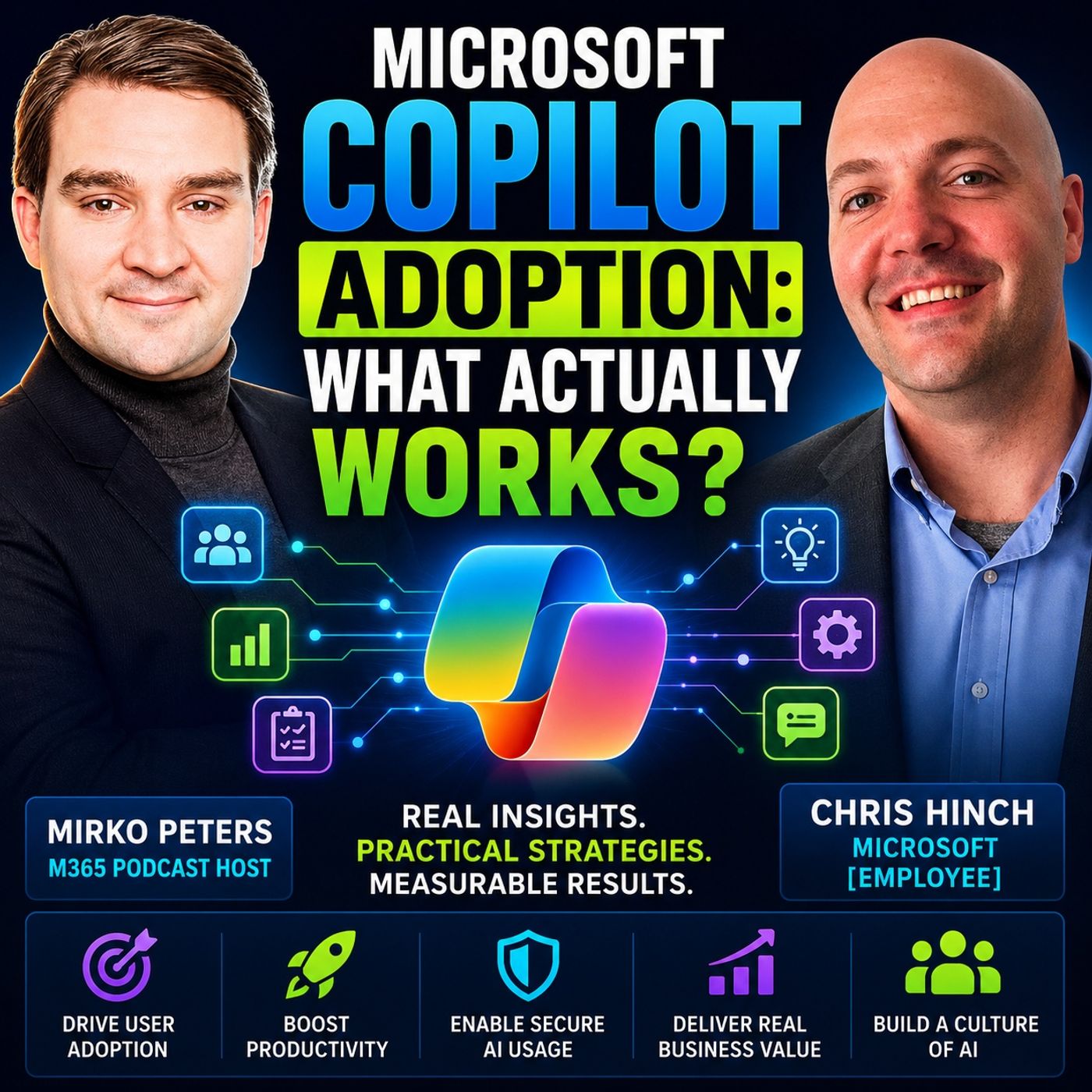 Microsoft Copilot Adoption: What Actually Works - With Chris Hinch [Microsoft]M365.FM · on Copilot Studio75 / 100
 How Microsoft Partners Turn Partnerships into PipelineIAMCP Profiles in Partnership · on Copilot Studio72 / 100
 AI Leaders Podcast #84: The path to Human + AI ImpactAccenture AI Leaders Podcast · on Data leakage risks68 / 100Episode 433: Passkeys, Passwords, and the End of SMS MFA88 / 100Episode 430: Scouting out Microsoft Scout65 / 100Episode 429: Getting started with LLM Wikis85 / 100Episode 427: Copilot Cowork Hands-On Experiences77 / 100Episode 426: Claude Cowork vs Microsoft 365 Copilot Cowork83 / 100