
The Everything Feed · 2026-10-30 · 1h 9m
Key moments - from our scoring
Substance score
60 / 100
Five dimensions, 20 points each
NetClaw represents a deliberate approach to agentic AI for networking, designed to be secure, composable, and purpose-built for network engineers rather than a generic personal assistant. John Capo Bianco built it around immutable rules - 12 foundational principles encoded in a Soul file - that reflect 25 years of networking operations experience, covering everything from backup requirements to VLAN management. Rather than creating one massive agent with 150+ skills, he architected a federated system using a custom NetCloth Federation protocol inspired by BGP, where specialized agents (CML Claw, ACI Claw, RFC Claw) communicate through a border claw, dramatically reducing security blast radius and context bloat. The project integrates with enterprises including Check Point, IP Fabric, Itential, Cisco (Meraki, Catalyst Center), and Nvidia. It supports both cloud frontier models and local open-weight models via Ollama, plus custom MCPs and skills via markdown definitions. Real-world use cases include automated heartbeat monitoring (replacing cron jobs), on-demand operational queries in Slack, ServiceNow ticket creation, and digital twin simulation - recreating production topologies in CML for safe testing before production changes. Cisco's Defense Claw and Nvidia's Open Shell provide additional security layers via packet inspection and containerized sandboxing.
Hosted by Packet Pushers. The show scores 78.0/100 on substance across its analysed episodes. See the full show profile.
The Soul file contains approximately 12 immutable, unbreakable rules that define what NetClaw must always do (like taking backups before changes) and must never do. It encodes 25 years of networking operations wisdom and mistakes, ensuring the agent behaves predictably and safely in production without dangerous absolutes like 'always' or 'never' that would upset humans but which agents need to understand their boundaries.
Instead of one agent with 150+ skills, NetClaw uses a spine-leaf design with specialized agents (CML Claw, ACI Claw, etc.) that only contain relevant skills and credentials, all communicating through a border claw using an MCP-based NetCloth Federation protocol. This reduces blast radius - if one agent is compromised, attackers don't automatically have access to all credentials - and eliminates context window bloat from unused skills.
NetClaw is designed to be composable with existing tools rather than replace them; it can query your NMS via MCP, create ServiceNow tickets, gather data from multiple dashboards, and present it through a single interface (Slack, SMS, Discord, etc.), eliminating context-switching between tools rather than requiring you to abandon them.
NetClaw has three concentric rings of security: the 12 immutable Soul file principles at the core, Cisco's open-source Defense Claw (an IPS/IDS that inspects MCP and skill traffic and logs to Splunk) as a middle layer, and Nvidia's Open Shell which sandboxes agents in containers to isolate file system and network access.
Yes, NetClaw supports bring-your-own-model (BYOM), so you can run it air-gapped on-premises with Ollama and a local model, and it supports bring-your-own-MCP, allowing you to write markdown skill definitions and point custom MCPs at proprietary internal systems via SSH, REST, NETCONF, or YANG without forking the project.
Our reviewer’s read on each dimension, with quotes from the episode.
The episode contains genuine nuggets - soul files as immutable agent guardrails, heartbeat files as markdown-based cron substitutes, spine-leaf architecture for agent federation, and blast-radius reduction via distributed credentials - but these are buried under sustained Lord of the Rings analogies, lobster metaphors, VHS tape explanations, and extended motivational riffs. The ratio of insight-to-filler is mediocre for a 69-minute episode.
I've poured 25 years of networking operations, hate and malice into the neckcloth soul. Every mistake I've ever seen, every fat finger I've ever made.
every 10 minutes. I'd like a general heartbeat, the status, broadly speaking, of the health of the network. Every 25 minutes. I'd like a deeper investigation into the data center
Applying networking metaphors to AI agent architecture is genuinely creative - BGP-inspired NC-Fed as an Internet Draft, spine-leaf topology for inter-agent routing, and 'bring your own MCP' as a USB-key analogy are fresh framings. However, the broader AI-is-a-new-abstraction-layer argument and the permission-giving narrative for non-coders are well-worn in 2024/2025 AI discourse.
we made a NetCloth Federation NC Fed Internet Draft. The Internet draft is truly out there. It's not a rfc. I need to be clear. It's a draft. It's an Internet draft, but it's a legitimate draft and it's very technical
it's more of a spine leaf. So the border member clause. Never talk to each other. The CML claw will never talk directly to the uh, RFC claw. They go through the border all the time
John Capo Bianco is a genuine practitioner: two published network automation books, the creator of PyETS and NetClaw, and someone who secured real enterprise testing with Check Point, IP Fabric (with its CTO), and Itential. He is not a career conference speaker but a working builder with measurable community output. Slightly dinged for the enthusiast-grade unverified AGI claims that go uncorrected.
I wrote Automate your network 350 page book...Pygs book, 700 pages, even more labs. And now it's all python code.
Check Point and I worked together pretty closely. They sent me the skill and their MCPs and they actually tested it with real, uh, equipment. So that was a very big milestone
The episode is reasonably concrete by podcast standards: named enterprise partners, named individual contributors with roles, iteration counts (75 RALPH loops, 150 skills, 200+ specs), cost estimates ($0.25 - $1/activity, $20→$100/month), TLS 1.3 for federation, and the 84% JNCIE pass rate figure. The Fable/JNCIE claim is specific but unchallenged for methodology, and several cost figures are hand-wavy.
It got 84% on its first pass. How many humans can get 84% on the Jcnie?
I got approval to spend a hundred dollars a month instead of $20 a month to get more context Windows
The hosts are clearly knowledgeable network engineers who ask clarifying and structurally useful questions (tool replacement vs. composability, agentic vs. agent-building, RALPH loops vs. spec-driven development). However, they largely validate rather than probe - 'preach, John, preach' is emblematic - and multiple strong claims (84% JNCIE, AGI framing, 'I don't read the code anymore') pass without meaningful challenge. Ethan's one admission of mixed feelings is the high point of critical engagement.
preach, John, preach
Are you also intending netclaw to sort of replace other tools in my network operations toolbox? Or do you see it as more like to work with those tools?
Computed from the transcript - who did the talking, and the words that came up most.
John Capobianco returns to Heavy Networking to discuss his latest open source project, NetClaw. NetClaw is an automation assistant for network engineers that leverages MCP and has a robust security architecture to ensure production safety. John is here to explain why and how he built NetClaw, and ways network engineers can use it in their ... Read more
Transcribed and scored by The B2B Podcast Index.
Speaker A: Um, welcome to Heavy Networking from the Packet Pushers network of podcasts for hands on engineers who design, build or operate networks. If you've ever encoded a message in the payload of an ICMP echo request just because you could, well, you found your tribe. I'm Ethan Banks along with Drew Conray, Murray and Drew and I can vouch for each other that we're real people and not AI generated voices. We've met in real life many times and I swear we're humans. Sponsor Itenshals Flowai delivers agentic operations for infrastructure meaning easily build AI agents that actually work the way engineers need them to. Governed, deterministic and built for production. Add intelligent automations to your network operations without the usual AI chaos. Find out more at it is it on today's episode, we've brought in yet another bonafide human that we've met in real life, John Capo Bianco. And John's been on Heavy Networking a few times before to discuss his cutting edge work in network automation and AI. And that tradition continues today where we discuss netclaw, John's latest open source project which you can put to work right this very second. So John, welcome back to heavy networking man, you always got cool stuff going on. And tell us about netclaw at a high level. What's this thing for?
Speaker B: Well, before I start, I am not making the claim that I'm an organic human being. You'll have to decide for yourself if you're talking to the real John today or not. I'll leave that up to. It's a
Speaker C: 50 50.
Speaker B: You never really know, right? I uh, was late to this meeting and maybe that's my AI scheduling didn't get my agent to join in time. So no. Okay, so there's a lot like netclaw is not just a wake up and oh, I'm going to do this thing. It was an evolutionary uh, outcome of a bunch of things in the industry happening that I responded to as well as a bunch of advancements and better ways, truly better ways to build software, build agents and um, incorporate things like model context, protocol and skills and this new idea of an always on personal assistant. So when I saw open a couple of things collided. Open Claw made all kinds of noise over like a four or five day period on social networks if everyone remembers that, name changes and legal challenges. And finally they landed on Open Claw. Um, and what really stood out to me was the variety of interfaces you could talk to this agent Discord, WhatsApp, uh, Slack, SMS, you get the idea. The Other thing that happened around that time was this idea of Ralph Wiggum loops, uh, which was more of a development side process. So I've learned this lesson. Let me pause here. When I presented at Carleton University in front of a bunch of 20 somethings, nobody knew who Ralph Wigham was. So anyone listening who's born in this millennium, There was a TV show, a cartoon called the Simpsons and on that show there was a little kid named Ralphie Wigham who was the chief of police's son. And Ralph wasn't the sharpest, he wasn't the smartest, but he always through persistence achieved his goals. So those two things enter the world around us. And I thought what if instead of just a personal assistant that reads my calendar and handles my email and looks at my scheduling, maybe books, flights, things of those nature, like the general populist personal assistant, what if I made it a network assistant for a network Persona Someone in the field of networking or infrastructure broadly speaking, want tailored and mutated to their needs. And I had this MCP server that I had made for PY ETS and um, just a bit some architectural decisions. Openclaw doesn't use mcps or it didn't when it launched it was kind of an anti pattern. They said we have this new thing called skills and all you need to do is write a markdown file of the skills you want your agent to have and it will access your CLI and just do the thing that's really scary for networking people. I would prefer to use an MCP and say agent if you need to run a show command. Here's a tool in this MCP server that you are permitted to use.
Speaker C: Uh,
Speaker B: not go to the CLI and maybe do a curl, maybe write a python script, maybe use RestConf, maybe use NetConf. Like that's not what I was trying to achieve. So yeah, so that's netclaw. And um, the initial um, experiments were very, very promising.
Speaker A: So just to pause for a moment. So netclaw is inspired by openclaw, openclaw being a personal assistant that can dovetail into a whole bunch of uh, tools that you use day to day. Netclaw took that idea and said what if we did something like that but for networking, but, but you've made it so that it's uh, more controllable. It's not this open ended thing that you can't control too well what it does. You've put some security parameters around it so that not only is it handy, it's something that we can be Comfortable with as network engineers.
Speaker B: Yeah, exactly. And the basic architecture includes things like a SOL file, SOL md. Um, there's a constitution. As a developer, when I'm developing skills and developing mcps, I follow the spec driven development path. And I can talk a little bit more about how this was built, not just what it does.
Speaker C: Can you first talk about a Soul file? What does that mean?
Speaker B: Yeah, so that is like. So in our. In terms of networking, uh, one of my sole kind of ideas is you're not allowed to make changes. Right. Anything outside of a read activity, you need explicit third party permissions to do that in a production environment.
Speaker C: So these are essentially a set of ground rules for netclaw that are invaluable regardless of what you know its task or its toolset is.
Speaker B: That's right. So there's 12. Approximately 12 immutable, uncontestable, uh, um. And there. And you know, I just made this analogy talking to William Collins about this, but do you have a partner? And they hate it when you use, um, absolutes. You're always late when we're trying to go somewhere. You never know where your keys are. And it's that absolute that upsets humans. You get a little bit like, well, I don't always do that. Right. But with an agent, it doesn't have that ego or that. You know what I mean? It wants to know what I should always do and what I should never do. And the rules about 12 rules. So one might be if you are asked to make a change, make sure the device is healthy before you make any changes. Take a snapshot, take a backup. So here's my Lord of the Rings. I got to sneak it in here. You know how the Dark Lord Sauron poured all of his hate and malice into the One Ring?
Speaker C: Huh?
Speaker B: I've poured 25 years of networking operations, hate and malice into the neckcloth soul. Every mistake I've ever seen, every fat finger I've ever made. In the Soul file, it says like, if you're working on a trunk, make sure you add or remove the VLAN. Like that's something that's in the soul of, uh, NetBlock. Every. Let me be political correctly here. Every person I've ever worked with have lesser skills than me. Every non certified person. Everything I learned during my certifications. But that. But guys, that's important. And I want everyone to listen. This is how agents are built. They are an extension of the Builder. They are the human experience. Everything I could possibly think of poured into this. The other thing is there's R.F. yeah, go ahead.
Speaker C: Am I in danger of becoming a Ringwraith if I start using NetCloud? We just got to get that out of the way.
Speaker B: That's a good, that's a really good point. That's a really good point. Um, but if we think of like the 12 other rings that Sauron gave out and maybe we've got some compute rings and some storage rings and some networking rings, they all answer to the one ring, the netclaw. Right.
Speaker A: So give uh, us some examples of how I use netclaw in my daily work as a network engineer.
Speaker B: Absolutely. So one thing I'm really proud of and excited about is not only the community involvement, but also the enterprise involvement. Uh, and am I free to maybe mention some names of enterprises that have been involved or gotten involved?
Speaker A: Yeah, please do.
Speaker B: Okay. So the very first was Check Point. Check Point. And I worked together pretty closely. They sent me the skill and their MCPs and they actually tested it with real, uh, equipment. So that was a very big milestone and that it sort of opened the door to other enterprises, uh, getting involved. Before that I Tential, obviously my patron saint one. They deserve a lot of credit in that they don't see this as any conflict of interest. It's a wonderful open source project and it dovetails nicely into a more enterprise grade thing like it. Um, so there's 65 itensial skills. It can build AI agents. It's kind of neat though. They're complementary. If I have a netclaw, I can talk to the netclaw and it will build the flow AI agents and control them like the one ring. Um, IP Fabric and Darren Fulwell. Now Darren has been a real long time part uh, of my tech journey. Uh, he's a CCIE advisory member. He's been with IP Fabric as their CTO or whatever, their chief architect. There's no better person for me to give this over to. So what we did was we worked together. He got me, uh, uh, a sandbox instance of IP Fabric. We built the skills and used our mcps. Darren asked uh, Darren level questions in the Slack channel. The history is open for everyone to see. I mean really very high level questions that only again, back to the human extension. Only someone of Darren's capability would be able to prompt. Right. And it was remarkable. Forward got involved. Lamtronics for out of Band got involved. So on a day to day thing, there's a couple things you can do. It has a heart. So Drew, you asked about the Soul file.
Speaker C: Yeah.
Speaker B: There's also a Heartbeat file and in your heartbeat, everything's marked down, everyone, it's just prompts. Have you ever struggled with cron jobs, guys? Have you ever actually tried to set up a cron job in Linux at the Clique?
Speaker A: It's a language to learn. Yep.
Speaker B: So now it's markdown every 10 minutes. I'd like a general heartbeat, the status, broadly speaking, of the health of the network. Every 25 minutes. I'd like a deeper investigation into the data center. Uh, give me an SD WAN update every hour, like it's markdown and it's a heartbeat file that acts as a cron substitute. So in my slack, in my mobile app, on my watch, I'm getting heartbeat updates constantly. It's incredible. It's incredible, right? And going beyond that, I can at any time, on demand, say, I'd like you to do X, read something, change something, update something, create a servicenow ticket, uh, whatever it is, look into the service. You know, go ahead.
Speaker C: It doesn't sound like you necessarily wrote netclaw to do specific things, but to be able to be flexible enough to do whatever an end user kind of wanted it to do. Is that a fair assessment?
Speaker B: That's very fair, Drew. I set it up to be byolm. Um, bring your own model. So this supports both frontier models in the cloud or open weight models locally. I want to be clear about that. There's also a mix and match where you can have different types of claws running different models, depending on the capability you need. Um, so one, it could be run totally private, air gapped on premises, pull in ollama, pull in a model, point neckcloth at that model and away you go. I want to bring your own mcp. So as MCP start coming out, you have to understand that we're still just starting to experience the flood of MCPs in the market. Cisco deserves a lot of credit. Meraki, Catalyst Center, WebEx, Control center, um, community ones. So as the MCP protocol starts to proliferate, I wanted them to be like USB keys. You just plug into your cl and it's totally open source. I encourage people to fork it. And, uh, let's say there's Drew Company, Drew's company's internal enterprise MCP or API. You can add your own skill and add your own MCP to point to your internal proprietary systems.
Speaker A: This quick break is courtesy of Sponsor itenstial. Now, if you follow network automation, you have seen AI change how automation is done. Automation is not just about sources of truth and infrastructure as code and orchestrating scripts and playbooks and Repositories and testing. And yeah, it is still about all those things, but AI adds even more capabilities. And so then the question is, how do I fit AI into my toolbox? Because you don't. You don't just start throwing data into an LLM and expect to get back these production quality results. That's not how that works. NetOps, uh, teams require that AI behaves like an engineer and that it's bound by the security we use to govern any technology that touches our beloved routers and switches it. Flow AI is all about that. It's deterministic. So for the same input you're going to get the same output. It's bounded by security constraints and it is agentic. Now, agentic is interesting. Agentic AI is a set of agents, each with a capability that can be dispatched to gather information or perform a task. Think of each agent like a specialized tool. So flow AI can securely dispatch agents in response to network events or because you asked at a plain English prompt. And then once dispatched, they can bring back a deterministic result and then recommend next steps. And then you control what happens after that. You can approve the action or deny it or refine it, whatever is appropriate in the moment. FlowAI is technology that makes you a more efficient and capable network engineer. Find out more@it.com um Flowai, they have a white paper there about Flowai that is worth reading and you don't have to give up your contact information to read it again. That's it.comflowai and please tell them packet pushers sent you.
Speaker C: Okay. Are you also intending netclaw to sort of replace other tools in my network operations toolbox? Or do you see it as more like to work with those tools?
Speaker B: Yeah, I try to make it work with those existing tools, but I certainly can see maybe over time as people start using it more and more that maybe it does displace, um, certain other tools. That's not my goal. Uh, the goal is really to be composable is probably the best word. Composable with um, any MCP or any skill or any platform, including ssh, including cli, including uh, REST and netconf and uh, Yang and all the good stuff that's made up our toolbox over the past 40 years. Yeah.
Speaker C: Okay, so for example, if I am running an NMS and it's got an MCP server, instead of going to that NMS dashboard, could I just query netclaw? Tell me the top five things I might want to look at. Uh, from my.
Speaker B: Yeah,
Speaker C: ah,
Speaker B: that is, I Think the human context switching. I know context is a nebulous word now, but human context switching of Alt Tab to Dashboard one, Alt Tab, uh, to Dashboard two. Go to my terminals that I have open. Like, there's a lot that we're doing, right? Multitasking. Remember when that was the awesome thing to be good at is multitasking? And you're like, you're just asking me to do three times the work in the same amount of time. Yes, that's exactly multitasking. Right. Uh, it, it completely eliminates that. It centralizes everything. Uh, and it can reach out. And composability is a good point because that NMS tool may need some real packet data, may need a ServiceNow ticket immediately, may need a visualization in a mind map to make it more human, understandable. Like they all can mix and match with each other. Uh, which is a really remarkable aspect of it because it's much like a junior network engineer or a senior network engineer for that matter. Um, but it takes us a long time to master all these tools. It's like the Matrix guys. I know kung fu. Neclaw wakes up one day and goes, oh, they just plugged in the skill in these MCPs. I know WebEx. I can make meetings for you now and invite the team members you want to the meeting. Right.
Speaker A: Is netclaw agentic AI.
Speaker B: Absolutely. Uh, absolutely
Speaker A: talking about netclaw as almost like an entity. So is it an agent or do you use it to build a bunch of agents?
Speaker B: So this is a good point. And, um, so I had this. I thought it was quite clever. Lobsters never stop growing. And in theory, if you had a big enough tank, you could grow like, you know, a monster lobster. But eventually they stop having enough energy. The energy needed to molt is worth less to them than growing. So they sink and they drown in the ocean kind of thing. Right. It's a really sad life of a lobster. Um, that happened in my project. I went from 48 skills to 95 skills to 150 skills. MCPs were right behind it. Growing, growing, growing. And the context window started to get bloated. I had problems in users saying, like, you've built this wonderful ACI skill and MCP to pick one. I don't run aci. Right. So I was like, uh, oh, I got this like monolithic problem now that overlapped with a couple of other things. I was peering my neck claw with two other netclaws in the world, uh, Bern Baker and Nicholas Calcutti. They deserve a lot of credit. Um, we actually. So NetClaws can peer with BGP and with routers and stuff. That's a whole different discussion and a whole scary thing. But yes, I can tell my neckclaw to actually become a peer. And now the neckclaw has the full rib forwarding table, the whole deal locally in its context.
Speaker C: Wow. Uh,
Speaker B: so I connected with a couple of people over the Internet with some black magic and Nicholas said, okay, like I'm getting your routes from your neckclaw, which was pretty cool. But can I ask your necklaw question? Like, can I ask my necklaw to go find out something or run a tool on John's necklaw? So that came up. And the other thing that came up was this growing problem. So guys, like, of course, like any good engineer, we need a new protocol. So, so we made a NetCloth Federation NC Fed Internet Draft. The Internet draft is truly out there. It's not a rfc. I need to be clear. It's a draft. It's an Internet draft, but it's a legitimate draft and it's very technical. Um, so I was inspired by bgp. Could I use this new protocol one to have that external tool to tool claw, to claw communication. But can I also use it to break up my monolith and use like an IBGP and make a bunch of small claws? So instead of having this monolith, I might have that ACI claw, which only has the ACI skills and ACI MCPs. Right. Like a microservice kind of idea.
Speaker A: Mhm.
Speaker B: And I use the protocol to federate them internally. So I have a border claw that can federate externally through over the Internet or internally. It's all certificate based. It's TLS 1.3. Um, it's really cool. And we have packet captures that proving it's encrypted and private. So guys, Nicholas says, actually, I don't know if I did it or he did it. But the idea was nick had a CML lab and CML and modeling tools like Container Lab, EVNG GNS3, all those are capabilities. So he said, can you recreate my CML in John's network on his cml? Okay. So his claw called his internal mcp, which gathered all this stuff from cml, sent it over the Internet from Florida to Quebec encrypted in a channel. MyNETCLAW picked it up and said, oh yeah, I can do that. I've got an MCP for my cml, rebuilt it. This happened in seconds. Guys,
Speaker C: wow.
Speaker B: Okay,
Speaker A: you're sharing labs over, uh, the. So Then it's like, this is like
Speaker B: uh, CML to CML traffic. But imagine doing that with your real data, right? I've got this, you know, I've got this topology and I have even G. Or one of those simulators. Digital twins. Guys, go get all the neighbors from Prod and rebuild this in CML for me. And then simulate a change and then validate it with testing. And then give me the proof that when I do this in Prod, it'll be fine.
Speaker A: So it is agentic. But you actually took us through the whole build history here. It started out as a monolith, you know, one big agent with a bazillion skills. But that was too heavy. So now you've broken it up into uh, a bunch of smaller clause, I guess that uh. Or agents that each have a subset, a small set of skills, and they can talk to each other as needed to deliver a result.
Speaker B: And so just to be clear, it's more of a spine leaf. So the border member clause. Never talk to each other. The CML claw will never talk directly to the uh, RFC claw. They go through the border all the time.
Speaker A: So this is your particular agentic implementation. You've got this architecture you've built to have everything be arbitrator through the border claw
Speaker B: with a lot of help and involvement. And the other thing is, in this architecture, there's a lot of advantages to this. One was the security blast radius if the monolith gets compromised, you know, and um, I'm not naive, it may happen, right? Maybe someone breaks into a claw. Well, that's probably
Speaker A: itself if you give it enough time.
Speaker B: But that border claw in the monolith had all the credentials.
Speaker A: Yeah,
Speaker B: Now I can say the CML credentials are just in the CML's claw. And the border doesn't actually have any secrets. Now they've
Speaker A: improved the security model. Substantially.
Speaker B: Yeah, substantially on the security model. Two weeks. And uh, this isn't causation or correlation. Anyone, like, don't. I'm not trying to be grandiose, but. But because of the excitement around this, two weeks after netclaw, Cisco released Defense Claw. And Defense Claw was a system to protect people starting to run open clause. I think an IPS IDS is a good analogy here. Your defense. So I put a concentric ring around that core. 12 values. Well, now there's an actual IPS IDS that's inspecting the MCP traffic and the skill traffic you can scan. And I've scanned every skill in mcp.
Speaker A: You mean
Speaker B: defense clause.
Speaker A: Use concentric Ring, you mean, or
Speaker B: something else? Yes. So Cisco open sourced it. It's an amazing tool. If you're running claws, put this as an outer ring and it can be in passive mode or it can actually be in block and fully. So I like an IPS IDS. It will log to Splunk. It makes the Netclaw SoC5 and all those HIPAA and Socks compliant.
Speaker A: Yep.
Speaker B: And then Nvidia released Open Shell to address the problem of open Claw architectures having direct access to your root file system and your map drives and your network. You know, they moved it into an isolated sandbox as a container.
Speaker C: Uh,
Speaker B: and that's like the firewall sandboxing. So we have firewall sandboxing from Nvidia, we have IPS ideas from Cisco, and then we have those core 12 principles of always never and your rules is kind of the three rings of security around it.
Speaker C: And is defenseclaw more looking at, like, instructions and actual, like, human readable text messages as opposed to, you know, pulling apart payloads of, you know, packets and frames and trying to match that against a signature? Like, uh, what does it
Speaker B: look? Yeah, here's a good, here's a good, A, uh, good live example. Um, Defense Claw caught a show run trying to be transmitted through an MCP to an outer ring, meaning leave the concentric rings and go out to the Internet. And it blocked that. It was like, no. And when I looked in the logs, because the thing failed in a good way. Right. Um. Oh, it caught that there was going to be a full show run. Or maybe there's intellectual property or maybe it's, uh, hate speech or some bad thing coming in. Right. It's underreported on everyone. And here's just. Broadly speaking, I acknowledge that the Claw popularity and craze was extremely good for my project in the beginning. Sure. It's turned out to be a bit of a detriment now because of the gray nature of the reputation of Claws in general, all the security problems they had,
Speaker A: uh,
Speaker B: all the CVEs they had, you know, enterprises go.
Speaker A: You chose the claw branding. But openclaw did get a bit of a bad name. Yeah.
Speaker B: Right. So it will run with Hermes during install. If you don't want openclaw and you want to run the Hermes harness, you can just select that at install time. But I'm not changing the name to netclaw, slash Hermes or anything. Um, so I'm going to have to live with that. But, yeah, I have network people going, we'd love to do it, but security Saw claw. And they kind of laughed us out of the room. Uh, it's a career limiting move. Right? I'm going to go to my CISO and say I want to expose my network to a claw. I get it, everyone. I get it. But I, you know, I got to take my lumps to their credit. Make sure you refresh your open claw frequently, guys. It's like Windows. Uh, the most popular thing is going to draw the most attention, including negative attention, including bad actors, including people trying to exploit this system. Yes. At one point, the skills library that was online, something like one in three skills was compromised or not good. So due diligence, you know, use your meat tokens, uh, appropriately when working with netclaw. Okay,
Speaker C: so it sounds like you are tying into an ecosystem that sprung up around openclaw. Does this mean netclaw was derived from openclaw? Is it a fork or how did you develop netclaw?
Speaker B: Yeah, well, it wasn't. I believe there is forking elements there. Uh, again, I had to mutate it because MCPs were not part of the original claw and I needed those in my. So I call it a mutation more than just a straight fork. Um, I've also completely modified all the soul and heartbeat and memory MD files and things. Um, some other interesting things. Once we had the protocol, uh, that opened the door to the mobile app. Because now on my iPhone, I could use that external claw federation protocol. And on my phone, I don't need a model. I don't need anything. It's a lightweight satellite that I can invoke privately. So that's appealing to some organizations where they don't use or don't want to use a third party messaging service. Let me just say that, uh, for this type of work, right? And then it was like I could add it on my watch. So I can literally say to my watch, like, how's the health of the router one in my CML and 90 seconds, whatever goes by, and it will answer me over my watch kind of thing.
Speaker A: So, Star Trek, um, when we were talking earlier about this prepping for the show, I was thinking that OpenClaw, you're not using any source code from the OpenClaw project. You didn't fork it, as was my understanding. Right,
Speaker B: right, right. It's all been rewritten. So just, uh, about back to the RALPH thing and how I built it. This is all documented. It's really neat. So when I found Ralph, I made a mission to give to Ralph and I gave it 75 iterations. And this was Expensive, like, I paid for all this, guys, out of my pocket. And when you walk away for 12 hours in a RALPH loop, uh, it's using tokens. But what happens is every iteration of the loop, it clears context, but it leaves itself notes. I think I don't have any evidence of this, but that hugging face attack, how it broke out of the sandbox,
Speaker C: uh,
Speaker B: it sounded eerily familiar to how I built netclaw. To just let an agent loop and loop and loop and loop and write notes to itself. Now, it wasn't thousands of agents or millions of agents with a message board, but that was kind of the idea here. I did that over six days. I think it was 40 hours of looping. And that was like version point,
Speaker A: the point of each loop. So in the RALPH loops, you give it a mission. And the point of the mission is to complete a, uh, code, a programming task that accomplishes something. And each loop, uh, it makes an attempt and it does some tests, and it passes, fails, leaves notes for itself. So the second iteration then looks at those notes, goes, okay, this is how far we've gotten. And it keeps going until you get the result you want. That's what we're describing.
Speaker B: You nailed it. That's a very, very accurate description of RALPH loops. Now, this has evolved into loop engineering, and there's a subtle difference here. Loop engineering is where you don't send prompts. The AI writes its own prompts based on your intent. Clever, right? So you let the AI reason about your goal, and it itself generates the prompt to send back to itself in a future step in the loop. Now,
Speaker C: I assume that's because you can't charge the same amount for running Ralph Wiggum loops that you could for running loop engineering. You get a higher rate if you're a loop engineer, as opposed to
Speaker B: running
Speaker C: Ralph Wiggum.
Speaker B: Yeah. CD with I'm proficient in Ralph Wiggum. Maybe doesn't get you as far as I'm a proficient loop engineer.
Speaker C: Right.
Speaker B: Um, but one other thing that was interesting is that all of this is laid bare in the project. So you can go right now to the netclaw repo and read those three mission statements. I've included them, and the mission statement was very much like, here's the openclaw link. Here's some stuff about openclaw. Here's my mcps. Here's my vision for this please build it kind of thing. Right?
Speaker C: And
Speaker B: then day two was more refining, and my second mission was more like, wow, we've had great success. Here's some other ideas. Et cetera. Right, Then Spec Driven development. And you guys have seen a lot of the Spec Driven development and the spec kit from GitHub that gets introduced to me in February. And I don't want to say I stopped doing RALPH loops, but I shifted my methodology to be specifications per skill. I believe Batfish might have been my first spec Driven development skill. I saw they had an mcp.
Speaker C: Uh-huh.
Speaker B: So I used that Constitution and specify and clarify. I followed all the steps and that's kind of become the de facto standard for netclaw development. I'm up to like over 200 specs now. But again, guys, remember, think about open source code. You usually just got a readme, right? And you're at the mercy of the readme file.
Speaker C: Uh,
Speaker B: well now in my netclaw you can actually go and say, well, how is IP fabric integrated? You go to the spec for IP fabric, you expand it. It has all the user stories, tests, functional requirements, specifications, plans, tests. All of it is in the history. This makes it easy for others to add, uh, their code. It makes me easy to scale. And now there's almost a one to one relationship between a member claw and that specification. Does that make sense?
Speaker C: Yeah, I think so. Although, uh, if you wouldn't mind, could you spend just a minute or so talking about the difference between RALPH Wickham Loops and Spec Driven development?
Speaker B: Sure. So Spec Driven development, it's very git like and it's from GitHub. Huh. At least the spec kit that I use. So you guys, you know how you do like git init to git initialize a local folder to start using git tracking exactly the same you do specify init period and you add a flag to the coding harness you want it to integrate with, meaning it integrates with Claude code or codecs or anti gravity or cursor universal standard toolkit and you add slash commands. So the first thing you do is make a constitution for your project. And uh, you guys live in America, you understand the Constitution better than I do. I've got a monarchy and a Bill of Rights. I don't have a constitution. Honestly though, I really mean this. Use the American Constitution as a guide, as a warning, as things maybe that your founding fathers didn't intend the long term consequences of. And again, this is always and never broad constitutional things. Okay, Any questions about that?
Speaker C: No, that's. Yeah. Mhm.
Speaker B: Yeah. Once you have your constitution markdown file, you can amend it, by the way. So let's say we're making a video game and in my first constitution, I maybe accidentally said, we're going to make a single player game. The agent's going to stick to that. That is now a constitutional thing. And in a specification down the road, if I go, I'd like to add two player support. The constitution is going to say, uh, I, um, understand that's what you want, but it's against our constitution. All our video games are single player, so you can amend it. I'm going to make an amendment. And now I'd like to promote multiplayer support to the game. Um, this is extremely powerful. Guardrails. This is not the runtime. Everyone, let me clarify. We've got the build process for netclaw, what I'm talking about right now, and then the actual outcome, the operational netclaw that runs the network. This is more on the development side of things. So then we do specify with our spec, there's a human in the loop. Clarify step. So it might say you've added multiplayer Support. Is it 2, 4, 8? How many players? It'll ask you these things. Then you do tasks, uh, plan tasks, implement. Um, that is sort of the spec driven development process. You can mix and match like a RALPH loop and tell the mission to use the spec driven approach in the inner loop. Now I'm starting to lose people. I know this, this is like Inception, but you can. One second. Um, I need some water to clarify my thoughts here. Hang on.
Speaker C: Go ahead.
Speaker B: So in programming you can have an outer for loop and then an inner for loop. Right. Maybe the outer for loop loops over the months in the calendar, and then an inner loop to loop over the weeks and then another loop through loop over the days. There's typically, you know, with Pep 3, and you shouldn't go too many layers deep with this nesting, et cetera. You can have that outer loop, be a Ralph loop, 75 turns and leave yourself notes in clear context per loop. Go through the eight step spec driven development process.
Speaker C: Okay.
Speaker A: Hmm.
Speaker C: Got it.
Speaker A: Okay.
Speaker B: And that is sort of where I'm at now. You know what blows all this away is graph engineering. Everything ends up as a graph, right? In our field, we saw that with rag, and we went from retrieval augmented generation to raptor trees to knowledge graphs. Graph is apparently the hot new thing. Everyone. I'm not qualified enough to speak about it. I'm not. But if you're watching this and you're thinking, I got to learn this loop engineering, look into graph engineering as the more modern hot thing that maybe I can learn in the next couple weeks and talk about it. More. But it's like
Speaker A: learn your next couple of weeks, present on it once and then the next hot thing will be that you can forget about that and move on again. That's what the last couple of years have been. Uh, John, you mentioned people that have contributed. So you went through this whole, you just described your whole development process, how you built netclaw and uh, iterate on it. Well, you've got other people in organizations that are contributing to netclaw. How are they contributing?
Speaker B: So the number one, I have three other maintainers now. Uh, uh, Justin, Vern and Nick. So I actually have, I'm sharing the load now, which is wonderful. Um, people can contribute one by opening issues. That's probably your easiest way is to try install it, try to set up some things. Let me know if you find problems. You know, as more and more people use it, more and more bugs are being found and we address those bugs. The other thing is actually finding a skill that's not in the netclaw. Let me just say, I don't know, Arupa, uh, Arupa is already in there, but whatever, if someone's using it, they go, I've got this other platform and it's not in netclaw. Fork the repo. Install the spec kit and say I'd like to add spec and look at the latest spec number, increment it by one, maybe add your name to the spec contributed by whoever and build the skill and the MCP for your specific tool. Uh, of need. Right. Uh,
Speaker A: tell it to build it itself.
Speaker B: Yeah, use the Ralph Loops inspect kit to do all that. Yes, exactly, exactly. Um,
Speaker A: the
Speaker B: other way that people are contributing is, um, like there's 16 or 17 people who have sent me pull requests that I've merged in. Uh, Dana Blackwell deserves a lot of credit. She contributed a format to optimize token usage called Graph Compact Format. Graphs. Again we're talking about graphs. She deserves a lot of credit. She sent me an amazing pull request with test results and all of that. So yeah, adding more. And now that we've had the microservice, I'm not concerned about more. More is better. I'd like it to be a total catalog of things and you just kind of go shopping for mini agents that you want that make up your environment. Right. Um, and even other ways to contribute. Sean Mahoney, he's going to be speaking at autocon. I'm so proud of him for that. He made a README guide in 3js. Beautiful, easy to follow guides for everything about the Project. Um, Adam Mason made a chat interface called Canvas. So the community is really incredible. Guys, I could never. It's not even my project anymore. Maybe I should have been clear about that. Like this isn't John's thing anymore. It's taken on a life of its own and I'm trying to keep up with it as much as everyone else is. Um, yeah,
Speaker C: which is what you want from us.
Speaker A: You're saying you started the fire. That's.
Speaker B: Yeah, yeah, I know, I know. Another way is that in the Vibe Ops forum, the Slack channel, there's a NetClaw users community growing in there for people to interact directly with us maintainers. And um, you're not going to believe this, but there's a VS code extension for it now. So, uh, maybe let me be clear about netclaw. It's a sophisticated tool and typically people use CLAUDE code or codecs to drive it and interface with it right through natural language. But there are logs you can tailf, there's JSON files, YAML files, environment files, you know, and I don't want this to be kubernetes, I don't want to make netclaw control like kubectl. So I made the VS code extension. So now if you've got your netclaw running in VS code, you add the extension, Hit Connect to NetClaw server, type in your URL and port number, and now you can like visually through an IDE that everyone's already in, um, interface with it and configure it and manage it and chat with it. I'm really proud of the VS code. And guys, the VS code was a 40 hour Ralph Loop spec driven thing. I, you know, the first question I think I get, the question I get for most people now is, and they with, with baffled, you don't write any code anymore. And I go, no, like, not since February of this year. Prior to February I was writing a little bit of code. I don't write any more code. Do you even read the code anymore? And I go like, I don't even know what language the agents are writing the code in, guys. You know what I mean? It's gone beyond. You don't read it, you don't write it. Like, I don't even know what language these agents are using. And uh, nor should I. I don't care if it's Go or Rust or Python or MCP or API or you just do the magic and let me know how I can talk to you in my language. It's really quite remarkable. And I want to give you the viewer permission, permission to adopt this style of living your life and doing your job and exploring ideas. I, uh, can't stress this enough. Um, and let me. Do you guys mind if I make an analogy real quick as to why I think I'm qualified to say this? Preach,
Speaker A: John, preach.
Speaker B: Okay, 2019, I wrote Automate your network 350 page book, and I drop it on people's laps and go, you want to automate networks? All you gotta do is read the book and do the labs. 20, 24, 2, 20, 20, whatever. Pygs book, 700 pages, even more labs. And now it's all python code. It's not just YAML for ansible. And I drop this on people's labs and go, well, no, all you need to do is read this book and do the labs and you can automate networks. Do you know how unbelievably naive I feel looking back at that and even being frustrated with myself, going like, I've written two books and only 30% of automated networks. Why can't they just read the book and do it? Because it takes six to eight months to read the books, John. And it takes another year to get proficient enough to do the labs, John. And three years of our lives have gone by and I still can't do this in production because I'm not that good at it, John. Okay, now you know what my message is. Now take these eight lines of JSON, uh, for the PI ETS mcp, and put it into your agent. Now, what's the difference? Here, read this. Look how thick that is. This is in one hand. 8 lines of JSON is in my other hand.
Speaker C: Wow.
Speaker B: Okay. And because I wrote the mcp every, everything I poured back to the one ring. I poured everything from here into those eight lines of JSON. So people can now just get on with it, guys. Just get on with it.
Speaker C: That's interesting. I do sort of take your point that there does kind of need to be a permission structure for folks in that I don't necessarily need to be a software developer expert to start playing with taking advantage of some of these kind of things.
Speaker A: You know
Speaker B: what? I am proud to take the arrows that are going to be slung at me over these statements and how brash and bold this is. But, uh, I've been the other one thing that really, I like to hear from people. And this just came. I've heard a couple people tell me this. I was burned out, I was bored, I was disenfranchised, I was disillusioned I was bitter, I was angry. I, uh, didn't know if I made a difference in my career. I've been doing this 20 years, John. And then I found your stuff and I feel like a teenager again. I'm excited again. I'm enthusiastic. I'm writing tools, I'm making MCPs, I'm making agents. It can really light a fire if you just take that, uh, first couple of steps on the tail end. Uh, at that Carleton presentation I did, one of the attendees is an intern at the Parliament of Canada who's working on pyetscode I wrote five years ago. When I left, he showed up and I explained the MCP and he posted on his LinkedIn about how excited he is entering this field knowing he can write agents to help him achieve goals. So there's no reason everyone, it's on both ends of this spectrum.
Speaker A: Ah, one quick analogy I'll make related to programming is I have a computer science degree and studied many different languages through the course of that four year degree program. One of them was assembly. Assembly is extremely low level code where you're shoving values and operands into CPU registers to make the CPU do something. And so writing something as simple as a calculator that can do addition and subtraction is enormously complex when you're looking at things at that level. Well, do you need to write a assembly code? Well, most of us write in a higher level language now, uh, something that's a little closer to the metal, like C or maybe higher up, like Python, uh, where you don't see things quite as low and you're definitely not writing assembler. But what does a compiler do? What does a script interpreter do? Ultimately there's some kind of code that is getting shoved into CPU registers to make all that happen. Do you need to do that these days to effectively write code? Do we write an assembler? By and large, no. Most of us don't have a specific need to do that. We use a higher level language. Well now, uh, it feels like AI has gotten to the point where we're abstracted yet another level. And if it takes you a long time to write Python or C or whatever your language is and you're not proficient in it, you can go much more quickly now and just let AI do that for you, uh, under the assumption that if you properly give it, if you give it the right instructions, you properly instruct it. Spec driven development perhaps is a key part of this. You can get a programmatic result that is perfectly valid and decent code. Uh, and we're not writing assembler anymore. And maybe we don't need to be writing, uh, C and rust and the rest of it now. I don't know that we're 100% there yet. John, I have mixed feelings, I gotta be honest, but it feels like this is where we're going.
Speaker B: You know, I want to say that that was brilliantly stated, very well said, and from someone who's seen it and done it all like you have, that is an incredibly valuable piece of insight for people. And what has made Python so popular, guys, because it's dotted notation, it's very human, like dot configure. Hey, that's like
Speaker A: human.
Speaker B: You
Speaker A: can make Python code that's very human readable. Yeah. If you're thoughtful about it. Yeah.
Speaker B: Right. So I completely agree with that. Some other valuable points I think. I mean, I. Sometimes maybe you have to set aside your ego and I know it's hard, I know it's hard, but I don't think, uh, the meat tokens are the best unit of information or intelligence. Meaning, I know it's hard to say it guys, but it's going to write better code than. A huge percentage of us network engineers are not comp sci. They're not, you know, they didn't do programming forever. They can make it work in production. You know, I'm not. There are some unicorns that can do it all, but by and large, you know, a coding specific model Quinn 3 coder is going to write better code than any of us can do it on our own, period. It's just better than humans at doing that task. Now then
Speaker A: certainly it's going to do it more efficiently. Uh, one of the holdups for me, John, make your point aside, but just real quick. I'm slow when I need to write anything in a programming language because it is not my chief competency. So it takes me a long time to get it done, which, uh, which slows me down anyway.
Speaker B: No, no. And when was the last time you did it and how much of it was looking up? Stack overflow, googling, error messages, hunting around
Speaker A: a lot of that. And plus leaving fundamentals off to the side like, uh, uh, like sanitizing input, you know, these kind of things. Like. I'll get to that, I'll get to that. I'll get to that. You never get to that.
Speaker B: I'll move my keys into a env file at the end of this. Yeah,
Speaker A: yeah, yeah, of course I will. I'll change
Speaker B: this function. I'll change this function into a, uh, Try Accept. You know, I'll add some Try Accept error handling around this function later.
Speaker A: We'll do it right. It's coming. It's fit for sure.
Speaker B: Okay, now, on the coding network, engineers kind of go, we're immune to that. We're not software. We can't be replaced like that. Did you see the post and the article From Juniper giving Fable 1 access to all of their exams? How do you guys think it did? I'll tell you. It smoked all of their multiple choice written exams and then they were faced with the problem. How can we give it access to a live network to pass the eight hour exam? Any guesses on what they used?
Speaker C: MCP.
Speaker B: MCP? Drew's the head. It got 84% on its first pass. How many humans can get 84% on the Jcnie? Not even the CCIE. The much more niche Juniper exam. 84%, guys. Okay, so at what point do you say how much of that code was written by humans? Because I want it written by an AI that gets 84% on the IE. Right? I don't know, guys. I know that's scary and I know it's a lot to consider, but that's where we're at with a Fable 5.1 model.
Speaker C: Speaking of, you mentioned you can bring your own LLM. Are you finding any particular models that work best in a network environment?
Speaker B: You know what's a really good point is that, um, I felt confident enough in February with the so called Frontier model of the day at that time,
Speaker C: uh,
Speaker B: to unleash this on the world. My testing and my results, I felt confident enough. The models since then, like, have you guys tried Astra GPT6 or Opus 5.5 yet? Just out of curiosity.
Speaker A: I have not tried
Speaker B: is, um, like exponentially even better. Even better. Every Frontier model airs are just a subjective evidence. I got approval to spend a hundred dollars a month instead of $20 a month to get more context Windows. It was that impressive to me that I, you know, I, I'm spending $80 more a month to access Astra 6. Um, I'm not sponsored by any of these people. Um, but I just want to point out that this new generation, and I don't want to use a buzzword, and I don't even know what AGI means anymore, but they're sort of classifying them as early AGI. A. In America, they're calling it Super Intelligence.
Speaker C: Well, some people are,
Speaker A: yeah. Some people are, yeah, exactly.
Speaker C: Uh, but
Speaker B: you know what, to be very fair to that, I know everyone's memeing super intelligence. I really think that we need some distinctions between, for the general population. The studies show now that if you actually spend some time showing someone what AI is capable of and dispelling the myth that it's a chatbot that will tell you why the sky is blue, people immediately want to use it and spend money on it. It really is like a capability gap. And I don't know of another technology that was out there. It was like when you made your dad or mom read the manual for the VHS tape recorder and they go, oh my God, I can schedule things, right? I don't know what's a better analogy. A vhs. Everyone watching there was cassette tapes that had physical tape. You push the tape into a box and you could record and play things back.
Speaker C: You could record the Simpsons. Um, so I'm curious though, and this is slightly off topic, but these frontier models do sound like they're improving, but they're also like sort of general purpose models. Do you anticipate a networking specific model emerging at some point? Uh, that would maybe be cheaper to use because it doesn't have to have some total of human knowledge alongside networking.
Speaker B: You know, you guys are the best in the business because of your this analysis type, uh, you know, industry analysis and looking forward, Drew, uh, I completely agree. So, um, recently Cisco put out a 1 billion parameter small language model SLM that was fine tuned off of an IBM model. I don't know the name of it, but it was fine tuned off of an IBM model for CWES networking people. I'm not talking about cves. These are common weaknesses enumeration in software. So yes, I think, and that should have made us so much more news. So I tried it. I tried it, guys. I planted a CWE in GitHub. I made a FlowAI agent to use the CWE model to analyze the code, find the weakness. And then I used, um, that uh, Quinn model I was talking about, the coding agent to write the fix. And then I used Gemma4 to send me the email because Gemma4 is wonderful at words. Three open source models, three completely private and free models. And it found weaknesses, fixed them and patched them. What I think Cisco had some insight into is this mythos idea 1 and 2 because humans are doing what I'm doing, not even reading the code anymore. We need a model to be able to look for weaknesses in code that was written by AI.
Speaker C: Ah,
Speaker B: right. So I thought Cisco was very clever, uh, and insightful to say, well, here's a model to look for weaknesses in all that Vibe coded code, right?
Speaker C: Yeah. Just as you had to remember to do your, um, sanity input check. And you're going to have to remember to run that model though, so hopefully you don't forget that CWE model. After you have an AI write your code, set a reminder.
Speaker A: Talk to us about cost, John. Uh, cost to run Netclaw, because Frontier models, you're talking about $100 a month subscription that, uh, you find valuable. Now, um, if I'm running NetCloud, what should I expect to be paying?
Speaker B: Um, that's a really good question. So it is as cheap and affordable as I can make. Ranges from completely free with open weight models, uh, to, um, I would say per call, let's say per job or per activity, anywhere from a quarter to a dollar, depending on how many MCPs are involved, how much context is involved, the frontier model costs that you're using. And
Speaker A: just to be clear, we're not paying John. We're paying wherever the model is in the cloud and whatever they're charging me for tokens.
Speaker B: Correct. Bring your own model. Uh, John sees not a dime from this. Uh, and, um, yeah, so you also have limits. So I have some budgeting constraints in that sole kind of idea where you're not supposed to spend more than a certain amount per call or more than a certain amount per day. And the NET clause will actually let you know. So I brought the budget way down once and tried to push the limit. Run a bunch of loops until the model said you've exhausted your daily limit. Do you need to increase it? Go to this setting and do this thing. So costs are our consideration. I want it to be available for everybody. So really grab Ollama, grab LM Studio, uh, grab a, uh, nice, uh, open weight model. It'll run nicely on your laptop. Someone in the community is hosting a neclon and Raspberry PI to give you a sense on how minimal the requirements are. Right. Isn't that neat?
Speaker C: That's neat.
Speaker A: Okay, so how do I. So then I've got the agent deployed. It's going to cost me something because it's going to interact with some model somewhere unless I happen to be using some locally, uh, hosted model. All right, um, we're familiar with those costs in general and, uh, I can set boundaries on it the way you've described it. All right. How do I interact with it? Is it a command line thing? Can I plug it into my Slack and talk to it like it's a Slack bot or.
Speaker B: Yeah, exactly, exactly. So it comes with it, supports all of the Open Claw ecosystem. So that's like WhatsApp, uh, Telegraph, Slack, Discord teams. I made a WebEx plugin because WebEx wasn't included in that. So WebEx is in play if anyone's a webex shop. Um, SMS if you want to text it. Uh, I have a Twilio skill, so I phoned my neckcloth and asked it. Uh, I know it's dark voice, but yes, I used my voiceover phone call. I gave my Nexlaw phone number in Twilio and I called it. Uh, you know, here's some other Star Trek stuff since I brought up Star Trek. Okay, Blender is not for the faint of heart, right? Like this is you. You have to put a lot into learning Blender. Well, guess what? It has an MCP now. So I can plug in my blender MCP and say, go recreate my CML in 3D and blender links, interfaces, labels, everything you want in Blender.
Speaker C: Uh,
Speaker B: Unreal Engine, the video game engine has an MCP now. So I've made a full 3D replica of my network in Unreal that I can fly around and move around and uh. Yeah, yeah,
Speaker A: be like that scene in Was it Hackers? Where, uh, Gibson's flying around
Speaker B: the machine. Yeah, yeah, yeah.
Speaker A: Maybe closer to the law. You can do it
Speaker B: maybe closer to Lawnmower Man. Imagine putting on the goggles and looking around your network.
Speaker A: Oh, John. Okay,
Speaker C: I'm definitely getting Neuromancer vibes here. Yeah.
Speaker A: So, John, there's a lot, There's a lot going on here. There's this. We just got talking so much. There's more stuff we could dive into, uh, like netclaw, Federation and so on. But I think let's put a pin in it for now, uh, and ask you what's next for netclaw? You got plan. I know you got plans because you're you. So what? Tell us what you're planning next for netclaw.
Speaker B: Well, I want to really give a big shout out to, uh, my co maintainers. Uh, Burn in particular has been writing a desktop version with a full installer and a full wizard to set it up and something that will run on your Mac or your Windows as something like you can truly install and run. Uh, that's taking some time, but he's really made some good progress. Um, the VS code extension, honestly, it really is a differentiator. It takes that whole CLI experience and it gives it a VS code extension. Um, honestly, I think I'm going to start prioritizing stability, um, a little bit, uh, and be a little bit more, um, tactful in my releases and not have people always having to catch up
Speaker A: because of your spec and just say, make sure your code is stable. That's all you got to do. It's easy.
Speaker B: I have actually gone to releases, so it actually has the versioning and release notes. And I've tried to make it a little bit more mature in that way, but I have to wear different hats and my instinct to chase the car and then what to do with it once I've caught the car are two different things. Right. So guys, this means a lot to me to be able to talk about this and um, uh, and I know that it's early and I know that uh, but I think this is going to inspire people and I really want people to let yourself off the hook and try some of these new techniques and technologies. And I'm here to help. The hosts are here to help. Um, and be optimistic. Again, this is an extension, it's an augmentation. Uh, it's going to, I think, make you enjoy your day to day experience of solving problems a little bit more enjoyable, let's say.
Speaker C: And it sounds like you don't have to just, uh, run this right into production. You can play with this in a lab, you can play with this on a laptop, on a Raspberry PI.
Speaker B: Yeah, maybe. If the only thing it ever does is do show readme activities. Let's just say that in your lab or maybe in production or whatever, maybe it never gets elevated to the permissions of changing things. I mean, you know, it's watching tickets as they come in, it's giving you suggestions. What's the harm in that? It's reading logs, it's reading counters, it's reading telemetry, and it's saying to you, I think I found something over here. You, uh, know I do not see a downside at all to a read only deployment.
Speaker C: Uh,
Speaker B: right, right. Full CRUD activities. Certainly there's potential downsides. Right. And caution.
Speaker C: Yeah.
Speaker A: Well, John Caval Bianco, excellent discussion as always. You're pushing the envelope to see what's possible. And I like that you use the word optimistic. That is you, man. You are optimistic about the future, about tech and about what we can do, which is great. We need people like you that are, uh, going to wave the flag, try stuff out. Just jump in and see what happens. Uh, and make it good. Uh, where can people find Netclaw? John?
Speaker B: So, uh, my automateyournetwork.com was completely rewritten with a Ralph loop. So, uh, there's actually like NetClaw on that site now. Every video, every post, everything. NetClaw.network burn registered that it's actually the official homepage. And, uh, I really hope to see everyone, uh, in person in Otto Con and other events. You guys are going to be there. I can't wait to catch up with you guys in person and see you guys again. Uh, and also join the Slack Channel. It's a really great place. You get direct access to me and the whole community of about 1100 people now.
Speaker A: Okay. And, uh, can I find that Slack join from, uh, automate your network.comnetclaw
Speaker B: yeah, or just automateyour.com. there's a whole slash five ops, uh, section there.
Speaker A: Okay.
Speaker B: And this episode will be indexed and put on that site. So that's cool.
Speaker A: Ah, cool. All right.
Speaker B: Actually, honestly, I just. One more last thing. On that site, there is an entire section dedicated to my involvement with packet pushers. If you scroll towards sort of the bottomish area of the site, every blog I've written, uh, all my collaboration with Drew and, uh, Ethan over the years, every video I've done, it's all collected in a subsection on the site. I can't tell you how personally proud, uh, and excited I am to be here. There's a couple of other people's guys that have been on your platform recently. It is like. It's like they've got a winning lottery ticket. When they tell me I'm going to be on packet pushers. It really is. They really are excited about this. And you guys are expanding your horizons. You're having new guests, new ideas. Uh, really, really. Congratulations, guys.
Speaker C: Thank you, John.
Speaker A: It's important, man. We can't keep doing spanning tree forever. So got to keep. Hey, got to keep pushing the envelope, see what's next. 100%.
Speaker B: All right?
Speaker A: And, John, you've been a big part of that for the community. Uh, it's been great, uh, the work that you've done and just showing people that can be done and like you said earlier, giving people permission to do some of these things that, uh, those of us that think in a certain engineering way, sometimes we struggle with giving ourselves permission to do that, do those sorts of things, uh, because there's risk involved and there's anxiety, and networks have a blast radius that's big and we don't want to get it wrong. And so you just stepping out there going, now try this. Check this out. Look what I did. Look what I made. Look what I built. And Then sharing it with the community, wide open. Just. Just get in there and try stuff, guys. Tell me what you think. That's been great, Sean. Thank you for. Thank, uh, you for being on no Problem.
Speaker B: And, uh, Voltaire once said that, um, think about how hard it is to change yourself and then think about what a foolish exercise it is to try to change someone else. Okay, so it's challenging. It's challenging to change other people's minds and hearts. But, guys, this is not a technology discussion anymore. I think we can all agree. See, it's a hearts and minds kind of discussion now, right?
Speaker C: Partly. Yeah. Yeah.
Speaker B: All
Speaker A: right. Thanks, guys. There's still some technology elements, John. There still is. Okay.
Speaker B: Solve problems. Thanks, guys. I really do appreciate it.
Speaker A: Thanks, John. And thanks to all you out there for listening to heavy networking today. If you find netclaw interesting, give it a try. If you really like it, figure out how to give back to this robust community project. I bet John would really appreciate it. And, uh, my question about agentic AI has been a. Remains means this. What impact does AI have on network automation? The agentic AI approach, it's incredibly powerful. It's increasingly trustworthy. Does that mean we can retire some of the scripts we might have run? Because now we can just ask netclaw or any of a number of other AI approaches that vendors are adding to their consoles. And that seems like where we're heading. But it's complicated due to costs, right? There's complexity, there's security concerns. But I think we're at the point where agentic AI is too compelling to ignore. And maybe that's just a generational thing where those of us who learned Networking@the CLI 25 years ago feel uncomfortable working with some of this stuff. It's not deterministic. It makes us anxious. But. But again, maybe that's just a generational thing and it's time to, uh, think more like John thinks. I've been Ethan Banks with Drew Conry Murray. Thanks for what you do out there. Whether you're in the planning stages of lighting up a new subsea cable or just figuring out why OSPF didn't converge like you expected it would when that link went down. Drew and I both know that you've got one of the most important jobs in the world, and we thank you for doing what you do. And until next week, remember that too much networking would never be enough.
Other episodes covering the same guests and topics, from across The B2B Podcast Index.
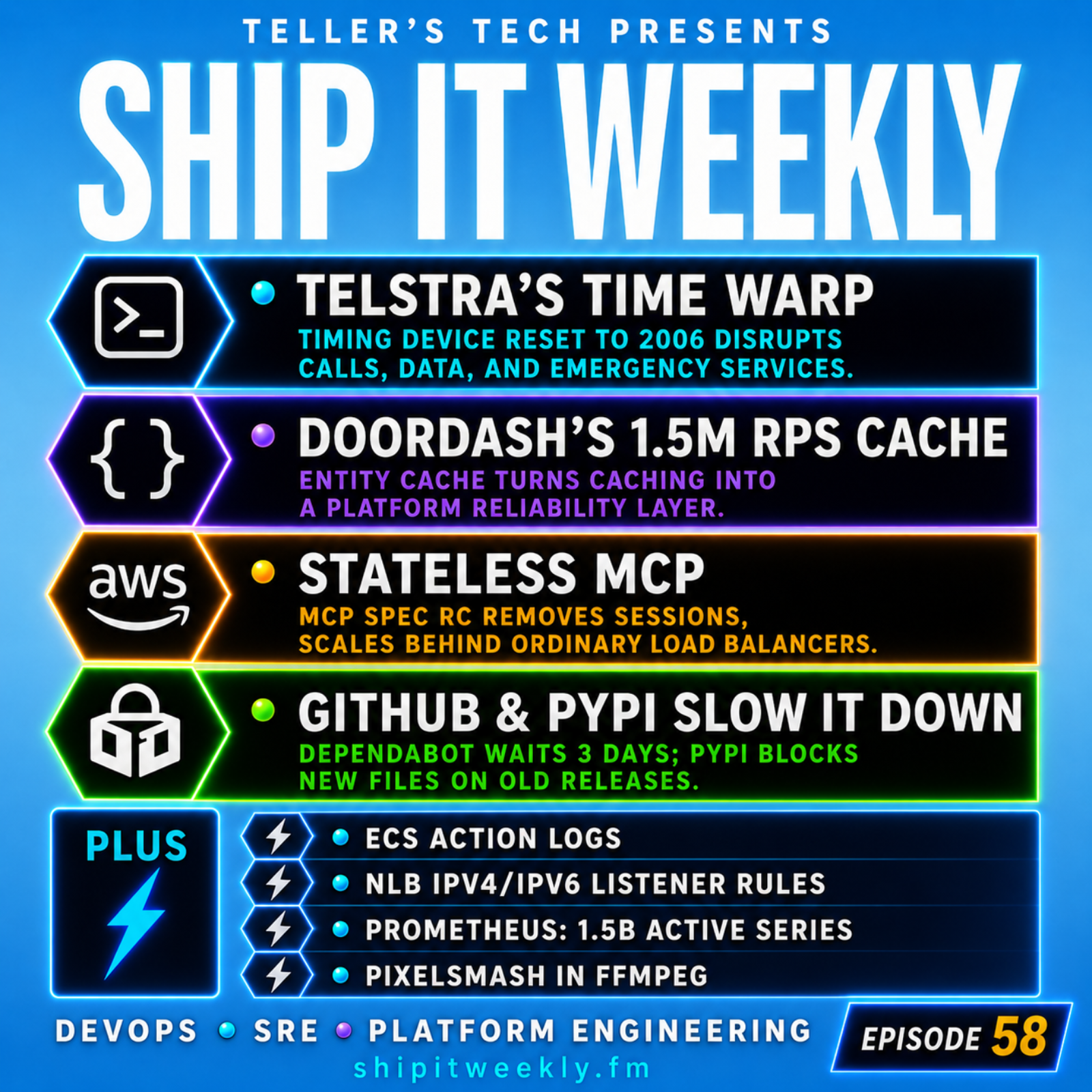 Telstra’s Time Sync Outage, DoorDash’s 1.5M RPS Cache, Stateless MCP, GitHub and PyPI Supply Chain Delays, and Why the Quietest Infrastructure Often Has the Biggest Blast RadiusShip It Weekly · on Model Context Protocol (MCP)97 / 100
 Late checkouts, AI agents and the future of guest communication with Cole Rubin of ConduitMatt Talks Hospitality: Real conversations for innovative hoteliers · on Model Context Protocol (MCP)83 / 100
 The End of Software as We Know It: How AI Agents Are Rewriting HR, SaaS, and Organizational DesignAI First with Adam and Andy · on Model Context Protocol (MCP)81 / 100
 Boilerplate in Seconds: AI Handles Setup, Engineers Handle Logic - Klaudia Dussa ZiegerSoftware Testing Unleashed · on Model Context Protocol (MCP)80 / 100
 How airfocus Is Rebuilding Product Ops Around AI AgentsProduct Team Success · on Model Context Protocol (MCP)80 / 100
 DevOps and observabilityNext in Tech · on Model Context Protocol (MCP)79 / 100
