
Marketing Leadership Podcast · 2025-11-20 · 32 min
Key moments - from our scoring
Substance score
42 / 100
Five dimensions, 20 points each
Isaac Rudansky breaks down critical CRO principles for omnichannel advertising, starting with the fundamental math: improving conversion rate from 1% to 2% cuts customer acquisition costs in half. He distinguishes between conversion rate as a percentage (not volume) and the importance of defining what counts as a conversion - whether purchases, form fills, page views, or engagement metrics. For e-commerce, healthy conversion rates typically range from 1-5% depending on price point and traffic quality. Rudansky identifies two major mistakes: first, confusing production quality with appropriateness (Costco and Chanel both work, but only in their respective contexts), and second, prioritizing brevity over clarity in copywriting. He advocates for the five-second test - showing a hero section for five seconds to confirm visitors understand what you sell, your value proposition, and why they should buy. Good copywriting must include objective facts, product-specific information, and cater to the seriousness of customer intent. The episode emphasizes that accessible conversion optimization doesn't require creative genius - it requires following fundamental rules around clarity, relevance, and audience-appropriate messaging.
For most e-commerce stores, 3-5% is healthy and quite good, though 1-0.5% can be very profitable depending on price point and traffic quality. Rates below 0.25% are likely too low, and rates above 30% suggest you're not bidding aggressively enough or targeting only brand searches.
Show a screenshot of your website's hero section to someone for exactly five seconds, then ask what the brand does, what value it provides, and why they should buy. If they can't answer clearly within five seconds, your messaging lacks clarity.
Designers get caught up in beauty and may create overly polished designs that don't match audience expectations, while great designers sometimes forget that merchandise needs to sell; copywriters who prioritize brevity over clarity fail to provide the information serious customers need to decide.
Lazy copywriting uses superlatives without substantiation, lacks objective facts or metrics, includes no product-specific research, and could work equally well on a competitor's website - good copy is unique to your product and built on real data.
The traditional 'focus on benefits' advice worked when products were novel (like early vacuum cleaners), but today when products are familiar, you need to explain distinctive features and why your version is different or better.
Our reviewer’s read on each dimension, with quotes from the episode.
There are a handful of genuinely useful practitioner points - the CPA math of doubling conversion rate, the design-appropriateness argument, the 'lazy copy' diagnostic, and the 5-second test - but they are buried in filler, host tangents, and basic definitions most experienced marketers already know. The second half on go-to-market devolves into general motivational advice.
If my traffic costs a dollar a click, then I've spent a hundred dollars worth of traffic to acquire a customer...take my conversion rate from 1% to 2% and then get a second customer from the initial hundred people I purchased. Same cost.
If you could take this headline, you could take this copy and put it on any of our competitors websites, then it's probably Lazy copy. If the copy was written without any research into the product, it's probably lazy copy.
The pushback on 'features vs. benefits' being outdated for commoditised products is a mildly contrarian take, and the Costco/Chanel design-appropriateness point is a decent reframe, but the episode otherwise recycles standard CRO and copywriting doctrine without genuine first-principles thinking.
Don't talk about the features, talk about the benefits...I think that's a mistake if you're selling vacuums today because everyone knows what a vacuum is.
If Costco is designed like the Chanel store, their AO would decline. If Chanel was designed like the Costco store, their AOV would decline.
Isaac Rudansky is a working agency CEO with clear hands-on PPC and CRO experience and runs an educational academy, making him a legitimate practitioner. However, he presents no named client outcomes, no scale indicators, and the conversation does not surface depth beyond what a mid-senior digital marketer would know.
I like to start with Google Ads. I think in most cases Google is a really strong bellwether for the market.
the advertisers and the brands and the companies with larger businesses and more mature sales cycles...are using that data and that history to spend more money and bid more aggressively in these auctions
The $1-per-click / 1% conversion rate / $100 CPA arithmetic is a concrete and useful illustration, and named retail brands (Costco, Chanel, Bergdorf Goodman, Macy's) anchor the design-appropriateness point, but there are no real client case studies, named campaign results, actual revenue figures, or industry benchmarks beyond rough e-commerce CVR ranges.
If my traffic costs a dollar a click, then I've spent a hundred dollars worth of traffic to acquire a customer...I have a $50 cost per acquisition from paid.
a 3, 4, 5% conversion rate for an E commerce store is pretty healthy...1% or a half percent conversion rate could be very, very good and very profitable.
The host asks a few reasonable framing questions but repeatedly interrupts Isaac's answers with lengthy personal anecdotes, self-promotion, and appeals to share the episode, burning significant airtime. There are no meaningful follow-ups, no pushback on any claim, and the rapid-fire section adds zero substantive value.
guys, you might ask yourself, is this a course? Maybe. But is this going to be useful for you? Absolutely. So please, please share this episode. Go back to part one, listen to part one and listen to part two as well.
My dad, My dad has this similar quote and that's, that's his favorite quotes. And, you know, I am like, you know, dad, and it's been a very stressful year
Computed from the transcript - who did the talking, and the words that came up most.
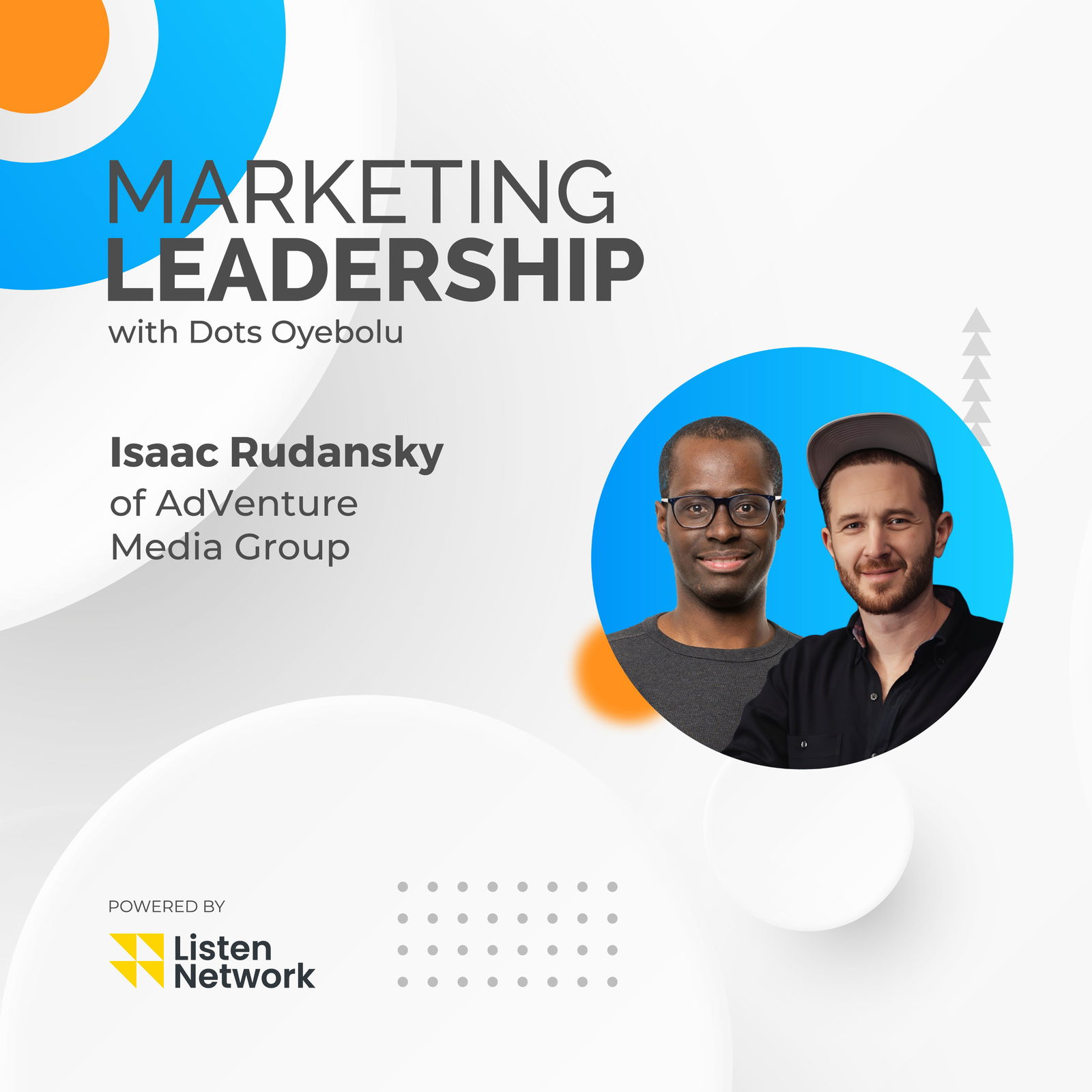
Dots Oyebolu speaks with Isaac Rudansky , CEO of AdVenture Media Group . Isaac shares practical ways to build commercially profitable omnichannel ad strategies and why CRO is the fastest path to improving profitability. He explains aligning production value with audience expectations, clarifying messaging and structuring tests that move the needle. He also covers the mindset required to launch and scale, emphasizing persistence, value and channel fit. Key Takeaways: 00:00 Introduction. 02:36 Improving conversion rate lowers acquisition cost and lifts profitability. 05:43 Design should reflect the brand and audience to protect performance. 08:51 Clear copy communicates value and advances the decision-making process. 11:13 Quick clarity tests validate positioning and reveal missing information. 13:00 Differentiated factual copy strengthens credibility and avoids generic claims. 20:48 Persistence and consistency are essential during early launch setbacks. 24:13 Value offered at a fair price underpins sustainable results. 26:09 Competitive markets are not level, so strategy and data matter.
Transcribed and scored by The B2B Podcast Index.
Speaker A: Welcome to the Marketing Leadership Podcast brought to you by Listen Network. Join your host, Dot Oyobulu as He learns from CMOs, agency leaders and business leaders about the state of performance marketing. Plus insights on strategies, campaigns and intelligence for commercial impact. Connect the dots and enjoy the latest episode.
Speaker B: Hi marketers. This is do and welcome to the Marketing Leadership Podcast. Umiye is Isaac Ransky, CEO at Adventure Media Group. This is part two of the topic that we've been discussing about the structures of commercially profitable omnichannel ad, ah, strategies. I know you guys are ready, uh, let's do it. Welcome back, Isaac. How are you doing?
Speaker C: I'm doing great, Do. Thanks for having me back. I'm excited to be here.
Speaker B: Absolutely. Uh, so we'll get right into it again. We are looking at the topic of having an omnichannel ad strategy that works basically, you know, forget all the other terminologies that ah, we try to uh, put into things as marketers. There is one part of that which I know you have a lot of expertise in conversion rate optimization. Being able to increase the relevance of your ad either from the traffic side or from the, I call it the online presence side. What are some of the common mistakes that you see when people are using uh, or leveraging CRO, you know, in omnichannel advertising? And um, what are the, you know, what are some of your, I guess, best practices?
Speaker C: Sure. I think it's important for people to realize how important CRO is because you're investing in acquisition. Every visitor to your site costs money, even direct traffic. Right. Because you've invested in your website. Maybe you're investing in SEO. You're writing articles, you're writing content. Especially if you're doing paid advertising, which is the world I come from. The total cost of your advertising ultimately is, uh, an expense against your revenue. So as you acquire more, your sort of fixed costs per sale go up. If my conversion rate on an E commerce store is 1%, then 1 in every 100 people coming to the site are buying. If my traffic costs a dollar a click, then I've spent a hundred dollars worth of traffic to acquire a customer. And if I want to acquire a second customer, I could do one of two things. Essentially I could buy another 100 clicks, right. So I could spend another hundred dollars getting another 100 clicks and then I'm get a second customer. Or I could take my conversion rate from 1% to 2% and then get a second customer from the initial hundred people I purchased. Same cost. And now the return the profit on my sale has gone up dramatically because instead of $100 cost per acquisition from paid, I have a $50 cost per acquisition from paid. So the higher you could increase your conversion rate, you have uh, a very significant direct impact on your profitability. So that's the first thing. It's an important thing to focus on. The second piece I would say to realize is conversion rate is a percentage of your visitors that convert. So there's two things there to keep in mind. One is that it's a percentage. So conversion rate, people sometimes confuse. We had a conversion rate of uh, 100 sales. That's not a conversion rate, that's just a volume of conversions. Conversion rates, percentage. You also have to define what a conversion is. A conversion doesn't have to be the last step of a funnel like a purchase or a form submission. If you're a lead gen business, conversions could be views of key pages. A conversion could be an event you set up in analytics that it's any visitor that spends a certain amount of time on the site, or a visitor that scrolls a certain depth of a page, or a visitor that downloads a white paper, or a visitor that makes a phone call. Conversion downloads.
Speaker B: Uh, a podcast episode.
Speaker C: Downloads a podcast episode, begins to listen to a podcast episode. Exactly, exactly. And then you have to understand that different rates are good, average, reasonable rates for an individual conversion. So let's say take an E commerce store, for example. Um, you have an E commerce store selling, I think, I don't know if we used this example last time. Stationary pens and you know, ink replacement.
Speaker B: Yeah, yeah, I think it was your notebook.
Speaker C: Our notebooks. Right. Stationary store online. All right, so what's going to be a convert? Like what's the right conversion rate? Now there's no right or wrong answer. But if a quarter of a percent or half a percent or one in every two or three hundred people are buying something, that's probably too low. And if you think you're ever going to get a 30 conversion rate, you're dreaming. Or you're getting a 30 conversion rate, you're not bidding aggressively enough. You're not bringing enough traffic to the site. You know, maybe you're just bringing people who are searching for your brand terms and even then, right those. So like, uh, in Most cases a 3, 4, 5% conversion rate for an E commerce store is pretty healthy. It's quite good for larger stores with higher, higher amounts of traffic and maybe more expensive price points. And 1% or a half percent conversion rate could be very, very good and very profitable. Okay, so that's sort of the definition and the understanding of conversion rate. And it's very important. A mistake. I see people, a couple you asked me about, you know, common mistakes. I'll mention two common mistakes. One common mistake is that people don't recognize that while you have to hit a certain production value, production quality, at a certain point it becomes a question of appropriateness. And I'll explain what I mean. You could take two different department stores. On the very high end, you have department stores like Bergdorf Goodman or the Chanel store on, um, Fifth Avenue or Tiffany. On the lower end, you might have a Macy's. They're designed very differently. Or you take a Costco, they're designed very differently. When you walk into Costco or you walk into Chanel, you feel very different. However, that doesn't mean that they have. That doesn't mean that Costco or Macy's production value is low and should be raised. If Costco is designed like the Chanel store, their AO would decline. If Chanel was designed like the Costco store, their AOV would decline. So there's a certain.
Speaker B: You have.
Speaker C: So there's two things here. One is you have like, uh, just
Speaker B: to clarify for anyone there, aov. Uh, what does that mean?
Speaker C: Average order value. Yeah, yeah. Your average order value, the revenue from the store or conversion rate. So there's a few things here. People, visitors do make a very quick. In less than a second or less than a half a half a second instinct, instinctual decision whether or not they're going to buy from you and whether. Whether or not they think that. Whether or not they think your products in your store are legitimate. And that happens within the first half a second of a person coming to your site. So you have to have your pages have to load quickly. Your formatting has to be correct. It has to look professionally designed. You have to meet that threshold. But then designers and stakeholders get very caught up in details that don't matter beyond a certain threshold. And in fact, sometimes an overly polished and minimalist production quality is going to hurt your brand. Uh, depending on the type of brand you are, depending on the type of look and feel your customers are expecting. So production value is extremely important. But beyond professionalism and usability and readability and navigability, the design should be appropriate for your audience. Okay, that's the first thing I want to mention. The second very common mistake, um, I see people making is around their copywriting and their messaging. Uh, there was a quote I once saw from a famous advertiser. He said that great designers seldom make great advertisers, he said, because they tend to get caught up in the beauty and they forget that there is merchandise that has to actually be sold. So copywriting has to work to sell the services. Now what does that mean? It doesn't mean that design is not important. Design is very, very important. Like we just mentioned, production value is important. But without good messaging, without good copywriting, you're not going to generate interest, sales and, and, and, and revenue. And good copywriting has to be clear first and foremost. A, uh, very common mistake people make is they try to either write too cute or funny or they try to write too brief. There's a misconception that you have to really be brief and write very little on a website. And we're seeing now, you know, Squarespace and Wix and all these templates. You have like a few uh, words, headline, full screen images, very little information. And I think in certain cases that's good. In many cases that's actually bad. Your goal is not to attract the most minutes, amount of attention as possible. The goal is to attract the most amount of minutes of the people who might buy from you say you have 100 visitors, 50 of those visitors are just not buying anything for whatever reason.
Speaker B: Yeah.
Speaker C: And nothing you do or say is going to convince them to. 30 of those visitors are sort of, or let's say, let's say 20 of those visitors are on the fence. Uh, okay, but they're leaning towards no. 10 of those visitors are on the fence leaning towards yes. They could be convinced. And then the other 10 are already going to be your customers even if you turn them away or if you're not, if you don't do such a great job. So your whole job is to really cater to the 10 people out of those hundred that are on the fence. Leaning towards yes. And think about last time somebody leased a car or if they were doing construction on a home or if they were reading up on their favorite sports team. They're reading quite a bit of information. They're spending a lot of time and you know, especially with business services or higher ticket, e commerce products. Customers who care about these purchases, they want information and I think too many brands because they think they have to write with such brevity. They have to be so concise and so short and they have to cut every possible word. They end up not giving the customer enough information. They don't talk enough about their products and services and they do a disservice to their customers and they do A disservice to their conversion rate. That doesn't mean you should waste words. That doesn't mean you should be overly repetitive. That doesn't mean you should write with flowery prose and FL bluff and bore people to death. But you should have enough content that caters to the seriousness with which a customer is approaching your product or your service. And if you're ever unsure, this is one of. I, uh, think it's a great test to run. If you're ever unsure, if you're being clear enough, do what we call a five second test. It's called the five second test. You take a screenshot of the hero section of your website or the top of a landing page or the top of a category page on your e commerce store. Yeah, you show it to, you show it to, uh, you show it to somebody for five seconds and you take it, take the picture away, take the image away and you ask them, what does this brand do or what do they sell? What value are they providing and what makes them different, unique, why you should, why you should buy through them today. And within five seconds of a customer or within five seconds of somebody looking at your headline and sub headline, they should have a pretty good sense of that information. Uh, so that's called the five second usability test. And you got to be clear, right? You got to focus on clarity. Focus on clarity. Oftentimes this is like a really classic and easy trick. If you go to most websites, you could just swap the headline and the sub headline and you're going to get a better conversion rate because usually the headline will say something to like, welcome to the best day of your life. And it's like, well, what the hell are you selling? And this could be for anybody. Or they'll say something like the number, you know, rated number one. Or they'll say just welcome.
Speaker B: The word will just be superlative. Staccato copy.
Speaker C: Right, exactly.
Speaker B: So three words.
Speaker C: Yeah. And then the sub headline will say something like replace your fountain, Replace your your, get your white sneakers cleaned for the low monthly fee of $9 and get your shoes back within six days or money back guarantee. Which is great, but that should have been in the headline or something. Something along those lines, right? So be clear as much as you can. And like you said, dots avoid superlatives unless they're real and substantiated, valuable. And um, use facts. I always say with copywriting, if you could take this headline, you could take this copy and put it on any of our competitors websites, then it's probably Lazy copy. If the copy was written without any research into the product, it's probably lazy copy. If the product doesn't include any objective facts, objective numbers, objective metrics, then it's probably lazy copy. And if you don't, and if you, if you solve for those three things, you're probably going to be writing very good copy. Writing good copy is, is pretty accessible to most people writing the best ad campaigns in the world. That's okay. That's a creative art and it takes a real creative genius to be able to come up with concepts and lines and big ideas that get into the mind of the everyday consumer and they stick. Like Nike's just do it for example. Okay, but we're not talking about that. We're talking about basic website copywriting optimized for conversion. And I think that's something that is accessible to most people and definitely achievable with some work and abiding by some rules.
Speaker B: Makes a lot of sense. And thanks for really breaking it down there, uh, something to add. There is. You know what might also help is come up with the most various versions of your positioning statement. Brand positioning statement as much as possible. The standard formula, um, we exist for this market to deliver this solution. Basically what is what it says there. And you could have a longer version, you could have a shorter version, but I know about that. Uh, well now I know it's called the 5 second test. But your either you're above the fold. People should be. No, should know exactly what you do. They know you should know exactly what you offer to them. It's not a silver bullet. And I think Isaac had mentioned a lot of things, a lot of areas to which you can look at this. So you know, just look at what works for you. Don't over test. But I would say some level of testing is definitely welcome. So you are testing messaging, you are testing, uh, design, uh, as well. But you know, just don't overthink it. I think yes, it's good that you need to appreciate the seriousness of a customer's intent to your brand. But yeah, still don't, still don't overthink it because you know, simplicity in marketing is still real. Uh, you know, if I were to really add to that as well. So guys, you might ask yourself, is this a course? Maybe. But is this going to be useful for you? Absolutely. So please, please share this episode. Go back to part one, listen to part one and listen to part two as well. So you see how we're able to sort of flow with everything. And please Share. Please share. It helps us a lot if you share with your colleagues. I have one more, you know, very interesting angle as well, um, for Isaac, but we will take a very quick commercial break from our sponsor and it's going to be the dots rapid fire. So getting away briefly from all the seriousness and having a little fun, uh, with a fire that will not consume Isaac for sure, but it's still going to be hot. So we'll see how it goes. Guys, don't go anywhere. I'm saving the best question for the last. Stay tuned.
Speaker A: This episode is brought to you by Listen Network, where podcasts meet their potential. If you're a brand needing podcast episode promotion or podcast follower promotion, Listen Network is here to give you the best in class analytics podcast growth attribution and podcast promotion success. Find out more at www.listenetwork.co.
Speaker B: guys, welcome back. So, like I said, it's a dot's rapid fire. Isaac is a witness in a virtual marketing court of law. So he's going to say the truth are nothing but the truth. Are you ready, sir?
Speaker C: Yes.
Speaker B: Okay, let's do this. First question, what is your favorite marketing metric apart from sales or revenue?
Speaker C: Apart from sales or revenue? Um, I like search impression share. And that's a look at how penetrated your brand is in Google search. Sort of, sort of Google search specifically. And it tends to be a good proxy for how nonlinear campaigns are performing, whether it's TV or radio or just in general how your brand is doing. Google commands a major percentage of, at least in the US of market share for search and um, share of search against your competitors for, for certain key terms I think is a, is a really interesting metric. And then of course, return on ad spend. I mean, I come from a performance world. That's where my job is very much centered around. And return on ad spend is a, is a big metric we look at, um, every day.
Speaker B: Interesting. Um, you're right. I think in, in the world of AI and search generative experience, that KPI may be more important than people think. And, um, yeah, return on ad spend. You know, at the beginning of the this episode, you're talking about the percentages version versus the counts. You know, some people would say, I say the averages versus the counts. And that is one average that people should, you know, really, really look at and hopefully measure properly. So that's good. Okay, second question. How long do you use social media every day? For work.
Speaker C: For work? Really? Very little. Fifteen minutes? Ten minutes?
Speaker B: Yeah.
Speaker C: Maybe I should be on LinkedIn a little bit more.
Speaker B: But I'm. I
Speaker C: don't use. I don't use social media for work that much.
Speaker A: Should.
Speaker B: We need to. We need to hear more. But I know you, You. You're very popular on, um, YouTube, you know.
Speaker C: Yeah, I used to, I used to be more. I used to be more engaged on YouTube and LinkedIn. Um, but it's a good. Yeah, I got to get back into it.
Speaker B: Yeah, yeah, yeah. Makes sense. Okay, last question. What is your favorite marketing quote?
Speaker C: I, uh, have a lot of favorite marketing quotes, but this one from David Ogilvie is, Is one that I like. He says, uh, hard work never killed a man. Men die of boredom, psychological conflict and disease. They do not die of hard work.
Speaker B: My dad, My dad has this similar quote and that's, that's his favorite quotes. And, you know, I am like, you know, dad, and it's been a very stressful year, you know, um, blah, blah, blah, talking about work. And it's like, hard work doesn't kill poverty. There's a way you say that in my language where it sounds like a rhyme because hard work and, um, poverty are, uh, the same letters. So in my, in my language, the Yoruba language of Nigeria. So great one there. I've, uh, never, never since, you know, had that quotes. We've had some great quotes, don't get me wrong, some very popular quotes as well, people saying similar quotes. But yeah, that gave me some, uh, Daddy Father's Day remembrance, even though it's not Father's Day yet. So. Yeah. Okay. So the last question again, I know you have a lot of experience and I've spoken to your colleagues as well. You have a lot of investments in being able to target customers based on your buying journey. So you're looking at the unique psychological characteristics of customers. And of course, that allows you to develop ad content. In this case, that is relevant, that also drives action.
Speaker A: Right.
Speaker B: Uh, what's your. If I use what's your checklist? You know, I come to you as a brand and I say I need to go to market, and I need you to first help me understand, you know, the characteristics. Psychological ah. Of my customers, how they behave and how we can play into that. What, what's. How do you take people through that journey? Yeah, let's just say to launch a new brand because it's. It's probably the hardest at that stage. So when you're going to market.
Speaker C: When you're going to market, I think first from a. From a more, let's say psychological motivational perspective, like people. Most people fail launching because they quit too early and they. There's no shortage of reasons why you're going to fail. Like, you're most likely going to fail statistically. But the people who succeed are able to live in a little bit of a realm beyond statistics, beyond likelihoods. They have a certain motivation, a certain optimism, a belief in themselves that interesting things are going to happen. If I stay the course, if I stick it through, if I show up every single day. And I think that's something you hear over and over again from people who have been successful in whatever they're trying to achieve. Um, is that it's not easy. No shortage of reasons why this is a bad idea. But it requires a lot of determination and a lot of optimism and a lot of consistency. So that's the first thing. Now, from a marketing perspective, I try to look at, say, okay, value, price, market, the basics. Do people want this? And you have to be honest, like, does this, is this something that you think people want? And that question is a little bit different depending on whether this is an established product and you're just doing something a little bit differently and you're doing it or a little bit more luxuriously or maybe you're doing a little bit more affordably. You could take a, like. I don't need to answer whether or not people want pillows. I, uh, know people want pillows. So then it's like, well, should I sell my pillow? Well, why is it like, is it any better? Is it cheaper? Is it different? And the real answer is it doesn't have to be any of those things. The way Internet commerce works is that access to customers has been democratized. It's available traffic is available to anybody willing to pay for it. You don't have to sell your pillow through Bed, Bath and Beyond, or through a department store or through a distributor. You could sell your products and they could be exactly the same as a thousand of the products in the marketplace. And it could still be a great business. You're not going to win any awards for creativity, but it could be a great business. But you still need to think through value, price, and the audience. Uh, so if it's a new product, if that's a whole different set of considerations, um, this, nothing wrong with a new product, but it, it, it establishes its own set of risks and its own marketing, let's say, principles. If I'm, um, if I'm selling something new, what I need to do is describe what this thing can do for you, why it's valuable, what the benefits, ah, are. If I'm selling a pillow. Like there's a, you know, that's a there. It's a common refrain we hear in advertising. Don't talk about the features, talk about the benefits. Like if you sell a vacuum or talk about why it's so great to have a clean room because nobody wants a vacuum. They want a clean room. But I think that's a mistake if you're selling vacuums today because everyone knows what a vacuum is. Everyone knows that a vacuum gets me a clean room. That might have been good advice when vacuum cleaners or electric vacuum cleaners were first coming on the market. Probably in the 1930s or whenever it was that, that, that happened. Well, yeah, but if I'm selling a vacuum today, I better be able to talk about the features and the specifics and the horsepower and the room coverage and how long the, how long the extendable cord is and how light it is and if it comes with what additional add ons because that's, if anything is what's going to ultimately differentiate me my product from the thousands of other vacuum cleaners out there. But if you're launching a new product, it's a different type of thing because you need to educate. If you're advertising a new product that has a similar use case to other products but this is just its own unique twist, then you advertise and you talk about what's new about it and why is that new thing better? Maybe that thing is maybe makes it last longer. Maybe you're a service business that's doing something more efficiently. Maybe you're offering the same value at a lower price. There's all different ways you can go. But ultimately consumers want value. And when you as a brand could provide that value but communicate in a way that recognizes your job is to provide value, you as the uh, seller, you recognize that I'm here to provide you value at a fair price. That's the vast majority of your marketing. That's the vast majority of your marketing. And a lot of brands fail to do that. So then I say okay, we have a product, we have a website. Is the production quality good? Do we work on our CRO and our messaging, the logistics, the infrastructure? Obviously whether you're offering a service or your retail or you're an e commerce brand, all these considerations are different. But at a high level they're, they're relevant to any type of category. And then you look at traffic acquisition. I like to start with Google Ads. I think in most cases Google is a really strong bellwether for the market. How Many people are in the market. How many people are searching for these types of products, how many people are searching for these types of services? And if it's really a brand new category, then you have Meta, which is more of a rich visual media type of advertising channel or, or format. And again you produce imagery and video that's very clear, very to the point, shows the item and you begin measuring. And it's very rare that your campaigns are going to do well in the beginning. You have to uh, you know, a business, the. It's not easy and it's not a given that you'll succeed. All of these advertising channels that are pay to play are very saturated, are very competitive. And it's not true that it's an equal playing field, it's just not true. Yes, anyone can start and anyone could spend money on these platforms, but it's not true that it's an equal playing field because the advertisers and the brands and the companies with larger businesses and more mature sales cycles and more mature revenue cycles, if it's E commerce, are uh, using that data and that history to spend more money and bid more aggressively in these auctions which is driving your cost up. But you might not be able to afford those more, let's say aggressive costs per click because you haven't figured out how yet how to earn that much revenue on a new customer that your competitor is earning on a customer. You're losing money when your competitor is breaking even or your competitor is willing to break even just because they're much more established and they have investors, uh, and you get pushed out of the auction and that could, that will happen. It can happen. And it's. So it's not true that it's a level playing field, but nevertheless it is an open competitive arena that still it's definitely, you know, look, new winners and new losers are emerging every day across Meta and Google, Amazon, TikTok, Pinterest. And it's um, it's absolutely possible for, for a new advertiser, a new business, a new brand that wants to spend more aggressively on these channels to do very well.
Speaker B: Interesting. What I like about, I think the biggest thing I love in everything you said, the value, you know, value versus benefits. Right. Some people also call it the job to be done. And you know, we often see on our side, you know, instead of doing just do it, we'll say, you know, achieve faster space, faster pace because of our aso, not strained after Iran because of so, so technology in the boots. Achieve this job to be done because of this feature, because of this capability. I won't, I wouldn't even say it as feature per se. You know, everybody uses a phone, nobody knows it's made of uh, you know, some chipset that is 400 gigahertz and all that. No, no one cares about that. Right. They just care about what the chip allows you to do. So that's where we come from. And you're right, you know, the era of using benefits, very fluffy stuff, is over. You know, now customers are also have ah, a lot of power on their hands. They're able to research things themselves because of the, you know, the growth of uh, digital media in general in terms of the cost, of course. By increasing your conversion rate, you tend to increase your level of competitiveness in the auction. So you know, if you, if you're looking at, you know, how do I break out when the level of playing field is not low, a high or is not even available. That's the right uh, word there is, you know, be able to make sure that your campaign is, is hitting people as much as possible, even if it's just one impression. I know that that doesn't make sense but you know, with as little data as possible, make sure that you, you are as relevant to your target market as possible. And then with that you can easily increase your relevance, increase your attractiveness and increase like you said, uh, Isaac, you know, you may not win the awards, you may not be on cnbc, but you're making business grow, you're making profits and that's really what's about. And you are paying the bills for your family as well. Uh, it's important to always tie those things together too. Uh, again, I can't thank you enough Isaac, for all that you have shared. You know, how you just sort of broken everything down. If you're listening, if you're watching, I hope you've taken as many notes as you can or as you, as you should and been able to you know, run ads the way it should be run. You know, we're not going too technical today. We are looking at the basics. We are looking helping you cover as much of the basis as possible. So Isaac, I would like more people to follow you. I have clamored. I am raising a virtual placard on why you should get more on uh, social media. M. But people also need to find your company the great things that your company have done. So please tell us about that for those who don't know already.
Speaker C: Yeah, I had a great time talking with you Dots. This was a really good conversation, very insightful, great questions. Uh, look, yeah, definitely get more active on social media. For now, listeners could go to learning adventure ppc.com learning.adventure ppc.com to check out our academy of courses, downloadable guides, toolkits, you know, to see what our agency is up to. They could go to Our main website, adventure ppc.com I'm on LinkedIn. Look me up, connect with me there. Uh, I'm on YouTube a little bit and I'm on Twitter at Isaac Radansky a little bit. I'm not super active there, but yeah, very easy to connect. I'd love to hear from your listeners and uh, hopefully some of our educational resources will be valuable.
Speaker B: Yeah, absolutely. Absolutely. So guys, this is how we do it. You know, More episodes like this, especially part one of this episode, can be found@dotsloves marketing.com you can also subscribe to the Marketing Leadership Podcast on Apple, Spotify and YouTube so you never miss a new great episode from a great guest. I'd like to thank Deskrie, Glisten, Network and content allies for their support. Till next time, connect the dots.
Speaker A: Thank you for listening to the Marketing Leadership Podcast brought to you by Listen Network. There will be links to resources mentioned in today's show notes. If you enjoyed this episode, please leave a five star review and be sure to subscribe. So you never miss an episode.
Other episodes covering the same guests and topics, from across The B2B Podcast Index.
 Why Your Marketing Attribution Is Missing the Holiday Season EffectMarketing Analytics with Fexingo · on Cost per acquisition (CPA)94 / 100
 How Performance Creators Beat Meta's New Algorithm with Mal Chia, Managing Director & Co-Founder at Ecom NationThe Partnership Economy · on Return on Ad Spend (ROAS)87 / 100
 Why isn't your CRO working? Emotional targeting is the missing piece, not button color - with Talia WolfClosing Time · on Conversion Rate Optimization (CRO)81 / 100
 How a Solo Dev Hit 10K MRR by Selling Templates on GumroadThe Indie Hacker Podcast with Fexingo · on Cost per acquisition (CPA)77 / 100
 Why Most Paid Ad Spend Fails (And How to Fix It) with Ari Pirutinsky (#75)Exit Algorithms · on Cost per acquisition (CPA)77 / 100
 I Grilled an Ad Agency CEO on How They Pick CreatorsSponsor Magnet · on Return on Ad Spend (ROAS)76 / 100
 Mark Evans - Skills To Becoming a Business-Building Marketing Leader47 / 100
 Jessica Rhodes - Grow Your Podcast with Predictable Podcast Guesting Strategies54 / 100
 Eric Montgomery - The Benefits of Using Branded Podcasts for Brand Growth52 / 100Mason Cosby - Leveraging Technology in Account-Based Marketing for Revenue Growth83 / 100
 Isaac Rudansky - The Structures of Commercially Profitable Omnichannel Ads Strategies (Part 1)54 / 100