
Just Power · 2026-04-29 · 40 min
Key moments - from our scoring
Substance score
64 / 100
Five dimensions, 20 points each
NICOR Gas serves 2.3 million customers across Northern Illinois, where natural gas remains essential infrastructure - 95% of buildings use it for heating and 75% of total energy consumption comes from gas. Meena Beyers explains why energy affordability shifted from a secondary priority to urgent focus following the 2023 PJM capacity auction crisis and Illinois Resource Adequacy Study. Rather than mandating electrification, NICOR is testing credible solutions rooted in local reality: underground storage facilities (where 40% of winter gas is purchased and stored in summer at lower prices), the Healthy Homes program (partnering with healthcare providers to address life safety barriers), and the Smart Neighborhood pilot with Habitat for Humanity and National Renewable Energy Laboratory - designing net-zero affordable homes optimized for reliability and low monthly bills rather than just upfront sustainability credentials. The Community Comfort pilot delivered immediate results: 30 weatherized homes in a concentrated neighborhood achieved 20% average monthly bill reductions ($31/month savings) by deploying pre-positioned contractor networks that bulk-purchase materials and work door-to-door within communities. Beyers emphasizes that scaling these programs requires regulatory creativity, operational excellence, cross-sector partnerships (Southern Company, BuildBlock, GE Appliances, GreenLink Energy Solutions), and policymaker education on costs and benefits. The 350-partner Community Connection resource fair network exemplifies post-COVID collaboration: moving beyond transactional utility relationships to integrated community services addressing root affordability barriers.
NICOR's Community Comfort pilot achieved 20% average monthly bill reductions (normalized at $31/month savings) in 30 weatherized homes over a winter period, using targeted neighborhood selection and concentrated contractor deployment rather than scattered individual retrofits.
95% of Illinois buildings use gas for heating, 75% of total energy comes from gas, underground storage provides 40% of winter supply at summer prices, and clean electric grids with reliable capacity and battery storage are not yet available - making gas essential for reliability and affordability during the transition.
A partnership with National Renewable Energy Laboratory to design and build net-zero or net-zero-ready affordable homes optimized for low monthly operating costs and high reliability over 30 years of ownership, using technologies like heat recovery ventilation and insulated concrete forms, with homes being deployed by Habitat for Humanity in Northern Illinois.
Post-COVID program connecting customers to 350 social service providers through quarterly resource fairs (now attracting 300-400 families) featuring 20+ partners including Illinois Tollway, Illinois Treasurer's Office, and community assistance agencies, addressing social determinants beyond energy bills.
Regulators typically fund peak-month assistance rather than long-term efficiency investments, and utilities lack the operational change agility and cross-sector partnership models needed to deliver solutions cost-effectively - requiring both regulatory redesign and shared investment from healthcare, real estate, and community sectors.
Our reviewer’s read on each dimension, with quotes from the episode.
The episode contains moderate substance with concrete program details (Community Comfort Pilot delivering 20% bill reductions, Smart Neighborhood specifics, contractor consolidation model) but is hampered by considerable soft framing and repetition of 'collaboration' and 'partnerships' without deep operational insight. The host asks competent questions but rarely pushes for surprising revelations or challenges assumptions, resulting in affirming rather than revelatory conversation.
In a small neighborhood, we completely weatherized about 30 homes. Those customers who participated in the pilot between November of 2025 and March of this year - when we looked at their bill analysis from having been weatherized by October - had a 20% monthly reduction in their energy bills through the winter.
instead of customers trying to find a contractor, which is the traditional model, we said: these three contractors from this town are your contractors. That enabled them to estimate how much work they'd do in that community and bulk-purchase equipment and materials, which drove down costs.
While the Community Comfort Pilot and Smart Neighborhood models show some operational creativity (geo-targeted weatherization, contractor consolidation, living lab approach), the framing relies heavily on conventional utility-sector language around 'partnerships,' 'community-centered approaches,' and 'all of the above' energy policy. The core argument that natural gas remains essential due to grid reliability is industry orthodoxy, not contrarian insight.
Credible solutions are rooted in a local reality. They use every tool in the toolkit.
natural gas - it crossed this line of it's not just a choice that customers deserve in places like Northern Illinois. It's a real necessity to keep this economy going
Meena Beyers is a substantive practitioner - VP of Business and Community Development at a major regional utility serving 2.3 million customers - with direct operating responsibility for real programs. She speaks from implementation experience rather than theory, though her role is somewhat bounded to a single utility's perspective and advocacy position on energy policy rather than broader operational expertise.
She is the Vice President of Business and Community Development at NICOR Gas. They serve 2.3 million customers across Northern Illinois
I do sit in a unique spot at the intersection of all things growth and economic development, delivering solutions for customers, as well as working every day with our local communities and leaders
The episode includes solid program-level metrics (2.3M customers served, 30 homes weatherized, 20% bill reduction, $31/month savings, 350 social service partners, 20+ partners at resource fairs, 300-400 families per fair) and concrete details on Smart Neighborhood technologies (heat recovery ventilation, insulated concrete forms). However, broader claims about policy impacts and grid dynamics lack supporting data; cost-benefit analyses are mentioned but not detailed.
In a small neighborhood, we completely weatherized about 30 homes... had a 20% monthly reduction in their energy bills through the winter. And we had a pretty severe winter here. That's an average of $31 a month that they paid last year that they did not have to pay this year
We have a network of 350 social service providers... we started with three partners at the fairs, and now a couple years in, we have 20-plus partners that come to these fairs. We have three or four hundred families coming through each time
The host, Carolyn Parrs, asks competent framing questions and shows genuine interest in learning, but rarely probes contradictions, pushes back on claims, or asks difficult follow-ups. Questions are largely open-ended and affirming ('Tell me more about that') rather than challenging. The guest is given space to elaborate on her initiatives without significant critical examination of trade-offs, scalability constraints, or competing evidence.
How far along are you in that pilot?
What have you learned, or what are you learning, about what it actually takes to move from a pilot to really scaling this?
Computed from the transcript - who did the talking, and the words that came up most.
The energy affordability crisis is well understood. What's less clear is what's actually holding up as credible solutions from inside the system. Meena Beyers knows. As Vice President of Business and Community Development at NICOR Gas - serving 2.3 million customers across Northern Illinois - she's doing that work right now. In this conversation with host Carolyn Parrs, Meena takes us inside several of NICOR's on-the-ground initiatives - from a Smart Neighborhood built with Habitat for Humanity to a Community Connection Center linking customers to over 350 social service providers - and shares what it actually takes to scale what's working. She also makes the case for customer choice over mandate in a region where 95% of buildings heat with natural gas, and what she'd tell policymakers still asking the wrong questions. Highlights The Community Comfort Pilot in action: How NICOR flipped the traditional weatherization model - bringing contractors and bulk purchasing directly into a targeted neighborhood - and delivered a 20% reduction in winter energy bills for participating households.
Transcribed and scored by The B2B Podcast Index.
Just Power Podcast Leading Through Energy Affordability: From Pilot to Practice with NICOR Gas Guest: Meena Beyers, Vice President of Business and Community Development, NICOR Gas Carolyn Parrs 01:08 We've looked at the data, we've heard from communities, and I've talked with leaders across the system. And at this point in the conversation on energy affordability, the problem is well understood. But what is less clear - and where the real work is right now - is what is actually holding up as credible solutions when you're operating inside the system itself.
Hello, I'm Carolyn Parrs and welcome to Just Power. This is our series, Leading Through Energy Affordability. And today I am joined with Meena Beyers. She is the Vice President of Business and Community Development at NICOR Gas.
They serve 2.3 million customers across Northern Illinois, where those questions are being tested across communities, systems, and policy in real time. So it is so great to have you with us today, Meena. Meena Beyers 02:07 Thank you so much, Carolyn.
It's great to be with you. Carolyn Parrs 02:10 All right. So across the country - it's not just happening in Illinois, right? - we're seeing rising energy demand.
We're seeing pressure on the grid and real concerns from real people everywhere. So where you're sitting at the intersection of growth, community, and customer programs, you're seeing all of this firsthand. How did this work on affordability become central to you? And was there a moment or a shift where it became clear that this just wasn't one priority among many, but something different?
Meena Beyers 02:45 Yes, thank you so much, Carolyn. That's a great place to start because I do sit in a unique spot at the intersection of all things growth and economic development, delivering solutions for customers, as well as working every day with our local communities and leaders, community partners, and corporate giving. And at the center of all of it are customers and communities. So I can tell you what that's looked like in Illinois.
We started seeing a shift during COVID, and we first started to hear from our customers that they needed help with much more than their utility bills. So for the past several years, we've been really focused on community partnerships that could bring more comprehensive services to our customers in response to that need. So then if you go over the next five years to get us to today, we started to see the shifts in state energy policy, some local policies - and we're on the front lines of seeing how some of those energy policies don't necessarily translate in the communities that we serve with those intended benefits.
And so we continue to work to design programming around partnerships that really drive access and continue to lower energy bills. But then last summer, I think is when we saw the real shift happen. And I think that's when the nation really started to see it. In Illinois, we saw what happened in the PJM capacity auction last summer, and electric capacity markets across our region, and how that really started to impact customers very immediately.
And then shortly after that in Illinois, the release of the Illinois Resource Adequacy Study. I think those several months there - locally, hyper-locally - that was a decisive shift in understanding that this was something very different. I mean, yes - data centers, we all know nationally that that's played a role in large demand. We know it's been wonderful to have acceleration in advanced manufacturing and reshoring of high energy industrial uses, growing electrification, and the use of EVs.
And we're also seeing that it's policies across multiple states that are constraining supply - with sunset dates on gas generation without adding new generation to keep up that isn't intermittent, particularly generation that can handle all the winter peaks. So I think that's where it became very, very clear to us that natural gas - it sort of crossed this line of it's not just a choice that customers deserve in places like Northern Illinois. It's a real necessity to keep this economy going, to keep households and businesses going.
And as a result, we are really stepping up our customer programming to figure out how we remove barriers and help customers that need it the most - some of whom have never needed assistance. Carolyn Parrs 05:41 Okay, yeah, and we're seeing that also across the country. Let's talk a little bit about Illinois and why natural gas - it's different in the center of the United States. So it's not just this clean energy story.
Illinois has very ambitious clean energy goals, and there's also reliability, right? Cold winters and things like that. We hear a lot about "all of the above" when it comes to strategy. So what's different about Illinois in that?
Meena Beyers 06:16 Yeah, I think the energy diversity in Illinois is our superpower here in the state. We have a large nuclear fleet. We have one of the most robust and modern natural gas systems in the country, next to the Henry Hub in Texas. Northern Illinois is one of the busiest trading spots for the natural gas industry.
And that brings us a lot of market liquidity, combined with our on-site, in-state underground storage facilities that help us buy natural gas in the summertime and store it for when we need it in the wintertime. That's what really creates that liquidity and really low costs in Illinois. So we enjoy very abundant supply of energy in Illinois, particularly with this natural gas system and our storage. And we enjoy the lower costs because of that market liquidity that we have here.
Carolyn Parrs 07:15 Okay, so are there trade-offs to that? How do they show up in your work? Meena Beyers 07:21 Yeah, so we have always understood that natural gas is part of the clean energy economy. Here in Northern Illinois, in our service area, 95% of the buildings use natural gas for heat.
About 75% of the energy used across all of Northern Illinois comes from natural gas. So it's not the kind of place where you just flip a switch and say, okay, well, we're not going to use natural gas anymore. That has to be a very planned transition. And there's always going to be a role for it - whether it's to support backup supply for electric generation, whether it's to support industrial processes that don't have a replacement for electricity.
So there is a long-term role for it there. But that being said, we still have a responsibility as a part of that sustainable future. So what that looks like for us: we focus on affordability programs to build efficiency in homes and businesses, and that creates greenhouse gas emissions reduction opportunities. We support the production and generation of clean molecules - investments in things like renewable gas interconnections to be able to catalyze more of that in the state.
And then of course, just continuing to modernize our system and having superior operations that really help us reduce the amount of leaks on the system. So those are important roles I think that we play. We don't think of it so much as trade-offs - it's that in order to continue to support this economy and have the reliability and affordability we're talking about here, we know that we play an important part. Carolyn Parrs 09:16 Yeah, okay.
So you're part of the whole puzzle. It's an important part. And I know gas has been an important part for so many states. So let's talk a little bit about electrification.
As the grid needs to be upgraded - we see storms happening, a lot of data centers, large loads happening - how should we be thinking about it when affordability is already a concern for so many households? Meena Beyers 09:53 Yeah, and I think an important part of that question is how that electricity is generated and how that capacity is created to serve all of it. Because I think the way that electrification became part of the playbook for a clean energy solution was on the premise that generation can become clean - 100% clean - and a grid can become 100% clean.
And I think we all understand, at least in the industry, that there's always going to be a role for backup generation. There is always going to be a mix or a need when renewable resources may be intermittent. So as we work toward that goal, there is going to be a need for diverse energy resources. So how we think we need to be thinking about electrification is: as a customer choice, not a mandate.
Here in Northern Illinois, policies that could mandate a switch to electrification would take this affordable and reliable energy choice away from customers when they need it the most - especially right now, with the strain that's on the grid and how that's causing an increase in prices. Any customer that wants to adopt electrification in their home or business can do that today. That's a choice that's available today. But when we start to look at mandates - and those come through in ways that customers are often unaware of, like new building codes that restrict the use of gas, or municipal ordinances that phase out or penalize the use of gas - they're not only harmful to the communities and the residents and businesses who didn't really have a voice in that, but they also demonstrate just a lack of understanding of how complex these energy systems actually are.
Carolyn Parrs 11:52 Yeah, so is that happening in Illinois, where you rely on gas so much? Meena Beyers 11:55 Yes, in Illinois, as part of the clean energy legislation here, it enabled the development of stretch energy codes, for example. So that is an effort that has been underway, and it is a constant education to help stakeholders understand what the impacts of some of those proposals are if they limit accessibility to abundant and affordable energy sources - the costs of implementing some of those.
That's something we've worked a lot with communities on. And home builders especially have talked about that. We've seen it in just a few communities. We have two or three that have either adopted or are considering such policies.
And I think that market response just tells you what communities are looking for. They're looking for choices that really support affordability and comfortable living. Carolyn Parrs 12:55 Okay, so it shouldn't be mandated - it should be a choice for the community. That's what I'm hearing you say.
Meena Beyers 13:00 Yeah, and I will clarify - it definitely should be at least while there's still a plan being put in place to figure out what that pathway is to a clean electric grid. We're just not there yet. Carolyn Parrs 13:21 Yeah, I'm with you on that. It's all of the above.
And all renewables right now is pretty darn expensive, right? Our batteries aren't there yet - the capacity of storage for batteries, although it's moving in the right direction. So we need it all, right? We need it all, especially as our grid is getting transformed and customers are feeling the pain of that.
So the central question of this series is about what credible solutions at this time look like. From NICOR Gas, what you're seeing in communities and business development - what does that look like? What are some solutions you would say are part of the transition we're in? Meena Beyers 14:15 Yeah, absolutely.
I think first of all - what do credible solutions look like? They're rooted in a local reality. They use every tool in the toolkit. So we're not leaving anything in the toolkit.
Our industry is in a kind of triage mode right now, and you've got to use every available resource to drive affordability and supply, from generation all the way to delivery. And most importantly, I think, is that we're looking at the actual costs and benefits of those solutions - not just offsetting upfront costs with incentives, but in the long run, what does it cost to own and operate and maintain these investments over their lifetime? So I think some of the things we're seeing that are really working are continued investments in tried-and-tested solutions.
Like our underground storage facility, where 40% of our winter deliveries are purchased in the summer, stored underground, and then delivered at those summer prices during the most expensive times to buy in the winter. That is a resource that benefits customers and should be maintained. It doesn't mean we don't also invest in long-duration battery storage - it just means we don't scrap the one that's working while we're still figuring out the battery storage. Creative partnerships is another area where we're really seeing credible solutions work.
We have a Healthy Homes program where we've really tried to partner with the healthcare industry to remove barriers and drive savings for customers. A lot of times there are life safety issues in the home that keep us from being able to make it tight and efficient. With those creative partnerships, we're able to overcome some of those and really bring affordability to customers who have been unable to access it in the past. I think some of the other credible solutions involve the data and analytics that go into it - the real research.
We're doing a project in one of our communities called the Smart Neighborhood. We've partnered with the National Lab of the Rockies to find the optimal technologies to make sustainable living affordable and reliable in new construction, really driving down the cost of new construction. And now we're deploying those in an affordable housing community being built by Habitat for Humanity - collecting all the customer data as they move in to compare and understand, in real life, how these customers experience these technologies and how they impact the affordability of owning that home.
Carolyn Parrs 17:26 How far along are you in that pilot? Meena Beyers 17:28 Yes, we just launched our demonstration home - our show home - last fall, where we can bring people in and educate them about the technologies. And actually in the next couple of months will be the first two home dedications for the first two homeowners moving in. We expect about 10 of the units to be occupied by the end of the year.
So it's really exciting. Carolyn Parrs 17:52 Okay. And when you say "affordable" - tell me more, because affordable to one person is not to another, right? Affordable housing is what we're talking about, marrying that with sustainable, which often aren't together.
Just give us a glimpse of what that looks like. Meena Beyers 18:08 Yeah, so the idea is that anyone can throw all the money at a home and say it's net zero or sustainable. What we learned from our community partners in understanding the challenges of homeownership - the concerns, the stumbling blocks - is that it's the cost to own and operate that home. Getting the keys is the first hurdle.
And then it's 30 years of trying to manage the challenge of being a homeowner. So we learned things like: the need for bills to be very low, yes, but also reliability - how detrimental it is to a household's budget to lose a week of groceries, and how that could throw that household off for a year. So we took all of that into account when we tried to optimize these technologies. We asked: if a home is designed to be net zero or net zero ready - as efficient and sustainable as it can be - what are the lowest-cost ways to do that while we optimize for the highest level of reliability and lower monthly bills?
We're testing technologies like heat recovery ventilation, for example. It's a great efficient technology that improves indoor air quality, but it also preheats and pre-cools the air that circulates in the home and creates more efficiency. The study found it's a super cost-effective way to build it in - it pays for itself and really gives back quite a lot to the homeowner. We also used advanced building materials - insulated concrete forms for the walls.
The incremental cost of building with that pays for itself over time in the bill savings that the customer will receive. Carolyn Parrs 20:29 So is this being spearheaded by NICOR Gas, or are you in partnership with a coalition of builders and material providers? Meena Beyers 20:40 Yeah, this has really been the epitome of collaboration. Southern Company has a number of Smart Neighborhoods - the first was at Alabama Power, there's another at Georgia Power.
NICOR Gas is Southern Company's first affordable housing Smart Neighborhood. The whole idea is that we have a research concept we want to test in a living lab. We partnered right away with Habitat for Humanity, one of the biggest affordable housing developers in our region. We lead it, but there are so many partners at the table.
BuildBlock is one, GE Appliances, GreenLink Energy Solutions, rooftop solar on the homes. And community partners - the city, home builders active in our region who are working with Habitat on sponsoring some of the homes. The list goes on and on about all the partners that have rallied around this idea. Carolyn Parrs 21:59 Yeah, I think this action of community partnerships has really begun to soar - through COVID, at least.
Because before that, as I remember, there would be communications and passing it on. But now I really see companies coming together and creating something together. Meena Beyers 22:22 Absolutely. And I think what we're also seeing since COVID is this combining of real engagement - really being together in the same physical space and working together.
Our Community Connection Center is another program that exemplifies that. We started it coming out of COVID, trying to provide services beyond the bill - beyond energy efficiency and energy assistance - understanding that our customers needed connections to other social services. We have a network of 350 social service providers that we wanted to be able to connect them with. And as we talked to those customers and learned about their needs, we decided to take that into communities.
So then we started these Community Connection resource fairs. I think we started with three partners at the fairs, and now a couple years in, we have 20-plus partners that come to these fairs. We have three or four hundred families coming through each time and getting all of these services - Illinois Tollway, Illinois Treasurer's Office, local community assistance agencies. The collaboration is kind of infectious.
There's just this hunger to be together and have real engagement. Carolyn Parrs 23:55 Okay, wow. Well, I want to hear more about that as it develops - maybe we'll have you back. So you've launched several projects and pilots: Healthy Homes, Community Comfort, Smart Neighborhood.
If you had to point to one where you're seeing the most traction for your customers right now, what would that be? Meena Beyers 24:24 You know, one I haven't really hit on yet is a small pilot we just did this past year. And I will first say, as the mama bear of all of these projects, they're all very meaningful and impactful - it's hard to pick just one. But to your question about where we're seeing impacts right now - we just did a pilot we call the Community Comfort Pilot.
In this pilot, we took data analytics and tried to figure out where the leakiest homes are. Where are the neighborhoods where, because of the age and size of the home, usage looks unusually high compared to the whole neighborhood? And where are the income levels such that they can participate in the weatherization programs we offer? So we targeted a geography where we had reason to believe that concentrated energy efficiency investment could have a very profound impact on that community.
Then we immersed ourselves in that community. We showed up, went door to door, held community meetings. We brought a contractor network there - instead of customers trying to find a contractor, which is the traditional model, we said: these three contractors from this town are your contractors. That enabled them to estimate how much work they'd do in that community and bulk-purchase equipment and materials, which drove down costs.
They're not rolling trucks every day from where their materials are to the site. They're in that community for a month, going door to door and doing this work. This was a big test, because we didn't know how this model was going to work. The results were astounding and immediate.
In a small neighborhood, we completely weatherized about 30 homes. Those customers who participated in the pilot between November of 2025 and March of this year - when we looked at their bill analysis from having been weatherized by October - had a 20% monthly reduction in their energy bills through the winter. And we had a pretty severe winter here. That's an average of $31 a month that they paid last year that they did not have to pay this year - normalized for pricing.
Significant. So they felt that immediate impact. And that's where the collaborations come in - we're limited in how much we can do, and we can't do it alone. So it's looking at how we bring other businesses with shared goals.
There are so many industries that share the same goals as utilities in trying to help build strong, thriving communities and grow household and business potential. If we can come together and figure out our piece of it, I think we can really scale something like this in a big way. Carolyn Parrs 27:57 So there you go - scaling. That was my next question.
What have you learned, or what are you learning, about what it actually takes to move from a pilot to really scaling this? Because I've seen pilots at utilities that never scaled - they were showcases. But we're in an affordability crisis. How do we scale this?
What are you learning on that? Meena Beyers 28:23 Yeah, so I think it's tricky in regulated utilities, right? We have to collaborate with our regulators to find a little more creativity - to be able to put investments where they're going to have the biggest and most lasting impact, not just immediate assistance for peak months, but the kinds of investments that really allow customers to sustain those savings year-round, summer and winter, year after year. So I think that's one of the challenges in scaling pilots: having the resources.
Southern Company, our parent company, is absolutely a leader in this nationally, looking across the system at how we bring different partners to the table - even data centers, different sectors, community partners - to share in this. Because again, utilities can't do it alone. And I think in the utility sector, we have to build that muscle memory of change agility - the ability to turn things on their side. We've all nationally been doing weatherization the same way for 15 to 20 years.
This pilot took a lot of things that were different. Our team loved that opportunity to just ask: why do we keep doing it this way? How can we do it better? Carolyn Parrs 29:54 Yeah, I mean, just that contractor idea alone - it's a money saver.
You probably have more control on quality, too. Meena Beyers 30:05 It is. And with limited resources, when we can drive down the cost and improve the efficiency of delivery, that means more customers can be served and benefit from those limited resources. So operational excellence and efficiency is definitely one of the levers we have to be able to scale.
Carolyn Parrs 30:26 Okay, so what role should policymakers play in this idea of scaling? Meena Beyers 30:34 Yeah, policymakers have always and continue to play an incredible role in this. First of all, I think we have to do a better job of educating policymakers with these details. We know that policymakers are so busy - they have a million topics they have to become experts on, and it's a big investment of time to really learn about this.
But our policymakers have been so excited to learn. In fact, they helped us pass some legislation last year that would actually give us opportunities to propose ways we can expand some of these programs. But I think first and foremost, it's about asking the right questions. Policymakers should ask about costs: who is actually paying for the things we're setting out to do, and who benefits - what do those real benefits look like, and are they immediate?
I think insisting on bringing subject matter experts to the table is also critical. That doesn't always happen, and policymakers are relying on the people around them to make sure the right people are at the table. A lot of the policies we're now running into affordability challenges with were formed without people who actually know how the systems work. And I think for policymakers - across many, many states - it's also okay to change course.
I think it's fair to say the world changed on everyone, a few times. This unprecedented energy demand wasn't anticipated six or seven years ago when a lot of those policies were put in place. And it is okay to pause on some of it and say: the world changed, and how do we pivot to make sure we keep customers and communities at the center of this transition? Carolyn Parrs 32:43 I love what you're saying.
And I love that it's part of the business model - really putting the community at the center, as a real part of the equation. I'm seeing that across the board in many states. And I'm so happy to hear that you're at the helm of that, Meena. How can people learn more about you and what you're doing at NICOR?
Meena Beyers 38:00 Yeah, I've shared a couple of links to learn more about our Community Connection Center as well as our Smart Neighborhood project. Certainly visiting our community page at nicorgas.com - and leaders are always welcome to reach out. We love to connect and build our network in this space.
We'd love to share what we've learned and also learn from others on how we can do that. So hopefully we can continue to grow these connections and build ways that we can work with new partners. Carolyn Parrs 38:35 Okay, well thank you so much for joining me today. What I've learned from this conversation is that the credible solutions we're all seeking are not coming from just one place.
There's not just one lever being pulled here. They're emerging intentionally from a lot of different places - how we connect systems, how we bring communities into the process, how we build partnerships. And I always say: we're all in this together. All together, we can work on this, and it's in motion now.
The solutions are in motion now. So thank you so much for sharing not just what you're doing, but how you're thinking about it going forward. And to you, our listeners: this is exactly what this series is about. Not just naming the affordability challenges we're in, but understanding what it really takes to respond to them in practice - and I think Meena has really shown us that today.
But that also includes you. If you have an idea, a comment, or an epiphany has happened - go ahead and subscribe to Just Power. We want to hear your voice, because it's going to take all of us to participate in this energy transition. We are all in it together.
Other episodes covering the same guests and topics, from across The B2B Podcast Index.
 Zero Waste at 73,000 Seats: How Mercedes-Benz Stadium Built a Closed-Loop SystemSustainable Design Lab · on Habitat for Humanity74 / 100
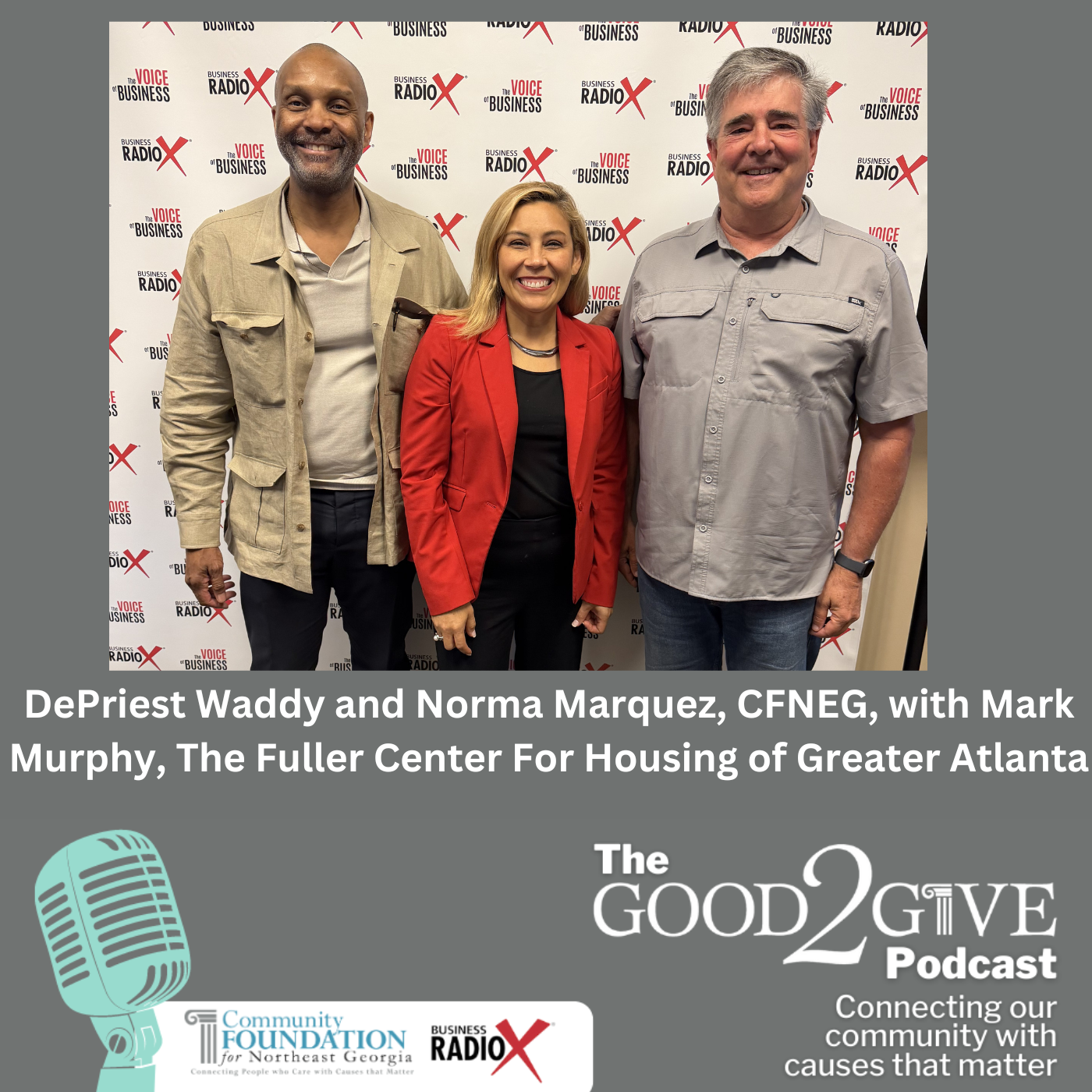 Fuller Center for Greater Atlanta: Homes for Working FamiliesNorth Fulton Studio · on Habitat for Humanity57 / 100
 Is LNG Entering a Golden Age? | Jean-Christian Heintz on the Future of EnergyEnergy Breaking Bias · on Henry Hub55 / 100
 Chris Caldwell: The Inconvenient Path of GratitudeGratitude Through Hard Times · on Habitat for Humanity42 / 100Season Finale: I'm Not Waiting (S5:E12)48 / 100Leading Through Energy Affordability: The Episode That Predicted This Season (S5:E11)86 / 100Leading Through Energy Affordability: An Open Door Isn't a Seat at the Table (S5:E10)81 / 100Leading Through Energy Affordability: Rewriting the Rules of Lending (S5:E9)86 / 100Leading Through Energy Affordability: The Watchdogs Inside the Room (S5:E8)88 / 100