
Growth Diaries by Zenoti · 2026-08-18 · 48 min
Key moments - from our scoring
Substance score
39 / 100
Five dimensions, 20 points each
Dr. Dhanraj Chavan, second-generation dermatologist and co-founder of Clear Skin and Hair MD, explains how he's modernizing his father's dermatology practice through technology adoption and data-driven decision-making. His father started the practice in Karad in 1989 and expanded into procedural and aesthetic dermatology around 2004; Dr. Dhanraj joined after completing his MD in dermatology and has scaled the business from a few clinics to seven locations across Maharashtra and Pune with 150+ staff and 2.2 million YouTube followers combined. A key part of his transformation has been implementing Zenoti CRM to replace Google Sheets and Practo, enabling better clinic management and data insights across locations. He emphasizes learning international procedures from renowned dermatosurgeons while adapting them for Indian skin types and affordability - selecting appropriate laser technologies and devices that deliver results at price points Indian patients can justify. He's also vocal about AI adoption, using ChatGPT and Claude to streamline workflows, analyze patient data, and simplify patient journeys, arguing it's now non-negotiable for any professional or business.
Dr. Dhanraj uses AI tools like ChatGPT and Claude to streamline clinic workflows, segment patient lists by condition or demographics without manual SQL queries, simplify patient journey mapping, and speed up tasks that previously took days - particularly useful for identifying which patients match specific treatment criteria.
Implementing Zenoti CRM replaced fragmented systems (Google Sheets and Practo) and provided unified data visibility across all clinic locations, enabling better decision-making, staff workflow standardization, and consistent patient experience as the business scaled.
Dr. Dhanraj learns cutting-edge acne scar and fat grafting techniques from internationally acclaimed dermatosurgeons through shadowing and conferences, then applies them while selecting laser technologies and treatment options that deliver results at price points Indian patients can afford and justify.
Many Indian patients didn't realize dermatologists treat hair, so creating the Hair MD brand (launched 2015 for hair transplants, expanded from the original Clear Skin clinic) helped patients understand that trichology services were available, increasing patient awareness and clinic revenue.
Dr. Dhanraj's father started creating YouTube content in 2017 simplifying medical terms and treatment options for acne, hair loss, and pigmentation, building the combined channels to 2.2 million followers and establishing authority that drove patient acquisition across multiple clinic locations.
Our reviewer’s read on each dimension, with quotes from the episode.
The episode contains a handful of genuinely useful observations - AI replacing SQL/Power BI dashboards, the Indian skin dataset gap in global AI training data, and the 'deciding what not to do' principle for technology selection - but large swaths of the runtime are consumed by school background stories, family history narration, and generic advice about discipline and learning that add no B2B value.
Deciding what to do is important, but deciding what not to do I think is more important.
Even to build a simple dashboard in power BI needed understanding of formulas of how to query the SQL database or the postgres SQL database. And to build that we always needed to take help of someone from the outside. AI has made it easier in terms of if you have a basic understanding and are able to interact with say cloud code, you'll be able to build the same databases in maybe 20 minutes, an hour or so now
The Indian-skin AI training data gap is a genuinely underexplored, first-principles observation relevant to any operator building health-tech for non-Western populations, and the explicit rejection of the 'med spa' label in favour of a problem-solution patient model is a useful reframe; beyond those two moments the episode traffics in conventional founder wisdom about humility, learning, and discipline.
I frankly do not believe that India, or at least in where we are at, we are not in the med spa business, but we are in a patient centric business where there's a problem and there's a solution
Most of the data sets that are there around the world help in solving problems or identifying problems for the European and Caucasian American skin, White skin.
Dr. Dhanraj is a genuine practitioner who has co-built a real multi-site clinical business (7 locations, 150 staff, 2.2M YouTube subscribers) and has hands-on experience with technology adoption, international clinical training, and expansion strategy; however, the scale is a regional mid-market operation rather than at the level of a truly large operator, limiting how far his specific learnings generalise.
now we are at six clinics in terms of skin and hair...we also have a parallel hair transplant vertical and my brother who's also a plastic surgeon
he has a wait list of almost 45 days out
The episode provides a reasonable number of concrete anchors - clinic count, staff size, YouTube follower numbers, the 45-day surgical waitlist, the 2012 Pune launch date, the 2027 DPDP Act timeline - but is entirely absent of revenue figures, marketing spend, patient volume, conversion rates, or any outcome metrics that would let a B2B operator benchmark or replicate what was done.
a combined YouTube following of nearly 2.2 million subscribers
building that whole vertical right from the basics getting his first patient, getting his first surgery, to now where he has a wait list of almost 45 days out
The host consistently summarises the guest's answers back rather than probing deeper, asks leading compound questions that telegraph the desired answer, and never challenges a single claim or requests a specific number when the guest is vague; mid-interview Apple Podcast solicitations further break the flow and signal a PR chat rather than a substantive interview.
So basically you use systems to make sure you're classifying your customer data properly. And then marketing is all about education for you. It's not about selling.
I think that's definitely something I've noticed with good founders is the willingness to learn and be humble
Computed from the transcript - who did the talking, and the words that came up most.
India’s dermatology and aesthetics market is booming, yet most of the growth is concentrated in metro cities, powered by med-spa branding and heavy digital ad spend. Meanwhile, millions of patients in Tier 2 and Tier 3 cities still lack access to qualified dermatological care. Moreover, the treatments, technologies, and AI diagnostic tools available globally remain largely calibrated for Western skin types. It’s against this backdrop that a family-run practice from a small taluka town in Southern Maharashtra has quietly built something remarkable. In this episode of Growth Diaries, host Sudheer Koneru is joined by Dr. Dhanraj Chavan of ClearSkin and HairMD to trace the full arc of that story, from his formative years at Sainik School to joining his father’s clinical practice and scaling it to six clinics across Pune. Dr. Chavan opens up about his father’s bold pivot from clinical to procedural dermatology at age 45, the power of YouTube-driven patient education that has grown to over two million followers, and the deliberate choices behind adapting international treatment technologies for Indian skin types and price points.
Transcribed and scored by The B2B Podcast Index.
Speaker A: Most of the data sets that are there around the world help in solving problems or identifying problems for the European and Caucasian American skin, White skin. Basically we should be working towards getting similar solutions for our Indian skin. The Noti presents Rogue Diaries the fascinating stories behind the best brands in beauty, wellness and fitness hosted by Sudhir koneroo.
Speaker B: Can a doctor also be a tech? At AI mastermind, Dr. Dhanrad Chavan from Clear Skin and Hair MD is proving the answer is yes. What started as his father's small clinical business in Pune exploded under Dr. Dhanrarj's data driven vision. It is now a seven location dermatology powerhouse that boasts a team of 150 and a combined YouTube following of nearly 2.2 million subscribers. This second generation doctor is completely rewriting what it means to run modern clinics and he's here to tell us exactly how he's doing it. Welcome to grow diaries. Dr. Dhanraj, thanks for making the time to be here.
Speaker A: Thank you so much. It is a pleasure to be here. A big fan of the whole ecosystem that Zenoti is. I'm very glad to be here. Uh, great. So before we get started, I actually
Speaker B: was very intrigued when uh, I was looking at your background that you went to sinic school. So I have another friend who went to Saini School. So I mean, so I thought you should share what is going to Saini School.
Speaker A: Like so Senec school was purely an academic decision. Like from the town that I am and it's known as Karad, it's a taluka place in southern and we didn't have CBSE schools in my town and my dad always had that thing that we should get the best education possible and the nearest one that we had was scenic school. Uh, and we had, I had a few family friends who were there and as always because it's in Satara, which is the district I am from, uh, a big name in itself and going to Senec school was a big thing then and that's why we went there because CBSE and all the name that it had and it shaped me quite differently. Like all I am today in terms of all the values that I have, the time, discipline that I have, like, and um, I'm something that I'm very proud of. It has come from there. So it was a great experience. All boys school hustle. I was there for five, uh, years till my tenth standard and then I came out. It was a great experience in that way and that's what shaped me.
Speaker B: So what is the kind of rigor they Have I heard they're pretty rigorous schools. They're not easy like going to city schools.
Speaker A: I think eventually you get used to the rigor. It's not like very different. You wake up at 5, 5:30, sleep at a good 10. So it's not like anything out of the world. But yeah, you do get up. And I remember Satara, uh, uh, where they're situated. Winters are crazy. It's like seven degrees in the mornings and used to. I remember a particular snapshot where I used to wake up in the morning. Then we used to have NCCs on Fridays and then the NCC dresses are uh, thick khaki clothes and the buttons are also quite thick. Like that was one of the things that we still remember like in terms of how the winters used to be. Apart from that just we wake up in the morning, go for a run, come back, get ready for school, go to school, come back, good afternoon, prep time, sports in the evening, compulsory, then study, go back. So in that way it's not anything out of the world. But because it is that routine day in, day out, it gets imbibed. So there is the daily routine which gets imbibed as a habit. And discipline, I think that makes a difference.
Speaker B: Yeah, I think the rigor brand brings a certain discipline which you probably carry forward and it's the metal with which you're made of.
Speaker A: Senec school as a fraternity is very much known for the brotherhood that all the ex Fennec school students share amongst themselves. It's especially of the same school but anyone else also like even if it's any others and a school from any other state and I might uh, meet an ex student. It's always like when we say it's an extent school, it is always a good connect.
Speaker B: So you came from that kind of grassroots which was like rigor and we put through and of course it's good that you had that opportunity. I want to switch today, for example, in the new AI world, how do you use AI generally? I'm not talking about Zenodi. How do you, how have you embraced AI in your business and personal life?
Speaker A: AI first of course, like for all of us it started with BASIC, the ChatGPT when it came out and the way it used to create small posts, small analysis of everything. That's how all of us got initiated into AI and one by one, one by one, as we went in and started realizing, okay, you can do so many different things with it and things that used to take us a few days to complete whatever in our business, in Our personal lives. And then when we saw it happening so fast, that really spiked my interest. And nowadays it's majorly for the clinics, for our patients. Whatever we do in terms of treating patients in the clinic, seeing patients in the clinic, wherever we think that, okay, this particular thing needs to be done, it's done faster with AI. So any particular workflow that we want to do, any particular patient, uh, journey that we want to streamline, make it easier for the patients, some of the other way. If we think that, how can we make, uh, this easier for both the staff and the patients? Uh, AI is always there to help it. Specifically speaking in terms of seeing the kind of patients that we want. So when we have a big list of patients and we want to see that, okay, I want patients of this particular type to come out of this data, speaking to the AI and getting that out is easier. Earlier we used to had to use filters, serial filters, SQL queries. We don't need to do that now. That part is definitely the one that's got to be easy, right?
Speaker B: No, that's good because, uh, the reason I asked was I keep encouraging people like, of course, Ukraine, you and even I had similar grassroots. We didn't have much tech exposure when we started our careers. And today you're forced to deal with this transformation that's happening, that it is an imperative for every person out there,
Speaker A: they take it seriously.
Speaker B: I mean, if, uh, you can make that switch, being a doctor, being other things, then the average tech person should be really happy.
Speaker A: I think everyone should do it. Shouldn't be an option anymore. Yeah, uh, to understand and interact with AI is something. I think everyone should do it as a part of their life, whatever field they're in, even any field. I think some amount of interaction with AI. So, of course, chat is what 90, 95% of the people will interact with. But with Claude Code coming in, Codex coming in, those workflows also that we do every day, apart from professional things that we do, can be simplified quite a lot. So exploring is what everyone should definitely start is what I feel.
Speaker B: So coming to the founding of Clear Skincare, obviously it's business, which your dad started, and so I wanted to give some context into how did your dad get this business going, Maybe actually give us some context about his grassroots and how he evolved to start this dad
Speaker A: came from very humble beginnings, like almost all of our parents, like the generation which came in before us. My grandfather was a freedom fighter and a farmer, a cooperative, a person who was very strongly in the cooperative grassroots network. And Then he went on to do his medical studies in Solapur. We have MCVM Medical College. Solapur got on into dermatology because it was a field which wasn't hectic then. It's like the bottom five fields when he did it. And he wanted a relaxed life. So he did dermatology. And eventually 20 years, uh, 15 years into his practice is when everything related to aesthetics, procedural dermatology started coming in. And around 2004, 2005 is when he, at 45 years of age, took a turn through his practice, shifting from clinical dermatology, uh, right into procedural dermatology, aesthetic dermatology. And that is a big turning point in general. By then the lasers started coming in. Various procedures. A good amount of Indian dermatosurgery, doctors, dermatologists had started coming in. Dr. Savant, who's one of the fathers of dermato surgery around the world, My dad was very fortunate to learn from him also. And he started doing all the procedures in the clinic. We come from a place known as Karad, like I said, in southern Maharashtra. And that is where he had started his practice in 1989. All his initial patients who used to come for him for all the dermatological conditions, eventually all the procedures that he started, uh, doing, they started benefiting from it. From Karad, we started a second clinic in Satara, third in Kolhapur, which is about an hour from our place. The patients were growing and we used to get a lot of patients from Pune on weekends who used to come to their home cases in Karad. And they used to say, so you should come to Pune. We would want you to come to Pune. And eventually 2012, end of 2012, is when he started in Pune. We started our first clinic then. Used to do work like almost till 2020, till Covid, he was working seven days a week the past 15, 18 years. Used to travel to Pune twice a week, do Karad two or three times. And then Satara and Kolhapur were on parallel. So they did that whole hectic thing of running around seeing patients daily doing procedures. Ably supported by my mother. So my mother's not a doctor, but she used to handle the whole administrative part, all the therapist training, all the treatment which the staff do. She used to lead all of them, train all of them, look after all the HR accounts, every single thing, every day. Me and my brother Both went to Sanic School in 2002. I went in 2002, brother went in 2003. And after that my mother started working with uh, dad and together right from 2005, six till we joined in, they've been working day in, day out, got into Pune one by one. Then in 2015 he also started with hair transplant. So initially he had started only as clear skin, which is for skin, and that was the name that the clinic had. But as we started doing more and more work, we started realizing that a lot of patients didn't understand that hair was also something that dermatologists, uh, catered to because trichology as a word was coming in, which had a lot of annotation with hair. People thought dermatologists didn't see hair. And if you go in, dermatologists actually study both skin, hair and nails. So then we started with hair md. Hair MD was the thing that we started. Initially it was just for hair transplants. So when we began hair transplants in 2013, 14, we, we did see a need where patients are not relating that clear skin did hair transplant. And that's when we started with hair MD as such. And 2017 is actually when my dad also started doing a lot of educational content on YouTube. He's one of the very initial, uh, doctors who went out, started speaking about doubts that patient have, simplifying a lot of medical terms, medical treatment options in terms of skin and hair care, especially acne, hair loss, pigmentation, melasma. That led to a lot of increase in terms of how patients perceived our uh, branch. Initially. Everything that patients used to think about, lasers and dermatologists and the treatments is not easy to understand for them. And I think, uh, he played a big role in simplifying that for patients. And that's how from one clinic we went on to two, three clinics. By 2020, we had three clinics in Pune running both clear skin and hairmd both. And then Covid came. We were just in the middle of starting with our fourth clinic in, uh, Pune. And then Covid came. So we had a setback, especially for elective procedures. I think there was a big break of a year where patients were also afraid, and rightly so. Everyone was apprehensive about what it was, what was happening. So we had that one or two year gap and then we went down to the fourth clinic, the fifth. And now we are at six clinics in terms of skin and hair, in terms of other verticals. We also have a parallel hair transplant vertical and my brother who's also a plastic surgeon, Dr. Dhruv, so that's the eighth, the third vertical that we have in the eighth center that's focused on aesthetic plastic surgeries that's where we are today.
Speaker B: So I guess the, I mean, surprisingly, quite late in his career he, uh, got onto YouTube in his education and all that. It's not, you know, young people can do that. But now. So clearly your dad has always been a willing and avid learner rather than just like we talked about you embracing AI because I think you have more than 2 million followers across those two channels and brands you have. And I think education, I've found, is one of the biggest things businesses should invest in if they want to grow. Because once you're seen as an, uh, authority and you're educating, I think it attracts clients kind of thing.
Speaker A: Yeah, definitely. And everyone's doing that right now. Need of the hour. And this is, I think, true for any specialization or any profession, be it finance, the whole m. Uh, science verticals, Finance verticals, simplifying it so that the consumer who is going to be benefited from the services should understand what we are going in for, what the benefits of it, uh, are, what the risks of it are. And that is where the education part comes in. And with the increase in social media, everyone being online, it is easy for them to listen to so many things. So when people who have the right credentials start educating about the things, it really helps in helping people get the right information. There's no dearth of information today.
Speaker B: Yeah.
Speaker A: Getting the right one is, I think, what is important.
Speaker B: Cool. So then of course your dad's business was, I mean, early days. It wasn't necessarily a big business. He was running it with his. With your mom and you guys were in signing school. Uh, was there a plan that you're going to do this? What led you to go into the field of medicine and become a doctor because, because you chose that for the profession.
Speaker A: It wasn't a plan. Be very frank. Uh, Till almost my 11th standard, I was preparing also for the engineering entrance exams also. And then by the time I came to my 12th standard, it did go in the direction of medical studies. Even during my mbbs, surgery was one of the very serious options that I was considering for my post graduation, apart from of course also doing mba, which was a completely tangential direction. Eventually it came around to dermatology through the, like, the discussions that we had. My likeness towards it also, and the way I understood what my dad was creating and the way I could contribute to it. So it did definitely help his.
Speaker B: So it was after your MBBS and getting into the PhD and all that. Dr. Yes.
Speaker A: That's when the uh, decision to go into dermatology Came on the whole.
Speaker B: And I guess in your family, I mean, it's important in the sense. I noticed that even in your entrance exam, you were like the 109 rank or something. So it's like, looks like commitment and discipline is integral in your.
Speaker A: I mean, I think anyone who's done in some other way, not always academics, but in some of the other way, everyone who does get into a, uh, thing seriously has to study about it. I think that is anyways necessary whatever field you go into.
Speaker B: So.
Speaker A: Yeah, cool.
Speaker B: And given that your business is, you know, it's not just a simple mitzpah, you actually do surgical procedures and all that stuff. I guess the intensity of education and training has been big. So after your md, you joined with your dad, but you have continued a journey of getting up to speed on a lot of international procedures and applying them here. Maybe you can give some color. I mean, what led you to doing quite a few of those?
Speaker A: I've been fortunate. My dad already being a dermatologist and me having the clinics as compared to other dermatologists, I've been very fortunate to have that opportunity to go places, learn about the things that are happening newly. My specific interest in acne scars, fat grafting, had always been there right from my post graduation. And then as I started learning more about it, uh, learning, doing more procedures, eventually I also started learning the limitations that I had, or we had in India in terms of the lasers, in terms of the procedures that we were doing, things that I could learn here. And that is when I started also interacting with other internationally acclaimed dermatosurgeons, uh, who are doing a lot of acne scar procedures, a lot of fat grafting procedures, and I was very fortunate enough to get in contact with them, have an interaction with them. And then whenever you used to get the chance to visit conferences in a particular country, then visiting other surgeons, dermatosurgeons for a month or two and shadowing them, learning from them, coming back, applying all of those learnings on patients so that whatever knowledge or whatever learnings I had that could benefit our patients, and that is important in terms of always each time that I've learned something, the whole objective is that to come the patient, help our patients with it. And then when we start doing something, we realize, okay, this is what we're able to address now, but this is what we are not able to address. And then that's how each time a new learning happened that, okay, now I'm doing this, but this kind of patience is something I'm still not able to solve to my satisfaction. And that is when the next learning happened and then one after the other.
Speaker B: So I think that's definitely something I've noticed with good founders is the willingness to learn and be humble, that is, not assume everything is known and constantly observing and listening what's going on. Like, you go to conferences, you listen, you engage and find a way to get in front of all these right people. And as you said, even when you come back and apply observing, in my mind, listening is listening to all the data in front of you. Hey, this didn't work. That didn't work. But I'm also curious. I think you've also written a little about making sure these things apply for Indian skin or Indian environments, et cetera. I mean, what kind of things did you realize, uh, you know, as you were going through any examples when I
Speaker A: was visiting and when I was learning from doctors and teachers around the world. Usually when you are at one or two clinics and, uh, coming to the Indian context, it does make sense to go for the best. Best in terms of the lasers that you have, best in terms of the technologies that you can get into your clinic to serve patients. But once you want to increase your services, there is some limit in terms of what you can get in, you can get in of the best. And because there's a whole lot of manufacturing technology around the world, there are lasers that coming from America, there are lasers that coming from Europe, from South Korea, from China. There is a lot of variation in terms of what the technologies do and can't do. And it. And I'm not referring to the fact that cheaper lasers are bad, though expensive lasers are always the best. It is not like that. And that is something that I learned eventually. So getting the, getting what is best for our patients at a price point that makes sense for them, not everyone can afford or can. It can't justify what they're spending in terms of the benefits that we are getting. So deciding what is the technology which can help the patient at a price point, which makes sense for our Indian patients, is very important. Deciding what to do is important, but deciding what not to do I think is more important. There are hundreds of options in terms of the lasers, the companies which manufacture them, consumables versus non consumables in terms of the devices that we do, deciding that, okay, this will help, and this is something we should get in versus this is something we should not get in is important. And that is where I think understanding the data in terms of what our patients want what our patients go for, what our patients avoid, usually from the initial clinics and the initial patients. That helps in replicating it to the newer ones that we do love the show.
Speaker B: Leave us a quick review on Apple podcast. It makes a huge difference. And don't forget to follow us on Spotify and YouTube for more episodes. So it's interesting. I've definitely seen that the awareness to make sure treatments work for Indian skin types etc is important. But your point about saying it has to also be affordable the price points if you want to impact the largest number of people. So planning your business according to that, that is also critical. That's a good insight. So you joined, you said before COVID around that and then Covid came and of course the business has grown since then. But what has been your role in terms of. Because your dad does have the clinical experience and has been running a good business. How have you shaped the business now?
Speaker A: I think what I could contribute at my level and at my level of experience was one was getting the technology. And one of the most initial things that I did was getting the CRMs and the data inward points in order. We were doing a lot of work by then also, uh, we had a lot of systems in place. When I joined in, we were already I think in a very good place. Uh, my cousin who looks after all the operations, Mr. Abhijit, he had already done a lot of work in terms of streamlining the workflows, streamlining the patient flows and making that patient journey great then. And as we were scaling, we did realize that there was a limitation to Google Sheets that we were using then Practo and Google Sheets was what we were running with at that point. So even though we were doing great from there onwards, I thought there was a good room for improvement. And that is when we came in and introduced Zenoti into the clinic because the staff from years together we used to using Pacto and what we were doing initially there was a period of adjustment, but once that happened it was, it helped us quite a lot. There was one in terms of simplifying the way we understood what was happening in the clinic at different clinics and comparing it together. So there was one technology was one thing that I think helped us quite a lot and I could contribute to the second was also deciding later on. So of course my dad had already set up quite an effective clinical protocol and then building up on that, introducing a few newer technologies in terms of the treatments that we are doing, in terms of the procedures that we were doing, some improvements in terms of the results that we have having in acne scar procedures, that is where I think I contributed right now, majorly. Uh, in the initial days, I also looked after marketing. Now Rucha looks after the marketing. But now in terms of strategy and deciding what kind of treatments, verticals we should be doing, the path that we should be taking in terms of expansion, that is where we collectively do a good discussion and then go on with it.
Speaker B: So I guess you've set up all the scalable processes so that you have data, you have all the information so you can make these decisions better.
Speaker A: Yeah, I mean, that's the hope going forward that wherever or whichever direction that we decide to go in, it becomes easier to take those decisions.
Speaker B: Yeah, I'm m glad that you seem to be quite, uh, focused on making sure you're listening to what the data is telling you, what customers are telling you. And but you mentioned about marketing. So of course you grew from three to six stores and you had to open new stores. And I'm sure as you're opening newer stores, some of these could be bigger investments because you're expanding as a business. How did you approach marketing? Was it, you know, to make sure these stores are built up?
Speaker A: So in dermatological, procedural dermatology, aesthetic dermatology, the education part played a big role. All the YouTube, uh, work that my dad, dad had done, it has helped us tremendously. There's no, ah, measurement to how that organic education helps in making patients aware of the services that are available. Even today, I think there's a huge gap in terms of the number of patients that can be served just in the geography that we are in, even though we are at six clinics. And we may think like sometimes we get that feeling that, okay, we're six, it's already too much. But we know deep down that we have not even scratched the surface of just one city. Also, there's a lot of people who haven't even heard of us. So getting out and making people just know that, okay, these services are available, there is a solution to this problem that in itself should, I think, be a primary aim or objective of any outreach activity. Uh, because then once they, once people know, then they can of course take a decision whether they want to go in for that or not. But if they're not aware of it, that becomes a problem. And it does help to have systems in terms of getting to know people who know you of versus who don't know you, who have already come in touch with you, and then pushing out information to them. And then those who don't know you. Of course we have different channels of doing that too. But that system, in terms of getting them in the whole information that they should have, in terms of what we are, what we can offer them, what uh, are the options that are available, that I think is important.
Speaker B: Cool. So basically you use systems to make sure you're classifying your customer data properly. And then marketing is all about education for you. It's not about selling.
Speaker A: You know, I don't think in the field that we are in because even though internationally, especially in the American market, European market, it's known as a med spa.
Speaker B: Mhm.
Speaker A: I frankly do not believe that India, or at least in where we are at, we are not in the med spa business, but we are in a patient centric business where there's a problem and there's a solution eventually. Uh, yes, aesthetic dermatology is also in India moving towards that direction where it's more of the med spa side of things. But we as clear skin hair md, we are still very much patient focused and as a problem solution thing. So the marketing in that sense I would say is not a very big focus on our part.
Speaker B: So you have now six clinics talking about growth in the Pune, uh, Maharashtra area and you still think there's more space for more clinics in that area itself, not like come to Hyderabad and all that stuff. What's your strategy in terms of eventually as you grow?
Speaker A: I think two important things that are a challenge is in general, and I think this is a challenge everyone around the country does face, is a dearth of good qualified dermatologists. That is one of the things that needs to be solved for. There's a lot of dermatologists, but getting good qualified dermatologists who has dedicated to the patients and willing to learn, willing to do those efforts in solving for the patients is important. Clinics also need to change their policies in terms of getting making the clinics a place that is suitable for the newer generation of dermatologists. I think that also is where we as clinics fall short. There's a mismatch of expectations that is happening and we are also learning we want to improve on that. So if you're able to solve for that and the staff training, there is a good scope for growth even in the geographies that we are, uh, in India is a big market. I believe if as a doctor you're doing an honest job of treating patients, it's a huge scope for everyone. It's a very big area that is there to serve as a country. And each area in itself has a lot of serving that is still left to do.
Speaker B: So you see more expansion within where you are, whether it's within the same clinics or adding clinics, but you know, more ability to reach out to more customers.
Speaker A: More outward, definitely. But maybe not in the tier one metros. There's a lot of unit economics that go in a different direction when we talk of the top, uh, higher metros, but more in terms of tier 2 and tier 3. And also specializing in what we are doing instead of trying to do everything at once, specializing on things which any particular doctor thinks that, okay, this is what I think I can do in a better way and then just concentrating on that. Even for us, for us there are verticals which we think we can serve or do best justice to and we concentrate on them. Maybe hair loss, acne, pigmentation, those are things which also have a, uh, huge need in our Indian population. So we are tending to concentrate on those and moving towards in the Tier 2 and Tier 3 direction.
Speaker B: Cool. And I think, yeah, generally I've heard the same concentration of your service makes your business more competent and also concentration of region like you said, you know, because you're an expert in that region and so it's uh, more easier for you to grow a more healthy business than going to Chennai from Pune. Then you learn everything about Chennai kind of stuff.
Speaker A: Yeah, yeah. I mean it is a different geography, different culture and of course we won't know of it unless we go there.
Speaker B: Yeah.
Speaker A: But also psychologically I think it plays a role where you tend to be in a geography where you are more comfortable with initially and then go on exploring.
Speaker B: So clearly educating the actual end consumer is an important metric and you invest a lot in it, as you mentioned, you know, very apparent with all the online presence on YouTube, etc. Now what about educating your doctors and your staff? Because I'm sure your services, as you said, also evolve and you have a criteria of how you pick these services, fitting the Indian market system, etc. So how does education work within your brand?
Speaker A: I think along with the hiring of the new staff, the next thing that does come in is the education. And like you're rightly saying, it is one of the most important things that you can do for your patients. Educating your staff right from the reception desk to the therapist and up to your doctors, dermatologists. It is important because each single interaction that a patient is going to have, as simple as asking a post treatment out to the reception desk, the answer that they give is going to make an impression on the patient. If that answer from the reception desk is also medically sound. The patient's care goes to the next level. So training the staff at all levels is important. Definitely. The way we try to do it is have weekly sessions for all the different teams, with their team leaders, with the doctors, with the dermatologists, each having cross trainings for each of the teams, structured trainings and unstructured both. So some of it will be pre planned, some of it are just open discussions, just discussing what is happening in each of the clinics. These are the problems that they faced or these are the doubts that patient had and how to go or solve for them. We do try to do that as frequently or as much as possible. And then once in maybe three months or six months, also have a dedicated full day of training for everyone. Uh, we would want to do more of that also because as much as Covid got us into the habit of doing everything on Yeem, I think physical meetings of all the staff, physical interactions do play a role, physical trainings do play a role and going in that direction is going to play a larger role in terms of improving the employee preparedness.
Speaker B: If you're enjoying the show, we'd really appreciate it if you left us a review on Apple podcasts. It only takes a minute and it helps others find the podcast. You can also follow along on YouTube and Spotify so you never miss an episode. And uh, this is truly a family, you know, run business in the sense it's. Your dad is still very active in the business, definitely. And then you have your brother as well in the role. So how does, what role does he play related to?
Speaker A: So my brother, uh, because we have had no history of plastic surgery as a vertical, he just became a plastic surgeon three years back and he has been building that whole vertical right from the basics getting his first patient, getting his first surgery, to now where he has a wait list of almost 45 days out. He has put in his work. I would say he has done more than what I have done in terms of getting the patients taking the efforts and he still does uh, it every day. And I'm sure he'll have to build that vertical into what we all dream for him and for the whole business. Where it should be one of the centers in India where people from all around the world come in for the aesthetic plastic surgeries that are there. Apart from that, in all the strategic discussions, we all do it together in terms of all the important operations. It is our Mr. Abhijit who takes care of it all. The non clinical part, the Accounts team, the HR team, the administration, operations is what he handles. Rucha is the one who handles all the marketing and then me along with my dad usually take care of the clinical stuff. Strategy in terms of what services to have, what not to have, and then together of course. And it is a family, uh, run thing right now. And I do understand eventually we also do want to have external help, external leadership come in who can take us in the right direction. Because there's a limit to which what our experience, what understanding can get us to. There's a step ahead that we would definitely like to work.
Speaker B: But I guess decision making and all can be much quicker and efficient in, in your kind of a system. Right. So I think on that, yeah. Great. And in your thing, you don't have as much of retail as a business. Like people come, as you said, it's a problem solution. How does retail play in your business?
Speaker A: Not much. We don't have own brand of medicines. We would want to go there. It makes sense in terms of giving the right quality for patients. Because of the 100 brands available per category, it becomes difficult for us also as doctors to track what is the quality of things that we are offering patients. Each single molecule that you may want to prescribe to a patient has 100 different brands in it. And then understanding which one has the right quality is difficult. So it is a natural progression to tie up with manufacturers whose quality we can speak up of, assure of to our patients. That would be a direction, but we have not done it till now. We are using brands which do make sense to us in terms of being reputed manufacturing facilities right now and then going ahead, we would want to diversify in that.
Speaker B: So you clearly an expert with skin, you said acne and other things. So what would you give as advice which is non negotiable to take care of skins to typical consumers out there?
Speaker A: I think in our Indian scenario, and there's a lot of awareness that is increasing with respect to understanding how much role uh, sun protection plays. Our Type 4 and Type 5 skin is designed to create more pigment to protect ourselves. And that is also the reason why we don't get as many skin cancers as the European or percussion skin. But that protection mechanism also leads to increased tanning. We have a very harsh sun almost nine months from of the year. Apart from the winters, it leads to a lot of sun damage. And then culturally we have been always advice or we always look up to having a fair skin, as unfortunate as it is. But that is how the culture is. So sun protection Understanding the importance of it is important. Not just sunscreen, but in general physical protection, using hats and trying to be in the shade, especially in the hot sun. I think that plays a role which everyone should uh, follow. And in terms of general nutrition, the importance of proteins, culturally, as Indians, our diets have a lot of less amount of proteins in it. Even though we consider dal as a protein, it's not a traditional high concentrated source of proteins. So understanding that difference and increasing the amount of proteins in our diets is uh, I think something we should all do because that plays a very important role in both skin and hair health. So doing that I think should be a priority for all of us.
Speaker B: So again, something I learned something new because I do hear people say sunscreen is important and that's something I've been becoming aware of. But this notion of both, of course eat protein helps with your skin and I wasn't aware. And that's good advice around staying in the shade and all that stuff. Yeah. In India, especially with all this, we
Speaker A: don't care because I think we're not aware of it.
Speaker B: Yes.
Speaker A: But being aware of it and taking those efforts. And of course there is that thing where most of India is vitamin D deficient.
Speaker B: Yeah.
Speaker A: And then sun plays a big role in creation of vitamin D. Uh, what the way I usually tell my patients is take all the sun you want, maybe just cover your face and then expose your body to the sun if you want to care for your facial skin and pigment.
Speaker B: And so what is I, uh, since you're in the business of helping other people feel good and fixing problems with solutions, what do you do to take care of your own personal well being?
Speaker A: Ah, uh, I just blessed with good genes in terms of skin. Both my dad and mother have great skin and that's what come to me. Nothing active to be very frank. No active treatments as such. But yeah, I do take care, uh, not to go out in the sun as much as possible. That is one thing that I do follow.
Speaker B: So we talked at the very beginning about AI. I want to know how are you trying to apply. I know there's a whole initiative, you have been very committed to bringing all this data together in your business. How do you envision using AI in your business?
Speaker A: I think two, three things which as Indian doctors, Indian society in general, the whole Indian engineering faculty also needs to concentrate more on is building solutions for the Indian skin. Most of the data and most of the uh, data sets that are there around the world help in solving problems or identifying problems for the European and Caucasian American skin, white skin. Basically we should be working towards getting similar solutions for our Indian skin so that it helps in faster identification of problems because of the dearth of dermatologists like we were discussing earlier. Also because of the dearth of dermatologists picking up the important or the severe signs of disease which need immediate care is important. And there's a huge difference in how the same conditions occur or appear in our Indian skin versus how they appear in Caucasian skin. So in that way a lot of work needs to be done of being able to identify Indian skin conditions, conditions for the which appear different in our skin. So effort should go on in that the government is also taking right efforts towards strengthening the data laws. Making the DPDP act which is coming in and will be implemented in 2027 May is a right step in that direction, making the consumers aware of their rights, protecting that data. On the same lines, it should also be clear as to how the progress in terms of developing this technology should go in. Uh, it shouldn't become a hindrance to develop technologies which help Indian patients. So that is one second I think using AI to improve patient journey because of the technology like for in our case we use Zenoti, we use one of CRM. There's a lot of data, we, there's a lot of data points which we get for the whole journey. Understanding what is important for the patient for improving the patient experience, the patient journey from all of this data, uh, it becomes difficult after time unless you know which questions to ask, what way to look at the data, it becomes difficult. AI does play a much bigger role in simplifying these things because there's only so much that each smaller data point you can go into. But if you have a uh, broader questions, a broader hypothesis, then AI has made it easier to ask those questions and get answers out of it. Of course even once you get those answers you will have to cross verify it. You will have to go deeper down in IT and understand what exactly is being said spoken by the data. But IT makes it more easier as compared to what it was earlier. For example, we had to do or get help of people with an IT background to ask questions to the data. So even to build a uh, simple dashboard in power, BI needed understanding of formulas of how to query the SQL database or the postgres SQL database. And to build that we always needed to take help of someone from the outside. AI has made it easier in terms of if you have a basic understanding and are able to interact with say cloud code, you'll be able to build the same databases in maybe 20 minutes, an hour or so now, because AI has made it easier. So understanding that and implementing it, I think helps.
Speaker B: It's nice to see that. I think the second part, which is using business data, uh, and analyzing it, I think I'm seeing many businesses do. But the way you think of that, along with also the clinical aspect of patients and how to surface skin conditions at the right time. So you're aware that think, uh, interesting ways to apply AI for your business. Since you've traveled so much and made education such a priority from all kinds of people and places, is there any company or people that stand out who have really helped shape you?
Speaker A: I think the Bay Area, uh, I've had the opportunity to visit there two or three times in the past few years and for longer durations each time I'm there. The amount of encouragement that I get, just simple encouragement that, okay, there's so much that can be done from a single city that affects the rest of the world. That whole idea, that whole view, that one small geography which is smaller than the whole size of Pune that I am from, can make inventions, can make discoveries which affect the whole world. Very inspiring. I just love to go there, just attend events, attend meetups, uh, learn what people are doing, understand what people are doing. That has made a lot of difference in terms of how I think that even as individuals, doing work which can affect a larger number of people is very much possible and we should be striving towards that.
Speaker B: Well, Pune is also a vibrant place in India, definitely emerging as one of the influential places where things happen. So both in software and other things. Great. Cool. Thanks a lot, Dr. Dhanraj, for making the time to be here with us and really appreciated, uh, knowing you as a person first, you know, because I also had very humble roots and to, you know, the discipline and rigorous with which education has been so important to you, your dad, and you know, dealing with customers, uh, education is where it starts. And I think that's something which most medspa kind of businesses aspiring to should focus on. Thanks, Yam.
Speaker A: Thank you so much for inviting. Been a big fan of the whole ecosystem that has been created with Zenoti. I've been following it right since 2015 when I was in MBBS and from there to today, interacting with you, uh, learning from you. Thank you so much for the opportunity and inviting me.
Speaker B: Well, I look forward to hosting you at Energize in Seattle next time.
Speaker A: Yeah, thank you so much. Looking forward to it.
Speaker B: Thanks.
Speaker A: Growth diaries is brought to you by Zenoti.
Other episodes covering the same guests and topics, from across The B2B Podcast Index.
 Interview Edition: The War for Talent Is Over. Here's Who Won. ft. Jim Link, SHRM CHROMy Friend in HR · on ChatGPT and Claude81 / 100
 #105 Inside the Underground Meme Marketing World: Jason Levin of MemelordSmart Friends · on ChatGPT and Claude70 / 100
 How Nutrafol CEO Cindy Gustafson is reaching men, growing retention with tech and plotting expansionThe Glossy Beauty Podcast · on hair transplants69 / 100
 Why Owners Should Common-Size Their FinancialsThe Deal Board · on ChatGPT and Claude56 / 100
 Growth lessons from franchise founders who got it right80 / 100
 75% Revenue From Memberships?!64 / 100
 What 350 competitors in Japan couldn’t replicate59 / 100
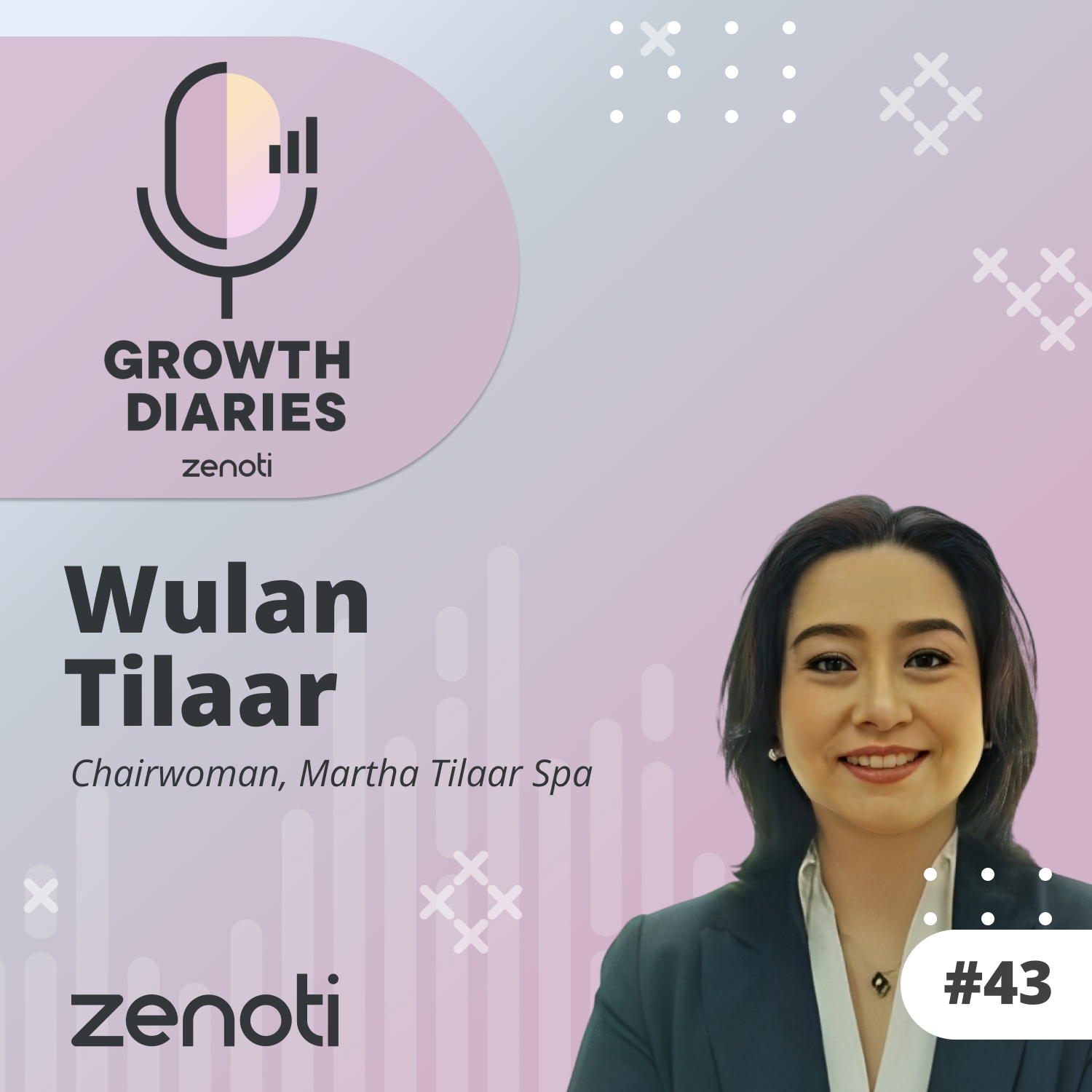 Second Generation, First in Purpose: Wulan Tilaar on Carrying Forward a Family Mission61 / 100
 How SILK Laser grew from a garage to 200 clinics with Martin Perelman77 / 100