
B2B Sales Trends · 2026-07-07 · 38 min
Key moments - from our scoring
Substance score
66 / 100
Five dimensions, 20 points each
The cybersecurity buying landscape has undergone a fundamental shift. Over the past two decades, enterprises progressed from viewing security as an insurance policy (firewalls and VPNs) to treating it as a boardroom priority, leading to rampant over-purchasing - some companies accumulated 50-60 security vendors. The post-COVID era brought conservative spending, tech debt, and failed deployments, forcing buyers to demand proof that new solutions integrate seamlessly and deliver measurable outcomes. Marty Overman explains that modern security buyers complete 85% of research before engaging a seller, rendering traditional product education obsolete. Instead, sellers must position themselves as problem experts who diagnose root causes rather than surface symptoms, conduct workflow impact assessments before POVs, and help internal stakeholders justify decisions to CFOs and procurement teams. At Darktrace, a behavioral security platform for humans and AI agents, this means training sales teams to uncover hidden use cases through informed discovery, visualize integration with existing toolsets, and address the multi-stakeholder approval process with confidence and assertiveness - moving beyond single-threaded relationships into full organizational alignment.
Workflow impact assessments are conducted ahead of the POV to help buyers fully understand how a solution integrates into existing workflows and what changes are needed to realize value. This prevents the problem of tools being purchased but never fully deployed or reaching value realization due to integration friction.
Sellers should move beyond relying on one champion by confidently articulating their experience with similar buyers and procurement processes, offering to guide the champion through necessary stakeholder conversations (procurement, finance, compliance) while positioning themselves as an advocate helping the buyer succeed internally.
Buyers have already completed 85% of their research and know vendor features before speaking to sellers; leading with product questions wastes time, damages credibility, and fails to differentiate. Instead, sellers should diagnose problems like how SOC analysts triage alerts or how phishing awareness campaigns are currently executed.
Post-COVID buyers became much more conservative, facing backlash from boards and CFOs over SaaS tools that were purchased but never deployed. This increased scrutiny around justifying new spend and led to a preference for platform consolidation over adding more point solutions.
Darktrace frames itself as a behavioral security company for humans and AI agents that has been applying AI-driven solutions long before AI adoption became trendy, allowing it to adapt its sales approach and messaging to help customers navigate AI adoption within evolving security landscapes.
Our reviewer’s read on each dimension, with quotes from the episode.
Marty delivers several actionable insights about the shift in cybersecurity buying behavior - the move from tech-debt cleanup to CFO scrutiny, the importance of workflow impact assessments, and the distinction between product expertise and problem expertise. However, the core insights (discovery matters, understand the buyer's business, build trust) are well-established sales practices repackaged for a cybersecurity context. The episode lacks novel frameworks, specific metrics, or counterintuitive claims that would push it higher.
There's a bank that shall remain nameless. At one point when I asked them, they said, we have a no vendor left behind policy. If you sell it, we've probably bought it.
We started doing what we call workflow impact assessments just ahead of when we do a pov, which is another piece of what you really got to do very effectively in the sales cycle now.
Marty applies the problem-expert framework and references Chris Voss's 'Never Split the Difference' but these are well-circulated sales concepts. The doctor-knee-brace analogy is useful but not novel. The framing of CISOs shifting from 'Dr. No' to business enablers, then back to risk-conscious gatekeepers due to AI, is somewhat fresh in the cybersecurity context, but the underlying dynamics (buyer caution, multi-stakeholder complexity) are mainstream B2B patterns.
It's an interesting shift to watch a seller make this transition or where you're not a product expert anymore and a lot of discovery you're focusing on, you know, how can I match that to my product instead becoming a problem expert?
The CISOs are back in that position now going, I don't want to say no because I know it's important.
Marty Overman is EVP of Sales at a real security vendor (Darktrace) with 20+ years in cybersecurity and hands-on selling experience. She speaks from direct deal management and team leadership, not theory. Her insights come from observing buyer behavior shifts across multiple accounts and negotiating complex enterprise deals. This is a practitioner at the right level - credible operator with specific context, though not a C-suite founder or exceptionally high-profile name.
I've been in cybersecurity for over 20 years. Um, I've played a variety of roles at a variety of cybersecurity, uh, vendors. I've been at darttrace for about a year.
I was having lunch with the, um, CISO at RSA actually, and he said he's like, I will not take a proposal forward if I haven't sat down and really fully understood the workflow.
Marty provides concrete examples (RSA Convention growth from one room to four halls; company with 50-60 security vendors; the doctor analogy; the 90-minute discovery call using 'why' repeatedly) and specific Darktrace practices (workflow impact assessments, POV timing). However, she avoids naming most customers, provides no sales cycle metrics, win rates, deal sizes, or quantified outcomes. The evidence supports her claims but remains anecdotal rather than data-driven.
When I first started going to RSA in 2006, and the RSA Convention was at the San Jose Convention center, there was, like, one room where everybody had lunch. It was small. And Fast forward to 2016. So even 10 years ago, there were. All of a sudden, we were in two halls at the Moscone center in San Francisco. Now it's four.
the best discovery meetings I ever sat in, this was years ago, the rep, literally for 90 minutes, asked different versions of the question, why got so much information that.
Harry asks solid foundational questions but rarely pushes back or challenge Marty's claims. When Marty references frameworks (Never Split the Difference, the doctor analogy), Harry affirms rather than tests them. The follow-ups are reactive paraphrasing ('so once we've identified the real problem') rather than generating friction or skepticism. There's no moment where the host challenges an assumption, asks for evidence of the 85% research claim, or probes whether her experience generalizes. The conversation feels collaborative but lacks the tension that elevates dialogue quality.
And I think it really shifted a few years ago, and buyers, again, have much more power, and the sellers are, uh, in a way to feel less powerful and therefore sort of reside somehow in their comfort zone by doing it the way they've always done it, but it's just not going to cut it anymore. Is that what you see?
So the strongest enterprise sellers today, and what are the top three things that they are doing differently?
Computed from the transcript - who did the talking, and the words that came up most.
Cybersecurity sales has become harder because buyers trust products less and scrutinize every decision more. The sellers winning today aren't better presenters. They're better problem experts. In this episode of the B2B Sales Trends Podcast, Harry sits down with Marty Overman, EVP Americas Sales at Darktrace, to explore how AI, buyer scrutiny, and enterprise buying behavior are reshaping modern B2B selling. Marty explains why discovery has become the most valuable skill in enterprise sales, why buyers demand proof instead of promises, and why trust has become the biggest competitive advantage in cybersecurity sales.
Transcribed and scored by The B2B Podcast Index.
Speaker A: My lovely people, welcome to another fabulous episode of the B2B Sales Trends Podcast. Now, something's interesting that's currently happening in B2B buying right now. The more sort of tech advances, the more technology that's used, the more cautious buyers seem to become. Uh, the scrutiny is a bit higher, the expectations are a bit higher, and AI is changing the way companies evaluate a lot of these decisions. So in a world where everything is becoming more automated, what actually matters most is the question that begs. On the B2B Sales Trends Podcast, we give you a sneak peek into the strategies of the world's best CROs. Go to market leaders, the systems, the playbooks they are using, so you don't have to figure it out the hard way. So if you're interested in increasing your win rate, shorten sales cycle and learn from the best of B2B selling. My lovely people, this podcast is for you. Today we're talking about the evolution of cyber security buying in the age of AI. I'm, um, super, super pleased. M. My guest today is Marty Overman. I, uh, hope I pronounced that right. She's the EVP of Sales of the Americas at Darktrace. Marty, welcome to the B2B Sales Trends Podcast.
Speaker B: Hi Harry, thanks for having me.
Speaker A: Marty, share a little bit about you and, uh, Darktrace with the audience to kick us off.
Speaker B: Uh, yeah. So me personally, I've been in cybersecurity for over 20 years. Um, I've played a variety of roles at a variety of cybersecurity, uh, vendors. I've been at darttrace for about a year. And Darktrace, um, is the behavioral security company for humans and AI agents in the enterprise. We've been doing AI since before people really knew what AI was or were even calling it AI. We use it to power our cybersecurity solutions and now are really just aggressively assertively embracing, um, what it means for AI adoption in the world, um, and, and adapting our, our, our sales approach and strategies to, um, be what we need to be, um, be what our customers need us to be in, uh, in. In this evolving landscape.
Speaker A: And it's interesting. One thing that we hear across B2B sales generally, and there's lots of different stats out there and uh, from different sources, is that, you know, buyers have become far more informed, far more cautious. They're, uh, much more aware, culturally or commercially, shall I say aware, uh, than they used to be. Now how has that evolution shown up specifically within, uh, cybersecurity?
Speaker B: Oh, gosh, uh, it's been such an Interesting journey. So as I mentioned, you know, I've had 20 years in this space and 20 years ago they were looking for firewalls and VPN concentrators. And it was an insurance policy. It was this thing, thing that a director of IT Security was trying to convince people mattered. And it was like, oh, it won't happen to us. Um, like, uh, nobody really even had conceptualized like what a breach would mean to their organization or even thinking that their data, anything could be done with it. I just, I don't even think it was a concept that was really resonating yet. Fast forward to, you know, all these, uh, you know, there were a bunch of DDoS attacks on banks in like 2011. Then, you know, you heard about some pretty high profile breaches where a lot of credit card data and personal data was stolen. And that launched into this whole new domain of cybersecurity where it was a boardroom conversation and everybody was really looking at it very seriously and frankly, spending a lot of money on it, um, kind of indiscriminately. There was, um, a period, you know, a few years ago where you could ask a, you know, an organization like, how many security vendors do you have in your environment? And, and even a small company might say 50 or 60. It's wild. There's a bank that shall remain nameless. At one point when I asked them, they said, we have a no vendor left behind policy. If you sell it, we've probably bought it.
Speaker A: Wow.
Speaker B: And then we hit Covid and it just, it went bonkers. Everybody was spending, you know, looking for remote access solutions to ensure that people could, you know, access the corporate network in a secure manner. And um, and it was a pretty, it was a time of pretty free spending. And the, the shift, you know, that pendulum has swung now back to the other side of intense conservatism around spending. There were a lot of solutions that were purchased, SaaS solutions that were bought that never got fully deployed. Um, there's a lot of shelf where common term is tech debt out there. And so it's increased the scrutiny. You use the, the exact word, the scrutiny of. It's not, hey, we know we need it, we know why we need it, but can any of these other 60 tools we've already bought accomplish what you're asking for? Or, you know, why didn't we fully deploy the other thing that you told me was going to fix the big problem we had? There's just all these additional questions and hoops to jump through around getting that additional spend and it's frankly, it's hard to argue with. It's responsible. We want you to fully deploy the product that you buy. We want you to see, you know, the value that we've promised out of it and to actually solve the problem that you need solved. But these, you know, the CFOs and the boards are asking a lot more questions. So are you going to use it? How are you going to use it? Are you going to use it better than the last thing you bought? Um, and then, you know, really looking at, do we really need it? Is it actually going to mitigate the threat? Um, and so then you see a lot more, um, platform plays getting very, very important as well, where don't bring another vendor into our environment. Can we do that with somebody who we're already working with? Is there an add on that we could include in something we've already purchased or deployed because that will improve our ability to actually use it.
Speaker A: This is, uh, a lot of change for the sales process, for the sales force, their behaviors and so forth. What are some of the changes that stood out for you in the sales process that, that were affected by that new sort of buying behavior?
Speaker B: So the selling process has had to evolve to be there. There, uh, are kind of a few dynamics in play. First off, buyers know more coming into it than they did previously. It used to be kind of a lack of familiarity. Um, you know, you had a little bit of time where you had to bring them up to speed on who you are, what you do, how you do it. They're coming in pretty well informed already. They've done a, you know, there's the data out there, all this research about, you know, they've done 85% of the research, you know, before they've even talked to a human. And, and it's turning out to be pretty true. There's just so much available out there. So they're coming in well informed. First off, um, some sellers would think, oh great, that means I can like, have a faster sales cycle because I don't have to do that whole education piece. But it actually means you have to spend a lot more time digging a lot deeper to uncover all of the potential use cases. And, and really kind of we say slow down to speed up, um, spend a lot more time in discovery to make sure you've got that match. And also when they're doing their research independently, they could be looking for one very specific thing and kind of missing the bigger picture where you do have a platform play, where there is more out there. They're looking to solve one very specific problem. So you've got to spend a lot of time in very thoughtful discovery and, um, in a way that's, that's pretty productive. And a lot of sellers can be kind of scared of that because they feel like, oh, well, they already know what they want to hear about. If I start asking a bunch of questions, they're going to get frustrated. And so there's a difference between, you know, kind of a Spanish Inquisition and asking informed questions, which means you have to know a lot more about their business going into it and, you know, the potential, um, you know, kind of where you've got the opportunity to educate them on some additional use cases. From what you've seen working with clients that are similar or, you know, in kind of similar to similar regulatory environment or, you know, may have some common, common concerns. But one really, really big piece is you have to be able to show them and help them visualize how they're going to use it and how it's going to integrate with their existing tool set and how they're going to be able to go to their board or to their CFO and confidently say, not only, you know, have we done the research and we validated that it will solve this problem or meet this need, it can integrate with our existing tool set and we'll be able to use it in this way because that's where they've been getting so caught up. You know, why we see all these tools that haven't been fully deployed or, you know, never really reach value realization is, uh, because of that diligence on the front end. So they're asking and expecting that diligence on the front end. I was having lunch with the, um, CISO at RSA actually, and he said he's like, I will not take a proposal forward if I haven't sat down and really fully understood the workflow, how it's going to integrate into our existing workflows, or what we're going to need to change in our workflows in order to really get the value out of this. We started doing what we call workflow impact assessments just ahead of when we do a pov, which is another piece of what you've really got to do very effectively in the sales cycle now. And that starts, get, we can, that starts getting more into like, in this world of AI, everybody's claiming they can do so much and now you've got to prove it. But the workflow impact assessment, we do it ahead of the pov, um, as a means of really making sure that they spend the right time too, in the POV on being able to document that and articulate it clearly so that they can help sell it internally.
Speaker A: You know, it's interesting. Um, there's a, there's a few pieces I would like to go back to from what you said. Uh, you, you mentioned, uh, you mentioned that discovery has become very important again. And, uh, I always feel that discovery has changed big time. Uh, it's not a case of asking 20 questions. To your point, 85% of the research is done right. So why, if the seller turns up, then we're asking the same old rubbish questions everybody else is asking. They're not differentiating themselves, nor do they really provide value to the stakeholder. Right, so how, in your opinion, is discovery done right then? Uh, so that you provide then value to the stakeholder during your discovery process and not turn up with the stuff they already basically know. What are some of the secret tips there that you may be able to share?
Speaker B: Um, you're going to be giving all my secrets away. Harry M. I think one of the really important parts, and this is, it's an interesting shift to watch a seller make this transition or where you're not a product expert anymore and a lot of discovery you're focusing on, you know, how can I match that to my product instead becoming a problem expert? And I always, I speak in analogies a lot. Um, my team does this much to their chagrin. Um, I think about going to the doctor if I have hurt my knee and I go to the doctor and the doctor's asking me a bunch of questions where basically he's trying to fit me for a knee brace. And, you know, it's, I'm, um, I'm, um. And they're kind of putting it back on me to tell them what's wrong and, you know, why it's bothering me and maybe help diagnose it. I'm gonna walk and be like, I don't. Does that doctor. Is that, Is that their first day versus going to the doctor who is kind of looking at, okay, can you jump? Can you move this? You know, can you do lateral movement? Okay. Hm, hmm. And then sits down and goes, all right, I understand exactly what's going on here. Here's my remedy for it. Follow this plan, and in six weeks I'm going to have you playing soccer again. Like, okay, that doctor knows what's up. He has seen a knee like this six times today and knows exactly how to solve my problem. And when sellers can kind of position themselves more as like that problem expert. And the discovery is focused on diagnosing the problem. And is the problem really what we think it is? Are we solving surface level or are we really, are we solving the, um, what's the saying? Are you solving the symptom or solving the cure? Is, you know, solving the actual problem, solving the disease, similar thing. Um, so when you focus your discovery on how is it going to fit into your existing environment? Um, you know, how are your soc analysts, you know, triaging alerts today? Um, you know, when you get, you know, kind of digging into how you might do, um, a phishing awareness campaign with your, with your internal teams, you're not actively asking, um, them how they serve the content today or how often they do it. You really want them to understand, hey, when somebody fails a phishing test, what is it that's usually getting them? Um, and so really shifting yourself into focusing discovery on identifying the problems and then you get the chance to circle back to, okay, we agree you've got this problem, we agree that it's a costly problem, potentially very damaging problem. And now I'm going to get to tell you how I solve that problem. I'm going to get to talk to you about product. But if you're leading with discovery questions that are very focused on features and um, functionality versus the problem identification, I think that's where you start to fall into some traps. So becoming a problem expert instead of that product expert, I think is really key.
Speaker A: And then also the idea to build on that is really how. So once we've then identified, uh, the real problem, how do we now connect this directly to the outcomes that we can help you achieve, uh, as a customer, that's then the next push and the next level. That's why this problem, uh, uh, uh, centerpiece really works well. Because really why are they doing that? Right? Why, why is the customer doing anything? They want to achieve a certain outcome with that. Right. And so to focus on that and to get sellers to do that, uh, is a challenge, but it's really necessary these days, right?
Speaker B: A.B. absolutely. And I think the hard part is so much of our onboarding and our enablement is focused on learn our product.
Speaker A: Right, right.
Speaker B: And, and you have to do that, you've got to do it again because they've already done all the research, they know your product before they're even talking to you. And so we, we focus on that. And, and, and that's why I think it's such an interesting skill to develop. Is this okay, that comfort around understanding their business enough to spend the time on the problem statements. And. Yeah, and what's it, um, in Chris Voss's book, Never split the difference there. There's one part that always sticks out at me, you know, so it's all about this negotiation, but really it's about human behavior and understanding. And one of the things that has always stuck out to me is the, um. In part of it, he says, you don't want them to say you're right, because if you're right, that means somebody's wrong. You want them to say, that's right, because that means. Now you understand me. I feel heard, I feel understood. And it opens up in Chris Voss's kind of expert guidance, it opens up this area for you to now start having a real conversation about how to get them what they need, how to get them what they want in order to resolve the negotiation dispute. And so that's what I think sellers really got to get to, is. That's right. That means you understand me, you understand my problem. Now let's talk about how we solve it.
Speaker A: And, uh, that's. That's really interesting. Uh, and going back to what you shared, that, uh, we train them on the product. Train them on the product. Train them on the product, and then we tell. Don't sell the product. Right. It's a little bit. The sellers are good. What is it that you want me to do? Right. Um, but, uh, to your point earlier, to really help them visualize of what it can do. Whatever you sell in this fact that nowadays exists that everybody in the buying process really has to justify their decision internally. Now couple that with a number of stakeholders suddenly involved, and. And now I have to help the technical team justify the decision, the finance team to justify the decision. There's a procurement person involved, maybe some executive leader involved too. They all have their. Their different set of problems, needs connected with the issue. So how do I really, as a seller, navigate that and do that really well and get everybody to understand that whatever I'm selling helps them achieve their individual outcomes? Uh, am I thinking about that in the right way?
Speaker B: Yeah, absolutely. And it's such a. It's such a tightrope to walk to because you get these. These buyers sometimes, or these, we like to call them champions. They may not actually be your champion. Um, you know, these coaches who get really attached to their salesperson, and they want to own that relationship and really hold it close. And what the seller has to do is navigate getting to those other people, because you can't. It's it's this um, it's this trust relationship that's built especially in this scenario that I just described where they've gotten really attached to you and kind of want to own that relationship and keep you to himself. It's common that you would end up getting single threaded and that's like, that's where deals go to die is being attached to one person and one person only in the account. So getting them, it's a, it's a whole other sales pitch actually. Like hey, get me to. Let me talk to procurement. No, I got it, I got it. I'll talk to procurement. I know how to navigate this. Okay, well, and this is where I think um, so I called it the problem expert, but it's also the solution expert. Um, that confidence and that gravitas of you know, going back to the, the doctor analogy, the confidence to say, hey, follow this program and I'm going to have you, you know, playing soccer again in six weeks. It's a similar thing of being able to look at the, at your coach or your champion and say, hey, you probably haven't bought an email security solution in five years. I've done this like six times in the last month. Let me tell you how this is going to go. You're, you've got this criteria. You need to share that with these people. Um, we're going to go to procurement. They're going to need X, Y and Z. Um, oh, it's a healthcare organization so we're going to have to do a baa. Hey, that's going to take seven weeks like and really getting front foot and articulating what you know to be true. You know, hey, I've lived through this with many, many, you know, prior um, engagements. Prior, prior deals I've done. And um, let's go ahead and start checking this off because I want to help you get what you need. And you know, I'd be doing you a disservice if, if, if I let this kind of fall by the wayside. And so having that um, ah, confidence and frankly it's assertive to lean forward and go like here's how I see this typically go and have them walk you through that. Tell me why this isn't true, tell me how your organization's different and I'll make sure that you're armed with what you need in order for us to go navigate this conversation. But I'm here for you, I'm your advocate. I want to help you get this. And it can be a little uncomfortable for a Seller. Because some, somewhere, a lot of us got it in our heads that we're supposed to be like a consultant or an advisor. And I'm like, look, they know why you're there. It says account executive on your business card. They've seen your LinkedIn. They know that you're there to sell them something. Um, the trick is to sell them something they need. And if they need it, then you can start having this conversation around. Like, this is how I typically see this process go. Let's start navigating it together. And now you've enlisted them in it.
Speaker A: You know, it's interesting, when I listen to you, the, uh, there are very strong pillars in that process, right? The discovery, the story that you build around, the justification piece and so forth, all these things. Now, one may claim to say, um, oh, well, you know, those things have existed for a long time. And you know what, What I see all the time is the fact that it's not a lack of knowledge and knowing that this is what I need to do as a seller. What we see a lot is that there is a lack of people doing it really, really well and really playing to that new buying behavior effectively. I think it really shifted a few years ago, and buyers, again, have much more power, and the sellers are, uh, in a way to feel less powerful and therefore sort of reside somehow in their comfort zone by doing it the way they've always done it, but it's just not going to cut it anymore. Is that what you see?
Speaker B: Teach old dogs new tricks? Uh, yeah. And look, those things have worked for centuries. Everybody's been selling something. You go back to the ancient marketplaces in the 1400s, everybody's been selling something. But it always starts with, do you need it? Does it solve a problem for you? Where does this fit in? You know, I joke about all the time. There's a pair of shoes that I keep in my shopping basket online that I've still never bought. I love them, I don't need them. There's literally, they can lower the price. They can, like, launch a new color. They can lure me with all this. I don't need them. I just don't. And so I've never bought them. And so, like, that's why that need is so, so important. And, And I do think, um, sellers, like, we're. We're humans, we're people. We have habits, we have, you know, ingrained behaviors and ingrained beliefs that can often be limiting beliefs. And you tend to revert back to what's comfortable or what has worked in the past. And what we're not factoring in is that so much has changed in cybersecurity. Um, when I first started going to RSA in 2006, and the RSA Convention was at the San Jose Convention center, there was, like, one room where everybody had lunch. It was small. And Fast forward to 2016. So even 10 years ago, there were. All of a sudden, we were in two halls at the Moscone center in San Francisco. Now it's four. And now everybody has a whisper suite that's in a different hotel. And it's gotten massive. There's so many different providers out there, and it's really noisy and very crowded for our buyers. And so if you're just there talking features, functionality, this one, you know, this one element that you solve for, it's so easy to get lost in the crowd and buyers are overwhelmed. They're just really overwhelmed. And so reverting back to your habits just isn't. It's not going to cut it. You've got to, uh, like, figure out how to make that adjustment and how to be. Yeah. The problem expert.
Speaker A: Be the problem expert and make sure that, uh, they see what the outcomes that this can, uh, help them achieve. Now, let's talk a little bit of AI. There's no episode these days where we don't have at least an AI piece or, uh, question in there. Now every leadership team these days is being told, wow, you need an AI strategy, and you got to do this and you got to do that at the same time. Security teams obviously are being asked to make sure it all happens securely and safely and so forth. How is AI changing the conversation that's happening between some of your stakeholders in your business?
Speaker B: It's happening so fast. I mean, literally every day you wake up and there's some new breakthrough, new set of research. Mythos is doing something else. They found another 10,000 vulnerabilities, and it is so fast. And so all these preconceived notions and plans have really been called into question. We've got CISOs left and right reaching out, going, hey, my company is running hard down this AI path. They've got these eight different AI solutions they want to use. And I'm over here going, no. So there was the CISO used to be Dr. No. They were the one holding everything up. Like, uh, you know, the business would want to do something. And the CISO was like, no, no, no, we can't do that yet. We've got to do it responsibly. Over probably the last six, seven years, the CISOs have really been able to move into a space of being a business enabler again. Like, hey, I'm actually gonna, I'm gonna help you pursue that transformation and we're gonna do it in this, in this safe, secure manner. And it was top of mind. These companies now are like, forget it, just go, just go, go, go deploy these AI solutions. We've gotta get the efficiencies, we've got a board level commitment to do it. And so the CISOs are back in that position now going, I don't want to say no because I know it's important. I know I need to help the business achieve this and accomplish this and I see all the benefits, but we've got to be smart about it. And so they're doing a ton of research on what's the best way to address it. How do I give the business what they need without compromising our security? It's a huge data loss risk. Um, what are you putting, what kind of information are you putting into this? A lot of them are public clouds. Um, and you know, kind of understanding what the prompts are going to do. Um, you know, what's a bad prompt? What, you know, what, what's someone really trying to, trying to get to there? Um, you know, we're going to have these agents on networks, potentially they could change a configuration. An agent is going to do what it is designed, what it is told to do, come one way or another. Cybersecurity, um, has in some cases been designed to be just frustrating enough that a human will give up. I don't need to try to get through that firewall, I don't want to try to get through that level of encryption or this brute force attack with a password. Agents are not going to give up. Our security teams are looking at this and going, how can I make sure I've got the controls in place? Now couple that with. It's very noisy. Everybody out there is claiming that they've got some way that they can address this very big problem. And, and so the CSIRs are going, okay, prove it. They want to say yes, they want to be the business enabler and allow, you know, be the supporting function for this massive transformation. Um, but they need, they need to know that what they're doing is going to do what it says it's going to do. And oh, by the way, it's probably going to change in three months because AI and the technology behind it and the use cases behind it and all of that is changing so quickly. So they're requiring a very high level of adaptability, which kind of going back to how we sell this, requires a very high level of adaptability and, you know, really being able to be comfortable with knowing less about the product, frankly, and more about understanding the problem and then how we can kind of engineer and design these things to solve the problem. It's an, it's an interesting time. If you're really curious and just like a consumer of information, there's a lot out there and you'll be able to really have some really interesting and very insightful conversations. But everybody's figuring it out.
Speaker A: And that, I would assume, affects obviously the decision making of the bias, because in a way that obviously people make decisions and there is a personal element attached to that decision and nobody wants to make the wrong decision. Right. People's reputations are, uh, attached to those decisions. That credibility internally is attached to it. And so there is, in terms of decision making, sort of a risk, risk avoidance sort of element. So sort of help me, help me eliminate that risk before I make that decision. How does that shape the role of the cell in cybersecurity specifically?
Speaker B: It's so funny because you talk about AI and it starts to feel like humans become less important.
Speaker A: Right, right.
Speaker B: Humans are more important than ever because there's such a high level of trust that's got to be developed there. So, a, again, we're all claiming to do something really big and really unique and, you know, really transformational and so building that relationship and establishing the trust and the credibility is vital because, yeah, I mean, you said it. They're, they're making a pretty big bet, hey, I'm choosing the right thing. But they're not just choosing the right thing. They're choosing a person, they're choosing a company. They're, you know, really pursuing a partnership and so building that trust. That kind of goes all the way back to the beginning. A, you can prove it to me that you do what you say you're going to do, but then also as things change and things shift, they've got to know they've got a good partner who's going to listen to them, who's going to understand, who's maybe going to teach them something and, and be able to adapt and, and grow and evolve with them. And, you know, so gone are the days of the rigid, hey, here's my product. Hope it works to, hey, uh, you know, I've taken the time to understand your problem, your current problem, so we can address that. But also what the future is potentially going to look like for you and I'm able. And we've got to be able to show them a pat, solving the immediate need, but also being able to grow with them as the use cases evolve, as they add, you know, different elements into it, and knowing that they've got somebody who's going to stay with them on that journey, I think the trust, the human factor becomes far more important than even it was before.
Speaker A: I fully agree. If we looked at the strongest enterprise sellers nowadays, what are they consistently doing differently? And I'm going to combine that also with my last question on every podcast, because I would assume they will link together is what are the top three skills and behaviors that top elite enterprise sellers are uh, using really, really well today to be, uh, the top of their game? And if you can also, uh, prioritize them in order of first, second and third in importance for us, there will be fabulous. So the strongest enterprise sellers today, and what are the top three things that they are doing differently?
Speaker B: This is going to sound a little contradictory and I promise it's not. Um, so that, that, that problem expert, um, the, the best enterprise sellers, you know, the ones who I just see consistently nailing it are, are the problem expert. They're also the, the customer expert. They are, you know, really distinguishing and defining themselves by knowing more about the business and you know, the drivers behind that and then being able to, you know, kind of tie that, tie that back to the problem. Um, they're also not lone wolves. So this is where the contradictory piece comes in. Um, as much as you're the problem and the, and you know, the organizational expert, they don't pretend to know everything and they don't have to maintain the sole ownership of being the brilliance of being the problem expert. They are pulling in expert subject matter experts, thought leadership, um, you know, technical leadership. You know, many of us, um, work with a vast network of partners, um, who have been working with those customers, you know, from on a day to day basis for years, if not longer. And um, so they're working with them and they're finding a way to stay top of mind and to stay relevant. But they're not the ones who are always having to do it. Um, they are working with cloud experts, with AI thought leadership, with again these resellers and getting integrated at various levels. So we talked about being multi threaded earlier. The implication one would immediately think is, oh, that means I, Marty, me, the individual seller, have to go develop every single piece of that and have all those conversations. The, the best enterprise sellers, the highest Performing ones for years running, have found a way to use, um, an entire team and bring the full strength of the company and bring the full strength of, you know, the partner community they work with to help build those relationships and ensure that they've got connectivity. You know, we talked earlier about the buyer who might want to keep you to themselves. Okay, fine, you can keep Bob, um, to yourself, but let's, you know, figure out how Marty and Amy and Ed and all these other, you know, experts, all these other, you know, people I work with, all these other teammates, can help build the connectivity within that company. And then especially for some startups, when you're a very small company, it's important to look bigger than you are and that, you know, by pulling in the whole team, it allows you to show up big and also give the customer confidence that, hey, this isn't some small shop I'm, um, working with. It's not, I'm not tied to this one person. I've now developed a relationship and trust with all of these people and I'm confident that that company is going to stand behind me and make sure that I'm successful because I put my personal credibility on the line. I'm not tied to one person. I have all of them. So I think one was, um, really understanding the problem and, you know, kind of taking that time to be the problem expert and, um, in the outcome expert. I like how you put it. Um, two is not being a lone wolf, you know, really using the full, the full power of the company and the relationships you've built to help to help bring that confidence and that stability into, into the sales process. And then the third thing, it's that curiosity. You're never going to know everything. And being comfortable asking why. One of the best discovery meetings I ever sat in, this was years ago, the rep, literally for 90 minutes, asked different versions of the question, why got so much information that. And she was very confidently at the end of the meeting able to say, hey, great, this is super helpful. I think we've got a complete sense of, you know, the challenge you're up against in your timeline to solve it. Give me two weeks, I'm going to come back to you with six different people, by the way, who are going to walk you through what, you know, what the outcome can look like for you. And it was so powerful. And she was just super comfortable showing up to the meeting, not having all the answers.
Speaker A: Love, um, it, my lovely people. You've heard it from Marty here. Number one, being a problem expert or an outcome expert, not be a lone wolf and use the team in the your ecosystem that is available to you in your selling process and have unlimited curiosity. Marty, you've been an amazing guest. Thank you for your contribution to the collective pool of knowledge here. We appreciate, uh, uh, your time and your contribution. Thank you.
Speaker B: Thanks Harry. Happy to be here. Thanks for having me.
Speaker A: My lovely people, what I take from this conversation is that cybersecurity, buying and in general, I would say, uh, buying has become a lot more business driven than technology driven. Now that's of course a shift for the sales, uh, teams, the sales processes, their behaviors and so forth. The companies winning today aren't just explaining what their product does. Problem experts and outcome expert focused is the way to go. They are helping customers justify decisions, navigate risks and create confidence internally to increasingly complex environments. My lovely people, that's what it takes, really. Before you go, we've just launched something very cool that you should check out is the Revenue, uh, accelerator. It's designed to help you identify where revenue is actually being won or lost in your pipeline. And also, uh, cool new white paper come from all of our, uh, past, uh, podcast guests. You're entering the deal too late. It's called. Check it out in the description box of that link. If you got value from this wonderful episode, follow the show, share it with your team, and subscribe on our YouTube channel. Wherever you get your podcast from, my lovely people. Until the next time, take care of yourself, your loved ones, and of course your B2B customers. Bye bye.
Other episodes covering the same guests and topics, from across The B2B Podcast Index.
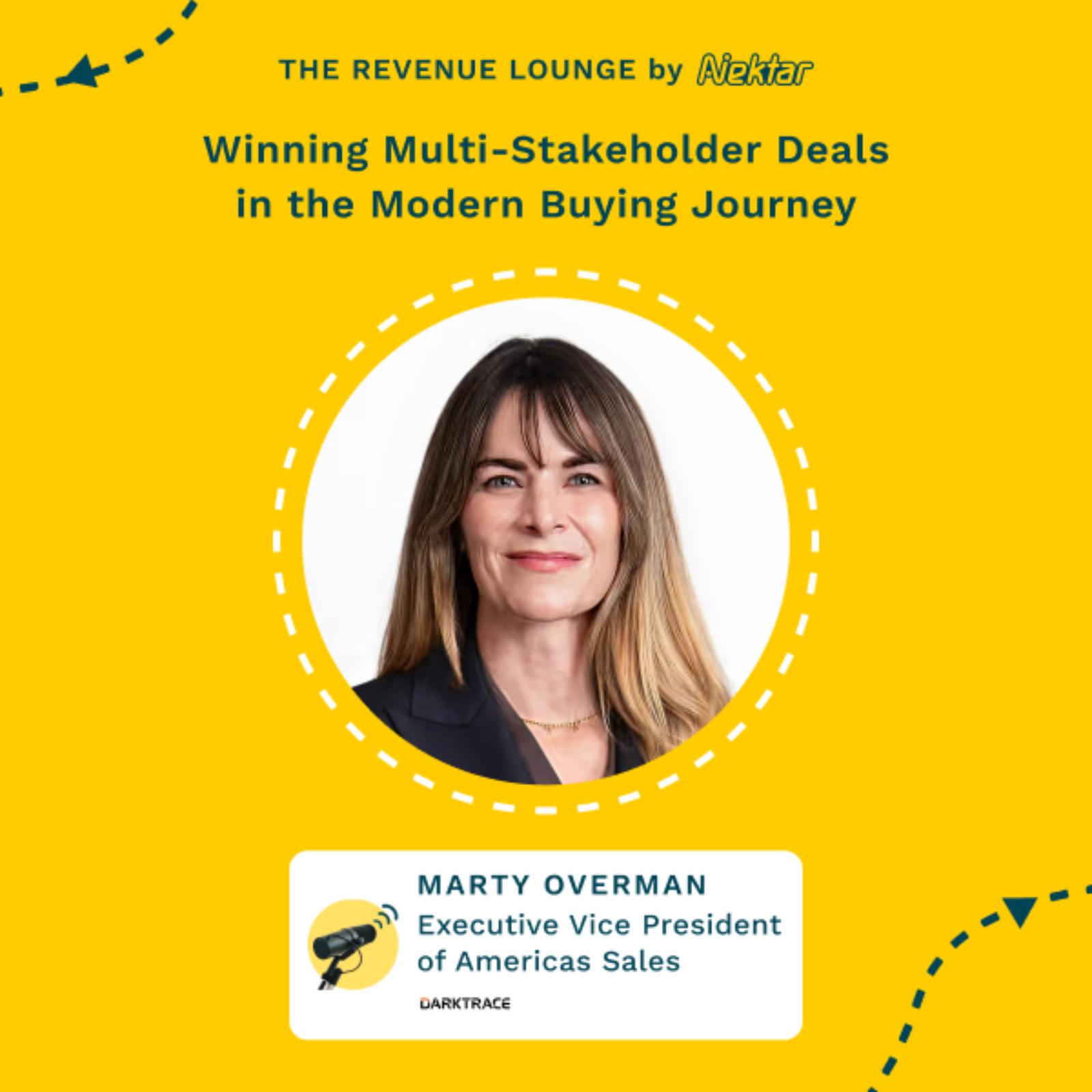 Winning Multi-Stakeholder Deals in the Modern Buying JourneyThe Revenue Lounge · features Marty Overman66 / 100
 Everybody Wants AI. Who's Paying for It?AI Proving Ground Podcast · on Tech debt85 / 100
 Urgency That Closes Deals: Lessons From Startup Sales - Josh Kriss, COO @ GeordieCyber Go-To-Market Talk · on Darktrace79 / 100
 How Non-Clinical Procurement Boosts Hospital MarginsTaking The Supply Chain Pulse · on vendor consolidation76 / 100
 Reframing Marketing ROI to Return on Objectives with Karl Van den BerghThe B2B CMO Podcast with Jon Miller and Sydney Sloan · on RSA Conference75 / 100
 The Truth About The Recent Vulnerability Spike w/ Aaron Mitchell | Episode 198The Software Leaders Uncensored Podcast · on Tech debt75 / 100
 147. Ingram Micro President on Why Intelligence Beats Instinct w/ Sanjib Sahoo77 / 100
 139. Most Client Briefs Miss the Real Problem w/ Emma Beckmann61 / 100
 138. Why Most Teams Are Using AI Completely Wrong w/ Fred Schwark55 / 100
 158. Customer Centricity Breaks When Internal KPIs Take Over w/ Hasancan Ozyurt
 157. Why You Can’t Automate Your Way to Better Sales Performance w/ Jacob Harris