
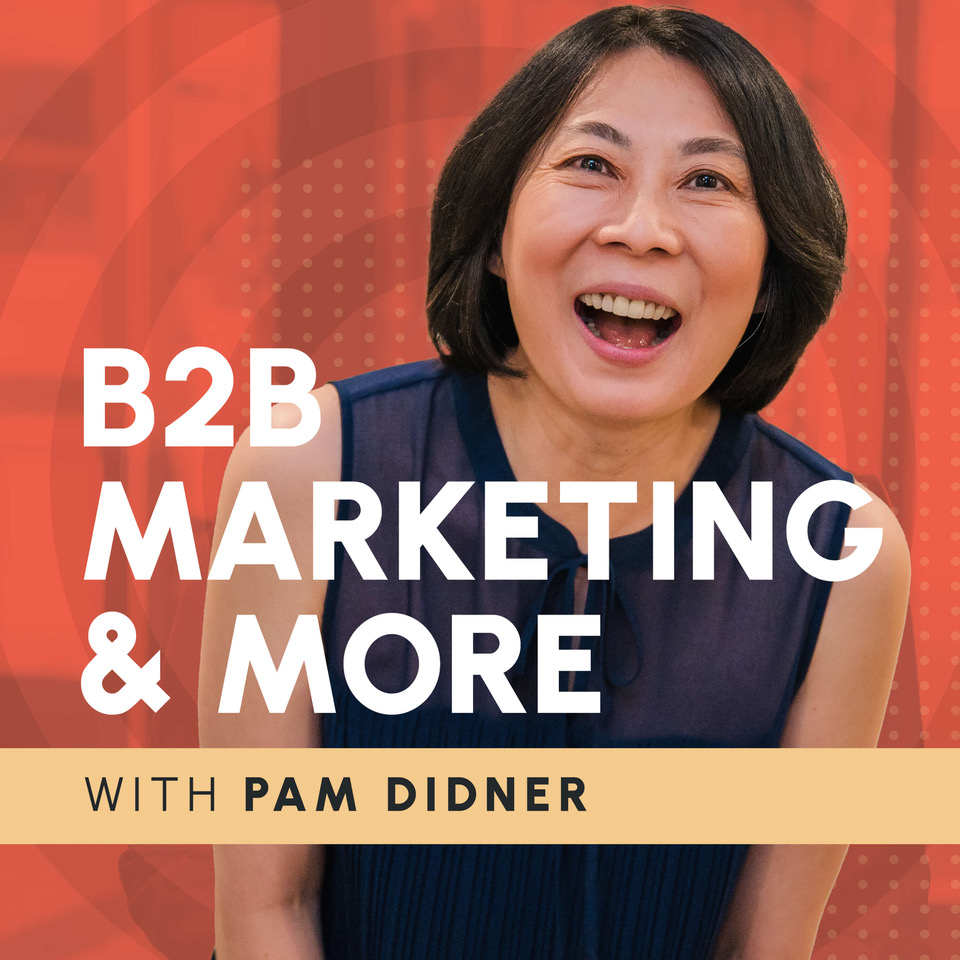
B2B Marketing and More With Pam Didner · 2023-03-24 · 21 min
Key moments - from our scoring
Substance score
52 / 100
Five dimensions, 20 points each
Agnes Fotino O'Connell brings dual sales and marketing expertise to discuss practical alignment strategies for B2B demand generation. HMI Performance Incentives, an incentive strategy company serving channel partners like wholesalers and distributors, operates with 18-24 month sales cycles - a reality that forces a reckoning with traditional KPIs. Rather than chasing monthly MQLs, Agnes and her team track pipeline opportunities by capturing sales feedback directly in opportunity records, asking reps to validate demand gen's role at deal creation. This backward-mapping approach - identifying the three moments of entry, engagement, and opportunity conversion - reveals which channels genuinely drive pipeline. Her tech stack spans RollWorks for intent data (top and bottom of funnel), HubSpot for CRM and marketing automation, Gong for sales conversation intelligence, Handwrite for automated handwritten follow-ups with QR tracking, and direct mail experiments. The episode covers critical advice for building internal buy-in: find your top salesperson as an advocate, pilot internally before scaling externally, and map your entire MarTech flywheel to show tool interdependencies across lead, MQL, and SQL stages. For career-focused listeners, Agnes advocates experiencing both sales and marketing roles through programs like HMI's Sales and Marketing Excellence Program for early-career professionals.
By capturing sales feedback at the opportunity stage, asking reps to validate demand gen's role in each deal, then working backwards through the contact record to identify when and where the prospect first engaged - mapping the three moments of entry, engagement, and conversion.
Referral traffic from third-party subject matter expert webinars, intent data monitoring (RollWorks at top and bottom funnel, third-party sources in the middle), webinar sponsorships, and ABM campaigns triggered by aggregated behavioral signals like consistent attendance on specific topics.
Identify your top salesperson and a mid-tier performer as internal advocates, show them how the campaign will make them successful, get them onboard, then pilot internally to observe reactions before launching externally - treating internal rollout like external trialing and piloting.
Core tools include HubSpot (CRM and marketing automation), RollWorks (intent data), Gong (sales conversation intelligence), Handwrite (automated handwritten notes with QR tracking), and direct mail solutions; prioritize mapping integrations in a flywheel showing which tools work at lead, MQL, and SQL stages.
Experience both roles if possible through programs like HMI's Sales and Marketing Excellence Program - understanding the constraints of each (sales reps making 50-100 calls daily) creates appreciation for the other function and leads to better-designed assets and career longevity.
Our reviewer’s read on each dimension, with quotes from the episode.
There are a handful of genuinely useful concepts - self-validated pipeline attribution, treating Gong as a marketing tool, and the three-moment contact-to-opportunity framework - but roughly a third of the runtime is consumed by introductions, mutual compliments, generic advice, and off-topic book/TV chat, diluting the signal significantly.
Our goals are to have essentially 50% of our opportunities be self-validated from sales saying, This was DemandGen who helped me create this.
I think the future state is really looking at those three moments in time and identifying, is demand generation at least a portion responsible for those important turns?
Using Gong as a marketing intelligence tool and framing third-party SME webinar attendance as intent data are mildly fresh framings, but most of the advice - find sales advocates, pilot internally, be data-driven, do both sales and marketing roles - is thoroughly standard B2B marketing doctrine with no contrarian or first-principles argument.
We've played around with Gong as a great marketing tool, which, you know, for your listeners is an incredible sales tracking tool... It's a marketing tool.
If we see that a contact is constantly attending one of our subject matter expert partners' webinars on a certain topic that we're sponsoring, it's essentially a form of intent data
Agnes is a genuine cross-functional practitioner who has worked both sales and marketing sides and built internal programs, making her a credible operator rather than a career thought-leader; however, she is a director at a niche, mid-market incentive agency without evidence of having operated at notable scale, which caps the ceiling.
I put up and set up a program at HMI that is the HMI Sales and Marketing Excellence Program that allows young grads to come in and see and experience both sides of the house
We're a small team and we're feisty at that. So when you have a small team, as I'm sure a lot of B2B marketers can relate to right now, data is your best friend.
The episode earns credit for named tools (RollWorks, HubSpot, Gong, Handwrite), a concrete attribution goal (50% self-validated opportunities), and a specific sales cycle length (18 - 24 months), but it offers no campaign-level results, revenue figures, or before/after metrics that would demonstrate real evidential weight.
we're talking about 18 to 24-month sales cycles on the long end of it, really high-end, high dollar value amounts
We have two instances of intent data formally stood up, one at the top of the funnel and one at the bottom of the funnel using our friends at RollWorks.
The host does interrupt to demand clarification and follows up on the attribution gap - genuine craft moments - but the interview is significantly undermined by extended mutual praise, a promotional segment for the host's own workshop, and several minutes of book and TV show small talk at the close.
Can you clarify that? Sorry to interrupt. What is a short-term KPI versus a long tail? Can you be specific about it?
So there's a gap right there. And how do you connect that gap and bring that content consumption or thought leadership play down?
Computed from the transcript - who did the talking, and the words that came up most.
Welcome to another episode of B2B Marketing and More with Pam Didner. I haven't done a lot of episodes lately. That's because I was busy writing a novel! Yes, I'm writing a novel. I will tell you more little later in a different episode. However, for this episode, I have a special guest for you, Agnes Fotino O'Connell , a Director of Sales Operations & Demand Generation for HMI Performance Incentive . We met at the B2BMX Conference in February. Agnes came to my workshop, and we hit it off right there. At that time, I was talking about sales enablement. Agnes told me that's something she's been doing for quite some time now. So, I invited Agnes to my podcast to talk specifically about a couple of things: how to better support sales and how to align sales and marketing for demand generation success.
Transcribed and scored by The B2B Podcast Index.
Hello everyone! Welcome to another episode of B2B Marketing and more with Pam Dina! Yay! I haven't done a lot of episodes lately.
That's because I was busy, I don't know, writing a novel. Yes, I'm writing a novel. I will tell you more a little later in a different episode. But today I have a special guest for you.
And she is a director of Dimengian for HMI Performance Incentive. And she is Agnes Fotino O'Connell. Hey, Agnes, so happy to have you here. Hey, I'm so excited to be here.
Thanks for having me. Yes. And we met at a B2B MX in February and Agnes came to my workshop and we had a great time. We hit it off right there.
And at that time I was talking about sales enablement and Agnes told me specifically that that's something that she has been doing and also is doing it. So that's why I invited Agnes to the podcast to talk about specifically a couple of things, how to better support sales and also better supporting sales through the main jam. Before we get started, Agnes, talk to us about your job and also what does your company do? Yeah, sure.
HMI Performance Incentives is a leading incentive strategy company, helping companies with a broad spectrum of needs and challenges motivate both their direct and indirect sales teams, customers, et cetera, to meet sales goals, increase loyalty, change behaviors, and everything else that you come to know and love about customer loyalty and incentive strategies. If I'm not mistaken, I think the incentive program that you set up is very much tailored for channel partners, such as the wholesalers working directly with their distributors and dealers and the value at the resellers, assistant integrator is basically kind of like a channel marketing tools.
And then you use that to incentivize and a lot of channel partners to reach a sales goal. Can you give us a very specific example about that? Yeah, sure. We might work with a large wholesaler.
Let's say they were in the building material space. They're a company that's trying to go after the contractor or the dealer, and we'd help them do a couple of things. One, we'd help them create a customer loyalty program that might go after what you'd call the middle 60 of customers, that group that is always with you. You know what to expect out of them.
And then might also help target their top 20% of their customers, the customers that bring 80% of their business typically. And we might put together some form of group incentive travel trip for those top customers, helping build a moat around them, helping them diffuse from competition taking them, and again, help grow that middle 60 to do more than they've historically done with them. So it's whatever your customer want to incentivize and you build a program and you are able to track the performance and they'll be able to award whoever reached that specific target.
You're spot on, Pam, for an incentive marketing agency. Okay, very, very good. So then talk to us. Now you have told us specifically in terms of what your company has done.
Your role is a director of a demand gen. And I remember when I was talking to you and you said you've been on the sales side, you've been on the marketing side. Before I talk to you about demand gen, can you talk to us a little bit about being on the sales side, being on the marketing side for any B2B marketers who like to supporting sales. Do you have any specific tips, trick or advice?
I think you have to just really understand what's important to the sales folks at a myriad of levels, right? And Pam, I actually think you gave some really amazing advice during your workshop at the B2B MX on this about, you know, finding your sales advocates, right? Finding those folks who are going to help you make an imprint, make a case study of what you want to accomplish as a marketer, you really have to go put your trust in sales hands and really help them help you get the job done.
So what I like to say is, go find that top salesperson and make them your advocate. Show them how your campaign or whatever you want to roll out as a marketer is going to make them successful. Get them on board and then go find someone maybe more in the middle, right? Someone who's meeting and exceeding their KPIs, but is maybe not a rock star.
and then onboard them onto your plan. And then when you have those two or four or six people on board, you're going to be pretty untouchable with whatever you try to roll out to your sales work So the bottom line is really really get to know them And it started with a small group of people might be your ally build your own tribe first and show them what kind of value you would add and then take it from there step by step. As marketers, we talk so much about trialing, right and piloting and looking at data.
And I think a lot of times marketers forget to do that internally, you know, we only tend to look at doing that externally. And it's kind of like, take a moment, pause, pilot internally, see what the reaction is, and then go run that externally. Love it. Love it.
With that being said, I'm going to touch the next topic, demand gen. So demand generation is hard. Super. I mean, I've been doing demand generation myself.
I mean, even actually try to build my own pipeline. That is hard. Not to mention that you work for a company and you have to sell products. And the many B2B marketers I haven't talked to, a lot of time they actually have a domain gen targets like a monthly basis.
It's actually very, very hard. Do you have any kind of like a holy grail or any kind of campaigns or anything that you do to actually help people to understand what they can do to better optimize their marketing campaigns? That's a great question. And it's a loaded one at that.
I think right now we've moved away from a lot of what I would call short-term KPIs, and we're really looking at the long tail. So can you clarify that? Sorry to interrupt. What is a short-term KPI versus a long tail?
Can you be specific about it? In our business, we have a long selling cycle, like hopefully most B2B marketers are experiencing right now. Yeah, we're talking about 18 to 24-month sales cycles on the long end of it, really high-end, high dollar value amounts. So for me, looking at monthly MQLs is really not a great output of what we're going to expect in that quarter.
For us, we're spending a lot of our time and attention looking at thought leadership, the sorts of downloads, the sorts of referral traffic that we're getting from that. If we can get pings on how that's coming up in conversations, how people are leveraging what we're putting out there is our best metric right now to understand success. We tend to not look at as much leads per month, net new MQLs. We're really looking at is our thought leadership content creating opportunities.
So does that mean that a lot of your metrics that you are responsible is tied to say pipeline opportunity driven? 100% of our metrics. What do you do to quantify that pipeline opportunity through, say, referral traffic or through thought leadership content? Because I feel there's a gap in terms of the content consumption and the leadership play and all of a sudden there's a pipeline activity.
So there's a gap right there. And how do you connect that gap and bring that content consumption or thought leadership play down? We're doing something very simple, which is capturing it at opportunity state, essentially understanding from the salesperson's perspective, how and why did this opportunity turn into a deal? And we're asking them in the opportunity form to state it.
And it's really interesting the amount of people that are essentially saying, hey, I feel like this was demand gen oriented for these couple of reasons. So our goals are to have essentially 50% of our opportunities be self-validated from sales saying, this was DemandGen who helped me create this. And then you can start to look backwards in the customer file, if you will, or in the contact card to understand where did they first come in to our database? When did they start to engage with us?
And then when did they turn into an opportunity? I think the future state is really looking at those three moments in time and identifying, is demand generation at least a portion responsible for those important turns? I love you identify the three moments as when they come in and when they probably become the opportunities. So based on your experience and the working backwards, what are some of the channels from your perspective is most common to capture that moment that possibly can turn into pipeline opportunity?
What kind of campaign tactics tend to drive to that specific point? For us, it's a lot of referral traffic from third party subject matter experts. And I can give you an example. If we see that a contact is constantly attending one of our subject matter expert partners' webinars on a certain topic that we're sponsoring, it's essentially a form of intent data, right?
So we're able to start to aggregate, okay, there's something here, right? Their ears are up. They're looking for something in this. Can we start to feed them a more aggregated essentially marketing plan of and around that topic And then can we start to create a conversation essentially using ABM tied to that Yep.
That makes a lot of sense. So you actually watch data like a hawk, I assume. Yes. We're a small team and we're feisty at that.
So when you have a small team, as I'm sure a lot of B2B marketers can relate to right now, data is your best friend. I mean, to go do things at scale is you have to be data driven right now. I 100% agree. So can you talk to us about what some of the tools that you use to actually unravel some of the key insights?
For us right now, we're pretty excited about our tech stack. I think a lot of things are kind of coming back in style right now. You know, at B2B MX, We heard a lot about direct mail. We're trying to add a few different tools for that into our marketing stack right now to try and understand behaviors.
We have two instances of intent data formally stood up, one at the top of the funnel and one at the bottom of the funnel using our friends at RollWorks. We're also trying to find a partner for more of that middle intent data where we just have some listening out in the universe. We're big advocates of HubSpots. We use them for both our CRM and our marketing automation.
On the send standpoint, we've just set up an integration with a very cool tool called Handwrite, which is sending out handwritten notes from our sales team after they meet in person, automated at a conference. So we're able to track that. It'll have a QR code to send them to some of our resources put on it, as well as a QR to their business card that we can track on the back end. We're doing obviously a ton with QR codes and trying to leverage that as another source of intent data.
You know, we're played around with Gong as a great marketing tool, which, you know, for your listeners is an incredible sales tracking tool that listens in using machine learning and AI to sales calls. It's a marketing tool. It's a marketing tool. It is a marketing tool.
So we've started to leverage a bit of the insights that that provides us. But at the end of the day, it's really just putting people right now to look at those moments in time that we're churning opportunities and then trying to scale those moments. So you brought up a lot of tools. A lot of marketers are overwhelmed because they feel they have to add a different tool at the different stages.
And all of a sudden, your MarTech stack becomes pretty complicated. And I think to some extent, that's inevitable. You have to use a different tool at a different time, and there's no one tool that fits all. And also, depending on what kind of campaigns you are running and different channels, you might need to use different listening tools as well.
So that I want to make sure everybody understands that when Agnes was talking about different tools that she needs to use, that's probably based on the process or the workflow or the marketing channels that she is utilizing. You have to kind of understand and talk to the vendors and see if that actually fit your own MarTech stack or your own workflow. So it may fit, it may not. But make a note of that, understand what those tools will do, and then you can make a decision if that actually works for you.
So for longest time, when I listened to a tool, I said, oh my God, Agnes, you use that tool? You know what? I probably should use it too, right? But then later I found out I need to evaluate that tool first before I can determine if that actually applies to me.
But there was a period of time I was like, you know what? Everybody's using it. I should too. But that's not necessarily the case.
So I want to make sure you understand that. Go ahead, Agnes. If I can, you know, it's something I'm passionate about. I love giving people the next tool sort of recommendations.
And something I'm coming out of actually just yesterday with one of my team members is essentially a MarTech stack audit. Audit? Audit. Okay, got it.
We look at how are all of our systems working together. And if you don't already have a flywheel of this, I would look at it. And it's going to become, hopefully it becomes a pretty complex flywheel because your different tools will speak to one another and you should draw that out. So just start drawing dotted lines or hard lines if it's a very strong integration.
And then you'll be able to show and explain internally how everything works, which is really helpful for both your team, but also the sales team, right? To show them, hey, here's how everything can work together. Here's what you can use. Here's what I can use.
Here's what we can both use. And then what you could layer on top of that is where different tools layer in. So for example, you could start to augment that flywheel to show here's what we're using at a lead level. Here's what we're using at an MQL level.
Here's what we're using at an SQL level. Here are tools that we use everywhere. And then you can start a part of this maybe ongoing deck is how I do it, at least that's updated that are, hey, here's some tools that are not the right fit for us right now. But I evaluated I understand their pricing and I understand what they can do And then you just put a slide in for them with some of your raw notes That way when a gap does come up you're not scrambling trying to go on G2 or wherever you might go for your insights.
It's, oh, I think I already did something there. Or let me see if I've already evaluated that. Flip through your deck and it's waiting for you. I love it.
So do you have that flywheel you can share with us? Yeah, I can send it out after this. Yay, I love it. So last question.
Now you've been working on the both sales and marketing side. Have you have any advice for anyone who are interested kind of moving back and forth between sales and marketing? You know, any kind of career advice that you have for them? My first thought would be do both.
And I truly stand behind that. And I don't just stand behind it. I put it in action. I put up and set up a program at HMI that is the HMI Sales and Marketing Excellence Program that allows young grads to come in and see and experience both sides of the house, everything from biz dev to field marketing to social to digital and so on.
But I think it's really important in your trajectory to understand how hard both roles are. It's an amazing skill set to understand what it's like to go do the role of a biz dev, of making those 50 to 100 calls every day. And I will say in turn, you understand then, and I think have a higher level of appreciation for when you need those marketing assets at your disposal to send out, how great those are to have and how to design them to be a better fit for not only the actual salespeople using them, but to the recipients.
So do both if you can. It'll make you, I think, a more well-rounded individual going into either your sales or marketing career on whatever side that you end up. Or you could be like me and just maybe hover somewhere in the middle. If you find an organization that will let you.
Well said. I really have nothing to add, except I don't do two at the same time, but try each one of them at a different time. So you really don't want to be Michelle Yeoh, like be everywhere, anytime, at the same time. I couldn't agree more.
so one last fun question so what show are you binge watching right now i've been watching a bit of top chef but the really old seasons of gordon ramsey which has been fun and hell's kitchen but i'm reading some really good books right now pam if you're interested i'm rereading thinking fast and slow which i think it's the best and then for a fun book reading when life gives you lululemons love it what are you reading Pam oh I'm reading I'm reading a drama it's very dark Julian Flynn's shop object oh yeah my god it's so dark yeah after I read it I was like you know what I'm actually getting a little depressed maybe a light book after the song yeah exactly But that was like I'm reading right now.
I'm actually reading more and more fictional. I got away from the business reading in the past two years. I guess I just need to take a break after 10 years. I was like, you know what?
I'm done. Let me read some fictional book. Anyway. Hey, Agnes, it's wonderful to have you.
You share a lot of insight. And by the way, it was so wonderful, so wonderful to meet you at my workshop. Such a great, great addition to have you at my workshop. We had a great time, right?
We sure did. Cannot recommend going to both B2B and MX. We'll give them a bit of a shout out because that was a really excellent conference. But also if you have an opportunity to get to one of Pam's workshops, it was incredible.
Truly lucky to sit in her grace there for like two and a half, three hours. You don't get a lot of those opportunities to learn like that from a marketing expert. So amazing, Pam. I actually pay Agnes to say that.
Just kidding. Just kidding. But I'm actually doing a workshop, a very similar one about sales enablement and how the marketing sales app and the biz app, even marketing apps, what you can do to better support sales in a changing environment, Ignite Chicago on May 23rd. So if you are interested, check that out or reach out to me.
And by the way, bring any questions to the workshop. I do answer them. Seriously, I do. She answers them the entire time.
It's amazing. All right. Hey, Agnes, it's wonderful, wonderful to have you here. Wish you best of luck and keep us posted about all the Domain Jan stuff that you are doing and come back next time.
Thanks, Pam. I appreciate it. If you want to see Agnes' flywheel, check out this episode's show notes or visit my website at pamdinner.com forward slash podcasts, episode 226.
Other episodes covering the same guests and topics, from across The B2B Podcast Index.
 The Evolution of Modern GRC ft. James Huang, Head of GRC @ GongSecurity & GRC Decoded · on Gong86 / 100
 Adamma Ihemeson on Building Autonomous AI Systems You Can TrustBack on T-R-A-C-K · on HubSpot84 / 100
 How to Hire a VP of RevOpsGTM Science · on HubSpot83 / 100
 The End of Software as We Know It: How AI Agents Are Rewriting HR, SaaS, and Organizational DesignAI First with Adam and Andy · on HubSpot81 / 100
 From the moshpit to the marketing plan | What a decade in the music business taught Jason Miller about attention in B2BTrust & Influence in B2B · on HubSpot81 / 100
 John Suarez on How Businesses Should Actually Use AI Without Losing Human JudgementMarketing for SMEs · on HubSpot78 / 100
 225 - Ask the Experts: Better Ways to Innovate, Market and Close the Deal
 224 - ft. Chris Carr: Improve Your Digital Marketing with Programmatic Advertising
 223 - ft. Tracy Niehaus: 8 Steps to Creating a Solid Account-Based Marketing Strategy
 222 - ft. Jeremy Shere - B2B Podcasting: Another Content Marketing Channel for Marketers
 221 - ft. Stacey Danheiser: Top B2B Marketing Competencies to Boost Your Career