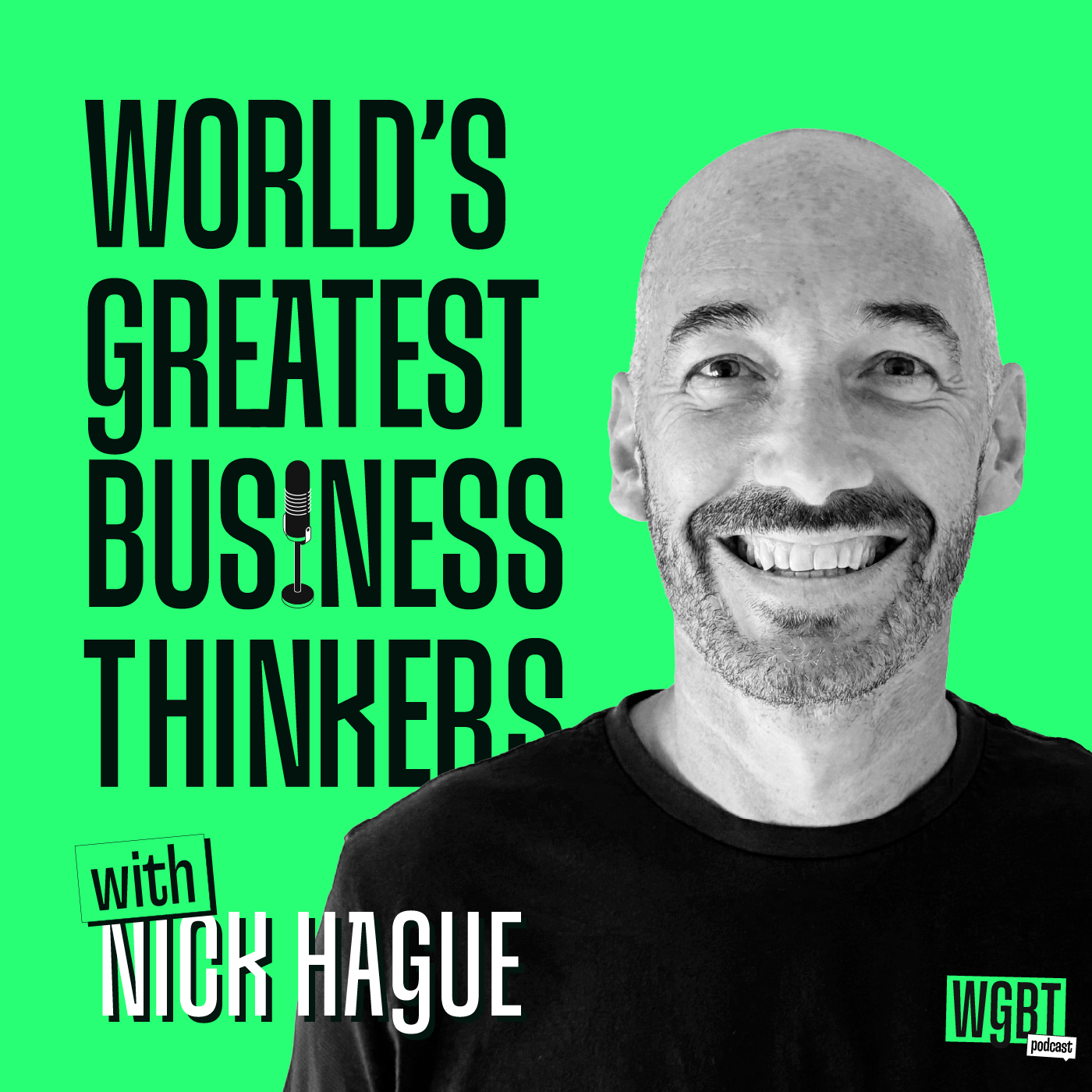
Hosted by Nick Hague
Listed under Business, Business › Management
Nick Hague interviews world-renowned business experts from a range of disciplines to discuss their favourite strategies, models, frameworks, and their latest book releases on how to achieve business success.
59 episodes · publishes fortnightly · latest 2026-09-23 · ~60 min/episode
Rank
#634
Substance
76.4
/ 100
Breakdown
Scored 2026-09
Updated monthly
Across the index
#634 of 6203
Substance
Top 10%
outscores 90% of the index
World's Greatest Business Thinkers ranks #634 on The B2B Podcast Index with a substance score of 76.4 out of 100, scored across 5 recent episodes. It scores highest on guest caliber and insight density. Ben Crowe has directly shaped outcomes at scale: Richmond Football Club's transformation (worst to premiership in one season), work with Ash Barty (3 Grand Slams, world #1, 81 weeks), and tenure at Nike during its peak. However, he is primarily a mindset coach and author rather than an operator who built a business or led a large organization. His expertise is in applied psychology to performance, not in running companies or leading revenue-generating functions. This limits caliber for a pure B2B business context.
Averaged across 5 recently scored episodes, with cited evidence.
The episode contains a mix of substantive frameworks (e.g., intrinsic vs. extrinsic motivations, play-purpose-potential, expectations vs. pressure redefinition) alongside considerable repetition and self-referential storytelling. While Ben articulates useful mental models, much of the runtime is devoted to elaborating the same themes across different athlete case studies rather than introducing novel operational ideas a B2B operator would find immediately actionable.
“expectations used to mean things we can control 100%, and pressure is defined as things we can't control, but we still want to control them”
“success is the alignment between what you truly value and how you live your life”
Ben's core frameworks - separating identity from outcomes, play-purpose-potential model, vulnerability as strength - are well-articulated but not novel in the performance psychology space. The Richmond FC turnaround is a compelling case study, but the underlying philosophy echoes widely-circulated ideas from Brené Brown, Simon Sinek, and positive psychology literature. His application to corporate settings adds some freshness, but the conceptual architecture feels derivative.
“beliefs that are holding you back from realizing your potential”
“the opposite of play isn't work, it's fear”
Ben Crowe has directly shaped outcomes at scale: Richmond Football Club's transformation (worst to premiership in one season), work with Ash Barty (3 Grand Slams, world #1, 81 weeks), and tenure at Nike during its peak. However, he is primarily a mindset coach and author rather than an operator who built a business or led a large organization. His expertise is in applied psychology to performance, not in running companies or leading revenue-generating functions. This limits caliber for a pure B2B business context.
“he helped CEOs and elite athletes alike navigate the invisible pressures of performance”
“I was able to identify the not enoughness stories that were holding him back”
The episode provides concrete examples (Richmond FC's 2016-2017 turnaround, Ash Barty's French Open semifinal at 3-love down, Andre Agassi's career arc) but lacks quantified business metrics, revenue figures, adoption rates, or measurable outcomes in corporate settings. Most specificity concerns personal/athletic performance rather than organizational or financial results. The Melbourne City FC example is mentioned but not detailed with results.
“Trent went from unofficially voted the worst captain in the AFL to officially voted by his peers as the best captain in the afl”
“nine months later, they went from being the worst team in the AFL to winning The Premiership”
Nick Hague asks sharp follow-up questions, draws parallels (Manchester United, his own agency experience), challenges Ben lightly, and pushes for specifics on frameworks. He references the transcript-building detail (Andre Agassi's book on the shelf, Ted Lasso parallels). However, the conversation rarely pushes back substantively on Ben's claims; Nick mostly validates and elaborates. There's genuine curiosity but limited productive disagreement or skepticism.
“where does this Hollywood version diverge from the messy reality of how you do change a team's mindset?”
“when should a leader consider an ashbarti exit from a strategy or even their role?”
4 periods tracked.
6 scored on substance · 58 tracked in total.
#57: From Pressure to Performance: How Great Leaders Find Their Mojo and Flow, with Ben Crowe
2026-09-03 · 1h 33m
#55: Leadership Starts with Respect: Kim Scott on Building Better Teams
2026-07-29 · 1h 12m
#53: The Unsexy Path to Building Wealth: Nick Huber on Why Boring Businesses Beat Tech Startups
2026-07-01 · 58 min
#52: 35,000 Decisions a Day: How to Get More of Them Right with Adrienne Adhami
2026-06-17 · 1h 3m
#51: How Customer Obsession Built a Sneaker Empire with Art Juedes & Rick Gering, Co-Founders of Eastbay
2026-06-03 · 1h 5m
#50: Why Unreasonable Hospitality Is The Ultimate Competitive Advantage with Will Guidara
2026-05-21 · 1h 10m
Add this badge to your site - it links back here and updates automatically as you rank.

<a href="https://index.fame.so/show/worlds-greatest-business-thinkers" target="_blank" rel="noopener">
  <img src="https://index.fame.so/badge/worlds-greatest-business-thinkers/badge.svg" alt="Ranked #45 on The B2B Podcast Index" width="360" height="136" />
</a>Track World's Greatest Business Thinkers's rank
Get an email whenever this show moves up or down the Index. Monthly at most, no spam.
Companies, products and tools that come up most across this show's episodes.
The themes that come up most across this show's episodes.

Founder-Led Sales Stories with Pete Kazanjy
Peter Kazanjy

The Secret Life of Great Leaders
TripleGoal

The Dental Economist Show
Planet DDS

The Centre for Army Leadership Podcast
The Centre for Army Leadership

Humanity At Scale: Redefining Leadership
Bruce Temkin

The Shift Code
Project Management Institute
Podcasts that dig into the same topics.

Leadership & Management Reset Podcast
Own Your Leadership with Sharon Smith

The Digital CX Podcast
Alex Turkovic

Mainline Executive Coaching ACT
Rich Baron and Maikel Bailey

The Coaching Outcomes Podcast from Values Based Leadership
Values Based Leadership
Leadership From The Heart
Romie Montpeiorus | Leadership Development Expert

Leadership Performance Under Pressure
Dex Randall | Leadership Performance Coach
