
Value Based Care Advisory (VBCA) Podcast · 2025-12-30 · 8 min
Key moments - from our scoring
Substance score
50 / 100
Five dimensions, 20 points each
The Medicare Advantage market is undergoing a fundamental restructuring that extends far beyond CMS policy announcements. Payers have moved decisively from growth optimization to margin durability, reshaping how they evaluate providers, vendors, and risk arrangements. This shift manifests in three critical ways: network narrowing is accelerating through quieter mechanisms like preferred tiering and performance exclusions rather than dramatic cuts; delegation is being repositioned from a reward into a stress test, with plans pushing more downside risk without proportional upside and even eliminating reimbursement for delegated administrative functions; and value-based care expectations have narrowed to defensible documentation, genuine downside readiness, and predictable utilization rather than pilots or care management without authority. Primary care groups lacking utilization control, enablement platforms without operational authority, and organizations waiting for final rules before engaging payers will lose ground in 2026. Winners will be those controlling decisions (not just referrals), willing to take selective intelligent downside through targeted risk bundles, and platforms with execution accountability and financial skin in the game - not software or consulting alone. The episode advises immediate action: audit Medicare Advantage exposure honestly, shift conversations from incentive discussions toward predictability needs, and simplify value-based stories to demonstrate real sophistication through clarity rather than complexity.
Payers are now optimizing for margin durability and predictability rather than growth at all costs, shifting focus to which partners can control costs and utilization when financial pressure hits.
Network narrowing is happening through quieter mechanisms like preferred tiering, performance exclusions, and administrative changes that shift volume to narrower networks of controlled providers, rather than dramatic public cuts.
Delegation is shifting from being positioned as a prize (capitation and upside) to a stress test, with plans pushing more downside risk without proportional upside and some eliminating reimbursement for delegated administrative functions entirely.
The biggest losers will be undifferentiated groups including primary care without utilization control, enablement platforms without operational authority, and organizations waiting for final CMS rules before engaging payers, as network decisions are already being made.
Payers now define value-based maturity as defensible documentation, real downside readiness, predictable utilization, and prospective payment models - not pilots, care management without authority, or strategies dependent on retrospective bonuses.
Our reviewer’s read on each dimension, with quotes from the episode.
The episode delivers substantive, non-obvious observations about payer behavior shifts - particularly the move from enrollment growth to margin durability, the acceleration of quiet network narrowing via performance tiers, and the reframing of delegation as a stress test rather than a reward. These insights reflect boots-on-ground understanding rather than public rhetoric. However, the density plateaus after the first 4-5 minutes; the final sections repeat core themes (predictability, downside risk, simplification) without adding materially new ideas, creating some filler despite overall substance.
Payers are no longer optimizing for enrollment growth, they're optimizing for margin durability. And when that changes, everything downstream changes.
Delegation is not a reward, it's a stress test for you.
The framing of margin durability over growth, the specific characterization of network narrowing as 'quiet' and administrative rather than headline-grabbing, and the inversion of delegation from prize to stress test are genuinely fresh takes not widely circulated in standard healthcare consulting discourse. However, the underlying framework (payers tightening, downside risk increasing, value-based maturity being overstated) is somewhat familiar within MA circles, preventing a higher score.
Network narrowing is accelerating even when it doesn't look like it... It's quieter than that preferred tier. I'm saying performance exclusions, administrative air quote changes that just happen to move volume to certain narrower network of providers.
Delegation was positioned as the prize right... The toner and delegation shifted from expansion to scrutiny.
This is a solo host episode with no guest. The host claims insider access to 'peer contracting meetings and network modeling and internal margin discussions' but provides no credentials, track record, or verifiable background. Without guest presence or host credibility establishing actual operator experience at scale, the episode lacks the caliber signal B2B operators expect.
I've been in enough of those conversations this year to tell you growth barely comes up anymore.
The episode provides directional insights backed by observed patterns ('recent delegation agreements where the plan is not paying the provider,' 'performance exclusions,' 'narrower network') but lacks named examples, specific companies, actual metrics, timelines, or dollar figures. Claims are grounded in anecdotal authority rather than data; statements like 'payers believe providers overestimated their value based maturity' are asserted without supporting evidence or named examples.
I've seen recent delegation agreements where the plan is not paying the provider for these delegated functions.
Most payers believe providers overestimated their value based maturity.
As a solo monologue, the episode lacks conversational back-and-forth, follow-up questions, or pushback. The host makes sweeping claims ('winning will be groups who take selective intelligent downside,' 'complex doesn't signal sophistication') without being challenged or required to defend. The tone is declarative rather than exploratory, and closing advice is generic (audit exposure, change conversations, simplify) rather than probing deeper into tradeoffs or counterarguments.
If your strategy depends on retrospective bonuses to make it work, you're starting to misalign with where MA is headed.
Complex doesn't signal sophistication anymore. It signals risk is what I'm saying.
Computed from the transcript - who did the talking, and the words that came up most.
While most providers are waiting on CMS, payers are already narrowing networks and rewriting delegation terms. Payers are quietly narrowing networks and rewriting delegation expectations. This playbook explains how to do business with MA business for 2026. If you’re waiting, you’re already reacting - not positioning. In this episode, Alex Yarijanian breaks down what’s actually showing up in payer conversations right now , long before final CMS rules are published. Drawing from real contracting, network, and delegation discussions, Alex explains why waiting for regulatory clarity is already costing providers and health tech companies leverage. You’ll hear how payer priorities have shifted from enrollment growth to margin durability, why network narrowing is accelerating quietly, how delegation has become a stress test, and what “value-based care” really means in Medicare Advantage today. This episode also outlines who is most at risk heading into 2026, the three types of organizations positioned to win, and what provider and health tech leaders should do in the next 90 days to stay relevant.
Transcribed and scored by The B2B Podcast Index.
I foremost wanted to thank everyone who's been tuning in for tuning in. I really appreciate you. It's really encouraging to see you all benefiting from these episodes. It looks like the Medicare Advantage episodes are doing really well, so I'm going to do a little follow up and leave you with that as the last episode of 2025.
Waiting is already costing you leverage, right? Medicare Advantage 2026 isn't something that's about to happen. It's been happening. It's already happening.
Not in the final rule, not in press releases, but in peer contracting meetings and network modeling and internal margin discussions that most providers never see. I've been in enough of those conversations this year to tell you growth barely comes up anymore. What comes up is predictability, margin protection, and who payers actually trust when things get tighter. I want to kind of walk you through what payers are doing right now and what they're not saying out loud and how providers and startups can still position themselves to win in Medicare Advantage 26 by acting early and acting strategically.
It's the first full year where payers are operating under the assumption that easy money is gone, right? Gone are Covid and other enhancements. Okay, CMS has been clear that growth at all costs is not the model anymore, right? I mean, I feel like we've been hearing this for some time, but of course it takes a while to change things, especially in such a massive monster industry such as healthcare.
The result of these discussions have been kind of an important shift in mindset which is impacting operational plans moving forward. So they're no longer payers are no longer optimizing for enrollment growth, they're optimizing for margin durability. The that's what's important to them. And when that changes, everything downstream changes, right?
Network changes, delegations, vendor relationships, and who gets invited into the room at all. Some of the things payers are not saying out loud is for example, network narrowing is accelerating even when it doesn't look like it. So publicly pairs will tell you they're focused on value, quality, access, blah blah blah. Privately, the question you're asking is much simpler.
Who actually controls cost and utilization when pressure hits? Who actually controls cost and utilization when pressure hits? And what I'm seeing is not dramatic headline grabbing network cuts. It's quieter than that preferred tier.
I'm saying performance exclusions, administrative air quote changes that just happen to move volume to certain narrower network of providers. If you're an independent group without real utilization control or hospital aligned group relying on referrals you don't manage, you're already being evaluated differently. You are, you're being looked at. 2.
Delegation is not a reward, it's a stress test for you. For a long time, delegation was positioned as the prize right. Capitation, autonomy, upside. That's starting to change.
Interestingly then, reasonably in recent payer conversations, the toner and delegation shifted from expansion to scrutiny. And on the provider side, they're looking at the cost. The question now sounds like you know, what the peers are asking now. So like who actually performs under downside?
Who survives when coding tailwinds disappear? Who needs constant exceptions? Who's not transmitting encounter data in a way that's hitting the plans, metrics at the state and so on level. Expect fewer new delegations, more pressure on existing ones, and more downside being pushed without proportional upside.
And so I need for example to point out that I've seen recent delegation agreements where the plan is not paying the provider for these delegated functions. So that, you know, is an example of more downside risk being pushed to the provider now without proportional upside. So proportional upside would be a downside risk would be the operational burden and you know, the need to comply with audit and so on. Otherwise the repercussions are faced.
And upside, proportional upside, which doesn't exist. There would have been some kind of reimbursement model to pay for that administrative work. Otherwise the health plan would have had. To done it right, performed the function that's been delegated.
So delegation isn't going away, but it's going to have more accountability and more risk involved on the downstream. 3. What I'm seeing is value based care means something narrower now. So most payers believe providers overestimated their value based maturity.
Value based care now means defensible documentation, real downside readiness, predictable utilization, not pilots, not care management without authority. If your strategy depends on retrospective bonuses to make it work, you're starting to misalign with where MA is headed. So think more prospective payments. Who loses in Medicare Advantage 26?
Let's be clear. The biggest losers in 2026 won't be bad actors. They'll be undifferentiated ones. Those include primary care groups without utilization control, enablement platforms without risk or operational authority, organizations waiting for final rules before engaging payers.
By the time rules are finalized, networks are already modeled decisions, mostly army, so waiting feels safe. But the most expensive decision you can make right now is waiting. Winners will be different types. Winner number one is going to be the organization that controls decisions, not just referrals.
Winner Type 2 is going to be groups who are willing to take selective intelligent downside, not global capitation, not risk and reckless exploits exposure but targeted risk bundles, subcap, narrow performance corridors and so on. And providers say here's where we're confident payers to listen then you gotta deliver winner type 3 is gonna be tech and service platforms with accountability. The future isn't software alone, it's not consulting alone, it's execution platforms. If you can't stand behind outcomes financially, selling into MA next year will get harder and not easier.
I have to tell you. So if I were advising a CEO or practice president right now, here's what I would say in the next 90 days. First, audit your MA exposure honestly. Where do you lose money?
Who drives variance? Who actually controls outcomes? Then I want you to look at to changing how you talk with your health plan partners. Stop asking about incentives and start asking about where they need predictability.
Third, simplify your value based story. Fewer partners, clearer accountability, less abstraction. Complex doesn't signal sophistication anymore. It signals risk is what I'm saying.
Both like simple designs and models that are effective. It sounds cliche, but think through that mindset and you'll win. Here's some of the takeaway pairs are choosing fewer partners. They're looking at these partners in a more rigorous fashion and the question is whether you help shape these decisions or they're made without you at the table.
In Medicare Advantage, being hard to replace is the real power. So that is what I want to leave you with. Thanks for tuning in. Until next time.
 The Ghost Network Behind Pediatric Home Nursing: When Authorized Hours Go Unfilled100 / 100
 Your Billing Problem Started in the Contract84 / 100
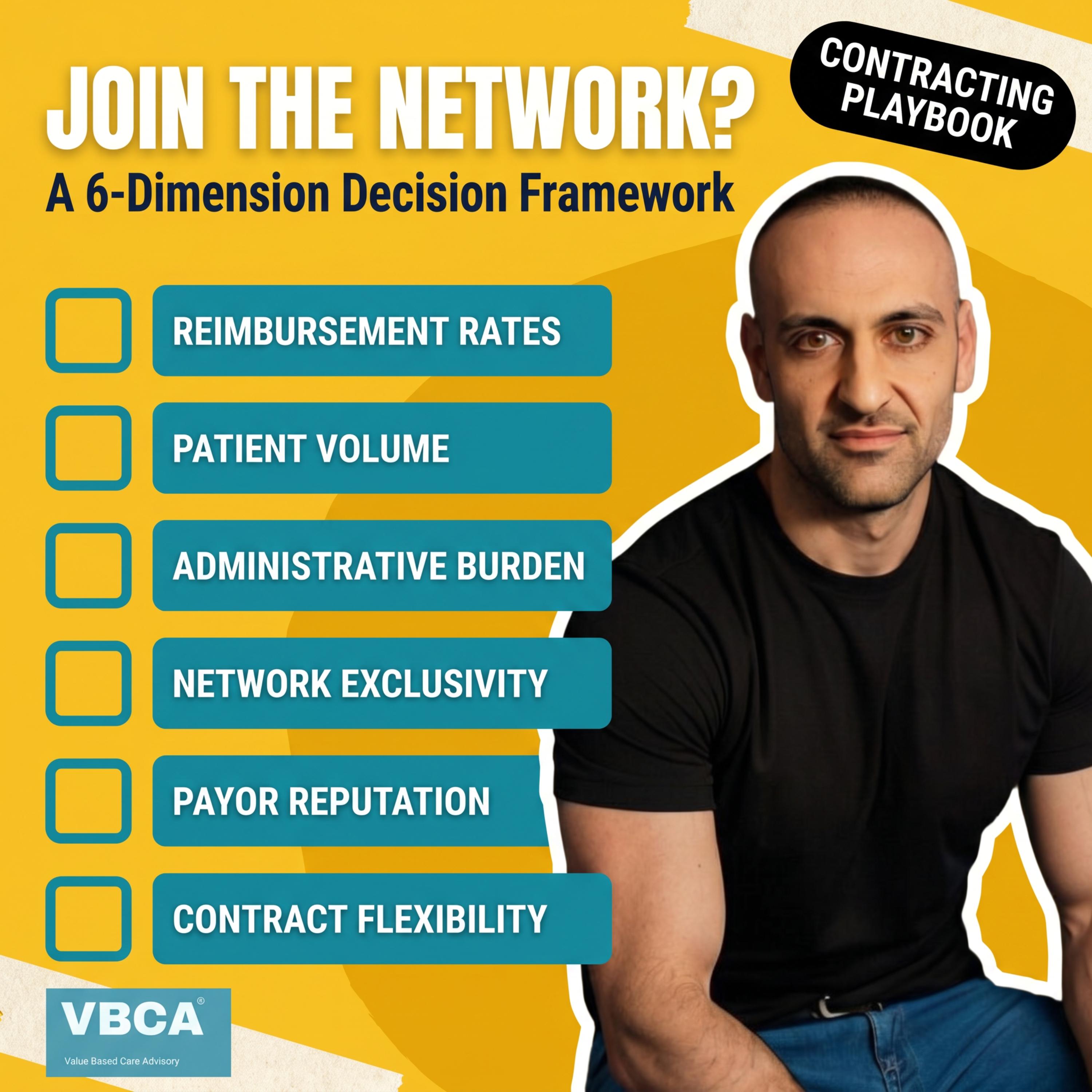 How to Decide to Contract with a Payer: Should You be Joining "the Network"?73 / 100
 LEAD Model: The ACO Test Most Organizations Will Fail - Before They Apply73 / 100
 The Definitive Playbook for Choosing Behavioral Health Markets78 / 100