
Value Based Care Advisory (VBCA) Podcast · 2026-06-29 · 7 min
Key moments - from our scoring
Substance score
64 / 100
Five dimensions, 20 points each
Revenue cycle teams routinely inherit billing problems that originated in contract language - and they take the blame for underpayments they never caused. Alex Yarijanian presents a concrete case: a multi-specialty group's commercial payer systematically underpaid specific procedure codes for over a year because a buried amendment's effective date clause created a six-week gap between the group's signature and the payer's counter-signature. The real issue: contracting (managed care/CFO) and revenue cycle (operations) sit in separate silos with different KPIs and vocabularies, leaving billing teams to decode unfamiliar contract provisions their systems weren't built to audit. Yarijanian lays out three immediate contract audit priorities - fee schedule effective dates, carve-out clauses for carved services like behavioral health, and appeals dispute timelines (especially critical in Medicare Advantage where windows are often shorter than internal denial workflows). The key insight: when a payment pattern persists despite appeals, the root cause is usually contractual, not operational. Revenue cycle directors, operations managers, and managed care professionals will gain a practical framework for distinguishing billing errors from contract problems - a critical distinction because contract underpayments can't be fixed at the claims level and require escalation to contracting teams instead.
A buried amendment contained an effective date clause stating 'rates effective upon execution by both parties,' but the payer counter-signed six weeks after the group signed. The payer applied the new rate from their execution date, not the group's, creating a six-week payment gap on high-volume services that went undetected because the root cause was contractual, not a billing or coding error.
Billing errors are coding or claims submission mistakes resolved through the standard claims process; contract problems stem from written agreement provisions (effective dates, carve-outs, dispute timelines) and require escalation to the managed care team, review of all amendments, and potentially formal dispute or renegotiation - not appeals within the normal denial workflow.
Examine the amendment language on the effective date clause (e.g., 'upon execution by both parties') and reconcile it against when both parties actually signed. Verify that the billing system has flipped to the new rates on the correct date, since misalignment between contract execution dates and billing system rate changes causes persistent underpayment that looks like coding errors.
Most providers lose Medicare Advantage appeals because the contract's dispute window is shorter than their internal denial management cycle; the clock runs out before the billing team can submit the appeal. The contract dispute timeline, not the organization's standard denial workflow, determines the actual deadline.
Carve-out clauses exclude specific service lines (most commonly behavioral health) from the base agreement and route them to a separate fee schedule or pay arrangement. If the billing team doesn't know which services are carved out and where to route those claims, the resulting denials appear to be coding errors when they're actually routing or contract configuration problems.
Our reviewer’s read on each dimension, with quotes from the episode.
The episode provides concrete, actionable insights about a specific structural problem (contract provisions causing underpayment) that most revenue cycle teams likely haven't systematized. However, the content is relatively compressed and the three takeaways (fee schedule effective dates, carve-out clauses, appeals timelines) are presented at a surface level without deep exploration of implementation complexity or nuance.
billing teams taking the blame for problems that were created upstream, meaning in the contract even before a single claim was filed
You can't fix the contract problem at the claim level
The core insight - that contract language causes operational billing failures - is solid and somewhat counterintuitive for practitioners focused on claim-level fixes. However, the argument itself is not deeply original; the separation of contracting and operations functions is a well-known organizational problem, and the framing, while useful, doesn't introduce fundamentally new frameworks or challenging assumptions.
the people who negotiate these contracts and the people who run revenue cycle don't sit in the same room
billing team inherits a contract they didn't negotiate, written in language they most likely don't fully understand
Alex Yarijanian presents himself as a consultant/practitioner working directly with revenue cycle teams and CFOs on contract issues, giving him relevant operational credibility. However, the episode is solo commentary rather than a guest interview, and while his experience sounds real, his title, organization, and depth of direct operational leadership remain unclear.
I'm sitting across the revenue cycle, director of a multi specialty group
I've been invited to provide a training, a webinar for these attendees
The opening anecdote about the six-week backdated rate application is concrete and specific, providing a real dollar-impact scenario. The three recommendations reference concrete contract clauses and mention a 73% stat on provider payment knowledge. However, beyond the lead example, the episode relies more on generic carve-out and timeline categories without naming specific payers, contract templates, or quantified impact across the portfolio.
the payer's counter signature came six weeks after her organization had already signed
buried in an amendment, one of the three amendments...a fee schedule effective clause that reads, quote, rates effective upon execution by both parties
This is a solo commentary/educational piece, not a conversational interview, so it lacks the dimension of host follow-ups and pushback. The delivery is clear and structured but reads more like a training deck than a probing conversation. No guest is challenged or questioned, and no disagreement or nuance is explored through dialogue.
I'm presenting this full framework on on this at the CHBMA Healthcare Business Management association
If you want the full framework, denial categorization methodology, contract audit checklist and all the works, I'm presenting this live August 12th through the CHBMA
Computed from the transcript - who did the talking, and the words that came up most.
Most revenue cycle teams are chasing the wrong fire. Persistent underpayment, denials that don't respond to appeals, patterns nobody can explain - these are often contract problems wearing a billing problem's disguise. In this episode, Alex breaks down the structural gap between contracting and RCM that costs providers real money every day, and delivers three things you can take to your next denial review right now. WHAT YOU'LL HEAR The real story behind a multi-specialty group underpaid for 12 months - and why their billing team did nothing wrong Why contracting and RCM live in separate worlds - and why that gap is your biggest revenue risk Fee schedule effective date clauses: the most dangerous amendment language in managed care contracts Carve-out clauses and why behavioral health denials keep looking like coding errors Contract dispute timelines vs. your denial management cycle - what happens when they don't match The one question to add to every denial review THREE THINGS TO APPLY NOW Check your fee schedule effective dates. Know the execution date on every amendment. Confirm your billing system actually flipped to the new rates.
Transcribed and scored by The B2B Podcast Index.
I'm sitting across the revenue cycle, director of a multi specialty group, solid operations, excellent team. And she's frustrated because for the better part of a year, one of their commercial health plans had been consistently underpaying on a specific set of procedure codes. I'm not talking about denials, I'm not talking about rejections, just paying less than the contracted rate. Her team had worked with the denials, so I asked her to pull out the contract.
And buried in an amendment, one of the three amendments. Layered on top of that base agreement is a fee schedule effective clause that reads, quote, rates effective upon execution by both parties, unquote. So what does that even mean? It could sound straightforward, except in this case, the payer's counter signature came six weeks after her organization had already signed and the payer had applied the new rate starting from their execution date, not hers.
Six weeks of claims, high volume service line. That's real money. That wasn't a billing error. Her team did nothing wrong.
There was a contract problem and it had been sitting there invisible for 12 plus months. I'm Alex Yarijanian, I'm your host and what I'm going to do is talk about the version of the story. I see consistently billing teams taking the blame for problems that were created upstream, meaning in the contract even before a single claim was filed. Here's the structural issue.
In most organizations, the people who negotiate these contracts and the people who run revenue cycle don't sit in the same room. Contracting is managed care, okay. Or under the CFO's office rcm. Revenue cycle management is operations.
These are different meetings, different KPIs, entirely different vocab. The result is that your billing team inherits a contract they didn't negotiate, written in language they most likely don't fully understand and governing payment logic. Their software wasn't built to catch. And when something goes wrong, the default assumption is coding error or payer system glitches.
Sometimes it is, but when you see persistent underpayment on a specific payer or service line, patterns don't move. No matter how many times you appeal. The root cause is often some contract provision or some provision the contract referring to some manual online that you can't find or that they change every month and that you can't keep up with. You can't fix the contract problem at the claim level.
Basic point. So I'm presenting this full framework on on this at the CHBMA Healthcare Business Management association and I've been invited, as I said, to provide a training, a webinar for for these attendees, largely revenue cycle managers. And what's going to happen is that they're going to walk away with a working contract audit list, but they're charging for this event. And what I'm going to do is provide you three things you can take to your next denial review right now and a sneak peek if you will on the webinar content.
So number one is looking at fee schedule effective dates when you renegotiate rates. The amendment language on the effective date determines everything. For instance, in this example I gave you quote upon execution. Sounds clean.
Unless there's a 45 day between your signature in the payers check. Your amendments, know your effective dates, reconcile them against your billing system and make sure that they've actually flipped to the new rates so you even know what you're expecting. There's a study that talks about 73% of providers don't know what they're actually supposed to get paid. So this is a huge issue.
Okay, I want you then to look at your carve out clauses. So a lot of contracts exclude specific service lines from that base agreement. For example, behavior is the most common one, behavioral health. And make sure you route them to a separate fee schedule or a separate pay arrangement entirely.
If your billing team doesn't know which services are carved out and where those claims need to go, the resulting denials are going to look like coding errors, which is misleading because they're not. And the third area is appeals and dispute timelines. I do this so often with my clients. Most billing teams I'm seeing assume their standard denial management cycle is the clock that matters.
It isn't. The contract has its own dispute window and in many agreements, especially Medicare Advantage, the window is shorter than your internal workflows. The number of times I've seen this. So you're not losing those appeals because your argument is weak.
You're losing them because the clock ran out before your team got there. Go find that clause in your active agreements right now. If the contract dispute window doesn't match your denial management cycle, that's a configuration problem. And every day you don't fix it, you're leaving money on the table.
What I'm asking you to do is add one question to your denial review process. If there's one practical shift you're going to take from this is the following. Ask when you hit a pattern that doesn't respond to standard appeals, is this a billing problem or is it a contract problem? Those require completely different escalation paths.
Billing errors get resolved through the claims process. Contract problems require your managed care team, the original agreement, all the amendments, and sometimes formal dispute or renegotiation. If your billing team is routing everything into the same queue, the contract based underpayments are getting written off and you have no idea. Think of it.
So if you want the full framework, denial, categorization methodology, contract, audit checklist and all the works, I'm presenting this live August 12th through the CHBMA. They are offering one CEU credit and I'll put details in the show notes. If you want to reach the checklist directly, reach out through VBCAPodcast.com I'll get it to you again.
I'm Alex Yarijanian. This is the Value Based Care Advisory Podcast.
Other episodes covering the same guests and topics, from across The B2B Podcast Index.
 The Healthcare Black Box: Prior Authorization, AI Denials, and Fiduciary Duty (Ep. 54)The Benefit Whisperer · on revenue cycle management85 / 100
 Ben's Den LIVE! at Fuse 2026 | AI in Healthcare: Beneath the Frothy SurfaceBen's Den · on Value-based care82 / 100
 Infusion Revolution Series | The Data-Driven Infusion Center with Chris Hilger, CEO of SolisRxThe Bottom Line Pharmacy Podcast · on revenue cycle management80 / 100
 Episode 124: Annie Lamont on Healthcare, AI, Epic, Medicaid, and the Future of American MedicineThe Puck: Venture Capital and Beyond · on Value-based care79 / 100
 The $19,000 Bill That Exposed Healthcare's Biggest ProblemBoombostic Health · on revenue cycle management73 / 100
 HIMSSCast: Payers and providers gird for an escalating AI prior auth arms race (brought to you by SuperDial)HIMSSCast · on Medicare Advantage73 / 100
 The Ghost Network Behind Pediatric Home Nursing: When Authorized Hours Go Unfilled100 / 100
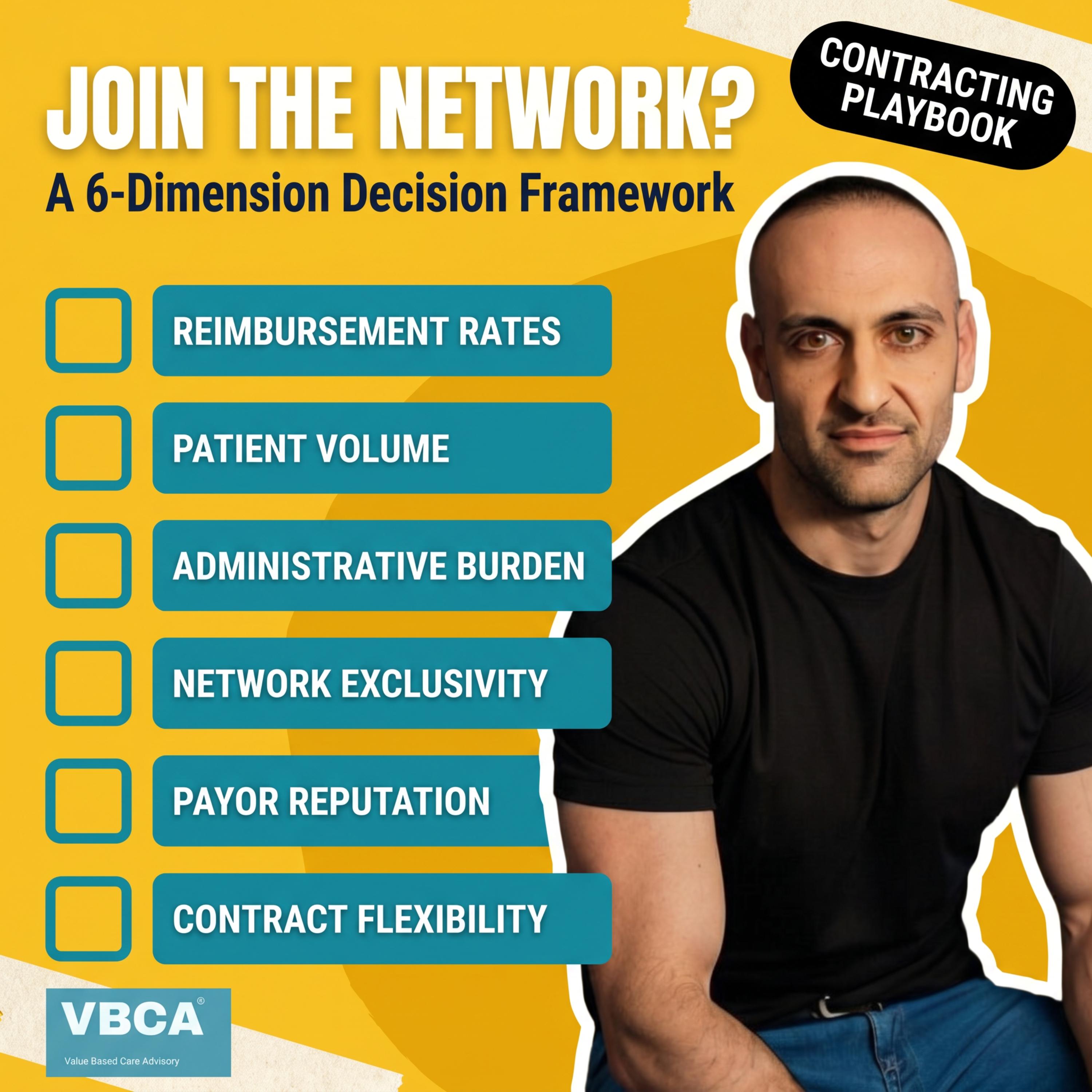 How to Decide to Contract with a Payer: Should You be Joining "the Network"?73 / 100
 LEAD Model: The ACO Test Most Organizations Will Fail - Before They Apply73 / 100
 The Definitive Playbook for Choosing Behavioral Health Markets78 / 100
 Medicare Negotiates Like an Owner. Commercial Doesn’t.93 / 100