
Value Based Care Advisory (VBCA) Podcast · 2026-08-01 · 12 min
Key moments - from our scoring
Substance score
82 / 100
Five dimensions, 20 points each
Alex Arajanian dissects a critical access failure in Medicaid managed care: the disconnect between approved pediatric private duty nursing hours and hours actually filled by available nurses. Using New Jersey as a case study, he reveals that while directories list 200+ home health agencies, only about 8 have dedicated pediatric designations - yet children remain hospitalized waiting for discharge because authorized care cannot be staffed. The MACPAC data shows 20-40% of authorized private duty nursing hours nationally go unfulfilled, a metric Arajanian argues should be the primary measure of network adequacy, not provider counts or contractual listings. He introduces the concept of "ghost networks" - directories that appear complete but functionally disappear when families try to access them - and traces why pediatric cases differ fundamentally from adult home care: ventilators, tracheostomies, feeding tubes, overnight coverage needs, and high-acuity requirements narrow the viable labor market far below what appears on paper. The episode prescribes an audit framework for MCOs that moves beyond static directories to live validation, capacity mapping by county and shift type, and treating unfulfilled authorized hours as access failures rather than provider problems. This resonates with CMS's 2024 Medicaid Managed Care Final Rule shift toward secret shopper surveys and appointment wait time standards - a move Arajanian argues should extend to tracking hospital discharge delays and actual staffing rates.
Because authorized hours and filled hours are different: a plan may approve 80 hours weekly of pediatric nursing, but if the contracted agencies cannot staff them due to narrow pediatric labor markets, the child remains hospitalized. The ghost network appears complete on paper but disappears when discharge planners try to use it.
According to MACPAC data cited in the episode, 20-40% of authorized private duty nursing hours nationally go unfilled, though this varies by region and is not limited to New Jersey.
Analysis of the NPI registry found approximately 8 dedicated pediatric home health agencies in New Jersey, despite directories listing 200+ general home health agencies, because most agencies do not accept new pediatric cases or cannot staff high-acuity pediatric conditions.
Pediatric cases involve complex medical equipment (ventilators, tracheostomies, feeding tubes), seizure management, fragile transitions from NICU/PICU, overnight coverage needs, and high-acuity requirements that narrow the viable labor market far below what general home health directories suggest.
CMS shifted from asking whether directories look complete to requiring secret shopper surveys, appointment wait time standards, and practical tests of whether members can actually obtain services - moving access measurement closer to real-world usability rather than static contractual lists.
Our reviewer’s read on each dimension, with quotes from the episode.
Packed with actionable distinctions rarely articulated in health policy discussions - the gap between authorized and filled hours, ghost networks specific to pediatric nursing, NPI registry analysis revealing 8 true pediatric agencies out of 200 listed, and seven concrete audit steps for MCOs. Minimal filler; nearly every claim supports the core access thesis.
A provider directory can include agencies that do not take new pediatric cases, do not serve the child's county, do not have high acuity cases to be staffed
If a child is authorized for 12 hours of nursing per day but the agency can only staff six, then that's the rest the family absorbs
Fresh reframing of a known problem (network adequacy) through the lens of authorized vs. filled hours - a distinction that inverts typical compliance thinking. The NPI registry enumeration (8 of 200) and ghost network application to pediatric home health breaks from standard MCO narrative. Not contrarian for shock value but genuinely first-principles in connecting discharge delays to network fiction.
The term ghost network gets used a lot in behavioral health, but the same concept applies here
Approving a service is not the same as delivering access. And we all know this. It is not the same. It's not one and the same
Solo episode by Alex Arajanian, founder of Carenodes (health tech/analytics firm focused on network adequacy), with direct practitioner experience auditing MCO networks, working with hospitals on discharge planning, and advising on Medicaid access. Not a career podcaster or external commentator - this is a working operator describing systems he actively analyzes and advises on.
This is not a published government statistics. It's what we've done at carenodes at my company to actually enumerate the network scope
When I advise a Medicaid MCO on this problem, I don't start with a generic network adequacy report
Abundant specificity: named agencies (Affirmed Home Care, Pediatrics and Adolescent Therapy Associates, Growing Hope), concrete data (8 of 200 NPI registrations, 20-40% unfilled rate cited by MACPAC), New Jersey Children's Hospital case study, CMS 2024 rule detail, and real clinical scenarios (ventilators, treks, seizure disorders, overnight coverage). Seven-step audit framework with measurable outputs.
when we reviewed the NPI registry for pediatric specific home health designations, the number of dedicated pediatric home health agencies looked closer to eight out of 200
Often cited in the 20% to 40% range, this isn't a New Jersey specific figure
Solo monologue format eliminates follow-up opportunity and guest pushback. While structured and logical, the presentation reads as prepared remarks rather than conversational exchange. No tension, disagreement, or genuine questioning of assumptions that would test ideas. Host-only format precludes conversational craft dimension by design.
I'm going to stop enumerating them because they're on and on
This is why the NPI registry analysis matters
Computed from the transcript - who did the talking, and the words that came up most.
Episode Summary A pediatric patient in a New Jersey hospital is medically ready for discharge - equipment arranged, family ready, nursing hours authorized by the health plan. The only missing piece: an actual nurse. This episode uses that scenario to examine the structural gap between authorized private duty nursing (PDN) hours and filled hours in Medicaid managed care, why standard provider directories overstate real pediatric home health capacity, and what CMS's 2024 Medicaid managed care access rule signals for how plans will need to prove - not just claim - network adequacy going forward. "When the network looks broad on paper, but families still cannot get care, the question is not, do we have enough providers listed? The question is, can a child actually get home?" Chapters The Discharge That Doesn't Happen - A clinically ready child, an authorized care plan, and no nurse to staff it. The Directory Problem - Why a state can show hundreds of home health agencies while only a handful actually serve pediatric high-acuity cases. Authorized vs. Filled Hours - The distinction that matters most for families, and the 20 - 40% unfulfilled-hours range documented by MACPAC.
Transcribed and scored by The B2B Podcast Index.
There's a child in a New Jersey hospital who is clinically ready to go home. Patient is ready to be discharged. Not almost ready, not maybe next week. They are ready.
The discharge plan is written, the equipment can be arranged, the family wants them home, the care team wants them home. And the health plan has authorized private duty nursing hours. But there is one missing piece. No nurse.
So the child stays. Not because the hospital is the right place anymore, not because the family failed to plan, not because the doctor forgot the order. The child stays because the home nursing network on paper doesn't match the home nursing network in real life. If you want to understand what is broken in Medicaid managed care access, don't start with a dashboard.
Start with that discharge planner trying to find a pediatric home health agency that can actually staff the case. Because on paper, New Jersey has hundreds of home health agencies. But when we reviewed the NPI registry for pediatric specific home health designations, the number of dedicated pediatric home health agencies looked closer to eight out of 200. The agencies that surfaced as pediatric specific included names like Affirmed Home Care, Pediatrics and Adolescent Therapy Associates, Active Pediatrics Therapy Services, Growing Hope, Pediatric Care for Kid Care, and Family Care Agency.
This is not a published government statistics. It's what we've done at carenodes at my company to actually enumerate the network scope as it relates to pediatric home health. When the network looked so broad on paper, it became a little bit of a head scratcher because it started to point to a much bigger problem. When the network looks broad on paper but families still cannot get care, the question is not do we have enough providers listed?
The question is, can a child actually get home? I'm Alex Arajanian and this is the Value Based Care Advisory Podcast. Today's episode is about pediatric home health, private duty, and one of the most important access problems in Medicaid managed care. That's the gap between authorized care and delivered care.
Because in Medicaid, authorization is not the finish line. Right? A health plan can approve private duty nursing hours. A hospital can discharge a child.
A family can be ready. But ifta, if those hours go unfilled, access has failed. And this is where the story gets uncomfortable for managed care organizations, regulators and provider networks nationally. The MACPAC has documented that a meaningful share of authorized private duty nurses go unfulfilled.
Okay, why is that? A meaningful share of authorized private duty nursing hours go unfulfilled. Often cited in the 20% to 40% range, this isn't a New Jersey specific figure, but it captures the scale of the access failure. If a medically complex child is approved for 80 hours of nursing a week and 20 to 40% of those hours are not staffed, that family is not receiving the benefit that we're authorized to receive.
They are receiving a promise with missing labor behind it. So managed care has a habit of treating provider directories as if they are proof of access. A directory says there are providers. A network adequacy filing says the plan meets the standard.
A contract says the service is covered. But pediatric private duty nursing exposes the weakness in that logic. A provider directory can include agencies that 1. Do not take new pediatric cases.
2. Do not serve the child's county. 3. Do not have high acuity cases to be staffed.
I'm going to stop enumerating them because they're on and on. They do not have overnight nurses do not accept the plans. The reimbursement rate are listed but are unreachable are technically contracted but functionally unavailable. This is how you get what's called a ghost network.
The term ghost network gets used a lot in behavioral health, but the same concept applies here. The plan appears to have a network. The directory appears to show access. But when a family or discharge planner tries to use it, the network just disappears.
Research on Medicaid managed care directories has found very high rates of inaccuracy or inaccessible listings. CMS cited similar evidence in a 2024 Medicaid Managed Care Access 5 Finance and Quality Final Rule when it justified new Secret Shoppers survey requirements. That matters because CMS is no longer asking, does the directory look complete? CMS is moving toward the question, can members actually obtain care?
That's a very different standard now. Why pediatric home health? Why is pediatric home health different? Pediatric home health is not just adult home care with smaller patients.
These cases can involve ventilators, treks, feeding tubes, seizure disorders, complex medication regimes, and fragile transitions from NICU to PICU to home. The family may need nursing coverage overnight. They may need nurses who are comfortable with pediatric acuity. They may need backup staffing when a nurse calls out.
That makes the labor market much narrower than the directory suggests. A general home health agency may exist in the state. It may be enrolled in Medicaid, but that doesn't mean it could staff a medically complex pediatric case tomorrow. This is why the NPI registry analysis matters.
If you search broadly for home health agencies, the market looks large. If you narrow to pediatric specific designations and actual pediatric orientation, the market looks much smaller. That smaller market is a real market that families experience, right? That's the actual patient experience, the small network.
So what is this unauthorized but unfulfilled problem? The most important distinction in this episode is the difference between authorized hours and filled hours. Authorized hours are what the plan says the child can receive. Filled hours are what actually show up in the home for families.
The second number is the one that matters. If a child is authorized for 12 hours of nursing per day but the agency can only staff six, then that's the rest the family absorbs, right? That's the rest of the impact. Parents become the backstop, siblings feel the strain, hospital discharge gets delayed, emergency department use becomes more likely, caregivers burn out.
And from a managed care perspective, the system may look compliant because the service was technically approved. That is the policy failure. Approving a service is not the same as delivering access. And we all know this.
It is not the same. It's not one and the same. This is where the story comes back to the hospital. New Jersey Children's Hospital and New Jersey Hospital association policy discussions have raised the issue of children waiting for weeks, sometimes longer, for discharge to home nursing.
This should be framed very carefully. But anyone who's worked on complex pediatric discharge knows the scenario is real. A child no longer needs inpatient care but cannot go home safely without nursing. The hospital bed stays occupied.
The family waits. The health plan has authorized the benefits, but the home based workforce is just not there. This is not a pediatric home care problem. This is a system capacity problem.
Now I know we're in 2026, but I'm going to remind you of why the CMS 2024 rule matters. CMS 2024 Medicaid Managed Care Final rule is important because it pushes managed care access oversight closer to reality. The rule strengthens access monitoring and network adequacy expectations. One of the most important ideas is that access cannot be measured only through static provider directories or contractual.
CMS is moving towards secret shopper surveys, appointment wait time standards and more practical tests of whether members can actually obtain services for pediatric private duty nursing. That logic could go even further. The key access question should be how many authorized PD private duty nursing hours were actually filled? How many children experienced delayed discharge because home nursing was unavailable?
How many agencies listed in the directory are actually accepting new pediatric cases? How many can staff high acuity pediatric cases? How many can actually partially versus fully be staffed? Those numbers matter.
Not just the network count, not the directory size, not just the provider is contracted. Yes, check mark. But it matters. What should health plans do differently?
When I advise a Medicaid MCO on this problem, I don't start with a generic network adequacy report. I start with a pediatric PD and access audit. First, compare authorized hours to filled hours. Second, identify children waiting in the hospital for nursing.
Third, validate every pediatric home health agency and directory through live outreach, which is what we did. Fourth, separate agencies that serve adults only, mixed populations and true pediatric high acuity cases. Fifth, map capacity by county, shift type and acuity. Sixth, identify rate or contracting barriers that make agencies unwilling to take cases.
And finally, seventh, treat unfulfilled authorized hours as an access failure, not just a provider staffing issue. Because if the plan authorizes the care but the family cannot get that care, the member experience is still a failure and the bad outcomes still stick with the plan. So what should providers document for pediatric home health agencies, hospitals and advocates? Documentation strategy matters.
Don't just say access is bad. That's not sufficient. Document the referral date, authorization date, requested hours, filled hours, miss shifts, agencies contracted reason for refusal, county discharge day delays, family impact. This is how your anecdotal experience becomes actual evidence that regulators, health plans and policymakers can act on and that you can leverage in your contracting discussions with the health plans.
So the story we started with was this child ready to leave the hospital but waiting for a nurse. It's not just a sad itch case, it's a stress test for Medicaid managed care. If the network is real, the child gets home. If the network is paper only, the child waits.
That is the difference between coverage and access. And in pediatric private duty nursing, the difference is measured in hospital days, family exhaustion, and children who should be home but are not. So the next time someone says the plan the health plan has hundreds of home health agencies in the network. Ask the better question, how many can take those pediatric cases today?
That is the network that matters. And I'm Alex Yarijanian. This is the Value Based Care Advisory podcast. If this episode was useful, share it with someone working on Medicaid access, discharge planning, or managed care network adequacy.
And if you want help turning provider director data into an actual access analysis, this is exactly the kind of work you can do following the guidance I just gave. Thank you.
 Your Billing Problem Started in the Contract84 / 100
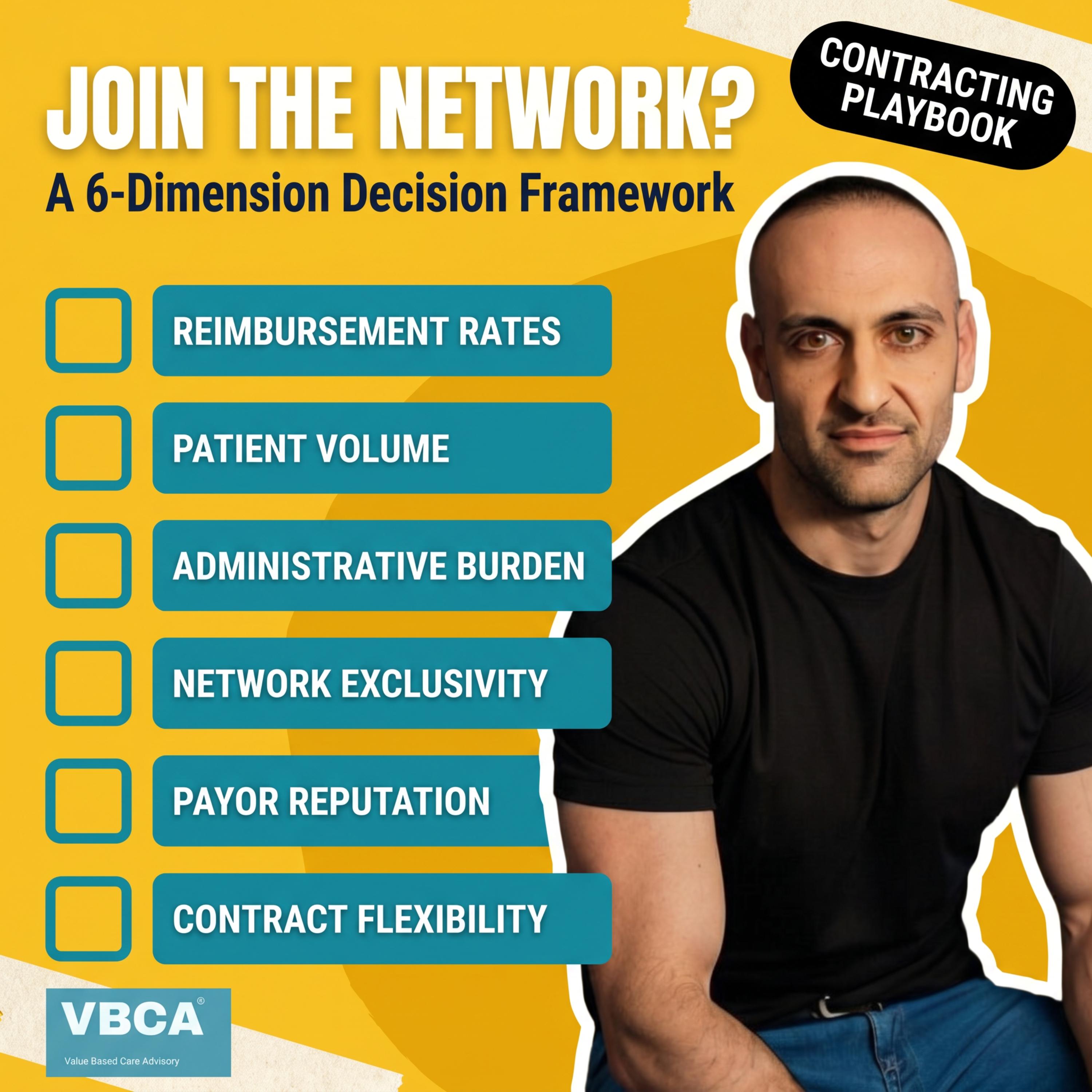 How to Decide to Contract with a Payer: Should You be Joining "the Network"?73 / 100
 LEAD Model: The ACO Test Most Organizations Will Fail - Before They Apply73 / 100
 The Definitive Playbook for Choosing Behavioral Health Markets78 / 100
 Medicare Negotiates Like an Owner. Commercial Doesn’t.93 / 100