
Value Based Care Advisory (VBCA) Podcast · 2025-08-31 · 16 min
Key moments - from our scoring
Substance score
39 / 100
Five dimensions, 20 points each
The 2026 Medicare Advantage environment represents a pivotal inflection point shaped by three converging forces: a $25 billion payment boost (5% increase), permanent telehealth coverage for behavioral health with no geographic or in-person visit requirements, and a major risk adjustment model transition to the full 2024 CMS HCC model. While CMS is tightening supplemental benefits (scaling back meals, transportation, OTC items), it's simultaneously expanding virtual care codes for digital therapeutics, ADHD treatment, diabetes prevention programs, and remote monitoring. Alex Arijanian emphasizes that the winners in 2026 won't chase every shiny perk, but instead anchor strategies around four pillars: bulletproof compliance and coding integrity (not creative documentation), world-class star ratings operations (with new breast cancer screening measures launching in 2029), virtual-first but hybrid care delivery models, and rapid scalability across forms, HRAs, prior auth, and network management. For providers and health plan leaders, success hinges on understanding that seniors care about trust, clarity, and outcomes - not CMS memos. The practical challenge is picking a battleground (stars, virtual care, documentation integrity) and executing at enterprise-class standards with payer partners.
CMS announced a 5% boost in 2026 Medicare Advantage payment rates - about $25 billion more than initially proposed - but this margin opportunity must be strategically deployed; it does not automatically flow to providers or innovators without intentional reinvestment in networks, benefits, quality, and care delivery.
Yes; starting 2026, telehealth for behavioral health becomes permanent with no geographic restrictions and no requirement for an in-person visit, applying to FQHCs and rural health clinics, effectively making virtual behavioral health a standard pillar rather than a supplement.
CMS is tightening the scope for optional supplemental benefits, scaling back non-medical services like meals, transportation, and over-the-counter items; this forces plans and providers to shift marketing focus from perks to core value (networks, medications, outcomes).
Starting October 2026, health risk assessments (HRAs) will be required for 2027 enrollment dates, with new breast cancer screening measures counted in 2029; this re-emphasizes preventative metrics as the benefit scope shrinks elsewhere and signals what payers will measure and reward.
Neither virtual-only nor brick-and-mortar-only models succeed; winners deploy a hybrid strategy with virtual-first, team-based care delivery backed by boots on the ground, treating virtual care as the backbone of the care model rather than a bolt-on feature.
Our reviewer’s read on each dimension, with quotes from the episode.
The episode delivers some policy-relevant insights (5% payment boost, telehealth permanence, supplemental benefit pullback, risk adjustment transitions) that would be useful for Medicare Advantage operators, but is diluted by considerable throat-clearing, editorial asides, and repetitive framing ('I want to tell you,' 'It matters because'). The core substantive content - roughly 7-8 distinct policy changes - is thin for 16 minutes.
CMS announced that final 2026 payments are up about 5% beyond the initial 2% that was proposed. So that's over $25 billion additional dollars to Medicare Advantage plans.
Telehealth for behavioral health becomes permanent. Okay, so virtual health is sticking around permanent coverage, no geographic restrictions and no requirement for an in person visit starting 2026
The episode recycles standard Medicare Advantage talking points (compliance importance, star ratings, virtual care as strategy, outcomes-focused benefits) without fresh angles or contrarian takes. The framing around 'battlegrounds' and 'turning point' is motivational but not particularly original. No first-principles rethinking or unconventional frameworks emerge.
Benefits should be connected to outcomes, not just marketing fluff.
virtual isn't an experiment, it's table stakes.
No guest appears in this episode; it is a solo host monologue. The host (Alex Arijanian) identifies himself as providing consulting to clients but does not substantiate his credentials, track record, or direct operational experience at scale in Medicare Advantage. Caliber cannot be assessed without a guest.
I'm your host, Alex Arijanian
this is where I share guidance and insights that I share with clients on calls
The episode cites specific policy figures ($25 billion, 5% payment boost, $12.9 billion in savings) and names some CMS programs (SSPCI, FQHC, HCC risk model), but lacks concrete examples of companies, provider implementations, star rating performance metrics, or real outcomes data. No case studies, no named health plans executing strategies, no specific numbers on member attrition or virtual care adoption rates - mostly abstract directives.
$25 billion additional dollars to Medicare Advantage plans
starting October 2026, RAs will be required for enrollment dates in 2027
This is a solo host format with no adversarial pushback, follow-up questioning, or external perspective. The host asks rhetorical questions ('Are you going to win?', 'Why does it matter?') to the audience but does not engage in genuine dialogue. The cadence is repetitive ('It matters because...') and lacks the sharpness of a host willing to challenge claims or probe deeper into contradictions.
So the question you have to ask if you want to listen any further here is are you going to win?
Why does it matter? Why does it matter?
Computed from the transcript - who did the talking, and the words that came up most.
Welcome back to the Value-Based Care Advisory podcast! In this episode, host Alex Yarijanian delves into the significant updates and strategies for 2026 in the Medicare Advantage space. He covers essential news and policy changes, including a 5% increase in Medicare payment rates, the scaling back of supplemental benefits, and the permanence of telehealth for behavioral health. Alex also discusses updates to the Medicare physician fee schedule, redesigned enrollment forms, new health risk assessment requirements, and the transition to a new risk adjustment model. Learn how these changes will impact care delivery, compliance, and strategy, and discover what it takes to thrive in this evolving landscape. Tune in and prepare for the Medicare Advantage showdown of 2026!
Transcribed and scored by The B2B Podcast Index.
Welcome back to the Value Based Care Advisory Podcast. I'm your host, Alex Arijanian and I see many of you listening in, tuning in from different parts of the world and certainly the United States. And I don't know who you are, but I welcome you to this space. So today's episode is all about 2026 Medicare Advantage showdown.
Again, this is a niche podcast. This is where I share guidance and insights that I share with clients on calls. Of course they pay. And then I wonder about all the others who don't have access to me, who don't have access to the capital or the resources to secure this type of business consulting, this type of go to market leadership and guidance.
So today I want to share it with you. I want to share with you what's coming 2026 in the Medicare space. That's the year when payment rules, virtual health and stars align. And I don't mean stars in the universe or the terrestrial stars, I mean Medicare star ratings.
All of these align and collide in ways that will decide who wins and who falls behind in Medicare Advantage. So the question you have to ask if you want to listen any further here is are you going to win? So if the answer is yes, keep listening. So I'm going to first give you some news and policy updates for 2026.
Number one really is the Medicare payment rates jump. So CMS announced that final 2026 payments are up about 5% beyond the initial 2% that was proposed. So that's over $25 billion additional dollars to Medicare Advantage plans. This has already spiked major insurer stock gains.
And it matters because more margin means more flex. Insurers can reinvest in network benefits quality if they choose wisely. Another is supplemental benefit pullback. So I don't know if you heard, but CMS is tightening the scope for sspci.
So that's a special supplemental benefit for the chronically ill. Those will be scaled down, they'll be separated. Scaling back non medical benefits, which is, to be honest, sad. I'm just giving you a policy update and I'll add some editorial in there.
Scaling back benefits like meals, transportation, over the counter items, it's not a disruption so much as a squeeze on the edges, right? Because it's not like you have mass delivery of these services anyway. And now you can kind of see why, right? Those who take risks and implement these types of delivery systems and deliver meals and transportation are still finding a lack of reliance and stability in terms of how these supplemental benefits are going to be administered.
Moving forward and it matters because it forces leaders to focus marketing not on shiny perks, but on core value. Core value, networks, meds, outcomes. So if you're in that space, your partnership prospects look like they need some attention for the coming year. Think about it now.
Telehealth, the big thing. Telehealth for behavioral health becomes permanent. Okay, so virtual health is sticking around permanent coverage, no geographic restrictions and no requirement for an in person visit starting 2026 for FQHCs and Rural Health clinics, federally qualified health care centers and rural health clinics. And it matters.
It matters because Medicare Advantage payers will continue to lean into virtual behavioral health, making it a standard, not a supplement. Next, I want to share how virtual care wins in fee schedule. So the 2026 Medicare physician fee schedule expands virtual care even beyond behavioral. So I'm talking about digital therapeutics for adhd, updates to the diabetes prevention program and, and new codes for remote monitoring.
All of these are on deck. And this is important. It matters to you. It matters because the infrastructure for virtual primary and chronic care is getting stronger.
MA plans that support and integrate these innovations will stand out. And it's, it's your role to stand yourself out. You have to understand, plans are dealing with thousands of thousands of network participants right now. How are they going to pick and choose?
How are you going to put yourself in front of the Medicare Advantage plans at the right time, at the right place, with the right messaging to get the right type of deal? I want to inform you of some paperwork related stuff, so enrollment and form updates. CMS is rolling out a redesigned Medicare Advantage Part D enrollment form. So before you start falling sleep behind the wheel, what they're going to do is they're going to remove optional demographics like race, ethnicity, sexual orientation, gender identity.
A little editorial here is that, you know, initially when all this information was starting to be collected, it was added one by one. So first it was race, then they came back and added ethnicity. Sometime later they added sexual orientation. Then they added gender identity, which, you know, it's great to collect data, but I think it sucks that race and ethnicity have to now go because this list was so long to begin with.
So that's upsetting to me. To remove optional demographics like race and ethnicity is. It's optional, but folks still have the option of reporting. And it's something we want to know.
And it matters because it might streamline enrollment and it also signals shifting priorities around this equity topic, dei, et cetera. But there is nothing that makes sense in terms of, hey, you don't know what risk strata to put your enrollees because you do consider race, ethnicity. Yeah. Also sexual orientation, certain instances into your risk modeling.
So a plan could perform better if they have better insight into the population, even though if it is optional. STAR ratings and health risk assessment rollouts. So we've been talking about this since the aca, AKA Obamacare was being implemented and I was director of managed care at these community clinics and the clock was turning, the law was about to be implemented. So we're still talking about how to do health risk assessments.
Truly, it's like the equivalent of lacking high speed rail in the United States. It's moving very, very slowly. And so I'm going to announce that starting October 2026, RAs will be required for enrollment dates in 2027. So new breast cancer screening measures will be counted in 2029.
Are you with me? So do you do understand that when it says starting 2026 that means the health plans are right now at the, in, in August of 2025 wrapping up deals to make that happen or thinking about how they're going to make it happen? Now the question is, will you pop up at the right place at the right time and let them know how you plan to help the Medicare Advantage organization make this happen? Why does it matter?
Why does it matter? DJ it matters because these measures re emphasize preventative metrics as the benefits scope shrink elsewhere. So as we're seeing shrinkage in the non medical services, we're seeing good expansion here with good old preventative metrics. And seven because I like the number seven sometimes although I like eight better is risk adjustment is fully transitioning now.
Fully transitioning. So it's been in transition. And when I read this from the cms, I remembered how it's been transitioning for some time now, is now using the full 2024 CMS HCC risk model, whatever that means. Right.
I mean it's complicated. They're updating algo, et cetera. The point of this podcast is tell you how that works, especially if you're driving. But what happens is that it brings you $12.
9 billion in savings to particularly trust fund which as a millennial, I'm very much for that trust fund being preserved. Of course $12.9 billion is not a whole lot, right? But the Medicare Advantage organizations could use some mitigation in terms of how much risk adjustment they get retro and moving forward.
So again, while the details of this I do not know if you are into providing the HCC risk modeling for plants, this is something you should Be reading, send me, tell me your notes. All right, so I'm going to focus on three. Why don't I focus on three areas that I just talked about and delve a little bit deeper and bring you some food for thought. Okay, so what did I say at the beginning of this podcast?
I said what CMS just changed for 2026. I talked about 5% boost in Medicare Advantage payments for 2026. That is a $25 billion flow into health plans. This is higher than the original proposal.
I know some of you might have heard, you know, earlier this year, MA plans are getting a boost, etc. Now we know it's a 5% boost and stocks for these insurance companies jumped overnight when this was announced. So let's be clear that money doesn't automatically make it to providers or innovators. Okay, you're not getting a $25 billion check at least yet.
It's a margin opportunity and how it's deployed will decide who thrives. But first you decide if you thrive and then how you deploy this margin opportunity will be the decisive factor in your performance in 2026. Remember, at the same time, CMS is tightening the belt on supplemental benefits perks like meals, over the counter, transportation, all of these are being scaled back. So what I want you to think about also is that if you had a strategy, if you're one of these states where you said, let's say California, where you do get paid for non medical services like meals under, for instance, the Calaim program and so on, you would have been smart to couple that with your Medicare supplemental benefit programs.
Now would you have, I mean, you know, conf figured how those would be rolled back potentially because they, they're optional supplemental benefits. OSP. They're not MSPs, those are mandatory supplemental benefits. So the message is simple.
Benefits should be connected to outcomes, not just marketing fluff. We don't want to see marketing fluff. And I'm glad that CMS is actually putting in mechanisms to reduce that. And then I told you about the risk adjustment.
I want to talk about virtual care here. The most important change really is that behavioral telehealth is being made permanent. No geographic restrictions. This really cements behavioral health as one of the pillars of Medicare Advantage strategy.
But that's not all. That's not all. Remember I told you about new billing codes available I was sharing with DJ earlier. These new billing codes update the Diabetes Prevention program model, which probably we should do an episode on.
And they provide new coding for remote monitoring. So CMS isn't just dipping its toe in the water. If you need a translation. Okay.
It's building the pipes for digital health. Building the delivery system for digital health. You know that the president administration is very forward on digital is very forward on kind of looking outside the box. Okay.
So if you're a provider group, a health plan startup, my question is this. Are you treating virtual care like a bolt on or are you backing it into the core of your care model? Because in 2026 virtual isn't an experiment, it's table stakes. If you're virtual only you have challenges.
If you're brick and mortar only you have challenges. What is your hybrid strategy now that's going to lead into. I'm going to tell you what payers really want in 2026. What are they looking for?
Efficient care delivery. What does that mean? Do the thing that you need to do to get the outcomes that is desired and do it in a way that is team based as virtual first, that has boots on the ground. Next is your compliance muscle.
The risk model shifts make stop making documentation and coding audits more critical than ever. Plans don't want partners who are creative with coding. Don't get creative. There's get creative with other things.
They want partners who are bulletproof. So please scale it down with the excessive PowerPoint slides talking about numbers that have nothing to do with that particular client or prospect. The MA plan. What is your digital member engagement strategy?
Seniors are switching plans at higher rates. So if I'm Humana and my patients, my seniors are leaving. Well I'm going to like if I hear a solution that keeps members loyal, simplifying benefits, reducing surprise costs and using digital channels to build trust. Next is Star performance.
Every operational leader is tied back to stars and with new measures like breast cancer screening being phased in. Are you a forward looking provider? Are you building processes that now now to stay ahead? Are you building processes to be ahead?
Think about it. Are you building process to accommodate current chaos? And last is scalability. It's a word that's been thrown around, it's lost its shine.
Scalability is for instance whether it's forms, health risk assessments, prior auth changes, contracting, network management, etc. Health plans want partners who can adapt quickly without breaking operations. We're not looking to disrupt, we're looking to facilitate. We're looking to enhance.
So this is where I stand you guys, this is where I land. The 2026 showdown in Medicare Advantage is about focus and execution. Yes, there's more money flowing. Yes, virtual care is becoming permanent.
But the winners won't be the ones trying to do everything. The winners will be these people. One they're nailing risk adjustment. They're getting what it means by compliance.
They have world class star operations. They use virtual health not as a perk, but as a backbone of care delivery. And they don't rely just on virtual. Seniors don't care about CMS memos or risk models.
Right. They care about trust, clarity, outcomes, how they feel when they interact with that system. Are they further relaxed or do they feel tension? Do they feel cared for or do they feel abandoned?
If you get that right, the revenue flows and it will flow. I just told you the sum is about to be flowing. So here's your challenge in 2026. Pick your battleground.
What will it be? Will it be stars? Virtual care? Documentation, integrity?
Whatever it is, commit, invest and execute at the world class level, standardized with your payer partners. Because this is not just another year in Medicare Advantage. It is a turning point. And with that, I'm Alex Arijanian and this has been the Value Based Care Advisory podcast.
Thanks for tuning in and I'll see you next time.
 The Ghost Network Behind Pediatric Home Nursing: When Authorized Hours Go Unfilled100 / 100
 Your Billing Problem Started in the Contract84 / 100
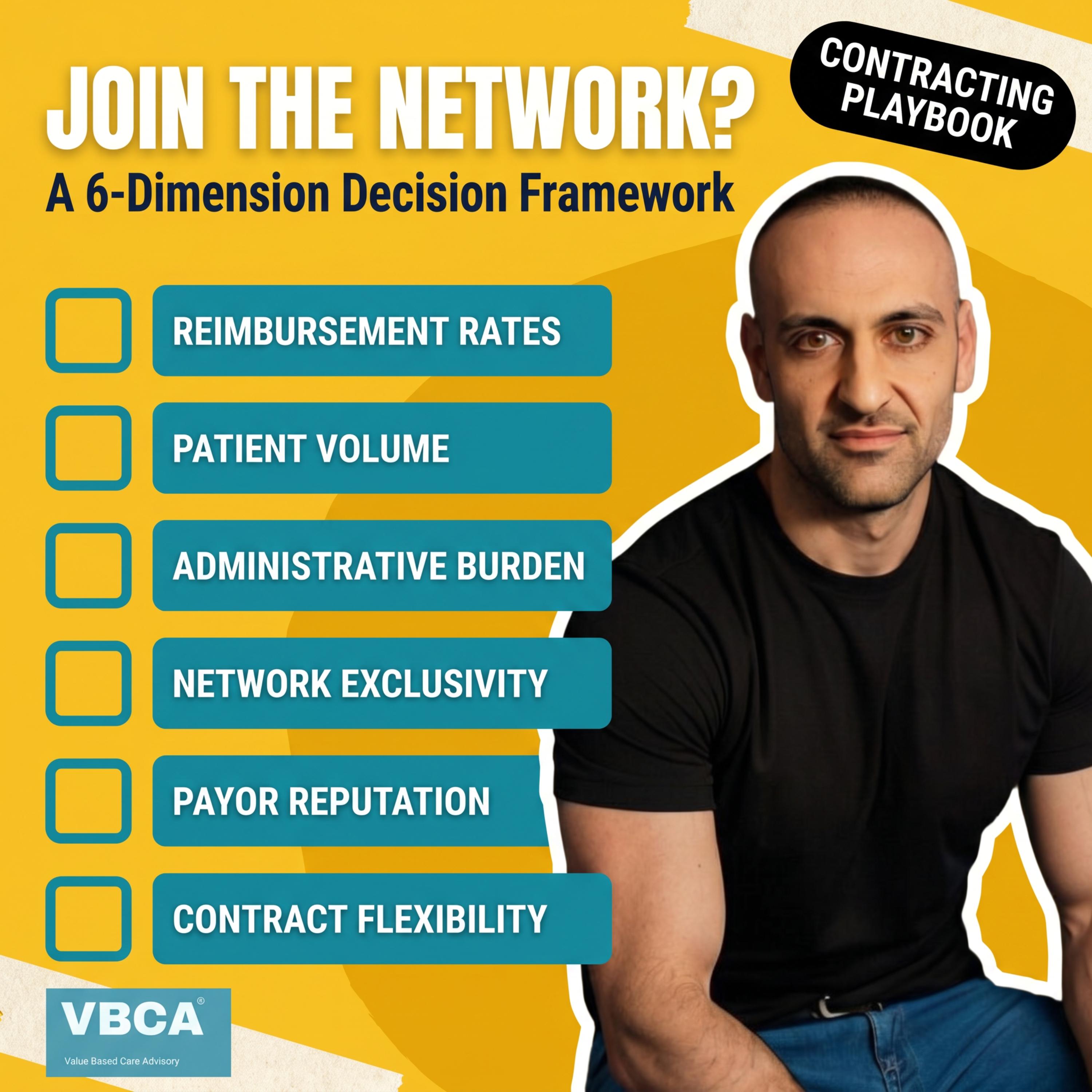 How to Decide to Contract with a Payer: Should You be Joining "the Network"?73 / 100
 LEAD Model: The ACO Test Most Organizations Will Fail - Before They Apply73 / 100
 The Definitive Playbook for Choosing Behavioral Health Markets78 / 100