
Value Based Care Advisory (VBCA) Podcast · 2025-11-26 · 9 min
Key moments - from our scoring
Substance score
39 / 100
Five dimensions, 20 points each
The conviction of telehealth founders for running a pill mill disguised as a telemedicine platform represents a watershed moment for digital health. The operation distributed over 40 million stimulant pills and generated $100M+ in revenue through aggressive DTC marketing, instant online visits, and automated refills - with zero clinical oversight or compliance infrastructure. Yarijanian argues this case will trigger cascading industry consequences: payers will demand real clinical governance and outcomes data before contracting, regulators will impose stricter prescribing oversight (especially for mid-level practitioners), and good actors investing in longitudinal care and measurement-based outcomes will gain competitive advantage as skeptical health plans retreat from bad actors. The core insight is that speed is not scale, volume is not value, and convenience is not care. For founders building in controlled substance categories - particularly behavioral health and opioid use disorder - the key takeaway is that sustainable models require clinical integrity embedded in organizational DNA from day one, not bolted on later.
The company used a hyper-aggressive direct-to-consumer pipeline with social media ads, instant online visits, easy prescriptions, and automated refills - with internal incentives focused solely on growing patient volume, stimulant prescriptions, and revenue while eliminating clinical oversight and compliance.
Payers will now demand stronger clinical governance, outcomes data, and value-based infrastructure before contracting; they will conduct more audits, increase prescribing oversight, and deprioritize companies without proven compliance and measurement-based care models.
Founders should build documented prescribing oversight processes (especially for mid-level practitioners), embed clinical governance into organizational DNA from day one, and be prepared to articulate safeguards to health plans - treating compliance as a core business requirement rather than an afterthought.
When clinical and business models are aligned around patient safety and total cost of care rather than volume and speed, incentives pull toward ethics instead of away from them, making shortcuts and fraud structurally difficult and unnecessary.
Our reviewer’s read on each dimension, with quotes from the episode.
The episode delivers several substantive takeaways for digital health operators - alignment of clinical and business incentives, anticipating payer scrutiny, building compliance into DNA - but these are partially obscured by repetition and motivational rhetoric. The core ideas are sound but not densely packed; much of the runtime is spent restating the same central principle rather than layering new operational insights.
Speed is not scale, volume is not value, Convenience is not care.
When you're accountable for total cost of care, patient safety, and outcomes, you really can't afford shortcuts.
The framing - that fraud cases create collateral damage for good actors and that clinical-business alignment matters - is sensible but well-trodden in healthcare discourse. The episode lacks fresh analytical angles, counterarguments, or first-principles examination of why incentive misalignment occurs structurally in digital health. The argument boils down to 'build ethically' without interrogating market forces or novel solutions.
The headline isn't a crime here, you guys. The headline is what this means for the future of digital health.
Value based care is the exact opposite of that. It's based on alignment, clinical integrity, patient safety, and financial accountability.
This is a solo monologue by the host with no guest interview. There is no external practitioner, operator, or expert brought in to provide direct experience or alternative perspective on the case or its implications.
Hey everyone. Welcome to the Value Based Care Advisory Podcast. I'm your host, Alex Yarijanian.
The episode references the Adderall fraud case with some specifics (40 million pills, $100M revenue, 20-year sentences) and mentions Straight Bro as a parallel, but provides almost no concrete data on payer contracting consequences, actual compliance requirements, or measurable outcomes from similar incidents. The prescriptive advice (more audits, prescribing oversight) is generic and lacks detail on implementation or evidence of effectiveness.
More than 40 million stimulant pills, over 100 million in revenue, and a business model built on speed, volume and zero clinical guardrails.
This happened when Straight Bro went down a couple years ago.
Without a guest, there is no conversation, follow-up questioning, or productive disagreement. The host delivers a prepared thesis with zero pushback, alternative viewpoints, or tactical specificity from someone with skin in the game. The monologue is hortatory rather than exploratory, repeatedly circling the same moral principle without digging into operational complexity.
So let this be a cautionary tale and let founders hold other founders accountable.
Right, because once an organization like this goes down, it becomes harder for all others to do business.
Computed from the transcript - who did the talking, and the words that came up most.
A federal jury has convicted the founders of Done, one of the fastest-growing telehealth companies in the stimulant-prescribing space, for orchestrating one of the largest Adderall distribution and fraud schemes in U.S. history. More than 40 million stimulant pills, over $100 million in revenue, and a business model engineered around speed, volume, and automated prescribing - all built with no real clinical guardrails. In this episode, host Alex Yarijanian breaks down not only what happened, but what this case means for the entire digital health ecosystem, especially behavioral health and companies prescribing controlled substances. When a company like Done collapses - and its founders now face up to 20 years in federal prison - it doesn’t just take itself down. It drags trust, access, and payer willingness down with it.
Transcribed and scored by The B2B Podcast Index.
Hey everyone. Welcome to the Value Based Care Advisory Podcast. I'm your host, Alex Yarijanian. Today I want to talk about a case that's going to really echo through digital health, payer contracting, and particularly behavioral health for some time to come.
This week a federal jury convicted the founders of a telehealth startup for orchestrating one of the largest Adderall distribution and fraud schemes in United States history. More than 40 million stimulant pills, over 100 million in revenue, and a business model built on speed, volume and zero clinical guardrails. The headline isn't a crime here, you guys. The headline is what this means for the future of digital health, especially for those of us building responsible value based models.
So here's what happened. A telehealth company built a hyper aggressive direct to consumer pipeline. I'm talking social ads, social media ads, instant online visits, easy prescriptions, automated refills. The internal incentives were simple.
Grow patient volume, grow stimulant prescriptions, grow revenue. And in that environment, quality collapsed. Clinical oversight collapsed. Compliance disappeared.
Federal prosecutors described it as a pill mill dressed up as a telemedicine platform. And now two telehealth founders are facing up to 20 years in federal prison. So let this be a cautionary tale and let founders hold other founders accountable. Right, because once an organization like this goes down, it becomes harder for all others to do business.
Because now you have to defend another organization's behavior and explain how it is not what we are doing at this organization. Value based care is the exact opposite of that. It's based on alignment, clinical integrity, patient safety, and financial accountability. So when a company breaks out alignments spectacularly, in this case, it affects the entire industry.
Payers tighten contracting, regulators impose restrictions. Good telehealth companies get pulled into the same spotlight as bad actors. If you're building anything in digital health, especially behavioral health, opioid use disorder, or anything with controlled substances, understand this. Speed is not scale, volume is not value, Convenience is not care.
At VBCA here, I talk a lot about the moral architecture of a healthcare business. You cannot build a sustainable clinical model on shortcuts. Let me tell you something, this case is going to have cascading effects throughout the industry. Okay?
This happened when Straight Bro went down a couple years ago. And more and more dominoes falling. The greater, greater difficulty for other telehealth companies to do business in this space. So being prepared is going to be important moving forward.
Being prepared in terms of what to do with your internal business operations, what to do when you're speaking with health plans and they ask you a question that's related here to either this case or how you would prevent something like this happening. Like I said this, this case is going to shape several aspects of the business moving forward. First and foremost, perceptions. It's going to essentially play a role in how health plans credential and contract with telehealth companies.
Some of the things I would say you should anticipate is more documentation, audits. I would expect more prescribing oversight, especially if you're using mid level practitioners, have a process in place that you can articulate. Because 20 years in prison simply not worth it, right? Simply not worth it.
And if you play your cards right, you have nothing to be concerned about. Sure, your issues might scale along with your organization, but if you build the right safeguards into the DNA of the organization versus those that have been convicted in this case, which they build the wrong incentives with the DNA of the organization, what you seed now will scale in accordance with your intention and your incentives. If your main incentive is to become a multimillionaire, then consider finance or another industry because now really it's going to become more and more restrictive, tell all it's going to get more and more scrutiny.
So that's really not the spotlight you want to be under. And of course all of this causes an issue, meaning less and less access for telehealth companies seeking to do business with health plans and less and less access for patients to actually benefit from these telehealth companies. There are plenty of good telehealth companies and only a handful of bad actors. But payers are tired.
Payers are tired of being burned. They're tired. I speak with many plan executives, they embrace telehealth now they're going to be looking for platforms with real clinical governance, real outcomes data and real value based infrastructure. This actually benefits the good actors because the company's investing in longitudinal care, measurement based outcomes, behavioral integration and compliance are going to be growing.
Okay, now what is the future? The future of digital health will be built on trust. And trust is only possible when your clinical model and your business model are aligned. They're not in opposition, they're not fighting one another.
This is why value based care matters, because you have that compass. You have the North Star of asking a single question is what I'm doing at this moment in the best interest of the patients and the answer should be a yes or no. There's really no in between. And you would immediately and instinctively know, right?
By posing that question is this in the best interest of patients. You would know whether you're on the right track. You would know whether you're drifting away from value. When you're accountable for total cost of care, patient safety, and outcomes, you really can't afford shortcuts.
Your incentives pull you towards ethics, not away from them. Here's my message today. If you're a founder, build your company like you're already under an audit. If you're a payer, demand clinical governance before you demand scale.
If you're a provider, never let a business model erode your judgment as an organization. And if you're a patient, understand that real care has structure, boundaries, and integrity. This particular case will be studied in business schools, medical schools, and compliance trainings for years. But if we're smart, it will also become a turning point where digital health finally shifts from.
From speed to substance, from value to volume. And I would really want to echo that. There is an important distinction between business reality and clinical reality. And as long as these two are misaligned, the organization's on a bad track.
So as long as there are efforts to align these two, then the organization will continue to not only survive, but thrive as other organizations are found to either be no longer good partners to do business with, or found in some federal indictment and subsequent conviction and so forth, like this particular case. So let this be a cautionary tale and let founders hold other founders accountable. Right, because once an organization like this goes down, it becomes harder for all others to do business because now you have to defend another organization's behavior and explain how it is not what we are doing at this organization.
Thank you for listening. This is Alex from the Value Based Care Advisory podcast. Thank you.
 The Ghost Network Behind Pediatric Home Nursing: When Authorized Hours Go Unfilled100 / 100
 Your Billing Problem Started in the Contract84 / 100
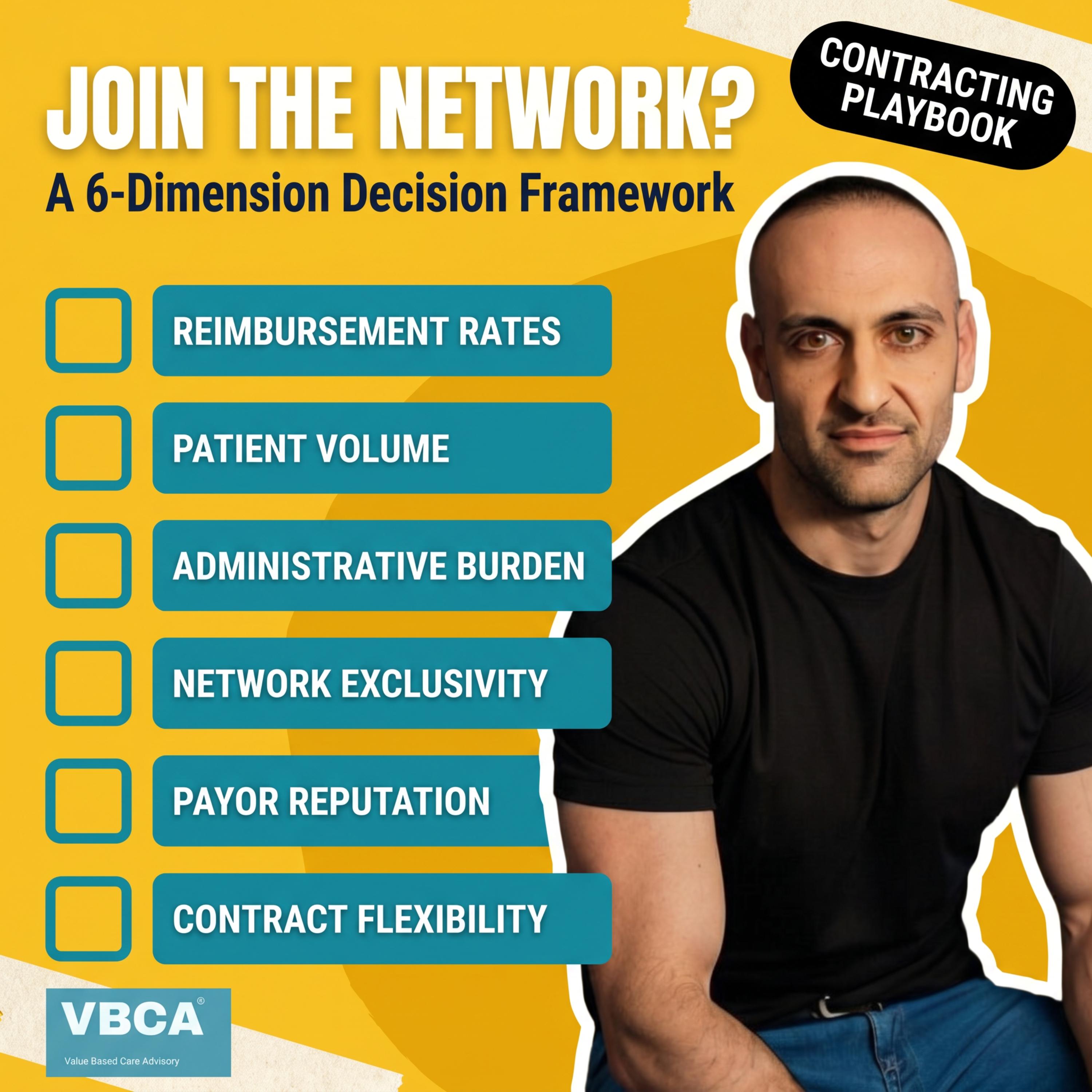 How to Decide to Contract with a Payer: Should You be Joining "the Network"?73 / 100
 LEAD Model: The ACO Test Most Organizations Will Fail - Before They Apply73 / 100
 The Definitive Playbook for Choosing Behavioral Health Markets78 / 100