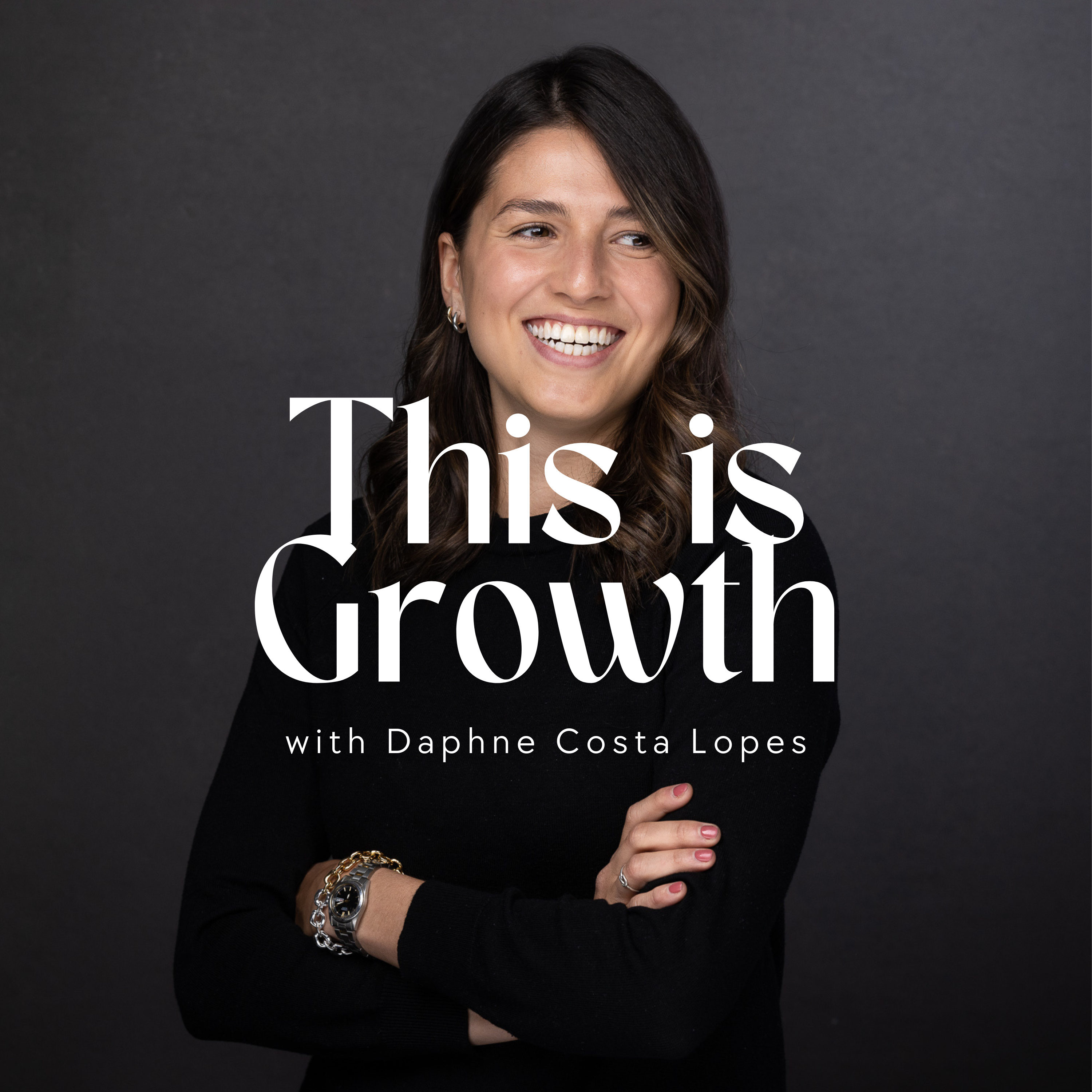
Hosted by Daphne Lopes
Listed under Business › Management
In this podcast, we help you build and scale your SaaS business using customer-led growth strategies. Here you're going to learn how to transform Customer Success into the second growth engine of your business. We talk to the experts and the do-leaders.
42 episodes · publishes monthly · latest 2026-07-29 · ~44 min/episode
Rank
#113
Substance
80.0
/ 100
Breakdown
Scored 2026-08
Updated monthly
Across the index
#113 of 1878
Substance
Top 6%
outscores 94% of the index
This is Growth! ranks #113 on The B2B Podcast Index with a substance score of 80.0 out of 100, scored across 2 recent episodes. It scores highest on guest caliber and insight density. Jim Richmond's credentials are exceptionally strong: 25 years in enterprise SaaS, founding a Y Combinator-backed company, five executive roles including CCO at a scaling company, and hands-on experience at the exact revenue inflection points (50 - 250M) where CS org design matters most. He has operated at significant scale and brings pattern recognition across multiple contexts. This is a practitioner, not a theorist.
Averaged across 2 recently scored episodes, with cited evidence.
The episode contains solid, actionable insights grounded in real experience - particularly around repositioning services as value (not add-ons), operational discipline at scale, and the shift from entry-level work to AI-augmented roles. However, significant portions drift into soft reflections on company culture, personal motivation, and philosophy that don't materially advance a B2B operator's knowledge. The bicycle analogy for AI is instructive but lightly developed.
“the pivot that the company was making from like scrappy startup where we'll do anything to make our customers successful, which is such a great energy...but that ultimately leads to things not being done maybe the way that they should”
“operational discipline. There's no substitute for it, and you have to have it in order to scale profitably over time”
The core arguments - value hierarchy varies by customer persona, services must be sold upfront, operational rigor enables scaling, AI is a tool not a panacea - are sound and well-reasoned, but they're well-worn frameworks in SaaS. The guest does not challenge conventional wisdom on retention, pricing, or go-to-market motion in ways that would surprise informed operators. The Medallia repositioning story is concrete but not contrarian.
“clients don't want to buy software, they want to solve problems”
“the primary way you could deliver value as a translator was through human labor. Uh, and that relationship has completely changed now with the advent of technology”
Jim Richmond's credentials are exceptionally strong: 25 years in enterprise SaaS, founding a Y Combinator-backed company, five executive roles including CCO at a scaling company, and hands-on experience at the exact revenue inflection points (50 - 250M) where CS org design matters most. He has operated at significant scale and brings pattern recognition across multiple contexts. This is a practitioner, not a theorist.
“I've been in enterprise software for the better part of 25 years”
“the places I've been most successful have been at, ah, SaaS, companies that were trying to get from maybe $50 million of revenue to $250 million in revenue”
The episode includes some specific examples (Medallia, Sprinklr, Smartling; four ICPs; 90-minute QBR windows; 70-vendor Martech stacks; 50%+ of HubSpot support tickets solved by AI), but many claims lack numbers or timelines. The gross retention improvement at Sprinklr is mentioned but not quantified with actual percentages or timeframe. The cost reduction at Medallia is discussed conceptually rather than with concrete metrics (% reduction, headcount changes, dollar impact). The title promises 70% cost cuts without layoffs but the transcript never substantiates that figure.
“our customers at Smartling is this idea of empathy, of putting ourselves in their shoes and more specifically making them the hero of the story”
“Smartling is a company, we're an AI company that makes uh, high quality translations available to uh, anybody at the right balance of cost and quality and speed”
The host (Daphne) asks thoughtful open-ended questions and demonstrates genuine engagement (e.g., asking about the Medallia cost story, pressing on value metrics, probing the career path question under AI). However, follow-ups are often soft and accept Richmond's framings without pushback. When he discusses the 70% cost reduction, the host doesn't ask for hard numbers or timelines. The conversation lacks productive disagreement or challenges that would pressure the guest to sharpen or defend claims.
“Can you tell us the story of that? Because I think the listeners will be very, very interested”
“is there a framework that you use, um, to really think about translating AI capability into what business outcome it drives?”
2 periods tracked.
2 scored on substance · 42 tracked in total.
Add this badge to your site - it links back here and updates automatically as you rank.

<a href="https://index.fame.so/show/this-is-growth" target="_blank" rel="noopener">
  <img src="https://index.fame.so/badge/this-is-growth/badge.svg" alt="Ranked #10 on The B2B Podcast Index" width="360" height="136" />
</a>Track This is Growth!'s rank
Get an email whenever this show moves up or down the Index. Monthly at most, no spam.
Companies, products and tools that come up most across this show's episodes.
The themes that come up most across this show's episodes.
Podcasts that dig into the same topics.