The So What from BCG · 2026-06-03 · 23 min
Key moments - from our scoring
Substance score
53 / 100
Five dimensions, 20 points each
Greg Emerson, who leads technology and AI investing for BCG Globally, challenges the prevailing narrative of AI-driven mass unemployment by arguing that AI exhibits "jagged intelligence" - excelling at specific tasks while remaining incapable at others - making it fundamentally complementary to human workers rather than a replacement. Drawing from BCG research evaluating 1,500 distinct job roles and hundreds of thousands of tasks, Emerson contends that AI will reshape three to four times more jobs than it replaces. He attributes job-loss headlines partly to science fiction narratives, media sensationalism, and some AI industry leaders amplifying concerns while raising capital. Recent tech sector layoffs, he argues, largely stem from 2020s over-hiring during low interest rates and high growth expectations - conditions that reversed before ChatGPT's emergence. For software engineers, lawyers, and sales professionals, the pattern is clear: the most skilled practitioners work harder and more productively with AI, while AI companies continue aggressive hiring rather than cutting roles. The real risk to workers isn't automation but resistance to adopting AI tools; business leaders, meanwhile, must move beyond simple tool deployment to fundamental organizational restructuring - changing team ratios, removing bottlenecks, and resetting expectations - to unlock AI's value.
BCG evaluated 1,500 job roles and hundreds of thousands of tasks and found that AI will reshape three to four times more jobs than it will replace, with very few roles eliminated entirely because demand for their output is fixed.
The best software engineers are 4x more productive but work 40% more because AI handles coding but not the broader responsibilities - system design, security, customer needs, and directing the AI on what to build - which remain human-led.
Deploy means giving workers AI tools and training, which drives minimal P&L impact; reshape means fundamentally restructuring teams, ratios, bottlenecks, compensation, and expectations to actually capture AI's productivity gains.
Emerson argues many layoffs stem from over-hiring during COVID when interest rates were low and growth was strong; those conditions reversed before ChatGPT, so layoffs that would have happened anyway are now being attributed to AI as a better story for Wall Street.
Leaders must lead with optimism - positioning AI as a driver of growth and human amplification rather than team elimination - because contradicting doom narratives with tool deployment won't convince resistant employees further down the organization.
Our reviewer’s read on each dimension, with quotes from the episode.
There are genuinely useful analytical frames - the COVID/interest-rate reframe for tech layoffs, the reshape-vs-substitute distinction across 1,500 job roles, and the software-engineer productivity paradox - but the episode is padded with well-worn takes on augmentation and carries a promotional feel for a BCG report, diluting the signal.
during COVID due to a really strong demand for digital products as well as low interest rates...there was lots and lots and lots of hiring and there was hiring with the expectation that both the growth environment and the interest rate environment would maintain. And neither of those have Maintained
we evaluated 1500 distinct job roles, hundreds of thousands of tasks being done by those roles, in order to consider them across those dimensions
The reframing of tech layoffs as macro-driven rather than AI-driven is a genuinely useful contrarian point, and the 'reshape vs. deploy' distinction adds some fresh vocabulary, but the core thesis (AI augments rather than replaces) is the dominant counternarrative in mainstream business press and hardly provocative.
It's a better story to tell, um, Wall Street
I've adopted a peloton. I'm still fat. Right? Like, it doesn't actually get that, like you have to actually change your routines
Greg Emerson is a senior BCG global practice lead with direct CEO client access and proprietary research behind him - meaningfully above a pure thought-leader - but he is a consultant/investor rather than an operator who has personally scaled a company through AI transformation, which limits the practitioner depth.
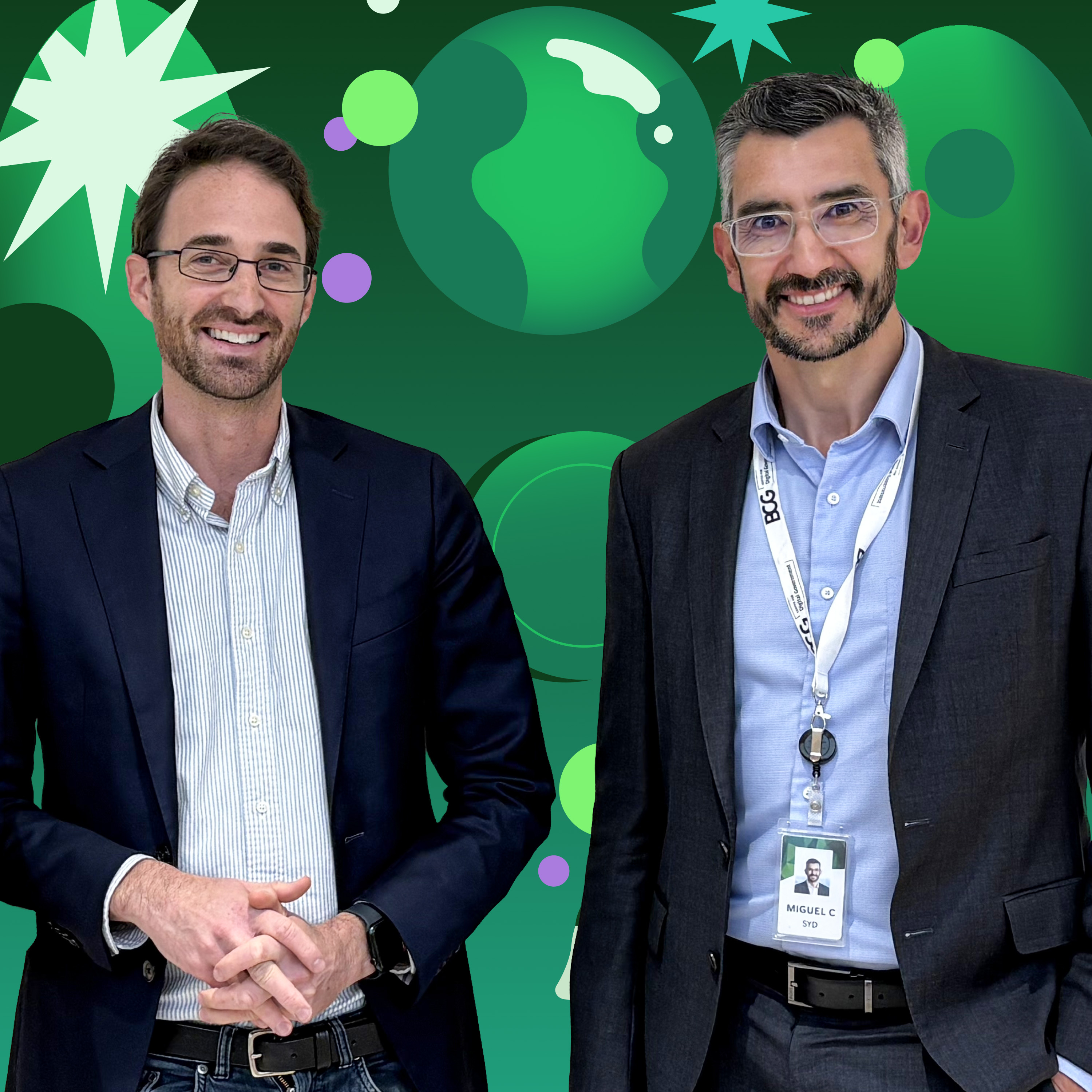
Greg Emerson, who leads technology and AI investing for BCG Globally
I've had conversations with multiple CEOs who said, yeah, I mean, I've had to fire those individuals that didn't get with the program
A handful of concrete anchors exist - 1,500 job roles studied, the MIT '95% of AI initiatives' figure, a '4x productive but 40% more hours' data point for engineers - but the episode lacks named companies (beyond Nvidia for a quote), dollar figures, and methodological transparency on how the 3-4x reshape ratio was derived.
they're four times as productive but working 40% more
there was study published about a year ago by MIT with the headline 95% of AI initiatives and businesses are not driving ROA
The host constructs a logical arc of follow-ups and makes one credible push ('inevitably there will be job losses') but never substantively challenges the guest's optimistic framing, lets the BCG promotional context go unexamined, and consistently accepts assertions without pressing for evidence or counterexamples.
Inevitably there will be job losses. If we're all working more, even that sort of reshaping will mean there will be jobs that, that go.
I'm guessing that the biggest risk then to workers...is if you don't embrace AI, it probably will take your job.
Computed from the transcript - who did the talking, and the words that came up most.
AI isn’t replacing jobs the way headlines suggest, but it is changing who keeps them. Greg Emerson, BCG’s global leader of technology and AI investing, explains why AI will reshape three to four times more jobs than it replaces. He argues that fears of mass unemployment are overblown and the real challenge for leaders is redesigning roles, workflows, and mindsets. You’ll Learn: The real risk: workers who don’t adopt AI will be replaced by those who do. How top performers will get more work, not less. Why leaders must move beyond tool adoption and fully reshape how work gets done. Learn More: Greg Emerson: AI Will Reshape More Jobs Than It Replaces: BCG’s Latest Thinking on AI: Latest Thinking from the BCG Institute: Watch The So What on YouTube: Chapters (0:00) AI Panic vs Reality (1:01) Is AI Replacement Imminent? (2:14) Where Are the Mass Unemployment Headlines Coming From? (4:28) Are AI Layoffs Really About AI?
Transcribed and scored by The B2B Podcast Index.
Greg Emerson: I believe a lot of the AI doomerism when it comes to jobs, unemployment and the economy is just dead wrong. AI will reshape far, far more jobs than it's going to replace some jobs that will go away and that will be very meaningful for those individuals. But the reality is that AI is primarily a tool for augmenting and amplifying human, human capabilities.
Georgie Frost: Welcome to the so what from bcg, the podcast that explores the big ideas shaping business, the economy and society. I'm Georgie Frost. Now, if you believe the headlines, artificial intelligence is coming for your job. Entire roles, even industries, will be wiped out. But step away from the noise and the picture becomes more complicated. What if AI isn't primarily about replacing jobs, but completely reshaping them? Well, joining me today is Greg Emerson, who leads technology and AI investing for BCG Globally. Greg, welcome. Greg. If you read the headlines, at the moment, it's all about AI, job losses, mass unemployment. But your research tells a rather different story. What's the reality?
Greg Emerson: So the reality is that AI models are incredibly powerful, incredibly capable and are going to change the world, and also, at least where they stand today, are not capable of doing many things, many things that humans are capable of. The term a lot of people use is the idea of jagged intelligence. Jagged intelligence means there are certain things that they are truly, truly world class and exceptional at and other things that I would, you know, trust many people before I trust an AI, an AI to do. The reality of that jagged intelligence is it makes it highly complimentary to people. A person working with the AI, interacting with the AI, pulling the best of the AI, uh, capabilities from the AI, but still bringing in human judgment, human expertise, human know how that, I believe is going to be the way of the future and precisely why I believe we're not going to see this sort of mass unemployment.
Georgie Frost: So I have to ask though, where are the headlines coming from? Why are people saying it? Why are we making that leap from AI can do some tasks better than us and well, and AI will completely take all our jobs or is currently taking all our jobs as we're seeing a lot of headlines suggest?
Greg Emerson: I think there's a few areas. First of all, we all grew up on science fiction, science fiction books, science fiction movies, and, and, and, and this idea that artificial intelligence is achievable. And at some point there became kind of a leap in the media headlines that this particular form of AI, which is one of many different forms of AI, of the, of the large language model, this is the thing that's going to replace human intelligence. And so it's been very easy for the media and industry leaders to pick up this narrative of this is it. We found it. It's just a matter of time. And the reality is some of the leaders in the AI industry have also fanned the flames with some of the comments they've made, um, often while they're raising capital in order to, um, kind of push this, this sort of narrative. But what I will say is looking at the very best models that exist today and what they are and they aren't capable of, it's very clear to me that that's not where we sit today. And then I would say further, there is no real consensus among the best AI researchers and thinkers in the world as to whether this path we're on with LLMs is actually going to reach human intelligence. It might happen. It's a distinct possibility, but it's certainly not an inevitability. One of the things about AI is, is it'll kind of do whatever you ask it to do, but that doesn't mean it will do it well. And it lacks the self awareness to tell you, you actually shouldn't be asking me to do this. Like I can't give you a good answer. Uh, junior consultant at BCG will tell me, I don't know how to answer that question. Like I, the AI won't do that. And so this is, I think the other side of it is, yes, you've got to embrace AI and get your employees to use it, but you've also got to use it in the right way. You're actually going to see your outcomes go down.
Georgie Frost: And what about the job losses that we've already seen recently, particularly in the tech sector?
Greg Emerson: There's been a series of material layoffs announced over the course of the last few months that have been attributable to AI. Um, I don't have any inside knowledge about what's happening in these cases, but I will share a few general observations. The reality is we've been seeing, uh, layoffs happen in the technology industry for several years now before ChatGPT. And there was a phenomenon that has happened in the technology industry over the course of the last six years, which was that during COVID uh, uh, during COVID due to a really strong demand for digital products as well as low interest rates. Low interest rates are really good for the technology industry. There was lots and lots and lots of hiring and there was hiring with the expectation that both the growth environment and the interest rate environment would maintain. And neither of those have Maintained interest rates have gone up, growth has gone down. And so that has led to a series of layoffs in the tech industry, really starting in early 2022, before ChatGPT was even a thing. Now the narrative around those layoffs has switched markedly in the last 12 months, where suddenly those layoffs have started to be attributable to AI. It's entirely possible that some of these tech leaders have found some sort of secret sauce to substitute their workers for with AI that others haven't found. I think it is also quite plausible that these are reductions that would have happened anyway for the reasons that I described that are now being attributed to AI. Because it's a better story to tell, um, Wall Street. Finally, one other point I'll make. There are a small number of tech companies. They're a small number, but they're very large in their size. And the number of people they employ that are participating in hyperscale, meaning they are not just using AI, they are building AI and they're building the underlying digital infrastructure required to provide AI. Now as many people know, that digital infrastructure is expensive. It is capex and cash flow intensive to build that out. So we are also seeing a small number of examples of technology companies say we're going to deprioritize this business unit, we're going to deprioritize this function, we're going to deprioritize this product and push that capital towards AI buildout. And that is a case of basically, you know, uh, uh, eliminating what roles? Eliminating people and putting that money towards AI. But it's a very specific use case to a small number of companies focused on building out that digital infrastructure. So I'd be very cautious in, uh, applying or extrapolating that to the broader tech industry.
Georgie Frost: So let's dig more into your findings. You say that AI will reshape three to four times more jobs than it will replace. Firstly, how did you come about those sorts of figures? When we talk about reshaping, what exactly do you mean? What changes? I suppose day to day we thought
Greg Emerson: about two different dimensions. When we think about the future of AI and work, the first dimension is one that's actually been very well covered by, um, a lot of different research institutions, which is thinking about whether AI is augmenting a job or substituting for that job. And put in its simple form, what we mean by augmentation is whether a human needs to interact with AI to achieve the outcome the job is trying to achieve. The second dimension we looked at, if a human is twice as productive. If a human is able to create twice as much output, does that mean we need half as many humans, or does that mean we just benefit from twice as much output? For example, we can talk more about software engineers. That is the cost to produce a line of code or a piece of software goes down as engineers become more productive. We actually need more engineers because it just means we get to have more great software and digital products. So, uh, those are the dimensions we really looked at. And we evaluated 1500 distinct job roles, hundreds of thousands of tasks being done by those roles, in order to consider them across those dimensions. And what we found is that there were very few jobs that sit in that, call it, that quadrant of AI can really fully do this job end to end, and the demand for that output is fixed. There's not any sort of expandability of the demand for those outputs. And those are the, uh, really the only jobs where we see potential for substitution. Everywhere else we see this as being a job that needs to be reshaped, right? A job where you need to use the AI to produce more, but that doesn't mean the job goes away.
Georgie Frost: You mentioned software engineers earlier. I'm just curious what all of this will look like in jobs like software engineering or law or sales. Can you give me a practical example?
Greg Emerson: So let's talk a little bit about what's actually happening in software engineering today. There's a few observations I would share with you. The first is that the very best software engineers in the world will tell you they are busier today than they've ever been in their life. They're working more and they're working harder. That doesn't actually sound like the AI is doing their job for them. If the AI was doing their job for them, you would think they would be working less. That seems kind of simple and intuitive. And it's the sort of thing where they're four times as productive but working 40% more. So actually that increase in work is driving a massive increase in productivity. So that's the first observation. The second observation I'd make is that if you look at where on a relative basis, hiring for software engineering is fastest, it's with AI companies, it's with the AI, not just the model companies, but all of these AI application companies are, uh, hiring software engineers like crazy. And you would think, well, these would be the companies that really figure out how to use AI and software engineering, yet they're all hiring software engineers. So those to me are two really interesting anecdotes or fact points. And so Then you ask yourself, well, why is this? And the reality is actually very simple. AI is excellent at coding. It is not all that software engineers do. Software engineers still need to think about how does the code that's produced plug into the overall system? Is the code being written, um, secure? Is it going to break some piece in the system? Is the product being generated, the piece of software being generated? The sort of piece of software that a customer is going to want to use? There's, there's a bunch of other things that the software engineer needs to do that interact with that code. Uh, most fundamentally, the software engineer needs to tell the AI what to do, right? Like tell the, what to go build. And the second point is I go back to this idea of the expandability and demand. We can always have more code, we can always have more applications, we can always, frankly, have better software. I think all of us who've interacted with software day to day would love that software to work better and work better for our needs. And so you combine these sorts of characteristics of this makes humans more productive in a field where there's lots of appetite for the output of what they produce. But humans remained essential in producing that output. And that's why we're going to continue to see growth in the software engineering category. I think that's a bellwether for a lot of different jobs out there. The moment that I start to see AI labs lay off all their software engineers, I will change my position on this. I will change my position on this. But I'm not worried about that happening in the near term.
Georgie Frost: Inevitably there will be job losses. If we're all working more, even that sort of reshaping will mean there will be jobs that, that go.
Greg Emerson: Yes, uh, absolutely. And we should talk more about this. I do want to draw a distinction between job losses that come from the elimination of a role because there's no longer a need for that role, versus job losses that come because leadership decided to replace one person with a different person. And I actually think we're going to see, and we're already seeing a lot of the latter. And what's specifically happening, and this is definitely happening in the software engineering world today, is that you have software engineers. And I could apply this to sales, I could apply this to law, I could apply this to any field, um, that are, that are, that are learning how to use AI, are gaining that productivity, are getting much more done. And you also have those that are resisting it. And they're resisting it for various reasons. Some of those are just, they're they're busy, they don't want to pick it up. Some of those are emotional. I mean, the whole media narrative around, um, this is the end of software engineering certainly doesn't help encourage people to use these tools. But I've had conversations with multiple CEOs who said, yeah, I mean, I've had to fire those individuals that didn't get with the program in terms of using AI to be more productive. But I didn't eliminate the roles. I brought in new individuals to replace them. So that is going to be a real source of job loss for individuals. And that it is attributable to AI, but I also think is not an inevitability for that individual. You know, part of the message to me is for workers of like, how do you embrace AI as a driver of individual job security?
Georgie Frost: Look, you're an expert in this space. Do you still meet with a fair degree of resistance to using AI tools
Greg Emerson: in the boardroom in the C suite? Everyone, of course, pro AI, driven by a talking about AI. But as you go further down into the organization to more individuals that feel that their job is being threatened by AI, that's where you see what I describe as soft resistance. It's not, they're not loud about it, they're not noisy about it, they're not public about it, but it is, it is very real and very challenging. And this is, I actually think, one of the big. And sometimes it takes the form of explicitly not engaging with the AI, but oftentimes it just takes the form of not really embracing it to its fullest potential. The reality is there is this perception, this incorrect perception that, you know, you're training it to do your job for you versus you're using it as an amplifier of your capability. And I think it's going to be very hard for CEOs to reshape their organizations when big swaths of their teams are resistant.
Georgie Frost: I'm guessing that the biggest risk then to workers, and we'll talk about business leaders in a minute, but to workers specifically, is if you don't embrace AI, it probably will take your job.
Greg Emerson: Yeah, I mean, Jensen Huang, CEO of Nvidia, said this a year ago. Right, um, uh, AI won't take your job. A person with AI will take your job. And I think it was a very, it was a very prescient statement when he made it. And it has, it is. I am seeing that play out in discussions with my clients as they think about talent, workforce planning. Now, again, there will be a portion of jobs that are eliminated entirely. And it is meaningful and it'll be meaning for those individuals. And, and uh, I'm very optimistic that new types of jobs will be created that will create opportunities for those individuals. But, uh, again, uh, for the far more individuals, what's going to matter here is learning to use AI so that you can do more and so you can not just keep your job, but actually elevate in your performance, your compensation, everything, because you're getting more done with that AI.
Georgie Frost: What about for business leaders? How does all of this change the picture for them?
Greg Emerson: So, so I think that this is the heart of why so many businesses have struggled to date with getting an ROI from AI. There, there, there was this, um, story published about a year ago or study published about a year ago by MIT with the headline 95% of AI initiatives and businesses are not driving ROA. And it got a ton of press and a ton of coverage. And there were some challenges with that study methodologically. But actually the headline of lots of enterprises are struggling with ROI from AI remains true. And I believe a lot of it has to do with this reshape versus substitute dynamic. So let me just be very clear. If, uh, all you had to do was take a bunch of digital AI workers, fire a bunch of your teams, replace them with the AI workers, and the AI workers picked up the job and got it and did what they were told like, and cost, you know, worked 24, 7 and didn't complain and cost 25%. Like, we would not be seeing this struggle that enterprise after enterprise admits of being able to deliver. It's not a binary dimension. It's not as simple as either we're using AI or we're not using AI. It's how we're using AI. It's what we've stopped doing. It's what we've started doing. It's how we've changed team structures and reporting structures. It's how we've changed compensation incentives, expectation. And in all of these dimensions, most of us, most business leaders still don't even know what good looks like. They don't know what full potential looks like. The historical benchmarks and references we have aren't relevant to the future. And so all of this actually makes getting this reshape exercise really hard.
Georgie Frost: So what then should organizations be doing? Because this isn't just about getting your workers, giving them some AI tools, training them up.
Greg Emerson: Yeah. Yes. And within bcg, you kind of teed this up. We talk about the notion of deploy versus reshape. And deploy is exactly what you've described, which is we've gotten everyone to adopt their technology and um, and, and, and giving them some training on it. And we found again and again that that drives 00p and l impact. Right? Adoption doesn't work. I always say, um, I've adopted a peloton. I'm still fat. Right? Like, it doesn't actually get that, like you have to actually change your routines and your exercises if you want to get fitter and lose weight. What matters is, is exactly what you're saying. There's change in organizational structure. You're talking about an engineering organization. What is the ratio of engineers to product managers to designers? That's optimal. What is our expectation of the amount of product the engineers ship? How do we remove other bottlenecks in the process? Okay, well, we've, we've increased the velocity of our engineering team, but we have a, you know, a compliance division that has to review any product that goes in front of the client that's currently bottlenecking actual release of products. So these are, enterprises are complicated and really getting the full value of it actually involves tackling many of these sorts of things. Now we're of the view, I'm of the view that um, you can't do it all at once. You've got to think use case by use case, where you think there's going to be really strong value from that, from that AI to drive results. Um, but you know, that's a whole other conversation around how to actually go and tackle this within the enterprise.
Georgie Frost: So if you're a CEO, uh, or a leader listening to this right now, Greg, what's the biggest mindset shift you think they need to make?
Greg Emerson: Leading with optimism. So I'm serious, like it is, you cannot go to the press and say 50% of white collar workers are going to have, you know, are going to be unemployed in four years and then turn around to your team and say, hey, here's a bunch of AI tools. I need you to change the way you work to use them. Right? You need to, you need to one believe that this is going to be a driver, first and foremost of growth, of being able to build better, sell better, serve your and delight your customers better. Right? That this is, this is a driver of, of growth and that the demand for what you're doing as a business is not fixed. You need to believe that this is a driver of amplifying your team rather than a driver of eliminating your team. And that message of optimism, optimism around humanity and around the future role that humans play. In driving value for business is, I think, the single most important mindset shift. If you want, particularly as you go further down in the organization, the employees, to really embrace this.
Georgie Frost: Greg, thank you so much. And to you for listening. If you'd like to read Greg's latest report, AI will reshape more jobs than it replaces. You can find the link in the show notes.
Other episodes covering the same guests and topics, from across The B2B Podcast Index.
 Radiology Can't Keep Up. Here's Where AI Actually Helps | Dr. Nina KottlerRethink Imaging · on Large language models96 / 100
 Episode 029 AI and the Rise of the Superpowered SoloAI Tools for Practicing Lawyers · on ChatGPT88 / 100
 Wins Above Replacement: The New Way to Judge FoundersVenture Unlocked · on ChatGPT88 / 100
 Paul Graham On Startups, Ambition, and Great FoundersY Combinator Startup Podcast · on ChatGPT88 / 100
 The AI-Native Law Firm, with Ryan Walker of General LegalMeeting of the Minds · on ChatGPT88 / 100
 #63 - The Fool: David Gardner explains his philosophy of buying stocks at high valuations after they have gone up a lotBehind the Balance Sheet · on Nvidia87 / 100