The So What from BCG · 2026-05-20 · 17 min
Key moments - from our scoring
Substance score
48 / 100
Five dimensions, 20 points each
Dr. Nicholas Lang of the BCG Henderson Institute challenges the conventional approach to strategic planning in volatile times. Rather than predicting a single future or abandoning planning altogether, Lang advocates for scenario-based planning across four plausible futures quantified along 20 key performance indicators spanning economic, geopolitical, societal, health, and environmental dimensions. The report projects outcomes to 2050, grounding projections in 175 years of historical data to avoid speculative extremes. Lang identifies four scenarios - AI Abundance (productive, three to four-day work weeks), Battling Blocks (fragmented, militarized world), Climate Coalition (green, regulated economy), and Digital Darwinism (unequal, tech-elite dominated) - each with concrete projections on GDP growth, working hours, and defense spending. The analysis debunks headlines claiming AI will multiply GDP tenfold or eliminate work entirely, anchoring forecasts in historical precedent: global GDP growth has peaked at 4.7%, and the AI Abundance scenario projects a three to four-day work week, not zero-hour employment. Lang provides CEOs with actionable resilience strategies: diversified supply chains, talent development, strategic technology sourcing, and regional organizational structures for fragmented futures.
The four scenarios are AI Abundance (tech-dominant, productive world with reduced work weeks), Battling Blocks (fragmented world with separate tech stacks and high military spending), Climate Coalition (green world with climate controls and wealth redistribution), and Digital Darwinism (unequal world where innovation benefits only an elite).
Planning for a single future leaves organizations vulnerable to unpredicted shocks like pandemics, conflicts, or tariffs. Scenario planning across multiple plausible futures allows leaders to develop strategies resilient to different outcomes and prepare operations for different base cases, optimistic cases, and negative cases.
The report traces 20 key performance indicators back 175 years to 1850 to ground projections in historical evolution. For example, global GDP growth has never exceeded 4.7% annually, and current worldwide working hours average 2,100 per year (1,500 in Europe, 1,800 in the US).
Key moves include practicing scenario planning to develop strategic foresight skills, building supply chain resilience through diversified factories and multiple suppliers, preparing talent for AI-augmented roles with purpose and support, strategically sourcing technology rather than relying on freely available tech, and establishing regional headquarters to handle potential fragmentation.
The four main scenarios have high double-digit probability, while Black Swan events like AI singularity, space wars, or nuclear fusion breakthroughs have low single-digit probability. Leaders should focus strategy on the four plausible futures but can stress-test their organization against extreme scenarios separately.
Our reviewer’s read on each dimension, with quotes from the episode.
The episode contains a handful of genuinely useful data anchors that puncture AI hype, but the bulk of the runtime is high-level scenario description and generic operational advice (diversify suppliers, build regional HQs) that most senior operators already know. The ratio of novel insight to explanatory padding is moderate.
the highest GDP growth we had was 4.7% in the early 1970s
when electricity was introduced in the early 20th century, GDP growth worldwide went from 1% to 2%
The core idea - plan for multiple scenarios not one - is decades-old scenario-planning orthodoxy, and the four scenario archetypes (tech utopia, geopolitical fragmentation, green transition, tech inequality) are standard consulting taxonomy. The originality comes almost entirely from using historical data to debunk AI productivity headlines, which is a genuinely useful move but not a novel framework.
scenarios are always precisely wrong, but generally right
AI will allow us to multiply GDP by 10x or more in a, I don't know, decade or two. Now when you look back at history, you see that actually GDP has never grown more than 5%
Nicholas Lang is a senior figure at BCG's research arm, but this is fundamentally a consulting think-tank leader presenting his firm's own report, not an operator who has run a business through uncertainty at scale. The episode doubles as a BCG marketing vehicle, which limits the candour and practitioner depth a true operator guest would bring.
I'm Nicholas Lang, global leader of the BCG Henderson Institute
together with my team, we really spent time on saying, can we describe the scenarios not only in a qualitative verbal way, but can we quantify it
The episode is notably stronger than average on concrete historical statistics - specific GDP growth ceilings, working-hour baselines by region, and defence-spend ranges anchored to real historical peaks - and the 2050 GDP range (1.4x to 3-4x) gives a quantified spread. However, the scenario KPIs are described but never actually shown, and the operational recommendations remain abstract.
The highest GDP growth we had was 4.7% in the early 1970s
Europeans are at the lowest part of this, which about 1,500 hours. US is at 1,800 hours
The host asks chronologically logical questions and lands one genuine push - querying whether a 25-year horizon is relevant to a CEO with a 3-year tenure - but otherwise accepts every answer without follow-up, never presses for specifics on the KPI selection methodology, and allows the 'no regret moves' section to remain entirely generic. The interview functions closer to a guided press release than a probing conversation.
CEO tenure is about 3 years. Is 25 years or 24 years just a bit too long?
What about the truly extreme possibilities? Do you think that we're all a little bit guilty leaders too, of getting a bit bogged down or distracted by the more implausible scenarios?
Computed from the transcript - who did the talking, and the words that came up most.
Navigating uncertainty means one thing: flexibility beats prediction. Nikolaus Lang, global leader of the BCG Henderson Institute, looks 25 years into the future, breaking down what four plausible scenarios mean for GDP growth, work hours, and defense spending. He explains what CEOs can do today to prepare for the faraway future. You’ll Learn: How scenarios connect uncertainty to revenue, risk, and strategy How to stress-test your strategy with data-driven foresight What separates resilient companies from fragile ones How to identify no-regret moves - from supply chain resilience to AI readiness to talent transformation Learn More: Nikolaus Lang: Beyond Tomorrow: Four Scenarios for the World of 2050: Latest Thinking From the BCG Henderson Institute: Chapters: (00:00) Why Planning for One Future Won’t Work (01:04) The Benefit of Planning for Plausible Futures (03:19) Should You Ignore Extreme Scenarios? (04:41) Future #1: AI Abundance (05:34) Future #2: Battling Blocs (06:09) Future #3: Climate Coalition (06:45) Future #4: Digital Darwinism (07:30) What KPIs Help Predict the Future? (09:09) What Scenario Is the Most Surprising? (13:50) Is 2050 Too Far to Plan for CEOs?
Transcribed and scored by The B2B Podcast Index.
Dr. Nicholas Lang: Many of my clients come to me and say, hey, Nicholas, how should we prepare for the future? And my answer is, well, don't prepare for the future, but prepare for futures in plural. This report provides corporate leaders with a set of four plausible futures, but not only qualitative descriptions, but a lot of very hard facts. How will the work world in 2050 look like from an economic, a political, a, uh, defense, a societal and many other dimensions. And I think that makes the difference.
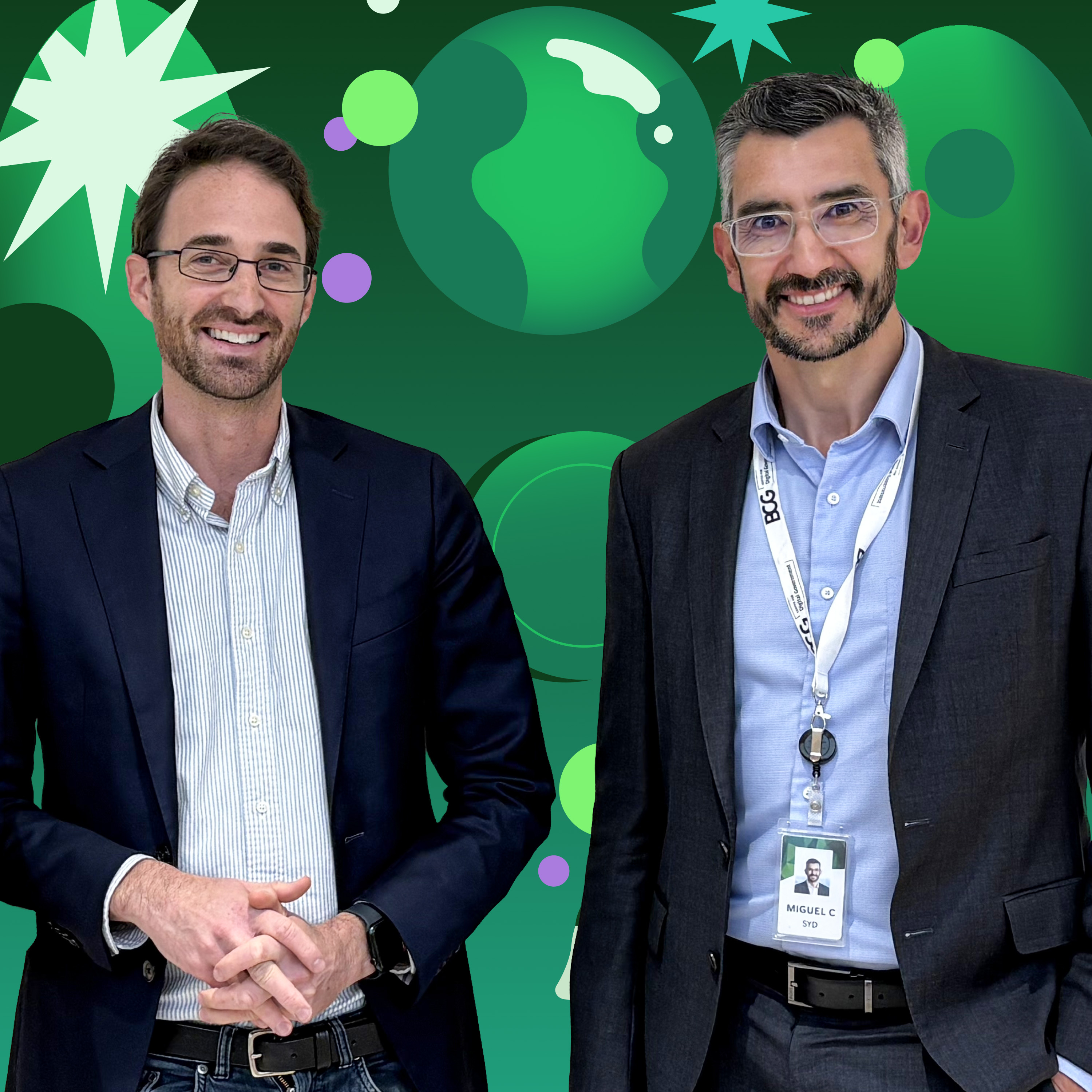
Georgie Frost: Welcome to the so what from bcg, the podcast that explores the big ideas shaping business, the economy and society. I'm Georgie Frost. In this episode, we live in volatile times and prediction feels like a losing game. Not planning though, at all would be reckless. Planning for one future is still a gamble, but planning for multiple plausible features, that's strategy. But how do you do it? Joining me today is Dr. Nicholas Lang, global leader of the BCG Henderson Institute. Nicholas, you've just launched a major new report looking into the imagined futures in 2050. But before we dig into your findings, just spell it out for us. The benefit of planning in unpredictable and volatile times.
Dr. Nicholas Lang: You know, we see clients, and particularly if you look at big impacts, whether it's pandemic, whether it's conflic, whether it's tariffs or other elements, I think many of our clients were just overwhelmed by the amplitude and suddenness of the shock. And I think the scenario planning allows you to be prepared, uh, for different futures. I think in the late 1990s, many companies did long range planning and predicted their revenues and their EBIT, uh, 10 years ahead. I think today the idea is to say, okay, what could happen? What could be different base cases, optimistic cases, negative cases going forward and develop your strategy according to this.
Georgie Frost: What do you mean plausible futures?
Dr. Nicholas Lang: So to look at where is actually the world going, scenarios are always precisely wrong, but generally right. Um, and very often clients tell me, well, scenarios are a qualitative description of the world. But that doesn't help me if I want to derive strategy from this. And so together with my team, we really spent time on saying, can we describe the scenarios not only in a qualitative verbal way, but can we quantify it? And so what we did is we quantified those scenarios along 20 KPIs key performance indicators, which cover varieties of society. You have economic indicators, geopolitical indicators, societal indicators, health indicators, environmental indicators that describe the world. And I think this is the powerful element of these scenarios, having four scenarios that go 25 years into the future and that go into a very clear, uh, quantitative Description of the world along all these parameters is quite rare and actually then gives the profound basis for strategic foresight work.
Georgie Frost: What about the truly extreme possibilities? Let's talk about those. Do you think that we're all a little bit guilty leaders too, of getting a bit bogged down or distracted by the more implausible scenarios?
Dr. Nicholas Lang: Every time I talk to corporate leaders they always come with the Black Swan of it. What happens if we have singularity, so AI taking over control? What happens if we have a war in space where satellites shoot each other down? What happens if nuclear fusion is changing the equation of energy management and so on and so on. I think these are obviously scenarios which we also described ah, in the report, um, but to a lower level because they are highly improbable. It would be wrong to focus your strategy only on this type of extreme examples. I think what we would suggest is that you take these four important scenarios which have a high, high probability, and then you can still stress test your organization with some of these black swan events. Um, but just making clear that those scenarios have a probability in the high double digit scenario probability, while autonomous swarms or a war in space is probably a low single digit probability.
Georgie Frost: Walk me through these four worlds, these plausible futures. What could 2050 look like?
Dr. Nicholas Lang: So the first one is called AI Abundance. It's actually a world where tech and AI are dominant, are clearly dominant, are uh, used in a beneficial way. This hasn't happened overnight. On the contrary, in these scenarios we predict major cyber attacks and cyber wars in the 2000s which triggers then humanity to say, oh, we need to have a much more responsible and positive perspective on AI. But the advantage is a highly productive world where AI is dominant, people working three to four days on average around the world, and of course benefiting of a high level of global interaction. The second scenario is called Battling Blocks. That's actually a very different scenario. It's a scenario where the world has separated in very different blocks, where you have different tech stacks, where you have different trade patterns, where you have also a, uh, high spend on military budgets and also a proliferation of conflicts in this area with the battling blocks. We are in an environment where people uh, work probably the same amount they work today, but in a much more tedious environment. The third scenario is called Climate Coalition. The Climate Coalition is what you would say the green world. But again, this world didn't happen overnight. Here also we predict some major climate catastrophe in the 2000s, 2000s, which act as a wake up call for the world to set up a World where you have climate control, where you have emission, ah, control where you might also have a higher level of taxing, and where you try to kind of distribute wealth in a meaningful way. This scenario again is very different from the fourth one, the digital Darwinism scenario, where you have actually a freewheeling tech world that is developing and progressing massively with big impact on productivity, on health, on innovation, but where this impact is actually reserved to a certain elite that can afford it. On the other side you have parts of the society that are in a very challenged economics in professional environment. So actually a very unequal world, uh, where of course you do not have the stability of other scenarios. So that was the attempt to explain you the world in 2050 along four dimensions in three minutes.
Georgie Frost: And you did very well. They're very vivid pictures. But this isn't about just storytelling, is it? You also put hard numbers on each of these futures. How did you decide which KPIs which measures to choose from? Because 20 is a lot, but I assume perhaps some were left on the table.
Dr. Nicholas Lang: Yes, of course. And this was a long debate on whether we take life expectancy or also biodiversity. So I think the first thing we wanted to do is we said we want 20 KPIs, uh, and um, a reasonable number but still diverse enough. And then we went with a clear perspective of saying we want to cover the key elements of the world. What I said before, there has to be something covering economy, something covering politics or defense, something covering, um, climate and so on. And uh, we obviously were also looking at KPIs which we can really predict. And I think this is also something which is interesting, KPIs which we can also trace back into history because, and I think what is quite powerful we did for some KPIs, we went back until 1850, so 175 years to see how the world evolved. Because although the future is unclear, the world is still, uh, an ecosystem which has always evolved along certain parameters. And so it's at least good to understand how the past was. And I think that was a little bit the combination. So is it meaningful? Does it cover the different dimensions? Is it traceable into the future and can we predict it? I think that's a criteria we adapted and applied to this selection.
Georgie Frost: So across those 20 indicators, the four scenarios, which ones do you think tell the most interesting story? What surprised you?
Dr. Nicholas Lang: Well, let me start with the one which I find pretty interesting, which is gdp. Uh, and why is it interesting? Because it's uh, in many cases at least an economic Sum of what all these parameters translate to. And so if you take GDP or uh, the growth of gdp, so the growth uh, of GDP over the years, it gives you the impact it has actually on the overall economy and the overall society. And what I found particularly interesting is that when you look at gdp, uh, you get a lot of very headline grabbing news such as AI will allow us to multiply GDP by 10x or more in a, I don't know, decade or two. Now when you look back at history, you see that actually GDP has never grown more than 5%, never, never more than 5% around the globe. The highest GDP growth we had was 4.7% in the early 1970s, uh, over, ah, a decade perspective. So um, I think that's one element where you say okay, 4.7% doesn't sound like 10x in 10 years. Uh, the other message you get is to say AI is like the invention of electricity. Well, when electricity was introduced in the early 20th century, GDP growth worldwide went from 1% to 2%. So again, we're not talking about 10x. So what I want to say is that it's important to ground GDP in the past development and to reasonably project it into the future. This doesn't mean that uh, our projections are very narrow. On the contrary, when I take the low projection and the high projection, the world in 2050 could have a GDP that is 1.4 times bigger or 3 times 4 bigger M. So there is a fundamental difference between the uh, projections we have, but it's still within reasonable boundaries.
Georgie Frost: You said a few things, surprised you. GDP was one. What were some of the others?
Dr. Nicholas Lang: Yeah, uh, one other which I found interesting is working hours. Again you have uh, a lot of headline grabbing news of saying, okay, people won't work at all anymore, we will have a, uh, universal basic income and things like this Today the reality is that on average the world works 2,100 hours per year. So every person, Europeans are at the lowest part of this, which about 1,500 hours. US is at 1,800 hours. What we foresee is that in our most aggressive scenario of AI abundance, we believe that probably we will end up in a three to four day work week, but we're not ending up in a one day work week for the world. Um, and we actually see that in most of the, let's say more traditional scenarios where AI is not uh, completely, uh, kind of driving this. We're in a more, I would say traditional, uh, perspective going forward. I found it very interesting again to go a Little bit beyond the headlines. And to say, if you look at the working time, if you look at real productivity, probably will have a reduction of working hours by 20% plus, but not by 80%. So that's for example, uh, point. Another parameter which I found interesting is defense spend. Those who spend, we spend on defense. The money we spend on defense. And given the moment we're talking about now, I think this becomes particularly relevant again. When you look back in history, you see that the world has rarely spent more than 5 to 6% of its GDP on defense. Actually, the highest spend was during the Cold War where we were at 6%. Currently we're at 2. Um, now people will tell you, oh, but that's not right because US has spent 12% during the Korea War, or Ukraine is spending currently 30 or 40% of its GDP. But the point is, these are single countries. This is not the global world economy. So if you bring it back to the global world economy, you see that actually in some scenario, in our most aggressive scenarios, battling blocks, we have 7%, uh, spend of GDP on defense, which is huge. Um, that's an extreme perspective. Uh, but it will not be 10, 20 or 25%. So I think that's something which is important to understand.
Georgie Frost: I think at a time when, and I Could be wrong, CEO tenure is about 3 years. Is 25 years or 24 years just a bit too long? Is there benefit to looking perhaps a little closer to them?
Dr. Nicholas Lang: Look, I think, uh, our perspective is that you should not only do 20 to 5 years exercises, but that it's a combination of what I would call a mid range scenario, a long range scenario, and then long term scenarios. And um, again for SEO, yes, I think there's a pressure of, uh, quarterly results. Uh, but at the same time, it is our conviction that uh, you need to take decisions now to be successful in the future. And uh, you cannot only calibrate into the short term. You need to have a long term perspective. And what is also interesting is I actually face a lot of CEOs who tell me, well, you know, my shareholders want to know where we stand in five, ten, maybe 20 years from now. Um, how resilient my operation is for a certain set of shocks that might not come in the next 18 months, but that might come in 10 years or later. Um, so I think a good corporate leadership has that also in mind.
Georgie Frost: So we've covered the so what, what about the now? What if I'm a leader listening to this? The range is wide, the future is uncertain. I can't bet on a single scenario. So what do I actually do? What am I? Next steps.
Dr. Nicholas Lang: We describe it in the report as a set of no or low regret moves. Um, the first uh, seems like a self advertisement but I think it's really important is use scenarios and practice strategic foresight. Develop the muscle to be able to do this. Uh, this doesn't come overnight because many of our corporate leaders used to do a one single mono dimensional future analysis. I think that's something which is important. But then when we look at the operations of the company, I think there are four or five areas where I double down on first and foremost supply chain and operating resilience. Um, don't focus on one single factory but set up a network of factories. Don't focus on a single supplier but have two or three supplier at hands to cover for unpredictable and unpredicted and unforeseen changes. Second, prepare talent for a new world where talent will have more support from AI but will also move to maybe more oversight jobs versus what they do today. Give them purpose. I think this is something which plays an important role. I think then the third element is also to really think around tech and AI. Where is your technology coming from? The future? Is it a tech that is freely available or is it tech that you will need to source from a strategic point of view? Then there is the whole dimension about how you set yourself up organizationally. Many of these future worlds are divided, are uh, fragmented. So is that the end of the global multinational company with one headquarter? Maybe you need stronger regional headquarters.
Georgie Frost: Nicholas, thank you so much and to you for joining us. If you want to gain more insight from Nicholas on this subject, you can find links to his report beyond tomorrow four scenarios for the world of 2050 in the show Notes.
Other episodes covering the same guests and topics, from across The B2B Podcast Index.
 Empowering Teams in Fast-Growing Startups w/ Shan MohtaLeadership Launchpad · on supply chain resilience83 / 100
 What Good Financial Leadership Looks Like in PracticeThe Fractional CFO Show with Adam Cooper · on Scenario planning80 / 100
 Moody’s x Coupa: Direct spendMoody’s Talks: Risk Reframed · on supply chain resilience78 / 100
 Business Growth Playbook with Jeremy ShapiroThe Lyon Show · on Key performance indicators (KPIs)75 / 100
 Mid-Year Pulse Check with Thor Olof Philogène, Founder & CEO at StravitoThe Insighter's Club Podcast · on Scenario planning75 / 100
 Episode 29: Retiring into the Next Chapter of Impact.Beer Stories for Private Equity · on supply chain resilience71 / 100