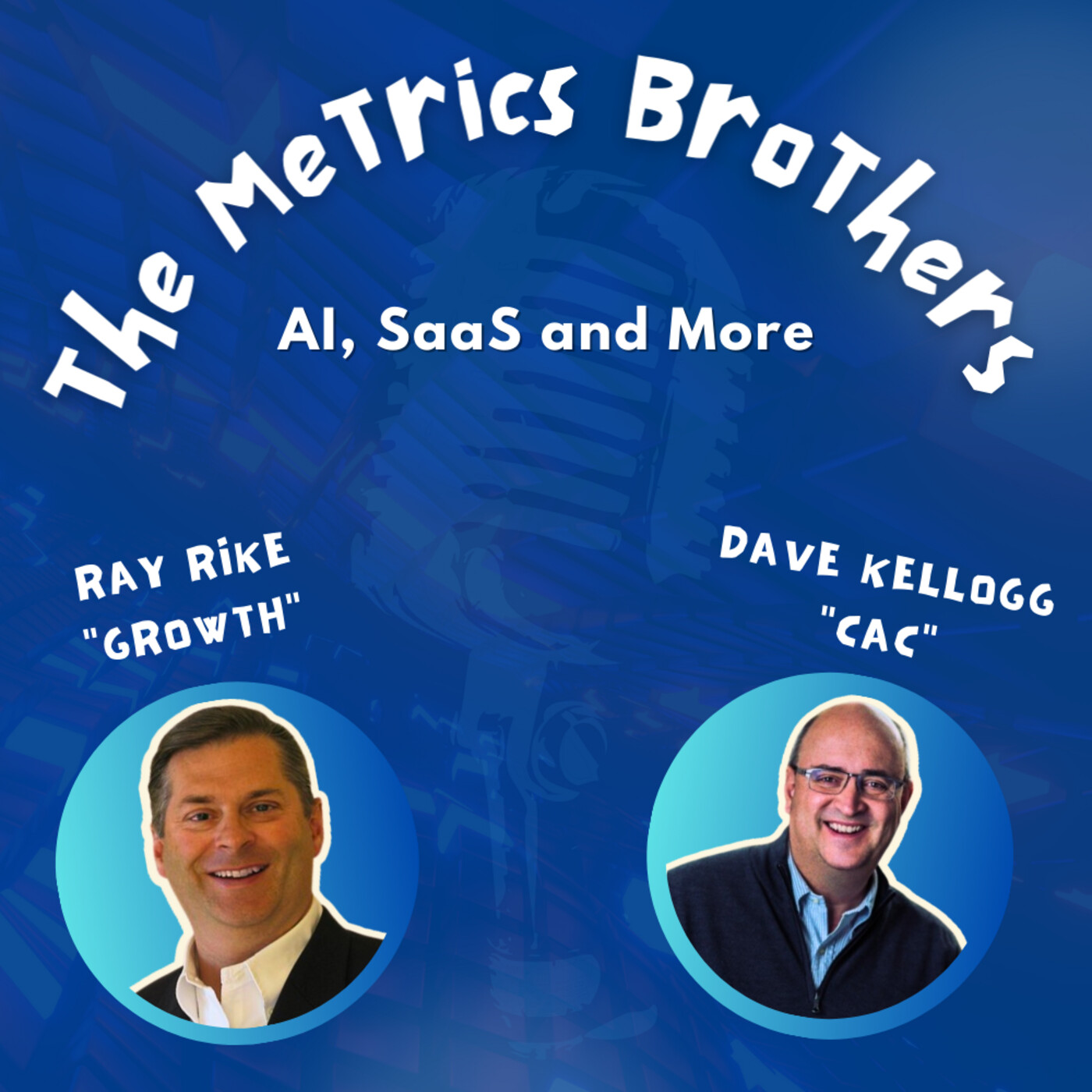
The Metrics Brothers · 2026-06-03 · 12 min
Key moments - from our scoring
Substance score
16 / 100
Five dimensions, 20 points each
After 122 episodes consistently ranking in the top 25-50 of Apple Podcasts' Business Management category, Ray Reich (founder and CEO of Benchmark) and Dave Kellogg (EIR at Balderson Capital) are putting The Metrics Brothers on hiatus. The two built a loyal audience by discussing SaaS metrics with genuine expertise accumulated over decades, but as AI became a dominant topic, they found themselves increasingly discussing concepts they hadn't yet lived through extensively. Rather than produce episodes on AI transformation without sufficient hands-on experience, both decided a break makes more sense than continuing with reduced quality. Reich is redirecting energy toward his AI to ROI podcast and newsletter, plus expanding his AI business impact metrics advisory services, while Kellogg plans to revive his neglected Kelblog (recently migrated to Ghost) and deepen his work across his Balderson portfolio companies and board seats. The hiatus length remains undefined - it could be one month, one year, or permanent - but both leave the door open to returning with deeper stories.
Ray Reich and Dave Kellogg are taking a break because the weekly production grind became relentless, and they increasingly felt uncomfortable discussing AI topics without sufficient real-world experience; they'd rather spend time actually working in AI than talking about it.
The NRR (Net Revenue Retention) episode was the most-listened-to of all time, followed by a Pipeline Generation episode, though the Intercom AI transformation episode set a record for most listens in the first seven days.
The podcast consistently ranked in the top 25-50 of Apple Podcasts' Business Management category despite focusing on the narrow subject matter of SaaS metrics.
Ray Reich is focusing on his AI to ROI podcast and newsletter plus AI business impact metrics advisory services, while Dave Kellogg is reviving his Kelblog (migrated to Ghost) and deepening his work across Balderson Capital's portfolio companies and boards.
The hosts describe it as a true hiatus with no predetermined end date - it could last one month, one year, or be permanent; they're open to returning in a year with new AI stories or transforming the format entirely.
Our reviewer’s read on each dimension, with quotes from the episode.
This is purely a meta-announcement episode with zero substantive B2B or SaaS metrics content. The only intellectually honest moment - admitting they lacked hands-on AI experience to discuss AI metrics credibly - is a single sentence in a sea of farewells and rock-band analogies.
We're doing a special short episode today to announce that the Metrix Brothers are going on hiatus after 122.
we didn't want to talk about stuff that we hadn't done dozens of times before. And the further we got the AI, the more that happened.
There is no original analysis, frameworks, or contrarian thinking in this episode whatsoever. The closest thing to a genuine insight - that podcasting about a domain you haven't personally practiced becomes inauthentic - is a throwaway observation rather than a developed argument.
it started as a fun hobby and it was becoming real work with the AI pivot
we worried about quality, but I think we pulled it off because the. The second thing, we did a ton of work.
Both hosts are legitimate practitioners - Dave Kellogg is a well-known SaaS metrics voice with real operating history and Ray Reich runs a benchmarking firm - but this episode is purely a social farewell that reveals none of that expertise; the caliber exists on paper but is completely absent from the content.
I'm kac, better known as Dave Kellogg, EIR at Balderson Capital, independent consultant and the author of Kellogg
I'm doing advisory services on AI business impact metrics. So hey, if you're investing $3 million on AI tools and tokens and marketing, how are you measuring the economic benefit?
The few concrete numbers present - 122 episodes, top 25-50 Apple Podcast ranking, first-seven-days listen counts - are all meta-statistics about the podcast itself, not evidence in service of any B2B argument; the Intercom AI transformation reference is a name-drop with no substantive unpacking.
In the business management category of Apple Podcast, we were consistently in the top 25 to 50
the top most listened to episode of all time was Believe it or Not. Ta da. Nrr.
There is no interviewing craft here at all - this is two co-hosts exchanging mutual compliments and nostalgia with zero challenging questions, no follow-ups of substance, and no productive disagreement despite the opening tease of 'editorial conflict'.
So Dave, since you're not going to have to spend an hour with me every week and spend hours on getting that script ready, what are you going to be doing next?
thank you to you, Dave. Yeah. Yeah. And thank you to you, Ray.
Computed from the transcript - who did the talking, and the words that came up most.
After 122 episodes covering SaaS metrics, GTM analytics, and the evolving world of AI-native software, Dave "CAC" Kellogg and Ray "Growth" Rike announce that The Metrics Brothers podcast is going on hiatus. In this abbreviated special episode, Ray and Dave reflect on what made the show work, what made it hard, and why now is the right time to take a pause. They share their top-performing episodes across 122 weeks, including the all-time most-listened episode on NRR, a breakout episode on pipeline generation, and the Intercom AI transformation episode that set a record for first-week downloads. They also explain the primary driver behind the break: AI changed the subject matter faster than their accumulated operator experience could keep up. What started as two veterans trading war stories about metrics they had lived with for decades became something that required more prep, more research, and more time to do with the quality they demanded. Both hosts decided they would rather spend more time inside AI from an operator's perspective to gain real-life AI experience, then return with better stories to tell.
Transcribed and scored by The B2B Podcast Index.
Speaker A: Foreign. From Schenectady, New York, it's the Metrix Brothers, Growth and cac.
Speaker B: And I'm Growth, better known as Ray Reich, founder and CEO of Benchmark.
Speaker C: And I'm kac, better known as Dave Kellogg, EIR at Balderson Capital, independent consultant and the author of Kellogg.
Speaker B: And together we are the Metrix Brothers.
Speaker C: And we go together like brotherly love and editorial conflict.
Speaker B: Ooh, that's a pretty big statement there, Dave. What's behind that one?
Speaker C: That is a big statement there. Right. Hopefully people have appreciated our similes. Uh, and that's a good one. Um, we're doing a special short episode today to announce that the Metrix Brothers are going on hiatus after 122. That's right, 122 episodes on SaaS Metrics. Didn't even know that was going to be possible. Ray, when we set this out, uh, we set out on this after 122 episodes, we're going to be taking a break.
Speaker B: Dave, that's like a rock band taking a two year plus tour with no breaks. I'm so excited we're going to have a break.
Speaker C: Yeah, it is nice. I have to tell you, for any fellow podcasters out there, props to you. Cause the weekly grind, uh, is relentless. And uh, that's certainly one of the reasons we're gonna take a break. But Ray, do you wanna talk about some of the other reasons why we're gonna take a break here?
Speaker B: Well, one of the things when we started this, one of the things that we had so much in common about was our passion and operating knowledge around SaaS metrics. So it's like taking a passion and hobby of ours and making it into a business, a podcast. It was fun and easy and. And then AI happened.
Speaker C: Yeah. And to be clear, look, we had some desire to make it into a business, but it wasn't the primary point. We've had sponsors from time to time. We've also continued when there weren't sponsors because simply put, it was fun and educational to make the thing. Um, and it was easy I think, because we talked about stuff we've been doing for ten years. Um, so if you said, hey, Ray, what do you think about measuring CAC ratio or CAC to LTV or LTV to cac? Um, we. Do you think about these metrics, we could instantly have an interesting conversation. So it was relatively easy to produce.
Speaker B: And Dave, we could tell a story from our experience five or 10 years ago. And as you know me, sometimes from
Speaker C: 30 years ago, which very often prefers the pre1970 stories.
Speaker B: Exactly. But the challenge today with AI is we haven't had enough maturity and nurturing, uh, in the application of AI metrics. So I know I wanted to go out and spend more time in the middle and doing work in the AI industry so I could actually learn and have, I would call it, real experience on how metrics are working in the AI industry.
Speaker C: Yeah, I think I'd say we both found that we didn't want to talk about stuff that we hadn't done dozens of times before. And the further we got the AI, the more that happened. That meant two things. One, we worried about quality, but I think we pulled it off because the. The second thing, we did a ton of work. Um, and so it made the podcast move towards being kind of, what I would just say is real work. It started as a fun hobby and it was becoming real work with the AI pivot. And I think both of us were saying, hey, gosh, wouldn't it be more fun to be out spending more time doing this than talking about it? Wouldn't it be a good time to take a break, um, and who knows, maybe in a year, come back and talk about all the stuff we learned, uh, rather than having to go through kind of episode by episode with tons of prep time?
Speaker B: Yeah, but I tell you, taking that rock band on turf for two plus years analogy to another level, you know, the charts were really important to rock bands. Hey, we didn't do bad on the charts. In the business management category of Apple Podcast, we were consistently in the top 25 to 50, Dave. And we built a following that could sell out the Madison Square Garden on a regular basis. I'm pretty excited about that.
Speaker C: Yeah, I'm excited about that too. Well, like I said, while we never made a really hard run at turning this into a business, we did want to build a nice audience and that we succeeded. Why we couldn't monetize it. Right. Who knows? Uh, but we had fun doing it. And yeah, like top 25 to top 50 given a pretty narrow subject matter, uh, to me was pretty, pretty amazing, right?
Speaker B: Yeah. And we had some. Just like rock bands had their top hits, we had some top episodes. You want to talk a little bit about what those were about?
Speaker C: Yeah. So. So depending on the metric you use to calculate top, the top most listened to episode of all time was Believe it or Not. Ta da. Nrr. Um, pretty interesting. A single metrics episode, Ray. That was always one of my favorites. Next one was on Pipeline Generation. I believe that was a Raylad episode, if memory serves. Um, and to show that AI episodes were breaking in the intercom AI transformation, I think was the record holder for most listens in the first seven days of existence. It's a little bit unfair to compare a two year old episode with a two week old episode. Right. And so you have to look at metrics like, uh, how did it do in its first week or two of life?
Speaker B: But that really tells you what's going on. Especially in the more legacy SaaS companies, they really wanted to learn more about that intercom AI transformation and I was actually blown away. My how many people downloaded and listened to that episode in the first seven days?
Speaker C: Yeah, and that was a great story. I'm glad we did that episode because that was a really. We had another episode with a company I won't name on the books to study another company's transformation. And our conclusion was that it was a lot less kind of legit and a lot more VC storytelling, whereas the intercom stuff was absolutely legit. If you don't believe me, just go watch Ian the Founder on Lenny's podcast for like an hour and a half talking deep about it. So it was a great story, it was a real story and I'm glad it got the attention it did.
Speaker B: So Dave, since you're not going to have to spend an hour with me every week and spend hours on getting that script ready, what are you going to be doing next?
Speaker C: Yeah, yeah, four to eight hours a week. My wife always saying, ah, are you working on the podcast again? You're grumpy. Um, so yeah, so we'll be freeing up like almost a day a week. Uh, and what am I going to be spending my time for? Me, Ray? Mostly more of the same. I'm pretty busy with the Ballerton portfolio. Right, right. Is an EIR there. I'm a non staff advisor and I work with dozens of companies, uh, in any given month, uh, about or every given two month period, I work with a dozen companies at least. Um, I got my four boards of directors that I sit on, I've got my advisory clients and of course I got kelblog, which for me was the thing that suffered the most due to the podcast. My post frequency fell in half in 2025 compared to 2024 and it was just too hard to keep all these plates spinning and, and kelblog was getting neglected. I'm definitely going to put more effort into that, especially since I was able to get it moved to ghost. So it's now fun to write and post again. WordPress was getting to be like Marley's Chains. Um, it was not fun to work in there anymore. So kelblog is already showing a much higher post frequency.
Speaker B: Well, I know it's going to free me up to really focus on something I started about six to seven months ago and that's the AI to ROI podcast and newsletter. Because I truly believe that especially in the enterprise segment, CFOs and COs are looking for great case studies and use cases about when people invested AI in this particular process or department. How do they measure the roi? What was the economic benefit? And I'm also doing a lot more benchmarks in the world of AI, things like AI and marketing, AI and go to market with scale ventures. So we're going to be doing a lot more benchmarks. There's. And then getting back to that real goal. I'm taking the SaaS metrics and benchmark assessment services I used to do and I'm now doing advisory services on AI business impact metrics. So hey, if you're investing $3 million on AI tools and tokens and marketing, how are you measuring the economic benefit? How do you convince the CFO to continue funding that? So I'm going to do more of that.
Speaker C: Dave, you been making another. I find out after 122 episodes that you've been making another podcast without me.
Speaker B: Ray, I know I was cheating on you a little bit, but it was the Metrics that Measure up podcast that I basically rebranded as the AI to ROI podcast.
Speaker C: Oh, is that true? I thought you had all three. Okay, I didn't realize you shifted. I thought you're actually making three. Um, okay, so you're now. Okay, some more effort for you into AI to roi. I wish you luck with that. And then for me, like I said, just more of the same. Now for the podcast itself, what's next? We're not sure. When we say hiatus, we mean it. Uh, we're not sure if this is a one month break, a three month break, a 12 month break, uh, or a forever break. We don't actually know and we don't want to decide right now. Um, we might reincarnate it, we might not, we might transform it and make something new. Who knows? Um, definitely keep the dad jokes.
Speaker B: Yeah, but I gotta tell you, like almost all great rock and roll bands, they almost all have taken a hiatus or break and now 30 years later, they're still coming back on tour. So I'm pretty confident there's uh, an audience out there.
Speaker C: Maybe I saw Rod Stewart tickets advertised this morning on my phone, which. Which melted my brain. And, in fact, people know I'm a Grateful Dead fan. They took a hiatus in 1974 for about 18 months and then toured for 30 more years, or 20 more years, uh, I should say, after that. So who knows where this will go? We're both kind of excited about it, uh, and we don't have any predispositions right now. Uh, I do think we'll have a lot more good stories to tell in 12 months. So who knows? Meantime, um, look, we will keep the episodes up so that it'll be there as an archive. You can listen to them. If you have ideas of what you think we should do next or you have any kind or unkind words to say about the Metrix Brothers podcast, you should mail us jointly via, uh, metricsbroschmarket AI. Or if for some reason you want to mail us individually, you can mail me at. I just use my Balderton email now as my public email, since it's out there anyway. D Kellogg, 2LS2G's alderton.com and Ray, I'm @RaynchMarket AI.
Speaker B: That's Benchmark ITwithAnit AI. And of course, you can always follow me on LinkedIn. Ayreich. And I think, most importantly, Dave, I was really humbled and grateful to see that we were able to build such a large and engaged audience and just want to thank everyone who listened to us, who joined us. And I know I go to a lot of industry events and so many people would walk up to me and say, we really enjoy you and Dave's dialogue, and we love the chemistry that you guys have. So thank you to the audience. And most importantly, thank you to you, Dave.
Speaker C: Yeah. Yeah. And thank you to you, Ray. This whole thing started one day because Ray called me up and said, do you want to make a podcast? So, um, it was very much Ray's idea. I think it was a good one. It's been a gas doing with you. I'll just say it one more time because it does actually blow me away. That we hit top 25 to top 50 in management with a podcast focused on SaaS metrics was just kind of, like, mind boggling. Uh, that's something to be proud of. There's a lot of us out there. Um, so let's stick together going forward. Um, it's been a pleasure, Ray, doing it with you and getting to know you and working with you, uh, for the past 122 episodes.
Speaker B: Great. And I know we've had some nice nights out having dinner, and we're going to see each other much more than just at our annual family reunion.
Speaker C: Dave we will indeed. Well, thank you everyone for listening. Thanks for being a part of the Metrics Brothers.
Speaker B: Bye everyone.
Speaker C: Take care. We'll see you who knows when. Till next time. Till next time. I'll as they say. Thank you everyone.
Speaker A: The metrics brothers, AI SaaS and more is a production of the Metrics Brothers Growth and CAC and a member of the BenchMarket Podcast Network. By accessing this podcast, you acknowledge that the Metrics Brothers make no warranty, guarantee or representation as to the accuracy or sufficiency of the information provided or the humor content of the jokes told. Um, Ray Information, opinions and recommendations presented are, according to our spouses, probably wrong and and provided for information purposes only. This podcast should not be considered professional or for that matter, unprofessional advice. We disclaim any and all liability for any direct, indirect, undirect, misdirect, incidental, special, ordinary, consequential, inconsequential, or other damages arising out of any use of, or, God help you, reliance upon the information presented here. Ray Grothrike is based in New York City and available on X at Ray Reich. Dave CAC Kellogg is based in Silicon Valley and available on X at Kelblog. Schenectady, which is French for unspellable, is not our actual production location. Thanks for listening.
Other episodes covering the same guests and topics, from across The B2B Podcast Index.
 Understanding Your True LTV and Company Value | Prof. Daniel McCarthyD2C Diaries · on Customer Acquisition Cost (CAC)96 / 100
 The 3-Pillar Framework to Scale Any E-Commerce Brand (Feat. Abir Syed)Brain Driven Brands · on Customer Acquisition Cost (CAC)90 / 100
 I Was Worth $5 Million at 23. Eight Months Later I Was Negative $1 Million | Ep. 416 with Leo Pareja CEO of eXp RealtyFounder's Story · on Customer Acquisition Cost (CAC)88 / 100
 How B2B Marketers Use Customer Marketing for ExpansionB2B Marketing with Fexingo · on Net Revenue Retention (NRR)83 / 100
 The Creative Testing Gap: Why Most B2B & B2C Lead Gen Campaigns Fail to ScaleThe Revenue Room · on Customer Acquisition Cost (CAC)80 / 100
 Selling a SaaS Business? The Metrics Buyers Care About Most Business Beyond You · on Customer Acquisition Cost (CAC)80 / 100The Agentic Work Unit (AWU)Private Credit and the Medallia IncidentThe Redpoint 2026 State of the Market ReportThe Intercom AI TransformationThe State of B2B Go-to-Market in 2026: The ICONIQ Findings