
The Big Bid Theory · 2026-07-29 · 41 min
Key moments - from our scoring
Substance score
63 / 100
Five dimensions, 20 points each
Danny Mays brings deep experience from his rise through procurement ranks to his current role overseeing operations for Maryland's $760 million judiciary budget. The episode explores his transition from banking to procurement and his philosophy on why mentorship and knowledge-sharing strengthen the entire profession. A significant portion focuses on his webinar on technology procurement failures, where he identifies four critical patterns: undefined problem statements before purchasing, underestimating change management complexity, insufficient validation of requirements (especially those generated by AI), and misalignment between RFPs, demonstrations, scoring, and contracts. Mays emphasizes that technology procurement failures are fundamentally planning failures, not technology failures. He advocates for procurement professionals to think holistically about operations, understand organizational mission, and prioritize people-centric approaches over rule-focused administration. For B2B operators and procurement leaders, this episode offers practical frameworks for avoiding costly technology implementation mistakes and insight into how procurement can elevate itself as a strategic function.
The four patterns are: undefined problems before starting procurement (buying without a list), underestimating change management requirements, insufficient validation of requirements especially from AI, and misalignment between RFPs, demonstrations, scoring, and contracts leading to different stakeholder expectations.
He believes procurement professionals should be bought into the mission they support, not just administering rules; the human element of stakeholder influence, change management, and understanding organizational needs matters more than procedural compliance.
AI should accelerate human thinking, not replace it - organizations must validate AI-generated requirements independently rather than assuming they are accurate, otherwise they arrive at bad outcomes faster.
Forum's primary value lies in networking and relationship-building across the profession, not just the formal sessions; these connections generate ideas, peer support for navigating gray-area decisions, and career opportunities that attendees often trace back to unplanned hallway conversations.
He emphasizes that procurement professionals will never feel completely comfortable or know everything, as the profession constantly evolves and every day presents new situations; this unpredictability is why knowledge-sharing and learning from peers is essential.
Our reviewer’s read on each dimension, with quotes from the episode.
The episode delivers solid, practical insights about technology procurement failure patterns and AI governance, with Danny's framework of four specific failure modes (undefined problems, underestimated change management, inadequate requirements thinking, misalignment) being genuinely useful. However, substantial portions are devoted to networking platitudes, career narratives, and Forum promotion that don't advance actionable knowledge. The AI discussion is sensible but surface-level - no novel frameworks or counterintuitive claims that would surprise a thoughtful practitioner.
most technology procurement failures aren't technology failures, they're planning failures
AI can take all of this information I find and spit out a really good summary or spit out some really good questions that I can ask
Danny articulates familiar industry wisdom - the importance of people-centric procurement, change management in tech implementations, and avoiding scope creep - but these are well-established themes in procurement discourse. The AI discussion reiterates common positions (humans in control, augmentation not replacement) without distinctive first-principles thinking. The four failure patterns are practical but not novel frameworks that would feel fresh to experienced practitioners familiar with procurement project retrospectives.
Procurement is a people business. It is a customer service business
don't go to the grocery store hungry. You know, go with a list
Danny Mays is genuinely credentialed and seasoned - CPO for Maryland Judiciary overseeing a $760M budget, holds multiple certifications (CPPO, CPPB, NIGP, etc.), rose from entry-level to ops leadership, and actively teaches and consults. He has legitimate authority to speak on large-scale government technology procurement. His 18-year journey and current executive position give him real operational weight, though the episode doesn't deeply test his thinking or surface expert-level nuance.
Chief Procurement Officer overseeing procurement strategy, contracts, grants, process improvement and cross functional operations for a statewide court system with a 760 million annual operating budget
I started from the very bottom...vendor file and learning
Danny provides some concrete examples (Maryland Judiciary budget figure, the refrigerator analogy, use of functionality matrices in RFPs, the one-page checklist from his webinar) but largely operates at the level of general principles and frameworks rather than specific case studies or measurable outcomes. No named failed technology implementations, no specific dollar figures for cost overruns, no timeline data on change management. The webinar reference is mentioned but not deeply unpacked with real examples from it.
here's my required functionality, here's everything that system needs to do, here's some nice to haves that I'd like to see
a functionality matrix in the rfp
Bill asks decent setup questions (career journey, why Danny mentors, Forum value, failure patterns) but largely conducts a warm, facilitative interview rather than one that probes, challenges, or follows hard on contradictions. When Danny makes claims about vendor over-promising or AI governance, Bill nods and affirms rather than pressing for specifics or testing assumptions. The conversation flows smoothly but lacks the edge and intellectual friction that would sharpen thinking or expose weaknesses in the guest's logic.
Yeah, I think many in our audience would agree
Yeah, I agree. You said it. Keep the main thing. The main thing
Computed from the transcript - who did the talking, and the words that came up most.
Bill Culhane sits down with Danny Mays, Chief Procurement Officer for the Maryland Judiciary, overseeing a $760 million operating budget for a statewide court system. Danny holds five procurement certifications (CPPO, CPPB, NIGP-CPP, CPSM, CPSD) and has invested creativity, passion and years sharing what he knows with the profession. In this episode, Danny discusses technology procurement failure patterns, the gap between vendor demos and actual delivery, what it means for the future of procurement to be empowered rather than diminished. Danny and Bill share why NIGP Forum in Columbus this August is worth attending. Straightforward, experienced, and worth a listen. Rick Jennings closes down the episode with a Crazy Bids that really rocks!... and waters. Danny Mays on LinkedIn More on Danny Mays: Danny Mays is the Assistant State Court Administrator of Operations for the Maryland Judiciary, where he leads Procurement, Budget and Finance, Facilities, and Security Administration.
Transcribed and scored by The B2B Podcast Index.
Speaker A: M Hello, friends, and welcome back for another episode of the Big Bid Theory, the podcast powered by bidprime and beaconbid, where public procurement gets the conversation it deserves and the conversation we hope will help you and your team. I'm your humble host, Bill Culhane from here in Austin, Texas. Coming up in today's show, My guest is Mr. Danny Mays. He's the chief procurement officer for the Maryland Judiciary, nigp, instructor, consultant, musician, professional wrestling ring announcer, fellow pain fan of ours and your Baltimore Orioles. And Danny is one of the most energetic voices in public procurement today. If, uh, those of you who know Danny know exactly what I'm saying there. Danny is visiting with us to talk about tech procurement challenges. Going to talk a little bit about AI and what it really means for the future of the profession. And we touch upon all of that and a few other things as well. That conversation is coming up a little bit later in the episode and stick around because after our conversation with Danny, our friend Rick Jennings is back with another round of crazy bids you can win. Rick, without telling us right now what you have for us, what have you got for us in this episode?
Speaker B: Well, Bill, I've got it right up in front of me here. I'm trying to think of a, uh, creative way to tease this one. And the first thing that comes comes to mind is just rocks and water. So I guess we've got rocks and water to look forward to a little bit later. So stay tuned.
Speaker A: Sounds exciting. Rick, our longtime audience members already know you're going to want to stay all the way to the end, towards the end of the episode for Rick's crazy bids you can win. But first, uh, another reminder. Get your nominations in for the David and Beverly Nash Leadership Award. We'll have the link in the show notes, meaning you can Please go to thebigbitttheory.com it's one of the most meaningful recognitions in the profession, the Nash Award. As a matter of fact, today's guest, Danny Mays, was a Nash Award nominee just last year. Okay, as we keep things rolling along, before we bring Danny in, here's a quick word from the folks who make the show possible.
Speaker B: The big bid theory is brought to you by Bidprime and BeaconBid. Are you missing out on game changing contract opportunities? Bidprime has over 15 years of industry leading technology in delivering real time bid alerts, deep data insights, and unmatched customer support. And now with emerging ops and future ops, you get ahead of your competition by spotting contracts before they go public. Don't Wait. See for yourself. Get your free no obligation trial today@bidprime.com Government procurement is now smarter and easier. BeaconBID has improved the way agencies publish solicitations, engage with more suppliers and collect responses faster and more efficiently than ever. With cutting edge AI based solicitation tools and the industry's most comprehensive RFP archive, you'll write better RFPs in less time. Plus, with EBID, bidders submit seamlessly and agencies collect and evaluate with ease, including vendor market research and cooperative and shareable contracts databases. It is time to take procurement to the next level. Request your free demo today@beaconbid.com
Speaker A: all right friends, you have been incredibly patient. Here's our conversation with Danny Mays.
Speaker C: Now we hop over to the YouTube segment on the Big Bid theory. Our special guest is coming up in just one second. Appreciate the audio only audience. You folks sticking around. I'm still Bill Culhane. This is still the Big Bit Theory coming to you from our palatial studios here in near downtown Austin, Texas. And some folks probably wondering, yes, the temperatures are approaching 100. We're all already there. But for us folks in Texas, that's pretty much the annual par for the course. So our guest today give you a real quick rundown, uh, about him, a busy person, uh, and incidentally his bio is in the description of the podcast of this episode. Rick or Lauren or somebody will be sure to include the information. But here are a few of the highlights and I've got my little run of show here. He's the Assistant State Court Administrator of Operations for the Maryland Judiciary where he leads procurement, budget and finance, facilities and security administration. He serves as the Judiciary's Chief Procurement Officer overseeing procurement strategy, contracts, grants, process improvement and cross functional operations for a statewide court system with a $760 million annual operating budget. And in case you're wondering, that budget is a little higher than our budget here at the show. Just to let you know, he holds certifications that will really make any cpo, any practitioner out there not in respect, including yours truly, cppo, cppb, nigp, cpp, CPSM and cpsd. Outside of procurement, he's a musician, a public speaker, even a professional wrestling ring announcer. And all of that is important. But Danny is also a fan of the Baltimore Orioles and, and who isn't a fan of the Orioles? Danny. Danny Mays, welcome to the show. We appreciate you joining us.
Speaker D: Thanks for having me. I'm excited to be here.
Speaker C: Yeah, we're excited to have you. Danny and I have known each other for, for quite A while. I think you go all the way back to Forum in Louisville. So that was what, about three years ago, I think, Danny, where you and I first met. Um, so let's roll up our sleeves. And anybody who's been a longtime loyal listener watcher, viewer of the show, uh, know that I have an interest, like many in our audience, about everybody's journey. So if you would, Danny, kind of give us a brief overview of your professional journey from where you began to now serving at the Maryland Judiciary.
Speaker D: Well, uh, like many other people, I did not sit in my, uh, third grade career day and listening to someone tell me about great it's going to be to one day be a procurement officer. Like many other folks in procurement, uh, I really kind of found the profession, uh, rather than setting out to pursue it. What I would say that's a little bit different for me is that I found it a little bit earlier. So I came from banking. Um, I was a banker. Uh, I got really, really tired of, uh, having to hit the numbers in banking. And I felt it was becoming a little bit more of a predatory retail, uh, existence rather than helping folks. Uh, so I was looking for a way out of banking and there was procurement. One of the unique things about my journey is I started from the very bottom. I started, uh, going back to the baseball thing. I started making the league minimum, doing, uh, the vendor file and learning. Just kind of getting my feet wet on what basic procurement was. And over the course of the last 18 years, um, I've had the really good fortune, uh, and really good mentorship to be able to grow through the profession to where I am now. One of the things that makes my, uh, position now unique is you don't really see a lot. And I think we talked about this last time we got together. It does feel weird not having this conversation at a trade show booth. But, um, I think we talked about. It's rare to see a procurement person rise into an ops level position. Normally you see people from kind of finance going into those roles. And one of the things that makes my journey and my position now very unique is all of the years I've spent in procurement give me a very unique perspective on how organizations operate, how our decisions impact delivery on our mission. So I've been able to take a very holistic view of how all of these operational functions work together. And in doing that, I've really kind of been able to provide procurement with a better position to where they can be valuable to the organization. All these things we talk about about procurement needs to be involved earlier. And procurement needs data from finance to understand how the budgets are being done. Uh, that's all kind of things I've been able to bring from my past, uh, into my current role. So it's been a very, uh, rewarding journey. It's been a long journey. Uh, and one of the things that I think that gives me a little bit of credibility with practitioners is I've been there, I've bought it, I've been in the trenches, I understand the struggles. Uh, so I think a lot of times when I'm speaking or mentoring, I'm saying, hey, this isn't because I'm smart, it's because I'm dumb. And I've already done all this dumb stuff. And I don't want you to do the dumb stuff. You do your own different thing. But don't try this. This didn't work. So I feel like the more, uh, experience you have, uh, in actually doing procurement under tough circumstances, the more valuable you can be in your journey. So not to say that someone can't come into procurement leadership, uh, without having that experience, but I feel like that experience really, really prepared me from where I'm at now.
Speaker C: Yeah, I think many in our audience would agree and we're going to go to the past and go back to the beginning of your journey, Danny, and we're not going to go back to the third grade to career day, but, uh, think back to the first time that you walk through the so called, you know, the public procurement door. If you could go back in time, knowing what you know now, what would you tell Danny? 18 years ago?
Speaker D: It's so much bigger than purchasing. I think I spent a great many number of years not understanding that procurement goes beyond the purchase that's in front of you, the transaction that's in front of you. Uh, it goes much deeper into strategy, operations, law, technology, people procurement is a people business. It is a customer service business. And I think that I spent a long time worried about, uh, the rules, which are important. Uh, but I think that I wish that I would have done, kind of understood the importance of the people portion first and the influence you have to have to be able to drive people toward the solution. Um, and I think that what I've learned over time is that your best procurement professionals really understand and are bought into the mission that they're supporting, not just the rules that are administered by the procurement department. So that's one thing that I wish I would have known, uh, earlier. The other thing is that you're just never going to be comfortable in this profession? Never. There's always going to be something that happens for the first time. There's always going to be something that catches you off guard. You're never going to know everything. And that's why it's so important for us to share knowledge, uh, back and forth. And I think that I kept waiting for that light bulb to go off that, like, okay, I finally know everything about procurement. Now I can stop worrying that something crazy is going to happen. I've learned everything there is to know. I've read all these books, I've gotten all these certifications, like, good to go. Uh, that's just not the kind of profession we're in. This profession is ever changing. We're operating in areas of gray all the time. So, you know, I've seen a lot of people over the years that, that just really, they can't get down with that. They need that regiment, they need that standardization, they need that predictability. And that just never comes in procurement. No matter how out in front of everything you feel, no matter how strategic you've become, uh, every day is a new adventure, which is what I love about procurement, but it doesn't work for everybody. So those are the two things that I think ate up a lot of my limited brain power in my earlier journey, earlier part of my journey that I wish that, um, either someone would have told me, or if they did tell me, I wish I would have been listening, uh, a little bit better when they told me.
Speaker C: Good insights there, for sure. And, uh, a moment ago, Danny, you mentioned the fact that you and I. I consider myself fortunate that you and I do cross paths from time to time. And I, of course, follow you on LinkedIn so I can kind of get a feel for, you know, what you're up to. And when we were at FAPO in Orlando, however many months ago that was, um, we talked. I think I mentioned, hey, Danny, you're out on the road a lot. You know, you're out sharing your knowledge. So. So you've been involved in sharing, whether it be your experiences, your opinions. And we're going to talk more about that later. Some more specifics here in a moment. But as you and I both know, that takes real time to be involved in that. It, uh, takes creativity. It takes a great support system, you know, your team around you to be able to make that happen. But my question to you, and I think our audience would ask, why do you do it?
Speaker D: Um, there's multiple reasons why I do it. Uh, one of the things that I feel like I was very fortunate with, was the mentorship I received, uh, earlier in my career. There have been a number of people that have poured into me, uh, and they all reinforced that teaching and mentoring, coaching is a way to give back to the profession. Uh, I think that we've all come across these people who protect knowledge, even to the point of where they're weaponizing knowledge. And I just don't believe that our profession gets stronger when knowledge is weaponized and protected like that. I often tell people, uh, you know, when you share something with someone, it's a copy paste, not a cut paste. You get to keep the original. You're just giving them a copy of what you know. And I think that everybody should be sharing that information because just because I've experienced something in the areas that I've been in doesn't mean it works in Texas, doesn't mean it works in Arizona, doesn't mean it works in California. So for me, uh, I don't think that I don't look at teaching and speaking and all that stuff is something I do in addition to my job. It all makes me much better at my job. Every classroom, every conference that I go to, every presentation, I learn something new. Because going back to what I said before, procurement is a people profession. And the more people that you talk to and the more ways you find out how people are tackling these very real problems, the stronger I become. So, I mean, I would say that I've probably learned as much as I've taught. Gosh, I hope I've taught folks something over the years, but I feel like I've learned just as much from being around those people, uh, and learning their journeys. And, um, you know, like, every time I teach, I end up learning something. Um, I'm teaching next week, and I guarantee you I will learn something. Um, and I just believe that nobody develops, uh, in this profession alone, you can't learn procurement from a book. You can learn the rules from a book, but you can't learn the people. You can't learn the process from a book. So I think that getting together and sharing this knowledge has always been something I've been very, very passionate about. And that's just kind of a continuation of that. I'm very blessed to have, uh, the opportunity to get to speak to some of the conferences and groups that I travel around and speak to. But, uh, I think it makes us all better to be in those situations.
Speaker C: Speaking of sharing and learning, uh, I mentioned earlier in the segment how Danny and I first met at NIGP Forum in Louisville a few years ago. And everybody, most likely everybody who's watching this conversation knows that Forum is coming up the end of August in Columbus. Danny, you've been involved in Forum in various capacities, I know, over the years, but your opinion of Forum as it pertains to procurement professionals, what would you say to maybe somebody who's never been to Forum, or has only been once, been twice, invaluable?
Speaker D: I think that you could look at just the sessions on their own and all of the just incredible folks that are giving their time, uh, to present sessions at Forum. And those certainly have a ton of value. But to me, the overlooked portion of Forum, it's a big family gathering. This is where you make your connections. This is where you network with people. I mean, most of the opportunities, uh, that I've had in this profession I, uh, can trace back to a conversation that I didn't plan on having. It was in a hallway somewhere with someone I'd never met. Um, so I always look at Forum as a chance to sit with strangers, eat with strangers, introduce myself to people. What are you guys doing? Where are you, uh, having challenges? What are you guys doing about this emerging technology or this emerging risk? Um, so I feel like, you know, maybe the agenda gets you to come to Columbus, but I feel like the relationships is really what you bring home from Forum. And I think that just having. We're a pretty small profession. I know we like to think of ourselves as this big, giant, uh, conglomerate. But I mean, public procurement is a fairly niche profession. So I think the more, the more we can network and the more we can meet others that go through the same thing that we do, um, just like teaching, um, the more ideas you have. So for me, Forum has always been this big just idea incubator. In addition to just getting to spend time with other people that go through the same things as you, it almost turns into a group therapy session. In some ways, procurement can be a very trying profession. And there aren't a lot of other people that understand the struggles that we go through operating in those areas of gray 24 7, 365. So just being around other people that can commiserate is a very calming, a very calming thing. And of course, getting to let loose, have fun, uh, you know, procurement is what you make of it. And I think that we can have fun together. And so for those folks that have never been to Forum, uh, getting to see that, uh, there's a really fun contingent, uh, amongst us in, uh, procurement too. And I think that we all need to be able to have that outlet, uh, sometimes. So I think that just building the network would be reason enough to get out to Columbus and the sessions, uh, would be reason enough to get out to Columbus. But I think when you, you put both of those together, it's a value proposition that's pretty easy to sell. For me, a forum is a, is a can't miss event, uh, for, for public procurement professionals around the country.
Speaker C: Uh, agree totally. And anybody who's been a long time member of our audience here at the Big Bit Theory knows how I feel about forum. And I always find it interesting, Danny, because I asked that question and almost to a person. They mentioned the education, they mentioned the schedule, mention the presentations, but immediately people pivot to, as you describe, you know, the networking, uh, the fellowship. And those kind of aspects are so important, so meaningful. Uh, speaking of meaningful, you recently hosted a webinar and let me make sure I get the title correct. Technology Procurements. What could possibly go wrong? Question mark. So what are the failure patterns you see agencies making repeating out there, Danny, and what are some of the ways to combat that?
Speaker D: So I could have made it a really short webinar, just saying, oh, nothing ever goes wrong. But uh, the folks that attended told me I was wrong, so I had to dive in a little bit on the issues. So I think that I tried to kind of put it into a digestible, what I call the four failure patterns, uh, that I see in technology procurements. And a lot of it isn't with the procurement activity itself. It's, we haven't clearly defined our problem. So we start shopping before we make the list. Everybody always says don't go to the grocery store hungry. You know, go with a list. Don't go without a list when you're hungry. I feel like agencies sometimes when they're, when they don't have a procurement office that's properly positioned with the proper authority. These end user groups sometimes go to the store hungry without a list and they start shopping before they've defined their problem. So now our requirements aren't really requirements, they become wish lists. We've clouded the difference between wants and needs and now all of our stakeholders have different expectations because we're not on the same page. We haven't triaged the difference between a, uh, want and a need and a technology procurement. And we all know with how quickly technology is evolving, it's very easy to go to what I call the shiny ball, where we always have our end user that wants the shiny new ball, no matter What? Ooh, look. Look what just came out. We have to have it. It's the latest and greatest. Is it actually solving a problem in our entity? And if it's not, now we've got this scope creep coming before we've even put the procurement together. So for me, that first failure pattern is we haven't defined the problem and no matter how well we do the rest of the process, now we're driving to an outcome that may not actually be what our entity needs because we have not defined that problem up front. So that's the first one. Uh, I think the second one is organizations just completely underestimating how incredibly difficult change management is. I think that we don't look at technology projects as holistic change management. We're not buying software, we're buying a change to the way our organization functions. And I think that we underestimate how much training needs to happen, how much buy in from our end users needs to happen, how much user testing needs to happen, governance, uh, what do we need to change in our policies and procedures to fit to the new system. I think that some organizations struggle from wanting the system to meet them where they are rather than taking the business process to meet the system. I mean the whole point of leveraging technology is to get the latest and greatest. So if we're not moving our processes to meet the technology, we're essentially asking the technology to dumb itself down to meet us to wherever the last time we updated our policies were. So it just, that inherently doesn't make any sense and it drives against the whole point of implementing new, uh, technology. Failure, uh, pattern three is just not thinking enough about what it is we want. We copy from a previous solicitation, we copy from another organization. We use AI to generate our requirements and we don't validate those requirements. Um, and I know that we'll probably get more into AI, but we're looking at AI accelerating our thinking, not replacing it. Because if we have it replace us, all it's doing is getting us to a bad place quicker. So I think that underestimating the value of the human element of putting that project together and keeping the project running is a failure as well. Um, and then where else I see it is just misalignment. Uh, our demonstrations don't really ask for the functionality that we expect to see. Our requirements say one thing and our scoring says another thing. Uh, our contracts, uh, say something different than our RFPs did. And now everybody leaves with a different, uh, expectation of how the project is supposed to go as we move toward implementation. So I mean, I think like overall the big theme to me is that I believe that most technology procurement failures aren't technology failures, they're planning failures. And I think there's just more planning, more aspects that go into those technology procurements that we just aren't thinking through enough. We don't have standard processes, standard checklists. One of the things that the folks that went to that webinar left with was just like a standard sanity check. How do we make sure we don't fall into these failure patterns? And it was a one pager. I mean, I know the last thing we need is more paperwork, more voluminous things to follow. So I mean it was just a little one page checklist. Like did you think about this? Did you validate this? Did you validate that? Um, and we're not, again not focusing on are we buying good software or bad software? Um, are we really sure of the complexity of the change that we're bringing to the organization by bringing these things in? So that's the hour long webinar in five minutes. But that was kind of where we, that was where the conversations uh, went to.
Speaker C: Yeah. Well, thanks for that summary, Danny. And I see out there in the virtual world, I see a lot of people nodding their heads in agreement with you. And I caught it a moment ago and I find it interesting, maybe in part because of my day job, but how can practitioners address that challenge of what a vendor demonstrates, what they present versus what is actually delivered? And I know it's not just a public procurement, you know, challenge, it's in our day to day lives. You know, people, people promise one thing, deliver another thing. But what would you suggest to people out there?
Speaker D: Yeah, here, the big bid theories, breaking news. Sometimes salespeople lie and sometimes they over promise. Woo. Uh, we broke the uh, we're writing that down. Yeah, that's not a surprise to anyone. Right. And like you said, Bill, that happens in all aspects of our life. But I think what we need to do is that's where a good procurement professional, uh, when you hear, spend the money like it's your own, that's one of the things that I think about. It's like, well, what level of certainty would I want to see? And this is like a really mundane example. But like what level of functionality would I want to see from this refrigerator before I decide that it comes into my house and it does what I need it to do for my family? I might go off and watch YouTube videos and you know, see the functionality we have an even better way in public procurement to tell them exactly what we want them to demonstrate. And I think where we fall short sometimes is we say, show us how this works. Instead of saying we want to see how this takes this requisition through a workflow to a purchase order and then bounces it out to a voucher and takes it to the payment. We want to see that entire functionality as we've described it in the rfp. The more detail you give for a demo, the more you're going to see out of the demo. And what I like to do is use a functionality matrix in the rfp. Going back to what we said earlier about separating my wants from my needs, here's my required functionality, here's everything that system needs to do, here's some nice to haves that I'd like to see what it can do. And then I'm just carrying that forward to the demos. Why wouldn't I want to see exactly what I put in the rfp? So I think sometimes we try to reinvent the wheel where if we go back to failure pattern one in the previous example, if we've got a very clear definition of our problem and a very clear definition of where we want to go, then I think that carries itself all the way through to the demos. And we don't allow the supplier to turn the demo into a hard sell of whatever features they feel like pushing on you or your end users, uh, who want that shiny ball at the time. Procurement has to keep that the main thing. The main thing. And I think that if we carry it all the way through the procurement, we've all validated the requirements, we're all going to put them in the evaluation matrix, we're going to have the suppliers respond in the RFP saying, yes, this is right out of the box functionality, this requires configuration, this requires customization that gives us a clue as to how heavy the implementation is going to be. And that should be a scoring criteria in our RFPs. So I think that the better the RFP is written, the clearer it's written, the clearer it is where we're looking to go. And the more we're all in the same car going the same way and it's not different stakeholders in the organizations interest splintering off because that's where the, the salespeople can exploit that in the demos and end up getting us interested in things that take our eye off the ball that we all agreed was the problem that we're trying to solve. So for me, I think it's all in the preparation, you can't. You can't get it back on the rails in the demo phase. I don't think you can try, but I think it's probably too late.
Speaker C: Yeah, I agree. You said it. Keep the main thing. The main thing, and keep the, um, keep the vendors, uh, accountable to that, um, to pivot. Mention a moment ago about AI. Right. Another news flash, right? We had Aaron Raz from the city of Westminster over in Colorado. He was on the show, uh, a couple of episodes ago. You've also been considering Danny AI's role in procurement, and I'm going to quote you here.
Speaker A: Uh.
Speaker C: Oh, I know, right?
Speaker D: Did I say this?
Speaker C: Hey, it's on the Internet.
Speaker D: It has to be true, then. Yeah, I must have said.
Speaker C: So walk us through what you mean when you say, quote, the future of procurement is not less human, it is empowered. Unquote. What do you mean?
Speaker D: Yeah, so I think that whatever we take beyond this, and I'll give a little deeper answer, but if people tune out or go to sleep, here's where it's at. A human is always in the driver's seat of any decision being made. So no matter what we use AI for, no matter how it's leveraged here now in the future, there is a human in the driver's seat of how it's being used. We look at AI as this mystical, mythical thing. At one point, we were doing purchase orders on a typewriter, right? And then we got computers. And I'm sure that there were people like, I'm not using computers. That's scary and weird. And they're doing the same thing with AI. You're gonna use AI. In fact, people that are saying they're not using AI, I bet you I could show you where you are using AI Copilot. And all of these things that are getting embedded into Google, like everything you're using on an everyday basis, even my. Even my. I won't say how old she is because she might listen to the podcast, but my mother, who's very young, very, very young, super young, uh, even she is using AI and not realizing she's using it. So we need to acknowledge that AI is here and that AI is baked into the way that we utilize technology. So now what we have to do is provide the guardrails within which our organization is going to use AI. So the first question that I ask an organization that hasn't thought about this is, what problems can AI help your organization solve? And for me, where I see the opportunity in procurement is we've Got a lot of administrative tasks, a lot of research related tasks. AI can take all of this information I find and spit out a really good summary or spit out some really good questions that I can ask. One of the things that I use AI for is not necessarily answers, but questions. My end users are struggling to give me this information in the scope. What questions should I be asking them to deepen my understanding of where they're at? Um, so the highest value activities that we're doing in procurement remain human centered. What I'm looking for AI to do is I want to spend less time formatting documents. I want to spend less time searching for information. I want to spend less time performing repetitive administrative tasks. I want to spend more time engaging my stakeholders, understanding their needs, managing my supplier relationships, which is something we really haven't gotten into. It's so much more critical now than it's ever been to establish and maintain those supplier relationships in order to make sure that we're being proactive and that we've got something in place in case an unforeseen thing happens in our organization. I want to spend more time being strategic. I go around the country begging procurement offices to make the case, to be more strategic, make the case to be in these meetings more. And a lot of what I hear is I don't have time. I'm buried in a ton of pos. We're understaffed. I'm buried in all these reports. Okay, now I'm hearing where AI might be able to help you and empower you. That's, I think back to what I meant by that quote. Maybe, I don't know, um, but it's not less human. The human element is going to become even more important. Everybody's going to have this tool. It's no longer impressive that someone can spit out this giant thing from ChatGPT. Anyone can do it. Now the differentiator is judgment, negotiation, relationship management, leadership, stakeholder engagement, things that procurement really can do to set itself apart. If we leverage AI correctly, it empowers us to really highlight the human element of procurement instead of the mundane but meaningful everyday tasks that have to get done anyway.
Speaker C: A lot of what you say there, Danny, um, aligns with what people like Aaron are saying. So we're talking about people who are leading the conversation when it comes to AI. Um, a lot of the things that you talked about, there are experiences that I have as I travel around the country. And I think back to a few years ago, even three years ago, where you mentioned AI and some people would leave the room. But to your point, AI is here to say I don't think it's going anywhere, but it certainly isn't a copy and paste solution.
Speaker D: Um, well, Dan, people tell on themselves. People tell on themselves when they use it as a copy paste solution, uh, both on the supplier side and on the organizational side. It is not a, uh. Maybe I'll live to regret saying this, but it is not a, uh, solution for a polished finished product. Again, human in the driver's seat is the key to, uh, any good AI governance 110%.
Speaker C: Well, Danny, on behalf of everybody here at the Big Bit Theory, certainly that includes our audience as well, do appreciate your time. If anybody would like to follow up with you or follow you. Is LinkedIn a good destination for them?
Speaker D: I mean, yeah, it's as good a destination as any if you enjoy being on LinkedIn. Uh, I am there. Uh, I try to bring a little levity to LinkedIn. Sometimes it can get a little braggadocious. Uh, so I do try to keep my LinkedIn, uh, informative and, uh, entertaining. You, uh, can catch me on Facebook too. Uh, I still have the old people. My daughter says it's an old people place. But if, uh, you're on Facebook and hit me on there. Instagram, um, I don't post much, uh, procurement, uh, things on Facebook and Instagram. If you're in it for just the procurement side, uh, LinkedIn's the place to go.
Speaker C: Very good. Well, again, Danny, thank you so much. All the best. And I look forward to the next time that our paths cross.
Speaker D: Absolutely. Thanks very much, Bill. Appreciate it.
Speaker A: Danny Mays, M.D. judiciary. So much passion for the profession and for helping others. Uh, as a matter of fact, I don't think I mentioned it, but I met Danny, uh, for the first time at Forum Nigb Forum speaking a forum in Louisville. And Danny was helping us with a, uh, presentation that we had going on there in, in Louisville. So if you ever get a chance to catch one of Danny's presentations, do yourself a favor. Speaking of catching Rick, it's always great to catch up with you, kind sir. Crazy bids you can win. Rick, you teased us at the top of the show. Let's see what you've got.
Speaker B: Uh, sure did. All right, so we are going all the way out to Yolo County, California. Uh, who is the publisher of this episode's crazy bid. The title of this bid is On Call List for Hydrogeologists. Uh, before I get into this, I was super curious. I'd never heard of this study before. So for those of you like me, who don't know what a hydrogeologist is and what hydrogeology is. Um, it's the study of groundwater. Uh, they might refer to it as geo hydrology or, uh, groundwater hydrology. Basically, it deals with how water gets into the ground and helping a lot with studying recharge zones and things like that. Um, those of us over here in Central Texas love our Edwards Aquifer, and I'm sure a lot of hydrogeology work goes on over there as well. So what we're looking at is basically Yolo county is looking for a scientist who studies subsurface water formations. Why are they doing that? Well, what they're doing, they are actually seeking qualifications from licensed hydrogeologists and those who are working with specialization in water resources to develop a list of qualified professionals from which agriculture well permit applicants may select from to prepare a hydrogeological report when required for the county's agricultural well permitting process. That's kind of a lot to take in. But this is also a really cool highlight of procurement in that the government buys and procures everything. And when we look at, uh, hydrogeology, I mean, it's also teaching us things that hopefully not a lot of our listeners really know about. So hopefully that was pretty educational. And hey, if you are a scientist who studies the, uh, water formations and recharge zones, and hey, you can help YOLO county out for this episode's crazy bid that you can win.
Speaker A: Who, who said. Did anybody say that we never get scientific here on tbbt. Um, we cover a lot of ground here. And now we, uh, kind of dabble in, um, another interesting topic. So many thank yous, Rick, for that crazy bids you can win. And that's a wrap on this episode of the Big bid theory. Huge thank you again to Danny Mace for his time, his insight and his energy. That's exactly the kind of conversation this profession needs more of, I would submit. And thank you also, of course, to Rick Jennings for another great round of crazy bids. Many thanks to our team for making the magic happen. And of course to you as well. We appreciate you tuning in for another episode of TBBT. This show is powered by BidPrime and BeaconBid. Check the show notes for links and resources from today's episode nominations for the David and Beverly Nash Leadership Award. A link is there in the show notes. If you know someone who exemplifies leadership in public procurement, get their name in. Do it today. If you got value from today's episode. Like it?
Speaker C: Please share it.
Speaker A: Please leave us a comment subscribe so you never miss an episode and that'll do it for this episode of the show. Until next time, go Gunners, Barracudas, Bobcats and Cubs and Orioles and we wish you the very best.
Speaker B: Powered by Bidprime and beaconbid, we thank you for tuning in to the Big Bid Theory from Austin, Texas. The show is hosted by Bill Culhane, produced by Bill Culhane and Jim Ward, and co hosted and engineered by Rick Jennings. Distribution, research and production assistance by Lauren Jones. You can find other episodes of the show on YouTube, I heart, Spotify, Apple, Podcasts, Spreaker, Google Play, and among other platforms. Thank you for downloading and sharing the podcast.
Other episodes covering the same guests and topics, from across The B2B Podcast Index.
 How Esper Is Building the Operating System for Government Policy | Maleka MomandThe GTMnow Podcast · on GovTech83 / 100
 From rep at ADP to CRO at Houzz with Tara Di-Cristo-SchmittOutbound Squad · on Mentorship69 / 100
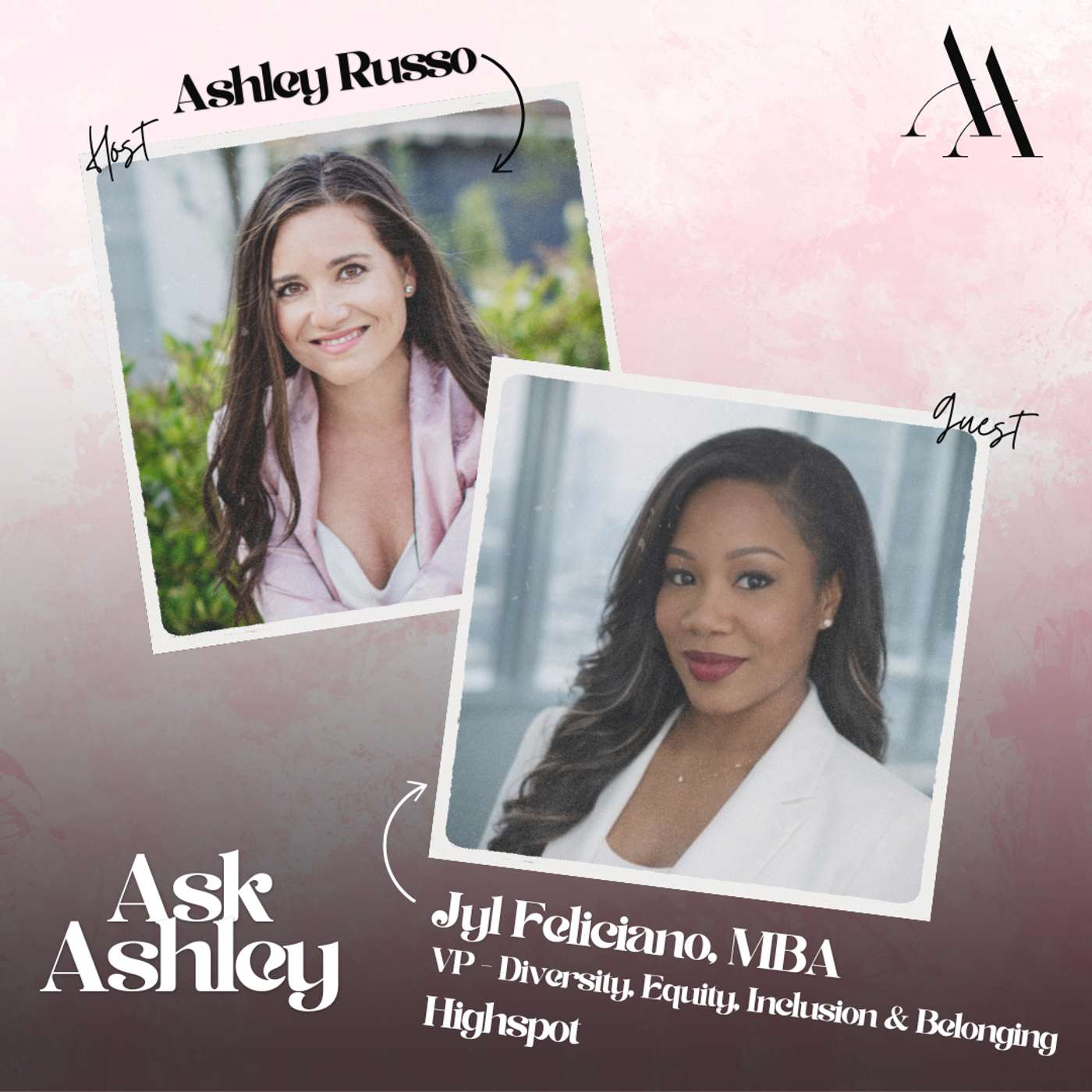 Finding Your Voice: Jyl Feliciano on Leading with Culture and BelongingAsk Ashley · on Mentorship66 / 100
 From Paralympic World Record to Daily Growth: The 1% Method with Mikael Avatar StjernvallThe Talent Forge · on Mentorship64 / 100
 Adi Bhoopathy, Managing Principal & Head of Capital Markets, Noble Investment Group, interviewed by Lan ElliottIt's Personal Stories, A Hospitality Podcast · on Mentorship64 / 100
 Ep 159: The Leadership Test Every Owner Faces with Dan Thieken and Ted CookeThe Limitless Leadership Podcast · on Mentorship56 / 100
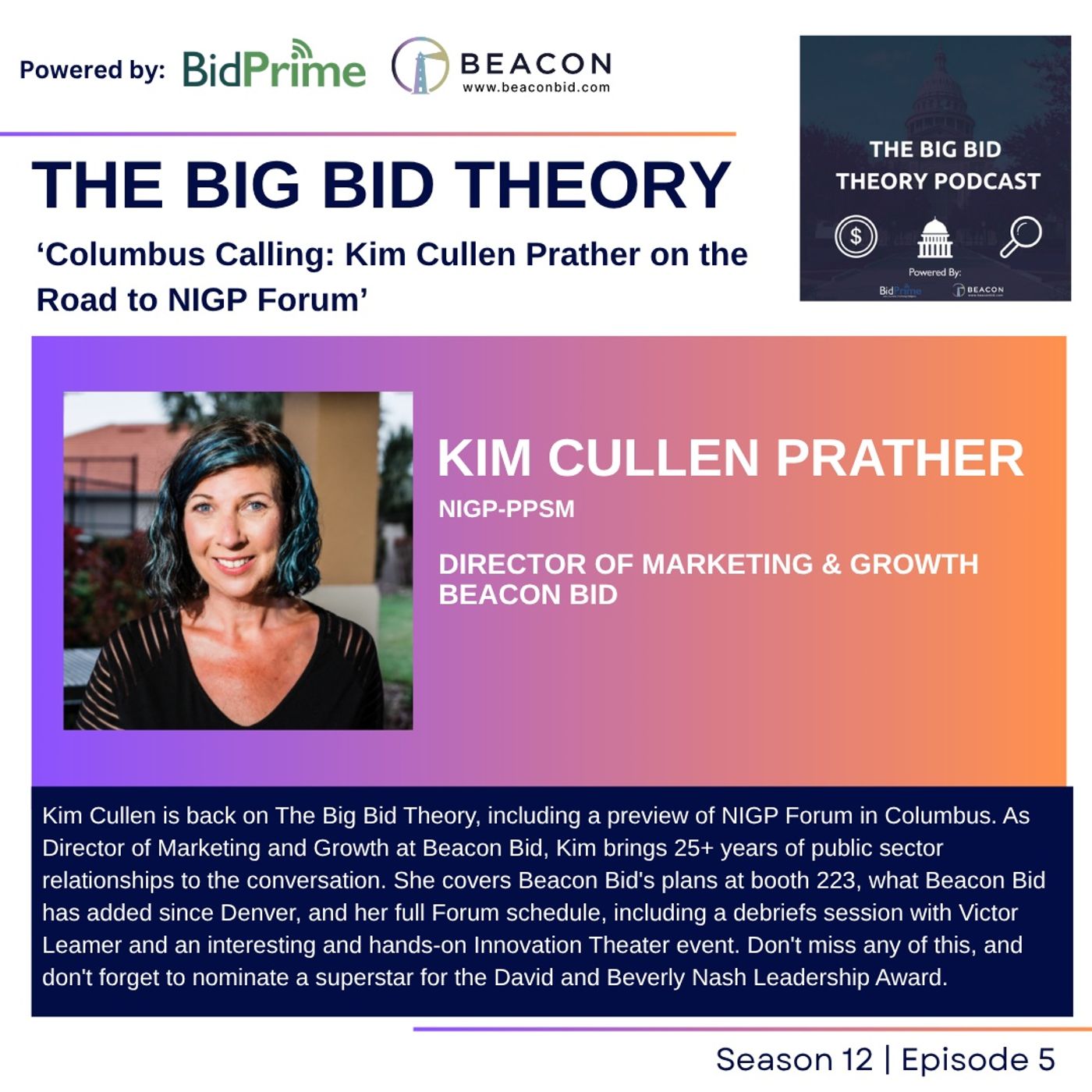 Columbus Calling Kim Cullen on the Road to NIGP Forum66 / 100
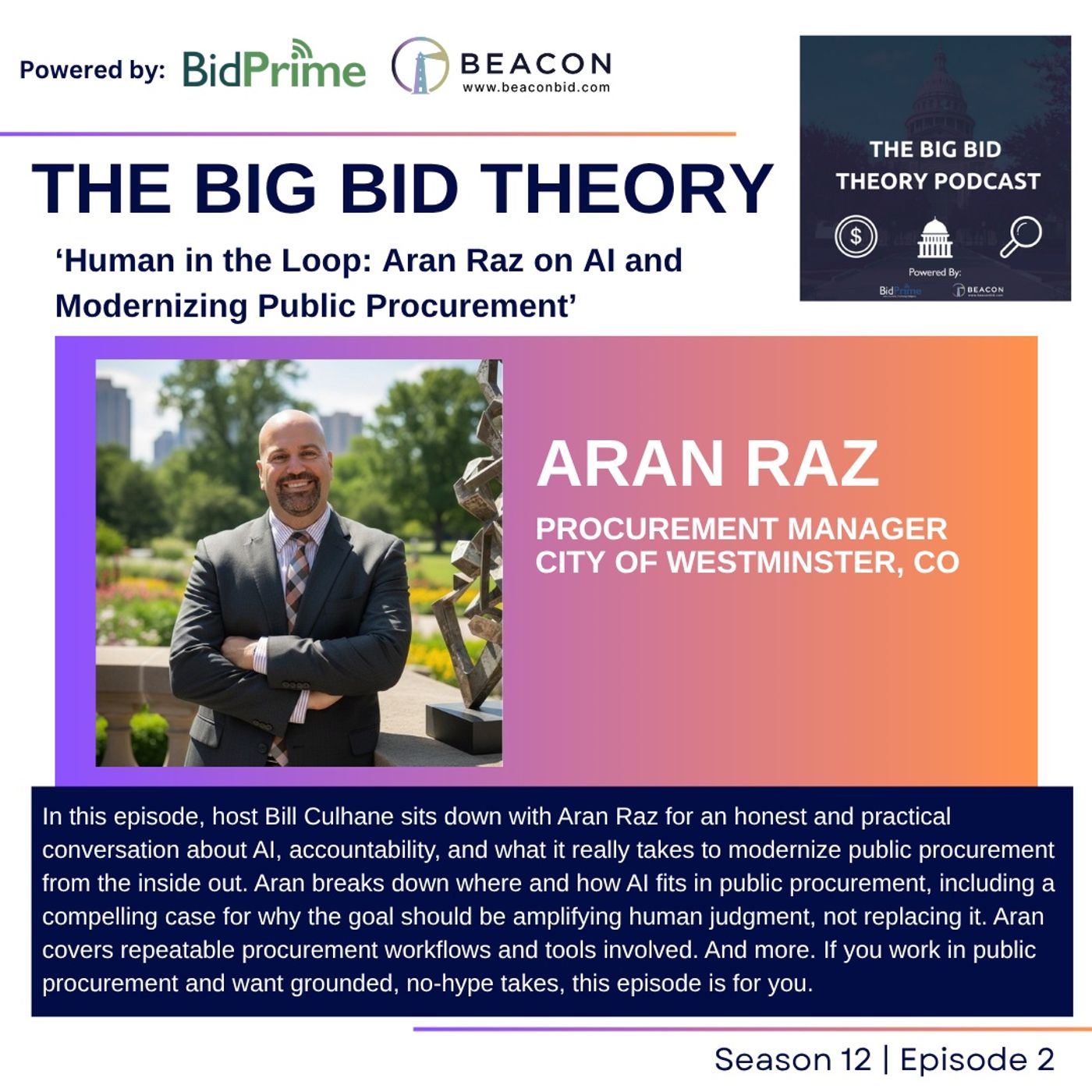 Human in the Loop Aran Raz on AI and Modernizing Public Procurement s12 e261 / 100
 Kim Cullen Prather on eProcurement, Debriefs, and Supplier Insights. Season 12 has launched! s12 e154 / 100
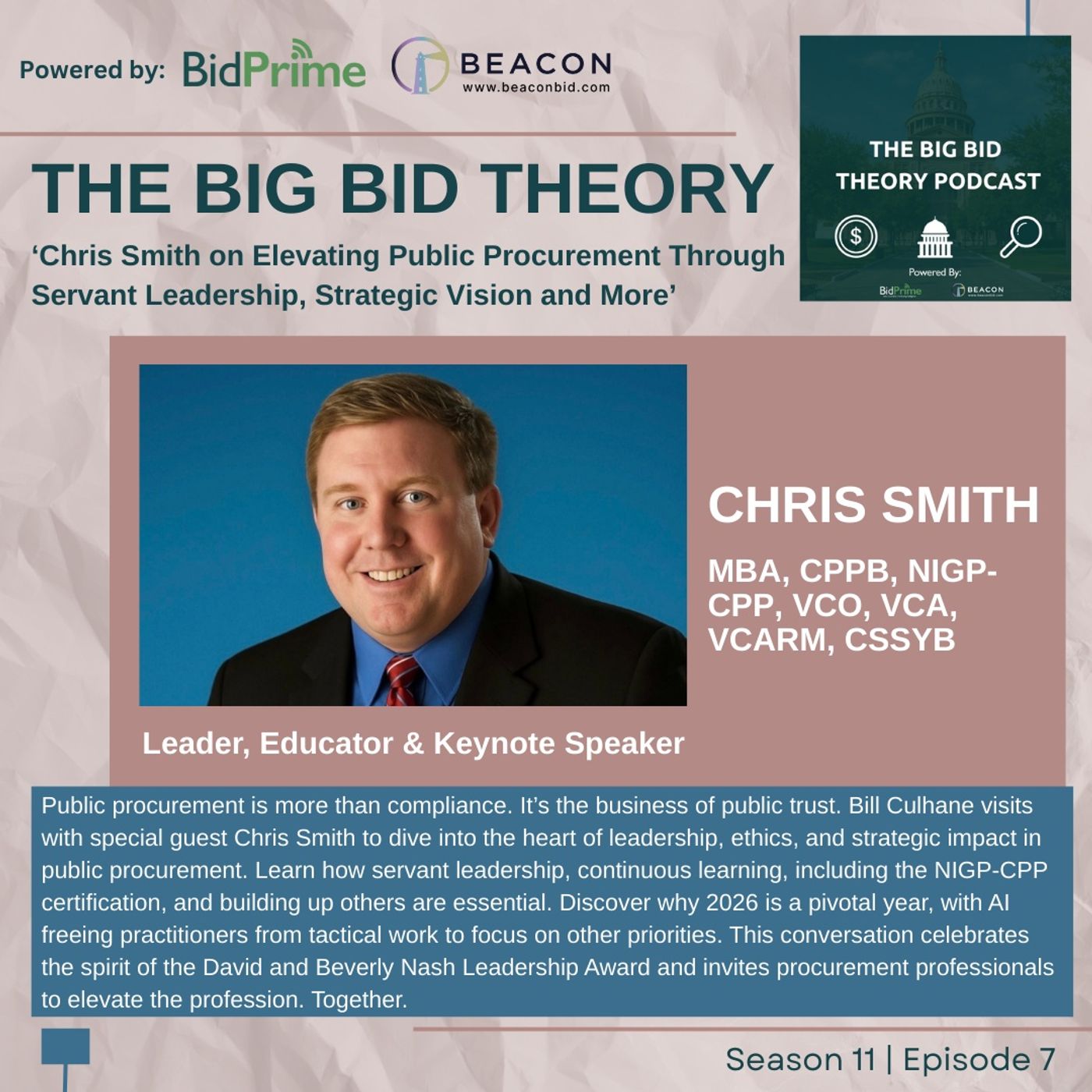 Chris Smith on Elevating Public Procurement Through Servant Leadership, Strategic Vision and More46 / 100
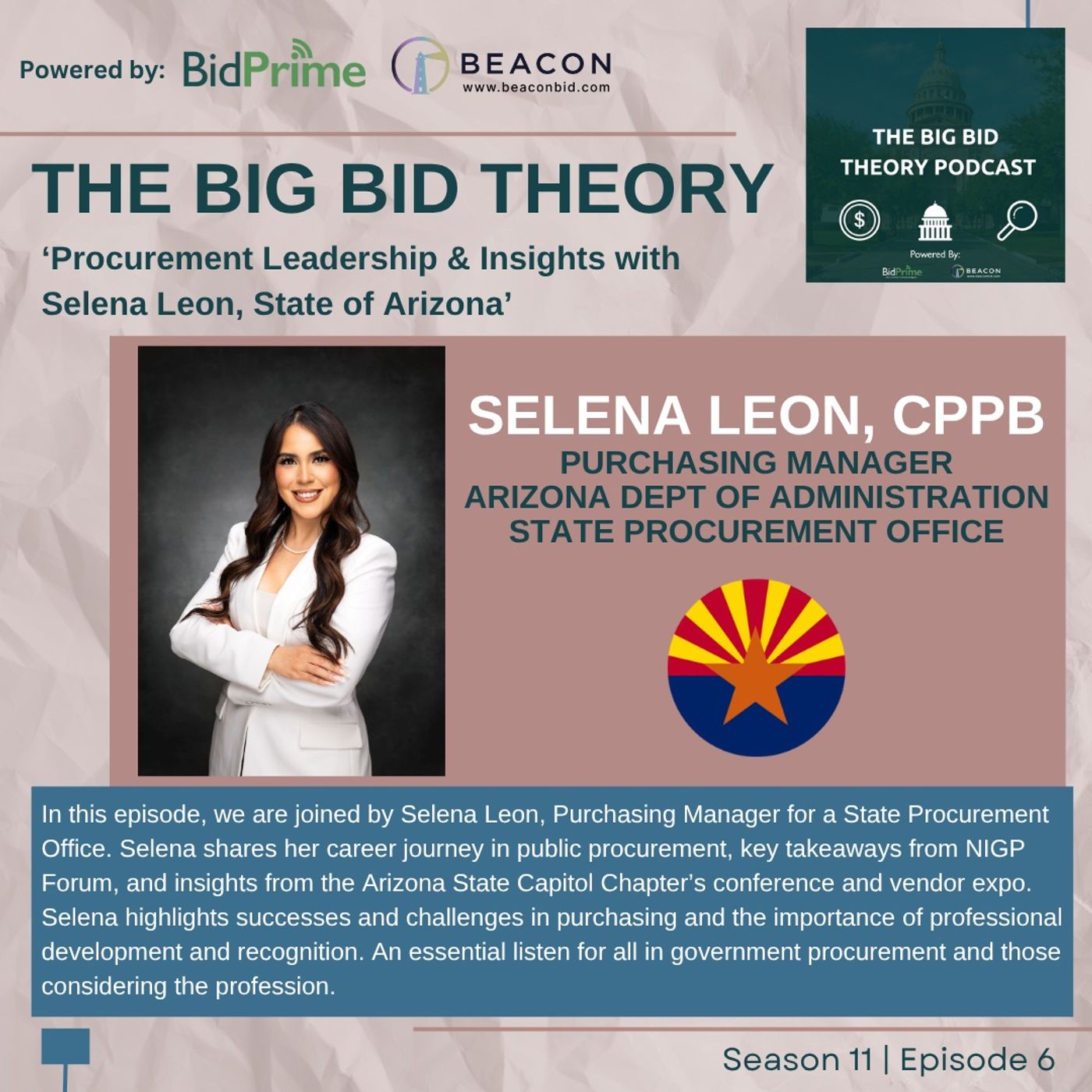 Procurement Leadership & Insights with Selena Leon, State of Arizona58 / 100