
The Bad Boss Brief Podcast · 2026-05-06 · 31 min
Key moments - from our scoring
Substance score
21 / 100
Five dimensions, 20 points each
The Bad Boss Brief hosts tackle three listener-submitted workplace challenges. First, they advise a 43-year-old public health professional laid off by Trump administration budget cuts, suggesting mock interviews to identify interview weaknesses, considering interim gig work (painting houses, construction) to maintain cash flow and emotional stability, and cautious skepticism toward paid job coaching that may be predatory. Second, they discuss "semaphore" - using signals instead of direct asks - drawing on personal anecdotes about gender socialization, neurodivergence, and workplace accountability. Eugene notes his difficulty reading indirect cues and shares a story about fighting for a Samuel Jackson cover story assignment he should have been asked to lead. Stephanie emphasizes that non-asks avoid accountability and often burden women who over-function without credit. Third, they address a part-time freelancer excluded from meetings across time zones and expected to deliver full-time output using AI, calling this exploitative behavior. Eugene references Sarah Horowitz's Freelancers Union as a resource and warns that companies exploit freelancers by hoping they'll sacrifice unpaid labor to prove themselves. Both hosts stress that bad-faith employment arrangements require exit strategies.
Get feedback on your interview performance from a mock interview with a coach or trusted person who'll tell you the truth about what you're doing wrong - everything from talking too fast to failing to articulate your value. Also invest in professional resume help (Eugene paid $300 for a resume specialist to help him downplay age-related cues), though be cautious of predatory services.
Yes - Eugene recommends it as a way to maintain cash flow, get out of the house, have a structured day, and create a neutral explanation (sabbatical, vision quest) for gaps. It's respectable work, you can undercut professional rates, and you maintain income without post-work emails or calls.
Tell them you need them to be explicit about what they're asking. Eugene, diagnosed on the spectrum, doesn't pick up on indirect cues and will skate through them until someone says 'I need you to do this now.' If you're struggling to read the signal, ask: 'What do you need from me?'
Stephanie traces this to childhood socialization to attend to others' emotional needs and read indirect cues. The problem is volunteers don't get credit, become resentful, and take on extra duties that prevent their own work - as her former boss advised, 'Don't ever do anything you're not asked to do because you're not going to get credit for it.'
This is deliberate exploitation by a bad boss - the company hopes your self-abnegation will rise so high you'll take all meetings unpaid. After a year with no real inclusion, you're being jobbed. Get out and look elsewhere; this isn't fixable. Check the Freelancers Union website for resources on protecting yourself.
Our reviewer’s read on each dimension, with quotes from the episode.
The episode is almost entirely generic career and emotional-wellbeing advice (mock interviews, exercise, avoid scams) with no novel frameworks, no data, and no B2B-relevant insights. The handful of personal anecdotes add mild colour but produce near-zero transferable density for an operator.
get out of the house, try to spend a certain amount of hours every day looking for work, uh, get exercise, move your body, be careful about the drugs and alcohol
you want to have somebody who knows what they're doing tell you the truth about every aspect
The 'semaphore' metaphor for indirect communication is the one mildly fresh framing in the episode; everything else - do due diligence, set boundaries, beware scams - is entirely recycled advice found in any generic career blog.
this notion of signaling your needs instead of actually asking for them, we see all the time
semaphore is the language where the way of communicating, where you use flags in different configurations
There are no guests whatsoever; it is two co-hosts answering listener questions. Neither host demonstrates deep B2B practitioner credentials in the transcript - Stephanie is a career coach/author and Eugene a writer-editor, and their contributions are largely personal anecdotes rather than scaled operational experience.
Welcome to the Bad Boss Brief. I am Stephanie Pierillo
I'm Eugene S. Robinson
There are a handful of named entities (InfoWorld, Code magazine, Carlos Watson, the Freelancers Union, Glassdoor) and one concrete dollar figure for a resume service, but no metrics, no timelines, no systematic evidence - just loosely relevant personal anecdotes.
I'm going to pay somebody else $200, $300, one of these resume companies to see what they could do for me
they laid off 80,000 people at Meta
The format is two co-hosts riffing on vague listener questions with no probing follow-ups, no productive disagreement, and frequent tangential storytelling; questions are never sharpened and claims go entirely unchallenged throughout.
That's a joker
That's terrible. But I guess for me, what I
Computed from the transcript - who did the talking, and the words that came up most.
We answer your questions on surviving a lay off, using your words and freelance vs full time foolishness. You, our favorite listeners, sent in some great questions and we get to some of them in this episode. How does a man who was laid off from his public health job after budget cuts do better in interviews? What happens when your boss or co-workers don’t use their words but expect you to anticipate their needs? Eugene and Stephanie have different experiences with and decide it is gendered. You’re freelance and left out of the loop by your full time co-workers. What can you do? Hint - working across time zones with an international team should never be this hard. Listen or watch now, and share this episode! As always, send us show ideas, comments or thoughts to wtf@badbossbrief.com . This is a public episode. If you'd like to discuss this with other subscribers or get access to bonus episodes, visit badbossbrief.substack.com/subscribe
Transcribed and scored by The B2B Podcast Index.
Speaker A: Foreign. Welcome to the Bad Boss Brief. I am Stephanie Pierillo.
Speaker B: And I'm Eugene S. Robinson.
Speaker A: And we are at episode 81, which we are calling you. Um, asked for it
Speaker B: for me. That always goes back to kiss. You asked for it, you got it Kiss. Or you asked for the best, you got it kiss.
Speaker A: So, so what we mean is that we're today going to be answering questions that you sent into us and again, always appreciate when you all send questions. Um, and so we've got a couple. We're going to cover as many as we can. Again, wtfadbossbrief.com, send us some more for future ideas and we'll start with this one. So this is a, um, reader, a listener who wrote in and said, what advice would you give? Someone who has worked in nonprofits, primarily public health and state government, is trying to find a job. Right? So his jobs have been cut. Um, he has because of Trump and the Trump administration. He says, I'm 43, live in the Midwest and only have a BA in history. I get interviews, but I keep getting kindly rejected for these jobs which I should be impossibly overqualified for compared to anyone else applying. I would be very appreciative of any advice assistant or anecdotes for a midlife Midwestern man. What do you think, Eugene?
Speaker B: That's great because I've got a daughter who was working for Health and Human Services kind of deal like ah, social work and she was just uh, laid off this week because, surprise, this is not a financial priority in a Trump administration. Taking care of your poor unwashed indigence, not something he cares about. So the budgets are going to be tight, uh, in that space where you are and um, if it's only something you're doing to make money, uh, I would gather that increasingly we're going to have to be aggressive about the ways in which we make money. Um, because for example, in the Bay Area, which I escaped from and no longer live, they laid off 80,000 people at Meta. And I thought that was a mistake at first. I thought, well, maybe they met 8,000. No, I was right the first time. And 80,000 is a huge number. You know, some would say that if you can lay off 80,000 people without damaging your business, those people may not have needed to have jobs in the first place. But ah, I disagree and I think that to recession proof, even the hardcore MAGA people I know believe that the market's gonna crash by the end of the year. Of course they believe it is the establishment out to get Trump, that's gonna cause it to happen. But they believe that by the end of the year the market's gonna crash. And I strongly suggest, and I kept this in my back pocket. Periods of unemployment, all of the service things that I knew how to do. Hanging Sheetrock, painting houses, moving furniture, um, construction were things that, uh, easy isn't that I get out at 5. I don't have money emailing me or calling me afterward. I get cash on hand and you can pay your taxes any way you like from that. Um, and uh, it's clean and respectable work. You're 43, you got lots of gas in the tank. And when it comes back to getting a work job in your field, to explain your absence, you chalk it up to you had a vision quest, you went traveling. Uh, you did, you know, you didn't go to prison. I don't want to say that. But then you, you spent some time, you, uh, had a sabbatical and that you were, you know, back, uh, uh, and you should never stop looking for a job. So that should have continued. That should have happened through throughout the layoff and, and up to now, this moment in very, this very moment in time. So that's what I would do. I mean, you can't, you know, you may. I don't care if it's an ego thing and you don't want to tell your family that, oh, uh, yeah, I'm m painting houses again or I'm moving for. Because people will pay for these things to buoy their, their self esteem and their feeling. I mean, if you can't do anything, paint your house. So, um, and you can undercut, I'm quite sure you could probably undercut the people who do it, who have been doing it professionally. So that's what I would do. It's either that or robbing liquor stores. No, no, no, no, no.
Speaker A: That's a joker.
Speaker B: Stores.
Speaker A: What I was thinking about is there's sort of, I think there's two pieces to having unemployment. First of all, I'm guessing if this, if this man has been working in public health, he is not motivated primarily by finances. Right. Uh, so that's just a guess. And I think these are the people that, where my heart really breaks. Right. Who are working in social services, who are working in marginalized communities. Education, lost their jobs. Right. So they're there for the right reasons. And we as uh, a, you know, country are not supporting them or the people that they were supporting. So I just want to name that, but I think there's Two pieces. I think there's an emotional piece in being laid off, like get out of the house, try to spend a certain amount of hours every day looking for work, uh, get exercise, move your body, be careful about the drugs and alcohol and you know, just try to be around other people, even if it's just going to a farmer's market and like be outside. So that's the one thing you need to pay attention to, your emotional well being. Because for a lot of people, they look for work for a really long time and it's exhausting and dealing with the rejection. The second thing is you talk about not, not getting jobs that you are overqualified for when you interview. And I think it's really important that we get advice and feedback from someone who will tell us the truth about all aspects of our process. Right. So if an interview is a particular problem for someone, what I will suggest is do a mock interview with another person. Right? So you could hire a coach or an advisor to do this with you. You could do it with a, ah, friend who has the wherewithal to tell you what you need to know. But there can be small things or large things that we do in interviews that we're not aware of, right. Do you talk too quickly? Do you talk? Not enough. A lot of people feel like they shouldn't kind of toot their own horn and so they don't really articulate the value that they have provided in, you know, in a particular way. And so there's, there's so many things where you could trip up in an interview situation. And I'm guessing if you're getting to an interview, you're probably, your resume is okay, how you're reaching out, like, you know, but you want to, you ideally, if you are unemployed and have been for a while, you want to have somebody who knows what they're doing tell you the truth about every aspect. Like you don't want to be losing a job because you have terrible body odor and you are not aware of it. Right. I mean like, that's an extreme example, but there are things that we just don't see about ourselves and you want to make sure that you've covered that. And then again to you know, Eugene's point, I remember being broke and I did get a job painting houses. That's what I did. Because I'm like, I can hold a paintbrush and people are going to pay good money for this. And you know, I went to work for a friend's mother in law who was a contractor and was like, okay, go paint these places. And, you know, I think recognizing what is a job that people will pay, that I have the physical capacity to do, understanding that it's an interim, um, you know, it's an interim situation. And then, you know, and then go do that. But again, I just want to name. It's very challenging to be looking for work, managing the emotions of looking for work, trying to make your money go as far as possible, and working a side job. So we're intentional and acknowledging that it's a heavy lift, but might help.
Speaker B: Yeah, and the numbers, I mean, somebody's going to be working. That means there's going to be some jobs available. So it's just, you've got to endure better, longer, harder, faster than the system that's allied against you. But one thing that kind of Stephanie touched on, and I've got personal experience with, you wouldn't think I have made my living. I've been getting paid for my writing since I was 14 years old. So putting together a resume should be the easiest part of it. And finally, at one point, I decided, you know what? I'm going to splurge. I'm going to pay somebody else $200, $300, one of these resume companies to see what they could do for me. And they asked a question that I thought was incredible, and they go, what are you hoping to achieve with this resume? And it was assumed that we both were speaking the same language that we were talking about, well, I'm hoping to achieve employment, but what would you like this resume to do? And I said, well, in a very specific way, I would like to conceal how old I am, this resume. And I hate to say it, but they turned in two pages that were, well, you know, well worth the $300 I paid and that I never in a million years would have come up with myself. And this never would have done it. I. I would never have sold myself this way. I would never have. I, uh, would never. And I've seen examples, and I'm, you know, studied. I've been in a hiring position, seen lots of resumes, lots of different formats, but it was really well worth the money. Um, you know, you could say, how many jobs did I get off of that? Well, it doesn't. That's not the point. I got one. So.
Speaker A: Right.
Speaker B: It was enough. But it was a worthwhile expenditure. It was a gamble. I think that paid off. And so what Stephanie was saying is, you know, get help. Uh, there's help out there. In my case, I had to pay for it. Which is kind of only really the help I respect, but, uh, um, but it was worthwhile.
Speaker A: Well, but I will also add a caveat to that, which is a lot of people, when they are unemployed, are told or think, I'm going to go to work for myself. And I see this as a person who has worked for herself for a dozen years and you know, done pretty well for most of that time. It is a very challenging, uh, enterprise and it takes a while before you start seeing money. And so, you know, if that is a viable career shift for you if you are fortunate enough to have a year's worth of savings in the bank and a spouse who has employer provided healthcare. Yeah, but I, my concern is there's a lot of people who are told, well, you know, I really enjoy photography, I'm going to become a photographer. That, that may be a legitimate dream to pursue. But do not underestimate how much time it's going to take for you to make money, if you even do. And also, you know, your experience, Eugene, of paying someone a couple hundred bucks to redo your resume and having good luck with that. I, as I've mentioned before, paid some people to help me with like PR and publicity for my book, which came out actually a year ago, um, this month. And I might as well set the money on fire in my backyard for all the value I got out of it. You know, so there, there are a lot of people who are, you know, looking to scam you by saying, hey, pay me $5,000 and I'll teach you to have, you know, this, that or the next thing. And you know, and this idea that is really prevalent that like, if you can get a bunch of followers on social media, yeah, yeah, that'll be a job. And you know, unless you're taking your clothes off, that's really not a very good reason. And you have to be taking your clothes off in a very specific category in order to make, to make money with that. And so I just, I think you also need to have a little bit of buyer beware, because you know what, And I've, I've been unemployed and looking for work. You are vulnerable and there are people who prey on, you know, those people who are looking for work. And so just just be careful. Hire people who are being realistic. Make sure that you're being realistic. And again, I mean, this is very self serving. But I do have to say I wrote a book called the Saint the Drunk about making decisions about your career. And there's some exercises in there that I think could Be really helpful, especially for people who are considering. Do I have to leave the career that I've had for whatever reason, and find something else to do? How do I do that without just sort of throwing darts at the wall? And I have a process in my book for that.
Speaker B: Chuck Dukowski, formerly of Black Flag and used to be at SST Records, said something when we had a record out on SST Records from my band and said something. I thought he said, well, what do you want to do about public relations pr? I said, well. And he goes, listen, let me just interrupt. And if the person approaches you about doing pr, they are to be avoided. They're selling you something, right? Figure, uh, out who the best is. Talk to your friends and see who they like, and then you approach them. These are the people that you can trust. And so I've latched onto that over the years. It's like anybody approaching me for stuff, right? The first thing I say is, is it free? It's not free. It's okay. I'll look at it on my own. Thank you.
Speaker A: Yeah, exactly. All right, so the second question is from a commenter who was, uh, reading my substack a couple of weeks ago. And usually we don't double dip. We both have substacks. We both have other, you know, you have other podcasts. But I thought this was a good one for a double dip, because the. The substack that I wrote was called no More Semaphore. And I was talking about the frustration at work of people who ask you things without asking. And one of our commenter, one of the commenters who watches this show said that would be a great thing for you and Eugene to talk about. And I think he probably wanted your opinion on this. But, uh, just to clarify, semaphore is the language where the way of communicating, where you use flags in different configurations. Right. And that would be how ships would communicate with each other before there was the advent of technology that allowed you to talk to them directly. And this notion of signaling your needs instead of actually asking for them, we see all the time, right? So you think of. You think of someone in a domestic situation who says, I'm thirsty, as their partner walks into the kitchen, as opposed to, hey, can you bring me a glass of water? And there's lots and lots of ways in which this happens at work, from bad bosses or challenging employees, and for a variety of reasons. But it could be something like, I'm busy, as opposed to, I need help with this. Can you take this project off my plate? And people do it for a variety of reasons. But what do you do when you're faced with a non ask ask.
Speaker B: Well, um, I'm as diagnosed by my children on the spectrum. Like, I was smiling when you were talking about. Because I almost. I was remembering almost getting stabbed by an ex girlfriend before we were boyfriend and girlfriend. Because she was telling me, I like you. I'd be like, yeah, I like you too. She was like, no, no, I like you. I go, and I like you.
Speaker A: I just wasn't.
Speaker B: I wasn't getting it. And she actually, at one point was so frustrating. She's walking around her apartment with scissors with this intense look on her face. And I was like, okay, now I know something's going on. And I said, what's going on? You need to relax. I felt my spider sense was tingling. So in a work situation, I've done very poorly with non ask you got. And people, um, at one point they. A job that I ended up getting. They called one of my references the guy who had been managing editor of New Times, you know, which published the Village Voice and the LA Weekly and so on. And they said, what kind of management style works best with Eugene? And he thought for a second, he goes, not for too long. But he goes, a creative one. It's mostly because I'm fully engaged in doing what has to be done. But you got to tell me, I'm not. I'm not the guessing guy. I'm not a mind. I'm not Kreskin. I'm not picking up on these cues. So typically, uh, when faced with non ask, I just skate right through them until somebody says, I need you to do this for me right now. And I go, oh, okay, cool, sure. I mean, I had that unfortunate incident at Corporate Computing magazine where the boss had asked me to do something for her. And I said, well, I'll do it when I finish this thing. And she walked back to her office, grabbed a phone book, walked back over and slammed it down on my hands, which were on the keyboard. Do it now. Um, I clearly didn't get that she needed it done now, but she communicated really badly. And that got a result in bad response from me as well. We never worked together after that.
Speaker A: That would be a bad, bad boss. Gold star on that one.
Speaker B: Yes.
Speaker A: That's terrible. But I guess for me, what I. I'm coming from a different perspective, which is I was deeply socialized to attend to the emotional needs of the people around me and the expectation when I was coming up, you know, working in the generation that we are in. Is that the. I was supposed to respond to the non. Ask, ask. Right. That I was supposed to respond to. Um, that. And you know, as I've gotten older, I've realized, like, that's, that's very counterproductive. And I think it's counterproductive in a couple of ways. Like one is it allows people to avoid the responsibility of actually asking for something. Right. So asking for. I. I need help with this. Will you do this assignment for me? It is by naming it. There's an accountability. Right. Whereas if. Because a lot of times, and I've seen this many, many times, and it's almost always a woman who is volunteering to overflow.
Speaker B: I was going to ask if there was a gender component.
Speaker A: Totally. I mean, not, not always. But mostly it is a woman who will volunteer to over function and do something for someone else. Sometimes without even being asked. But sometimes with this kind of semaphore, I'm signaling that I would rather have you do this thing. They'll jump in and then a couple of things happen. They don't get credit for it and they end up getting resentful or they take on additional job duties so they're not able to do the things that they were supposed to do. Right. One of my bosses once said, don't ever do anything you're not asked to do because you're not going to get credit for it.
Speaker B: Yeah. Wow.
Speaker A: And I don't know that I 100 agree with that, but I do think that it is. You know, and if you are a woman who's listening to this, think about how you grew up. And if you grew up around people who didn't use their words. Right. And again, it's social. Like, I was noticing my grandson, who is all of four years old, will sometimes walk in and be like, I'm hungry. And I will say to him, what would you like me to do about that?
Speaker B: Yeah.
Speaker A: Right. Not because, I mean, he's four, but also to just be like, I'm gonna start right now with the assumption of like, I am interested in your statement of what is happening. How can I help you with that? And he will think about it and then he'll be like, can I have, you know, a banana? Can I have some yogurt? Like, whatever. Which is good because I'm also inviting him to be like I am.
Speaker B: Participate in the.
Speaker A: Interested in your agency and what you would like to consume. Right.
Speaker B: Now, I remember when I was at Code magazine. Ah. And the woman who put it together was somebody from Conde Nast. And, um, she walked into my office and said, um, I need you to find a writer for the debut issue cover story with Samuel Jackson. Uh, can you think of anybody? And I go, let me think about it. She gives me a weird look and leaves my office. And I'm like, what? And I'm. Now I'm forced into some momentary reflection. I go, you know, I'm a writer. You know, I'm editor in chief. Why wouldn't you ask me to do it? Why? What just happened? And then I got irked enough where I stood up and I pulled a Dick Cheney, which, not to say I shot her while hunting, but I walked into her office and said, um, I found the best person for the job and that is me. And she goes, I wondered why you didn't say anything. This was like terribly misleading. You asked me like you didn't want me to do it, you know, so you put me in a position where you want to see if I would fight for it. That's a stratagem that fails with me. I'm a fighter for fun, but not for that kind of stuff. But in that instance, it worked. I was the best person job, actually. So. Well, and that's. Language is very strange.
Speaker A: Well, and it's also, I try to try to, and advise people to, you know, be intentional about language. Make sure you understand what is being asked. Make sure you are clear about what it is that you are willing to do. Right. Like, these assumptions can often really derail projects and challenge, you know, careers. If you make an assumption about what it is that you're doing, there's no reason you can't just quickly be like, okay, so let's just. Next steps. You're going to do this thing. You're going to do this thing. This is what we're all doing. And it's going to be done by this, by this date. So, yes, the non ask ask is a no, no and to be avoided at all times. All right, so our last question was about. It was from someone who is a freelancer. And, and they wanted us to talk about some of the challenges of BEAT that can happen between freelancers and FTEs or full time employees. Uh, they were talking specifically, how do you navigate the tension between freelancers and full time employees? And then the listener who wrote in talks about only working part time but being expected to do a tremendous amount of work part time because, well, you can use AI. But then she's left out of the loop on meetings, reviews and other information. So she can't work as effectively. And she said that a lot of the challenges she's working with an international team and so people are working at very different time zones. And so sometimes she's left out of meetings because it's the middle of the night her time. But she talks about like kind of what do you do in those circumstances. Do you have any thoughts for her?
Speaker B: Yeah, this is a sleazy, terrible, sleazy company that you're working for because you know, after a certain point there's a friend of mine, Sarah Horowitz, and she's the one who won a MacArthur Junior Genius Grant for starting the freelancers union. You should go to their site and give it a read through. There's some interesting stuff there about how to apply yourself as a freelancer amongst full time employees. But this is, this is garbage. What they're hoping to do is that your level of self abnegation will rise so high that you'll say I'll take all the meetings, I'll do this because you're worried about your freelance books and do all this non remunerated stuff to make them happy. I, you know, I mean you, you are uh, like a substitute teacher. You're a bit player. And usually the people who are in your position are there for really good reasons. Like they have, they, those are their plan B's. Their plan A is something else that they're doing with their time that they really want to do. Um, and uh, if after a year they haven't made you part of the team, you're being jobbed, exploited is what I'm saying. Um, and the full time employees know that you're like Cinderella. They will abuse you if given the opportunity. And it's not necessarily malice either. If the company is understaffed and these people oppressed and they're shoved up against the wall, well that's what you're there for. But um, it's not uh, like one person once said, uh, about fighting. They said it's not a long term career goal. So you got to get out. You got to get out.
Speaker A: Right? And you know the, I want to name too, that this is really bad boss behavior. So this is an inexcusable setup. There are many, many tools, they're not even that expensive that organizations use to manage asynchronous workflows. There are plenty of international teams. I work with some of them. And there are many systems where you can do everything from recording little short videos to working on documents together to project management updates. These exist and they have existed for Years and years. So if there is not a system in place to facilitate coordination between teams in different time zones and then, you know, whether they're full time or freelance or whatever, that's a huge. That's, that's a huge problem. Right. And I understand, I mean, again, I work for myself and I understand that you want to. Somebody offers you a job and you feel like you have to take it if things are slow. But I always try to do some due diligence because what happens is, is that these jobs suck your soul and they also take away from your ability to pick up the next job, which could come in, in, you know, two days, two weeks or two months. And if you're busy because you're stuck with this horrible one and figure out what your kind of yardstick is. Right? So for me, I look at, you know, do I think these people are going to pay me? Are they paying me a reasonable rate? Um, and I will ask, like, how do you coordinate what is. What are the expectations? Right? Like, and I don't, you know, and again, there have been, there have been jobs that I have taken where I am working with an international team. And I know that at least once a month I'm going to be getting up really early or staying up really late, having a call with India, because that's how it's going to work, right? And I can fit in Australia in the afternoons. And, you know, and. But I know that going into it and I'm signing up for it. And I think too, with the understanding of, like you mentioned, the reader mentions, that there's an expectation of her productivity that's connected to her use of AI, you know, and to me, that's one of those things where it's like, yes, of course, if an organization has guardrails around how we use AI and how we use, you know, if there's workflows or templates, absolutely use those things. But if they're assuming that she's her workflow is her own internal AI process, then that's something that also needs to be clarified. Right? Because if they're expecting that you can turn around something in, you know, 15 minutes with a good prompt, um, then why are they not just doing the prompt? Correct, Right. And then there also comes a point where it's like, how I do my business is not any of your business.
Speaker B: Right?
Speaker A: Like, if it takes me 15 minutes to write something and it's worth $5,000 to you, then you should pay me $5,000. It doesn't matter how it, how it all comes together.
Speaker B: It's also, I like your due diligence part because I was about to take a job. I feel comfortable talking about the company at this time, InfoWorld, which you've seen, it was a newsprint, large format newsprint, computer journal from the Valley. And Michael, who was the executive editor, I don't even remember his last name at this point. He said, uh, look, why don't you come into the office and I'll give you a tour. And I wasn't going to do it because I didn't really believe in due diligence. They pay, I'll take the money, I get paid, what do I care? But I went through the office, and I was so glad that I did because I felt like I was walking through San Quentin. None of the people there seemed happy. They all seemed pressed to the wall, the grindstone or whatever analogy works for you. And I declined the job offer specifically because I could. Uh, the waves of unhappiness that just washed over me. And since then, I've been religious about doing due diligence. And that's what Glassdoor has been, uh, really solid. Yeah.
Speaker A: Well, and the last thing is you teach people how to treat you.
Speaker B: Yeah.
Speaker A: And so walk into any new gig and be really clear about that's going to need to be in the folder an hour before, you know, like, like, this is my timeline. This is how I communic. This is what I need. And the, like, oh, my gosh, the emergency is happening. I need you to be on a call at midnight your time. I'm not available.
Speaker B: Uh, somebody I know famously did that with convicted felon Carlos Watson. They've been hired by him to do something incredible. And you said, no professional will say yes. They can do this. And I'm a professional, and I won't say yes to this. And of course, this was Stephanie with convicted felon Carlos Watson. And, uh, um, the. I think the chairwoman of the board called you. And your line, which I loved and I used in other circumstances, was, look, all I told him was no. That was the period. Close quote. Perfect.
Speaker A: Uh, but I think, you know, no is a complete sentence. But also recognize that I no longer worked for Watson soon after that, which I do. I mean, that was a mutual choice, Like, I wasn't going to continue to participate in this. But there is, you know, there is a cost. Right. And I also want to name the fact that some freelancers take jobs that are terrible because they need the money and. Or they need the experience, or they're getting something else. Out of it. And so I don't want to in any way shame someone who isn't in a position to set those boundaries. But you'd be surprised, right? And setting the boundaries, being clear about how you're going to work, how much time you have, what extra work you're going to do. Because one of the things. One of my biggest frustrations is I hate to see people whose boundaries are trampled by the bad bosses they work for.
Speaker B: Right.
Speaker A: Even just watching a TV show about it. I have a friend who is in that situation right now, and every time she calls me, I'm just like, uh, you know, and again, like, she has reasons, and I understand that, and I want to be a supportive friend, but inside I'm like, leave your job. At the end of the day, you know, it's like, you tell her that
Speaker B: story about the guy with the brick in the warehouse house. That might make her. That might make her happy.
Speaker A: I'm gonna be the guy with the
Speaker B: brick in the warehouse.
Speaker A: I'm gonna be the one. Like, I want to get you. All right, that's all we have time for. Thank you very much to everybody who sent in questions, comments, ideas, keep doing it. WTF? BadBoss Brief.com I read everyone and respond. Um, unless you're, you know, selling us something. And, uh, until then, we'll see you in a couple weeks. Bye.
Speaker B: Adios.
Speaker A: Thanks for joining us for another episode of the Bad Boss Brief with Eugene S. Robinson and Stephanie Pierolo. You can find Stephanie on substack@spayrolo.substack.com and you can find Eugene on substack@eugenesrobinson.substack.com as well as over on Instagram at the end. That's the number three. If you've got a workplace question, situation, or story you'd like us to discuss, send it to me, Stephanie at wtfadbossbrief.com Be sure to join us every other Wednesday at, uh, badboss brief.substack.com for new episodes. Until next time, don't be an asshole at work. Thanks for listening.
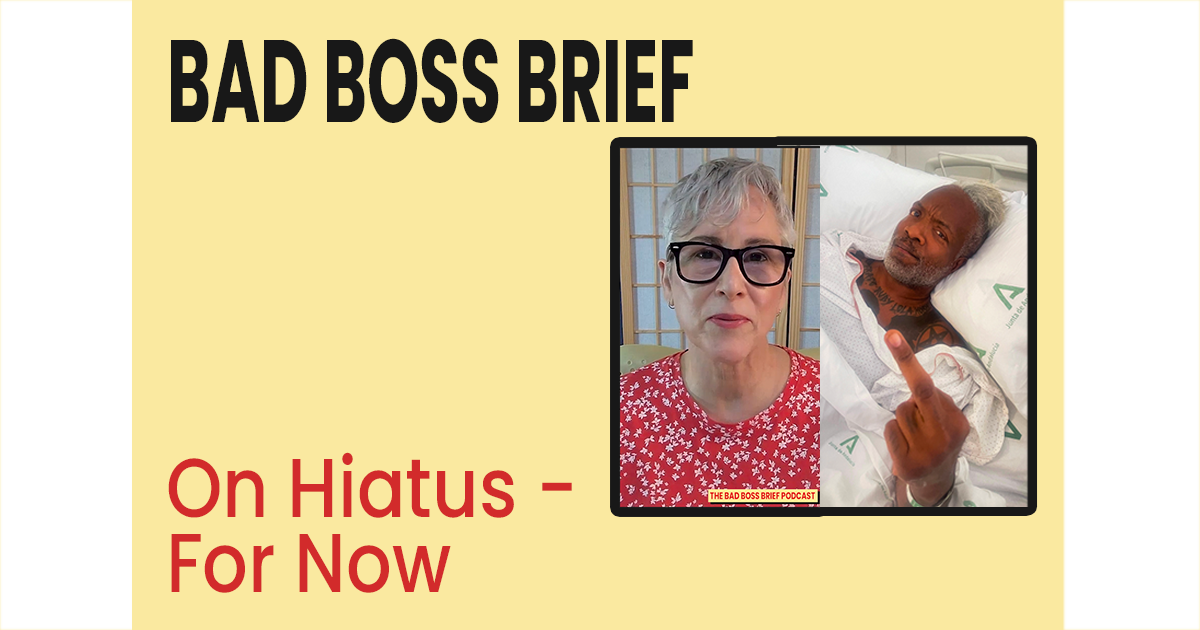 On Hiatus - For Now 20 / 100
 EP 85: The Fear And Work Show76 / 100
 EP 84 The Man/Woman Show42 / 100
 EP 83 Judgement Day47 / 100
 EP 82 Do You Want to Know44 / 100