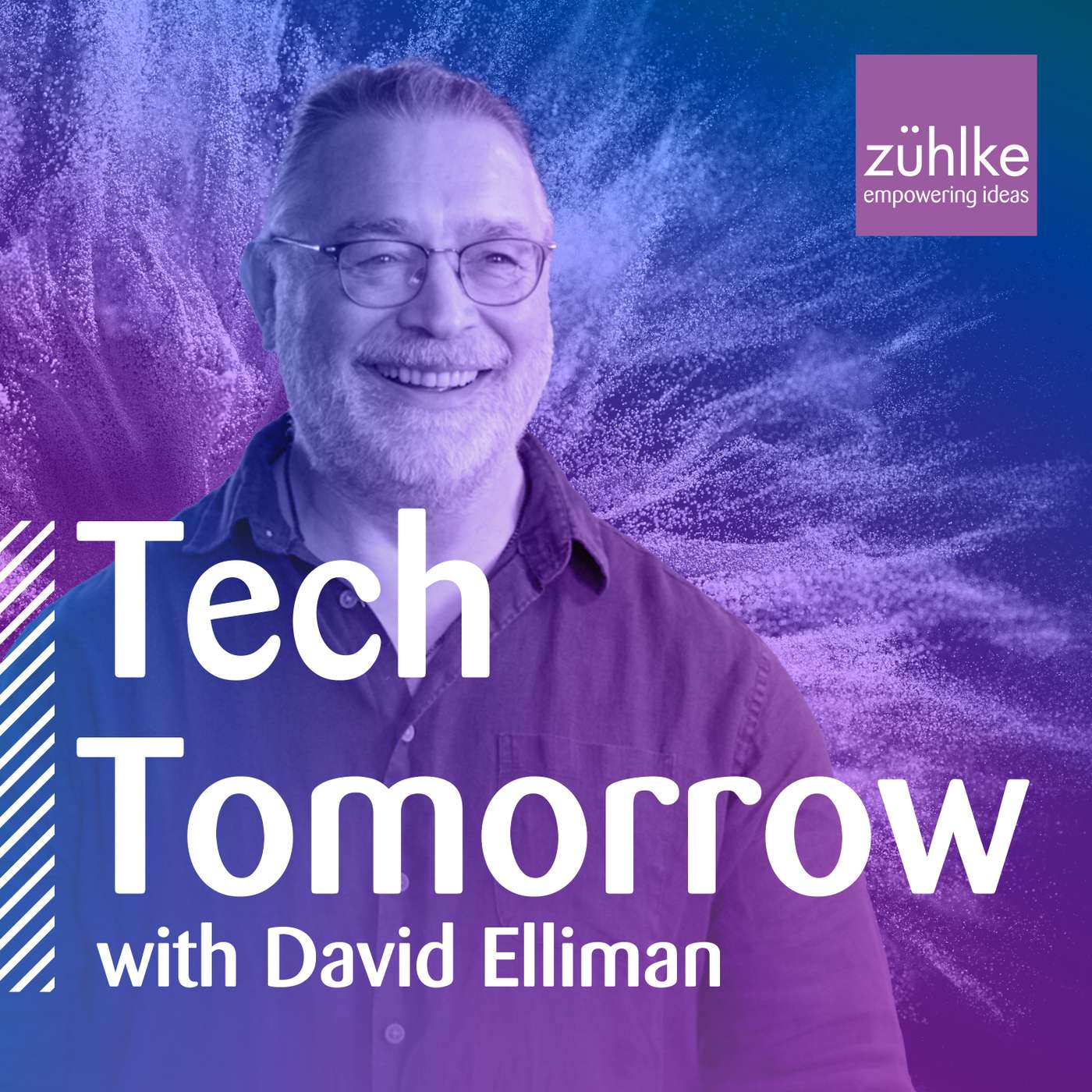
Hosted by Zühlke
Listed under Technology, Business
Tech Tomorrow is your front-row seat to the conversations redefining the future. Each episode explores one big question about data, AI, or emerging tech, giving leaders clear, focused answers they can trust.
32 episodes · publishes fortnightly · latest 2026-06-23 · ~22 min/episode
Rank
#176
Substance
78.3
/ 100
Breakdown
Scored 2026-08
Updated monthly
Across the index
#176 of 1878
Substance
Top 9%
outscores 91% of the index
Tech Tomorrow ranks #176 on The B2B Podcast Index with a substance score of 78.3 out of 100, scored across 4 recent episodes. It scores highest on guest caliber and insight density. Fruchterman is a highly relevant, battle-tested practitioner with 30+ years of direct experience building a nonprofit tech company to $5M+ revenue - exactly the kind of operator who has 'done the thing.' His credibility is earned through specific outcomes, not theoretical framework-building. His perspective as both a failed venture founder and successful nonprofit founder gives him rare, cross-domain legitimacy.
Averaged across 4 recently scored episodes, with cited evidence.
The episode contains several substantive, non-obvious insights about the structural differences between for-profit and nonprofit tech models, particularly the counterintuitive claim that 80% of tech companies grant free licenses to nonprofits and the explanation of why (pride in craft, not greed). However, significant portions involve throat-clearing, extended storytelling without new insight, and restating the same core thesis multiple times rather than deepening it.
“they say yes, 80% of the time. And people go those greedy so and so's why. And I'm like, they're immensely proud of the products they've created.”
“the answer is the one that will work best”
Fruchterman presents a genuinely contrarian observation (tech leaders' generosity driven by pride, not altruism) and the specific strategic framing of nonprofits as serving markets that for-profits have abandoned. However, the broader thesis - that nonprofits can adopt business practices, that profit and impact can coexist with the right structure - is well-trodden ground in the social enterprise space. B Corps, Pledge 1%, and 'mission-driven' tech company frameworks are all established concepts, not novel.
“tech for good as centering the good in tech rather than the profit in tech”
“you choose the corporate form that like is the most effective in reaching your goals”
Fruchterman is a highly relevant, battle-tested practitioner with 30+ years of direct experience building a nonprofit tech company to $5M+ revenue - exactly the kind of operator who has 'done the thing.' His credibility is earned through specific outcomes, not theoretical framework-building. His perspective as both a failed venture founder and successful nonprofit founder gives him rare, cross-domain legitimacy.
“serial social entrepreneur”
“And that was over 30 years ago”
The episode includes concrete historical examples (OCR reading machines for the blind, the $5M nonprofit revenue, the 75% hardware discount, Microsoft/Oracle/Salesforce clawing back licenses) and specific numbers ($1M market size estimate, $25M invested, 80% licensing rate). However, many claims lack supporting detail: the '80% yes rate' is asserted without methodology or sample size, the 10-20 year gap claim is vague, and most discussion of other companies remains anecdotal rather than evidenced.
“maybe we're at 15 million a year”
“within three years, we were a $5 million a year break even charity”
Host Ellerman asks reasonable setup questions and provides a useful contextual commentary bridge, but rarely pushes back, probe deeper, or challenge Fruchterman's framing. Questions are largely open-ended invitations for Fruchterman to elaborate on his own thesis (e.g., 'what happened and what did you learn') rather than adversarial or probing. The host's own commentary segments sometimes overshadow the guest, and there are no moments of genuine productive disagreement or pressure-testing of claims.
“So that, that sort of journey from your experimentation, discovery of OCR and its applications, and then I guess making that choice between profit and non profit, how did that pan out for you?”
“I'd just love you to expand on that a little bit”
2 periods tracked.
4 scored on substance · 32 tracked in total.
Are leaders deploying AI faster than they can effectively govern it with Zahra Shah
2026-06-23 · 23 min
Is it possible for tech for good to exist within a for-profit model with Jim Fruchterman
2026-06-09 · 22 min
Can executives balance AI innovation with societal responsibility with Lord Clement-Jones
2025-11-25 · 27 min
Will AI and digital twins make animal testing in drug discovery obsolete with Professor Julie Frearson
2025-11-11 · 24 min
Add this badge to your site - it links back here and updates automatically as you rank.

<a href="https://index.fame.so/show/tech-tomorrow" target="_blank" rel="noopener">
  <img src="https://index.fame.so/badge/tech-tomorrow/badge.svg" alt="Ranked #24 on The B2B Podcast Index" width="360" height="136" />
</a>Track Tech Tomorrow's rank
Get an email whenever this show moves up or down the Index. Monthly at most, no spam.
Companies, products and tools that come up most across this show's episodes.
The themes that come up most across this show's episodes.
Podcasts that dig into the same topics.

What’s the BUZZ? - AI in Business
Andreas Welsch

SaaS Scaled
Qrvey

AI Proving Ground Podcast
World Wide Technology: Artificial Intelligence Experts
Moody’s Talks: Risk Reframed
Moody's Analytics
Cyber Sentries: AI Insight to Cloud Security
TruStory FM

The Changing State of Talent Acquisition
Graham Thornton



