
NORTHBOUND: Executive Leadership Coaching · 2026-02-18 · 28 min
Key moments - from our scoring
Substance score
16 / 100
Five dimensions, 20 points each
Chris Sanchez, host of Northbound Executive Leadership Coaching, uses General Theodore Roosevelt Jr.'s D-Day landing at Utah Beach as the centerpiece for a masterclass on decisive leadership when plans fail. Roosevelt, 56 years old and walking with a cane, landed with the first wave on June 6, 1944 - but currents pushed the troops a mile south to Victor zone instead of the planned Uncle Red zone. Rather than hesitate, Roosevelt declared, "We'll start the war from right here," adapting immediately and ultimately achieving better outcomes than the original plan would have allowed. This action study identifies eight traits of decisive leaders - competence, courage, servanthood, security, responsibility, initiative, character, and commitment - while emphasizing that decisiveness is built through preparation, not discovered under pressure. The episode is essential for CEOs, operations leaders, and team managers who face unexpected obstacles and need frameworks for staying calm and moving forward. Sanchez provides concrete action steps: boost skills through mentorship and study, define your identity and responsibilities, practice fast decision-making (assess-decide-act), and build courage through hard conversations and boundary-setting.
Rather than hesitate or wait for new orders, Roosevelt declared "We'll start the war from right here" and immediately adapted the mission plan, ultimately discovering the alternate landing zone (Victor) had lighter enemy defenses and caught German forces by surprise, resulting in a better outcome than the originally planned landing zone (Uncle Red).
The eight traits are competence, courage, servanthood, security, responsibility, initiative, character, and commitment. These traits enable leaders to make bold, timely decisions without hesitation, especially when plans break or conditions are imperfect.
Leaders build decisiveness through preparation by chair flying (running through different scenarios beforehand), boosting skills to build confidence, knowing their identity to build security, taking ownership to build trust, and practicing small decisive decisions to build momentum.
Leaders don't just rise to the occasion - they fall to the level of their preparation. When plans break, if leaders haven't prepared by studying hard problems and knowing how to respond to different scenarios, they will fail worse. Strong preparation acts as a foundation that catches them when things go wrong.
Leaders should assess the situation, decide what action to take, and then act upon that decision - not just decide and let it sit. They should track how long each phase takes, then measure improvement on the same decision type over time to strengthen their speed and decisiveness.
Our reviewer’s read on each dimension, with quotes from the episode.
The episode is almost entirely composed of generic leadership platitudes recycled around a single historical anecdote. The ideas-per-minute rate is extremely low, with significant repetition and throat-clearing between each point.
bold, timely decisions create opportunity. When you are indecisive and you can't decide, you, you will lose opportunity.
Leadership is not self preservation. Leadership is about everyone else that we lead and that we serve ultimately.
Every framework and concept here (courage, competence, ownership, preparation) is textbook generic leadership content with no contrarian angle or novel synthesis. The 'you fall to the level of your preparation' framing is a well-worn paraphrase of a widely circulated quote.
you don't just rise to the occasion, you fall to the level of your preparation
Courage is pushing past that fear, not letting that fear stop you from making decisive decisions and from moving forward.
This is a solo host monologue with no guests whatsoever. The host references Air Force experience briefly but provides no evidence of operating at scale in a B2B context relevant to the audience.
Hi everyone. Good afternoon and welcome back to the Northbound podcast. I'm your host, Chris. Glad you're here.
In the Air Force, we called that chair flying, which some of you are going to make a joke about the chair force, whatever.
There is some genuine historical specificity around the Utah Beach landing - troop positions, landing zone names, Roosevelt's physical condition - but zero business data, metrics, or named company examples. All actionable advice is entirely abstract.
he was 56 years old. He walked with a cane. He had some heart conditions and severe arthritis.
there were currents that brought all the landing craft farther south about a mile
This is an uninterrupted solo slideshow narration with no interview, no questions, no pushback, and no dialogue of any kind. The delivery is repetitive and meandering, frequently re-stating the same point multiple times within the same segment.
So let's start the war from right here. That was what on D Day, June 6th, that was what General Theodore Roosevelt Jr stated. And why did he state that?
And so we want to make bold, timely decisions. And when, when things go wrong. See, we're going to talk about this with the troops that landed on Utah Beach.
Computed from the transcript - who did the talking, and the words that came up most.
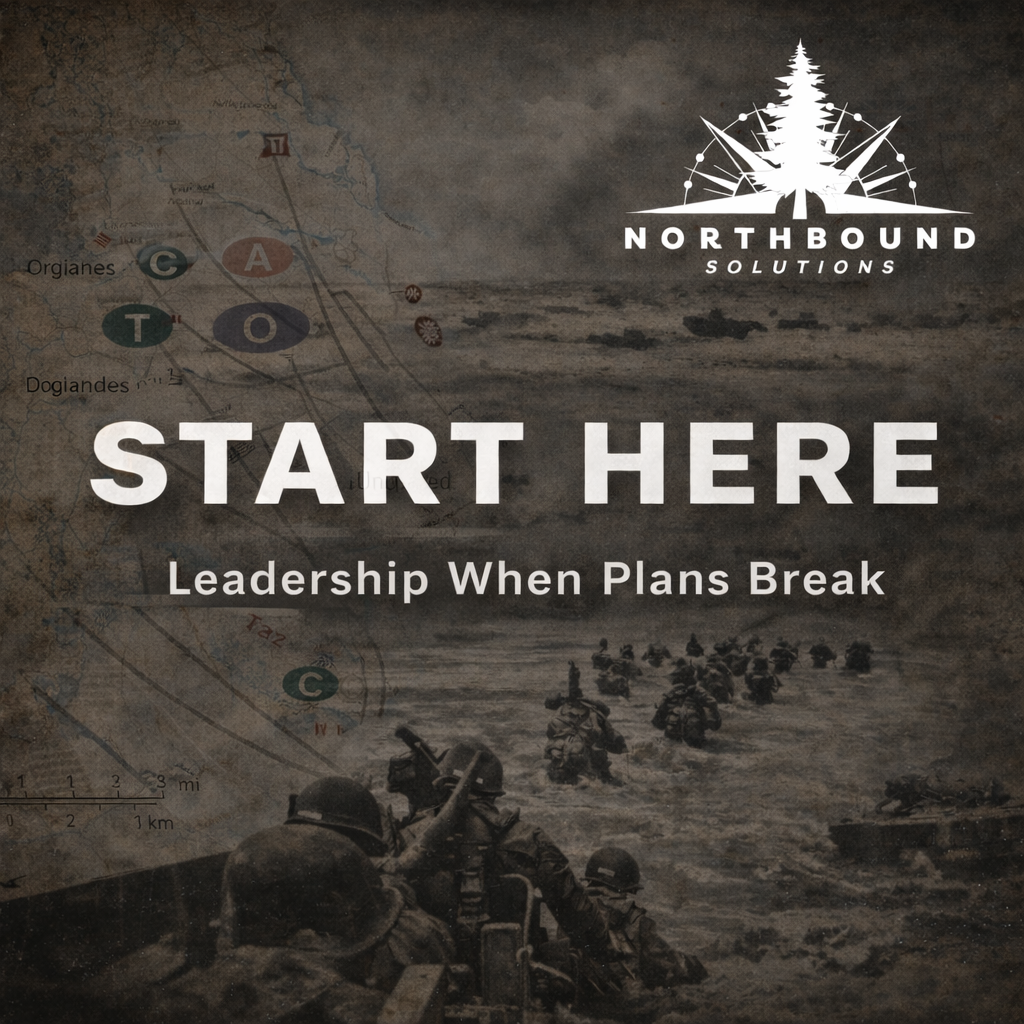
Northbound Podcast - Action Study: Leadership When Plans Break (Start Here!) What do you do when the plan breaks, the conditions aren't perfect, and your team lands "off course"? In this Northbound Podcast Action Study , Chris builds on the previous audio episode ( Start Here ) with a practical leadership lesson drawn from D-Day, June 6, 1944 - specifically the landing at Utah Beach and the decisive leadership of General Theodore Roosevelt Jr. When troops landed at the wrong location, Roosevelt's response became a leadership moment that still teaches today: "We'll start the war from right here." This episode explores what decisive leaders do under pressure - and how you can build those traits before the pressure hits. Because the truth is: you don't magically rise to the occasion… you often fall to the level of your preparation. That's why this episode focuses on turning insight into action, not just information.
Transcribed and scored by The B2B Podcast Index.
Narrator: Most people don't realize how much of their personal information is being bought and sold every day. Data brokers are making millions, pulling details about you from public records and the Internet, then packaging and selling it, usually without your consent. That's how your information lands in the hands of scammers, spammers, even stalkers. It's why you get endless robocalls and why ads seem to follow you everywhere. That's where Aura comes in. Aura actively removes your data from broker sites and keeps it off. They also instantly alert you if your information shows up in a breach or on the dark web. But Aura goes beyond data protection. With one app, you get a vpn, antivirus, password manager, spam call protection, dark web monitoring, and even up to $5 million in identity theft insurance. All backed by 24, 7 US based fraud support. Other companies might just sell credit, monitoring or just a vpn. Aura gives you all of it together at the same price. Competitors charge for just one service. Start your free trial today at aura.com hidden protect yourself now at aura.com/hidden.
Chris: Hi everyone. Good afternoon and welcome back to the Northbound podcast. I'm your host, Chris. Glad you're here. Today we are talking about leadership when plans break. And we're specifically going into a story where on D day and some of the incredible decisions that were made by a very, very good leader and bold leader. And so I'm going to share that story. The whole point of these action studies is to build off of one of the audio podcasts that I've already done. So the last one I did was Start Here. This podcast episode just builds on that. It's a video, as you can see, because you're watching. But it's basically to take that audio podcast go maybe a little deeper or not so much deeper, but just to provide practical action steps that we can take as leaders to be better. So we're going to listen and internalize and then we're going to take that and put it to action. So this action study is, is titled Start here. It's about leadership when plans break. And let me go ahead and advance this to the next slide here and that we are going to go over main points, traits of decisive leaders, some key takeaways, and then talk about that right path, the action that we should take as leaders. So let's start the war from right here. That was what on D Day, June 6th, that was what General Theodore Roosevelt Jr stated. And why did he state that? Well, he was on the first wave of troops to land at Utah beach that Morning. And, and General Roosevelt was older than most of the men. He was 56 years old. He walked with a cane. He had some heart conditions and severe arthritis. And so he should, uh, you know, by, for all intents and purposes, he should never have been landing on the beach that morning. But he believed that if he went in with the first wave, he would steady the men and he would boost their morale. And he was told he couldn't do it. And then he kind of fought back. He said, no, I really believe that I need to do this and I should do this. And so he was finally allowed to do it. And he is quoted as saying, I would love to do it. So it's pretty cool. So he landed that morning with the rest of the troops. And when they landed, they landed at the wrong spot because. And we're going to talk about that here a, uh, couple slides later. But they landed at the wrong place. And the response from General Roosevelt was, we'll start the war from right here. And that is incredible leadership. And that's what I highlighted on the audio podcast just a few days ago. Now we're going to go into, uh, just a little bit more highlight some of those same things we talked about on the audio podcast. We're going to highlight them here. We're going to learn about some decisive leadership traits and just talk about them a little bit and see some pictures and go into a little bit about where they landed versus where they were supposed to land and why it mattered. So decisive leaders make bold, timely decisions, and bold, uh, timely decisions create opportunity. When you are indecisive and you can't decide, you, you will lose opportunity. You're going to miss specific key times where you could have gotten something accomplished or accomplished something. It's a better way of saying it. And so bold, timely decisions open that up. It opens up your time to make even more decisions and to get more done and to be leaders. So just continuing in that same kind of idea and thread, there is that indecision ultimately just creates vulnerability. If you can't make a decision, you're opening yourself up to bad outcomes. And so we want to make bold, timely decisions. And when, when things go wrong. See, we're going to talk about this with the troops that landed on Utah Beach. But they were off course. Their plan was broken, and they could have waited, they could have hesitated. They did not. They pressed forward. Well, uh, one thing to remember is that when they pressed forward, they had prepared enough to know where they were and where they were pressing forward to. And that is really, really key because you're not going to just rise to the occasion. They did, they rose to the occasion. They said, here, we're going to start the war from right here. Awesome. But you're also going to fall, in some cases, to the level of your preparation. So when everything falls apart, when the plan goes wrong, if you didn't prepare, you're going to fall farther. And so we want to prepare. It's so important that we lead teams that are prepared, because then when the plans do break, when you're not exactly where you were supposed to be, you're only falling down to how much you've prepared. So in this case, um, these guys had done it right. They had prepared all the different landing zones. They knew the differences between them. They knew what they were going to do if they were off course. They knew that. So because they had done their due diligence, then when they did land at the wrong place, the general knows, we'll start the war from right here. We've already planned. We know where we're going. No big deal, right? That is so important. And it's great leadership, both before they ever got to that point and then after. And we're going to talk about why, what, what happened when they went ahead and moved, uh, forward. So this one is, is. Could be a little controversial. And that is that leadership can be emotional, but our response should be decisive. What I am not saying here is that emotions are not part of leadership. They are. In fact, all of us are emotional human beings and we lead with some amount of emotion, but we have to also be decisive in our decision making. It doesn't mean that we don't take emotions into account, both our own and other people's. And it doesn't even mean that the decisive decision is void of emotion, because that's not possible. So if anybody says make decisions that aren't emotional, that's actually not a, uh, it's not possible because we make all decisions and everything has some amount of emotion to it. Even a lack of emotion is emotion for that person. So we're not removing emotion from our decisions, we're just making decisive ones. So when it's time to make a decision, when it is time to lead, when lead. That's the key to that point. So here's just a little overview of. We are talking today about Utah Beach. This is where General Roosevelt landed with the troops on D Day, June 6, 1944. And these are the other beaches. There was Sword, Juno, Gold, Omaha. And, um, they landed at Utah So I'm just giving you that visual and the map so you can see how. And we're going to go more into that here. So Tare Green. Tare Green was one of the proposed landing sites on Utah Beach. As you can see by that, Uncle Red was the planned landing zone. That was where they were going to land. And you can see here, those are the secured, you know, like the, that was the enemy or the Germans defenses. And those defenses there were very, very robust, uh, inside that red circle, as you can see. And so landing at Uncle Red, which was the planned landing zone, was, was going to be rough. And in fact it was going to be a, uh, pretty tough spot to land with a lot of defenses. However, that was where we believed was the best, per the intel, it was the best place to land in order to go inland. And it was just, we were just going to take the enemy by surprise and advance right there and take out those defenses right off the bat. Okay. But what happened was we actually landed at another landing zone that had, that was planned or, um, had been, um, mission planned. Right. But we did not plan to land there. But we ended up landing at the Victor zone. And the reason why is because there were currents that brought all the landing craft farther south about a mile. And so that became the actual landing site for the troops that morning on Utah Beach. And as you can see by this second red circle here is that the. There were some defenses south of where they landed. But what happened when they landed at the wrong spot, even though it was not up to plan, it was turned out to be a great thing because the defenses were very light there. And also the enemy actually did have some intel of where they thought we might land. And they were not planning on us landing where we did. And so we actually took them by surprise. And they weren't ready to kind of change their, uh, tactics, if you will. And so we came on fairly easy compared to what we probably would have expected with Uncle Red. Now we can get into all the details or we could, we could go down the road of. Well, why didn't they just plan on Victor to begin with? I don't know all that. If you do a lot of research and reading, you can, you can learn some of that, but I'm not going to go into that today. But they landed at Victor. And I just want to share with you that it ended up being a really, really great thing that they landed there because they caught the enemy at a weak point. And the momentum that they had really did kind of create Some confusion with the Germans. And so anyways, there you go. So traits of decisive leaders. Let's, let's get into that because General Roosevelt is an example of a decisive leader. And one thing that he had was competence. We should have competence. We need to know what we're doing now. There are times where we're going to say, I don't know, there are times where we're going to rely on our team, maybe in a certain area, that someone is more competent in that area than another. We're going to rely on that person in their area of expertise. But decisive leaders do need to have a certain level of competence. And if we don't have it, we need to continue to become more competent. Courage, Courage. Fear is always going to be there. There's fear of the unknown, there's actual in, in battle, there's actual fear of death or of getting injured. Fear is going to be there. Courage is pushing past that fear, not letting that fear stop you from making decisive decisions and from moving forward. And so courage is a trait that is required because we cannot let the fear of unknown or, or anything else stop us. And in battle that is so important, right? We cannot let the enemy, the fear of the enemy stop us. We have to advance. So, all right, servanthood, that's the next one that I have for you here. And that is that leadership is not self preservation. Leadership is about everyone else that we lead and that we serve ultimately. And so it is others first. Number four, security. We cannot be insecure as leaders. If we are insecure, we are going to hesitate and we can't hesitate. We have to move forward. That does not mean that we're moving forward without input. Getting input from your team is very, uh, important. Preparing beforehand is very important. But insecure leaders have a hard time making bold, timely decisions. So you gotta be secure so that you can decide quickly. All right? And then responsibility is the next one. Decisive leaders do not blame others. They do not deflect their responsibility. They also own the outcome of what happens. If you are in charge, if you lead, it's time to lead. And it may seem unfair at times, but you are responsible. So when something goes wrong, you are responsible for that. You own the outcome. And then when something goes right, we go back to servanthood. Um, we also go back to courage and to a lot of these other ones. And that is when things go right, you want to make sure that you are, are just praising your team for what they did. So when it goes wrong, it's on you and you take it all right? When it goes right, it's about everybody else, and you give it out. That's just, that's just how it works. If you're in leadership position, it's time to lead, and that's how you do that. Number six is initiative. You're going to move first. You don't wait to be told. There are times where you do. You are under an order to wait until you're told. I get that. But in most cases, you got to take initiative and move, uh, out. That doesn't necessarily mean that your decisions are always going to be the best ones. In fact, you might move out on your own decision. And someone says, hey, I think that's a bad decision. And you're like, whoa, you're right. We should probably do it more your way, because that would be a better way. Let's do it. Let's move. Okay. You just made a decision, and you just showed that there is value in that person's expertise and what they shared with you. So you showed value in what they said. You honored them in that. And then you also made a courageous decision to move forward based off of their input and their feedback. So initiative and character is the next one. When things go wrong and you're put into that kind of, that pressure pot, like I said on the other podcast, I said you're kind of like you're in a pressure cooker. War is one of the biggest ones why there's so much pressure in that environment. But the same thing in your workplace or even in ministry. There can be a lot of pressure put on you. And when there's pressure and stress, a lot of times you see the real person. I had a boss once or a, uh, commander once who said, chris, when someone shows you their true colors, believe them. And that is so true when you, especially in stressful and, and, you know, high stress situations, you sometimes will see who that person really is. And when someone shows you their true colors, believe it. All right? And so we want to have character before we're ever put in that position. That means having character or not, um, having integrity is one of them. Just having good, sound, ethical character. Commitment is another just key, decisive leader trait. And that is that you stay with the decision. That doesn't mean you don't change the decision in certain cases. But what I mean is that you've made the decision and you follow it through. If you're changing course and doing a little redirection, that's okay. But you're always keeping your eyes on the mission. You're focused on the mission and you're committed to that. And then discernment. Not everything out there is a wise way to go. Not every opportunity is wise. You have to have discernment, and you must be able to see clearly. So how do we get discernment? There are lots of ways that you get discernment. Studying is one, praying is another one. Taking, um, taking other input and seeing what others, you know, the values of somebody else, someone else's opinion or their feedback. All that will build discernment so that you can make those quick decisions. And you also have to have, like we just talked about solid character, because that's going to add a lot of discernment as well. And then, uh, having the ability to solve problems, that is also very, very key. And sometimes as a leader, others around you are going to be the ones that know how to solve the problem. But the first step of solving the problem and the first step to being a problem solver is to acknowledge that and create an environment where others feel like they can show you the solution. If the people that you lead are not comfortable showing you solutions, you got a problem and you're not a problem solver. And they may be, but they're not willing to speak up and show you their solution, and that's a problem. So the first step as a leader to being a good problem solver is to create that environment where others can bring up their solutions. And then being your own, uh, a good problem solver, um, yourself is also a good thing. So again, back to what we said before. You don't rise to the occasion, or you don't just rise to the occasion, you fall to the level of your preparation. So solving problems starts well beyond. Well before you ever get to the mission, before you ever get to the let's start the war from right here. Before you ever get there, you have been preparing, you have been solving problems, or you've been kind of like going, hey, if this problem happens, here's our solution. If this problem happens right. In the Air Force, we called that chair flying, which some of you are going to make a joke about the chair force, whatever. You can make those jokes, if you will. Doesn't bother me. So. But the chair force does Chair fly. And what I mean by chair fly is before we ever go on a mission, we take the time to run through all the different scenarios of what could happen and what our response should be. Key takeaways. Today you are going to land off course. Your plans are going to break, and conditions will not be Perfect. So I know that sounds kind of doom and gloom. I'm sorry, but it is reality. In any organization, you're going to have times where you don't quite land on course. There are times when your plans do kind of break down or don't go according to what you thought they were going to, and it's not going to be perfect. So then you got to ask yourself, am I going to hesitate or am I going to advance? What am I going to do? It's a really good thing to ask yourself, just, just to kind of think about, like, if something comes up, if there's a problem, what do I do and am I going to hesitate or am I ready to go? And if, if you think, well, I actually don't know what I would do in that situation, it might be good to plan what you would do. Decisiveness is built before that pressure hits, before that stress hits. You have ran through all the different scenarios. So how do you do that? How do you do that? How do you build that decisiveness before the pressure hits? Well, one way is boosting your skills, because skills are going to build your confidence. And then you also need to know who you are. Identity. Who you are is going to build security. And we're going to talk a little bit more about that on the next slide. Then ownership. Taking ownership is going to build trust. You need to build trust with your team. And so taking ownership is going to do that. Your team is going to say, oh, I. Okay, I can rally behind someone who takes ownership of things when they go wrong and who gives out praise when things go well. Small decisions build momentum. Get into the habit of making those small, decisive decisions because that's just gonna build more and more and more, and soon you'll be making bigger decisions and more timely, and it's gonna build momentum in your organization. So let's talk about the action steps, the right path. We talked about building competence. One of the ways you can do this is by taking classes, taking a course, finding somebody who can mentor you and build you and help you, maybe find some of those blind spots that you have and study your job. Whatever your job is, study it more. If you're in ministry, um, it could potentially be just studying those. If you share messages from the Bible, study those hard passages, the ones that sometimes we skip over, study it. It's the same thing in your job. Study those hard things. Be ready for the hard things, Be ready to make the hard decisions. And if, if you can't, you know, maybe you're studying, you're like, man, I just. I just can't wrap my head around this. Find a mentor to help you. Find someone who went before you to help you. Okay. Know your identity. We talked about this too before. Know who you are and who God made you to be. You're going to do that through reflection. You're going to do that through prayer. You're going to do that through learning who you serve, learning more about him and who you serve, and then journaling your values. And then one of the most important ones here that I have is listing your responsibilities. And I said this on the other podcast, and that is to write down who. Like literally write them down. Family members, who am I responsible for? Team members, who am I responsible for? And as you write them down, think about how you are taking care of them. Are you meeting their needs? Are you communicating how valuable they are to the team? Your clients? Most businesses do a pretty good job of knowing who their clients are. And why do they do a good job of knowing who their clients are? Because the clients bring in the money, right? But, man, we cannot forget about the employees. We can't forget about our family that is at home. And we also can't forget about our leadership. It is lonely in leadership. And oftentimes your leadership, we all have leadership. Even if you're a big, you know, highfalutin CEO, you still have leadership. There's somebody above you, and they may need a little encouragement, and you are responsible for them. I know that seems a little backwards, but you are. We're responsible for each other. And someday we will answer to God on how we treated each other. And I haven't treated everybody perfectly, and I will answer for that, same as you. And so we need to do a better job collectively of knowing who we serve and then serving them to the absolute best that we can. We also need to practice fast decisions. We need to train ourselves and track it. And so we need to assess the situation. We're going to decide what we're going to do, we're going to act upon it, and then we're going to record how long it took us. I know this seems kind of silly, and you're like, ah, uh, maybe you're like, I'm not going to do this. I would encourage you to, to maybe just think about doing this. So just think about it. You don't. Maybe you're not writing it down. If you want to write it down, that's great. But when a decision, when it's time to make a decision, take a mental note of how you assessed the situation and what you decided to do. And then does it stop there? Or maybe it stopped. Maybe you didn't even assess it. Where did it stop? I want you to assess and then not stop there. Then I want you to decide, what is it that I'm going to do? And then after you decide what it is you're going to do, then act upon that. Do it. Don't just decide and let it sit. Do it. And then look and see. Okay. Hey, did that take me three days? Did it take me an hour? What did it take? And it's going to depend for each. Some decisions are going to take time. Some decisions are going to take input from other team members. Once you get the input, once you make the decision, you act upon it. How long did it take you? And then when you make that same decision the next time, how long did it take you that time? Okay, this is going to lead to strengthening your courage daily, but there are other ways to strengthen your courage daily. Hard conversations, setting boundaries and saying yes when it costs, man. Sometimes it does cost you to say yes because it's hard creates more work for you. I don't know what it is, but sometimes saying yes does cost. That's okay. It's going to strengthen you. It's going to build you up. And then as a leader, you need to own the outcome, admit mistakes, adjust quickly and move forward. All right, that's it. That's the action study. And I want you to start from right here. Okay, thanks everybody for tuning in to the northbound podcast and listening and watching and I encourage you to come be a part of the community where we can encourage each other even more. You can comment there on the videos and on the podcasts and on the weekly updates and uploads and stuff like that. Plus you can just reach out to members in the community. It's a great way to network and so I encourage you to go there. The link will be in the description of this video. And again, I am glad you joined me today. Thank you. And go northbound. See ya. I started Ornod in 2013 and we make bike apparel. The best part of Shopify for me is our ability to run the business as essentially non technical people. We're able to admin everything on the back end, front end, and sell things online easily. If Shopify were a bike accessory, I think it would actually be the bicycle. It's the thing that you do the thing on. Um, we run the business on Shopify. Start your free trial on Shopify. Com.
Other episodes covering the same guests and topics, from across The B2B Podcast Index.
 The Fastest Way to Kill Buy-In Is Your Own Good Idea | Dave Garrison - E71Leadership Unlocked · on problem-solving frameworks66 / 100
 Preview: Why Great CI Programs Don't Get Funded (and What to Do About It)KaiNexus · on problem-solving frameworks60 / 100
 Calm under fire series- E2- control, silence, speed, compliance, collapse. Which one is running youThe NeuroLeadership Edge: Pressure-Proof Leadership™ & Calm Authority · on Leadership under pressure56 / 100
 9| Is a Leadership Challenge Threatening Your Reputation? Four Reputation Management Principles to Protect Your Personal BrandAmbitious Leadership for Christians · on Leadership under pressure53 / 100
 The Real Reason Your Team Moves So SlowlyNo Bullsh!t Leadership · on Decision-making under pressure52 / 100
 [EON] The To-Be List: Why Growth Requires More Than Getting Things Done | Paper Napkin Wisdom EpisodePaper Napkin Wisdom · Leadership & Entrepreneurship Insights for Founders and Executives · on Leadership under pressure52 / 100
 Start Here! - Northbound Action Study (Video Version)39 / 100
 Start Here! - Leadership When Plans Break34 / 100
 Hard Pass First - Northbound Action Study47 / 100
 Don't Sit It Out - Northbound Action Study33 / 100
 Go Northbound - Don't Sit This One Out (Full Episode Audio)34 / 100