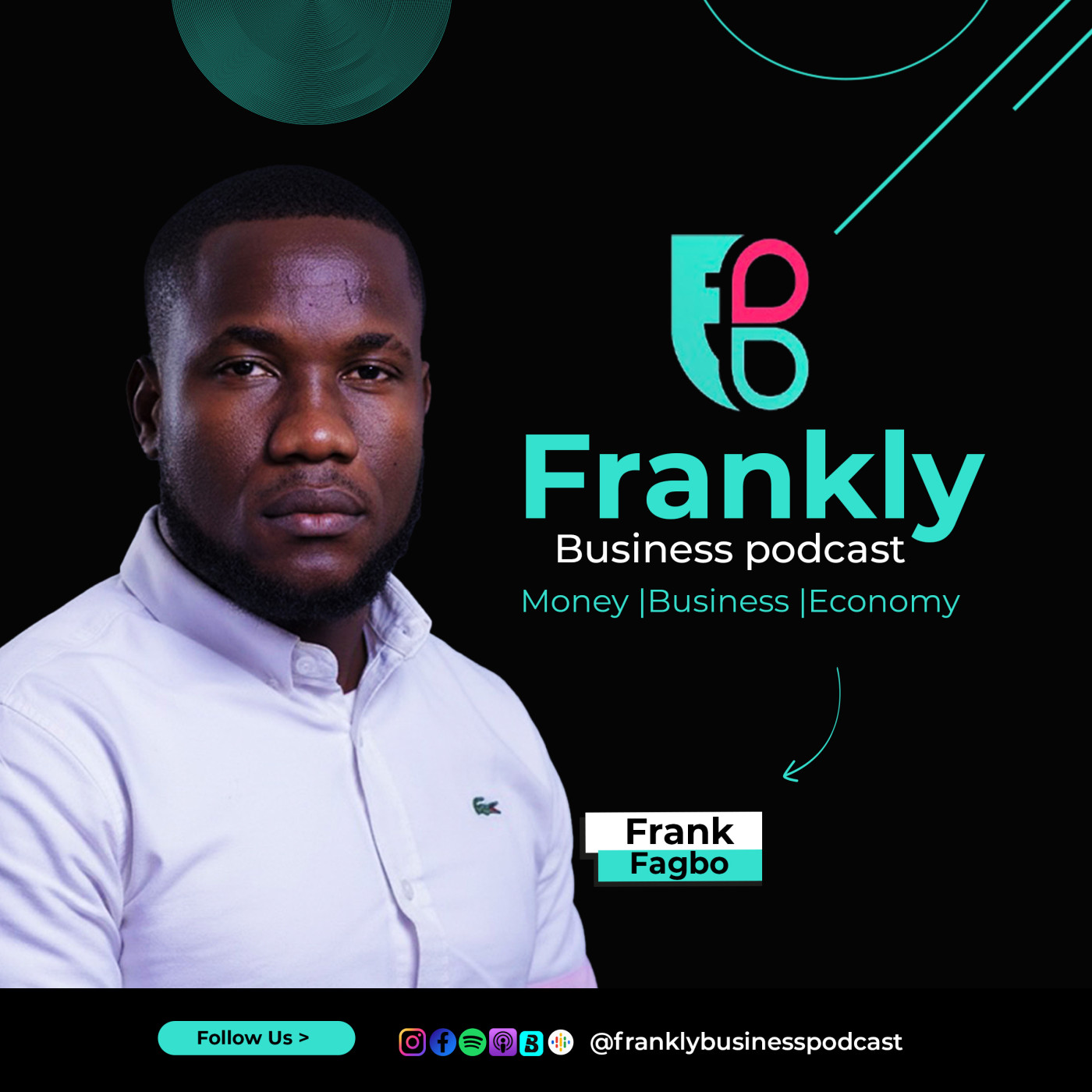
Hosted by Frank Fagbo
Listed under Business › Entrepreneurship
The Frankly Business Podcast is a platform for clear, intelligent conversations on business, finance, and the economy across Nigeria and Africa.
19 episodes · publishes fortnightly · latest 2026-07-30 · ~82 min/episode
Rank
#84
Substance
81.5
/ 100
Breakdown
Scored 2026-08
Updated monthly
Across the index
#84 of 1878
Substance
Top 4%
outscores 96% of the index
Frankly Business Podcast ranks #84 on The B2B Podcast Index with a substance score of 81.5 out of 100, scored across 2 recent episodes. It scores highest on guest caliber and specificity & evidence. Ajayi is a credible operator with direct experience: former Mercedes-Benz executive (senior role, trained in German factories), founder of a functioning auto assembly company with 100-200 staff, proven revenue generation, actual investment backing from respected VCs, and expansion into EVs and financing. He is actively solving the problem he discusses, not theorizing about it. His credibility is genuinely earned through execution, though he is still relatively early-stage relative to mature industrialists.
Averaged across 2 recently scored episodes, with cited evidence.
The episode contains numerous substantive insights about manufacturing constraints (high financing costs at 27-28%, infrastructure gaps, raw material imports), market dynamics (less than 1% local market share), and policy solutions (tariffs, government patronage). However, there is significant repetition - particularly around the manufacturing vs. assembly distinction, which occupies disproportionate time - and some filler dialogue that dilutes density. A smart operator would learn concrete lessons, but the pacing is uneven.
“One of Nigeria's biggest problem is productivity and not corruption. But I also tell people that the reason why productivity is low is because of corruption.”
“Manufacturing is a long term. Almost all over the world most manufacturing countries maybe 5% maximum. Some of them are even less than 3%. So but I don't know recently is about 28, 27% that uh, you cannot manufacture at that rate.”
Ajayi articulates a coherent thesis linking leadership quality (non-manufacturing backgrounds) to industrial capacity, and makes a sharp distinction between productivity and corruption as root causes. The tariff-based policy proposal for brand-new vs. used vehicles is somewhat novel. However, much of the framing - Africa's manufacturing gap, mindset issues, Chinese dominance in EVs - is well-trodden territory in development discourse. The guest repeats frameworks rather than introducing genuinely counterintuitive thinking.
“Most people that have led us are traders. Either they were in the military, civil service, they don't understand what it takes to actually take a position as paying for citizens.”
“So tariff for brown new cars. So. Because if you're driving a brand new car, you have money now. Obviously a rich guy... let us separate the. That's the boys from the men.”
Ajayi is a credible operator with direct experience: former Mercedes-Benz executive (senior role, trained in German factories), founder of a functioning auto assembly company with 100-200 staff, proven revenue generation, actual investment backing from respected VCs, and expansion into EVs and financing. He is actively solving the problem he discusses, not theorizing about it. His credibility is genuinely earned through execution, though he is still relatively early-stage relative to mature industrialists.
“What I learned from Mercedes Benz in my opinion was more than everything I Learned in my 4 years or 5 years, sorry, university.”
“I met Samson in 2019... when I... you know... at this time I already give give up on not because I had finished my money I own not represent this time time 100”
Ajayi provides concrete numbers (27-28% interest rates, less than 1% market share, ~20,000-unit breakeven for tooling, 6-year model lifecycles, top 10 import categories from Nigerian statistics) and specific examples (Dangote's refinery and steel plant ambitions, a friend buying used cars, Unilag partnership, NAMA WhatsApp group, Ogun State governor purchase). However, there are also vague sections (no specific revenue figures for Nord, no exact timeline for European entry, limited dollar amounts), and some claims lack supporting data (e.g., precise talent retention metrics in construction).
“The federal government especially, you know, and for good reasons. The military, the police, you know, they are very patriotic. You know, there's no way you carry gun, you go and uh, fight in the bush.”
“We sell less than 1000 units a year. But I need to, but to justify what I'm doing, I need about 20,000 units that I have to face out maximum in six years.”
The host asks reasonable opening questions and follows up on key claims (government patronage, EV feasibility, failures, funding). However, follow-ups are often soft and accept Ajayi's framing without pushback. When the guest repeats the assembly-vs-manufacturing distinction at length, the host does not press for brevity or challenge the necessity of that tangent. The host misses opportunities to probe deeper on contradictions (e.g., if tariffs work, why hasn't India or Brazil used them more aggressively?) or to test edge cases. The conversation feels more like a platform-building interview than rigorous interrogation.
“Um, a lot of people here made in Nigeria cars. And what they say is you're just assembling plants, you're just assembling parts from China. Does it really annoy you, or is that. Does it have some element of truth?”
“You once worked in Mercedes Benz and um, you understand global standards. In all regards. Um, tell me about what do you think about Nigeria's industrial um what do you think about our manufacturing industry in Nigeria?”
2 periods tracked.
2 scored on substance · 19 tracked in total.
Add this badge to your site - it links back here and updates automatically as you rank.

<a href="https://index.fame.so/show/frankly-business-podcast" target="_blank" rel="noopener">
  <img src="https://index.fame.so/badge/frankly-business-podcast/badge.svg" alt="Ranked #10 on The B2B Podcast Index" width="360" height="136" />
</a>Track Frankly Business Podcast's rank
Get an email whenever this show moves up or down the Index. Monthly at most, no spam.
The themes that come up most across this show's episodes.

TechSurge: Deep Tech Podcast
Celesta Capital | Deep Tech Venture Capital Firm

A Product Market Fit Show
Mistral.vc

The Puck: Venture Capital and Beyond
Jim Baer
Venture Unlocked
Samir Kaji

Engineering Founders
The Engineering Leadership Community (ELC)

SaaS Interviews with CEOs, Startups, Founders
Nathan Latka
Podcasts that dig into the same topics.
The Engineering Leadership Podcast
The Engineering Leadership Community (ELC)

Insight Exchange by L.E.K. Consulting
L.E.K. Consulting

Strategy Sprints
Strategy Sprints

AI for Business Owners
Jeff Torello

Practical Product Management
Leah Farmer & Marilyn McDonald

TechCrunch Startup News
TechCrunch
